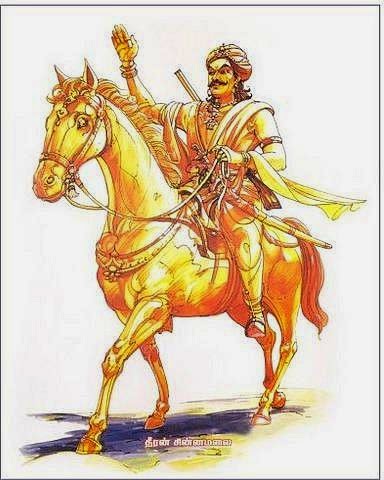
Compiled by London swaminathan
Date: 22 April 2015; Post No: 1819
Uploaded in London 8-54 am
By T A Srinivasan, Indian Express, 4th April 1985
I was about to throw out my old paper cuttings. One of them was written by my colleague in Indian Express and it is a good article about a great hero. So I am typing the full article published thirty years ago: London swaminathan
Dheeran Chinnamalai alias Theerthagiri
Long before the First War of Independence in 1857 which the British historians derisively referred to as the ‘Sepoy Mutiny’, many Polygars (Paalaiyakkaarar in Tamil) and chieftains in the South had fought against the British, chief among them being Hyder Ali, Tippu Sultan, Kittur Chennamma in Karnataka, Velu Thampi, Paliathachcan and Palasiraja in Kerala, Kattabomman, Oomaithurai, Pulithevan and Marudu Pandiyar in Tamil Nadu. But not so popular were many valiant fighters and one among them was Dheeran Chinnamalai, the hero of the Kongu country, whose memory has been cherished by the Tamil Nadu Government by naming a Transport Corporation after him.
His heroic deeds do not find any mention in any mention in the scores of history books that this writer has occasion to come across, but he has been immortalised in folk songs recited in the area and a poetic tribute to this great hero has been offered by Mr Sakthikanal, who has come out with a Kummi work of 96 pages. But for him and the Tamil Nadu Government cherishing his memory, he would have been a forgotten hero like the scores of others.
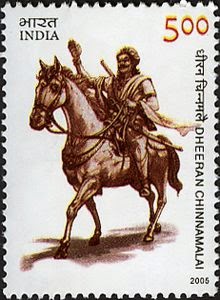
Pandya Gift
According to legend, Chinnamalai’s forefathers had served the Pandya kings and one of them was Uthama Kamindar or Karian Sarkarai of Anoor, who worked under Sathrusathana Pandya. The then Choza king, Uthama, performed a Bhuta Yaga and ordered the demon who came out of the Yaga Kunda to destroy the Pandya country. Kariyan sarkarai worsted the Choza king and his demon in the battle field and Pandya king, in turn, gifted 24 villages in the Kongu country to him and made him his chieftain. One of his descendants was Kotraivel Sarkarai, who besides being an able administrator, was a great poet and “Nalla Mangaiamman Sathakam” written by him deals with medicines, animal husbandry and farming. He had two wives but no issues and he adopted two sons, Senapathi and Rathinam. The kingdom was divided into two and Senapathi became the ruler of Anoor and Rathinam Sarkarai got the area west of it with headquarters at Melapalayam.
Dheeran Chinnamalai was the second of the five sons of Rathina Sarkarai and he was born in 1756. The name given to him by his parents was Theerthagiri and after getting preliminary education in traditional schools, he learnt martial arts. His elder brother Kuzandaisami , and the youngest Kuttisami were peace loving men. The other two Thambi and Kiledar, like Chinnamalai, loved battles.
The Kongu country then which consisted of the present Coimbatore, Periyar, Salem, parts of Tiruchi districs with Palai hills as northern and Palani hills as the southern boundaries. It was under the suzerainty of Mysore rulers. The Mysore king then in turn was under the control of the British and Chinnamalai , who hated the British from childhood, wanted the Kongu country become free.
Marava Warriors
When Hyder Ali died in 1782, and Tippu became the ruler of Mysore, Chinnamalai wanted to strengthen his hands and he recruited a large contingent of Marava warriors and all of them joined Tippu’s army. Chinnamalai also built a big palace at Oddanilai on the banks of Noyyal and trained his warriors.
When the fourth and the last Mysore War broke out in 1799, Chinnamalai and his forces fought valiantly along with Tippu against the English forces which invaded Mysore from the east and the west. A British contingent from Bombay, led by General Stuart, forced Tippu to retreat from the Coorg frontier; the Madras forces under General Harris, aided by the Nizam’s forces and led by Col.Wellesley, routed Tippu at Maalavalli. Harris further marched towards Srirangapattinam and laid siege to it in 1799. The capital was stormed and Tippu was killed in the battlefield.
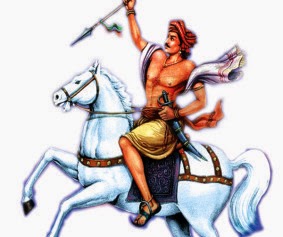
Kongu Heroes’ Challenge
Chinnamalai, with his remaining warriors, retreated to the Kongu country. He sought the help of other Polygars in the area to fight the British. He became a force to reckon with and the British sent an ambassador to his court offering to acknowledge him as the ruler of the Kongu country with the condition he should pay royalty to them. Chinnamalai not only rejected the offer outright but also challenged the meet him in the battle field.
Colonel Maxwel, who was leading the British forces at Sankagiri, then ordered the British forces to loot Chinnamalai’s country. Chinnamalai, who got annoyed by these acts of the British, looted their areas and the two forces met on the banks of Cauvery, in 1801, in which Chinnamalai’s forces became victorious. Col. Maxwell who had a narrow escape in the 1801 war took a bigger force a year later consisting of 10,000 soldiers to the Kongu country. The Kongu forces, which were only 3000 strong, defeated them and the English captain was killed in action. The Kongu forces which had no fire power or other weapons, which the British possessed, were able to defeat mainly with the ‘crowbar tactic’. They attacked the British with the crowbars on their hands by swinging them right and left and were able to win the war.
Hindu Idol Destroyed
The British unable to bear the ignominy, sent a 3000 strong cavalry under the leadership of Colonel Harris in 1803 to the Kongu country. Chinnamalai had strengthened his army in the meantime and acquired fire arms. The Kongu people were then celebrating the festival at the Arachalai Amman temple at Arachalur. Col.Harris forces stormed them and the British colonel disfigured the idol of the Amman (goddess). The Kongu forces, which were infuriated by this, attacked the British forces with vigour and Chinnamalai shot at Colonel Harris’ horse. The injured horse ran helter skelter and others followed suit. Chinnamalai was third time lucky in making the British forces retreat from the Kongu country.
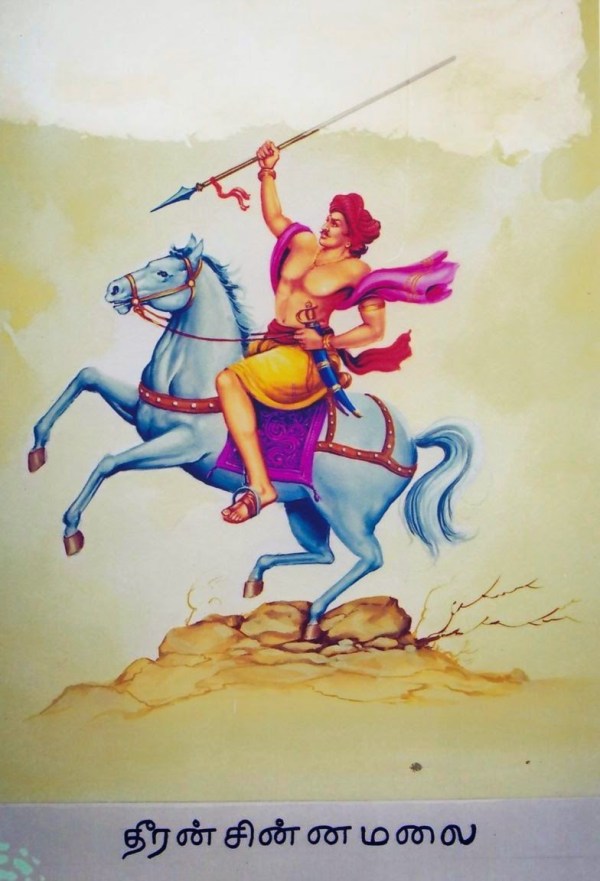
Chinnamalai Victorious in Three Wars!
Having failed in their efforts to defeat Chinnamalai in three wars, the British sent a much bigger force with canon power from Calicut and Chinnamalai who got prior information about it, left Oddanilai along with his forces and took refuge in Karumalai forests in the Palani Hills.
The British forces destroyed Chinnamalai’s palace and fort at Oddanilai and went back to Calicut. The British who were not satisfied with this, somehow wanted to get at Chinnamalai and his men. Due to the betrayal of Chinnamalais cook, he and his brothers were taken prisoners by the British who chained them and took them to Sankagiri fort in 1805. They were hanged there like Kattabomman, Marudu Pandiyar, Oomaithurai and other great heroes.
It is in the fitness of things that the Tamil Nadu Government decided to honour this unhonoured and unsung hero by naming a transport corporation after him as it had done in the case of Marudu Pandiyar and Kattabomman. The buses which will run bearing his name, will make the people remember this valiant fighter and sing his glory for a long, long time to come – T A S
Indian Express, 4th April 1985
 Tamil and Vedas
R Nanjappa
/ April 22, 2015There is no definitive account of what caused the uprising of 1857, and its nature- there are two sides to the story, and will so remain for long.. About the various other figures mentioned in the article, we cannot rely on sentimental accounts but need substantial supporting evidence. They might have fought the British but that alone does not make them ‘national heroes’.
But, whatever may be the truth of the others, at least two figures- Hyder Ali and Tipu Sultan do not definitely belong to the line of freedom fighters or even national figures. Both were down right rascals who only tried to establish Muslim rule, even by asking the Afghan ruler to invade India!. The forced conversions of lakhs of people in Malabar, the looting of Coorg and Malabar temples,their cruelty and other atrocities connected with it are now well known and well established by authentic independent research. See for instance the recent book:*’Tipu Sultan-the Tyrant of Mysore’ by Sandeep Balakrishna; Rare Publications, Chennai,2013.*
This article by T.A.Srinivasan is based on old information, which requires to be updated by further research and other findings. At least in respect of Hyder Ali and Tipu Sultan, this article is not based on facts. It is an insult to real nationalists to even mention the names of these two bigots along with them.
V.S.Krishnan Iyer.
/ April 22, 2015Dear LS Ji,
Tippu Sultan can not be glorified as a warrior of Indian freedom straggle. He is a pakka opportunists, destroyer of Hindu temples and forced many to Islamism.
Krishnan vs.