Written by London swaminathan
Research Article No.1876; Dated 19 May 2015.
Uploaded in London at 19-21
Origin of the word “TAMIL (THAMIZ)” has been debated for long by scholars. Several scholars said the word Tamil came from:–
Dravida=Dramila=Tamil
Some countered this argument by saying it worked the other way round:–
Tamil=dramila= Dravida
But those who study the following answer will have to accept that the first argument is correct i.e. Tamil came from Dravida. Since dra, bra, pra, gra sounds don’t exist in Tamil they always write it as da, ba, pa,kira in Tamil as in the words Thamiz, Piraman(Brahma), Padimam (Pratima),Kirantham (Grantha) (Following answer shows that the sound change works in only one direction)
The second point is that one can understand from the following answer how Sanskrit words/sounds changed into European languages in course of time. The oldest Indo-European language is Sanskrit. All the European languages are very much younger than Sanskrit. Their literature came into existence at least 1000 year after the Vedas.
Question and Answer from a British News Paper
Question:How do we know the correct way to pronounce a dead language?
(From the Notes and Queries- volume 4 of The Guardian News Paper)
Answer: Old languages don’t die. They just fade into new languages (at least most of them do). While the entire sound system of an ancient language rarely survives intact, fragments can usually found scattered around its daughter languages.
For example many traits of Latin pronunciation are directly observable in Italian, French, Spanish and Romanian languages. The job of the linguistic historian is try to piece these various bits together. The most tried and tested technique is comparative reconstruction, which focusses on systematic sound correspondences that emerge when we compare the same words in different sister languages. Where this exercise turns up different sounds, it is usually possible to trace them back to a common historical source.
For example many English words beginning with ‘t’ corresponds to words beginning with ‘ts’ – spelt tz – in the sister language German; compare English ten, to, time with zehn, zu, zeit. On the basis of this and many similar correspondences, we can reconstruct a common Germanic parent language in which the older sound in this particular instance is the knowledge that each type of sound change takes place in one direction only. On the strength of what happens in other languages, we know that ‘t’ at the beginning of a word can turn into ‘ts’ but not vice versa. The more widely we cast our comparative net, the further we can reach back into the mists of time.
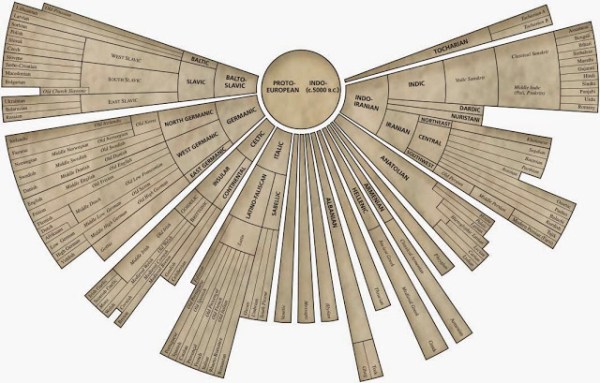
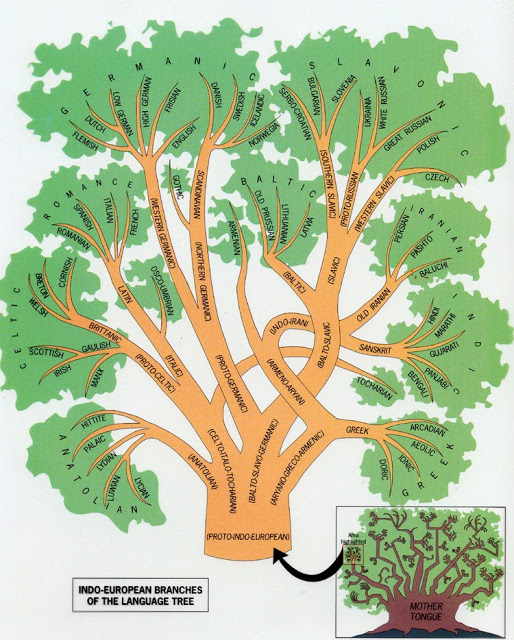
The ‘t’ of early Germanic itself derives from an even older ‘d’ – contrast English two and tooth with, say, Italian ‘due’ and ‘dente’. Ultimately we arrive at the sound system of an ancient indo – European tongue, the common ancestor of languages as apparently diverse as English, French, Russian, Irish, Greek and Urdu.
John Harris, Department of Phonetics and Linguistics, University College, London
 Tamil and Vedas
R Nanjappa
/ May 19, 2015The connections and associations between languages is a very fascinating subject but unfortunately it is clouded by political interests and prejudices. In Tamil Nad especially, two ideas form the bedrock of their present politcal base: the supposed disconnection or even opposition between Sanskrit and Tamil, and that Sanskrit is a dead language ( vazahkku ozhinda mozhi). Because of the charged political atmosphere, there is no serious informed, non-partisan discussion on the subject.
The item from the London newspaper clarifies that a language never dies but is transformed into its successors or sister languages. In respect of Sanskrit, there is no question of the language having gone out of use, as even today that is the language of the rituals and pujas all over the world. It is true that Sanskrit is not spoken,but *by its very nature- samskrut ie refined or perfected- it is not meant for ordinary discourse but for special use or use by learned people. ( My old Tamil teacher told me that the word ‘Vadamozhi’ that people commonly use for Sanskrit actually meant ” VADU AL MOZHI”- the exact rendering of Samskrutam in Tamil, and it did not refer to a language coming from the North! Every Indian language has a region where is centred or mainly spoken, but Sanskrit alone has no such area – it is common to the whole country, wherever learned people lived.) *And this is made clear by the word meant for normal, worldly use- *Prakrutam. *Indeed, is there evidence that the language of Sangam literature was used for conversation among common people? Early in the last century, some Tamil scholars did try to promote such style but it failed miserably, even in this age!. And we have the example of King’s English. One reason why English is popular is that it has one strand only. Even then, those whose mother tongue it is do not speak strictly grammatical English- as it is written! Many of the words used by them- slang, for eg- are purely colloquial and local or regional, and cannot be found in the usual dictionary. And the style of usage in poetry is distinct- even today, when meter, rhyme and such classical rules are not followed.
Sri Aurobindo and Subrahmanya Bharati had interactions. Sri Aurobindo studied Vedas in a non-traditional way, and has said how he found knowledge of ancient Tamil provided keys for understanding the old Sanskrit words. Unfortunately, he did not pursue this line of research.
Perhaps, the usage of the expression “Indo-European” languages is the cause of lot of mischief. Once it is proved that Indian (Hindu) civilization is indigenous ( as scholars are now proposing- the theory of indigenous origination), and that our people went out to all parts of the globe, as it is written in our Puranas, the idea that Sanskrit is the mother of all languages will gain ground. But such theories have been used by ruling powers for their purposes- as the so called philologists riding on the colonial wave did.Sri Aurobindo completely discredited the idea that comparative philology as it was being developed by the Europeans was a science. We need strong indigenous scholarship, uninfluenced by foreign prejudices, to take up such issues but that needs political backing.If India becomes strong, Indian scholars will gain respect and hearing. Till then, we will be the blotting paper of the West. Most of the world’s languages are related or somehow connected but there are too many pet theories which prevent a proper understanding. This article today provides some clues.