Compiled by London swaminathan
Post no.1886,
Date: 24 May 2015; London Time: 12-12
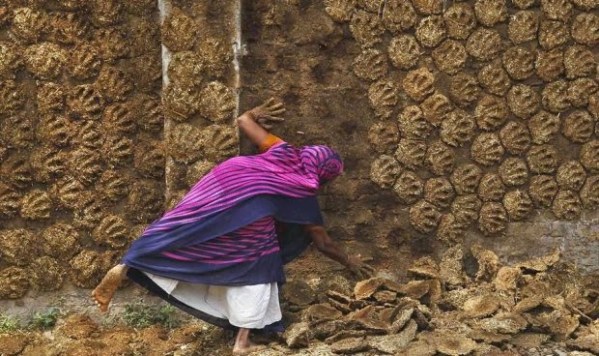
There was a woman saint who lived with her Guru serving him. Both were votaries of divine name. She used to prepare cow-dung cakes which are used as fuel in India. She had put them up in the sun or drying. A neighbouring woman had also prepared similar cakes and spread them out nearby. When the cakes were dry, the woman saint and her neighbour went to collect the. The cakes had got mixed up somehow. The neighbour wanted to take, besides her own cakes, the cakes of the saints also.
Hearing of it, the Master whom the woman saint serving, said he could easily find out the cakes prepared by his disciple. He took each cake and placed near his ear. In some of them, he heard the sound of god’s name. Those in which god’s name was being sung, were sorted out from others were sorted out from ohers – these belonged to his disciple. Thus the dispute was settled.
As the woman saint was always repeating God’s name, even while preparing the cow-dung cakes, the cake absorbed the divine vibrations and her master could hear the God’s name in the.
–p63, Stories as told by Swami Ramdas

Pearl necklace gifted to Hanuman by Sita
Rama Navami is the festival that marks the advent of the Lord as Rama. Many years, the festival occurs when Swami is in Kodai. On such occasions, the festival becomes a truly memorable day for the boys. On one such Rama Navami day, Sri Sathya Sai Baba materialised the pearl necklace that Sita gifted to Hanuman at the time of Rama’s Coronation.
Rama was distributing various gifts to members in the assembly but somehow, He seemed to skip Hanuman. Sita was troubled by this apparent indifference; how could such a loyal one like Hanuman be overlooked on an occasion like this? So, she whispered to Rama that Hanuman should not be forgotten. Rama whispered back that Hanuman was way above material gifts. Sita was not quite satisfied by this reply; so she took out a pearl necklace that she was wearing and offered it to Hanuman.
While receiving the necklace, Hanuman gave it a suspicious look. He then placed the necklace near one of his ears as if to check whether the individual pearls were emitting some sound. He appeared to examine every pearl in the necklace, and once in a while, he would bite a pearl. Sita was shocked by this behaviour. Was Hanuman proving that, after all, he was a monkey? She demanded an explanation from Hanuman for what he was doing.

With great humility Hanuman replied, “Mother, for me the Name of Rama is supreme. An object is worthless if it does not resound with the Name of Rama. Some of these pearls are not emitting the proper sound and so I am chewing them up.” Sita was neither convinced nor amused and tersely remarked, “Pearls do not emit sound.” Hanuman replied, “Everything that is saturated with the Rama Principle will always chant the Name of Rama. Let me demonstrate.” So saying, Hanuman plucked a hair from his body and offered it to Rama. When Sita took it near her ear, she could clearly hear the chant of Rama’s Name! This was the way Hanuman proved to the world how intense true devotion really is.
After narrating the story and materialising the necklace, Swami passed it around and asked the boys to carefully examine it. Sure enough many pearls had teeth marks! After everyone present there had had a look, Swami made the necklace disappear!
Story from Radio Sai

Guha’s Previous Birth!
A king who was guilty of the heinous sin of killing a Brahmana went to the hermitage of a rishi (seer) to learn what penance he must perform in order to be purified. The rishi was absent, but his son was in the hermitage. Hearing the case of the king, he said, “Repeat the ‘name’ of God (Rama) three times, and your sin will be expiated”.
When the rishi came back and heard of the penance prescribed by his son, he remarked indignantly, “Sins committed in myriads of births are purged immediately uttering the name of the Almighty but once. How weak must be your faith, O fool, since you have ordered the holy name to be repeated thrice? For this weakness of your faith, you shall become an outcaste”. And the son became Guhaka of the Ramayana.
p.98, Tales and Parables of Sri Ramakrishna, Ramakrishna Math, Chennai, Year 1947
(My comments: Brahmins even today repeat Rama’s name thrice during several rituals such as Tithi and Tarpana for departed souls, saying “Rama’s name purifies one from all sins, No doubt about it.” Then they repeat the name thrice.)
Just the name of Rama!!
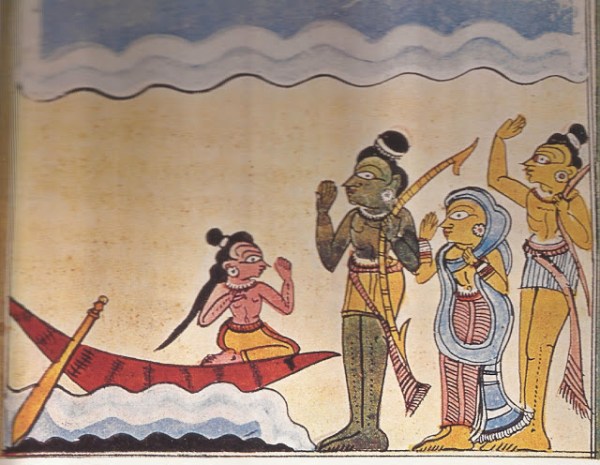
Once a man was about to cross the sea. Vibhishana wrote Rama’s name on a leaf, tied it in a corner of the man’s wearing cloth and said to him, “Don’t be afraid. Have faith and walk on the water. But look here – the moment you lose faith you will be drowned”.
The man was walking easily on the water. Suddenly he had an intense desire to see what was tied in his cloth. He opened it and found only a leaf with the name of Rama written on it. “What is this?”, he thought. “Just the name of Rama!.” As soon as the doubt entered his mind he sank under the water.
p.99, Tales and Parables of Sri Ramakrishna, Ramakrishna Math, Chennai, Year 1947
 Tamil and Vedas
R Nanjappa
/ May 24, 2015There are of course many *stories *about the greatness of God’s name in our religious lore. But there are are many recorded incidents also in recent history. 1.Swami Ramdas was a votary of the divine name. It has been reported that in his Anandashram in Kanhangad, the gentle, musical sound of the name of Rama could be heard emanating from the trees there! This is a corroboration of the calim made in respect of the Jivasamadhi of Sri Bhagavannama Bodhendra on the banks of the Cauvery in Govindapuram, near Kumbhakonam. Bodhendra it was who, in spite of being the 59th Pontiff of the Kanchi Mutt, first initiated the sampradaya of Namasankirtana in the Chola desa, as the remedy for the ills and as the means of liberation in this Kali age.He has written an authoritativel treatise(Sri Bhagavannama Rasodayam) establishing this, based purely on our traditional Scriptures, from Upanishads onwards. 2. It is well known that Sri Tyagaraja performed Sri Ramanama Japa 96 crore times (after getting proper initiation) and had Darshan of Sri Rama. But Tyagaraja, like all true saints, did not want anything for himself. “*Neevera kuladhanamu santatamu, neevera jeevanamu'” was his stand.It is said Rama grants people want they want, and for those who do not want anything, He gives Himself!* 3. We have the history of Sri Bhadrachala Ramadas. His method was Kirtana- which is also a form of Nama japa. He obtained his release from prison due to intervention of Rama-Lakshmana, but it was his Sultan Tani Shah who had the fortune of seeing them, but without realising their identity. Strange are the ways of God. “God moves in a mysterious way his wonders to perform”, an English poet has sung.Tyagaraj held Ramadasa in high esteem and has sung about him in 4 kritis, In one of them he calls him ‘*Dheerudau Ramadasu”. The full line is an allusion to the incident of Rama freeing him from the prison. “Dheerudau Ramadasuni bandhamu dheerchinadi vinnaanura” (Ksheerasagara Sayana).* *4.*Perhaps the greatest , latest, historical proof of the power of the Name is the story of Gandhiji. In the 20s, Gandhiji had clearly written that if his heart could be cut and seen there would be nothing other than Rama there. True enough!. When he was felled by bullets at point blank range, he did only say, “Hey Rama”. Though in politics, his heart was full of the divine name and consiousness- a fact which is recorded by our Subrahmanya Bharati in the Mahatma Gandhi panchakam, beginning “Vaazhga nee emmaan”. 5. We should not also forget that Ardhanari, the palace cook from Mysore, went to Palani for relief from illness.and learnt a few Tiruppugazh songs. Later he went to see Sri Ramana Maharshi. One day, the Maharshi suddenly asked him to get down the hill. Dejected at being sent away so summarily, he came down and met Sri SeshadriSwami on the way! After some exchange, Sri Seshadri Swami told him: “Tiruppugazh contains everything. It s the Mahamantra for you. Go to Vallimalai and do Tiruppugazh parayana and tapas.” So he went to Vallimalai, learnt all the Tiruppugazh songs though he could not even read and write Tamil .properly.(He had asked a school boy to teach Tamil alphabets in Palni.) There in the nights, he used to hear the Tiruppugazh songs sung by some mysterious sources in set Ragas. He learnt them and later propagated them in those Ragas. He himself became known as Vallimalai Swami. This is the testimony to an unlettered fellow emerging as a highly respected spiritual person through the sheer power of the name- for Tiruppugazh is nothing but a garland of divine names and glories.
Such is the living power of the Divine Name!.