Post No. 8067
Date uploaded in London – – – 29 May 2020
Contact – swami_48@yahoo.com
Pictures are taken from various sources for spreading knowledge; this is a non- commercial blog. Thanks for your great pictures.
Personal and Social
Bhakti is both personal and social. Personal practice is more ritualistic, rule-based, what is called Vaidi bhakti. This we see mostly prevalent in the South, and generally among the orthodox sections. But in the North, we observe the social aspects of bhakti, especially as when we see the Aarti performance in temples or other holy spots, where people participate freely. In the South, even when people congregate in temples, the worship is primarily individualistic, where they perform archana in individual names. Also, in the South, worship at temples is always mediated by a priest. It is only during mass festivals when large number of people go on pilgrimages to famous temples that we see congregational worship in the South. Communal worship is more common among the non-orthodox sections, especially in connection with cult or family deities. However, the bhajan and sankirtan performances are outstanding social events among the orthodox in the South, where in the smaller gatherings, the whole audience joins in! This often combines excellent music, lyrics of great saints in various languages, covering the lore and legend of the whole Bharatvarsha, easily traversing the centuries , along with minimum ritual, such as a pooja in the beginning and a ceremonial dance round a lamp at the conclusion!
Stories from Puranas
One of the standard methods of spreading and sharing devotion is by sharing stories from Puranas, lives of saints, events from the Itihasas , through methodical reading of holy books like Ramayana, Bhagavatam, etc in public congregations.[Harikatha] This is such a simple yet powerful way, requiring very little paraphernalia. Often, such recitals are accompanied by great music, and literary and philosophical exposition.
Our classical music compositions heavily drew from themes and motifs from our ancient lore, though in the north the Muslim rule had almost destroyed it. But now everywhere, the spread of light secular music through the cinema and the electronic and digital media is exerting a negative impact on such traditional forms. Among the so called educated ( that is those who have been through formal schooling), the focus is on tele-viewing or now, participating in social media through the cell phone and the internet. Serious listening has almost disappeared as an art. Sri Shuka declares in the Bhagavatam that its nectar has to be “drunk” through the ears- “pibata Bhagavatam rasam”. And Suta adds that the moment it enters through the ears, the bliss of Liberation is at hand- ” yat sravana gata muktyuktigathane” ( Bhagavatam, Mahatmyam, 6.80 & 100) But this would be Greek to our younger generation, getting increasingly alienated from our traditional air and fare.
Appeal of old legends & stories
The lives of saints and Avatars provide a staple source of edification, consolation and religious education in an informal setting. Even remote, legendary stories have perennial appeal and relevance, and provide inspiration, confidence and hope. They have the power to move our heart and appeal to our mind because they come from the depths of truth. That God saved an Ajamila, that he hastened to rescue a mere elephant, or provided succour to a Draupadi at the time of her trial in the assembly continues to inspire and motivate us even today. They give hope even to the least of us, even when we realise that we do not have perhaps even a millionth part of such faith as these legendary figures had.
This is quite scientific- how many of us have measured or even understood gravity, or relativity? One experiment by a noted scientist is taken as universally valid. Similarly, that one sinner was saved shows that sinners can be saved! This is the message ultimately conveyed by these stories and historical narratives- there is hope for every one. No theory or philosophy can ever match their power. Even in our day we see how the following of Shirdi Sai Baba is spreading, entirely on the basis of stories shared among the devotees, without any government. backing or central organization! This was how our saints kept alive the springs of devotion among the common people during the middle ages, when orthodoxy almost collapsed and neglected the common man and communal life, with hardly any royal protection or patronage for our dharma.
Tanjore, an oasis
Sri Tyagaraja appeared at one such turbulent period, and he lived in the one area in Tamil speaking land which somehow survived as a cultural centre- the Tanjore area, under the protection, though largely nominal and dwindling, of the Marathas, following the collapse of Vijaynagar. Traditional arts and music, learning and religious practices still prevailed, though under strain. Tyagaraja used music to spread the bhakti cult, along with his personal spiritual practice based on Unchavritti, which was rare even during his times, and saguna worship of his personal Deity. Like Sri Ramakrishna later, who proved by his life that one could lead a spiritual life without modern education, Sri Tyagaraja proved that one could still adopt ancient forms of spiritual practices even in changing times.
Tyagaraja rejuvenates tradition
Tyagaraja’s musical compositions combine stories from our ancient scriptures, along with relevant philosophical and social comment and exposition. However, the predominance gained by the musical aspects, especially the concert platform, has obscured the real religious and philosophical message. The damage or loss is serious, since people do not even regard his compositions as serious literature. The professional musicians do not render full justice to the kritis; they do not sing many of them, nor sing them fully, rendering all the charanams in any composition. And their diction and pronunciation are often atrocious, to put it mildly.
Coming in the Bhakta tradition, Sri Tyagaraja recalls major events recorded in our Itihasa-Purana lore, keeping alive the perennial flow. Almost all the events of the Ramayana are covered in his kritis, where often he adds his own subtle touches, and many chronicles from the Bhagavatam. He has composed a separate musical drama on the history of Prahlada- Prahlada Bhakti Vijayam and highlighted one incident from the life of Krishna in another musical drama- the Nauka Charitram. But today we will see how he refers to other histories and incidents in his other kritis.
Listening to, reading and reciting such incidents connected with the lives of devotees and Bhagavan cover three aspects of the nine-step bhakti advocated by our saints: sravanam, mananam and kirtanam!
Mari mari ninne (Kamboji)
Mari mari ninne moralida nee
manasuna daya radu
Kari mora vini saraguna chana neeku
garanamemi sarvantaryami
Karunato Dhruvuni keduta nilchina
katha vinnanayya
Suraripu tanayunikai nara mrugamau
suchana lemayya
Marachiyunna vanacharuni brochina
mahima delupavayya
Dharanuvelayu Tyagaraja sannuta
taramugadika ne vinanayya
O the one who pervades everywhere!
Even though I make repeated appeals, somehow your heart has not found mercy for me!
Did you not hasten to rescue,, listening to the pleading of a mere elephant? What was that due to?
I have listened to how you appeared before Dhruva, with all your kindness.
What is the mystery behind your assuming the form of Man-Lion, for the sake of the son of Hiranyakasipu, who was the enemy of the Devas?
Tell me the greatness of your saving Sugriva, who was wandering in the forest, without any hope, forgetting everything?
O my God! I cannot bear it any longer. I will simply not listen to you.
Na morala kim (Devagandhari)
Na morala kimpavemi Sri Rama
Nee mahimalu vini vini ne
nento nera nammiti
Oka vachana rudala nadu
sahodaru badhalu
talaka molalida brochitivi
tanaku sugrivamu gada
Oka nisicharudannamata
lorvaka charanaga
suka vachanamulo nadu
palukulanni vibhishanama
Poosalu goorchina yatuvale
pooni bhajinchaga
aasalu gala Tyagaraju
dasudanuchu delisi
Sri Rama! Will you not listen to my pleadings? I have heard of your greatness and am sorely dependent on you.
When one wandering in the forest, appealed to you, unable to bear the suffering caused by his brother, did you not save him? Was it because he had a beautiful neck? Is not mine as beautiful (sugrivam)?
When a Rakshasa wandering in the nights surrendered to you, unable to bear the hard words of his brother, and you protected him, did his words sound sweet to you like the sounds of a parrot? Are my words alone causing fear ( vibhishanam) for you?
You Know that this Tyagaraja is eager to worship you steadily, without any break, like beads strung together. Even then, you do not listen to his appeals.
Here, Tyagaraja is taking great liberties with the Lord, showing his intimacy. He is also punning on the words, Sugriva and Vibhishana. While he deals with their incidents, he skilfully avoids mentioning their names, while meaning them; but he uses their names as adjectives to pun on them! This is something we should enjoy on close reading by ourselves, as too much of explanation will spoil the refined fun intended by the Swami, the great poet that he is!
But in the next kriti, he is more conventional!
Ksheera sagara sayana (Devagandhari)
Ksheera sagara sayana nannu
chintala bettavalena Rama
Varana rajunu brovanu vegame
vachinadi vinnanura Rama
Narimaniki jeeralichinadi
naade ne vinnanura
Dheerudau Ramadasuni bandhamu
deerchinadi vinnanura
Neerajakshikai neeradhi daatina
Nee kirtini vinnanura
Taraka nama Tayagarajanuta
dayato nelukora Rama
O Rama! Sleeping blissfully in the milky ocean!
Why should you keep me submerged in worries? (and thus make me unable to sleep?)
I have heard the incident that you came post-haste to save the elephant king.
I heard long ago how you bestowed (endless) garments on Draupadi to save her honour.
I have heard how you removed the bond of chains from that heroic Ramadasu.
I have heard of your fame in crossing the ocean for the sake of the lotus-eyed Sita.
O the one with the Taraka nama! Please accept me mercifully.
Holy Feet
It is a strong tradition among bhaktas to rely on the Name and they also hold the Feet of the Lord as sacred- in fact the Name and the Feet are held in even greater esteem than the named! It is remarkable that Tiruvalluvar talks of the Feet of God in the opening section of his Kural- in 7 out of 10 couplets! No other parts like Face or eyes are even mentioned! Only the singing of His praises is mentioned in one Kural! In the still more ancient Sangam literature Paripadal, it is stated ” Your feet are even more glorious than you”- ” ninnir seeriya nin taal inaiyavai”. நின்னிற் சீரிய நின் தாள் இணையவை
In the case of Rama, both his Name and Feet are especially famous. About his name, we have seen earlier. About the feet, Tyagaraja sings now.
Nee pada pankajamu (Begada)
Nee pada pankajamulanu
ne nera namminanu
Bhoopalula garvambu lanasu kora
ka Parameshvaru chapamu drunchina
kopamuto munu taapasiyichina
sapamuna Ahalya anudinamu
chaparati tanu taapa morvale
napenugani paritamapu deerchina
Nee pada pankajamu
I am firmly depending on your lotus feet.
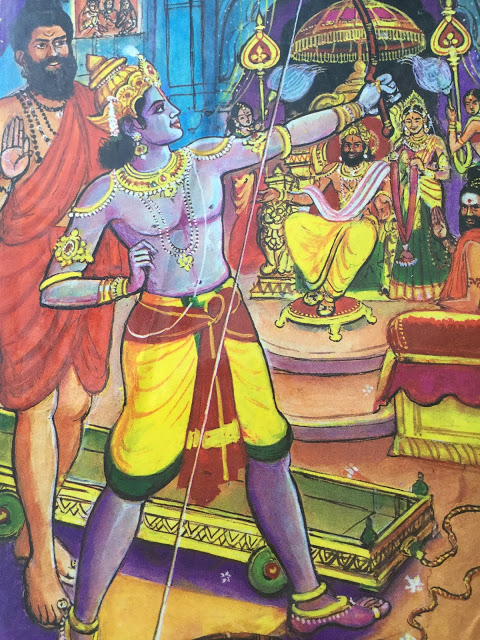
Your sacred feet helped you when you undertook to break the bow of Shiva, in order to subdue the inordinate pride of the assembled kings ( in Mithila).
Rishi Gautama cursed Ahalya with great anger. She turned into stone and underwent great bodily suffering. Your golden feet removed her suffering.
Feet V.Sandals
Sri Tyagaraja has a strange doubt- whether Rama’s feet are necessary; whether his sandals alone would not do?
Sandehamunu deeerpavayya
Saketa nilaya Ramayya
Nandarchita padayugamulu melo
Nagarikamagu paduka yugamu melo
Varamaunulelala jaranam mulanu
smariyimpa needu pada mosangene
Bharataarchana che paadukalu
dhara ninnosange Tyagaraja bhagyama
O Rama! With Ayodhya as your place! Please resolve my doubt.
Are your feet worshipped by Sunanda and others superior? Or are your sandals connected with the town of Ayodhya superior?
The great munis of excellent tapas meditated on your feet and they got Vaikunta, which is your abode.
But due to Bharata worshipping your sandals, he got You Yourself! So which of them are superior? Please resolve my doubt, O the fortune of Tyagaraja!
With such a background, Tyagaraja the parama Bhagavata- what would he wish for?
Sri Rama padama nee krupa jaalune
chittaniki raave
Vaarijabhava Sanaka Sanandana
vaasava Naradadu lella poojinche
Dhaarini silayai taapamu taalaka
vaaramu kannneerunu ralchaga
Sura Ahalyanu joochi brochina
reeti dhanyu seyave Tyagaraja geyama
O the blessed feet of Rama! Your blessings are sufficient for me. Please come and reside in my chitta.
You are worshipped by Brahma, Sanaka, Sanandana, Indra, Narada and others.
You are full of such valour that when you found Ahalya on the way, assuming the form of stone, and constantly shedding tears unable to bear the suffering, you saved her!
Please bless this Tyagaraja also in the same manner!
Again he requests:
Nee japamu nee smarane nee pada
Puja neevaari chelimi yosagi
rajiga daya cheyu………..Sri Lakshmi Narasimha
O Lakshmi Narasimha!
Please consent to grant me your nama japa, your remembrance, worship of your feet, association with your devotees, and thus bless me.
Here, Tyagaraja is seeking four of the nine classical prescriptions: japa, smaranam, puja and satsanga! Thus is the Sadguru teaching us what to seek!
To be continued……………………
tag- Tyagaraja -20
 Tamil and Vedas