WRITTEN BY R. NANJAPPA
Post No. 8618
Date uploaded in London – – – –3 SEPTEMBER 2020
Contact – swami_48@yahoo.com
Pictures are taken from various sources for spreading knowledge; this is a non- commercial blog. Thanks for your great pictures.
BOOKS INDIANS SHOULD READ – 35
R.Nanjappa
Chapter 13 Part 2
THE COLLECTED WRITINGS OF DHARAMPAL-8

GANDHIJI’S SCHEME
So for Gadhiji, Swaraj meant a direct reversal of the prevailing pattern of exploitation and
exchange, in favour of the urban areas, and against the villages. This would be possible
only if the Polity of free India restored to the village its dignity and economic strength
and autonomy in local affairs. The village had to be made the basic unit of administration,
and economic and political life. He said:
There are seven hundred thousand villages in India each of which would be
organised according to the will of the citizens, all of them voting. Then there
would be seven hundred thousand votes. Each village…. will have one vote.
The villagers would elect the district administration; the district administrations
would elect the provincial administration and these in turn would elect the
President who is the head of the executive….
Gandhiji’s ideas were the base of Congress policies. His ideas on the reorganaistion of
village life and restoration of its powers were widely shared by Congressmen, many of
whom had taken part in the Constructive Programme.
However, Nehru did not have much love for the villages. He wrote to Gandhiji in 1945:
” I do not understand why a village should necessarily embody truth and non-violence. A
village, normally speaking, is backward intellectually and culturally, and no progress can
be made from a backward environment.”
[Nehru also had strong Socialist views, running counter to Gandhi’s ideas. It is strange
that Gandhiji still chose Nehru as his heir!]

HUMBUG BY THE DRAFTING COMMITTEE
When the Constituent Assembly was formed to draft the Constitution, B.N.Rau, a pucca
bureaucrat, was given the job of making the initial draft. He did this by studying and
borrowing from the Constitutions of the countries of Europe, Americas and USSR. He
submitted the draft just after Independence. The Assembly then appointed a committee to
scrutinise the draft and suggest amendments.
The members of the Committee were:
- Alladi Krishnaswamy Ayyar
– N.Gopalaswami Ayyangar
– Dr.B.R.Ambedkar
– K.M.Munshi
– Saiyed Mohd.Saadulla
– B.L.Mitter
– D.P.Khaitan
When the draft of the constitution was read and discussed in the Assembly, the
omission of any place of importance to the villages was noticed and seriously
discussed.
- Member after member expressed support for recognising the village and the
overwhelming opinion was in favour of it. But it did not finally happen.
The problem was with the composition of the Committee itself. Of the seven members,
only K.M. Munshi had taken part in the freedom struggle under Gandhiji. Dr.Ambedkar
had been a supporter of the British and worked against Gandhiji. Saadulla had been
a British supporter. The others had no concern with the
freedom movement. None of them could therefore enter into the spirit of the freedom
struggle and the ideals that had motivated them.
Three members made strong points.
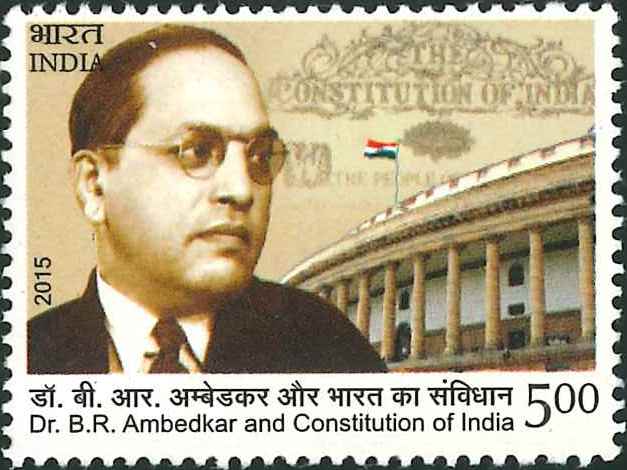
T.T.Krishnamachari: on 5 November 1948:
….the amount of attention that was necessary for the purpose of drafting a Constitution …
has not been given to it by the Drafting Committee. ….of the seven members nominated…
one has resigned… and was replaced. One died and was not replaced. One was away in
America and his place was not filled up..another person was engaged in State affairs and
there was a void to that extent. One or two were far away from Delhi and perhaps reasons
of health did not permit them to attend… the burden of drafting this Constitution fell on
Dr.Ambedkar…attention that was due to a matter like this has not been given to it by the
Committee as a whole. …certain aspects of our Constitution have not had the amount of
expert attention that was necessary.
[He also pointed out a legal lacuna in the status of the Committee’]
*
 Tamil and Vedas