Compiled by London Swaminathan
Date: 11 September 2016
Time uploaded in London: 14-46
Post No.3143
Pictures are taken from various sources; thanks.
‘The Art Heritage of Bangladesh’ by Enamul Haque (The International Centre for Study of Bengal Art, Dhaka, Bangladesh, Year 2007) has lot of information about Hindu idols, statues and objects discovered in Bangladesh. It includes the latest discoveries. The book is worth buying; it has 536 illustrations.
“In an extraordinary study of the late medieval temples of Bangladesh and West Bengla, the temples of the Muslim period and colonial period taken together, David J.McCutchion (year 1972) offered a classification of thirteen major types and 60 sub-types. Most of these temples are made up of bricks, a few in lateritic stone in West Bengal. In Bangladesh, the temples, irrespective of their shapes, sizes, styles or uses are variously called Mandir, Deul, Math, Devalaya, Than, Domamacnha, Rasamancha etc. David have divided them in the following categories:-
Chala type, Bangla type, Ratna type, Shikhara type, Math type, Composite type, Rasamanchas/Dolmachas, Non-raditional type.

Chala type
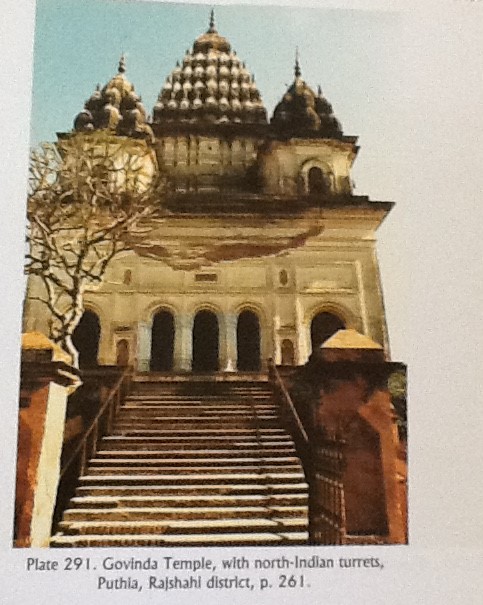
This type, called char chala or chau chala, consists of a shrine,square or rectangular, with a hut shaped roof of four sloping segments. Based on extant remains, the construction of the char chala type temples appar to be post-muslim tradition, as char chala vaulted domes are already in use in Shahid Gumbad Mosque (1450). The 18th century Barashiva temple at Hatikumrul in Sirganj temple and Gopala temple at Puthiya, both with rich terracotta decorations belong to this type. Other examples: Math at Ujani, Kapileswara temple at Tarash, Madan mohana temple at Satrajitpur, Shiva temple atNandual. The four subsidiary shrines of the Dharakeswari temple, in Dhaka city stand on a raised plinth.
The other variety of char-chala temple is the at-chala or eight segmented.e. a temple with a further miniature char chala roof over the lower char chala sturucture. They aare more numerous in West Bengal. Examples of this type in Bangladesh are the
Shiva temple at Chanchra
Gunchanatha Shiva temple at Telkupi
Abhaynagar Shiva temple in Jessore District
Rameshvari temple at Jhenidaha district
Raghunatha temple at Dhulgram
Jora Shiva temple at Chaigharia
Jora Shiva temple at Dohajari
Shiva temple at Chandina.
Bangla Type
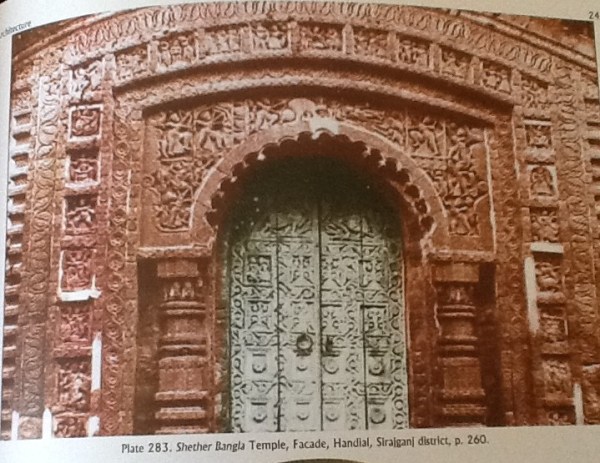
During the Sultanate period in Bengal while certain elements such as the curved chronicle of the village huts made of mud or bamboo with thatched roof was introduced in architecture, the Hindu temples beginning from the 17th century saw the entire hut structure translated into brick. Thus the popularly known do-chala or two segmented roof, sometimes called ek bangla, imitating the basic rural huts, soon became popular among the temple builders. They are comparatively more common I Bangladesh. Few examples:-
Chota Ahnik Temple at Puthia
Gopalbari Temple at Naldanga
Narayana Temple at Kaichal
Shether Bangla at Handial
An abandoned Temple at Pura
One of the best preserved specimens of Jor Bangla (twin hut temple) is at Bishnupur in West Bengal.
In Bangladesh,
Gopinathpur Temple at Dakshin Raghavpur
Narayana Temple at Lohagara
Govinda Temple at Kotakol
Jor Bangla Temple at Nalia
Ratna Type
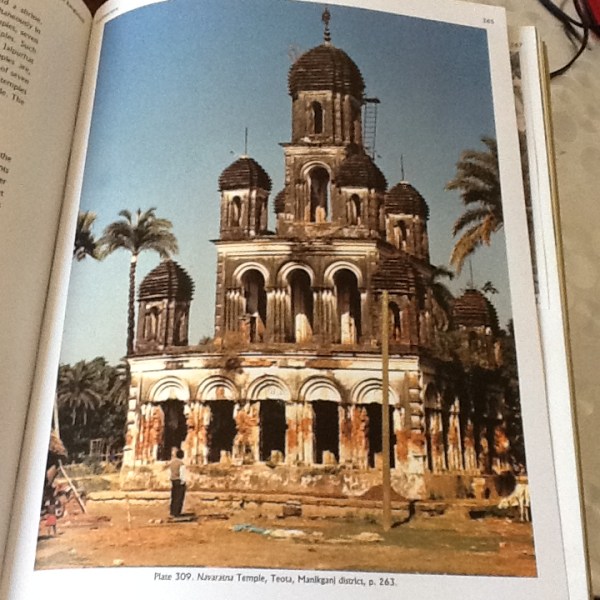
The Ratna type consists of a square shrine with an ambulatory around or with a verandah in front. The term ratna means gem/jewel, but in the context of architecture, it stands for a shikhara or tower.
Temples can be ek ratna (one towered)
Pancha ratna (five towered)
Nava ratna (Nine towered)
Ekadasha ratna (11 towered)
Trayadash ratna (13)
Saptadash ratna (17)
Ekush ratna (21) and pancha vimsati (25).
In Bangladesh, there is no ekratna temple, there being many in West Bengla.
Examples in Bangladesh:-
Pancha ratna type- Govinda temple at Puthia
The Kali Narayana Ray Shamsan Temple – Jeydevpur
Harekrishna Temple- Muhammadpur
Mahadeva temple at Naldanga
Prana Gopal Temple at Gopalganj
Shiva Temple at Sribari
Navaratna type – Kantaji Temple at Kanatanagar built by Maharajas of Dinajpur
But all the 9 towers are lot due to the earthquake in 1897.
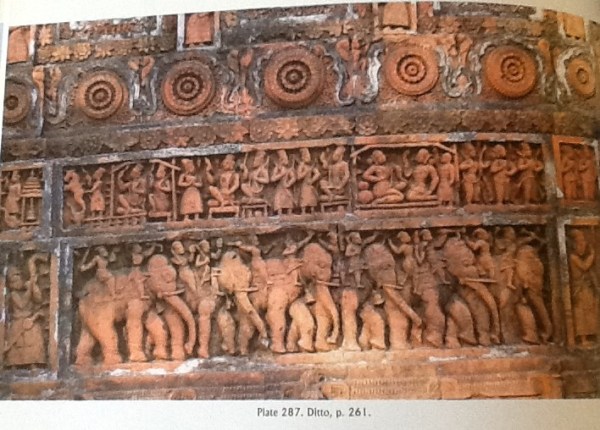
A wooden replica of the original temple is preserved in the Indian museum. The extraordinary feature of the temple is that every inch of the temple surfaceon all floors is covered by terracotta ornamentations, representing various mythological and social scenes of contemporary everyday life, punctuated by flora, fauna and geometric motifs.
Hatikumrul navaratna temple – Sirajganj District
Ruined Navaratna temple at Potajia
Ruined navaratna temple at Nanikhir
Shyamsundara temple at Sonabaria
Navaratna Temple at Damreli
17 towered temple: Jagannatha temple – Comilla town
Documentary evidence for destroyed ekush ratna (21 towered) and ekadasha (11) temples at Lakshmi Janardhana temple at Kishoreganj and Rajnagar.
Ruins of 25 towered temple at Gopalpur
Shikhara Type
Mathurapur Deul – Madhukhali
Kodla math at Ayodhya , Bagherhat District
Math Type
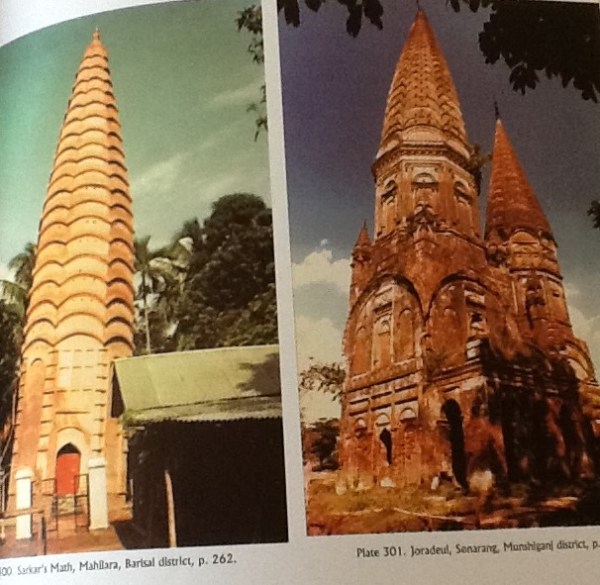
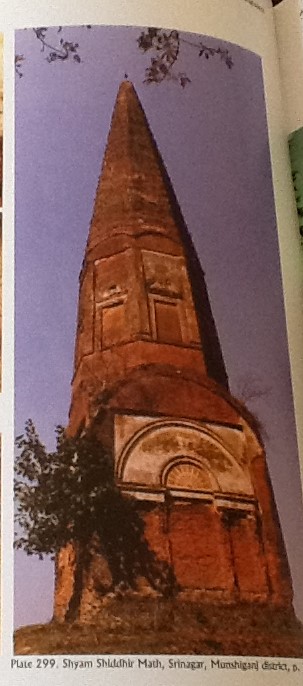
Under this type can be noticed a large number of square, octagonal or 12 sided temples with one tall slender tower. These are mostly found in S E Bangladesh.
Examples
Sarkar’s math – Mahilara
Twin towers at Sonarang
Kali temple with a height of 45-73 metres- Sonarang
Shyam Siddhir math at Srinagar
Sutalari math – Jhalakathi district
Newra math – Chandpur district
Jatramani math – Tulatuli
Composite Type
Combinations of sevral types together
Jagaddhatri temple at Puthia
Rajaram Temple – Khalia
Khelaram Datar Temple – Dhaka District
Rasamanchas/ Dolamachas
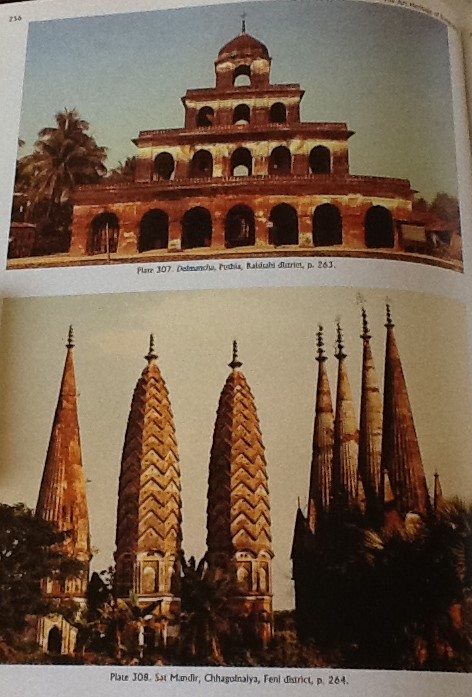
These are octagonal or square buildings related to the Krishna cult enabling the deity to be seen from all sides.
One temple in Bardhankuti is lost.
Dolmancha at Muhammadpur
Ratha mandira t Puthia
Dolmancha of Govinda – Salnagar

Non traditional Type
Chanda Bhairava Temple – Ishvaripur, built in 16th century by Raja Pratapa Aditya.
Cluster of temples are built by succeeding gnerations. 4, 7, 9, 11 12, 108 temples are known.
A group of twelve char chala temples is in Belamla
Gropu of 7 temples called Satmandir is at Chagolnaiya.
It is only a short list. There are lot of temples in many other sub categories.
My Comments
1.It is heartening to note that most of the Bangladesh place names are still in Sanskrit in spite of Muslim rule
- It is a sad thing to hear about several ruined and lost temples
- Indian Government and Hindu organisations should renovate all the temples by mobilising Bangla Hindus with the help of Bangladesh Government.
4.The classification of temples by David or other foreigners is only on the basis of existing or recorded temples. But Bangladesh had temples for thousands of years or at least 1500 years. So we must gather all such details.
5. thousands of temples were destroyed by the invading Muslims and ruling Muslim kings. So Hindu scholars must collect all such vital information from recently discovered inscriptions and rewrite the History of temples in Bangladesh.
–subham–
 Tamil and Vedas
You must be logged in to post a comment.