
Compiled by London Swaminathan
Date: 26 August 2016
Time uploaded in London: 16-56
Post No.3094
Pictures are taken from various sources; thanks for the pictures.
Not many people in India knew that we have only 11 parts out of 1130 parts of the Vedas. It is a great loss. Every ancient language in the world has lost lot of books. In India we know how many books we have lost in Tamil and Sanskrit. Foreign invasions, negligence by the people, weather conditions and insects such as white ants Rama baanam (Rama’s arrow insect) have destroyed thousands of books. Nalanda University Library was burning for several days when Muslim invaders set fire to the university and its library. It emphasises the need to preserve at least what we have now.
What is the meaning of ‘preserving’?
I don’t mean preserving and saving the books in museum shelves. I mean actual support for learning the Vedas and lending all sorts of support to the Vedic Pundits. The reason being they are used until today in the temples, prayer halls, houses, weddings and funeral ceremonies. No one else in the world has such as old legacy. It is the history of human race.
Patanjali in Mahabhasya says,
Rig veda has 21 shakhas (branch or parts)
Yajur veda has 100 shakhas
Sama veda has 1000 shakhas
And
Atharvaveda 9 shakhas
But the Muktikopanishad says that we had 21, 109, 1000 1nd 50 shakhas respectively.
Whatever the total number is, it shows we have lost a big chunk of the Vedic literature. Today we have only 11 Shakhas in full.
The way to find out what we lost is to look at the commentaries where the lost books are quoted. Some authors list the books that were current at their time or before their time. Varahamihira refers to lot of books which are not available today. Kalidasa and Panini mentioned their predecessors whose writings are not available today.
We have 20,000 suktas from the four Vedas at the moment. No one can master such a huge volume of literature.
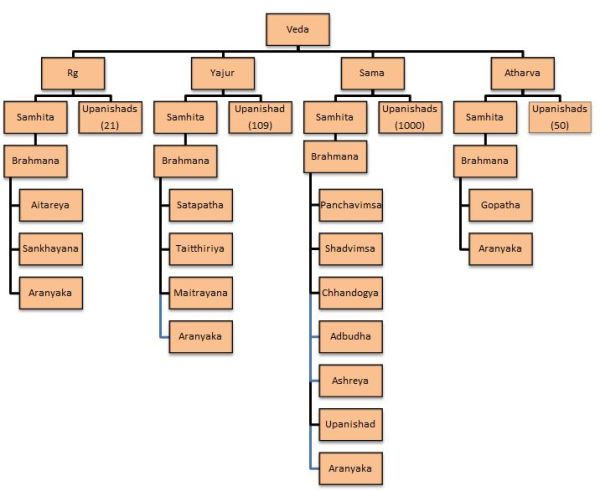
Why did Veda Vyas divide Vedas into four Vedas?
Even during the epic period Vedas became unwieldy; its vastness prevented people from mastering it. So Veda Vyas found out a solution by dividing it in to four: Rik, Yajur, Sama and Atharva and gave them to his four disciples to spread them. If it had become too vast to handle around 3100 BCE (Veda Vyas period), no wonder we had lost a lot today.
Look at what happened to Manu Smrti:-
Narada Smriti says that Manu had
100,000 slokas/couplets in Krita Yuga which was reduced to 12,000 by Markandeya and 4000 by Sumati, Bhrgu’s son.
Now we have 2685 slokas in 12 chapters.
What does it show?
Hindus knew that it would be impossible to use vast number of rules in Kali Yuga and so accepted the reductions.
And Hindus believe that ‘change is inevitable’. Everything must change including the law books. So they composed various smritis according to the need of the time.
Also the law makers knew that Hindus wouldn’t have time to read all the books or rules in ages like Kaliyuga where the span of life is reduced to 100 years. In Krta yuga, the golden age, people had lived for 400 years according to Manu.
Foreign invaders gave wrong dates to all our scriptures by looking at the latest addition or updates. I have already written in one of my articles that several Manus were named in the oldest book in the world – The Rig Veda.
It is our imperative duty to preserve all the books, particularly the Vedas, that we have today.


-Subham-
 Tamil and Vedas
You must be logged in to post a comment.