Written by LONDON SWAMINATHAN
swami_48@yahoo.com
Date: 26 OCTOBER 2019
British Summer Time uploaded in London – 17-22
Post No. 7141
Pictures are taken from various sources; beware of copyright rules; don’t use them without permission; this is a non- commercial, educational blog; posted in swamiindology.blogspot.com and tamilandvedas.com simultaneously. Average hits per day for both the blogs 12,000.
Let us continue with chapter 9; most of the things said here have no relevance today; we have no evidence to show that these rules were ever observed. This chapter is only of academic interest. May be useful to researchers.
When one wants to assess ‘Manu’s justice’ one must consider:
What time did he write?
For whom did he write?
Were they followed verbatim or just rules in the book?
What happened in the contemporary civilizations?
In my view, most of the rules were academic. Foreign writers who visited India about 1500 years ago praised the Hindu society for its truthfulness and honesty. They saw order and discipline everywhere.
More over all communities around the world gave importance to male children because they were the bread winners, farm workers and fighters (in the war). But Manu empahasized more about the ablutions to the departed souls by the eldest son. This son’s duty to the departed souls and the Veera Matha (mother of heroic sons) concept are seen both in Pura nanuru of Sangam Tamil literature and the Vedas. Typical Hindu concepts seen from the Himalayas to Kanyakumari.
In addition to it, we see the Veera Swarga concept in the Bhagavad Gita, Pura Nanuru (Sangam Tamil literature) and the Islamic Koran. That is, who dies in war will get a direct ticket to the Heaven.
So, one must think twice before passing judgement on Manu. They must consider the rules of contemporary civilizations.
Throughout my comments on Manu, I have been showing the original Manu lived during Rig Vedic times. I have given the reasons for it (No reference to Sati, all reference about Mighty Saraswati River, No Ganga). All the Hindu scriptures except Vedas are updated constantly. Manu Smrti also updated during Sunga rule. Manu’s examples are all from very ancient times. He never mentioned Rama or Krishna. He never gave examples of epic heroes. Even in this chapter he gave examples about Daksha with 50 daughters, not Kuchelaa/Sudhama with 27 daughters
Manu considers all hypothetical situations such as 4 wives of a Brahmin , unmarried daughter delivering a child secretly at father’s house. He never forgets or hides anything. Even though such things are rare, he talks about rules concerned with them.
Let us continue from 9-137
9-137:- Through a son he conquers the worlds, through a son’s son he obtains immortality, but through his son’s grandson he gains the world of the sun.

138. Because a son delivers (trayate) his father from the hell called Put, he was therefore called put-tra (a deliverer from Put) by the Self-existent (Svayambhu) himself.
139. Between a son’s son and the son of a daughter there exists in this world no difference; for even the son of a daughter saves him who has no sons in the next world, like the son’s son.
140. Let the son of an appointed daughter first present a funeral cake to his mother, the second to her father, the funeral to his father’s father.
ADOPTION
9-141. Of the man who has an adopted (Datrima) son possessing all good qualities, that same (son) shall take the inheritance, though brought from another family.
142. An adopted son shall never take the family (name) and the estate of his natural father; the funeral cake follows the family (name) and the estate, the funeral offerings of him who gives (his son in adoption) cease (as far as that son is concerned).
143. The son of a wife, not appointed to have issue by another, and he whom an appointed female, already the mother of a son, bears to her brother-in-law, are both unworthy of a share, one being the son of an adulterer and the other produced through mere lust.
144. Even the male child of a female duly appointed, not begotten according to the rule given above, is unworthy of the paternal estate; for he was procreated by an outcast.
145. A son legally begotten on such an appointed female shall inherit like a legitimate son of the body; for that seed and the produce belong, according to the law, to the owner of the soil.
146. He who takes care of his deceased brother’s estate and of his widow, shall, after raising up a son for his brother, give that property even to that (son).
147. If a woman (duly) appointed bears a son to her brother-in-law or to another (Sapinda), that son, if he is begotten through desire, they declare to be incapable of inheriting and to be produced in vain.
148. The rules given above must be understood to apply to a distribution among sons of women of the same caste; hear now the law concerning those begotten by one man on many wives of different castes.
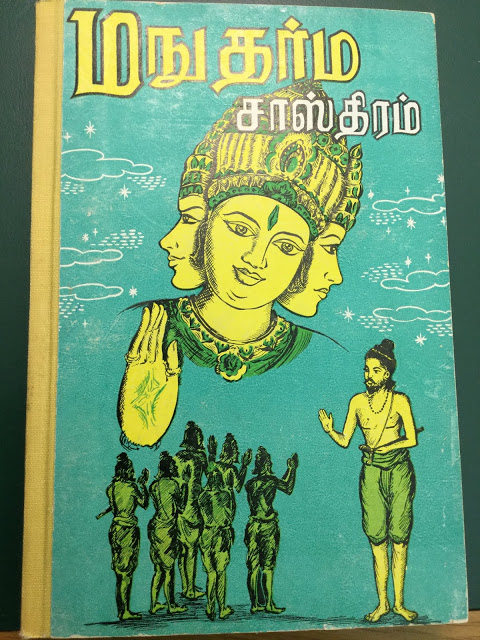
Brahmin’s Four Wives
9-149. If there be four wives of a Brahmana in the direct order of the castes, the rule for the division of the estate among the sons born of them is as follows:
150. The slave who tills the field, the bull kept for impregnating cows, the vehicle, the ornaments, and the house shall be given as an additional portion to the Brahmana son, and one most excellent share.
151. Let the son of the Brahmana wife take three shares of the remainder of the estate, the son of the Kshatriya two, the son of the Vaisya a share and a half, and the son of the Sudra may take one share.
Distribution of Ten Shares
9-152. Or let him who knows the law make ten shares of the whole estate, and justly distribute them according to the following rule:
153. The Brahmana son shall take four shares, son of the Kshatriya wife three, the son of the Vaisya shall have two parts, the son of the Sudra may take one share.
154. Whether a Brahmana have sons or have no sons by wives of the twice-born castes, the heir must, according to the law, give to the son of a Sudra wife no more than a tenth part of his estate.
155. The son of a Brahmana, a Kshatriya, and a Vaisya by a Sudra (wife) receives no share of the inheritance; whatever his father may give to him, that shall be his property.
156. All the sons of twice-born men, born of wives of the same caste, shall equally divide the estate, after the others have given to the eldest an additional share.
157. For a Sudra is ordained a wife of his own caste only (and) no other; those born of her shall have equal shares, even if there be a hundred sons.
Six plus Six Sons
9-158. Among the twelve sons of men whom Manu, sprung from the Self-existent (Svayambhu), enumerates, six are kinsmen and heirs, and six not heirs, (but) kinsmen.
159. The legitimate son of the body, the son begotten on a wife, the son adopted, the son made, the son secretly born, and the son cast off, (are) the six heirs and kinsmen.
160. The son of an unmarried damsel, the son received with the wife, the son bought, the son begotten on a re-married woman, the son self-given, and the son of a Sudra female, are the six who are not heirs, but kinsmen.
Unsafe Boat
9-161. Whatever result a man obtains who tries to cross a sheet of water in an unsafe boat, even that result obtains he who tries to pass the gloom of the next world with the help of bad substitutes for a real son.
162. If the two heirs of one man be a legitimate son of his body and a son begotten on his wife, each (of the two sons), to the exclusion of the other, shall take the estate of his (natural) father.
163. The legitimate son of the body alone (shall be) the owner of the paternal estate; but, in order to avoid harshness, let him allow a maintenance to the rest.
164. But when the legitimate son of the body divides the paternal estate, he shall give one-sixth or one-fifth part of his father’s property to the son begotten on the wife.
165. The legitimate son and the son of the wife (thus) share the father’s estate; but the other tell become members of the family, and inherit according to their order (each later named on failure of those named earlier.
AURASA, KSHETRAGA, DATRIMA, KRITRIMA
9-166. Him whom a man begets on his own wedded wife, let him know to be a legitimate son of the body (Aurasa), the first in rank.
167. He who was begotten according to the peculiar law (of the Niyoga) on the appointed wife of a dead man, of a eunuch, or of one diseased, is called a son begotten on a wife (Kshetraga).
168. That boy equal by caste whom his mother or his father affectionately give, confirming the gif with a libation of water, in times of distress to a man as his son, must be considered as an adopted son (Datrima).
169. But he is considered a son made (Kritrima) whom (a man) makes his son, (he being) equal (by caste), acquainted with (the distinctions between) right and wrong, (and) endowed with filial virtues.
GUDHOTPANNA, APAVIDDHA, KANINA, SAHODHA
9-170. If a child be born in a man’s house and his father be not known, he is a son born secretly in the house (Gudhotpanna), and shall belong to him of whose wife he was born.
171. He whom (a man) receives as his son, (after he has been) deserted by his parents or by either of them, is called a son cast off (Apaviddha).
UNMARRIED MOTHERS
9-172. A son whom a damsel secretly bears in the house of her father, one shall name the son of an unmarried damsel (Kanina, and declare) such offspring of an unmarried girl (to belong) to him who weds her (afterwards).
173. If one marries, either knowingly or unknowingly, a pregnant (bride), the child in her womb belongs to him who weds her, and is called (a son) received with the bride (Sahodha).
KRITAKA, PAUNARBHAVA, SVAAYAMDATTA, PARASAVA
9-174. If a man buys a (boy), whether equal or unequal (in good qualities), from his father and mother for the sake of having a son, that (child) is called a (son) bought (Kritaka).
175. If a woman abandoned by her husband, or a widow, of her own accord contracts a second marriage and bears (a son), he is called the son of a re-married woman (Paunarbhava).
176. If she be (still) a virgin, or one who returned (to her first husband) after leaving him, she is worthy to again perform with her second (or first deserted) husband the (nuptial) ceremony.
177. He who, having lost his parents or being abandoned (by them) without (just) cause, gives himself to a (man), is called a son self-given (Svayamdatta).
178. The son whom a Brahmana begets through lust on a Sudra female is, (though) alive (parayan), a corpse (sava), and hence called a Parasava (a living corpse).
179. A son who is (begotten) by a Sudra on a female slave, or on the female slave of his slave, may, if permitted (by his father), take a share (of the inheritance); thus the law is settled.
180. These eleven, the son begotten on the wife and the rest as enumerated (above), the wise call substitutes for a son, (taken) in order (to prevent) a failure of the (funeral) ceremonies.
181. Those sons, who have been mentioned in connection with (the legitimate son of the body), being begotten by strangers, belong (in reality) to him from whose seed they sprang, but not to the other (man who took them).
182. If among brothers, sprung from one (father), one have a son, Manu has declared them all to have male offspring through that son.
183. If among all the wives of one husband one have a son, Manu declares them all (to be) mothers of male children through that son.
184. On failure of each better (son), each next inferior (one) is worthy of the inheritance; but if there be many (of) equal (rank), they shall all share the estate.
185. Not brothers, nor fathers, (but) sons take the paternal estate; but the father shall take the inheritance of (a son) who leaves no male issue, and his brothers.
186. To three (ancestors) water must be offered, to three the funeral cake is given, the fourth (descendant is) the giver of these (oblations), the fifth has no connection (with them).
187. Always to that (relative within three degrees) who is nearest to the (deceased) Sapinda the estate shall belong; afterwards a Sakulya shall be (the heir, then) the spiritual teacher or the pupil.
188. But on failure of all (heirs) Brahmanas (shall) share the estate, (who are) versed the in the three Vedas, pure and self-controlled; thus the law is not violated.
BRAHMANA’S PROPERTY
9-189. The property of a Brahmana must never be taken by the king, that is a settled rule; but (the property of men) of other castes the king may take on failure of all (heirs).
190. (If the widow) of (a man) who died without leaving issue, raises up to him a son by a member of the family (Sagotra), she shall deliver to that (son) the whole property which belonged to the (deceased).
191. But if two (sons), begotten by two (different men), contend for the property (in the hands) of their mother, each shall take, to the exclusion of the other, what belonged to his father.
192. But when the mother has died, all the uterine brothers and the uterine sisters shall equally divide the mother’s estate.
193. Even to the daughters of those (daughters) something should be given, as is seemly, out of the estate of their maternal grandmother, on the score of affection.
194. What (was given) before the (nuptial) fire, what (was given) on the bridal procession, what was given in token of love, and what was received from her brother, mother, or father, that is called the sixfold property of a woman.
195. (Such property), as well as a gift subsequent and what was given (to her) by her affectionate husband, shall go to her offspring, (even) if she dies in the lifetime of her husband.
196. It is ordained that the property (of a woman married) according to the Brahma, the Daiva, the Arsha, the Gandharva, or the Pragapatya rite (shall belong) to her husband alone, if she dies without issue.
197. But it is prescribed that the property which may have been given to a (wife) on an Asura marriage or (one of the) other (blamable marriages, shall go) to her mother and to her father, if she dies without issue.
198. Whatever property may have been given by her father to a wife (who has co-wives of different castes), that the daughter (of the) Brahmani (wife) shall take, or that (daughter’s) issue.
199. Women should never make a hoard from (the property of) their families which is common to many, nor from their own (husbands’ particular) property without permission.
200. The ornaments which may have been worn by women during their husbands’ lifetime, his heirs shall not divide; those who divide them become outcasts.
201. Eunuchs and outcasts, (persons) born blind or deaf, the insane, idiots and the dumb, as well as those deficient in any organ (of action or sensation), receive no share.
202. But it is just that a man who knows (the law) should give even to all of them food and raiment without stint, according to his ability; he who gives it not will become all outcast.
203. If the eunuch and the rest should somehow or other desire to (take) wives, the offspring of such among them as have children is worthy of a share.
204. Whatever property the eldest(son acquires by his own exertion after the father’s death, a share of that shall belong to his younger brothers, provided they have made a due progress in learning.
205. But if all of them, being unlearned, acquire property by their labour, the division of that shall be equal, (as it is) not property acquired by the father; that is a settled rule.
206. Property (acquired) by learning belongs solely to him to whom (it was given), likewise the gift of a friend, a present received on marriage or with the honey-mixture.
207. But if one of the brothers, being able to maintain himself by his own occupation, does not desire a share of the family property, he may be made separate by the others receiving a trifle out of his share to live upon.
208. What one brother may acquire by his labour without using the patrimony, that acquisition, made solely by his own effort, he shall not share unless by his own will with his brothers.
209. But if a father recovers lost ancestral property, he shall not divide it, unless by his own will, with his sons, (for it is) self-acquired (property).
210. If brothers, (once) divided and living (again) together (as coparceners), make a second partition, the division shall in that case be equal; in such a case there is no right of primogeniture.
211. If the eldest or the youngest (brother) is deprived of his share, or if either of them dies, his share is not lost (to his immediate heirs).
212. His uterine brothers, having assembled together, shall equally divide it, and those brothers who were reunited (with him) and the uterine sisters.
213. An eldest brother who through avarice may defraud the younger ones, shall no (longer hold the position of) the eldest, shall not receive an (eldest son’s additional) share, and shall be punished by the king.
214. All brothers who habitually commit forbidden acts, are unworthy of (a share of) the property, and the eldest shall not make (anything his) separate property without giving (an equivalent) to his younger brothers.
215. If undivided brethren, (living with their father,) together make an exertion (for gain), the father shall on no account give to them unequal shares (on a division of the estate).
216. But a son, born after partition, shall alone take the property of his father, or if any (of the other sons) be reunited with the (father), he shall share with them.
217. A mother shall obtain the inheritance of a son (who dies) without leaving issue, and, if the mother be dead, the paternal grandmother shall take the estate.
218. And if, after all the debts and assets have been duly distributed according to the rule, any (property) be afterwards discovered, one must divide it equally.
219. A dress, a vehicle, ornaments, cooked food, water, and female (slaves), property destined for pious uses or sacrifices, and a pasture-ground, they declare to be indivisible.
9-220. The division of the property and the rules for allotting shares to the several sons, those begotten on a wife and the rest, in due order, have been thus declared to you; hear now the laws concerning gambling.
XXXXXXXXXXXXXX
 Tamil and Vedas