COMPILED by London Swaminathan
Date: 5 September 2018
Time uploaded in London – 7-47 am (British Summer Time)
Post No. 5395
Hair contains lot of sulfur-containing amino acids, and these attract mercury and provide a permanent record of the person’s exposure to the element.
It was often the custom in earlier times to preserve locks of hair from those who had died. When these have been analysed by modern methods, curiously high levels of mercury have been found, leading some to suspect that the person was medically treated with calomel because they had syphilis or they had taken part in alchemical experiments and thereby breathed mercury vapour.
The hair of Isaac Newton (1642-1727) contains high levels of mercury, which almost certainly came from his alchemical work because he was known to have been a celibate all his life; the mercury in the hair of Scottish poet Robert Burns (1759-96) suggests he had been treated for venereal disease. Napoleon’s hair also shows that he was probably given calomel when he was taken ill on St Helena, but this was not the cause of his death.

Mercury in hair does not always imply syphilis or alchemy. One of the saddest deaths of a scientist was that of Danish astronomer Tycho Brahe (1546-1601) who suffered with prostate trouble. At a royal banquet in Prague he dared not leave the table to relieve himself, with the result that his bladder split and he died of urinary poisoning a few days later. Analysis of a strand of hair, which had the root intact, showed that the day before he died he was given a mercurial medicine in an effort to save his life. It has been tempting to assume that when famous people were treated with mercury the reason was syphilis. King Henry VIII of England and Ivan the Terrible of Russia were both dosed this way. Charles II almost certainly died of mercury poisoning but probably not as a result of medical treatment, although he too might well have needed it as a result of notorious sex life. He was exposed to the metal while doing alchemical experiments which he carried out in poorly ventilated room in the palace.
The alchemists believed that mercury was unique. In their theory it was the element, a component of all metals, and so held the key to transmutation of base metals into gold. It uniquely represented the quintessential property of fluidity. Therefore reports from Siberia , that mercury could freeze solid, and thereby lose its elemental fluidity, were discounted as little more than traveler’s tale.
So it came as a shock to two Russian scientists, A.Braun ad M. Lomonosov, of St Petersburg when, on 26th December 1759, they experimented with snow to see how low a temperature they could achieve. A mixture of ice and salt can produce a temperature drop of many degrees below 0 degree C and they thought that mixing snow and acids might result in even lower temperatures, and so it did. Suddenly the mercury in their thermometer stopped moving, and appeared to have been solidified. Curious to know what had happened, they broke away the glass and found that the mercury in the bulb had become a solid metal ball with mercury from the tube protruding like piece of wire, which they could bend, just like other metals. The belief that mercury was unique had been destroyed.
Cmemical Properties
Symbol Hg
Atomic Number 80
Atomic weight 200-59
Melting Point Minus 39 C
Boiling Point 357 C
Oxide HgO
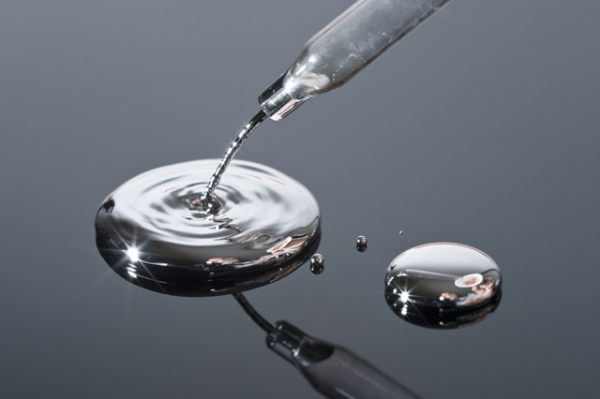
Mercury is a silvery metal and a member of the group 12 of the Periodic Table.
Source- Nature’s Building Blocks, John Emsley,2001
–subam–
 Tamil and Vedas