Written by S NAGARAJAN
Date: 21 July 2017
Time uploaded in London:- 6-01 am
Post No.4100
Pictures are taken from different sources such as Face book, Wikipedia, Newspapers etc; thanks.
by S.Nagarjan

All great men gave very much importance to the Prayer.
How to Pray?
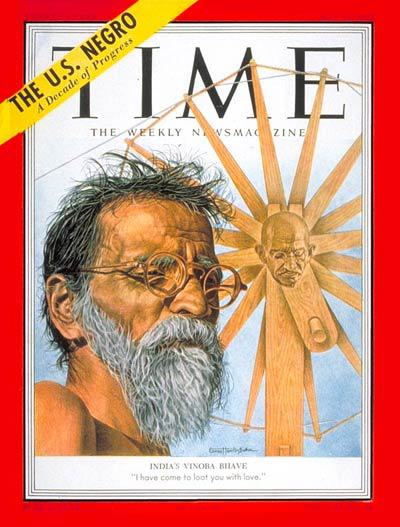
This question been answered by great sages. In this article we will see Vinabha Bhave’s views.
Vinobha Bhave in his Memoirs points out that the silent form of Prayer is the best form of Prayer.
Given below is the extract taken from his Memoirs.
Prayer
It was only after I entered Gandhiji’s Satyagraha Ashram that I had any experience of community prayer. Before that I had never joined with others in prayer, nor had I had any fixed time for individual prayer. It came naturally to me to recite or sing when I was in a devotional mood, but to sit with others, or even to set apart a regular time for private prayer, was not my nature. In my childhood I was taught the Sandhya, but I did not perform it. I refused to repeat words whose meaning I did not understand. This is not to say that I lacked the spirit of devotion, even then. But with Gandhiji there was regular daily prayer. The experience of sitting together with so many worthy people gradually had its effect on me. This effect, I think, was not so much due to the prayers themselves as to the fellowship of devotion which we shared.
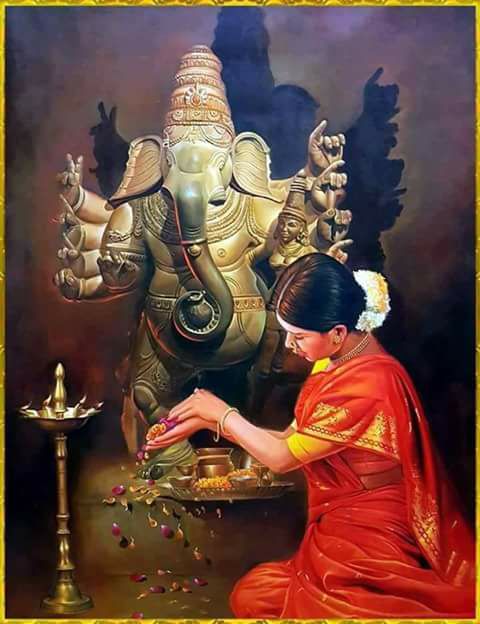
People used to ask Bapu what they should do if they found it difficult to concentrate, or felt sleepy during the prayer. In that case, Bapu suggested, they should stand for prayer instead of sitting. These questioners were honest people, and every day three or four of them would stand during the prayers. But of course concentration cannot be achieved merely by standing ! Bapu began to teach us how to pray, just as one might teach children how to read, using illustrations from his own life. This was a new experience for me, such as I had never had before.
In Bapu’s time a number of passages were included in the prayer, many of which I knew. I would never myself have chosen some of these verses, or considered them suitable, but still I joined reverently in the recital, un- attractive though I found them. Later there was a proposal that these verses should be omitted, but after discussion with Bapu they were kept, on the ground that we should not change what was already in use.
When I was imprisoned, I ceased to use these verses in my morning prayer, and recited instead my own prose translation of the Ishavasya Upanishad, which was much in my thoughts at the time; a number of other people used to join me. But I kept unchanged the verses of the Gita which had been chosen for the evening prayer, as I was very fond of them. This change in the morning prayer was made while Bapu was still alive, and after I was released from jail I went on using the Ishavasya in the Paunar Ashram.
I do not like the queer notion that unity can be brought had by accepting a single form of prayer. Unity is some- thing which must spring from within. I do not want to make any particular verses obligatory in the prayer. So when I was working among the Meos we recited verses from the Koran, and used an Urdu translation of the Gita and Urdu hymns. It seems to me to be best to use whatever the people around me can understand most easily.
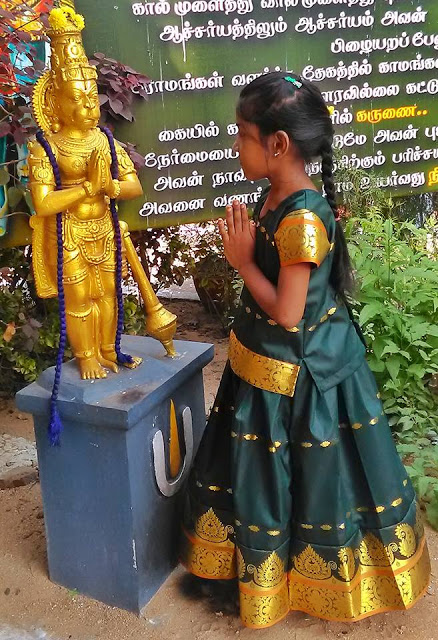
In Bapu’s time we also used prayers drawn from all religious traditions. That is all right when people of different religions and languages are meeting together, but all the same it is a kind of khichadi, a mixed grill. The main idea therein is not so much to please God as to please our fellows. Still, if we think that a human being is also a mani- festation of God, the practice cannot be called wrong.
Thinking this over I came to the conclusion that for community prayer silent prayer is the best form. It can satisfy all kinds of people, and deeper and deeper meaning may be found in it, as I can testify from my own experience.
During the early days of my bhoodan pilgrimage we included in the evening public prayer the Gita’s verses about ‘the man of steadfast wisdom’. But in Andhra I began to use silent prayer instead. This silent community prayer is of very great value. The idea has been with me for a long time that all should come together to pray in the quietness of mind; this thought is maturing slowly and as my experience increases, so does my confidence and courage.
****
 Tamil and Vedas