WRITTEN by London swaminathan
swami_48@yahoo.com
Date: 3 May 2019
British Summer Time uploaded in London – 18-52
Post No. 6340
Pictures shown here are taken from various sources including google, Wikipedia, Facebook friends and newspapers. This is a non- commercial blog. ((posted by swamiindology.blogspot.com AND tamilandvedas.com))


 Tamil and Vedas
R.Nanjappa (@Nanjundasarma)
/ May 4, 2019All the points touched on here are of great cultural significance for Indians, especially Hindus. They constitute the foundations of both refined thought and righteous conduct- which is the real meaning of the term ARYA.
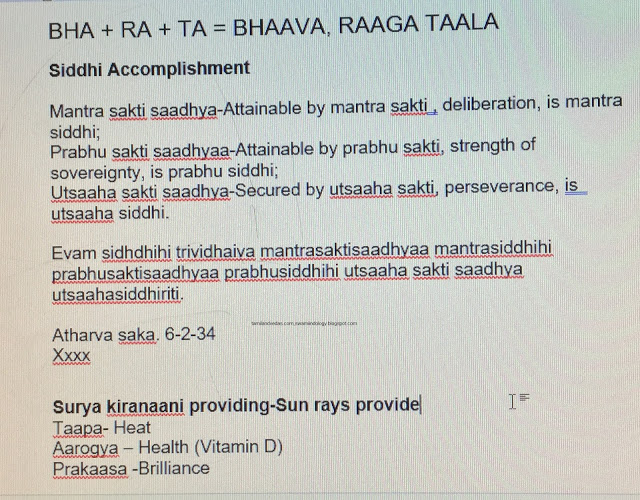
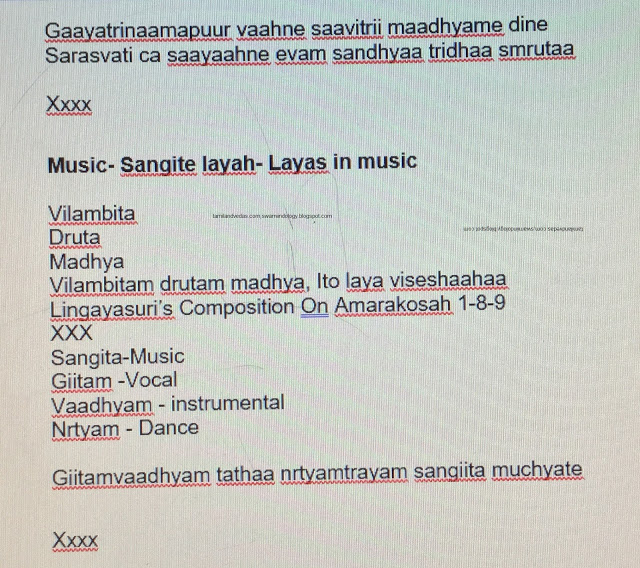
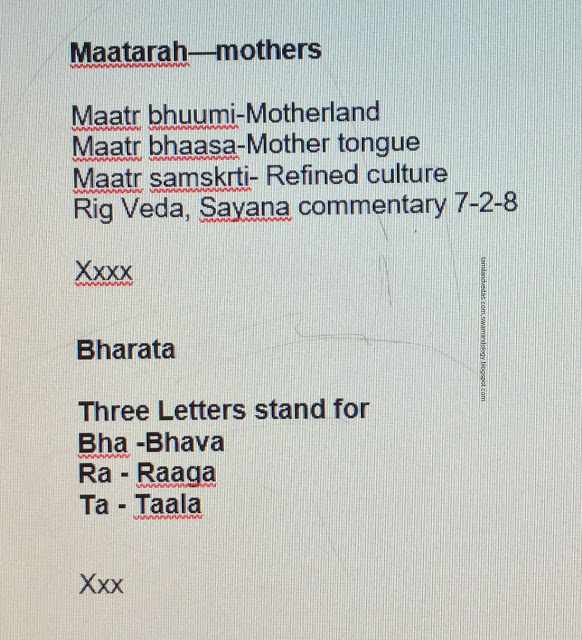
Bharata = Bhaava+Raaga+ Taala is very interesting.
This is the basis of our classical music and dance. It is said: Shruti Maata, Laya: Pita.Shruti and laya (rhythm) form the very foundation of music. Any sound that does not lie within these boundaries is mere noise.
Raaga is based on Swaras, which are only seven in the main. But each is capable of varied nuances in expression, so that their permutation and combination give rise to many Raagas.
How does Bhaava arise? Bhaava is mood or emotional expression. This arises from both Raaga and Sahitya or lyrics, so that we have Raaga bhava and Sahitya bhava.
Words contain “dhwani”. This dwani when properly expressed causes some emotion to spring that we experience (Rasa). For instance, we often use the same words in different contexts to mean different things. We say ‘ he is a donkey’, or ‘rascal’ , ‘idiot’ which may mean a really useless or bad person or in the case of our own children or dear friends, an expression of endearment.
Words contain dhwani- so even poetry is basically dhwani. This is enhanced by literary embellishments like alliteration, rhyme , meter etc. So that we are asked to read poetry aloud to derive real enjoyment. Sri Aurobindo spoke of Mantric poetry ie poetry containing the power of mantra, which are inspired utterances of Realised Sages, as in our Veda-Upanishads.
But the dhwani we speak of in music is of a different kind- more exalted than mere poetry, less exalted than mantric utterances.. When two swaras combine, what we get is not a merely mechanical third swara, but a magical output. Robert Browning expressed it well thus in Abt Vogler.
But here is the finger of God, a flash of the will that can,
Existent behind all laws, that made them and, lo, they are!
And I know not if, save in this, such gift be allowed to man,
That out of three sounds he frame, not a fourth sound, but a star.
Consider it well: each tone of our scale in itself is nought;
It is everywhere in the world—loud, soft, and all is said:
Give it to me to use! I mix it with two in my thought:
And, there! Ye have heard and seen: consider and bow the head!
The Raagas are a structured arrangement of swaras in designed ascending and descending order which produces an effect on our mind, heart and soul. This does not necessarily call for any technical knowledge or theoretical familiarity. Some Raagas naturally appeal to us, even to a child or certain animals like the cow or the elephant. Sahana, Kanada, Aarabhi, Kalyani, Karaharapriya, Mohanam, etc are some such Raagas which make an instant appeal. Raagas like Todi, Naattai, Gowlai, Purvikalyani, Panthuvarali take some effort on our part to appreciate.
A Raaga is a vehicle to convey a mood, a predominant mood or emotion But in effect, most Raagas are capable of expressing a range of emotions within a band- like a rainbow. We can appreciate a Raaga through voice or instrument. But in that case, the full range of emotions cannot be expressed or experienced. This is where Sahitya or lyrics come into play. Sri Tyagaraja Swami has given us many kirtans in the same Raaga. If we study them attentively, we would see that each expresses a different strand of emotion. Expert musicians bring out the different nuances even at the stage of Raaga delineation ( aalaapana).
It is the emotion that binds the listener and performing artiste. The result of the music should be to induce a state of peace or foretaste of bliss or Shanti ( rasa anubhava). No artiste can produce this state if he has himself not felt or experienced this. In the olden days, even great vidwans like Madurai Mani Iyer limited themselves to a few Raagas but what they sang still lingers in our mind after half a century. Nowadays, people sing in so many new raagas and so many new songs- they rush out of our mind even as we leave the hall or switch off the radio or music device. This is because the old stalwarts really lived their music- not just by it. Madurai Mani Iyer would not sing “Nidhi chala sukhama” in Kalyani. He said that he gave concerts for money, so how could he honestly feel the emotion of that song? If he could not feel himself, how could he convey it to others?. This is the greatest example of manodharma that we have seen. This shows the power of Sahitya over the artiste, no less than the audience.
Raagaas themselves have their innate emotion= raagaha bhaava, quite apart from Sahitya bhaava. This we see primarily in Hndustani music, and also in the music of Muthuswamy Dikshitar. Dikshitar has resorted to another device= Swara aksharam, using a letter for the same swara! This calls for great expertise in both raaga and sahitya.
In Carnatic music, it is usually said that Tyagaraja exemplifies Sahitya bhava, Dikshitar Raaga bhava, and Shyama Sastry Taala. This is only partly correct. There can be no classical music without adherence to Taala. We see most vidwans openly keeping taala. It is only a rare artiste like M.D.Ramanathan who had an innate laya sensitivity, so that it was said he resorted to Brahma taalam!
In old Tamil literature, we do have references to the music that prevailed in the ancient days. But in the absence of details of swara notations, and a living tradition we cannot make out what those old melodic patterns ( Pann) were. If Venkatamkhin codified the Raaga patterns based on the Swara, he did not illustrate them with details. It is in the Sahitya of Sri Tyagaraja and Dikshitar that we get practical examples of these Raagas. Muthu Thandavar, Arunachala Kavi and Marimutha Pillai also gave us kritis in Raagas, and not in Panns. Here too we see the combination of raaga and sahitya bhava.
In Carnatic music, the mridanga represents taala. But in most concerts, taala and sahitya run parallel. I have seen only Palghat Mani Iyer and Umayalpuram Sivaraman really making music out of Taala! In Kerala, there is a practice of taalam accompaniying even Taanam. There we see how taalam produces the effect of Swara! But In Hindustani concerts, we regularly observe the Tabla actually contributing to and creating the swara pattern.
Sadly, in our Carnatic music concerts, the sabha culture and concert pattern have killed both sahitya bhava and raaga bhaava. Behind this is the villainy of corporate sponsorship which dictates what shall parade in the name of music.
But the sheer power and brilliance of classical music cannot be under rated. Music- all music has the power to move us -physically and metaphorically. For some music we instinctively dance.Even Western music is based on the same swaras- as the character of Shankara Sastri in that Telugu film Shankarabharanam so simply explained.Only, the arrangement of notes is different. The beauty of Indian Classical music is that the same Raaga is capable of yielding multiple tunes. Thus Dikshitar created many tunes out of Shankarabharanam, when he was urged to make some music to match the music of the Western bands which were becoming popular in his day. In the fifties of the last century, our Hindi movie music directors created hundreds of tunes based on our classical raagas, which are still popular. The tunes may look attractively modern, ( because of the instrumental interludes,) but the basic Raaga is Indian. Who will believe that a popular song like “Mera jutha hai Japani” of a popular movie like Shri 420 is based on raaga Bhairavi (Hindustani)? Many other songs of that movie were based on this Raaga! But what different emotions/moods they convey or celebrate! That is the power of Bhava+Raaga+ Taala!
Truly has it been said that a person who cannot appreciate music is an animal sans horns and tail!
Tamil and Vedas
/ May 5, 2019Thanks. It is a treat for music lovers.