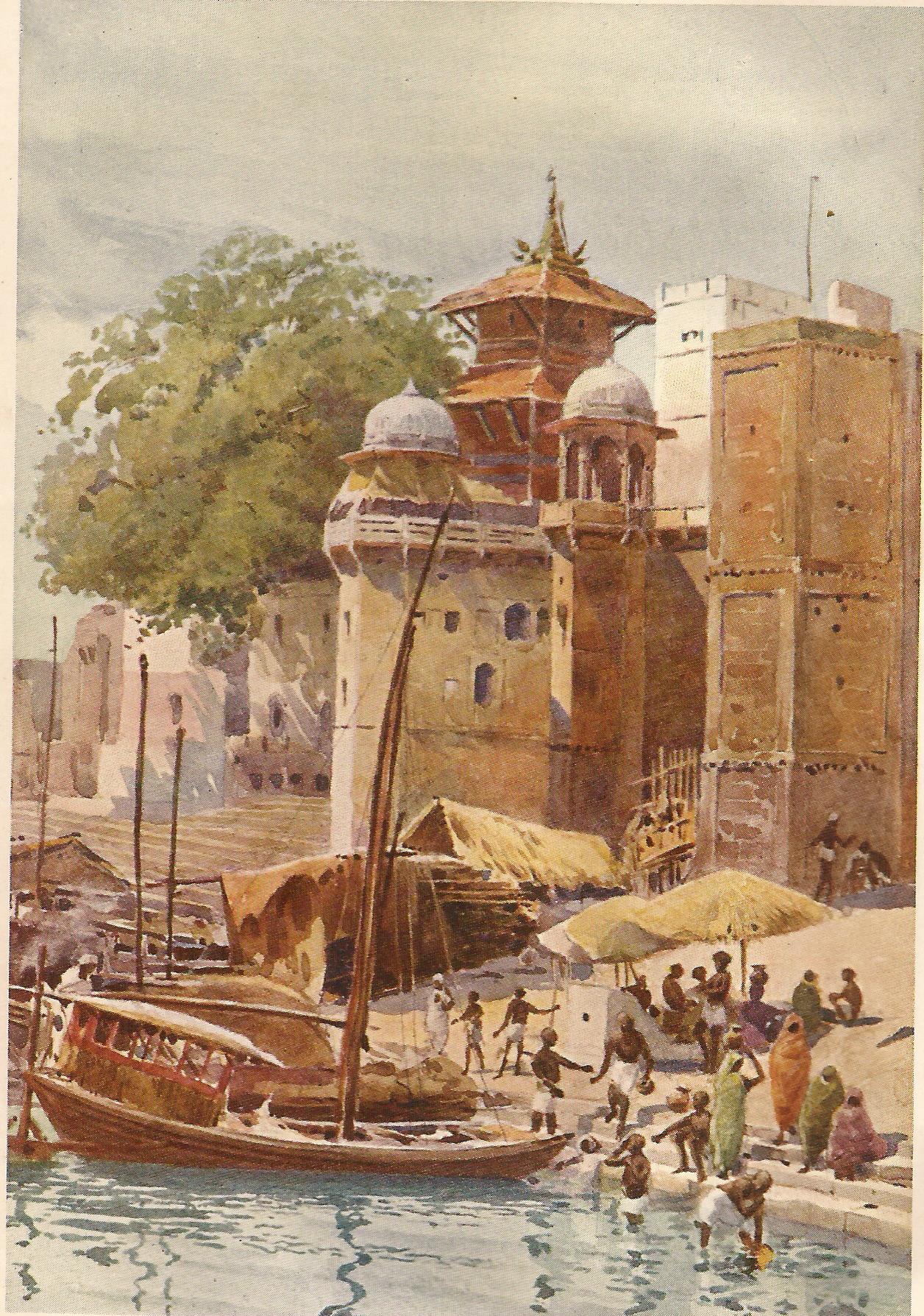
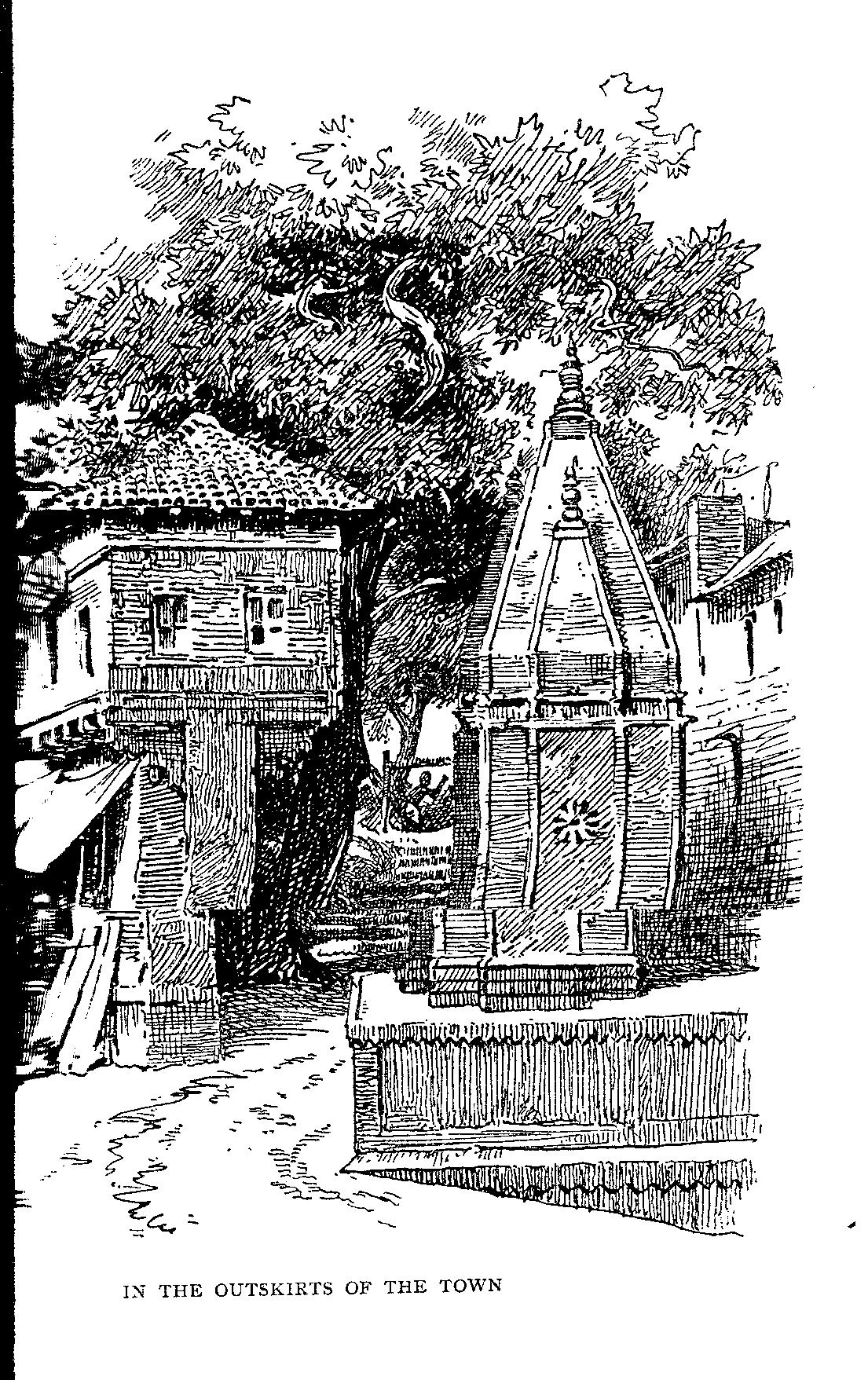
Benares Ghats, sketch by A H Murray
Compiled by london swaminathan
Date: 5 April, 2016
Post No. 2697
Time uploaded in London :– 18-42
( Thanks for the Pictures )
DON’T REBLOG IT AT LEAST FOR A WEEK! DON’T USE THE PICTURES; THEY ARE COPYRIGHTED BY SOMEONE.
(for old articles go to tamilandvedas.com OR swamiindology.blogspot.com)
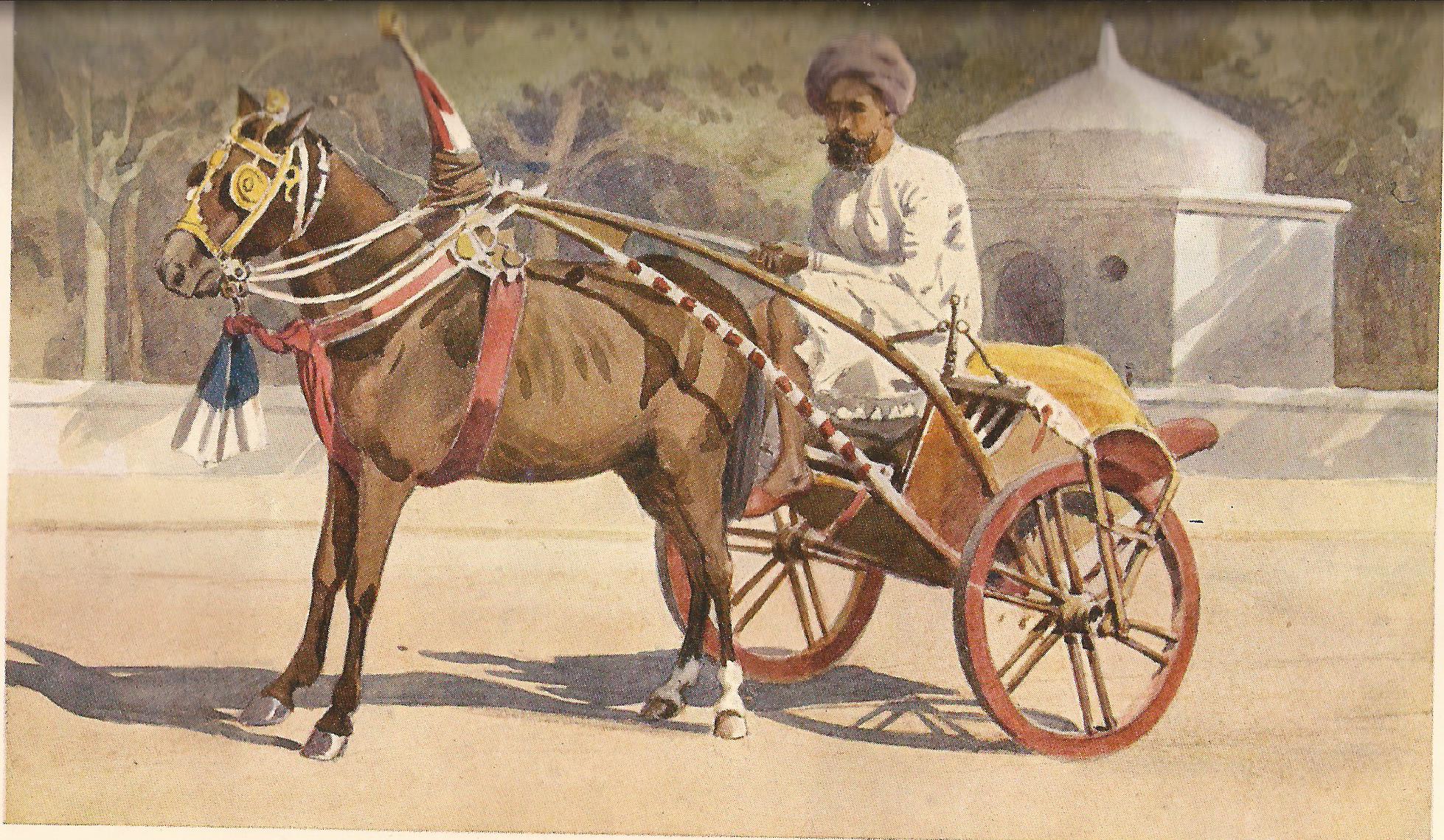
Benaress ekka; sketch by Murray
I gave the description of Benares from A H Hallam Murray’s book The High-Road of Empire (London, year 1905 yesterday. The book contains his water colour and pen and ink sketches in India.
Here I continue with his observation in Benares, the holiest of the holy cities in India:-
“Early on the morning of February 6, we started to drive to the Temple of Durga, sometimes called the ‘Monkey Temple’, at the far west extremity of the town. Durga, or Kali the terrible, is one form of Shiva’s wife, and worshipped over the greater part of the peninsula. The Thugs and Dacoits, now happily practically suppressed, were devotees of Kali, in her most terrible aspect. An unfortunate traveller, once marked down by them would be followed for days or even weeks, before the fitting occasion for the climax offered; but the Thug never lost his quarry, and the fatal noose ended the victim’s life at last.
No religious festival I so popular in Hindu homes, especially in Bengal, as the milder Durga Puja in October. A small plantain tree covered with straw and clay is painted with vermilion, n silk saree adorned with tinsel ornaments, and, being consecrated, is believed to be the habitation of the goddess. After a solemn procession to the river, it is brought to the house of the devotee who had it made, and is, for a month, venerated and worshipped, with fasts by day and feasting by night, finally, Mai Durga is said to be “going to the house of her father in law” – like Persephone:- the image is again carried on a bamboo stage to the river side, and amidst shouts and dancing is thrown into the stream. The ceremonies usually terminate with drunken bacchanalia and disgraceful scenes.
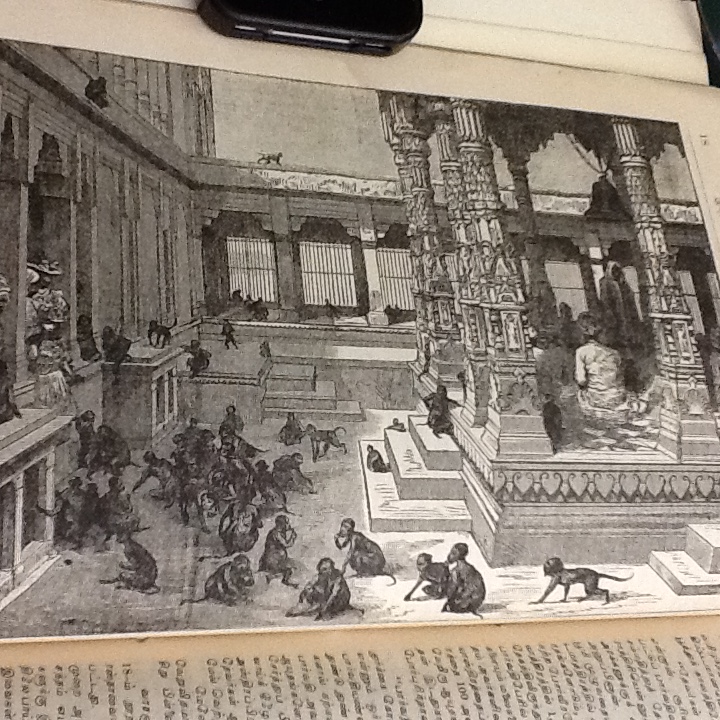
There is nothing particularly remarkable about this temple of Durga (in Benares), though its architecture is simple and graceful, and it has some fairly elaborate carving round the inner colonnade. It is painted red and stands beside a tank, overshadowed by some fine peepul trees, which, as usual in India, are held sacred.
There are groves of trees in India held so sacred that, though timber and firewood are in great request, no stick is ever cut, nor is even the dead wood picked up. The sacred character of this site probably dates back to a dim period, when these trees, or their predecessors, were venerated, in connection with the tree worship of the aboriginal tribes, as sheltering the spirits whose good will had to be secured, by sacrifices and oblations, to ensure good harvest. In these trees the tribe of sacred monkeys swarms and breeds, and chatters incessantly, descending at intervals to take their share of the offering.
In the temple are also number of monkeys, climbing and leaping about everywhere; and as many beggars and other creatures, worry you to look at this, or that, or press you to buy food to feed the monkeys. Though the monkeys have no respects for persons- the boldest of them actually jumped upon us – yet I greatly preferred the monkeys to their masters.
After a sketch at the Golden temple, we made our way to the Man Mandir Ghat, chose by Raja Jaisingh’s lofty seventeenth century observatory. Old travellers tell us that the Brahmans whose business it was to calculate the eclipses of sun and moon were trained in astronomy and astrology in Benares.. here we embarked in a barge with a house upon it, on the roof of which we sat, and were slowly rowed up the Ganges as far as Ashi Ghat, and down again to the Mosque.
The river bank is a marvellous sight. The Ghats, in flight after flight of irregular steps, descend the broken precipitous cliff a hundred feet to the water’s edge, amongst temples and shrines of all sorts and sizes. The cliff is crowned by high houses and palaces pierced with deep archways, which give access to the narrow streets of the town, and culminate in domes and minarets. The effect is enhanced by the sweep of the river, which bends in a crescent shape facing the rising sun.
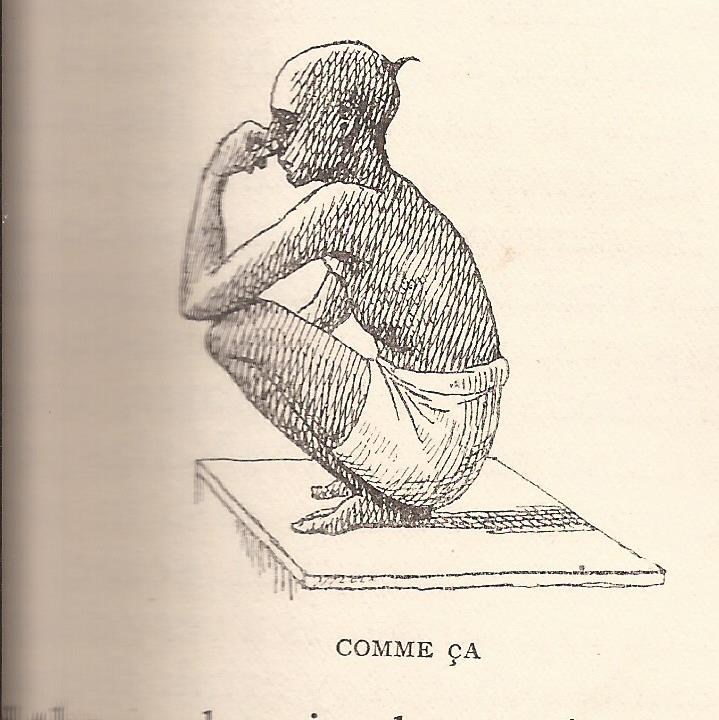
A stream of bathers and devotees, in the most brilliantly coloured garments, continually ascends and descends the steps; issuing from the dark arch ways and lanes above, they collect below on the brink of the water, under huge straw umbrellas; and behind tall screens, which protect them from the heat of the sun, they proceed by one operation to wash away their sins, to wash their bodies, and their simple and scanty clothing as well. They then grind themselves in clean attire; and afterwards return to one of the terraces to have their caste marks replaced upon their foreheads, by an official of the temple; he is provided with a number of little saucers filled with coloured powders for the purpose. This done, they sit on a plank over the water to meditate and bask in the sun shine. The pose is a squat, and the devout appear to hold their noses comme ca.
I was charmed by one scene in particular which we watched. Two graceful women in bright coloured silk saris came down the steps, each carrying on her arm a folded sari of a different hue. Leaving this on the brink, they stepped down as they were into the sacred water and drank and dipped. Coming back to the step in the wet garments, they wound them off, simultaneously, by the same mysterious movement, clothed themselves in the fresh silk drapery with which they had come provided. The process of transformation was as elusive and complete, as that by which a snow capped mountain is changed at the after-glow. The taking the strip of wet drapery, and deftly gathering it in narrow folds crosswise in either hand, they went back to their daily occupations.
The worshippers, standing waist-deep in the river, pour libations into the water, murmuring as they do so the words from the Vedas prescribed by the sacred ritual, and also cast in wreaths of jasmine flowers.
(After this he described the burning of the dead bodies on the banks)
Next day, Sunday, after church and lunch, I made a sketch of a Benares ekka – a very picturesque conveyance with double shafts on either side, drawn together on the top of the pony’s back and fastened to a saddle. The trappings of some of these ekkas are very bright and gay, and have some canopy like a bird cage on the top. This ‘machine’ holds, besides the driver, two persons, who sit sideways, and hang their legs over the wheels.
–Subham–



 Tamil and Vedas
You must be logged in to post a comment.