Research Article Written by London swaminathan
Date: 9 July 2016
Post No. 2956
Time uploaded in London :– 17-54
( Thanks for the Pictures)
DON’T REBLOG IT AT LEAST FOR A WEEK! DON’T USE THE PICTURES; THEY ARE COPYRIGHTED BY SOMEONE.
(for old articles go to tamilandvedas.com OR swamiindology.blogspot.com)
Part 5 was published here on 6th of July. First part contains a detailed introduction.
Source book: The People of India by Sir Herbert Risley, second edition 1915, London
Now I will give the description of H.Risley, a foreigner, with my comments side by side:
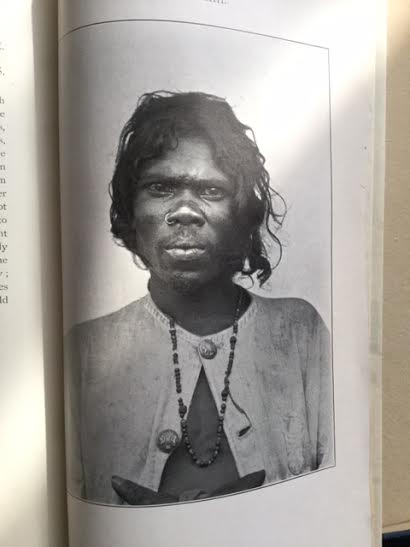
Sholaga from The Nilgri Hills, Pure Dravidian Type (Plate 33)
“The Sholagas are a jungle tribe inhabiting the British district of Coimbatore and the adjoining parts of the Mysore state. They live on millets paste and yams, supplemented by sundry jungle animals and birds, but they will not eat parroquets, which they say they are their children. Their main occupation is the collection of various jungle fruits, roots, bark and hony in the cavities of the rocks. They bury their dead, and after the funeral erect in the burial ground of the sept to which the dead man belonged a memorial stone to serve as an abode for the spirit. They are excellent trackers of game, and some of them have recently begun to do a little rude cultivation. Those of the better class have a simple form of marriage ceremony; but the poorer members merely elope with their brides to a distant jungle, and return home only after a child has been born”.
My comments: – Parrots are raised by Brahmin families who treat them as children. It is found in Mandanamishra’s house during Adi Shankara time and in Brahmin houses of Sangam Tamil period according to Sangam literatre (see Perumpaanaatruppadai). In both cases they say that the parrots repeated the Vedas said by the Brahmins. Here we see pure Dravidians treating parrots as children and never eat them! Though the hero stones (memorial stones) are seen in sangam literature it was laid only for heroes. Laying stones for the dead is seen in many cultures. Brahmins do it at the backyard or in the crematorium and Tibetan Buddists do it which is seen on the banks of Manasarovar in the Himalayas. So in the above we don’t see anything Pure Dravidian. Burial and cremation were found in Vedas and the Tamil Sangam literature. Their belief in the spirit of the dead is purley a Hindu belief.
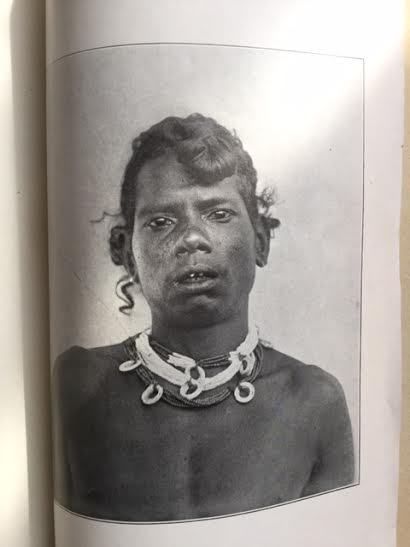
A Kadir from the Anaimalai Hills, Madras Pure Dravidian Type (Plate 34)
“The Kadirs are a jungle tribe found in the Anaimalai Hills of Madras and other ranges extending southwards into the State of Travancore. They are of short stature with dark skin and borad nose they are a happy people, living on the produce of the forests where they reside. They are nomad in habit, building neat huts at places which they temporarily occupy; good trackers and experts in the pursuit of game; wonderfully clever in climbing high trees, their method of ascent, closely resembling that of the Dayaks of Borneo. They have a horror of cattle, and will not touch the products of cow. Their reticence in regard to the disposal of the dead has given rise to a legend that they eat the corpse.
The remarkable custom of chipping the teeth curiously resembles that of Jakuns of the Malay Peninsula. The Kadirs chip all the or some of the upper and lower incisors into the form of a sharp-pointed, but not serrated, cone. This is done by means of a chisel, bill-hook and file. Both sexes undergo the operation; it is said that it makes an ugly man or woman handsome, and that a person who has not been improved in this way has teeth and eats like a cow”.
My comments: The writer himself compares the Kadirs with people living in Borneo and Malaya. Their belief about cow and handsomeness are strange; Within a small area of Nilgris we have seen different tribes with diametrically opposite beliefs. There is no relationship between them except the skin colour and broad nose. How can we justify they all belonged to Dravidian Race? All these artificial divisions created by the white skinned foreigners to justify their occupation of India. All these prove what I have said in the introduction.

Dom Basket makers from Bihar (Mixed Dravidian Type)- Plate 35
“The doms are semi nomadic tribe found in Bihar and the adjoining districts of the United Provinces of Agra and Oudh. One group of them, known as Maghaiya, are habitual thieves and burglars. Other sections are more or less settled, and live mainly by making mats and baskets out of the slips of bamboo. Their social statues is very low, because they eat beef, pork, horse flesh, filed rats and even the flesh of animals which have died a natural death – all abominations to orthodox Hindus. They act as executioners, and at holy places lord it at the burning ground, because they alone can supply fire to light the funeral pyre, and they must be heavily bribed before they will permit the corpse to be cremated.
My comments: Here the Dravidians are described as habitual thieves. The fact of the matter is we see robbers who kill the travellers and rob them, in Tamil Sangam and Sanskrit literature. There is no question of Dravidian or Aryan here. A section of the jungle dwellers led their life like robbers. We such people around the world. Nandanar was not allowed to enter the holy town of Chidambaram in Tamil Nadu because he also belonged to the caste of beef eaters. At last he became a pure man and entered the town and made a saint by the Tamils. Circumstances and living conditions only made them robbers no Dravidianis is in it. Kallars of Tamil Nadu were also were like that. But their belief in God was beyond comparison. Kannappan who was born in a family of hunters became a saint in Tamil Nadu 1500 years ago. We see a pure soul in the character of Dharmavyadha, the butcher in Mahabharata.
As I said in my introduction, there was no racial division in India. From time immemorial we see city civilization and tribal culture existing at the same time, leading their lives without any clash. But white skinned foreigners concocted the story of one race driving the other into forests. It is proved a blatant lie by the thousands of differences among the hundreds of tribes.
to be continued…………………..
 Tamil and Vedas
You must be logged in to post a comment.