Please click below to see my latest article Rain Miracles in Tamil –
Posted by Tamil and Vedas on January 7, 2012
https://tamilandvedas.com/2012/01/07/rain-miracles-tamil-article/

Donkey wedding, Karnataka, 2010

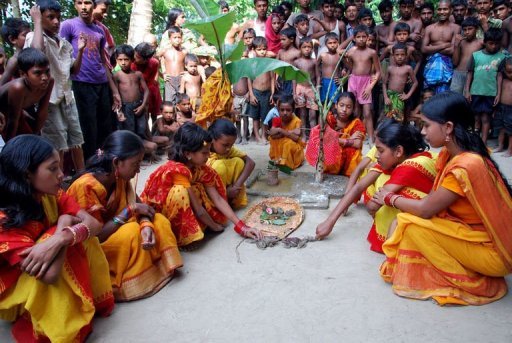
Frog Wedding, West Bengal, 2009
Hindus, knowing the importance of rain, have been singing about it from the Vedic days “When the rains fail, the strong victimise the weak, for the waters, they are the law”, says the Satapata Brahmana. The great Tamil poet Tiruvalluvar compared rains to Amrita/ambrosia. He continues “if rains fail charities and devotional practices will not be observed. Festivals and daily worship of the gods will cease”. “For nine months, the sky drank the ocean’s water, sucking it up through the sun’s rays, and now gives birth to a liquid offspring, the elixir of life” (Valmiki Ramayana 4-27-3).
Rain by Havan, Rain by Women, Rain by Music, Rain by Rishis, Rain by King, Rain by Venus, Rain by Donkey and Frog weddings; Read about the strange Hindu practises.
“If there is one righteous person is on earth, rain will fall for that person’s sake” says another Tamil poem.
Rains are crucial in India, as the majority of the country’s population of over a billion depend on agriculture. When it doesn’t rain for a long time, Hindus perform strange things to bring back the rains.
1. Rain by Havan (Fire ceremony):
Hindus believed that the fire ceremony will make the heavens open. So they organised special types of yagnas/havans glorifying Varuna, the god of water sources. When there is a scarcity of rain priests stand in water and recite certain mantras praying to Varuna. It is called Varuna Japam. Twigs from certain trees are used with butter for this purpose. Hindus used mango or peepal twigs for the yagnas, along with butter.
2. Rain by Chaste Women:
Another strange belief is that chaste women can control and command nature. Tamil poet Tiruvaluvar said, ”A virtuous woman who knows no other god but her husband may command the very clouds to pour forth rain and they will do so”. (Ref. Tirukkural 55) We should not take it literally. If women are chaste, god will be pleased to send the rains to that place. Discipline in society was valued more than anything else.

3. Rain by Music
Hindus believed that particular a raaga (key) called Malhar will bring rains. There is a very interesting anecdote about one of the three great composers of Carnatic music Sri Muthuswami Dikshitar (1775-1835). Dikshitar, Thyagaraja and Shyama Sastry are regarded as the Trinity of Carnatic Music. Dikshitar was famous for his Sanskrit compositions. Once he travelled to a place called Ettayapuram in Tamil Nadu. Drought had caused havoc in the region. He invoked the Goddess Ambika by composing a song in the raga Amritavarshini. Immediately after he sang it there was a downpour bringing relief to the people of the region.
4. Rain by Rishis: Deer Horn Saint/Rishyasringa:
Rishyasringa was the son of Vibandaka and celestial nymph Urvasi. When the region of Angadesa was affected by a serious drought King Romapada was advised to invite Rishyasringa to bring rain to his kingdom. The king and his ministry worked out a curious plan. They sent beautiful girls to dance in front of him when his father was away. Rishyasringa who hadn’t seen a woman ever before became transfixed by them and followed them to Angadesa. The rain followed. This is not only a story of rain but also a story of human psychology. Sex is a natural instinct and nothing unusual about it. Ancient Hindus believed that there will be three rains every month if truth prevails in all aspects of life.
5. Rain by King’s Just Rule:
Tamil and Sanskrit literature say that the rains will fail a country where an unjust king rules. If the king is good, there will be plenty of rain and natural forces will abide by the king. Kalidasa and Sangam Tamil literature say that a deer and a tiger will drink water from the same source, forgetting their natural enmity in a place where there is rule of law. If the rains failed, people blamed the king.
6. Rain by Planet Venus:
Planet Venus, known as Shukra in Sanskrit (Velli in Tamil) is associated with rain. Its position in the heavens cancels the negative effects of other planets with regard to rain. So they keenly watched the position of Venus to forecast rain. The Mayans and other Mesoamerican cultures also gave much importance to Venus and linked it with the rains and the production of corn. Tamil Sangam literature has several references to Venus and rain. Venus appears in the morning for some time and evening for some time of the year. Tamils believed that Venus portends the prospect of rain for the year. (ref. Pathitrup. 24). In Purananuru, another anthology of 400 Tamil verses, all the verses about Venus are arranged together: 383, 384, 385, 386, 387, 388, 389 and 390. This arrangement of all Venus verses together shows us that they cared deeply about the position of Venus 2000 years ago. All the poets linked Venus with either rain or drought.
Tamil book Pattinappalai (lines 1 and 2) says that there will be drought when Venus moves southward. This is confirmed by three more poets (puram 117, 338, Pathitru.24)
7. Rain by Donkey Wedding and Frog Wedding
The village folk believe that a wedding of donkeys or frogs make the sky god happy enough to send rain. In recent years farmers of Patalur of Karnataka married off two donkeys. The donkeys entered wedlock in the presence of a priest. Like human beings the donkey bride and bridegroom were taken in a procession with colourful new wedding dress. The entire village wore a festive look on the wedding day of the VIPs! City people did not lag behind in such rituals. The people of Bangalore, the Silicon Valley of India, also performed a donkey wedding. Two donkeys, Ganga and Varuna, tied the knot in front of 100 guests. The donkeys wagged their tails happily.
Villagers in West Bengal caught and named two frogs Rama and Sita and performed their marriage. The frogs’ heads were smeared with Kunkum and 3000 people were fed in Madhya Baragari village. The frogs went in to the river for their honey moon! The marriage of frogs for rain is a local custom followed in Assam and Bangladesh as well.
8. Proverbs about Rain:
Apart from all of these beliefs there are lot of proverbs about rain. One of them is that if ants carry their eggs and go to raised areas rain will follow. If cuckoos sing and peacocks dance then there will be rain. Peacocks spread their feathers like fans when they see dark clouds. Hindus are keen observers of nature and used their knowledge for farming. If Venus is not visible (asthamana), there won’t be rain. When Venus is in Aquarius there will be plenty of rain and flooding. Venus’ northward journey will bring the rain according to Hindu astrology.
9. Cloud seeding
Scientists use Cloud Seeding to make rain. They place dry ice (frozen carbon dioxide, silver iodide or liquid propane in the clouds to make it precipitate. Havan and Yagnas (Hindu Fire Ceremonies) come very close to this planting of frozen carbon dioxide in the clouds. More research is required to prove it.
**************************
Posted by Tamil and Vedas on January 7, 2012
https://tamilandvedas.com/2012/01/07/rain-miracles-rain-by-fire-and-music/
By S Swaminathan

Solar Eclipse
The earliest reference to a solar eclipse occurs in the Rig Veda. Atri Maharishi speaks of the wonders of the solar eclipse (RV5-40-5). Like today’s newspaper reports, he also tells us how confused animals and birds become when the sun suddenly disappears. He must have watched a total solar eclipse. This eclipse happened in 3,928 BC according to some scholars. Later the Brahmanas give more details about the same eclipse. Panchavimsa Brahmana speaks of four different stages of an eclipse. It describes beautifully the changing colours during the eclipse. The Vedic hymns also imply that Atri maharishi knew the secret of eclipses.
In the Mahabharata there are 8 references to solar eclipses and Dr S Balakrishna of NASA did a thorough study of them with advanced computer software. When he went through the eclipse pairs i.e two eclipses happening in a 13 day interval, which the Mahabharata refers to, he matched one eclipse that happened in 2,559 BC.
References to lunar eclipses and solar eclipses are plentiful in our literature. Tamil Sangam book Purananuru also described a solar eclipse. The commentator explained how the demons tried to outsmart the devas in the episode of churning of the Ocean of Milk to get Amrita. The word used for Vishnu in this verse (Anjana Vannan) is used for Krishna as well in Tamil. So we can interpret this is a reference to the fourteenth day war in the Mahabharata.
What happened on the 13th day? Jayadratha, the king of Sindhu Desa (Indus Valley King) killed Abimanyu, son of Arjuna on the 13th day of the war. Arjuna was furious and vowed to kill Jayadratha before the sunset next day. The whole Kaurava army gave Jayadratha full protection. When the sun appeared to set, Jayadratha poked his head out to show that he was victorious. Suddenly the sun reappeared in the sky and Arjuna shot Jayadratha down. The story goes that Krishna hid the sun with his Sudarsana chakra. Actually Krishna tricked Jayadratha with the knowledge of the solar eclipse happening on that day. Arjuna’s brothers Nakulan and Sahadevan were experts in such calculations.
People were told for a long time that the war started on a new moon (Amavasya) day. Latest research by scholars with computer software shows that it started on a full moon day. Ancient people preferred full moon day for any big festivals or events. Almost all famous Hindu festivals fall on full moon day. It helps people to move around safely and easily in the evening. Mahabharata war, a Dharma Yudhdha, was fought according to strict rules. They stopped all fighting at sunset. Later both sides of the war visited their relatives on either side and helped to dress wounds like the modern day Red Cross. Dr B N Narhari Achar, Department of Physics, Memphis University, USA also supported the theory of war starting on a full moon day.
Now if we look at the Purananuru verse 174 sung by Marokkaththu Nappasalaiyaar and the commentary, it matches well with the 14th day of war where Anjana Vannan alias Krishna played a major role with his Sudarsana Chakra – the solar eclipse. Ancients Tamils had full knowledge of the epics. In fact they have given three or four episodes in their 2000 year old books which were not even found in the Valmiki Ramayana or Vyasa Mahabharata.
Follow me on Twitter: @Swami_48
Posted by Tamil and Vedas on January 3, 2012
https://tamilandvedas.com/2012/01/03/238/
By S Swaminathan
 |
| Sibi in Borobudur (Indonesia) |
Tulabharam is a Hindu ritual that has been practised from Dwapara Yuga. Tulabharam means a person weighing himself or herself in a balance and pay in equal weight of gold, fruits or grains to God when one’s prayers are fulfilled. Temples in Tirupati, Guruvayur, Dwaraka, Udupi and several other towns practice such offerings. Recently, Guruvayur temple hit the headlines in newspapers when a businessman from Bangalore gave the temple his weight in gold – 70 kg. Tirupati temple hits the headlines now and then when famous politicians and film stars give something to god measure for measure. This is offered to the gods when their prayers are answered.
The earliest reference to a Tulabharam comes from the Mahabharata, about the great emperor Sibi. He was so famous his name is found in ancient Tamil Sangam literature in four places and later in hundreds of places. He was even praised in Buddhist Jataka stories and Borobudur (Indonesia) sculptures. Emperor Sibi was a just king. Lord Indra and Agni wanted to test him and came in the form of an eagle and a dove. When the dove came to Sibi for protection from the chasing eagle, Sibi was ready to offer anything to save the dove. The eagle asked him to give his flesh measure for measure. Sibi cut himself bit by bit but the pans in the balance were never equal. At last when he himself stood on the pan the Gods appeared in front of him and blessed him. The story is found in other Sanskrit works as well.
The Tamil king who refused to take gold
The worst thing we read in Sangam Tamil literature is the execution of a little girl just because she took a mango fruit from the king’s garden. Tamil poets were so angry that not only they refused to sing about him but also ridiculed him in the Cankam poems. The story is as follows: Nannan was a king who ruled part of Kerala called Poozi Nadu. A mango fell from one of the trees in his garden and it was washed away in the water of a canal. Any little girl or boy who sees a fruit will naturally go for it. So did a little girl in his town. The servants reported this ‘theft’. Immediately Nannan ordered to kill the girl for theft. The whole town rose against him. The girl’s father with the support of the VIP’s of the town met the king and begged to release his daughter. He even came forward to give Nannan 81 elephants as a penalty. Nannan did not budge.
Then her father told him that that he WOULD GIVE GOLD MEASURE FOR MEASURE. But evil Nannan executed the girl refusing to accept the gold. One of the great poets of Tamil Cankam (Tamil Academy) Paranar gave this story in Kurunthokai poem 292. Perunthalai Sathanar who sang a poem long after this incident refused to sing about another king Ilam Vichiko (puram 151) just because he was born in Nannan’s clan. Till this day Nannan was ridiculed as a ‘Murderer of a little girl’. This story shows the practice of Tulabharam in ancient Tamil Nadu. Look at the words – MEASURE FOR MEASURE in gold.
Tulabharam in Silappadikaram
Indian kings used to give sixteen kinds of gifts to Brahmins and poets. The Vijayanagara empire period inscriptions mention Tulabharam as one of them. We have a literary reference to such a practice in the famous Tamil epic Silappadikaram. Cheran Chenguttuvan who went to the holy Himalayas to get a stone for the chaste woman Kannaki washed it in the holy river Ganges and consecrated the statue at a place in modern Kerala. At that time he gifted his body weight of gold to a Brahmin called Matalan. The epic says the king weighed 50 Tulams (not Tola which is only 12 grams).
Periapuranam: Amarneethi Nayanar
Peria Puranam gives the life story of 63 Saivite saints called Nayanmars. Amarneethi Nayanar of Pazaiyarai was one of them. He was running an inn at Thirunalloor. One day a bachelor came to the town and asked Amarneethi to take care of his loin cloth until he comes back from bathing in a nearby river. When he came back the loin cloth was not found at the place he left it. After a frantic search Amarneethi started panicking and offered anything in compensation. The bachelor, who was God himself in disguise, asked him to give some cloth equal in weight to what he was keeping as a spare. When Amarneethi put one loin cloth after loin cloth on the pan, it did not rise even a single inch. Getting ready to sacrifice himself he stood on it. Even then, the scale did not move. When all his family members came and stood on the pan of the balance the pans were equal. God blessed all of them after this Tulabharam.
Krishna Tulabharam
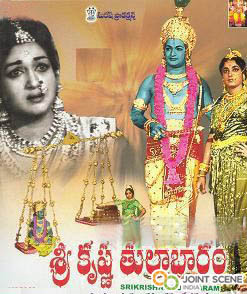 |
| Telegu film of Krishna Tulabharam |
The most famous Tulabharam story comes from the life of Lord Krishna. Tamil and Telugu films were made using this story long back. Krishna had several wives including Rukmini, Sathyabhama and Jhambavati.
There was a rivalry between the posh, proud, jealous and fashionable Sathyabhama and simple and innocent Rukmini. The heavenly sage Narada wanted to teach Sathyabhama a lesson. When he met her he mooted a plan to attract Krishna towards her. Sathyabhama fell prey to his clever and cunning plan. The plan was to sell Krishna as a slave to Narada and buy him back with gold. Whoever pays more would win Krishna. Sathyabhama was so confident that she would win hands down because Rukmini was not as rich as her. Innocent Rukmini had to accept this when Krishna himself agreed to be sold. When the scene was set, Sathyabhama brought all her gold and diamond jewellery to buy back Krishna. It could not match Krishna’s weight. Seeing Sathyabhama struggling, the mischievous Narada himself suggested that she borrowed some gold from Rukmini. Pure hearted Rukmini knew that nothing was greater than the Tulsi (Holy Basil) leaves and she put some Tulsi leaves onto the pan after removing all of the jewellery. The problem was thus solved. This story also showed the importance of Tulsi in Hindu worship. Tulsi is one of the most powerful medicinal herbs.
Sumerian Tulabharam
Sumerian culture has a lot of similarities with Indian culture. No one can dismiss them as sheer coincidences. (Please read my article DOUBLE HEADED EAGLE: INDIAN SUMERIAN CONNECTION). Clay tablets from the 13th century BC unearthed at Ugarit give some interesting information about a king. His name is given only in consonants KRT (perhaps Kirta or Kurita rather than Keret). The king lost his brothers and seven wives but had no heir. Praying for a son, he was advised in a dream by their chief god El to sacrifice to Baal then march with his army to Udumu to ask for it’s king’s daughter Hurriya as his wife. On the way he VOWED TO GIVE TWICE HER WEIGHT IN SILVER AND THRICE HER WEIGHT IN GOLD TO THE GODDESS ATHIRAT (AHSERATH) of Tyre, if he were successful. When he got her, he did not fulfil his vow to the god Athirat. The god struck him with an illness. This story of Keret was published in the Dictionary of the Ancient Near East. The story continued with what his wife did later etc. We can even see some similarities in the names with Hindu mythological names Kratu (KRT), Surya (Hurriya), Kreeta and many more. But we could clearly see the practice of Tulabharam to gods and goddesses, offering in silver and gold.
*******************
Posted by Tamil and Vedas on January 2, 2012
https://tamilandvedas.com/2012/01/02/230/
 Tamil and Vedas
You must be logged in to post a comment.