How to identify Hindu Gods and Goddesses?

Research Article: written by London swaminathan

Post No.2217

Date: 5   October 2015

Time uploaded in London: 19-27

Don’t use pictures. Don’t reblog for at least a week.


One hundred years ago, even the illiterates in India were able to identify scores of herbs, trees, flowers, stars in the sky and all Hindu Gods and Goddesses. Though they were not able to sign their names, they had all the practical knowledge.

There is an interesting anecdote in Tamil literature. Two thousand years ago two villagers, husband and wife, visited a temple near Madurai in South India. There the wife was wonderstruck with a painting on the temple wall where a cat is slipping out of an Ashram (hermit’s cottage). When she asked her husband, what it was her husband says “don’t you know the story of Indra and Ahalya? This is Indra in the form of a cat sneaking out of the Ashram after molesting Ahalya”. This scene is described in Sangam Tamil literature (Paripatal) This anecdote shows that even the villagers were able to identify the figures on a wall painting (mural). And such paintings were so common in the temples in those days.
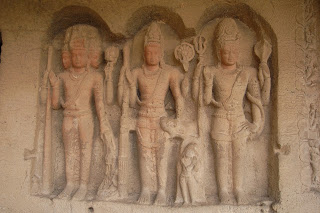
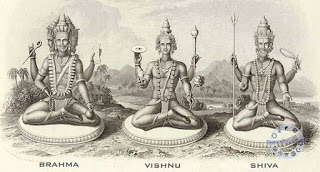
Trimurti in Ellora

Now even the scholars who are well versed in the scriptures have no practical knowledge. Their knowledge is more bookish than of field study. Moreover countries like Thailand and Cambodia have distorted the figures of Hindu Gods and Goddesses. A Hindu from India would find it difficult to recognise Indra or Shiva in South East Asian countries. Only figures like Vishnu or whoever rides on a Vahana (Mount of God) will be easily recognised; so I have compiled a list of Gods and Goddesses with their symbols.

The sculptors or goldsmiths who made the statues and idols of gods and goddesses used the Sanskrit slokas (couplets) with description for the figures.

Most of the confusion arises when Buddhist and Jain gods and goddesses are shown in any book or museum along with the Hindu Gods. They took lot of things from Hindu iconography and changed them according to their whims and fancies. Particularly confusing are the Tibetan Buddhist figures. But recognising Buddha in his meditative posture and Tirthankaras as straight standing figures with a Srivatsa on their chests won’t be difficult.

Easiest way is to recognise a vahana first and then identify its rider. But recognising the statues without vahanas is very difficult. Following list of identification will be very useful:

Brahma stamp by France

Brahma

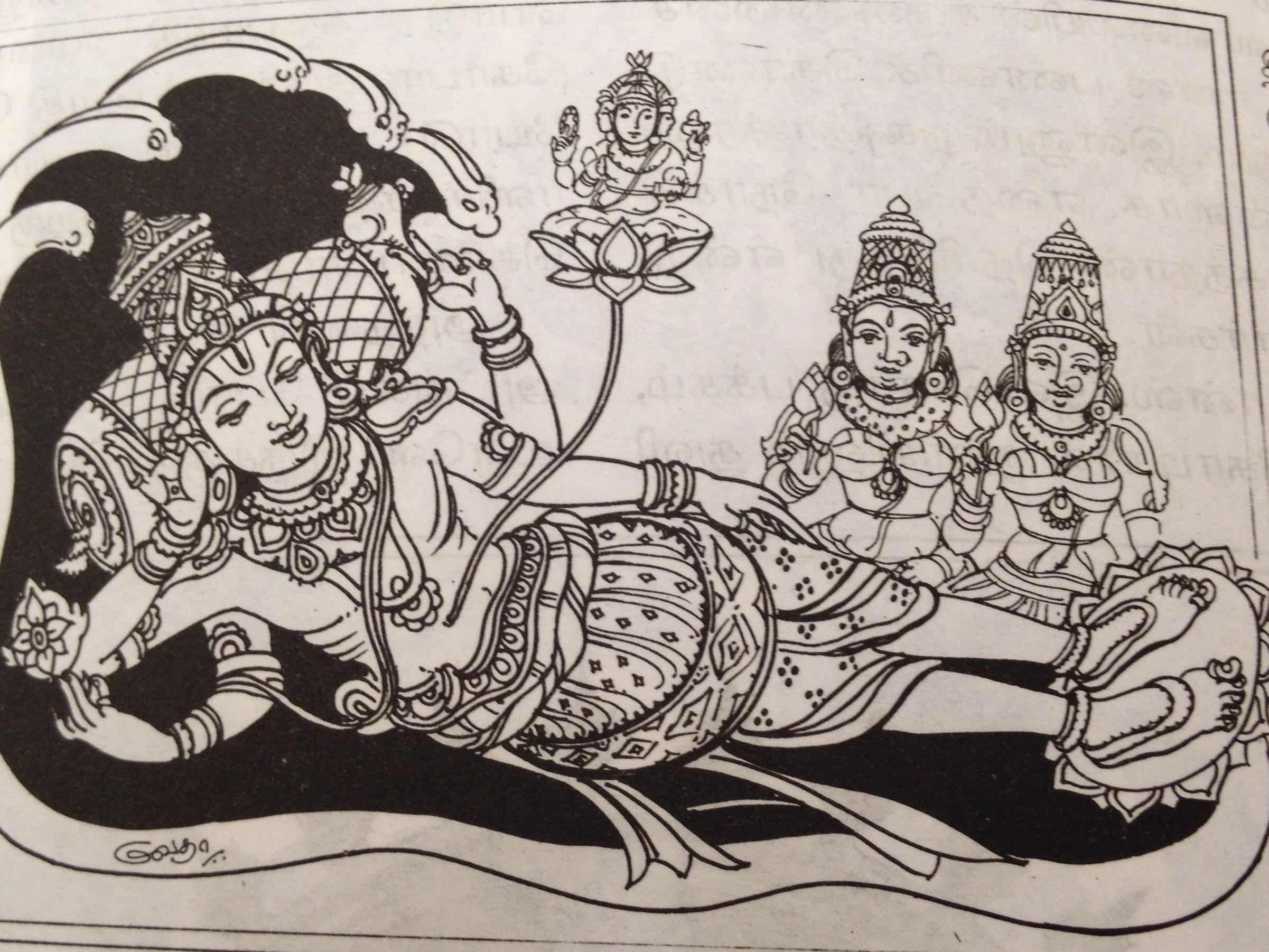
Four heads (one head is not shown), Four hands, rosary in one hand and Vedas on another hand; swan or goose nearby (if it is a figure with Vishnu he is shown as if coming out of Vishnu’s belly button, seated on a lotus); sometimes Brahma is shown with beard.

Vishnu

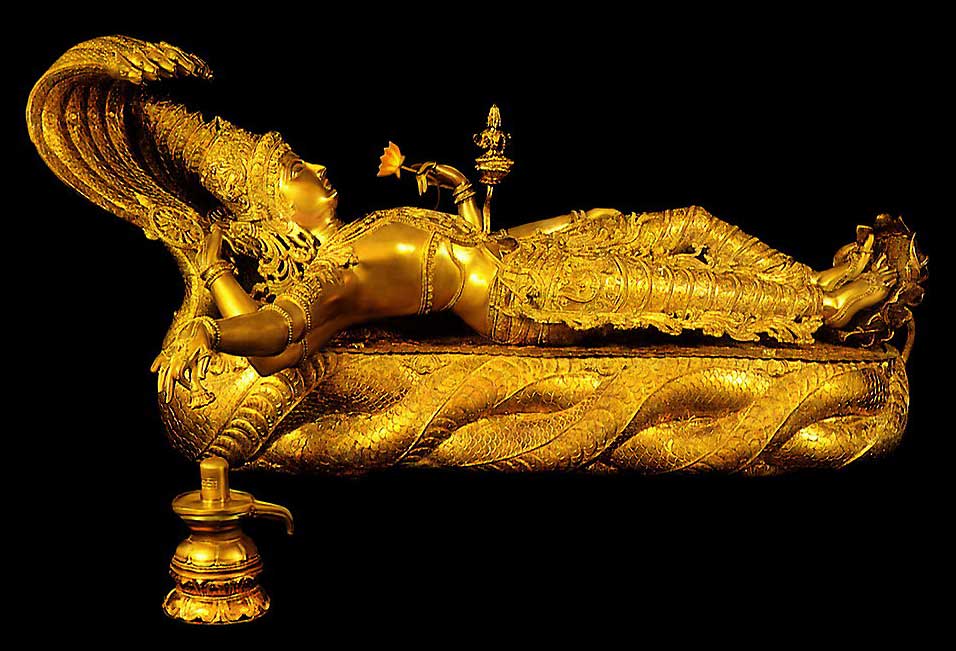
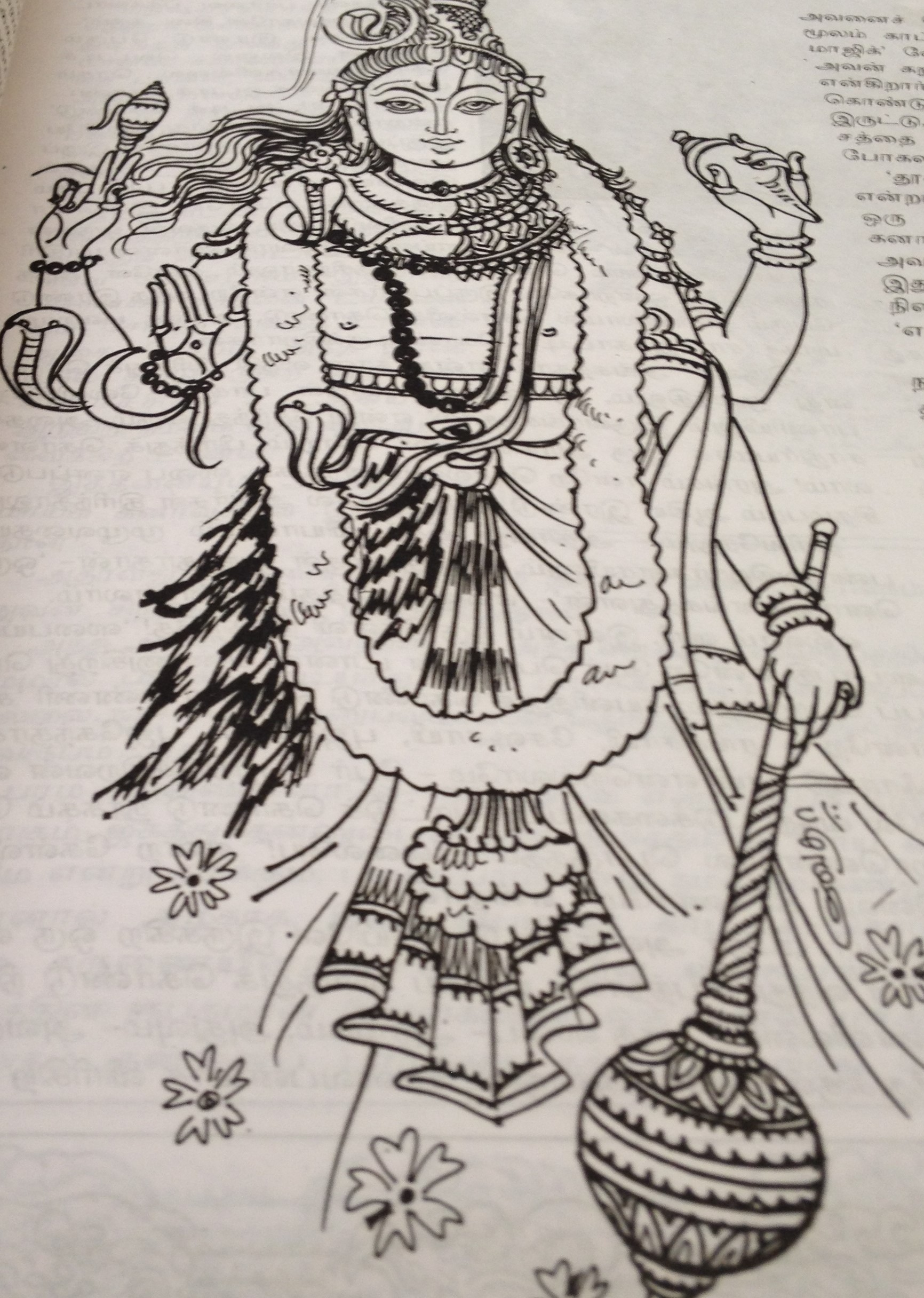
Four hands, Wheel and Conch (Shankgu and Chakra) on both hands and Garuda (Eagle or Kite) as the Vahana; mace or Gatha is also seen in some pictures.

Vishnu’s another pose is Seshasai: Here he is shown lying on his snake bed. The multi-headed snake is called Adisesha.
Vishnu_1

Shiva

Trident in hand, matted lock with crescent on the hair; sometimes the third eye on the forehead is shown; riding on a bull (Rishaba); battle axe, Damarukam/drum,  and deer are in other hands. Snake is shown around his neck.

Nataraja

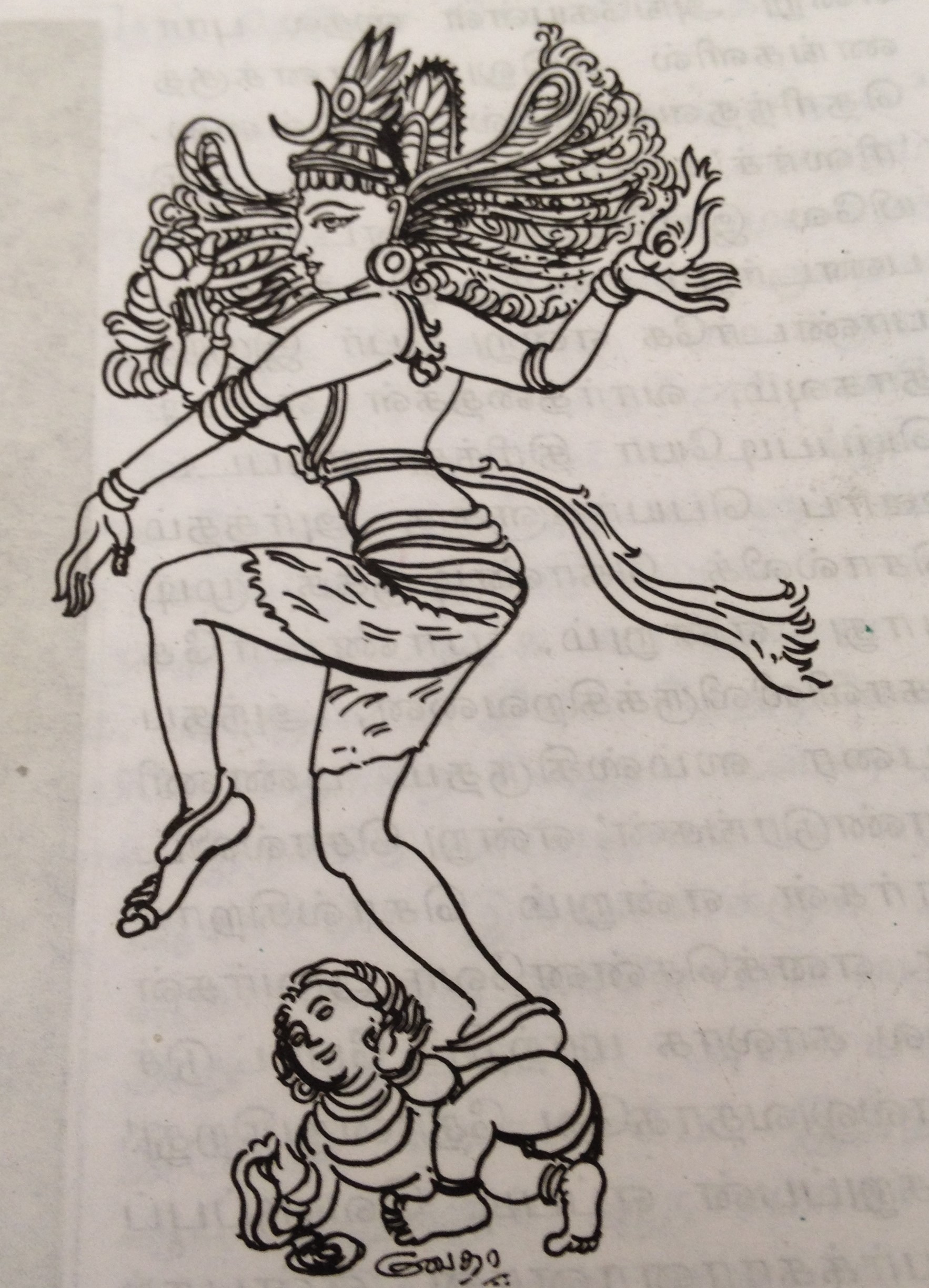
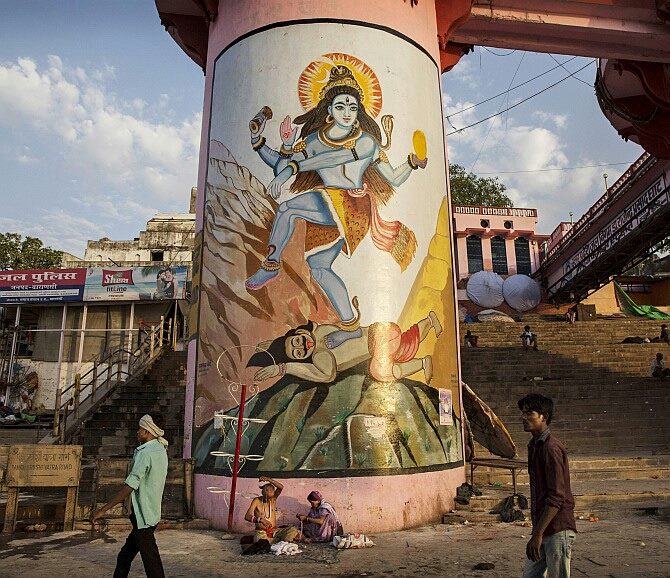
Dancing Shiva can easily be identified with one leg up and a demon under his feet. The Universal dancer holds a drum in one of his hands and Fire/agni in another hand.

Veerabhadra

Siva’s another form is Veerabhadra; he is also shown with trident.
ganesh lanka

Ganesh

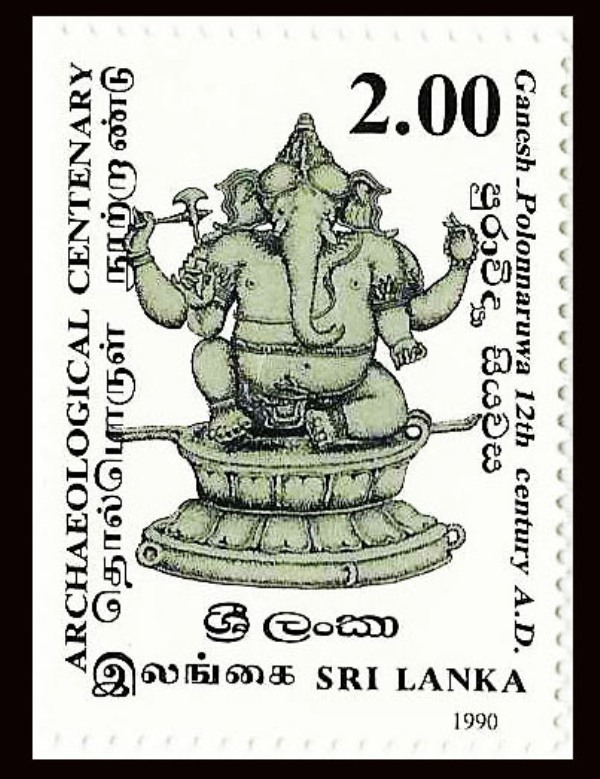
Easiest Hindu god to recognise is Ganesh because of his elephant head. Sometimes the rat or mouse is shown as vahana on a very small scale

Hanuman

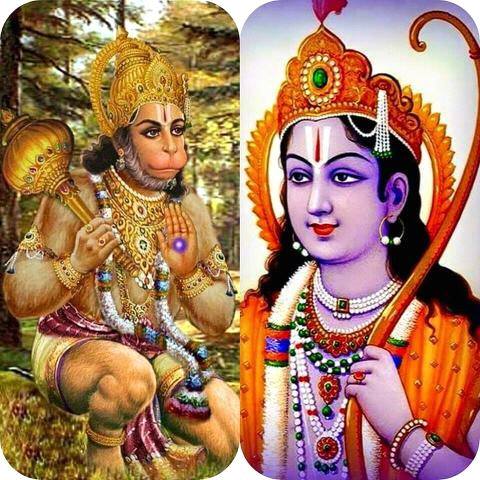
Monkey faced god from Ramayana can also be easily recognised like Ganesh.

Rama

Rama is always shown with his bow; and mostly with Sita and Lakshmana on either side.
hanuman raman

Dasavatara

Hindus know the stories behind Ten Incarnations of Lord Vishnu known as Dasavatara in Sanskrit; they can be easily identified by close observation of the following points:

Matsya (Fish) Avatara: Half the body is shown as Fish (In western countries sea nymphs are shown this way)

Kurma (Tortoise/turtle) Avatara: Bottom half of body is shown as tortoise

Varaha (Boar) Avatara:This Avatara is shown with a boar like face and holding the earth on the tip of its nose.

Vamana (Short) Avatara:- A short figure with a tuft like a Brahmin with an umbrella.

happy onam, sivaraman post

Narasimha (Man-lion) Avatara: Face is shown as a lion or ferocious looking; if the full figure is shown, one can see even the sharp animal toes with long nails.

Parasu (Axe) Rama: Parsurama is shown as a tall figure with an axe in his hand. He always looks angry.

Rama (Full man) Avatara: Explained above; shown with a bow, usually a very tall figure.

Balarama: Shown with a plough; he was a great agriculturist who spread agriculture and cultivation by travelling to different parts of India. He was always on pilgrimage. Wearing yellow cloth if it is a colour picture.

Krishna: Shown with a crown wearing peacock feather, handsome, tall, holding/playing on a flute, standing nearby a cow or Radha; if it is a colour picture then he is shown with blue cloth to distinguish him from his brother Balarama.

Buddha: Buddha is considered by some as one of Vishnu’s Avataras. Easily recognised because of his meditative posture and shawl on his shoulder. Closed eyes with peaceful countenance.

Kalki: Hindus believe that the last incarnation of Vishnu -Kalki is yet to come. Kalki is shown riding a white horse with a sword in is hand. Sometimes he is shown horse faced.

murugam balan

Kartikeya

Shiva’s two sons are Ganesh and Kartikeya (Skanda/Murugan) . He is easily identifiable because of his Spear and his vahana- the peacock. He is shown with his two wives Valli and Deivanai in some places. Also shown with six heads and 12 hands in Tamil books.

VEDIC GODS

Indra: He rides the white elephant ‘Airavata’ with multiple heads or single head. Indra holds thunderbolt (Vajrayudha) and lotus in his hands.

Agni: The hair of Agni is shown as fire; he rides on a goat. He holds rosary, vase in his hands.

Varuna : he is shown riding a Crocodile; noose and lotus are in his hands.

Yama: he rides buffalo and have staff and noose in his hands. Very dark in complexion.

Vayu: Vayu is shown with his vahana stag; hands are in boon giving position.

Kubera: The god of wealth is shown with mace and boon giving hand. He is also shown with a gold pot full of coins. He is short with a big belly. His vahanas varies between man, horse and goat

Nirruti: sword, shield and Katri are in his hands; man (dead body) or ass or camel is vahana
IMG_2906

Nine Planets

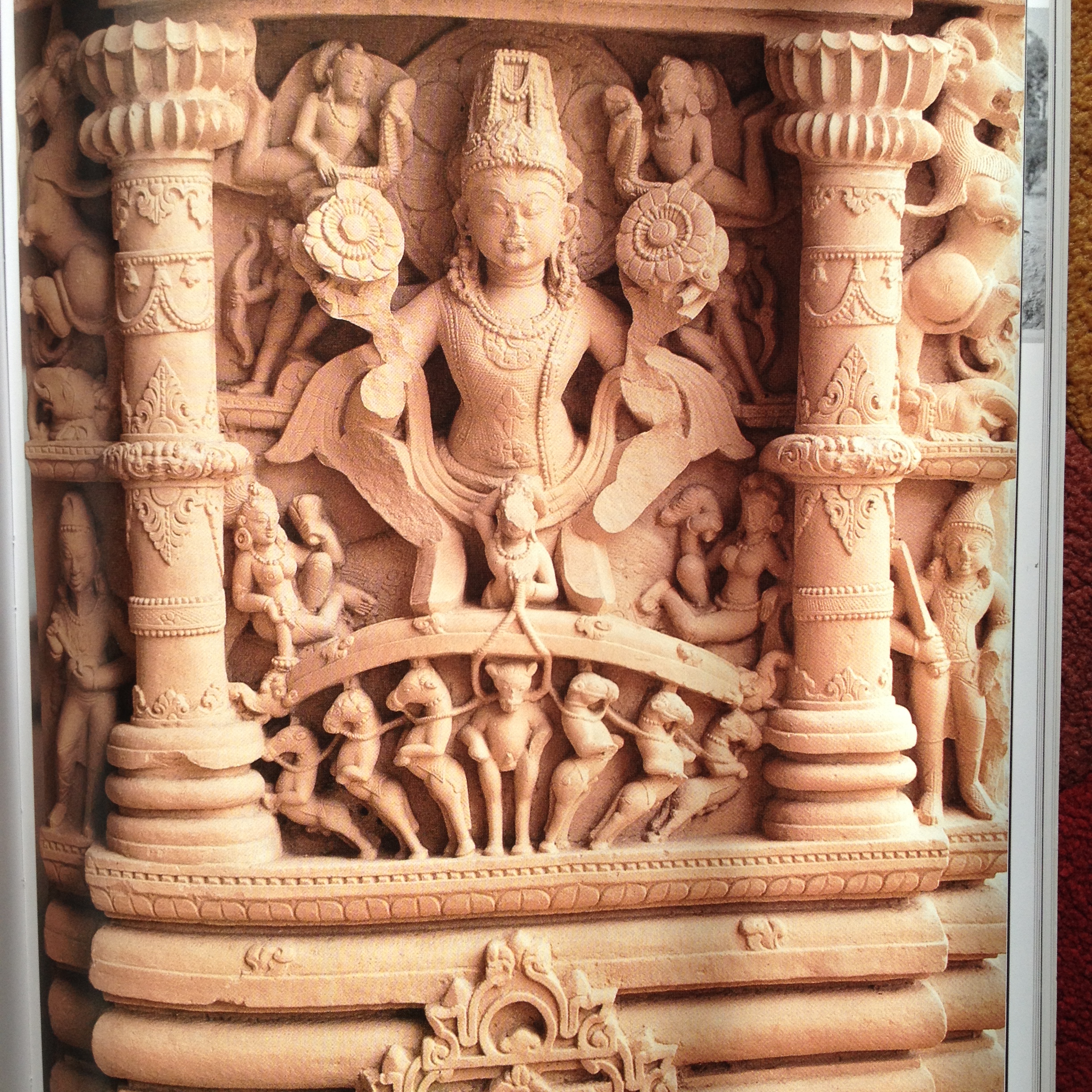
Surya: Lotus in each hand, one wheeled chariot driven by seven horses

Chandra/Moon : mace, rosary or lotus in hands; chariot driven by ten horses; Rohini on his right side and sometimes shown with his wives Kanti and Shhoba

Angaraka/mangala/Mars: Goat vahana, rosary, staff, javelin are in his hands

Budha(Mercury): Lion vahana; sword, shield mace , bow, rosary, Yoga mudra in hands.

Guru (Jupiter): Rosary, vase or staff or book are in his hands; golden chariot driven by horses is his vahana.

Sukra (Venus): Rosary, vase or staff; chariot driven by horses

Sani /Saturn: Arrow, bow, javelin, staff, rosary are in his hands; Crow is his vehicle; sometimes vulture or buffalo

Rahu: sword, shield, javelin;  face half moon, ugly face

Ketu: mace or shield in hands; serpent tail or serpent body with ugly face.

Goddesses

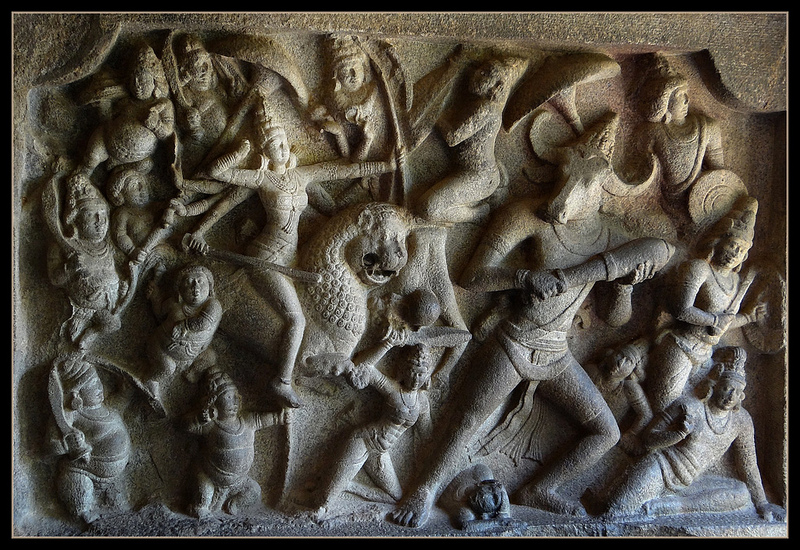
Durga: Durga is the destructive form of Uma or Parvati. She is shown as killing Mahishasura (Beffalo demon); she is also shown as Narayani with Conch and wheel or with garland of skulls; vahana — lion or tiger.

Lakshmi: seated on lotus; if it is Gajalakshmi form, two elephants on either side doing Abishekam; bowl of leaves; vahana owl

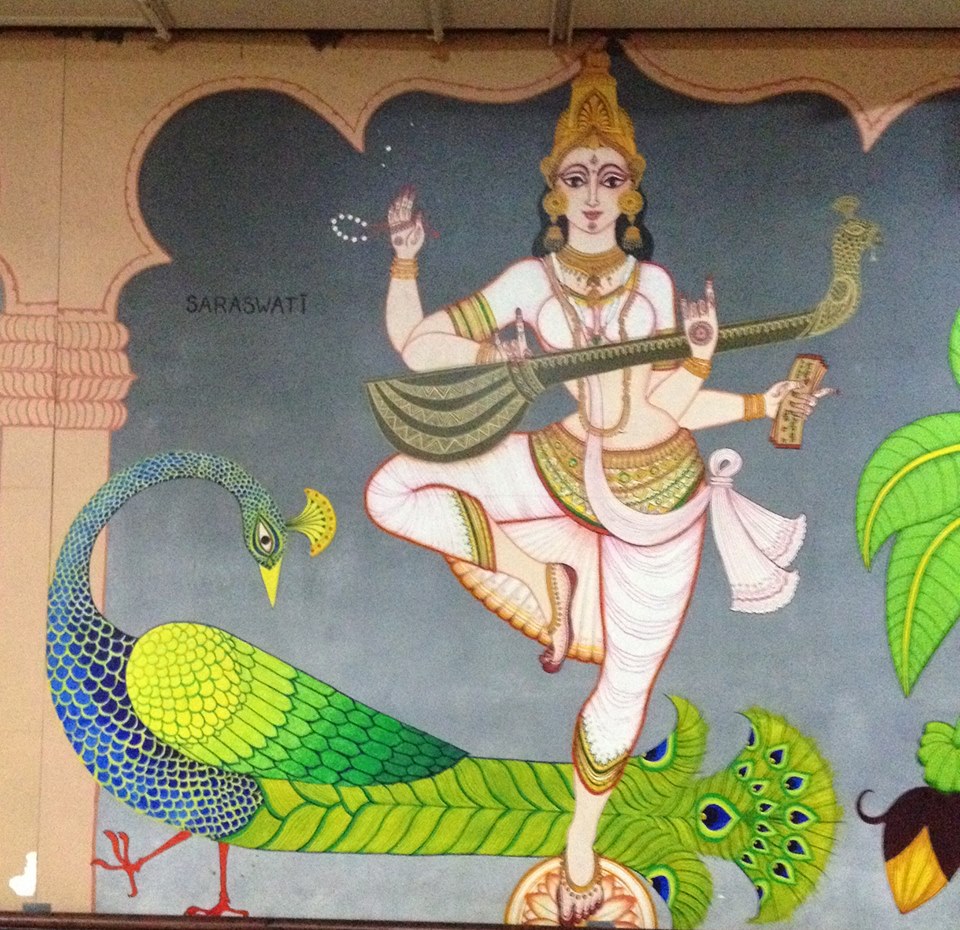
Sarasvati : Veena (musical instrument), rosary, books, vase, flute; swan or peacock is shown as vahana.
durga, mamallapuram

saraswati lakshmi

Gayathri: She is shown seated on a lotus flower, with five faces and ten hands holding rosary, bowl, battle axe, conch, wheel, mace etc. Sometimes a swan is shown by her side.

The above list is not a comprehensive list. Still there are lot of forms like Sapta matas, Lalita, Raja rajeswari, Chamundi, Kali and other forms. For every mythological story we have a special form of god or goddess. The study of Hindu iconography is a very big field. Grama devatas have (Village goddesses) have different forms. Sastha, Ayyanar, Santoshimata, Bhagavati …. list goes on and on. But one will be able to identify most of them with Tri Murtis or their three consorts.

In South Indian Temples, Vishnu is shown in three poses: Sitting, Standing and lying down. They are huge sculptures.

For each god we have different forms when they kill some demons. Particularly with Krishna, his forms like Kaliya nardana or Kaliya mardana  (dancing and tackling the snake Kaliya) are more popular.

If elders in the family learn all these things and the significance of each and every symbol, it will be useful to teach the youngsters in the family.

We must also tell them that these are symbolic representations; When Brahmachari Ganesh is shown with his “Two Wives” Siddhi and Buddhi, that means anyone worshipping god in this form will attain Success (Siddhi) and Intelligence (Buddhi). When Moon is shown with Kanti and Shoba, we must make sure they understand that these are the words for Brightness, Shining etc. When Sun has a “wife” by name Chaya (Shadow) they must know shadow follows light. Since they forgot the symbolism, now all the stories have become “myths”!!
IMG_4537 (2) siva is pillar

Nataraja and Shiva

–Subham–
A Foreigner’s account of Chidambaram Temple Festival!

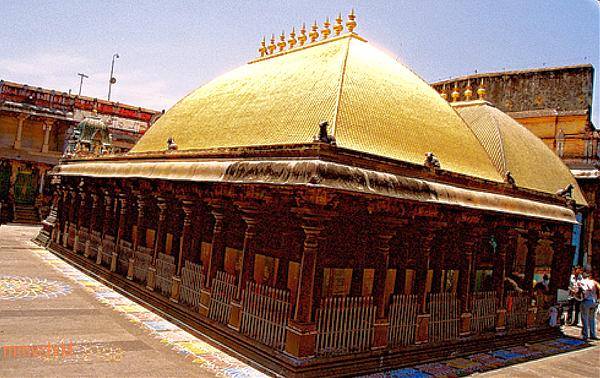
chidambara gold

DON’T REBLOG IT AT LEAST FOR A WEEK!  DON’T USE PICTURES; THEY ARE COPYRIGHTED BY SOMEONE.

Compiled  by London swaminathan

Date: 30 September 2015

Post No: 2202

Time uploaded in London :– 20-01

(Thanks  for the pictures)

From the book SOUTH INDIAN HOURS by Oswald J.Couldrey

Year of Publication 1924, London

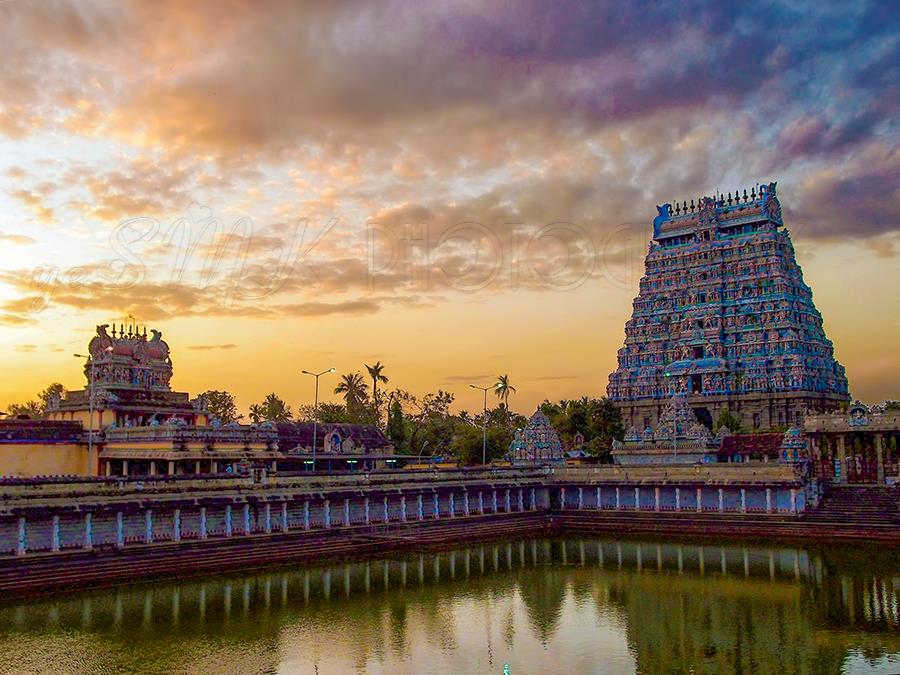
I lately visited temple of Nataraja, the Dancer, at Chidambaram. The Dikshitas, a sect or tribe of Brahmins whose hereditary right is conduct the worship, and share the revenues of the temple, keep considerable state. They made me leave my boots under the gopuram; “put off”, they said, ‘thy shoes from off thy feet, for the place whereon thou standest is holy’; a requisition with which it was not in my conscience to refuse compliance, particularly as I very much wanted to see the temple. But the pavement of the outer court was rough and weedy, and a European always feels rather small and foolish without his boots; and I suspected all the Dikshitas arrogated unto themselves much of the honour of my homage, for they seem to regard the god as a kind of an elder brother, or first among the equals, and boast that he has but a lot and share in the sacred household, like one of themselves.

The Hindus know more than we do about God, but they sometimes appear to presume upon their familiarity…… These Dikshitas are sleek, well grown fellows, who wear the golden emblem of the god embossed upon the clasp of their rosaries, and knot their hair jauntily on one side of the head, not at the back, as ordinary Brahmins do. Some of the boys in their white clothing and sallow sapliness were especially charming, and the youger ones reminded me of Italian angels, but without the rose.

chidambaram there2

Hindu Rathas/Chariots are Museums on Wheels!

To see the cars (Chariots) was one of the main objects of my visit. I had somehow never got the sight of processional cars of the Madura deity, though doubtless he somewhere stables vehicles worthy of his wealth and fame.

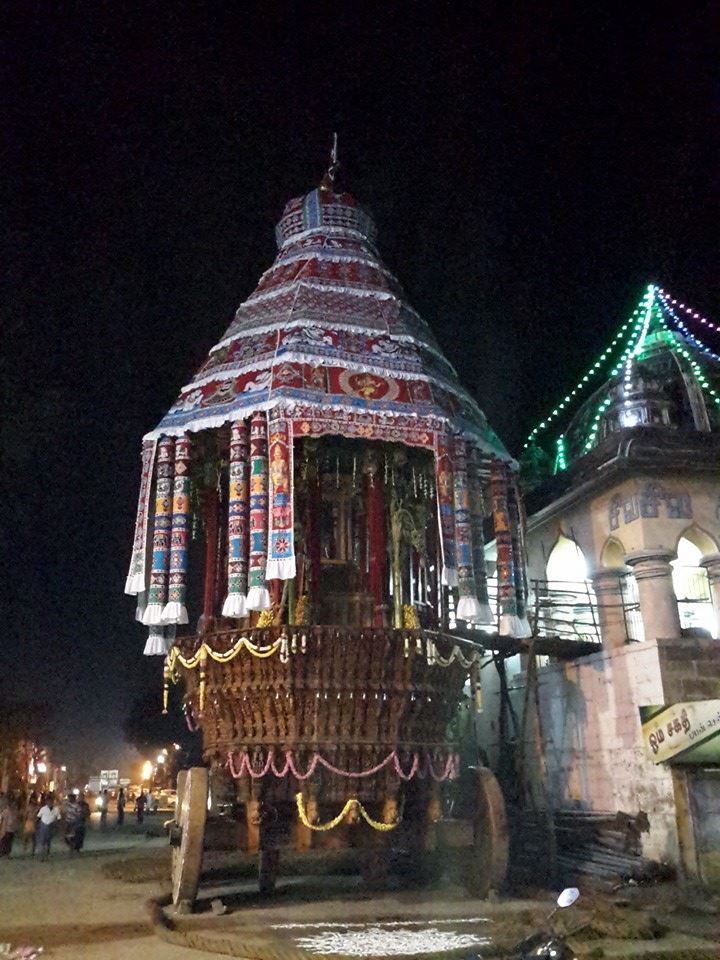
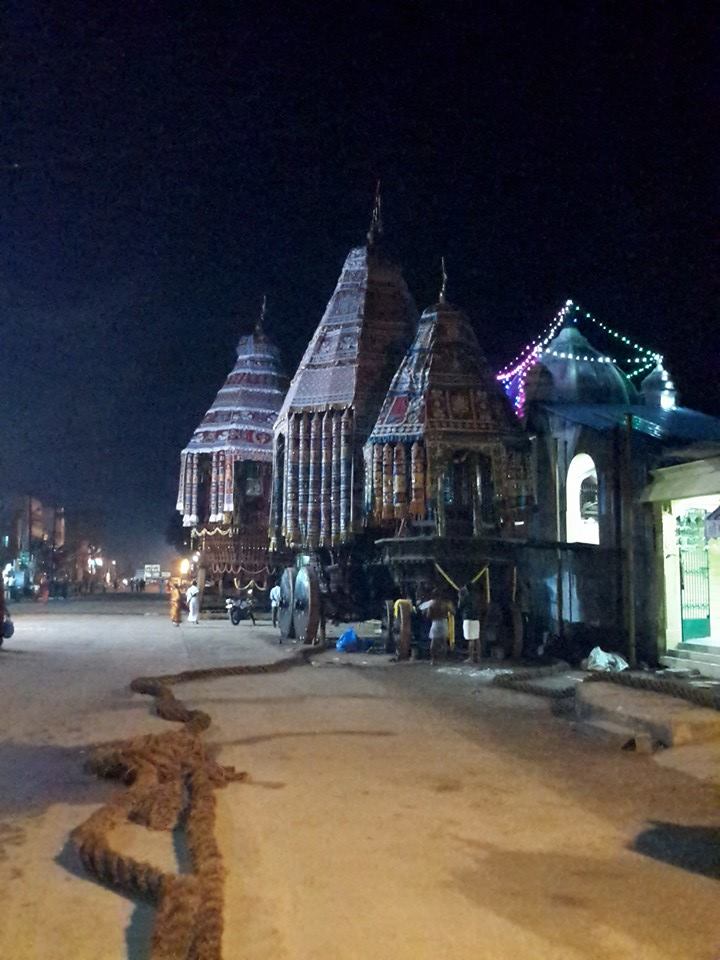
I was lucky enough to arrive at Chidambaram a few days before the festival, and the cars stood in a line before the eastern gopuram, bared of their huge caps of thatch and ready to be decorated. They were, if I mistake not, five in number, enough to accommodate all the Siva’s household and over. The chariot of the paternal deity was new, and the height of the wooden hull alone must have been nearly twenty feet the car was, as usual octagonal in shape, and over hung; and though inferior to some of the older cars in design and ornament, it was by no means unworthy to be placed among them.

The former car of the god, which stood beside it, and perhaps to devolve upon his consort, was not so large, but far superior in boldness and beauty of design and ornamental fancy. It stood like a museum on wheels, a moveable abridgement of Dravidian sacred art, not only learnedly representing all the persons and legends of the Saiva mythology, but displaying in exquisite miniature upon corbel, bracket and panel moulding all those decorative devices and canonical figures, the model shrines, and lotus bells, and mounted atlantes, and ramping beasts, and curious columns, and florid scrolls, that together constitute the very style and language of those epics in stone, the temples of the south. The other three cars were neither so large nor so elaborate as these, but seen anywhere else, would have well deserved admiration and study.

chidambaram ther

Panchamrita = Pentambrosia

As a reward, perhaps, for taking my boots off, I was allowed much further into the sacred apartments than is usual with strangers in other temples. I stood before the ancient silver steps, curiously graven, of the shrine of the Dancer himself in his dancing hall – a raised porch thronged with the yellow, lusty torsos of serviceable Brahmins, who shealed large armfuls of plantains and threw them into pans. They were engaged, I am told, in preparing the Panchamrita or pentambrosia (if I so Hellenise the Sanskrit), the fivefold food of immortality, a mixture of the fruit aforesaid with butter, milk, honey and water, which is dealt out as a sacrament among the worshippers.

I was shown the famous Air Lingam, the secret of Chidambaram, which is no more, I am told, than an empty cell, said to contain the invisible emblem of the god; a queer blend, like so much else of popular Hinduism,  between spiritual teaching and the craft of the showman.

chidambaram old

God’s Procession

Those were the festival days at Chidambaram, and every morning the five gods went in procession through the streets nearest the temple. Wreathed and almost hidden in garlands of yellow flowers, the brazen images were carried in carved and gilded arks or thrones upon the shoulders of the temple servants. The god’s two elephants, one of them a very giant, walked before caparisoned in crimson, and there were curious flags, and a music of old world instruments, and chanting choirs; not all in evidence at first, but added severally from day to day so as to maintain a gradual increase of display, until the climax of the festival should be marked, presumably, by the appearance of the cars.  Brahmins from all parts have come together on this occasion, to minister pilgrims, and share the bounty of the Dikshitas. Increasing numbers of them walked daily in procession hand in hand, singing responses and receiving alms of rice, which one of the Dikshitas distributed, walking up and down the lines.  This functionary with his golden ornaments, and scarf of crimson silk thrown over his naked shoulders, in token, I presume, of his dignity as the vehicle of god’s bounty, looked very spruce and sleek beside his poor and vagrant brethren. The latter, for processional purposes, were divided into two bands- the veterans and the bachelors. They sang their Sanskrit antiphonal with a vigour and sharpness of enunciation, an exactitude of mutual register, an absolute perfection of unison, such as I should not have considered possible among vagrants gathered suddenly together.  They chanted like one stentorian throat and gave me a new notion of the power of words and music, properly welded, to set each other off.

Last Day in Chidambaram

I spent a week in Chidambaram, loitering and making sketches. I became familiar with the life of the place, and learned the ritual of the festival. I had to leave Chidambaram while the festival had some days to run, so that I did not see the cars in motion after all. But on the last night of my stay, as I left my house, fortunately early, for the little railway station, I saw the southern gate head aglow with a great orange light. I hastened to the spot, and found in the street a numerous concourse of people watching the same pageant, which I had seen daily in the forenoon, but now very much enlarged, and quite transfigured. It shone, not with Washington gas lights, such as vulgarise all the night festivals of the north, and even of madras, but in fierce old-fashioned flare of torches.

sunset, chidambaram

There were the elephants, the musicians, the Brahmin choirs, reinforced beyond recognition; but the gods themselves, who came after, no longer rode on Chairs, or arks, or whatever you choose to call the little tabernacles in which they moved before, but upon their appropriate ‘vehicles (Vhanams)’, Siva on his bull, Skanda on his peacock, Ganapati on his bandicoot, like the Seven Deadly Sins in an old morality. All too hurriedly I perused this weird procession. The animals were cast in some silvern metal, and the style of Siva’s bull in particular put me in mind of Jeroboam’s idol, or the calf in Horeb. They were fixed upon huge timbers, and borne shoulder-high by much greater number than were found before necessary to carry the tabernacles. High above the smoke and glare, the din, the moving multitudes, the dance of monstrous shadows, a green moon, three-quarters full, the moon of the festival, hung aslant in a sky of jade.

Sringeri Shankaracharya’s Talk on Bhakti!

abhinava-vidya-theertha

DON’T REBLOG IT AT LEAST FOR A WEEK!  DON’T USE PICTURES; THEY ARE COPYRIGHTED BY SOMEONE.

Compiled  by London swaminathan

Date: 29  September 2015

Post No: 2199

Time uploaded in London :– 20-00

(Thanks  for the pictures) 

People of my age were lucky to have the darshan of two great Shankaracharyas of Kanchi and Sringeri. Because of them the Mutts got great recognition from even secular circles. Kanchi Paramacharya Sri Chandra Sekhara Indra Sarasvati (1894-1994) and Sringeri Shankaracharya Sri Abhinava Vidhyatirtha Bharati (1954 -1989)—both had visited Madurai several times and camped there for weeks or months.

What is Bhakti (Devotion)?

Following is an excerpt from His Holiness Sri Abhinava Vidhyatirtha Svaminah’s talk:

It is inherent in man’s nature to develop an attachment or devotion to some object or other. Even the Mumukshus are devoted to the attainment of Atma –Jnana or knowledge of the Self. When devotion is directed towards God, it is designated as Bhakti. God is worshipped even by those who have attained the knowledge of the Atma. It is therefore needless to say that God should be worshipped by the seekers of knowledge, wealth and other objects.

Bhakti in Bhagavad Gita

God has assured to the mankind in the Bhagavad Gita that his Bhakta will never perish. Faith in God and Bhakti towards him are therefore sure to save mankind and secure its good.

Works like the Bhagavata have been written solely for the purpose of helping mankind to foster Bhakti by reading them or listening to them.

In the Vishnu Sahsranama, God is described as Bhayakrt and Bhayanasanah. If he generates fear, it is only as a temporary test or a trial of our devotion. He destroys all fear ultimately.

guru-shishya

Similes of Ankola Tree and Rain Water

Adi Shankara has given a wonderful description of the true nature of Bhakti in one of the Slokas of Sivanada lahari (Sloka 61): The bahkta is stated in that Sloka to be drawn towards God, becoming one with him even as the seeds of the Ankola tree are at the due time drawn towards the tree itself as iron towards the magnet.

The waters of the ocean are converted into clouds and the rains that are released by the clouds become the rivers and all rivers ultimately flow in to and become one with the ocean. Even as the rivers merge into the ocean, so should Jiva merge itself into the Paramatma (God). Every drop of the waters of the ocean partakes of all the characteristics of the entire waters of the ocean. So does the Jiva partake of the Chaitanya of the Paramatma; only the Chaitanya of the Jiva is limited while that of the Paramatma is limitless.

Bhakti in School Syllabus

Bhakti should be taught along with ordinary education to everyone from infancy. Nama sankirtana such as the chanting of “Hare Krishna, Hare Rama” is a great sadhana of Bhakti.

To be born as a human being in this world is a rare fortune. It is true that the Devas are not afflicted by old age; but they have no Adhikara, competency to practise the sadhanas necessary for attaining the Divine Bliss or Mukti.

The path of Karma, which is otherwise known as the Pravrtti –Marga requires the help of others; but the path of Bhakti does not require any extraneous help.

TULADHARA

It should, however, be remembered that just because one has developed great devotion to God, he is not absolved from the duties enjoined upon him by the sastras (scriptures). It is only by practising right conduct one can attain the fruits of bhakti or devotion. The merchant Tuladhara conducted his trade with the object of making available to those that needed the things that he was selling at reasonable prices with allow margin of profit and did not want to get rich or get rich quickly. His devotion to God coupled with his right conduct helped him to attain Mukti.

adisankara

DHARMA VYADHA

The lives of Dharma Vyadha who was a butcher, of Dhruva who was a boy, of Gajendra the elephant, of Vidura who was not high born, of Ugrasena the weakling king and of Kubja the deformed maid servant, who were all great Bhaktas, should serve to illustrate that Bhakti can be attained and practised by one and all without any extraneous help, by one’s own efforts and does not require any special qualification.

MANMATHA

Purity of thought is absolutely essential for Bhakti. Flowers to be offered to the Lord with the intention of worshipping Him. Such worship yields the desired good results. The story of Manmatha illustrates the importance of intention in the matter of worship and Bhakti. Manmatha’s arrows, no doubt, consisted of flowers; nevertheless, since his shooting them at Lord Shiva was for the purpose of causing disturbance to his Tapas (penance), it resulted in his being reduced to ashes. This shows that the attitude of sincere devotion alone counts and not mere external show.

Nine Sadhanas

In a sloka in the Bhagavata, Prahlada explains to Hiranyakasipu that there are nine sadhanas to foster Bhakti, namely, Sravana, Kirtana, Smarana, Padasevana, Archana, Vandana, Dasya, Sakya and Atmanivedana. Listening to the stories of God’s Lilas, singing  His praises, and constantly remembering them are the first steps. Visiting holy shrines and offering worship to his images are also sadhanas. Vandana helps to express our wish to seek refuge in Him. One should regards himself as God’s servant and do service to Him and to all created  beings, which are but his manifestations. One should regard himself as God’s Sakha and knowing his mind, serve him and place him in every way. Ultimately comes the stage when one offers himself up to God effacing his self completely.

May God help us all to attain the right type of Bhakti!

More joy in pining for God!

IMG_4538 (2)

DON’T REBLOG IT AT LEAST FOR A WEEK!  DON’T USE PICTURES; THEY ARE COPYRIGHTED BY SOMEONE.

Compiled  by London swaminathan

Date: 28  September 2015

Post No: 2196

Time uploaded in London :– 18-15

(Thanks  for the pictures) 

There is a Sufi story which illustrates how familiarity breeds contempt. Some devotees, therefore, do not wish to meet God but would prefer to thirst and pine for Him all their life. They find a particular joy and ecstasy in merely crying and wailing for Him all their life.  The story is this:

On a hot day a herd of sheep was grazing on a hill. When the sun had ion of gone down meridian, the sheep felt inordinately thirsty. With raised heads they looked for water in all directions in great expectation of seeing a water course or a stream some distance from there.

Fortunately for them, they saw down on the slope, about half a mile away, a stream of crystal water flowing. The sight enchanted them because their thirst was great, so also their love for water. All the sheep now rushed in a body towards the stream in tremendous haste. Soon they reached the stream and, going in it knee deep, drank the water to their fill. Then they stood for a while in the water and turned it dirty by passing into it urine, etc. they lost the long eagerness to see and drink the water. On the other hand, they made the water dirty.

Too near association of your Beloved gradually wears away your high veneration and love for Him or Her who was held by you at one time in high esteem as you all in all.

–Story told by Swami Ramdas of Anandashramam

IMG_4536 (2)

Many Tamil Vaishnavite saints, known as Alvars, also enjoy Lord Vishnu this way. They are ready to be born as steps made of stones in the Balaji temple. What they want is to enjoy God from a distance, but for ever. This gives them more joy than going closer to him. Kulasekara Alvar, one of the 12 Alvars, praises the Lord of the Venkata Hills and prays to him that he should be born as a crane or a fish or a stream or a tree in the holy Venkata hills. Both Saivite and Vaishnavite saints look at the Lord as husband and himself or herself as a woman longing for Him. This gives them immense joy. This is known as Nayaki- Nayaka Bhava.

–Subham–

Name is the only Remedy!

Sant-Tukaram-1608---1650

DON’T REBLOG IT AT LEAST FOR A WEEK!  DON’T USE PICTURES; THEY ARE COPYRIGHTED BY SOMEONE.


Compiled  by London swaminathan

Date: 25 September 2015

Post No: 2188

Time uploaded in London :–  21-05

(Thanks  for the pictures) 

Tukaram was a great saint of Maharashtra. He lived in a place called Dehu. He was spending all his time in singing God’s name, talking about His glories and performing Kirtan in the company of devotees. At home, he was sitting in a corner engaged in chanting the name of the favourite God, Vitoba of Pandharpur.

One day, when he was absorbed in the chanting of Vitoba’s name “Vittal, Vittal”, one of his children took ill and was rolling on the gound with stomach ache. Tukaram’s wife was very much upset over the child’s condition and told Tukaram to go and fetch a physician. But Tukaram taking no notice of what his wife said, went on singing god’s name. Tukaram’s wife got wild over his indifference. But Tukaram kept quiet.

Soon after, the child vomited and all the indigestible stuff in its stomach was thrown out. The child immediately ceased groaning from stomach pain. It sat up and was perfectly cheerful. Then Tukaram seeing the recovery of the child went up to his wife and said “the child has now recovered from its pain by God’s grace. If I had called in a physician to treat it as suggested by you we would have to pay him his fees for the treatment. Will you kindly pay me the fees which you would have paid the physician so that I can use the amount for feeding the poor”. The wife turned away from him without giving him any reply.

Story told by Swami Ramdas of Anandashram at Knanhankadu in North Kerala.

Image Worship in the Vedas: Sringeri Acharya

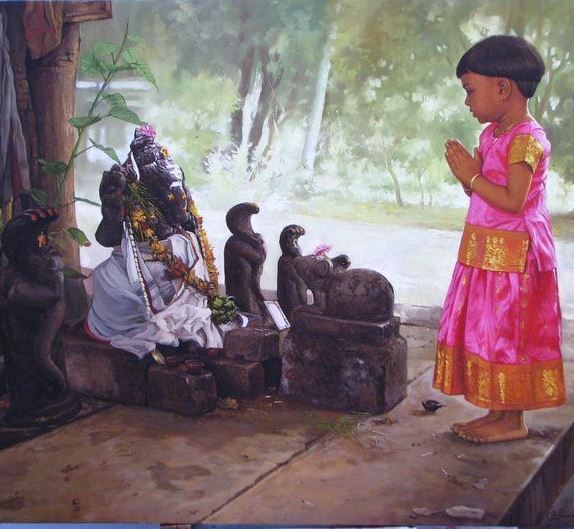
ganesh kutty

DON’T REBLOG IT AT LEAST FOR A WEEK!  DON’T USE PICTURES; THEY ARE COPYRIGHTED BY SOMEONE.


Compiled  by London swaminathan

Date: 24 September 2015

Post No: 2185

Time uploaded in London :–  20-52

(Thanks  for the pictures) 

His Holiness Sachidananda Siva Abhinava Narasimha Bharati Svaminah of Sringeri Mutt (33rd Head of Sringeri Shankara Mutt) said in one of his lectures:

As long as God remains but a notional hypothesis, it is impossible for our gross to have any contact with Him, much more to surrender ourselves to Him He has to be conceived of as manifesting Himself through forms which are gross enough to be comprehended by us. That conception of Godhead is not a mere abstraction for, by reason of His omnipresence, there is really no form which is not permeated by Him. He can therefore be contacted through any form in the universe. Though this proposition is theoretically perfect and true, when our capacity for such contact is taken into account, it is only some form that help us to have such contact and what those forms are prescribed by the Sastras (scriptures). The grossest of such forms but a very necessary step towards establishing contact with subtler forms is the image of God. It is sheer ignorance to decry the value of image worship.

It is sometimes urged that, in the Samhita portion of the Vedas, there is no warrant for image worship. The several Gods like Agni, Indra and Varuna sre described there with hands and feet, as holding several weapons and as doing several exploits. How can this be possible if they have no forms?

Assuming that the Samhitas do not mention image worship is it not enough if the Brahmana portions mention it? If the Penal Code makes no mention of the law of succession, does the latter lose its validity? As the Vedas comprehend both the Samhitas and the Brahmanas, it is illogical to expect that every portion should mention all that the Vedas intend to say.

It is thought by some that in image worship God the omnipresent is sought to be confined within the dimensions of the image. On the other hand, it is quite illogical to say that the omnipresent God is not in the image. Nobody who engages himself in image worship ever commits the mistake of limiting God to that image. He knows clearly that the image is resorted to for the purpose of establishing contact with the intangible universal godhead who can manifest Himself in any form.

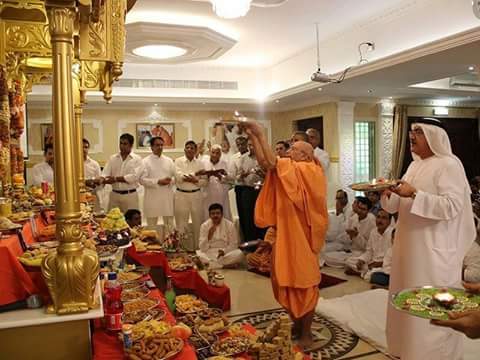
dubai muslim deeparadhana

Nobody who wants to write is immediately able to write small letters and in a neat hand. He has to begin the practice of writing big letters on sand or on rough sheets till he gets some proficiency. Similarly, the aspirant who wants to contemplate on god has to begin by concentrating his mind on a gross visible image of God.

It is meaningless to say that we are in anyway decrying God by worshipping Him in a limited concrete image are we decrying the ruler of the land if we show respect to a picture of his> the ruler will really be pleased to know that even his picture is worshipped. He does not commit the mistaking of thinking that the picture is being worshipped in preference to himself nor is the worshipper foolish enough to think that the picture as such is his ruler

garauda, alakar koil

FOLLOWING IS FROM MY OLD POST:–

WHY DID VYASA WRITE SO MANY PURANAS?

Post No. 725 dated 28th November 2013

“As the tastes and inclinations of people are infinite in their variety, it cannot be said that a single uniform form of God will appeal to all as worthy object of worship. Our system therefore prescribes innumerable forms from which any aspirant may choose that which most appeals to him, as the result of his pre -natal leanings and training.

“This explains why saint Vyasa has written so many Puranas in each of which he has extolled a particular form and described it as the highest. Do we not see that a hospitable host who invites a large number of friends for dinner does not content himself with preparing a particular tasty dish to be relished by all of them but has several dishes prepared so that each guest may select what is most palatable to him and partake of it more than from other dishes? The host will really be inhospitable if he wants all his guests to take only the single dish which he chooses to prepare.  The guests who are not able to relish it will have to return disappointed and hungry. It is to avoid such a contingency that several forms are prescribed for God.

“As the satisfaction of the guests is the prime motive of the host in having a variety of dishes, the variety in the forms of God is intended only to help every aspirant  towards the feet of God.

“If we take children to a sweat meat shop and ask them to select what they want , a child may prefer to have a ring shaped sweat meat, another a rod like one , another in the form of a peacock, another in the form of a chair, and so on. We know all these are made up of sugar and it is not material to us what form each child chooses. We know also that, once the children put the sweat meats in to their mouths and begin to taste them, the particular forms will easily dissolve themselves leaving only the taste of sugar and that this taste will be common to all the children though the forms through which they obtain it are quite different from one another.

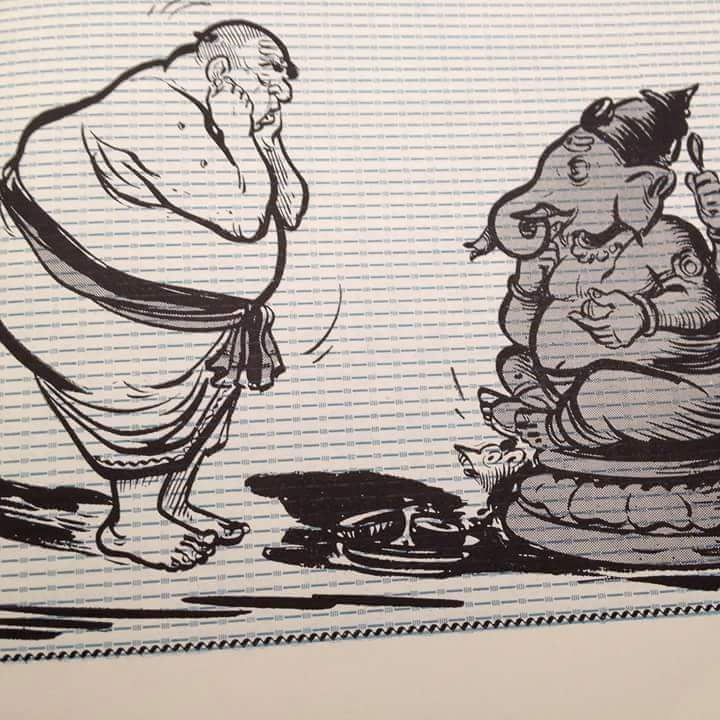
ganesh drawing

“Similarly our religion recognises that forms of God are necessary and that the forms lose their significance when the Godhead in them begins to be realised.

It is only by constant practice of worshipping the formful God that one attains competence to contemplate on God who transcends all forms”.

From the book ‘Golden Sayings’,1969 publication by Sri Jnanananda Grantha Prakasana Samiti, Thenkarai, Madurai District.

Acharya’s Advice to an Angry Brahmin!

chanakya (2)

DON’T REBLOG IT AT LEAST FOR A WEEK!  DON’T USE PICTURES; THEY ARE COPYRIGHTED BY SOMEONE.


Compiled  by London swaminathan

Date: 23 September 2015

Post No: 2183

Time uploaded in London :– 14-21

(Thanks  for the pictures) 

His Holiness Sringeri Shankaracharya Sri Sachidananda siva Abhinava Narasimha Bharati Svaminah (33rd Acharya) was staying in the bungalow of Sri P .N. Krishnamurti, the then Dewan of Mysore. He expressed to His Holiness his desire to give a rupee each to every Brahmana who came to his compound on a particular morning and requested Acharya to depute a competent person to carry it out.

(One rupee in today’s terms is equal to a Silver Coin)

His Holiness well pleased with his generous impulse asked a Sastri to attend to the proper distribution. Thereupon the Sastri entered upon the duty entrusted to him very early on that morning and went on distributing to thousands of Brahmins . Just about the noon the crowd was thinning and Sastri with aching legs and aching hands looked forward eagerly to the close and felt greatly relieved when there was none else in sight and turned about to enter the bungalow. Just then he heard someone call out Sir! Sir!. In his state of exhaustion, the Sastri naturally got vexed and shouted, “No, everything is over” and walked into the bungalow.

His holiness who was about three apartments off sent for the Sastri.

HH: I heard your voice louder than usual. Anything special?

Sastri: I have been standing at the gate from early morning distributing money and when I had finished doing so and turned back somebody called me and I waved him away.

HH: Did anybody approach you yesterday for money? You undertook to pay today and he came  when our host is so generously giving, wil we be carrying out his intention if we allow even one man to go away disappointed? The man is still at the gate. Go and pay him.

From the moment Satri was so patient that he never lost his temper.

angry-red-face-md

XXXXXXX

Even when there as an occasion to chide a servant, His Holiness never used any harsh words.  Once when he went to shrine in the Mutt, he found out the lamp in the sactum was burning feebly. Without mentioning anything about it, he asked the Archaka (priest) there to bring a lighted lamp and added, “I want to see if there is light near the deity.” The Archaka immediately ran up and made the lamp burn brighter.

Source : Golden Sayings, Thenkarai, 1924.

Sringeri Acharya’s Advice on Anger Management!

shiva abhinava bharati

DON’T REBLOG IT AT LEAST FOR A WEEK!  DON’T USE PICTURES; THEY ARE COPYRIGHTED BY SOMEONE.


Compiled  by London swaminathan

Date: 22 September 2015

Post No: 2181

Time uploaded in London :– 20-08

(Thanks  for the pictures) 

A Forest Officer who was camping a few miles off Sringeri came there and paid respects to His Holiness Sri Sachidananda Siva Abhinava Narasimha Bharati Svaminah (33rd Acharya of Sarada Mutt between 1879 and 1912).

F.O: I am in the forest department and, as happened to camp in the hills about ten miles from here and learnt that Sringeri was so neat it struck me that I might worship Sri Sarada Devi and pay my respects to you, my hereditary Guru, though I cannot claim to have any orthodox leanings and habits.

HH: I am glad you have come. It is past ten o’clock. You may take your breakfast in the mutt and then go.

F.O: I have to return to my camp forthwith. I pray for your gracious blessings and for any practical advice which even I can follow in spite of my drawbacks.

HH: There is no occasion at all for despair in anybody born of a respectable family. Are you the top most officer in your department?

anger-management-stress-ball-set-67

F.O: Not so. But I am fairly high in the ladder.

HH: I suppose you get frequent occasions which make you angry in the course of your employment.

F.O: Very often.

HH: That is, you have occasion to get angry with your subordinates?

FO: Yes.

HH:  Suppose your anger is not quite justifiable, will your subordinate point it out to you?

FO: He will not have the courage to do so.

HH: If your anger is not justified and if he cannot say it to you, will he not have a sense of resentment?

FO: He may have.

HH: But he cannot show it to you?

FO: If he does show it, his job will be in danger.

HH: How is he then to give vent to his resentment?

F.O: If he chooses, he may visit it on his subordinates.

HH: Will it be proper to direct the resentment against the subordinate when the latter is quite innocent and does not in the least merit it? Will not that subordinate resent such treatment and how is he to give vent to his resentment?

F.O: He must pass it on to a lower official.

HH: It appears therefore that if you unnecessarily get angry, it gives rise to a chain f unnecessary angers and you are primarily responsible for it.

F.O: It may be so. But what can I do?

anger book

HH: People who get angry may be classified under three categories: 1. those that know they are GOING to get angry, 2.those that know that they ARE angry and 3those that they know they WERE angry. Ordinarily the majority belong to the third category. To which category do you belong?

F.O: I think I can feel the anger coming on.

HH: I am very glad to hear it. There must be an interval ever so short between your feeling like that and the actual anger. You may just utilise that interval to think for a moment whether you really need to get angry. If you find that anger is not really so urgent, you may prevent the anger coming on. If the person KNOWS that he is in angry mood, even he may stop for a moment to think whether it is necessary to persist in that mood any longer; if he does so, the anger will lose its momentum. A person who gives way to anger and is aware of it only AFTER he has given vent to it may in his calm moments consider whether the anger he gave vent to was justified; he will be then more careful when he gets angry next time. Thus in all three cases a kind of self-enquiry at the time or later on will easily blunt the edge of anger and he may ultimately get rid of it altogether. It will be very useful if you bear that in mind.

AngerBall

Then the officer took leave of His Holiness and rode his horse back to his tent. It was past one o’clock and the ride for twenty miles had been a tiring one especially in the hot sun so much so that he felt very hungry. As soon as he entered the tent, the cook hastened to place before him a silver plate with a small rice cake in it and also a cup of water. Having missed a sumptuous breakfast at the Mutt and being faced with such a scanty fare before him, he naturally felt a surge of anger coming up with him, he naturally felt a surge of anger coming up with him but before he gave vent to it, he remembered the advice of His Holiness, put a check on his temper and began to question the cook.

F.O: You know I shall be coming late and hungry. How is that you have not prepared the regular meal yet? Is it proper to offer me now this small cake?

Cook: I certainly know. The servant who went down the hills to purchase the provisions has not yet turned up and, as I felt that you must have something to sustain you till he comes and till I prepare the meal, I got together what rice flour I had here and prepared the cake.

F.O: If you have used up all the available flour and if you are to have your meal after preparing the meal and serving me, what will you do then?

Cook: It does not matter. I am accustomed to late meals. But you are not. Hence I prepared this.

The forest officer realised that he was about to get angry with a faithful servant who had so affectionately cared for him and he insisted upon the cook sharing that cake with himself. It need hardly be said that, in course of time, he completely got rid of his anger and, with deep devotion and gratitude to His Holiness for His Gracious blessings and advice, began to resume his traditional habits and earned the status of an earnest devotee.

anger-in-the-workplace-233x300

N.B: There are few more anecdotes which I will post separately: swaminathan

Source: GOLDEN SAYINGS, Compiled by Shri Jnanananda Bharati Svaminah, year of publication 1969,  Shri Jnananda Grantha Prakasana Samiti, Thenkarai, Madura District

–Subham–

Two Anecdotes: Love your Enemy!

finnisdeath

Article written by London swaminathan

Date: 20th  September 2015

Post No: 2175

Time uploaded in London :– 19-18

(Thanks  for the pictures) 

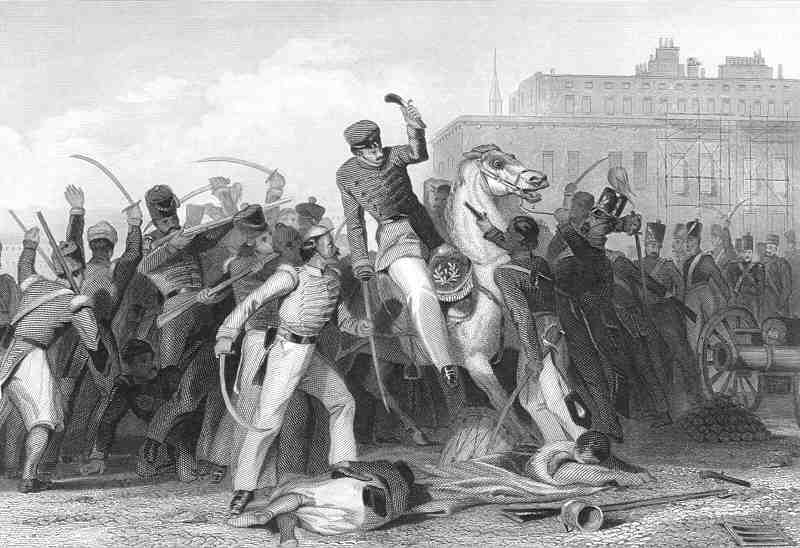
This happened during the Great Indian Mutiny in the year 1857. Indian soldiers revolted against the British Government and the government took stern steps to put them down. The result was, people left the villages in panic. At one place, when they were running away, they saw a Sadhu coming towards their village which they had abandoned. The villagers warned the Sadhu that the British soldiers would be there shortly and kill him mercilessly. The sadhu did not pay heed to the advice, but went on. When he was nearing the village, a British soldier came towards him and stabbed him. The sadhu was fatally injured. He fell down and was about to die. The soldier was looking at him to make sure if he was dead. Before breathing his last, the Sadhu looked at the soldier, his murderer, and smilingly said “You also are He” (Tat Tvam Asi).

Even in the agony of death, the Sadhu saw God in him. What a glorious vision was his! It is indeed wonderful.  Such is the vision of one who has realised God.

periya_puranam_a_tam

Safeway to a Tamil Murderer

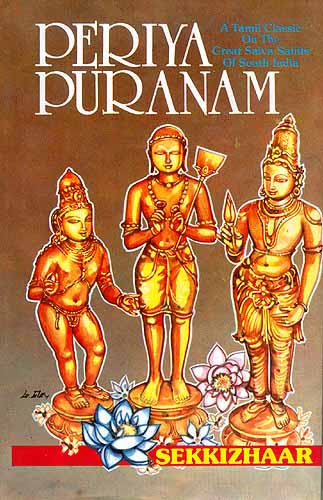
Periyapuranam is a great Tamil literary master piece which deals with the lives of sixty three Saivite Saints of Tamil Land. One of the sixty three saints was Meypporul Nayanar who ruled a small kingdom from Tirukkovilur in North Tamil Nadu. He had a rival in a neighbouring kingdom whose name was Muthanathan. He invaded Meypporul Nayanar’s country several times but was defeated. So he planned to kill him by hook or crook. He knew that Nayanar respected Saivite devotees a lot.

One day Muthanathan came to Nayanar’s palace disguised as a Saivite saint. It was dead of night and so the guards at the gate refused him permission to enter the palace but he insisted that he had brought something important to give it to the king. Then Nayanar’s bodyguard Tattan came and allowed him in; but Tattan was very suspicious about this ascetic guy. So he was ready to meet any eventuality.

When Muthanathan went into the palace, Nayanar was sleeping with his queen in the bed room. She woke up at the slightest noise and woke her husband immediately. As soon as he saw someone with holy ash smeared all over his body he fell at his (Muthanathan’s) feet. Nayanar asked him what brought him at the dead of night to the palace. “Ascetic” Muthanathan told Nayanar that he had got a rare book and wanted to teach him the same night. Nayanar told him that he was ready to receive it the very next minute. But Muthanathan insisted that his wife should not be in the room. Immediately she left the bed room.

When Nayanar fell at Muthanathan’s feet in the traditional way before start of the lesson, Muthanathan took his sword from inside the ascetic robe and stabbed Nayanar. He fell on the floor. As soon as the body guard Tattan heard the noise he rushed into the bed room and caught Muthanathan red handed. But Nayanar, before breathing for the last time, instructed Tattan, “Tatta, He is our man. Please allow him a safe passage”.

As instructed by Nayanar, he took Muthanathan, inspite of a big lynching crowd, out of the city limits and allowed him a safe passage. He was pardoned by Nayanar just because he came in the guise of a Saivite (Shiva) saint.

There are several episodes like this in Indian literature.

Two Stories: See yourself in all beings!

177414-petrin-hill---hall-of

Don’t Reblog it for at least a week; don’t use pictures.


Article written by London swaminathan

Date: 19th  September 2015

Post No: 2172

Time uploaded in London :– 20-22

(Thanks  for the pictures) 

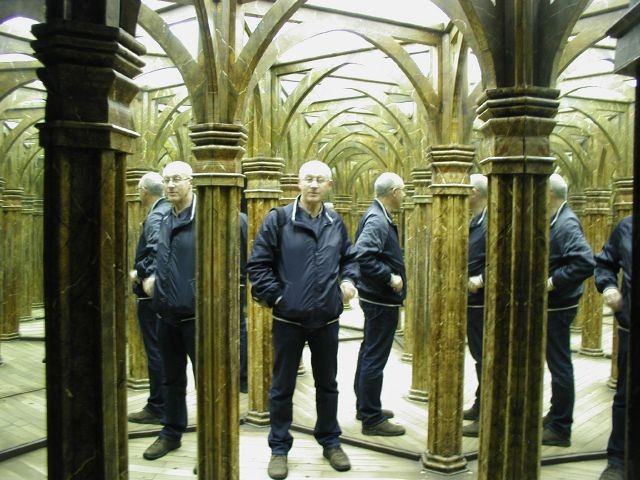
In order to have some fun a man procured innumerable small mirrors and had them fixed in his room on the walls, in the ceiling and on the floor. There was not an inch of space where there was no mirror. After closing the door, he switched on the light and stood in the middle of the room. He saw himself reflected in myriad forms in the mirrors— above, below and on all sides. He enjoyed the sight very much because he loved to see himself everywhere. After having had this fun for a while, he left the room, but forgot to close the door.

His dog entered the room a few minutes later and it saw its own reflections in the mirrors. The dog started barking at its own reflections and jumped and fought with them, as it thought those were dogs different from itself.  It fought till it got completely exhausted and fell down dead.

So, man in his ignorance, when fighting with his fellow thinks that they are separate from him. When he realises that all beings are the images of his own Self, instead of quarrelling with and disliking them, he will love them all equally.

elephant3_

 Ramakrishna Paramahamsa’s Elephant story 

In a forest there lived a holy man who had many disciples. One day he taught them how to see god in all beings and knowing this, to low before them all.

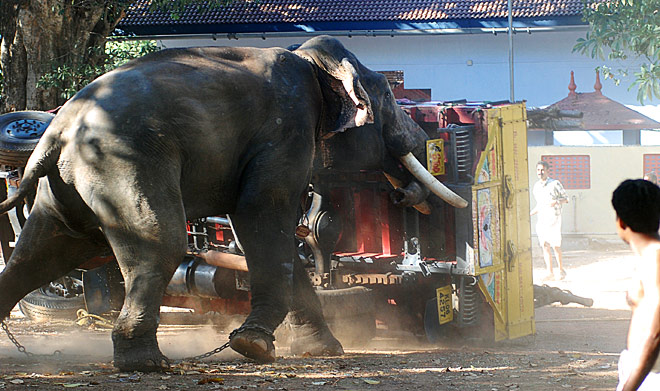
A disciple went to the forest to gather wood for the sacrificial fire. Suddenly he had an outcry, “Get out of the way! A mad elephant is coming!” all but the disciple of the holy man took to their heels. He reasoned that the elephant was also god in another form. Then why should he run away from it? He stood still, bowed before the animal, and began to sing its praises.

The mahut of the elephant was shouting “Run away! Run away!” but the disciple didn’t move. The animal seized him with its trunk, cast him to one side and on its way. Hurt and bruised the disciple lay unconscious on the ground. Hearing what had happened, his teacher and his brother disciples came to him and carried him to the hermitage.

With the help of some medicine he soon regained consciousness. Someone asked him, “You knew the elephant was coming. Why didn’t you leave the place? “But”, he said, “our teacher has told us that God Himself has taken all forms, of animals as well men. Therefore thinking that it was only the elephant God that was coming, I didn’t run away.”

At this the teacher said, “Yes, My child, it is true that the elephant God was coming; but the mahut God forbade you to stay there. Since all are manifestations of God, why didn’t you trust the mahut’s words? You should have heeded the words of the Mahut God.”

God dwells in all beings. But you may be intimate only with good people; you must keep away from the evil minded. God is even in the tiger; but you cannot embrace the tiger on that account! You may say, “Why run away from tiger, which is also a manifestation of god?” The answer to that is: Those who tell you to runaway are also manifestations of God – and why shouldn’t listen to them?

God undoubtedly dwells in the hearts of all – holy and unholy, righteous and unrighteous; but a man should not have dealings with the unholy, the wicked, the impure. He must not be intimate with them. With some of the he may exchange words, but with others one should not go even that far. One should keep aloof from such people.
—Subham–