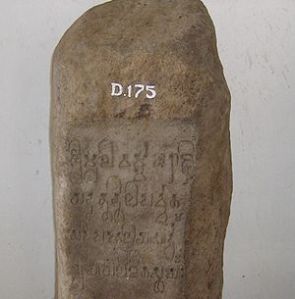
Mulavarman Sanskrit Inscription of Indonesia (Post No.5093)

Written by London swaminathan


Date: 9 JUNE 2018


Time uploaded in London –  16-54  (British Summer Time)


Post No. 5093


Pictures shown here are taken from various sources such as Facebook friends, Books, Google and newspapers; thanks. Pictures may be subject to copyright laws.


I read the following piece of interesting information today about the oldest inscriptions in Indonesia, the largest Muslim country in the world.


“The oldest known inscriptions in Indonesia – we read in The Economic and Administrative History of Early Indonesia (van Naessesn and de Longh 1977)  – are those of East Borneo. Here there are seven stone sacrificial posts, called ‘yuupaas’ by archaeologists, that date from around 400 CE. What is written on them is described in the following terms:-

In clear, well written Sanskrit verses Mulavarman ‘the lord of king’, his father Asvavarman, ‘the founder of the noble race’ – and his grandfather, the great Kundunga, ‘the lord of men’ are mentioned on the occasion of a sacrifice. For that sacrifice, we read on one of the stone poles (yuupaa), this sacrificial post  has been prepared by the  chief amongst the twice born (dvija=Brahmins).


Apparently these priests who had come hither ( as written on the second pole) were rewarded by the King Mulavarman for their religious services.

Thus the third inscription sounds, “Let the foremost among the priests and whatsoever other pious men hear of the meritorious deed of  Muavarman, the king of illustrious and resplendent fame (let him hear ) of his great gift, his gift of cattle, of a wonder tree, his gift of land. For this multitude of pious deeds this sacrificial post has been set up by the priests.

(wonder tree= Krapaka Vriksha in gold or Soma plant?)

A Sanskrit inscription in West Java dating from around 450 CE deals with an occasion on which the Brahmins were presented with 1000 cows.


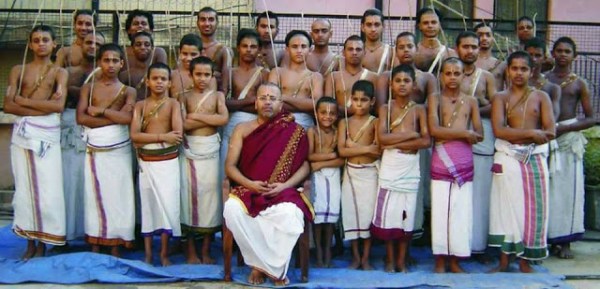
40,000 Brahmins!

(An inscription in the southern most village of India, Kanyakumari,  claims that the founder of the Cola dynasty, finding no Brahmins on the bank of Kaveri, brought a large number of them from Aryavarta and settled them there. His remote descendant Vira Rajendra created several brahmadeya (donation to Brahmins) villages and furnished forty thousand Brahmins with gifts of land (see Gopinath Rao, 1926)


Kanchi Parmacharya (1894-1994), Sri Shankaracharya Chandra Sekhara Indra Sarasvati of Kanchi Kamakoti Peetam mentioned about this inscription in 1950s. Now the world is shedding more light on it. When they discovered it, Borneo island was full of thick forests. They thought that thy were virgin forests and were surprised to find the Yupa posts inside the deep forest. Once upon a time it was a place where people lived happily.


Yupa post is mentioned in 2000 year old Tamil Sangam literature with the same Sanskrit word. Great Pandya King Mud Kudumi Peru Vazuthi did so many fire sacrifices (Yagas) and Kalidasa mentioned  that the Pandya king was always wearing the Yaga clothes. So Yupas were very familiar with the Tamil Pandyas and Cholzas. When Cheran Chenguttuvan was boasting about his historic march to the Himalayas, a Brahmin openly challenged him amidst a big crowd that he must stop the wars and do Yagas and Yajnas. This episode of Madala Maraiyon is in the most famous Tamil epic Silappadikaram. Instead of chopping the head of Madala Maraiyon for this open criticism, Cheran Senguttuvan the great Chera king immediately ordered for the fire sacrifices. He rewarded the Brahmin with gold equal to the weight of huge Chenguttuvan.

Source books- From Turfan to Ajanta, Edited by Eli Franco and Monika Zin, Lumbini International Research Institute, Nepal; Silappadikaram; Kanchi Paramacharyal Discourses, Kalaimakal Karyalayam.


–Subham–


Old Sanskrit Inscriptions in Mosques and on Coins

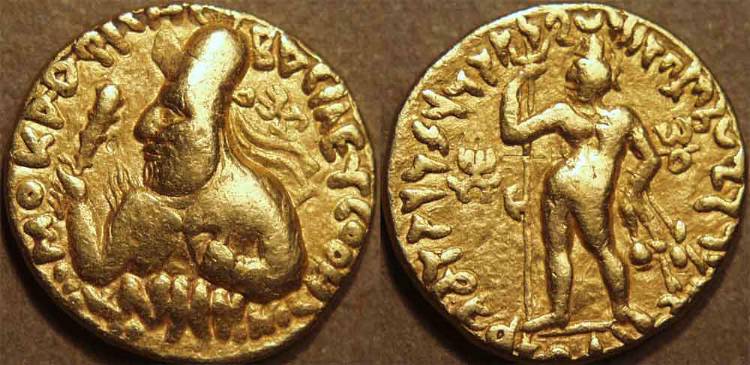
Vima Khadpises gold coin with Sanskrit inscription

(Second part of Sanskrit inscriptions in strange places. Please read the first part)

Sanskrit inscriptions older than Rudradaman (150 AD) are found on coins. A notable gold dinar coin of Vima Khadpises shows Lord Shiva with a Sanskrit inscription. It is written in Kharoshti script along with Greek script. The legend on the coin is: Maharajasa Rajadirajasa Sarvaloka Isvarasa Mahesvarasa Vima Kathphisasa Tratara. It is dated 112 AD. Vima Khadpises had issued coins with Shiva on bull (Rishaba) vahana as well.

In the mosque

Bhoja is a famous name in Sanskrit literature. There were several Bhojas and they were all great Sanskrit scholars. One such Bhoja lived during the times of Kalidasa in first century BC. But now we are looking at a Bhoja who ruled from Dhar in Madhya Pradesh. He built a temple for goddess Saraswathi. It was destroyed during Muslim invasion. The mosque had several parts of destructed temple. Fortunately one structure was left intact and that was the Sanskrit vyakarana (grammar) written as Chitra Kavi. It shows grammar in wheel shaped diagrams or pictures. This Bhoja ruled between 1010 AD and 1060 AD. He was a master of many arts and authored at least thirty books in Sanskrit ranging from astronomy to economics. One of the idols he installed is in British museum in London. But the vyakarana chakra (grammar slokas written in circular diagrams) is in the mosque itself. Now the archaeological survey has arranged for Hindus and Muslims worship on different days.

S E Asia

Most of the South East Asian Sanskrit inscriptions are written in Pallava Grantha script. We may surmise that the South Indian sculptors who travelled from the east coast must have inscribed them. It also shows South Indians were great Sanskrit scholars. South India had produced famous Sanskrit scholars like Adi Shankara,Patanjali,Nilakanta Dikshitar and they in turn wrote a lot of books until last century. In our own times Kanchi Shankaracharya’s Sanskrit composition for world peace was sung by MS Subbalakshmi in the United Nations which reverberated throughout the world.

Sanskrit can’t die as long as India and Hinduism survive. All our personal names and place names and Gods names are in Sanskrit. Even the motto of Government of India is in Sanskrit : Sathyameva Jayate-Truth alone triumphs from the Mundakopanishad. Not only the temple archanas (gods names) but also all the religious literature are in Sanskrit.

The most famous Mantra of the Hindus Gayatri (Rig Veda) has been recited by millions of Hindus for thousands of years without any break. The ancient seers (Rishis) started reciting this from 1500 BC according to Western “scholars”. But Hindus believe them s eternal sounds in the sky like radio waves. If you are at the same wavelength you can catch them like radio frequencies. So no one can call Sanskrit a dead language like Latin. Latin is used by Pope and his circle only. But Sanskrit names are used by millions of laymen. Indians can’t survive without Sanskrit. For instance if someone orders tomorrow that no Sanskrit word should be used for twenty four hours, Indians can’t function for twenty four hours. It is like ordering the entire country to stop using electricity for 24 hours. In short unlike Latin, Sanskrit has mixed with our life which no force in the world can separate for generations to come.

Anyone reading this piece, stop reading and think for a minute- think about your grandparents names, think about your friends’ names and think about your towns names and last but not the least your language. Everywhere you will find Sanskrit. This is true for all the South East Asians as well.

This divine language and its magical spell (mantra) will help India to survive for eons. When all the five big powers have gone India will survive because of it’s motto alone: Satyameva Jayate !

Ancient Sanskrit Inscriptions in Strange Places


Mulavarman’s inscription in Jakarta Museum


Old Sanskrit inscriptions are found around the world in strange places! Sanskrit is the only language in the world to have inscriptions around the world covering a vast geographical area and covering a long historical period. Rig Veda is dated around 1500 BC. This book is in Vedic Sanskrit like Sangam Tamil literature is in ancient Tamil. There are hundreds of Sanskrit inscriptions in Cambodia, Laos, Vietnam, Thailand, Burma, China, Russia, Indonesia and Malaysia. The inscriptions are in different scripts. In India we have Rudradaman’s inscription (150 AD) in Nagari script.

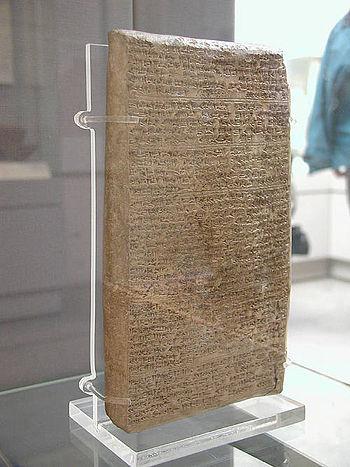
The inscriptions are not only in big cities but also in dark, thick tropical forests of Borneo and a Christian church in Malaysia as well. Mulavarman, a fourth century king did a Yagna and installed seven Yupa posts to commemorate it in Borneo island of Indonesia. It was discovered in an area covered by very thick forests. Egypt, Turkey, Syria, Iran and other Muslim countries have some written documents in the form of letters, manuals or inscriptions where in Sanskrit names or words figure prominently. Rama’s father was Dasaratha is a well known fact. But before him there were three or four Dasarathas and one of them ruled part of Syria ! He gave his daughters in marriage to an Egyptian pharaoh and wrote many letters to him!

According to many scholars, Mahabharata war was fought on Indian soil in and around 1500 BC (Hindus believe it was before 3102 BC) .At the same time there was a Dasaratha (Spelt Thusratta) ruling Syria/Turkey area which are Muslim countries now. That kingdom was called Mittanni (Mitra is one of the names of Surya). We have the Mittanni kings name in Sanskrit. It shows that Sanskrit language existed from the eastern corner of India to Egypt in Africa 3500 years ago. Dasaratha’s letters are very interesting to read. His daughters name are in Sanskrit and they were married to Egyptian King Amenothep (may be Amana Devan ).

We have even recovered a Horse Training Manual written in 1350 BC with Sanskrit words! For thousands of years horses and elephants were trained using only Sanskrit words. Sangam Tamil book Mullaipaatu mentions that elephants were trained by using Sanskrit words in Tamilnadu (Mullaipattau lines 32-36)

The horse manual written by Kikkuli ( Aswa Sena) runs to 1080 lines on clay tablets. Though it is written in Hittite language the numerals Aika,Tera,Pancha, Satta, Nava vartaana (1,3,5,7,9 intervals) and words for colours are in Sanskrit.

Vedic Gods in Muslim country!

We have the Vedic Gods name in an agreement in Bogazkoy in Turkey . This agreement was written by Hittite King Suppililiuma  and Mittannian king Matiwaza (may be Mathi vachanan). The amazing thing about the agreement is the Vedic gods names Indra, Mitra, Varuna,  Nasatyas (Aswins ) all are in the same order as in Rig Veda. Not even the order was changed. It shows that Vedas were used from the plains of Ganges to the land of Syria and Turkey at the same time- 1380 BC!  In Vietnam (Champa in olden days) the Pandyan King’s name Sri Maran is found on an inscription. Sri Maran is a Sanskrit word for Thirumaran (We have one Muda Thiru Maran in Sangam Tamil literature). Please find more details in my article The Pandya King who ruled Vietnam.

In Karatepe ( In Turkey) we have found a long inscription which ended like Indian inscriptions. It is dated 850 BC. Those who deliver Indian religious discourses very often use a phrase, “so long as the sun and moon shines, this will survive——-“. Karatepe inscription finished with these lines which showed Indian influence.

13. Now, if a king among kings, or a prince among princes,
14. or any man who is a man of renown, gives
15. orders for the name of Azitiwada to be effaced from the statue
16. of this god, and puts up his own name, or more than that, if he
covets
17. this city and says, I will make
18. another statue and put my own name on it, and the
19. statue of the god which Azitiwada made, (that of)
20. Baal KRNTRYÅ , which is at the king’s entrance in(to)
25. ……….[Only may the name]
26. of Azitiwada last for ever like the name
27. of the sun and the moon!
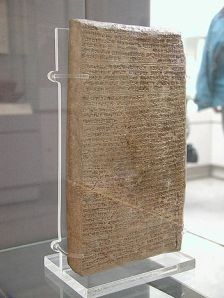
Thusratta’s letter to Egyptian king in Cuneiform script

(The Egyptian King who installed only one God was called Aknaten (Eka Nathan= One God)! The Egyptian river Blue Nile was named after the Sanskrit colour Nila=blue! The word Syria is nothing but Surya (sun). Hurrian is also Suryan (sun). Iran is nothing but Aryan).

In Nepal Kings of Lichavi dynasty had issued more than 85 Sanskrit inscriptions between 463 AD to 770 AD. There were more than 3000 slokas in the inscriptions. In Rudradaman inscription we have beautiful slokas. It shows that people around the world, whether it is Cambodia or Indonesia or Nepal knew bombastic, stylish and ornamental Sanskrit language. All these inscriptions maintain high standards. Art Historian Sri C Sivaramamurti has shown how the greatest playwright Kalidasa had influenced these inscriptions from 2nd century AD.

Tamil inscriptions were also found in South East Asia. But whatever the language, if it is Indian language, it can’t be written without a Sanskrit word.

All the Asokan and all the Tamil inscriptions have Sanskrit words. Prakrit is the spoken form of Sanskrit. In Sanskrit dramas women and clowns speak in Prakrit. Kings, ministers and high ranking officials speak in Sanskrit. Dharma in Sanskrit will be Dhamma in Pali. I have already written that there is no ancient Tamil work without a Sanskrit word.

Sanskrit in Church!

Catholic pilgrims in Malaysia go on a pilgrimage to Bukit Mertajam in Penang. They send petitions and thanks giving at the church of St Anne on 26th July every year. Inside the church complex is the Cherok Tok Kun Inscription in Sanskrit. Unfortunately only a French historian copied it and published it in French. So we did not have the full text.

So called scholars of western countries were partial when they dealt with Sanskrit. They invented new theories like Indo European, Indo Iranian, Indo Aryan ,Ancient, Middle, Later and confused the people. They did not use it for Hebrew, Greek or Tamil. Old Testament or Old Hebrew literature, Iliad and Odyssey, Sangam Tamil Literature were all written in the ancient or archaic forms of the respective languages. No Tamil could understand Sangam literature without commentaries. The spellings for the same Tamil names are different in Sri Lanka, Tamil Nadu, Pondicherry and Mauritius even today. Dhamayanthy and Subramaniam are written with four different spellings by four different Tamil communities!! But they don’t call themselves different people. But if it is Sanskrit, there will be 100 theories about it!

B. B Lal (Former Director General of Archaeological Survey of India) has shown that Indians migrated to West Asia and established Kingdoms like Mittanni 3500 years ago. Baudayana Srautasutra (18.44) mentions it.  In the same way Agastya  and Kaundinya led another group of Indians to South East Asia to establish Hindu kingdoms (Please read my article Did Agastya Drink ocean? And How old is Indian Civilization? )

Baudhāyana Śrautasūtra (18.44) Reference:

Pra-n.a-yauh. pravavra-ja tasyaite Kuru–Pan~cha-la-h. Ka-śi- -Videha- ity etad A-yavam pravrājam. Pratyan. Ama-vasus tasyaite Ga-ndha-rayas Parśvo Ara-t.t.a– ity etad A-ma-vasavam

Tamil Reference:

தேம் படு கவுள சிறு கண் யானை
ஓங்கு நிலைக் கரும்பொடு, கதிர் மிடைந்து யாத்த,

வயல் விளை, இன் குளகு உண்ணாது, நுதல் துடைத்து,
அயில் நுனை மருப்பின் தம் கையிடைக் கொண்டென,
கவை முட் கருவியின், வடமொழி பயிற்றி – முல்லைப்பாட்டு (35- 36).

*********************