WHAT IS THE COLOUR OF DRAVIDAS? BHARATA MUNI REPLIES (Post.9968)

WRITTEN BY LONDON SWAMINATHAN

Post No. 9968

Date uploaded in London – 12 AUGUST  2021     

Contact – swami_48@yahoo.com

Pictures are taken from various sources for spreading knowledge.

this is a non- commercial blog. Thanks for your great pictures.

tamilandvedas.com, swamiindology.blogspot.com

List of ornaments in Natyasastra

Ornaments for Men, Slokas 15-20; Chapter 23, Natyasastra by Bharata

Crest jewel and crown for the head,

Ear ring, ear pendant and ear top for the ears,

Strings of pearls, stringed gold and Harsaka/snake shaped one for the neck,

Bracelet and signet rings for hands and fingers,

Armlets and armbands for above the elbow,

Three stringed necklace to hang on the chest ,

Suspended Pearl necklaces and Garlands etc

Talaka to be worn below the navel and

Golden thread for the waist.

This is how the male characters,viz.that is Gods and Kings should wear ornaments

My comments

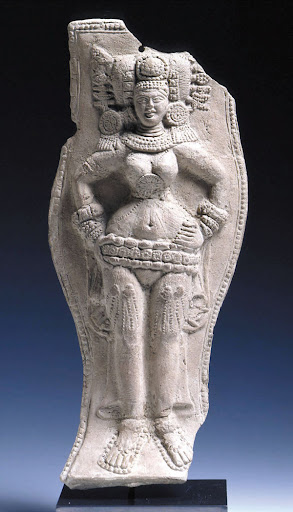
This is not an exaggeration. If one looks at the statues and sculptures at Bharhut, Sanchi, Amaravati and at the paintings in Ajanta, Sittannavasal and Sigiria in Sri Lanka and other places, one will feel the ornaments mentioned by Bharata is only 50 percent. There is more to it.

Look at the pearls used for men and women. It shows South Indian, particularly, Tamil influence. Pearls are available in Gulf of Mannar in Tamil Nadu. In the olden days they were getting from the coast of Gujarat as well.

The word Pearl has link to Tamil PARAL.

xxx
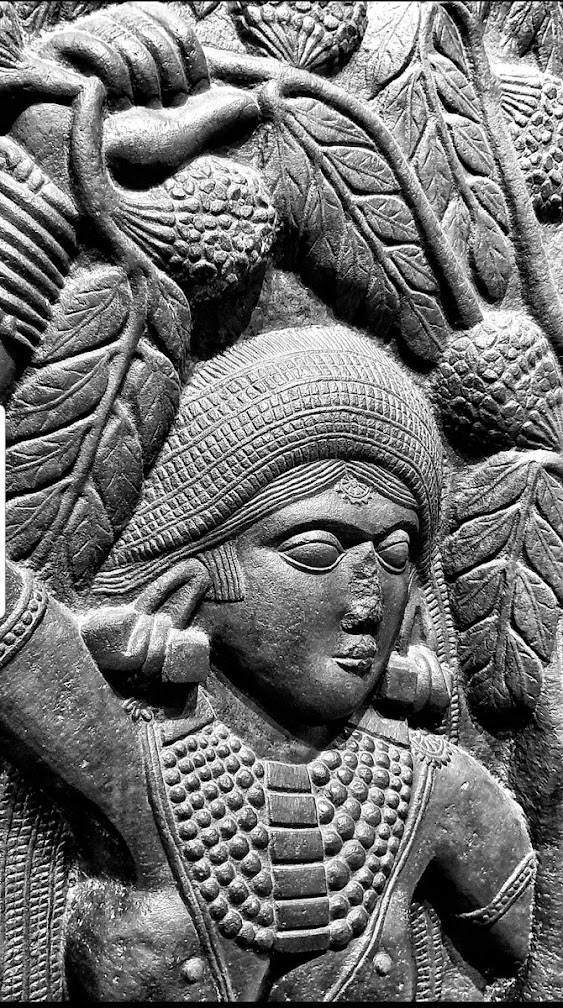
Ornaments for women

Slokas 21-41, Bharata says,

“I shall now speak about the ornaments for females.

Sikhapasa, Sikhajala/ ornaments for tresses,

Pindi patra/ feather for the forehead, crest jewel,

Pearl net with large meshes,hair net are the ornaments for head.

Ear rings , peacock feathers, braids of hair stringed,

Karnika, Karna balayage, Patrakarnika, ring round the ears and ear lotus,

These made by various pearls and ivory for the ear.

The tilak Mark on the forehead in an artistic way.

On the eye brows, marks in the shape of a flower,

Tilaka and Patra lekha/ designs of leaves on cheeks

And the Triveni for the breast.

Collyrium is to be applied to the eyes and red to the lips,

Teeth must have various colours, but four of them to remain white,

So that the whiteness is emphasised by contrast .

For innocent and beautiful women, teeth white like pearls or teeth must be red like lotus petals.

(Pearly Teeth/ Muthup Pal is a Tamil Expression.)

With the colour of Asma/ a kind of stone, their lips would look like as beautiful as sprouts.

The Pearl necklace, the snake necklace, the Manjari, the jewel necklace and the jewel string are the ornaments for the neck. So also is the necklace with two or more strings of gold.

Garlands made of different jewels as well as one studded with pearls will be for breast.

xxx

Make up for Different Characters including Dravidas

Slokas 90-108

One should paint the body according to the region, custom, and age of the character.

Gods Yaksas, Apsaras and Rudras, Brahma and Skanda are to be painted in Gaura/ pale red colour.

Moon, Brhaspati , Venus, Varuna, the stars, ocean, Himalayas and Ganga are to be painted white.

Mars should be red , Mercury and fire yellow.

Narayana and Nara and Vasuki- blue.

Daityas, Danavas, Rakshasas, Guhyakas, mountains other than Himalayas, Pisascas, sky and Yama must be painted dark blue.

The Yaksas, Gandharvas,, the Bhutas, Pannagas,Vidhyadharas,Pitrs/ancestors and monkeys in various colours.

Gods and others, snakes and the other animals ,mountains, rivers, some weapons- all these are treated as living human beings for the sake of drama.

Human beings who dwell on seven continents ( except our own Jambudwipa) are to be painted in burnished gold.

When he comes to Bharata varsha,,Bharata says the following,

Following colours are used

Kings- pale red, dark blue or lotus colour

Happy people- pale red

Vile people, possessed, diseased, inferior births- a sita/ not fair

Sages- plum coloured,

Kirata, Barbara, Andhdra , Dravida, People of Kasi, Kohala, Pulindha and southerners- asi ta / not fair

Sakas,Yavanas,Pahlavas,Bahlikas – pale red complexion

Pancalas, surasenas, Mahisas, Odras, Maghadas, Angas, Vanga and

Kalingas – dark blue complexions

and

Bharata continued the chapter with the details of beards and moustaches.

xxxxx

My comments

Look at the variety of ornaments ancient Hindus used. 2300 year old sculptures and paintings prove what Bharata said is right.

As I mentioned earlier Greek did not influence us; we developed our own dance dramas independently. Colour plays a big role in makeups.

There is no Arya- Dravida racial division.

Cheras, Cholas and Pandyas are missing, because here geographical divisions only are given. More over the kingdoms mentioned here are very ancient, mostly found in Mahabharata.

I commented on the Dialogue poems of Rig Veda, about 20 hymns, as Proto Dance Dramas in one of my articles. One of the Dialogue poems is Dialogue with Rivers. Here Bharata says treat all the animals and inanimate objects in drama as human beings. So one man  or woman will come on stage to represent a river or a mountain. This shows that Rig Vedic dialogue poem with Rivers was also acted by Rishis at the end of or during the Yagas. According to Rig Vedic commentators, some Yagas were done for a whole year or more than a year.

— Subham —

tags — Colours Dance, Dramas, Dravida, Bharata, Men ,ornaments, Woman, ornament 

COLOUR FOR ACTORS AND ORNAMENTS IN NATYASHASTRA (Post No.9961)

WRITTEN BY LONDON SWAMINATHAN

Post No. 9961

Date uploaded in London – 10 AUGUST  2021     

Contact – swami_48@yahoo.com

Pictures are taken from various sources for spreading knowledge.

this is a non- commercial blog. Thanks for your great pictures.

tamilandvedas.com, swamiindology.blogspot.com

Bharata, author of Natyasastra, gives amazing details about the role of colours in the dance dramas. It is not surprising to see the use of colours because we see colour coding even in Bhagavatha. Krishna wearing yellow clothes is called Peetambaradhari and Balarama wearing blue clothes is called Neelambaradhari.

Bharata even applies colour coding for seats. Please see the link given at the end.

Hindus’ obsession with colours began in Rigvedic period. Indra’s horses are described as tawny coloured. Sometimes they are red. Different colour skins of cows are also mentioned by Vedic Rishis.

Coming to ornaments and hair styles, he gives minute details. Before going into the details of colours and ornaments, let me make my comments

  1. Hindu dramas of ancient India followed their own rules in ornaments and dresses. It has nothing to do with the Greek dramas . The big difference between the Hindu statues and Greek statues is ornaments. Greeks don’t wear ornaments. Hindu statues and paintings of Ajanta, Bharhut,Sanchi, Aamaravati are seen wearing ornaments all over the body. They have names for ornaments from head to toe.
  • Colour coding is also not found in Greece .
  • Another important point is the division of Hindu society. Foreigners who translated Vedas made adjective words into proper nouns. Arya should be translated as ‘educated, cultured ‘ etc. But they put capital A for Arya and made them a race. In the same way Dravidians should be southerners. But they put one capital D for the word and made it a race. We have very good evidence against Maxmuller gang, the advocates of Aryan-Dravidian theory. Here in Natyasastra, we don’t find Aryan or Dravidians. If Dravidians are mentioned we know it is about southerners. But they are mentioned with other peoples. In short, they are not racial.

Now let us look at the colours , from Chapter 23 of Natya sastra

Make- up (Slokas 72-89)

“Now I shall speak about the proper make up of male characters.

First of all their bodies should be painted. White, blue, yellow and red are primary colours. There are derivative colours as well as minor colours.

The derivatives are

White + blue = Pandu (yellowish white)

White +red = Padma (lotus colour )

Yellow +blue =  Harita (Green)

Blue + Red = Kasaya (deep red)

Red + Yellow = Gaura (pale red)

Besides these, there are many colours made up of three or four primary colours.

Once the fans get used to these colours, they can easily understand the story. Dialogues may be inaudible, but the colours of characters will help them to recognise them.

Bharata continues with hair styles and ornaments…

Slokas 49-61

Celestial women should be distinguished by their ornaments and costumes, and females of Vidhyadhara, Yaska, Naga and Apsara groups as well as daughters of sages and gods to be distinguished by their costumes. The same rule applies to Siddha, Gandharva, Raksasa  and human females.

(Here we must note that there is no Arya or Dravidian classification. Through out devotional Tamil literature Lord shiva is addressed as Arya. It has no racial connotation.)

The vidhyadhara women should have their hair tied in a top knot, must have many pearls, but wear white costume.

The Yaska and apsara women should wear many jewels, costume to be the same but the yaksa women’s hair must be worn in a Sikha. The naga women should wear ornaments like goddesses, should wear ornaments of pearls and jewels, but the latter must be in the form of wild fruits.

Daughters of sages must wear their hair in a single braid and there should not be many ornaments.

The siddha women must wear plenty of ornaments pearls and emeralds and yellow costumes.

The gandhrva women should wear ornaments of rubies, costumes of saffron colour and a Vina in their hands.

The Rakshasa women should wear blue stones, white protruding teeth and black costume; the goddess pearls and Vaidurya and costumes green like a parrot tail, but this only while they are enjoying love;I n other conditions white.

xxx

Hair styles for different regions are as follows…..

Avanti women- curled hair

Gauda- a sikha pasa

Abhira women- two braids with head band

North east women- a sikhandaka standing up. They must cover their body up to the hair.

Women of South- wear tattoos on their fore heads

Then he describes make ups for different characters.

Let me summarise,

All these show that our drama and dance have unique features. The oldest portion of Natyasastra goes back to fifth century BCE.

I will give the list of ornaments separately

Links to old articles:-

Natya sastra | Tamil and Vedas

https://tamilandvedas.com › tag › natya-sastra

  1.  

27 Feb 2021 — The ”Natya Shastra” is the oldest extant literature in the field of dramatic arts. The black-coloured sculpture, conceptualised by classical …


Colour Coding of Seats in Ancient Theatres! | Tamil and Vedas

https://tamilandvedas.com › 2014/05/13 › colour-codin…

  1.  

13 May 2014 — In the Natya sastras we have references to 18 different types of stages. … The Natyasastra of Bharata is a compendious treatise on …

You visited this page on 03/08/21.

–Subham–

tags- natya sastra, colours, costumes, ornaments, Bharata