
Compiled by London swaminathan
swami_48@yahoo.com
Date: 25 JANUARY 2019
GMT Time uploaded in London –11-31 am
Post No. 5984
Pictures shown here are taken from various sources including google, Wikipedia, Facebook friends and newspapers. This is a non- commercial blog
compiled by London
swaminathan
Fluorine is one of the 118 known elements. It belongs to the
Halogen group.
Fluorine is useful to us in the following ways:-
Tooth paste to strengthen the tooth enamel
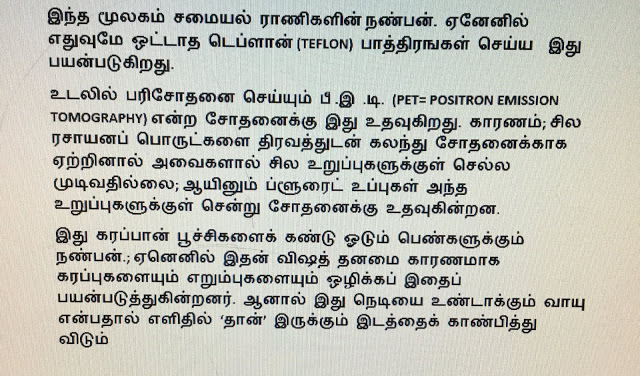
Non sticky Teflon pans
P E T – Positron Emission Tomography in health checks
Landing on Moon and other Space Explorations
Important Medicines
First let us look at some interesting tit bits:-
Contrary to popular belief, it was not space exploration that
led to the development of the non -stick frying pan, but the other way round.
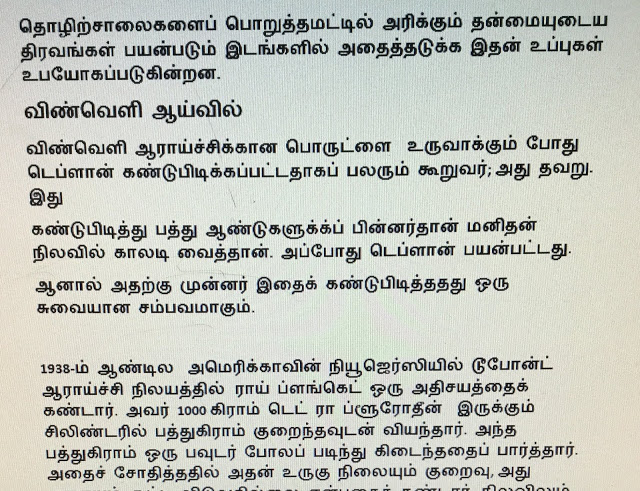
The non- stick frying pan relies on Teflon, the polymer Tetrafluoroethene. That
was discovered by Roy Plunkett at the Du Pont research laboratory in New
Jersey, U S A, in 1938.
((posted by swamiindology.blogspot.com AND tamilandvedas.com))
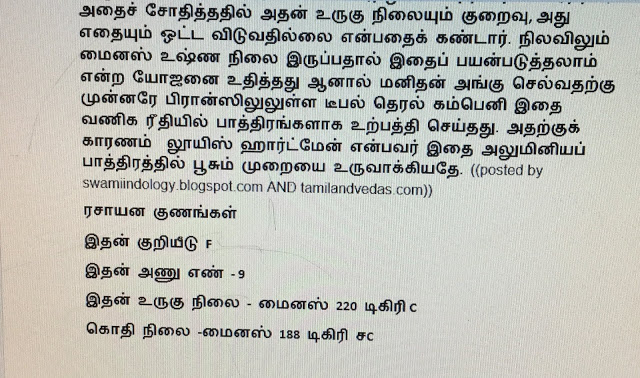
One morning he opened a cylinder of tetrafluoroethene which was supposed to hold 1000 grams of the gas but only 990 grams came out. The missing ten grams had turned into a curious white powder which was a plastic with remarkable properties. It would not dissolve in anything, was not affected by heat, wouldn’t burn and was not attacked by hot corrosive acids. More unusual was its ability to flexible down to minus 240 Degree C. It was this property which made it so important for use in space and on moon where such temperatures prevail.
Later Louis Hartman found a way to use this on aluminium pans in 1950s. The French company Tefal, marketed the first non -stick frying pans ten years before man set foot on the Moon.
Nobel Prize
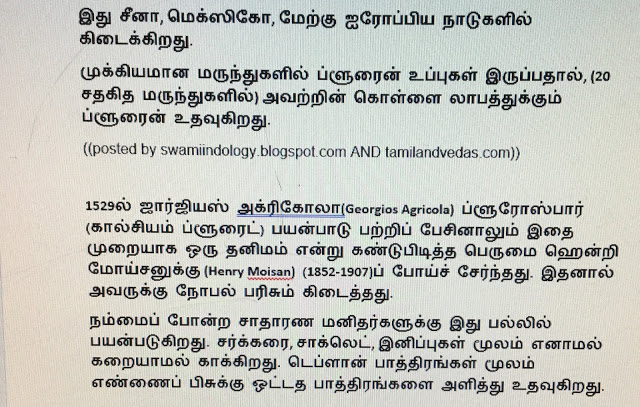
Georgius Agricola described the use of fluorspar, calcium fluoride, in 1529. But it was Henri Moissan who extracted fluorine and got Nobel prize for chemistry in 1906.
Fluorine was named meaning ‘to flow’.
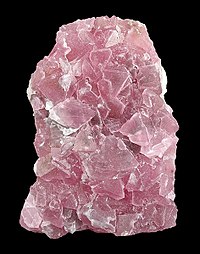
Chemical symbol F
Atomic number 9
Melting point minus 220 degree C
Boiling point minus 188 degree C
Useful to humans
In humans, most of the fluoride accumulates in the bones and
teeth. It strengthens both, converting the calcium phosphate of which they are
made into fluorapatite, a harder material. This in tooth enamel, can better
resist the corrosive effect of acids produced by oral bacteria acting on sugar
for this reason it is added to water supplies and tooth pastes.
Cockroach killer
Fluorine is poisonous. But humans need it in minute quantities.
Laboratory animals without fluorine in diet became anaemic and infertile.
Because of its toxic effects, it is used in insecticide to kill cockroaches and
ants. ((posted by
swamiindology.blogspot.com AND tamilandvedas.com))
47 people died
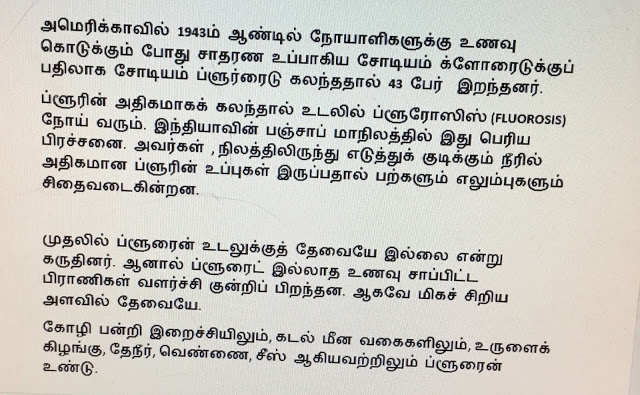
At a hospital in the USA in 1943, patients were served
scrambled eggs to which sodium fluoride had been added instead of normal salt
sodium chloride. 163 people became sick and 47 of them died.
Punjab Problem
If too much fluorine is taken, fluorosis disease comes. It
results in mottled teeth and deformed skeletons. In Punjab, people drink water
with high levels of fluoride and millions of people are affected by this.
Fluoride comes to us from foods such as potatoes, butter,
cheese, sea fish, pork and chicken.
Fluorine is produced in China, Mexico and west Europe.
PET
Fluorine has an effect on enzymes, effectively blocking their
activity. This is useful in certain experiments and treatments.
The isotope fluorine 18 is used in medical diagnosis through
the technique known as P E T , positron emission tomography. The half- life of
the isotope is only 110 minutes. It can go into places in our body which other
substances can’t do. This helps us to study the internal organs.
Twenty percent of important medicines are made with fluorine
compounds and the pharmaceutical companies make big money with it.
Friend of women in kitchen, friend of pharmaceutical
companies, friend of every tooth paste using human and friend of space
explorers is FLUORINE.
((posted by swamiindology.blogspot.com AND tamilandvedas.com))
Source Book:-Nature’s Building Blocks
John Emsley
Xxxx


















 Tamil and Vedas