Post No.7782
Date uploaded in London – 4 April 2020
Contact – swami_48@yahoo.com
Pictures are taken from various sources for spreading knowledge; this is a non- commercial blog. Thanks for your great pictures.
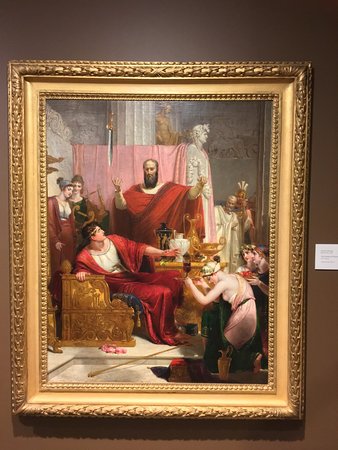
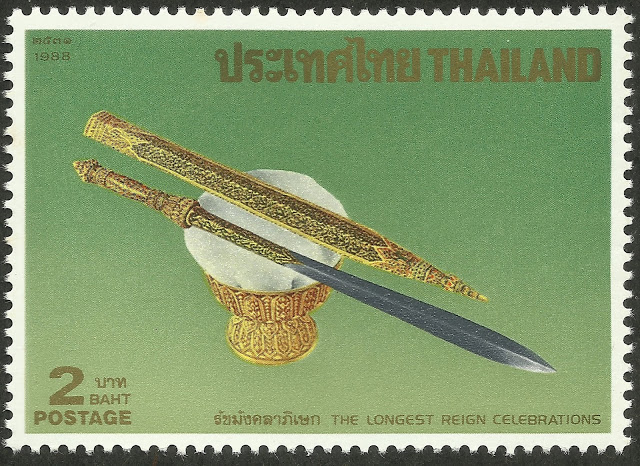
There is a very interesting story in Greek literature. The story is ‘The Sword of Damocles’. No student of English literature could miss it, because it is used by many writers and speakers from Cicero to John F. Kennedy and Nikita Kurushev. Shakespeare, Chaucer and all famous writers used the phrase.
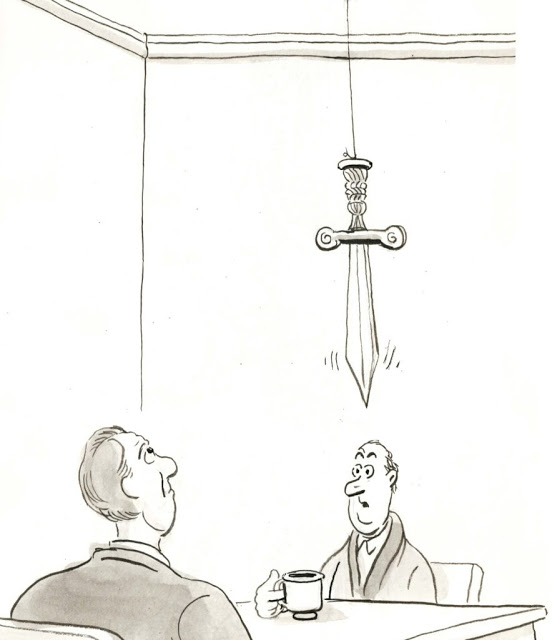
So, what is the story?
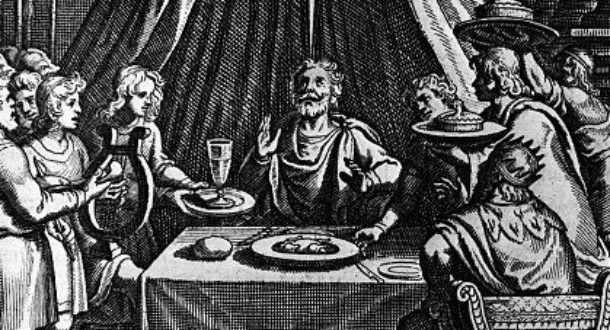
Damocles, 4th century BCE, in classical literature, was a courtier of the elder Dionysius , ruler of Syracuse ,Sicily (now part of Italy) . When Damocles praised Dionysius sky high and said that he was very fortunate to be a king. But Dionysius invited him to a feast where he symbolically hung a sword over Damocles’ head by a single horse hair to demonstrate the precariousness of the happiness of the kings .
Later versions of the episode are more interesting. Cicero popularised by saying that rulers are not enjoying.
In fact Dionysius was a tyrant . He had so many enemies around him and he did not allow anyone else other than his daughter to cut his hair. He invited Damocles to rule the country for a day when he hung the sword over the throne. Fearing for his life Damocles ran away. Now we know how difficult to is be a Prime Minister or President where there are unruly opposition parties. US President John F Kennedy and Nikita Kurushev of USSR also used the phrase in the same context. tamilandvedas.com, swamiindology.blogspot.com
Tamil Sword
Tamils also used the sword but in a different context. They saw a sword over their head in the form of Sun. They told the world “Look at the sun. it is shining over head and you people praise it. But in reality it is a sword that cuts, saws your life every day. That is, every day passed is Minus 1 in your life.
A woman by name Miss Allur Namullai used it for the first time. It is in Kuruntokai, part of 18 books of Sangam Age. That lady saw a sword every early morning . When she had menstruation she cried that its going to deprive her of husband’s hug for three days. Very rare are the verses about menstruation 2000 years ago. Hindu women never talk about it openly. Hindu women never allow any one to touch them during that three day period. They wont even water the plants.

Nan Mullai means good Jasmine flower. The genus Jasminium has hundreds of varieties and Sanskrit is the only ancient language with 100s of names for jasmine and 100s of names for lotus. Many Sangam Age poets who lived 2000 years ago took the prefix Good for their names; in Sanskrit it goes like Su +Mati, Su+ Niti, Su+ Gandhi, Su +Nita etc. In Tamil it is Nan+ Mullai, Nak +Kannai, Nac+ Chellai, Nap+ Pinnai. In short, they followed the Sanskrit prefix GOOD = Su=Na.
Allur Nan Mullai is a translation of Su Kumari. Sukumari is one of the jasminium (Mullai) varieties in the Sanskrit dictionary.
Around 4th or 5th century CE, came the greatest of the ancient Tamil poets Tiruvalluvar and composed 1330 didactic couplets. In 140 couplets under ‘ascetism’ he gave the essence of Hinduism. In fact, he divided the book into three chapters called Dharma, Artha and Kama and placed Moksha under subheading ‘ascetism’.
This ascetism has a chapter called’ Instability’ where he compared a day (sun rise ) to a sword-
“TIME SEEMS ALL SMILES AND LAUGHTER, BUT VERILY IT IS A SAW THAT CEASELESSLY SAWS AWAY THE LIFE OF MAN”.- Kural/couplet 334
Another translation of the same couplet 334 is
“The day which measures time is comparable to a sword which , day by day, cuts short the life of man “– 334

MILTON TOO SAID THIS…………
Dr S M Diaz, Inspector General of Police, Tamil Nadu, India comments on this verse as follows (in his two Volumes titled TIRUKKURAL)
“The day shows itself as an entity, but in reality it is just
The relentless movement of a saw, that cuts through life” – Kural 334.
The day is not just the entity that it appears to be; it is the inexorable movement of a saw that cuts through life. The interpretation is based on Parimelllagar’s. Manakkudavar would interpret the expression ‘naal ondrupol kaatti’ as meaning, showing the day itself as an object of enjoyment. The comparison of time to a sword is found also in the Sangam literature Kurunthokai.
Milton, the doyen among English poets, has given expression to the same thought thus –
“The scythe of time mows down “.
xxx tamilandvedas.com, swamiindology.blogspot.com
Naladiar is a book with 400 moral verses. In fact, Jains wanted to compete with Hindu poet Tiru Valluvar and composed 400 verses on the same didactic topics. One of the Jain poets says,
“Yama, the God of Death devours away your life daily using the resplendent sun as his measure. Perform therefore virtuous deeds and become compassionate, for otherwise all those that are born will be considered as unborn.” – Naladiar verse 7
Vedic God Yama is Kuutru or Kuutram in Tamil.
Swami Vivekananda also said, “They alone live who live for others, the rest are more dead than alive”
tags — Tamil sword, Greek sword, Damocles, Naan Mullai, Kuruntokai, Sun saw
–subham—


R.Nanjappa (@Nanjundasarma)
/ April 4, 2020Uncertainties of the king’s life were well known and appreciated by all good kings. Apart from the fact that grave responsibilities accompany great power, they cannot even sleep in peace, without fear or anxiety.Shakespeare said it so well in Henry IV, Part II :
How many thousands of my poorest subjects
Are at this hour asleep! O sleep, O gentle sleep,
Nature’s soft nurse, how have I frightened thee,
That thou no more will weigh my eyelids down,
And steep my senses in forgetfulness?
Why rather, sleep, liest thou in smoky cribs,
Upon uneasy pallets stretching thee,
And hush’d with buzzing night-flies to thy slumber,
Than in the perfum’d chambers of the great,
Under the canopies of costly state,
And lull’d with sound of sweetest melody?
O thou dull god, why liest thou with the vile
In loathsome beds, and leav’st the kingly couch
A watch-case or a common ‘larum-bell?
Wilt thou upon the high and giddy mast
Seal up the ship-boy’s eyes, and rock his brains
In cradle of the rude imperious surge,
And in the visitation of the winds,1725
Who take the ruffian billows by the top,
Curling their monstrous heads, and hanging them
With deafing clamour in the slippery clouds,
That with the hurly death itself awakes?
Canst thou, O partial sleep, give thy repose1730
To the wet sea-boy in an hour so rude;
And in the calmest and most stillest night,
With all appliances and means to boot,
Deny it to a king? Then, happy low, lie down!
Uneasy lies the head that wears a crown.
[I have heard the expression in the last line in Tamil as: அருமந்த அரசாட்சி அரிதோ, மற்றெளிதோ தான் attributed to Kamban, but I am not sure.]
These days under democracy. the rulers have fixed tenures, but in India, even that is not assured! So the glorious uncertainties continue, except under brutal dictatorships.
The other theme, the Transience of Time, is a fundamental aspect of our philosophy, along with the transience of youth and that of wealth. Time passes unnoticed. We celebrate the return of New Year, or of the seasons, without realising what it implies for our own life! Acharya Shankara put it so well:
मा कुरु धनजनयौवनगर्वं
हरति निमेषात्कालः सर्वम् ।
Don’t become proud of your wealth, retinue or youth.
Time snatches away everything in a trice.
दिनयामिन्यौ सायं प्रातः
शिशिरवसन्तौ पुनरायातः ।
कालः क्रीडति गच्छत्यायु-
स्तदपि न मुञ्चत्याशावायुः ॥
Day and night, dusk and dawn, winter and spring come and go. But this is how time is playing with us, our life is ebbing. Yet the storm of desire does not leave.
But this has not been confined to the serious books of philosophy. Our wandering minstrels carried the message to the masses. The Indian psyche is saturated with this idea, so much so that even our celluloid poets sang of this, ensuring that millions heard it .
In the 1954 Hindi movie BOOt POLISH , Kavi Saraswati KUmar Deepak wrote these lines:
raat gayi phir din aata hai
issi tarah aate jaate hi
ye saara jeewan jaata hai
itna bada safar duniya ka
ik rota ik muskaata hai
ik rota ik muskaata hai
ha aa aa aa aa
kadam kadam rakhta hi raahi
kitni door chala jaata hai
ek ek tinke tinke se ae ae
ek ek tinke tinke se ae
panchhi ka ghar ban jaata hai
Night has gone, another day comes
Thus coming and going,
Our entire life passes.
How long is the journey of life
One cries, one laughs
Going step by step, how long does he go!
Like, with twig after twig, the bird’s nest is complete !
This same sentiment was expressed in another HIndi movie Aap Ki Kasam twenty years later, by poet Anand Bakshi.
ज़िंदगी के सफ़र में गुज़र जाते हैं जो मकाम
वो फिर नहीं आते, वो फिर नहीं आते
Zindagi ke safar mein guzar jaate hain jo makaam
Woh phir nahin aate. woh phir nahin aate
The marks (places) we pass in the journey of life,
they never return, they never return.
सुबह आती है, शाम जाती है
सुबह आती है, शाम जाती है यूँही
वक़्त चलता ही रहता है रुकता नहीं
एक पल में ये आगे निकल जाता है
आदमी ठीक से देख पाता नहीं
और परदे पे मंज़र बदल जाता है
एक बार चले जाते हैं जो दिन-रात सुबह-ओ-शाम
वो फिर नहीं आते, वो फिर नहीं आते
ज़िन्दगी के सफ़र में …
Subah aati hai, raat jaati hai
Subah aati hai, raat jaati hai yun hi
Waqt chalta hi rehta hai rukta nahin
Ek pal mein yeh aage nikal jata hai
Aadmi theek se dekh pata nahin
Aur parde pe manzar badal jata hai
Ek baar chale jaate hain jo din-raat, subah-shaam
Woh. woh phir nahi aate, woh phir nahi aate
Morning arrives, night departs,
Time keeps moving on, doesn’t stop,
Just in a moment (trice), it moves ahead!
Man is not able to perceive this properly
And the view keeps changing on the screen
Zindagi ke safar mein guzar jaate hain jo makaam
Woh phir nahin aate. woh phir nahin aate.
What we pass by in the journey of life, they never return.
Perhaps, the last word here is by Uncle Shakespeare:
Tomorrow, and tomorrow, and tomorrow,
Creeps in this petty pace from day to day
To the last syllable of recorded time,
And all our yesterdays have lighted fools
The way to dusty death. Out, out, brief candle!
Life’s but a walking shadow, a poor player
That struts and frets his hour upon the stage
And then is heard no more. It is a tale
Told by an idiot, full of sound and fury,
Signifying nothing. [Macbeth]
On another level,
Buddha taught us to live in the moment, not to ruminate on the past, or dream about the future. Bhagavan Ramana used to say that the Present is the only reality: the past is only a memory, the future is not yet, and when it comes, we will only experience it as today. So the present is the only reality.
Not surprisingly, this too is expressed by poet Sahir Ludhianvi in a song in 1965 ( Movie: Waqt)
आगे भी जाने ना तू, पीछे भी जाने ना तू
जो भी है बस यही एक पल है
Aage Bhi Jaane Na Tu, Pichhe Bhi Jaane Na Tu
Jo Bhi Hai, Bas Yahi Ek Pal Hai
You do not know what lies ahead of you,
Nor do you know what is behind you-
All that you have is just this moment.
अनजाने सायों का राहों में डेरा है
अनदेखी बाहों ने हम सब को घेरा है
ये पल उजाला है, बाकी अंधेरा है
ये पल गवाँना ना, ये पल ही तेरा है
जीने वाले सोच ले, यही वक्त है कर ले पूरी आरजू
Anjaane Saayo Kaa Raaho Me Deraa Hai
Andekhi Baaho Ne Ham Sabako Gheraa Hai
Ye Pal Ujaalaa Hai Baaqi Adheraa Hai
Ye Pal Ganvaanaa Na Ye Pal Hi Teraa Hai
Jinevaale Soch Le Yahi Vaqt Hai Kar Le Puri Aarazu
Aage Bhi
UNknown shadows are camping on the path,
Unseen hands have enclosed (embraced) us
This moment alone shies, rest is all darkness,
Don’t miss this moment, this is all you have
O people, think- this is the time to fulfil your wishes.
इस पल के जलवों ने, महफ़िल सवारी है
इस पल की गर्मी ने धड़कन उभारी है
इस पल से होने से, दुनियाँ हमारी है
ये पल जो देखो तो, सदियों पे भारी है
जीने वाले सोच ले, यही वक्त है कर ले पूरी आरजू…
Is Pal Ki Jalavo Ne Mahafil Savaari Hai
Is Pal Ki Garmi Ne Dhadakan Ubhaari Hai
Is Pal Ke Hone Se Duniyaa Hamaari Hai
Ye Pal Jo Dekho To Sadiyo Pe Vaari Hai
Jinevaale Soch Le Yahi Vaqt Hai Kar Le Puri Aarazu
Aage Bhi
The light of this moment has graced this gathering
The warmth of this moment makes our heart race,
Because of this moment, the world is ours!
This moment is more valuable than ages.
O people, think….
इस पल के साए मे अपना ठिकाना है
इस पल के आगे ही हर शे फ़साना है
कल किसने देखा है कल किसने जाना है
इस पल से पायेगा जो तुझको पाना है
जीने वाले सोच ले यही वक़्त है कर ले पूरी आरज़ू
आगे भी…
Is Pal Ke Saae Me Apanaa Thikaanaa Hai
Is Pal Ki Aage Ki Har Shay Fasaanaa Hai
Kal Kisane Dekhaa Hai Kal Kisane Jaanaa Hai
Is Pal Se Paaegaa Jo Tujhako Paanaa Hai
Jinevaale Soch Le Yahi Vaqt Hai Kar Le Puri Aarazu
Aage Bhi
In the shadow of this moment is our settlement
Beyond this moment, everything is just a story
Who has seen tomorrow, who knows it?
Whatever you want to achieve, it has to be at this moment.
O people, think…..
Superficially, this song may appear to be epicurean , but deep down it emphasises the fact that the reality of time, and of life is this moment. One has to seize the moment for any achievement-spiritual or material. Not a moment to be wasted.
Tamil and Vedas
/ April 4, 2020Thanks for adding lot of interesting points. it deserves to be a separate article/post. You are welcome to contribute articles whenever you feel so. We will post it as separate post in your name.