Are Children Innocent or Naughty? Why did the Lady Teacher Cry?

Chinese_students_f_3348697k

Compiled by London swaminathan

Post No.2233

Date: 10  October 2015

Time uploaded in London: 22-13

Thanks for the pictures.

Don’t use pictures. Don’t reblog for at least a week.

Teachers and Class rooms

In the classroom the lady teacher was trying, without success, to quell what looked like a small riot. The principal was passing through the hall, stopped and what all the noise was about.

The pretty young teacher was almost in tears. “I was explaining the students the difference between the concrete and abstract, stating that abstract is something you can’t see, and concrete is something you can see. Then I asked James to give me an illustration.

“My pants are concrete. Yours are abstract, he answered”.

The principal, attempting to repress a smile, helped the teacher restore order to her class, and then, going into the hall, finally gave vent to the laughter he could no longer restrain.

Xxx

Children are Innocent

The day of a big snowstorm, the country school teacher felt called upon to warn her students against playing too long in the snow. She said, “Now, children, you must be careful about colds and over exposure. I had a darling little brother only seven years old. One day he went out in the snow with his new sled and caught cold. Pneumonia set in and three days later he died.”

The room was silent and then a youngster in the back row raised his hand asked, “Where is his sled?.”

Xxx

In English class a small boy was told to write an essay about King Alfred, but was warned not to elaborate overly much on the family story of the cakes. The boy delivered his essay which, after summing up the chief historical facts, concluded with, “There is another incident in King Alfred’s life. One day he visited a house where a certain woman lived – and the less said about that, the better.”

Xxx

bhadravathy sai school

Too beautiful to describe!!

When the pupils are assigned the task of writing an essay on “the most beautiful I ever saw”, the least aesthetic young man in the class handed in his paper first with astonishing speed. It was short and to the point –“The most beautiful thing I ever saw was too beautiful for words.”

Xxx

Stack of One Hundred Dollar Bills U.S.

Stack of One Hundred Dollar Bills U.S.

Million Dollar Question!!

Given the assignment of writing a composition about what they would do if they had a million dollars, all of the children in the class except Willy were busily writing away.

The teacher, becoming of his aware of his idleness, said severely, “Willy, don’t you know that you are supposed to tell what you would do if you had a million dollars?”

“Well”, said the boy, lazily leaning back on his chair, “this is exactly what I would do if I had a million dollars.”

–Subham–
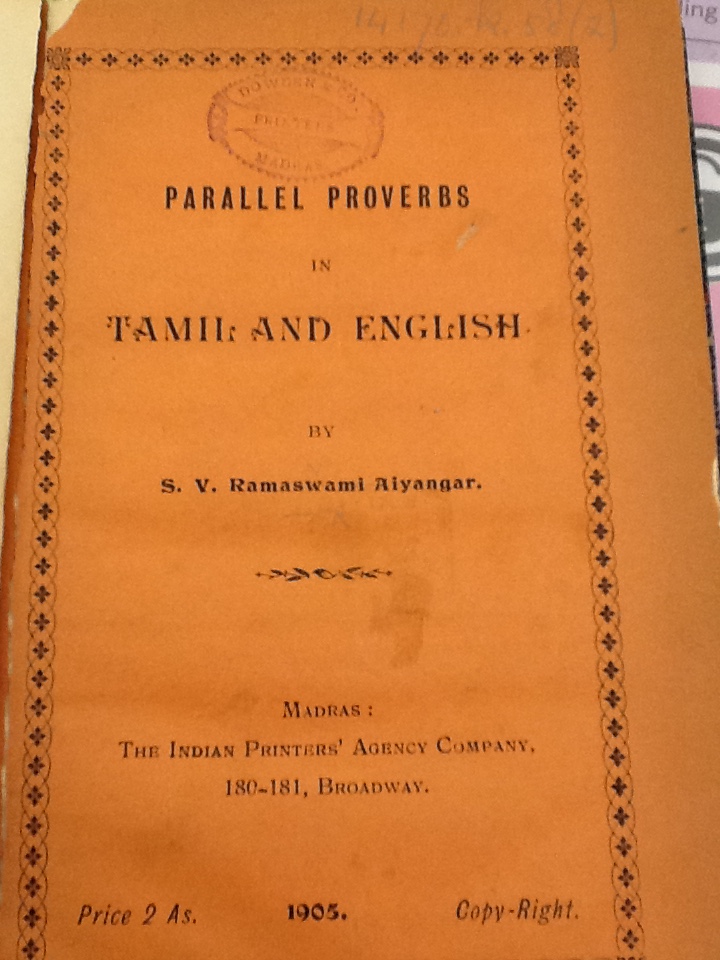
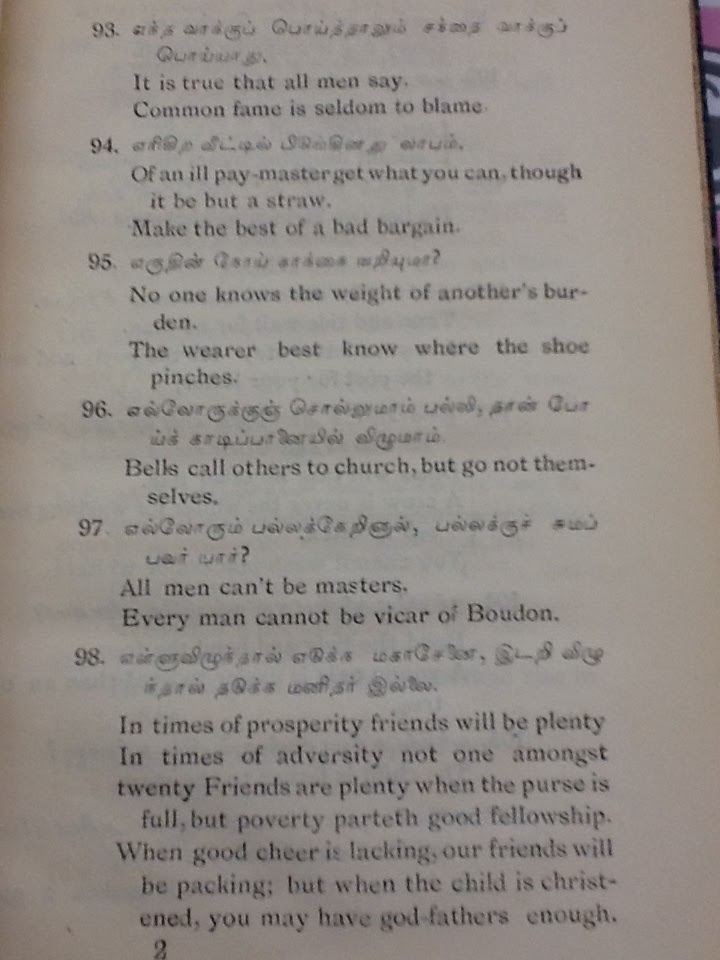
தமிழ்ப் பழமொழிகள்: TAMIL- ENGLISH PROVERB BOOK -2 (First Part)

Compiled by London swaminathan

Post No.2219

Date: 6   October 2015

Time uploaded in London: 15-48

Thanks for the pictures.

Don’t use pictures. Don’t reblog for at least a week.

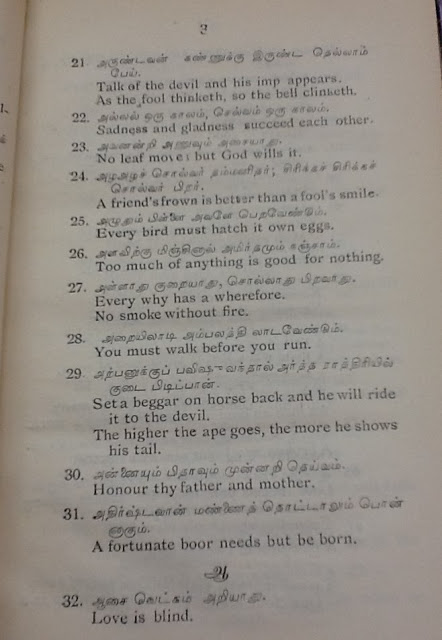
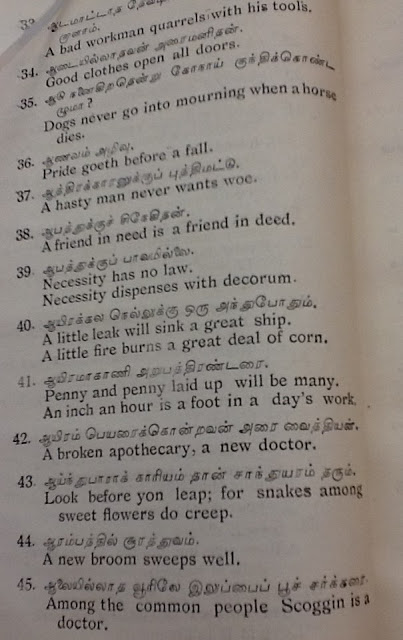
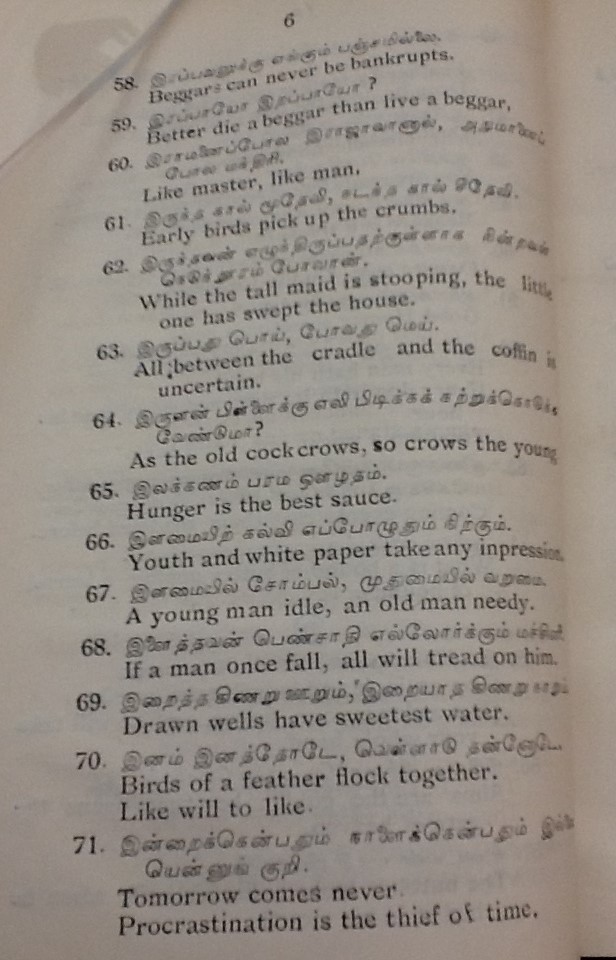
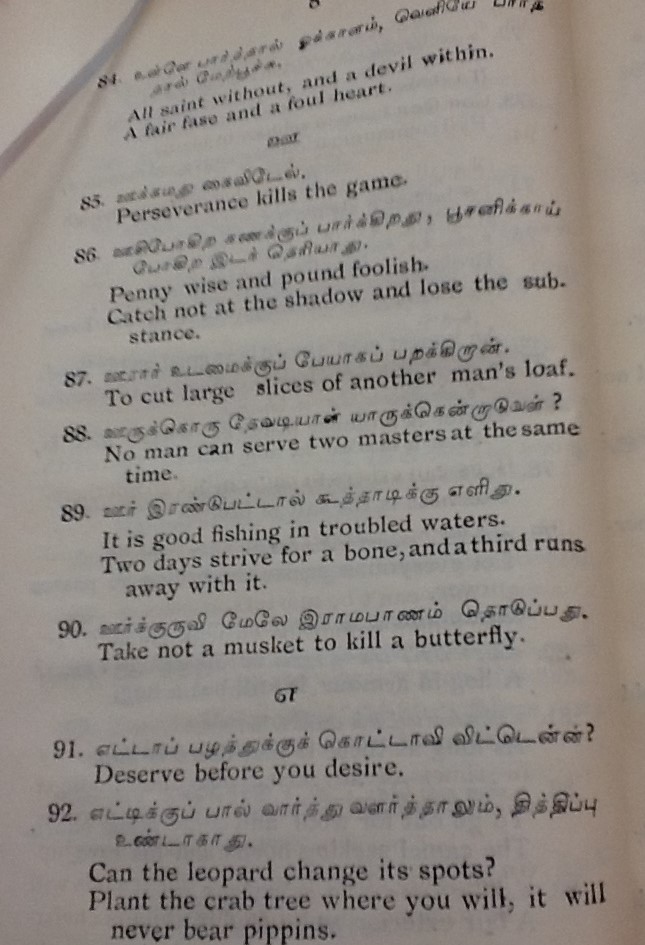
On 17th August I posted (Post No.2078) an old book with 108 Tamil proverbs and its English equivalents in this blog. Today I am posting another old book with 348 Tamil proverbs and their parallel proverbs in English:


Title of the Book: Parallel Proverbs in Tamil and English

Author of the Book: Ramaswami Ayyangar

Year of Publication: 1905

Contents: 348 Tamil Proverbs and 348 English Proverbs or phrases

Source: British Library, London.

Though it is over 100 years old, it is very relevant for today. We can use every proverb even today in our conversation.

Here are the book pages; please zoom in and enlarge and then read the pages.

In the first part I am posting only 10 பக்கங்கள்

IMG_2731

IMG_2732

பழமொழி: அச்சில்லாமல் தேரோடுமா?

பழமொழி: அரண்டவன் கண்ணுக்கு இருண்டதெல்லாம் பேய்.

பழமொழி: ஆனைவரும் பின்னே, மணி ஒசை வரும் முன்னே

பழமொழி: உயரவுயரப் பறந்தாலும்,  ஊர்க்குருவி  பருந்தாகுமா?

பழமொழி: ஐயர் வரும் வரைக்கும்    அமாவாசை காத்திருக்குமா?

தொடரும்………………………………………

Saints do not Toil for Food!

woodcutter_cutting_wood

Compiled by London swaminathan

Post No.2215

Date: 4   October 2015

Time uploaded in London: காலை 15-15

Thanks for the pictures.

Don’t use pictures. Don’t reblog for at least a week.

There was a Sadhu (ascetic) in Malabar, a tall and stout person. He was in the police service before becoming a sadhu. He used to wear only a small towel round his waist. Once when he was going for his Biksha ( asking for alms/food), a householder, seeing his good physique, asked him why he should not work and earn his bread, instead of begging for it. The sadhu was told that he would be given a meal if he was prepared to cut a few logs of firewood that were lying in the householder’s court yard.

The Sadhu without uttering a word, started splitting the firewood with an axe given to him and, within a short time, cut the whole lot and stacked the pieces in the proper place. Then, leaving the axe near the stack, the Sadhu simply walked away.

The householder saw the Sadhu going without taking food. He called him back and asked him why he was going before getting his meal. The Sadhu then replied, “I do not take my food where I work, and I do not work where I take my food!”. This means Sadhus subsist only upon alms offered to them with love.

–Story told by Swami Ramdas of Anandashram, Kerala.

OCTOBER 2015 CALENDAR

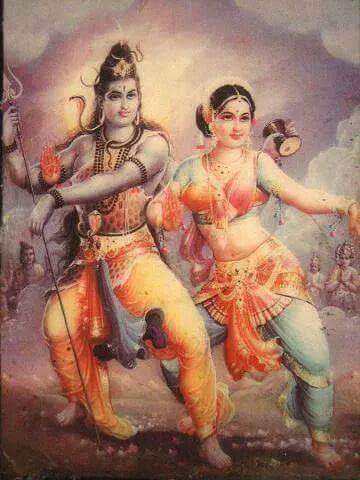
dance siva uma

Quotations from Swami Ramdas

DON’T REBLOG IT AT LEAST FOR A WEEK!  DON’T USE PICTURES; THEY ARE COPYRIGHTED BY SOMEONE.

Compiled  by London swaminathan

Date: 27 September 2015

Post No: 2193

Time uploaded in London :– 16-56

(Thanks  for the pictures) 

WE ARE GIVING 31 BEAUTIFUL QUOTATIONS FROM SWAMI RAMDAS’ (1922-1963) WRITINGS. HE FOUNDED ANANDASHRAM NEAR KANHANKADU IN NORTH KERALA.

Every month Quotations from Hindu sources are given in the Good Thoughts Calendar.

Important Days:

OCTOBER 2 GANDHI JAYANTHI 8 and  23 EKADASI 12 MAHALAYA AMAVASAI/NEW MOON,13 NAVARATRI BEGINS,21 SARASWATHI PUJA,22 VIJAYA DASAMI,24 MOHURAM, 27 PURNIMA /FULL MOON.

AUSPICIOUS DAYS: 19,22, 25, 26.

Jammu, aUGUST 27 An artist dressed up as Shri Krishna dance during shoba yatra on the eve of Janmashtami in Jammu city on Tuesday. Photo by Vishal Dutta

Jammu, Janmashtami

October 1 Thursday

Let life be like a flower – born in full bloom and given away utterly – petals, scent and all to the gardener who brought it into existence.

October 2 Friday

God works in His own mysterious ways and, wherever we turn, His hand is visible.

October 3 Saturday

You cannot dislike people and expect God’s grace to come to you.

October 4 Sunday

Contentment is a gift of God which we get through faith in and submission to Him.

October 5 Monday

To soothe the aching heart, to infuse courage into the drooping spirit, to bring upon smile the face pale with woe, to assuage sorrow by loving word are the works of a God-lover.

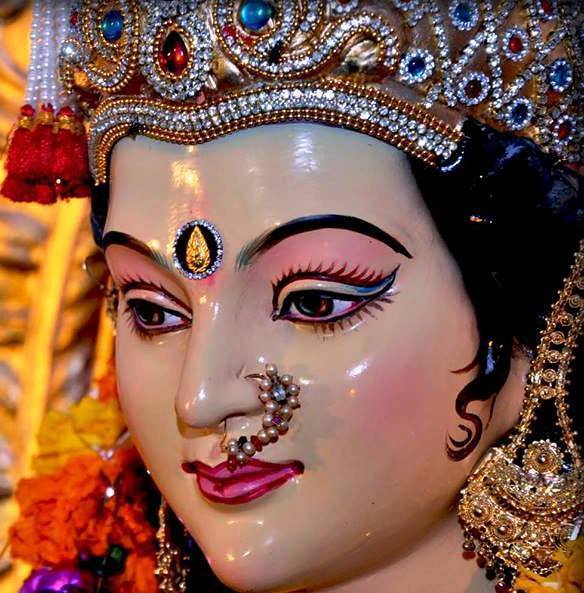
amman lakshana

October 6 Tuesday

A saint is a real redeemer and a saviour of the fallen soul, for a saint is God himself manifest in flesh and blood.

October 7 Wednesday

Let the flame of life burn with the splendour that heals, uplifts and serves humanity.

October 8 Thursday

Universal love is not a thing to believed or not believed. He who possesses a universal vision spontaneously lives it.

October 9 Friday

Be a blazing flame of Truth, be a bounteous blossom of love and be a soothing balm of peace.

October 10 Saturday

We want a religion that knits man to man, irrespective of any apparent distinctions, into a common community on earth.

baktas

October 11 Sunday

Love makes life gentle, soft and sweet. Love is the crown of spiritual experience. Love embodies the highest realization of Godhead.

October 12 Monday

It is not philosophy, however high soothing, that can really sweeten life. It is simple love and joy that elevates, ennobles and liberates it.

October 13 Tuesday

Peace dawns in the soul when the tumult of passion ceases.

October 14 Wednesday

Every blade of grass, plant and tree says: “Give your all like us and make world’s life beautiful”.

October 15 Thursday

The sea speaks incessantly: “Thy heart be like my billows – Rise and fall with love and compassion.”

bhakta mira friends

Picture of Bhakta Meera

October 16 Friday

Love fills the heaven above and the earth below. Love alone survives and all passes away.

October 17 Saturday

Let your eyes look with kindliness, your tongue speaks with mildness and your hand touch with softness.

October 18 Sunday

The secret of true joy lies in self-sacrifice and not in self-seeking.

October 19 Monday

When thy heart glistens with purity and peace,

That is the Temple of Lord.

October 20 Tuesday

Life is a beautiful gift of God. It is intended to be placed at His feet like a dedicated flower.

IMG_2080

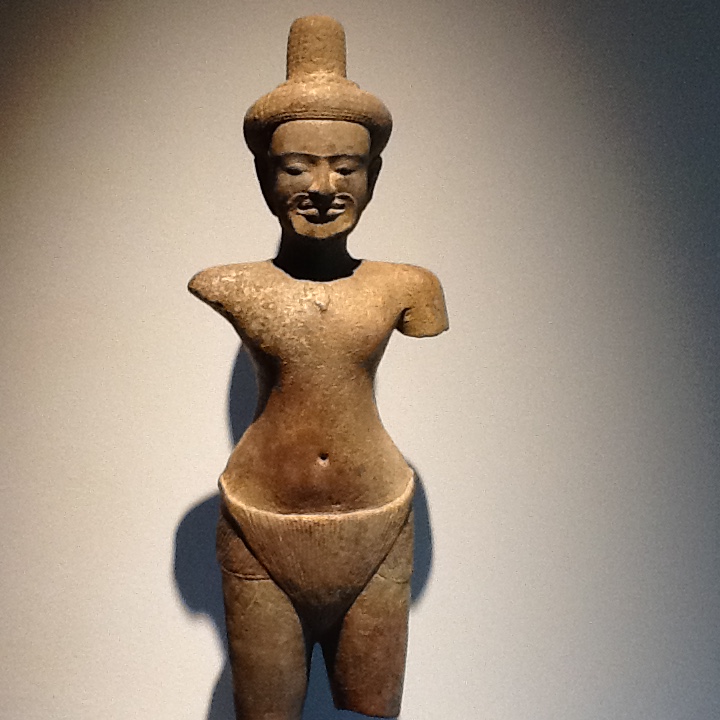
Hindu Yogi from Cambodia, Ashmolean Museum, Oxford.

October 21 Wednesday

You are neither a weak, nor a puny, nor a faulty creature, but you are the radiant child of a resplendent Mother whose song of power and victor resounds through worlds and space.

October 22 Thursday

The whole world is good to us if we are good.

October 23 Friday

Worshipping brass images and conceiving hatred for men is not devotion.

October 24 Saturday

To suffer calmly, act nobly and live peacefully is the purpose of life.

October 25 Sunday

Do repeat the Mantra constantly. It is the seed of everlasting peace.

kanchi river bank

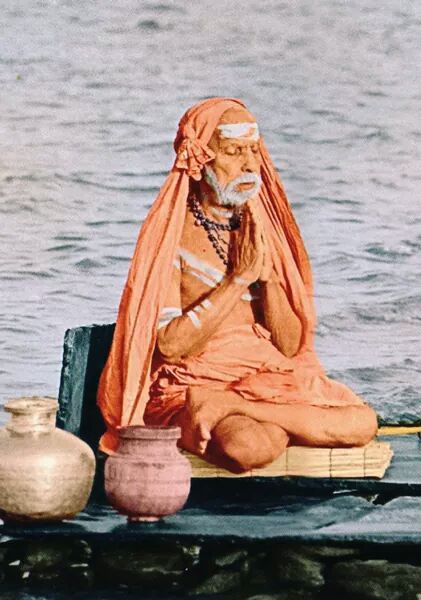
Kanchi Shankaracharya (1894-1994); one of the greatest saints of our time.

October 26 Monday

Life is immortal. Life is glorious. Life is a positive expression of the Divine. Know that this is the truth about your life.

October 27 Tuesday

Love travels quicker than thought – it is invisible, mystic touch.

October 28 Wednesday

Life is sweet when it is spent in the service of saints.

October 29 Thursday

Guru and God are one. Guru is who he satisfies the spiritual hunger of the aspirant.

IMG_6786 (2)

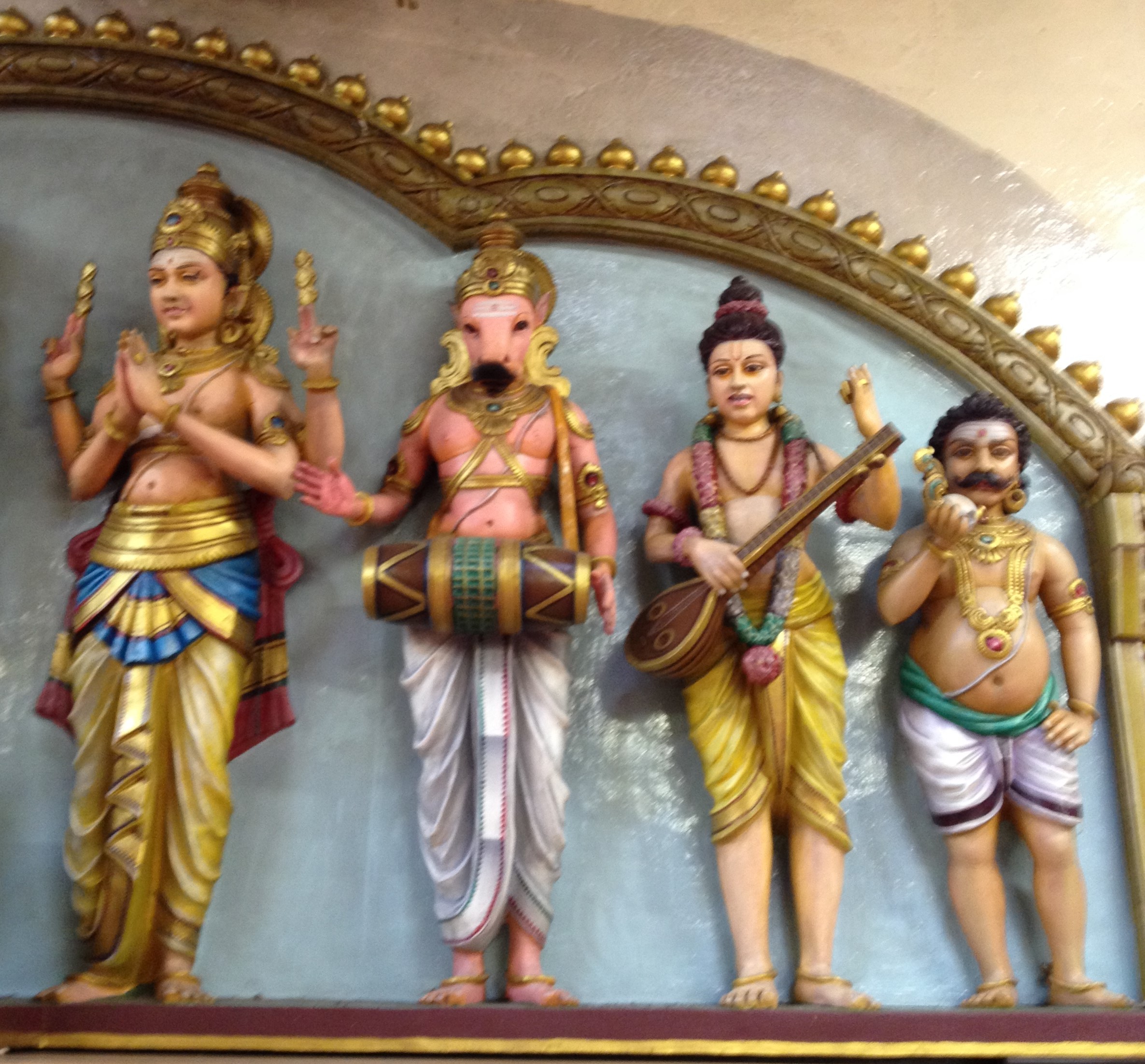
Tumburu and Narada with their musical instruments.

October 30 Friday

God realisation is nothing but the manifestation of one’s own divinity.

October 31 Saturday

We want a religion which brings love and joy to the heart, and light and wisdom to the head.

–Subham–

As the King, so are the People: Yatha Raja Thatha Praja!

chola-flag-2

DON’T REBLOG IT AT LEAST FOR A WEEK!  DON’T USE PICTURES;
THEY ARE COPYRIGHTED BY SOMEONE.
Compiled  by London swaminathan
Date: 26 September 2015
Post No: 2191
Time uploaded in London :– 18-38
(Thanks  for the pictures) 

There is a proverb in Sanskrit ‘yatha raja, thatha praja’. Like the king, people are. If the king is corrupt, ministers become more corrupt and people become the most corrupt. There are two anecdotes to illustrate this proverb:

Nausherva of Persia was reputed to be a just king. Once he went on a hunting expedition. He hunted any animals in the forest and the lunch time came. Everyone was hungry. Suddenly the king and his retinue realised that they forgot to bring salt for eating the meat. When the food was cooked the king also came to know about it. He, therefore, asked one of his servants to go into the village nearby and get the salt. But he added, “Don’t forget to pay for it. Otherwise the whole village will be ruined.”

Hearing this the servant was greatly surprised. So he said, “Your Majesty, how could a pinch of salt, obtained without payment, cause the devastation of the whole village?”

Naushervan answered, “If the king, exercising his authority, plucks and eats even only one fruit from the garden of any of his subjects, then his servants, following his example, will destroy the whole garden, root and branch.”

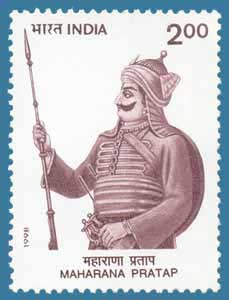
Maharana-Pratap-Stamp

Following  story proved this correct:

A revenue officer was camping near a village for collection of tax. He called his servant and told him, “My wife and children like fresh rice. So go to the fields and pluck some and bring here. Make sure no one sees you.” So the servant went during night time and entered a field illegally and plucked some paddy and brought it to the officer. Other servants came to know about it from the man who went into the field.

Taking the hint from the officer servants started collecting rice from each and every field. When the officer went for tax collection, the harvest shown on records were lower than the usual quantity. Then he started questioning his servants. What happened? Why the harvest is very much lower this season? Who was stealing the crops?

The servant who went into the field for the first time answered, “Sir, it is the secret permission you gave me the other day. I took some rice for my family. My colleagues also took some rice for their families. That is all.”

The officer said nothing. He was like a thief stung by a scorpion. He can’t cry aloud.

“Yatha raja ,thatha praja”. If the officers are themselves corrupt, they have no moral authority to question anyone! Even if he says something, it would not have any effect. All will laugh at him, behind his back.

–Subham–

Acharya’s Advice to an Angry Brahmin!

chanakya (2)

DON’T REBLOG IT AT LEAST FOR A WEEK!  DON’T USE PICTURES; THEY ARE COPYRIGHTED BY SOMEONE.


Compiled  by London swaminathan

Date: 23 September 2015

Post No: 2183

Time uploaded in London :– 14-21

(Thanks  for the pictures) 

His Holiness Sringeri Shankaracharya Sri Sachidananda siva Abhinava Narasimha Bharati Svaminah (33rd Acharya) was staying in the bungalow of Sri P .N. Krishnamurti, the then Dewan of Mysore. He expressed to His Holiness his desire to give a rupee each to every Brahmana who came to his compound on a particular morning and requested Acharya to depute a competent person to carry it out.

(One rupee in today’s terms is equal to a Silver Coin)

His Holiness well pleased with his generous impulse asked a Sastri to attend to the proper distribution. Thereupon the Sastri entered upon the duty entrusted to him very early on that morning and went on distributing to thousands of Brahmins . Just about the noon the crowd was thinning and Sastri with aching legs and aching hands looked forward eagerly to the close and felt greatly relieved when there was none else in sight and turned about to enter the bungalow. Just then he heard someone call out Sir! Sir!. In his state of exhaustion, the Sastri naturally got vexed and shouted, “No, everything is over” and walked into the bungalow.

His holiness who was about three apartments off sent for the Sastri.

HH: I heard your voice louder than usual. Anything special?

Sastri: I have been standing at the gate from early morning distributing money and when I had finished doing so and turned back somebody called me and I waved him away.

HH: Did anybody approach you yesterday for money? You undertook to pay today and he came  when our host is so generously giving, wil we be carrying out his intention if we allow even one man to go away disappointed? The man is still at the gate. Go and pay him.

From the moment Satri was so patient that he never lost his temper.

angry-red-face-md

XXXXXXX

Even when there as an occasion to chide a servant, His Holiness never used any harsh words.  Once when he went to shrine in the Mutt, he found out the lamp in the sactum was burning feebly. Without mentioning anything about it, he asked the Archaka (priest) there to bring a lighted lamp and added, “I want to see if there is light near the deity.” The Archaka immediately ran up and made the lamp burn brighter.

Source : Golden Sayings, Thenkarai, 1924.

Sringeri Acharya’s Advice on Anger Management!

shiva abhinava bharati

DON’T REBLOG IT AT LEAST FOR A WEEK!  DON’T USE PICTURES; THEY ARE COPYRIGHTED BY SOMEONE.


Compiled  by London swaminathan

Date: 22 September 2015

Post No: 2181

Time uploaded in London :– 20-08

(Thanks  for the pictures) 

A Forest Officer who was camping a few miles off Sringeri came there and paid respects to His Holiness Sri Sachidananda Siva Abhinava Narasimha Bharati Svaminah (33rd Acharya of Sarada Mutt between 1879 and 1912).

F.O: I am in the forest department and, as happened to camp in the hills about ten miles from here and learnt that Sringeri was so neat it struck me that I might worship Sri Sarada Devi and pay my respects to you, my hereditary Guru, though I cannot claim to have any orthodox leanings and habits.

HH: I am glad you have come. It is past ten o’clock. You may take your breakfast in the mutt and then go.

F.O: I have to return to my camp forthwith. I pray for your gracious blessings and for any practical advice which even I can follow in spite of my drawbacks.

HH: There is no occasion at all for despair in anybody born of a respectable family. Are you the top most officer in your department?

anger-management-stress-ball-set-67

F.O: Not so. But I am fairly high in the ladder.

HH: I suppose you get frequent occasions which make you angry in the course of your employment.

F.O: Very often.

HH: That is, you have occasion to get angry with your subordinates?

FO: Yes.

HH:  Suppose your anger is not quite justifiable, will your subordinate point it out to you?

FO: He will not have the courage to do so.

HH: If your anger is not justified and if he cannot say it to you, will he not have a sense of resentment?

FO: He may have.

HH: But he cannot show it to you?

FO: If he does show it, his job will be in danger.

HH: How is he then to give vent to his resentment?

F.O: If he chooses, he may visit it on his subordinates.

HH: Will it be proper to direct the resentment against the subordinate when the latter is quite innocent and does not in the least merit it? Will not that subordinate resent such treatment and how is he to give vent to his resentment?

F.O: He must pass it on to a lower official.

HH: It appears therefore that if you unnecessarily get angry, it gives rise to a chain f unnecessary angers and you are primarily responsible for it.

F.O: It may be so. But what can I do?

anger book

HH: People who get angry may be classified under three categories: 1. those that know they are GOING to get angry, 2.those that know that they ARE angry and 3those that they know they WERE angry. Ordinarily the majority belong to the third category. To which category do you belong?

F.O: I think I can feel the anger coming on.

HH: I am very glad to hear it. There must be an interval ever so short between your feeling like that and the actual anger. You may just utilise that interval to think for a moment whether you really need to get angry. If you find that anger is not really so urgent, you may prevent the anger coming on. If the person KNOWS that he is in angry mood, even he may stop for a moment to think whether it is necessary to persist in that mood any longer; if he does so, the anger will lose its momentum. A person who gives way to anger and is aware of it only AFTER he has given vent to it may in his calm moments consider whether the anger he gave vent to was justified; he will be then more careful when he gets angry next time. Thus in all three cases a kind of self-enquiry at the time or later on will easily blunt the edge of anger and he may ultimately get rid of it altogether. It will be very useful if you bear that in mind.

AngerBall

Then the officer took leave of His Holiness and rode his horse back to his tent. It was past one o’clock and the ride for twenty miles had been a tiring one especially in the hot sun so much so that he felt very hungry. As soon as he entered the tent, the cook hastened to place before him a silver plate with a small rice cake in it and also a cup of water. Having missed a sumptuous breakfast at the Mutt and being faced with such a scanty fare before him, he naturally felt a surge of anger coming up with him, he naturally felt a surge of anger coming up with him but before he gave vent to it, he remembered the advice of His Holiness, put a check on his temper and began to question the cook.

F.O: You know I shall be coming late and hungry. How is that you have not prepared the regular meal yet? Is it proper to offer me now this small cake?

Cook: I certainly know. The servant who went down the hills to purchase the provisions has not yet turned up and, as I felt that you must have something to sustain you till he comes and till I prepare the meal, I got together what rice flour I had here and prepared the cake.

F.O: If you have used up all the available flour and if you are to have your meal after preparing the meal and serving me, what will you do then?

Cook: It does not matter. I am accustomed to late meals. But you are not. Hence I prepared this.

The forest officer realised that he was about to get angry with a faithful servant who had so affectionately cared for him and he insisted upon the cook sharing that cake with himself. It need hardly be said that, in course of time, he completely got rid of his anger and, with deep devotion and gratitude to His Holiness for His Gracious blessings and advice, began to resume his traditional habits and earned the status of an earnest devotee.

anger-in-the-workplace-233x300

N.B: There are few more anecdotes which I will post separately: swaminathan

Source: GOLDEN SAYINGS, Compiled by Shri Jnanananda Bharati Svaminah, year of publication 1969,  Shri Jnananda Grantha Prakasana Samiti, Thenkarai, Madura District

–Subham–

Two Anecdotes: Love your Enemy!

finnisdeath

Article written by London swaminathan

Date: 20th  September 2015

Post No: 2175

Time uploaded in London :– 19-18

(Thanks  for the pictures) 

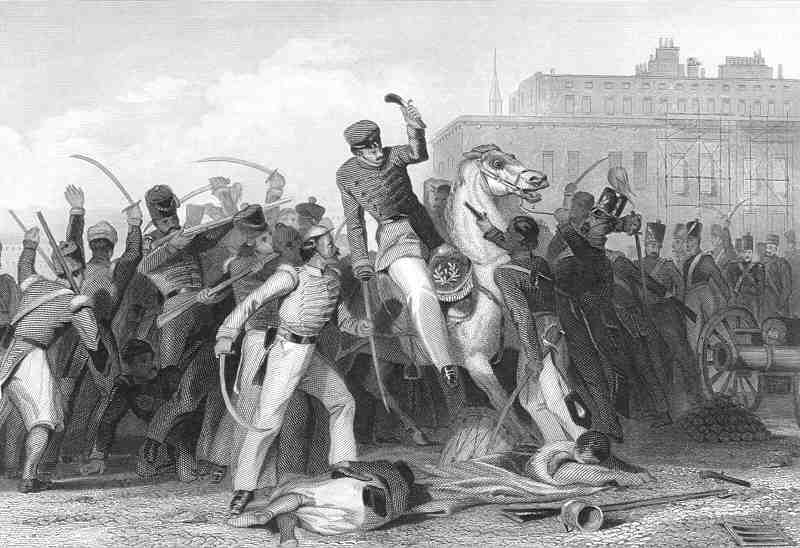
This happened during the Great Indian Mutiny in the year 1857. Indian soldiers revolted against the British Government and the government took stern steps to put them down. The result was, people left the villages in panic. At one place, when they were running away, they saw a Sadhu coming towards their village which they had abandoned. The villagers warned the Sadhu that the British soldiers would be there shortly and kill him mercilessly. The sadhu did not pay heed to the advice, but went on. When he was nearing the village, a British soldier came towards him and stabbed him. The sadhu was fatally injured. He fell down and was about to die. The soldier was looking at him to make sure if he was dead. Before breathing his last, the Sadhu looked at the soldier, his murderer, and smilingly said “You also are He” (Tat Tvam Asi).

Even in the agony of death, the Sadhu saw God in him. What a glorious vision was his! It is indeed wonderful.  Such is the vision of one who has realised God.

periya_puranam_a_tam

Safeway to a Tamil Murderer

Periyapuranam is a great Tamil literary master piece which deals with the lives of sixty three Saivite Saints of Tamil Land. One of the sixty three saints was Meypporul Nayanar who ruled a small kingdom from Tirukkovilur in North Tamil Nadu. He had a rival in a neighbouring kingdom whose name was Muthanathan. He invaded Meypporul Nayanar’s country several times but was defeated. So he planned to kill him by hook or crook. He knew that Nayanar respected Saivite devotees a lot.

One day Muthanathan came to Nayanar’s palace disguised as a Saivite saint. It was dead of night and so the guards at the gate refused him permission to enter the palace but he insisted that he had brought something important to give it to the king. Then Nayanar’s bodyguard Tattan came and allowed him in; but Tattan was very suspicious about this ascetic guy. So he was ready to meet any eventuality.

When Muthanathan went into the palace, Nayanar was sleeping with his queen in the bed room. She woke up at the slightest noise and woke her husband immediately. As soon as he saw someone with holy ash smeared all over his body he fell at his (Muthanathan’s) feet. Nayanar asked him what brought him at the dead of night to the palace. “Ascetic” Muthanathan told Nayanar that he had got a rare book and wanted to teach him the same night. Nayanar told him that he was ready to receive it the very next minute. But Muthanathan insisted that his wife should not be in the room. Immediately she left the bed room.

When Nayanar fell at Muthanathan’s feet in the traditional way before start of the lesson, Muthanathan took his sword from inside the ascetic robe and stabbed Nayanar. He fell on the floor. As soon as the body guard Tattan heard the noise he rushed into the bed room and caught Muthanathan red handed. But Nayanar, before breathing for the last time, instructed Tattan, “Tatta, He is our man. Please allow him a safe passage”.

As instructed by Nayanar, he took Muthanathan, inspite of a big lynching crowd, out of the city limits and allowed him a safe passage. He was pardoned by Nayanar just because he came in the guise of a Saivite (Shiva) saint.

There are several episodes like this in Indian literature.

Two Stories: See yourself in all beings!

177414-petrin-hill---hall-of

Don’t Reblog it for at least a week; don’t use pictures.


Article written by London swaminathan

Date: 19th  September 2015

Post No: 2172

Time uploaded in London :– 20-22

(Thanks  for the pictures) 

In order to have some fun a man procured innumerable small mirrors and had them fixed in his room on the walls, in the ceiling and on the floor. There was not an inch of space where there was no mirror. After closing the door, he switched on the light and stood in the middle of the room. He saw himself reflected in myriad forms in the mirrors— above, below and on all sides. He enjoyed the sight very much because he loved to see himself everywhere. After having had this fun for a while, he left the room, but forgot to close the door.

His dog entered the room a few minutes later and it saw its own reflections in the mirrors. The dog started barking at its own reflections and jumped and fought with them, as it thought those were dogs different from itself.  It fought till it got completely exhausted and fell down dead.

So, man in his ignorance, when fighting with his fellow thinks that they are separate from him. When he realises that all beings are the images of his own Self, instead of quarrelling with and disliking them, he will love them all equally.

elephant3_

 Ramakrishna Paramahamsa’s Elephant story 

In a forest there lived a holy man who had many disciples. One day he taught them how to see god in all beings and knowing this, to low before them all.

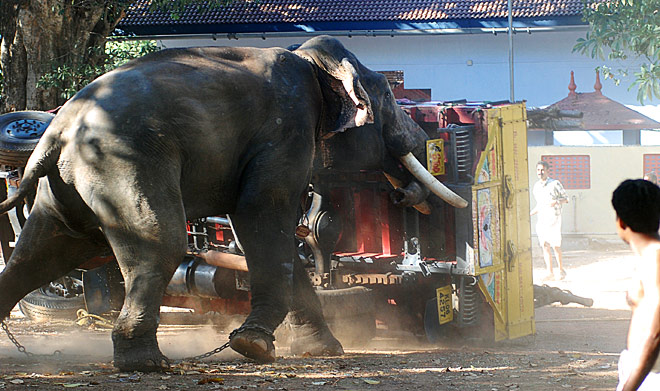
A disciple went to the forest to gather wood for the sacrificial fire. Suddenly he had an outcry, “Get out of the way! A mad elephant is coming!” all but the disciple of the holy man took to their heels. He reasoned that the elephant was also god in another form. Then why should he run away from it? He stood still, bowed before the animal, and began to sing its praises.

The mahut of the elephant was shouting “Run away! Run away!” but the disciple didn’t move. The animal seized him with its trunk, cast him to one side and on its way. Hurt and bruised the disciple lay unconscious on the ground. Hearing what had happened, his teacher and his brother disciples came to him and carried him to the hermitage.

With the help of some medicine he soon regained consciousness. Someone asked him, “You knew the elephant was coming. Why didn’t you leave the place? “But”, he said, “our teacher has told us that God Himself has taken all forms, of animals as well men. Therefore thinking that it was only the elephant God that was coming, I didn’t run away.”

At this the teacher said, “Yes, My child, it is true that the elephant God was coming; but the mahut God forbade you to stay there. Since all are manifestations of God, why didn’t you trust the mahut’s words? You should have heeded the words of the Mahut God.”

God dwells in all beings. But you may be intimate only with good people; you must keep away from the evil minded. God is even in the tiger; but you cannot embrace the tiger on that account! You may say, “Why run away from tiger, which is also a manifestation of god?” The answer to that is: Those who tell you to runaway are also manifestations of God – and why shouldn’t listen to them?

God undoubtedly dwells in the hearts of all – holy and unholy, righteous and unrighteous; but a man should not have dealings with the unholy, the wicked, the impure. He must not be intimate with them. With some of the he may exchange words, but with others one should not go even that far. One should keep aloof from such people.
—Subham–

Story about Company of the Good: Vasishta X Viswamitra clash!

hare krsn bhajan

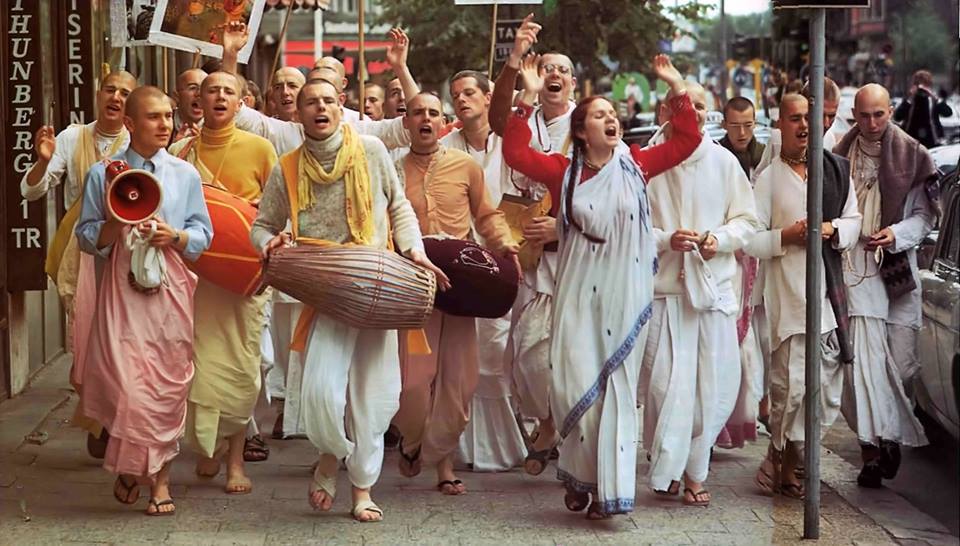
Satsang by Hare Krishna Devotees

Don’t Reblog it for at least a week; don’t use pictures.


Article written by London swaminathan

Date: 18th  September 2015

Post No: 2169

Time uploaded in London :– 16-54
(Thanks  for the pictures) 

Satsangatve nissangatvam

Nissangatve nirmohatvam

Nirmohatve niscalitatvam

Niscalitatve jivanmuktih

–Adi Sankara’s Bhaja Govindam

“Through the company of the good, there arises non-attachment; through non-attachment there arises freedom from delusion; through delusionlessness, there arises steadfastness; through steadfastness there arises liberation in life.”

There is a story about Viswamitra. Once there was a discussion between him and sage Vasishta, the Guru of Sri Rama. The discussion was: which was greater, the power of austerities or the power of the company of the saints. Vasishta said that the power of the power of the company of the saints was greater. Viswamitra disagreed with him. The matter was brought before Lord Vishnu. He directed them to Mahasesha, the big serpent on whose head this earthly globe is supposed to be resting.

The sages went to Mahasesha and asked him which was greater — company of saints or austerities. Mahasesha said: I have this heavy burden of the earth on my head. If you will just lift it for a moment from my head I will be free to give the answer. At this, Vasishta and Viswamitra looked at each other as to how best this problem could be solved. Viswamitra suggested that he would apply the power he had gained by his austerities and lift the earth. He put forth all the strength he had gained by his austerities but the earth did not move. Then Vasishta came forward and applying the strength which he had gained by one minute company of saints, lifted the earth. Now Mahasesha said: your question has been answered.


Ramakrishna Paramahamsa’s Story

The agent of a rich Zamindar (land owner), when he goes into rural localities tyrannises over the tenants in various ways, but when he come back to the head quarters, and under the eyes of his master, he changes his ways, becomes pious, treats the tenants kindly, investigates into all their grievances fully and tries to meet out justice impartially to all. The tyrannical agent becomes good through the fear of the master and also  by reason of his society. Similarly does the society of the pious make even the wicked righteous, awakening awe and reverence in them.

Clean Temple Elephants

Elephant and soil

If you wash an elephant well and leave it at large, it is sure to make it self dirty in no time; but if, after the wash, you tie it down in its stable, it will remain clean. So if by the good influences of holy men, you once become pure in spirit, and then allow yourself to mix freely with wordly men, you are sure to lose that purity soon; but if you keep your mind fixed on god, you will never more get soiled in spirit