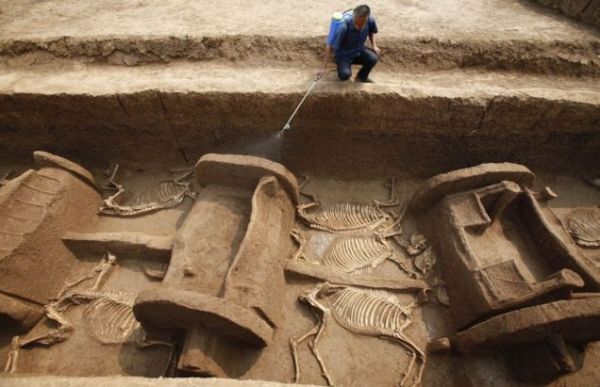
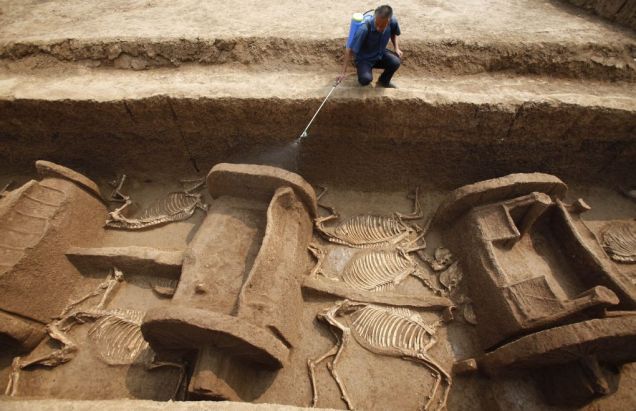
3000 year old horse and chariot burial in China.
Research Paper written by London Swaminathan
Post No.1255; Dated 27th August 2014.
Rig Veda, the oldest record of religion and human history, is full of mysteries. Foreign “scholars” who translated it have added footnote at every other page, ‘the meaning is uncertain’, ‘the meaning is not clear’, ‘the meaning is obscure’, ‘Sayana says this, but it is vague’. Each of those “scholars” contradicts the other. For thirty three minor gods of the Rig Veda, they have written more than 33 different interpretations. If someone wants some entertainment or jokes, they can compare those interpretations. But I have to warn you that you may go crazy one day!!
Great scholars of India such as Adi Shankara or Sayana haven’t got any such doubts or confusion, because they believed in what the Veda says. It is like we believe in what our parents or teachers say. Moreover they know the overall underlying meaning, because they were born and brought up in this culture.
Some westerners cannot look above the waist. They look only below the waist and give sexual interpretations. Sri Ramakrishna Paramahama explained the seven stages of mind and said that the bad ones cant go above the third level. Some can’t look at the heart but only at words and give racial interpretations. They have never done it to any other religion except Hindu religion. They know that Hindus are simpletons who will believe anything they say without reading the original books. Thank god, now there is some awareness and they are slowly waking up and reading the originals! I know millions of Hindus who have never read just 700 couplets of Bhagavad Gita, but ask umpteen questions raised by non believers!!
God bless them!
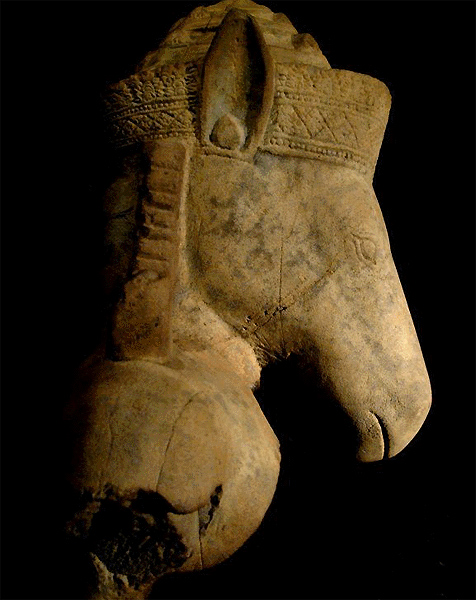
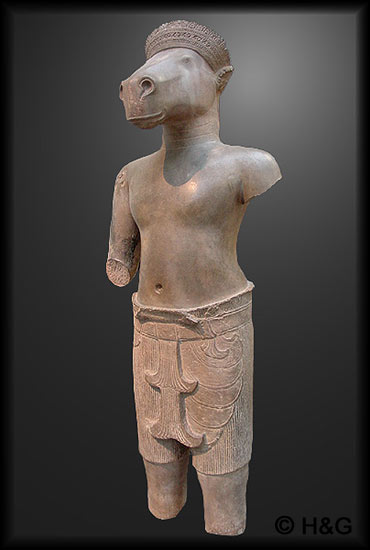
Hayagreeva from Khmer (Cambodia), 10th century CE
I will try to list the mysteries of R.V., one by one.
One of the mysteries of Rig Veda that puzzled the westerners is the Story of Dadhyanc Atharvan, a Rishi with a horse head. Until the year 2000, they wrote that they have discovered his grave in Potapovka near Samara in Russia. By 2010 they have changed their view!
Excavations of 1985-86 of a kurgan burial dated 2200 BCE at Potapovka revealed in grave shaft of kurgan no.3, a decapitated man with a horse skull replacing his head. In simple terms, the man’s head was removed and a horse head was fixed. They thought that it was the grave of Rig Vedic seer Dadhyanc. Later research showed that the skeleton of both the horse and the human being were not of male, but of female. They also found the horse head was fixed 1000 years after the human being’s death. This shows that we can’t jump to conclusion by listening to archaeologists! They only “interpret” it and confirm in what they have already believed. In this case they started talking Aryan migration from the Steppes.
Still some questions remain unanswered: Why did they put horse head there after 1000 years? Why did someone behead the man or woman?
But horse heads were used in Western countries in the graves, church buildings etc., for its mysterious powers until 300 years ago.
((If you google horse burials, chariot burials, you will get loads of matter)).
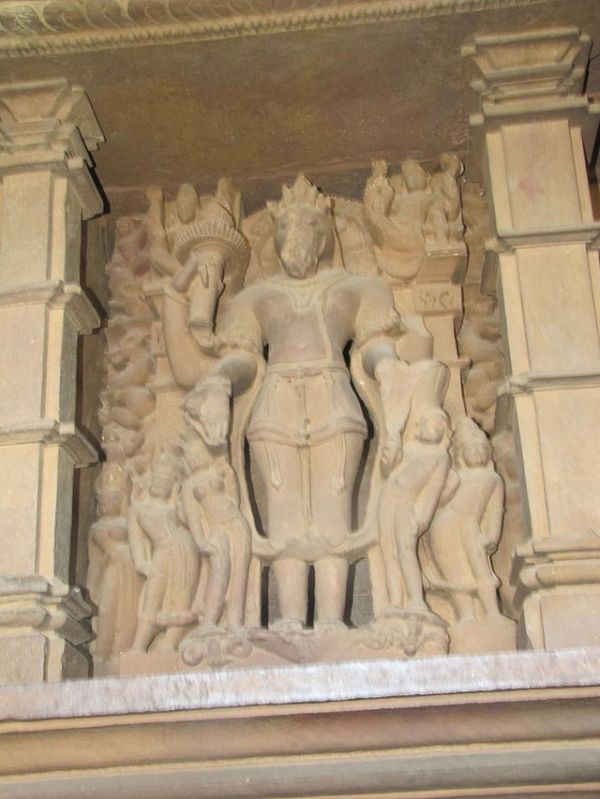
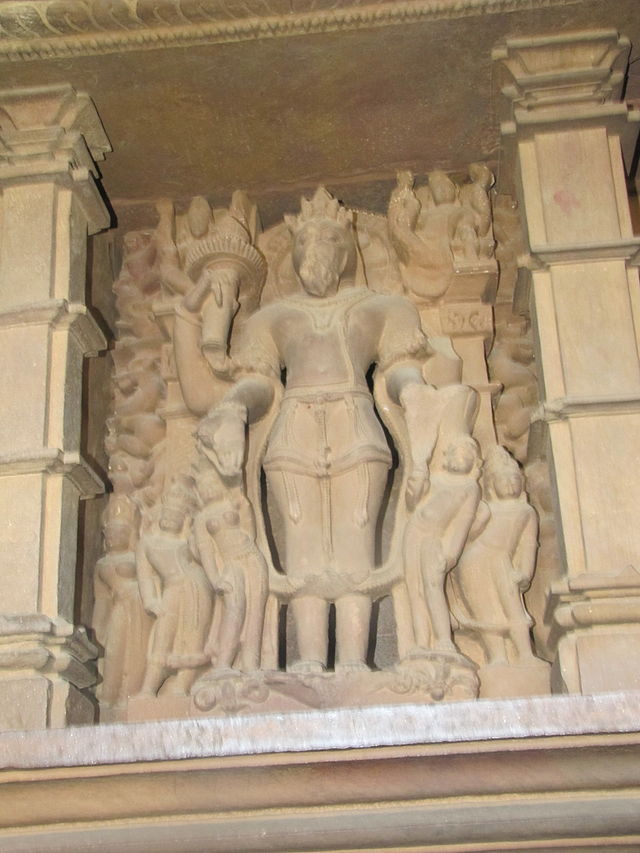
Khajuraho Lakshmana Temple, 12th Century
Now let us look at the interesting story of the horse headed Dhayanc! His story is in RV 1-84-16; 1-116-12; 1-117-22; 10-48-8, Satapatha Brahmana 14-4-5-13; Brhad Aranyaka Upanishad 2-5; Bhagavatam 6-10 Adhyaya. His story is found in many places in the Vedas.
Dadhyanc was the son of Atharvan. He and his father were regarded as the founders of Vedic sacrifice. They knew a secret mantra known as Madhu Vidhya. Dadhyanc taught this to all his devoted students. Those who learn this vidhya gets free from all miseries of life. Indra also came to the seer and learnt the vidhya. But the seer warned him that he should lead a life worthy of it. Indra became angry at his advice and told him that he would cut off the Rishi’s head if he had taught it anyone else.
Later the Vedic twins Asvins came and asked the seer to teach them. When he told them about Indra’s curse, the Asvins cut his head off and preserved it in a safe place and learnt the Madhu Vidya. During that study, they fixed a horse’s head on Dadhyanc. Some people can interpret even this to show that head transplant surgery was common during Vedic days. But this is beyond the scope of this article.
When he finished teaching them, Indra’s thunderbolt came and cut off Dadhyanc’s head. Later Asvinikumaras fixed his original head.
Rishi Kakshivan has glorified Asvins in his Rig Vedic hymns. Asvins are attributed with mystical powers throughout the Vedas.

Horse faced Vajimuka in Guimet Museum, France.
For Hindus, head replacement or transplant is nothing new. We have Lord Ganesh with elephant head, Hayagriva with horse head, Daksha with a goat’s head, lord Narasimha with lion’s head and vishnu’s avatars with fish, tortoise and pig forms. Horse headed Hyagreeva sculptures are available even in Cambodia.
Griffith has added the following the following foot note in his Rig-Veda translation:–Dadhyanc was called Dadhica later. With his bones or with the horse head bones, Indra made his thunderbolt weapon. Indra slew Vritra with this weapon. Vritra with held the rains. The Vedic legend which was modified and amplified in later times, appears to have been connected in its origin with that of Dadhikras, often mentioned in the Veda and described as a kind of divine horse, probably a personification of the morning sun in his rapid course. Dadhyac may be the old moon whose bones when he dies, become the stars with which Indra slays the fiends of darkness. (page 53 of The Rig Veda; foot note to RV 1-84-13 and again in 1-116-12).
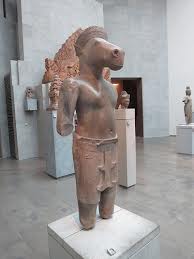
Hayagreeva in Paris
Many of the Vedic stories are symbolic. We can’t interpret them literally. But all the Hindu saints quote Dadhichi for his sacrifice. Indra made his Vajrayudha only with Dadhichi’s bones. That seer made a sacrifice for the welfare of the humanity, to destroy evil. Griffith says both Dadhichi and Dadhyanc are one and the same.
Vedic legends remain a mystery!
contact swami_48@yahoo.com

 Tamil and Vedas
You must be logged in to post a comment.