- Many of us know that Indonesia is the largest Muslim country in the world, but many of us do not know the fourth largest Hindu population is in Indonesia! This is the country which has highest number of Hindus outside Indian subcontinent (next to Nepal and Bangladesh). It is a country with 17,000 islands and 300 volcanoes.
- Bhagavad Gita statue in Bangkok
Knowing the popularity of Mahabharata and Bhagavad Gita, a statue of Krishnopadesam was erected in Jakarta, capital of Indonesia. Arjuna and Krishna are riding a chariot. When Suharto, President then, opened the statue he exhorted the people to follow Bagavad Gita’s main teaching: Work without expecting any benefits (selfless Service).
3. Sukarno=su+Karna
Indonesia’s great leader Sukarno was named after the famous Mahabharata character Karnan. Sukarno’s father was very much attracted by the characterisation of Karnan. But Karna supported the wrong side in the great war. So his father named his son as Su (good) Karna. Sukarno’s daughter was also given a Sanskrit name Meghavati Sukarno Puthri. She is the president of the country now.
4.Ramayana, Mahabharata dance drama and puppet show:
Throughout the year Ramayana and Mahabharata dance and puppet shows are staged. They are called Wayang Kulit and Wayang Wong. We can’t see such a running show even in India, the land of Ramayana! Hanuman was in their military emblem/mascot!
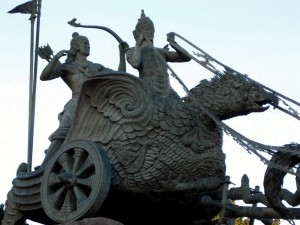
Picture: Arjuna and Krishna in Jakarta
5.Lord Ganesh on Currency Note:
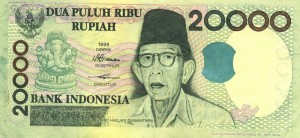
Lord Ganesh picture is inscribed on 20,000 rupee currency in Indonesia. Ganesh was worshipped in India even before Ganesh came to South India. Tamils have Ganesh statue from 6th century AD. But Indonesia has Ganesh statues from 1st century AD, discovered in in Panaitan islands. Lord Ganesh travelled faster by sea than on land in his Mushika (mouse) vahana! There is lot of scope for further research in this field. Ganesh was depicted as Bhuta Ganathipathi with skulls! Java is also known as Ganapathya Land, country where Ganesh is worshipped. A very big Kapala / Skull Ganapathy is in Leiden Museum (Holland).
6. Ramayana, Mahabharata stamps:
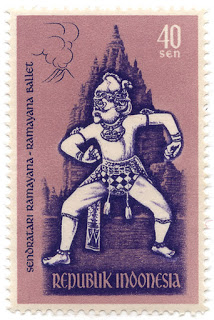
Indonesia has issued many stamps on Ramayana and Mahabharata . All the characters are known to Indonesians, whether they are Muslims or Hindus. But the picture is changing very fast because of modern culture and extremists’ propaganda.
7. Ramayana Translation even before Kamban:
Ramayana was translated in to Kawi language of Java even before Kamban ‘s most famous Tamil translation known as Kamba Ramayanam (1200 AD). Kakawin Ramayana in old Javanese language was translated in to 1200 verses in 870 Ad during the era of Medang Kingdom. There are more than 200 research works on Kakawin Ramayana. Even awards in the name of RAMA, are given.
8. Bali Islands:
Bali Island has the biggest Hindu population in Indonesia. There are over 4,600 Hindu temples. But the Balinese follow some strange and ancient customs not known in India!
Saraswathy Puja/ Vijaya Dasami is a national holiday here. Temples with 11 tier towers are of Shiva, 9 tiers –Brahma and 7 tiers- Vishnu. Badara Guru, a form of Shiva, was typical Indonesian Hindu God.
9. Garuda Airlines and Kubera Bank:
The official airline of the country is named after Vishnu’s Vahana Garuda (eagle) and the National bank is named after the Hindu god of wealth Kubera. Serayu river in Java is named after Sarayu River of Ayodhya. Kings of Java bore the Sanskrit titles Bhupati,Arya and Adyaksha
10. Bhasa Indonesia:
Brahmi script is the basis for all the S E Asian languages.
Sanskrit words are found everywhere. Sumeru, Brahmo, Kaliya mardhan, Tharmasagara etc.
The language of Indonesia is Bahasa=Bhasha=language in Sanskrit. Thousands of Tamil and Sanskrit names are found in Indonesia, many of them in their corrupted forms because of distance in time and space. Kawi is the language of poetry in Indonesia. Kavi means poet in Sanskrit.
11. Pallankuzi (Mancala, Congklak):
The whole world agrees that the board games including Chess originated in India (British Musem in London has a display board). But the Pallangkuzi= a wooden board with 14 or 12 pits played with seeds or cowries is found in Africa and Indonesia. It is called Mancala in Africa. This shows that Tamils took their board games wherever they went. It is known as Congklakin Indonesia. Indonesian Hindus took their rice cultivation, Sanskrit language and Pallangkuzi to Madagascar and other places (Please read my article Madagascar-India Link via Indonesia).
12.Agastya statues:
Agastya whose name we find in Rig Veda, is associated with Tamil language from the very beginning. He was the one who established land route to South India by crossing the Vindhyas and he was the first one to travel across the ocean for migration.(Please read my article “Is Bramastra a Nuclear Weapon?” for more details about Agastya drinking the ocean).
So Agastya statues are dug out in several places in South East Asia. Some are in Indonesian museums. A two meter tall Agastya idol was also discovered. Singasari and Yeh-Pulu were two places which gave us lot of Hindu statues and Idols.
13.Mulavarman Inscription in Jungle:
Please read my blog “Sanskrit Inscriptions in Strange Places”.
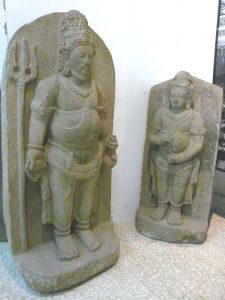
Picture: Agastya Statue
14.Indian Business Community:
A ninth century inscription in Central Jawa listed all the communities that frequented the island: Kalinga, Arya, Sinhalese, Pandiyas, Keralites, Dravidians, Chams, Khmers.
15. Borobudur
Borobudhur Buddhist temple is considered one of the 100 Wonders of the World. It is in Sri Chakra form. It is spread over ten kilometres. Hindu King Vishnu (775 AD) began the work on this temple. But it was stopped after his death in 785 AD. Another king of Sailendra Dynasty made it as a Buddhist temple in 11th century. Scenes from Dasavatara, Ramayana, Mahabharata were sculpted here. It is said that there are one million sculptures in the monument. All the Hindu Gods are found in it. Lot of materials are available on the websites about this wonder. The dimensions of the structure, its gigantic conception and its lavish decoration make it one of the most renowned monuments of the world.
16.Kalidasa, Manimegalai ,Ramayana references:
Indonesian islands, particularly Java and Sumatra, are known to Indians from time immemorial. Ramayana, Kalidasa’s works and Tamil epic Manimegalai refer to these islands as Yava Dwipa = Island of Barley and Suvarna Dweepa= Island of gold. They were famous for their spices and the Dutch named these islands as East Indies.
17. Mathura, Kaliyamardhana:
We see lot of names of Lord Krishna such as Mathura, Kalya Mardhan (Kalimanthan). Borneo Island was named after Varuna. Baruna= Borneo=Varunasya Island. Omkara (Aum) is used in coronation ceremonies. Pranava (Aum) is in Javanese language.
18.Jakarta Museum wonders:
Statues of Ganesh, Agastya, Vishnu, Shiva and other Sanskrit inscriptions are kept in Jakarta Museum. A lot of sculptures were taken by foreigners and seen around the world in museums and private collections. Victoria and Albert Museum in London has an Agastya statue.
19.Volcano temple miracle
10300 feet high Mount Agung or Gunung Agung is a mountain in Bali . There is an active volcano. The famous goddess Pura Besakih (Vaisaki Devi) temple is situated at 3000 feet on the slopes of a volcano. The volcano erupted in 1964 sending huge debris into the sky. Though lava overflowed for a few weeks, it missed the temple by a few yards. Balinese believed this was a miracle of the goddess. They call this mountain Meru. On top of the mountain there is a Shiva temple. Though there were massive volcanic explosions in 1980, the temple is still intact. Every hundred years Eka Dasa Rudra Makha Yagna is performed here. A crater with 10 mile diameter was formed in 1926 eruption.
20.Meaning of Indonesia:
The country’s name is Indus Land (country of Hindus)
21.1500 year Hindu empire:
Hindus established their cultural empire in Java 2000 years ago. Then they wielded some political power during the periods of Sailendra and Majapahit empires. They had their own kings. Mulawarman of fourth century AD was one of the famous kings. His Sanskrit inscriptions were found in the thick tropical forests of Borneo Island. Since they were written in Pallava grantha, their South Indian link is established beyond doubt. King Airalanga of 11th century was another famous king who translated lot of Sanskrit works.
22.Prambanan-largest Hindu temple
Borobudur was the largest Buddhist temple and Prambanan Shiva temple was the largest Hindu temple in Indonesia. Prambanan temple has a 140 feet tower and three corridors. Fa Hien (337-422 AD), the Chinese traveller of fourth century AD mentioned that there were many Shiva temples in Java. A traveller of first century AD referred to Prambanan temple. The temple was rebuilt in 850 AD. But whether it is Hindu or Buddhist, the sculptures of all the Hindu gods Brahma, Vishnu, Shiva, Goddess Chandi and Ganesh are seen everywhere.
23.Cock fight:
Cock fight is an ancient sport which is mentioned in Sangam Tamil literature and Sanskrit dramas. Hindus of Bali islands use cock fighting in a strange way. They do it as religious practise to spill the evil out of people.
24. Bheema and Ghatotkachan statues
BJP leader LK Advani was invited to attend World Sindhi Conference in Indonesia. When he was driven in car in Denspar, capital of Bali he saw big statues of Ghatotkacha and his father Bheema (one of the five Pandava brothers). Shri LK Advani has written about his visit in his blogs.
26. Bali Yatra: People from East Coast of India went to Java and Sumatra islands for business two thousand years ago. Even today Bali Yatra is done symbolically from Paradeep port of Odisha to Bali islands in Indonesia. Paradeep may be Para Dweepa=port for Islands beyond and Bali= named after the king Bali who was sent to Patala =islands below India , by Vishnu in his Vamana Avatar. If it is true this must have happened before 1500 BC. Vaman avatar is mentioned even in Rig Veda. Pallava Dynasty’s trade with the Indonesian islands is referred to in a Malay language History book.
27. Karaikal Ammaiyar:
The earliest Tamil saint Karaikal Mother (Ammaiyar) was known and worshipped throughout S E Asia. Statues and Idols of Karaikal Ammaiyar were discovered in Indonesia as well.
28. Music and Musical instruments: Indonesian musical instruments and the tunes/ ragas are very close to Indian classical music. A lot of scope for research awaits music scholars.
29. Balaputra Deva of Indonesia erected a monastery in Nalanda. It shows that the Mahayana Buddhists travelled to Nalanda University in Bihar 1600 years ago.
30.Recorded history takes us to 73 AD, when a Prince of Gujarat landed on Java Island. Tara daughter of Dharmapala, a king of Bengal introduced Mahayana Buddhism into the island around fifth century according to Dr Stutterheim, the Dutch archaeologist.
31. The great Indian astronomer Aryabhatta (476 AD) calculated noon at Yavakoti (in Java) when it was midnight at the land of Romans. So these islands were known to all Indians by fifth century AD.
32. A legendary Indian called Aji Saka taught the Javanese their system of writing and chronology, and gave them their first social and political organisation.



 Tamil and Vedas
You must be logged in to post a comment.