
Post No. 8399
Date uploaded in London – – – 25 July 2020
Contact – swami_48@yahoo.com
Pictures are taken from various sources for spreading knowledge; this is a non- commercial blog. Thanks for your great pictures.
By R. Nanjappa
Hinduism in Retreat

The religion of the Vedas (miscalled Hinduism) has been on the retreat ever since the Muslim invasions began and Muslim rule was established in some areas. The spirit of spontaneous exuberance and native creativity gradually disappeared and the religion shrank into a shell, and was reduced to mere outer rituals, and repetition of old forms. Muslim rulers banned public celebration of religious events, attacked and destroyed old temples, banned the contruction of new temples, and did not permit renovation of old temples. There was a brief respite in the South due to the Vijaynagar empire. We read in the life of Chaitanya Mahaprabhu (1486-1533) that the Muslim Nawabs in Bengal were antagonistic to public performance of bhajans and Hindu religious processions. The same situation was observed in Maratha areas at the time of Samarth Ramadas (1608-1681). Chaitanya Mahaprabhu stood up to them and had his public Sankirtan parties. Samartha Ramadas outwitted the Muslim rulers by organising congregational religious worship in Bhajan sabhas ( and not temples) where he installed Hanuman deity for worship. But there was apprehension, an overall feeling of unease and lack of freedom. Many of the regular observances shrank during this period. We can now appreciate why Shivaji Maharaj talked of “Swaraj”.
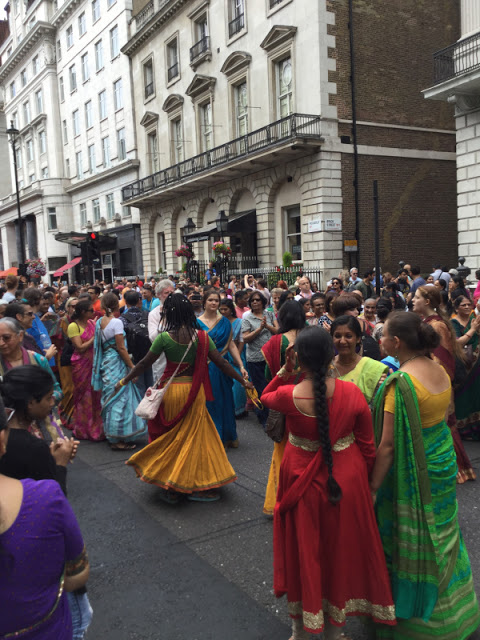
The Bhakti movement initiated by many medieval saint-singers did not halt the Muslim expansion, but saved the common people. Unfortunately, such Bhakti elements were not absorbed by the orthodox Mutts and incorporated into their routines.
The British did not directly or outwardly interfere with our religious practices. But they used the Christian Missionaries and the educational system to undermine the faith of the Hindus in their religion.and to break their social cohesion. Attack on the religion and philosophies of Hindus was vicious- as we observe in the time of Sri Ramakrishna and Vivekananda. But the British brought Hindu temples (not the Churches or Mosques) under government control. Dr.S.Radhakrishnan has written how he encountered adverse criticism of Hinduism by Christians in the Christian College where he studied.
Anti-Hindu Secularism
After Independence, the Government under Nehru called itself secular but was highly prejudiced against Hinduism. When Somnath temple, which had been subject to repeated attacks and pillage and plunder by Mahmud of Ghazni was proposed to be renovated, Nehru was against it, calling it ‘Hindu revivalism’. Gandhi agreed to the renovation, but said that they should not take money from the government! Due to the efforts of Sardar Patel and K.M.Munshi Somnath was renovated. President Babu Rajendra Prasad was to inaugurate it. But Nehru wrote that Prasad should not go, as he was President of a secular government. But Rajendra Prasad did go. (However, his secularism did not prevent Nehru from giving grants for Buddhists at Sanchi and Sarnath subsequently) The so-called secular outfit under Nehru was thus anti-Hindu from the beginning.. It freely interfered with Hindu religious beliefs and practices through legislation, while keeping away from other religions. The Nehru dispensation created a general atmosphere of anti-Hindu sentiment in the country, which has pervaded the bureaucracy and the educational system. He called the new big industrial projects temples of new India, but Hindu temples continue to be under government occupation and control. Most Hindu organizations have silently and spinelessly reconciled to this situation, in fear or expectation of favour. Every new Hindu organization or movement that appeared in the recent past has given the impression of not being really Hindu in spirit, having compromised on many points.
Swami Vivekananda broke the curse of inclusiveness. Characteristically, he did not begin in India, but in the USA which was emerging as the new world power. He used the occasion and platform of the World Parliament of Religions in Chicago in 1893 to boldly proclaim the greatness of Hindu religion. But he refrained from projecting his Guru Sri Ramakrishna, and any theistic aspect of our religion. Instead he carefully cultivated the elite and talked of Vedanta and Yoga. He did not address the commoner.
Many Indian Swamis and Gurus went to America since then and they all spoke of Vedanta and Yoga, but each gave his own twist. They tried to please the West, attempting to bring even Christ under the Vedantic umbrella! (One Swami interpreted the Sermon On The Mount in terms of Vedanta). It was all theoretical, though some of the meditation techniques like that of Mahesh Yogi (TM) caught on and stood scientific investigation with credit. Their overall attitude was one of playing a game to please the West and secure their appreciation.

ENTER SRILA PRABHUPADA
In such circumstances, the entry of Srila A.C Bhaktivedanta Swami Prabhupada into the US in 1965, on a visa for two months, is remarkably different. It was a small event at the time, but created a tsunami later! It injected a new dimension to life in the West and permanently changed history in twelve short years..
Prabhupada was a Gaudiya Vaishnava of the Chaitanya sampradaya. It is officially known as “Brahma Madhva Gaudiya sampradaya.” His Guru, Bhaktisiddhanta Thakur had, in 1922, implanted in him the urge to preach the message of Chaitanya Mahaprabhu in the West. He waited for 40 years and prepared himself. His businesses failed, but he progressed in his sadhana. He did not get support from his immediate family, nor did he get financial assistance from other sources.. He struggled in Jhansi, Delhi and Vrindavan to gather support for his work of spreading the message of Chaitanya . He started a magazine- “Back to Godhead” and walked the streets to sell copies, but finally started translating the Bhagavatam. He completed the translation of the First Canto in three volumes and published them with difficulty, with donations from well wishers. [When he used to visit the printers to oversee the printing, he would not have had his breakfast: he had either no money or saved it for paper!] He wrote to our leaders- Gandhi, one month before his death; Nehru, Rajendra Prasad and others but none replied. He met PM Lal Bahadur Shastri and presented him his Bhagavata. He met President Radhakrishnan and had some verbal exchange with him! But the President gave a letter of recommendation, which helped him to obtain his passport and visa.
He was 69. (b. I September, 1896) He had no money or contacts. Sumati Morarji of Scindia Steam Navigation gave him a complimentary ticket on a Cargo vessel (though she had doubts about his mission, due to his advanced age.) He had with him 200 sets of his Bhagavatam book. He boarded the ship on 13 August, 1965 at Calcutta, endured a sea voyage of 35 days and two heart attacks, and landed in New York on 19 September. He had just Rs. 40 on his person (equal to 7 dollars then, which remained intact, since it could not be exchanged.) The journey had started during the monsoon, when the seas were very rough, but beyond the initial few days in the Arabian sea, the voyage happened to be very pleasant across the Atlantic. It was considered very unusual by the experienced Captain, as it was usually the season of hurricanes.. . This made the captain realise that this swami was not ordinary cargo! Prabhupada credited it to Krishna’s mercy.
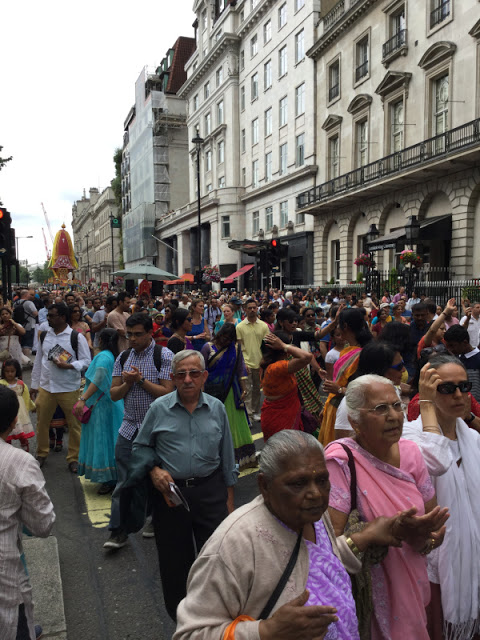
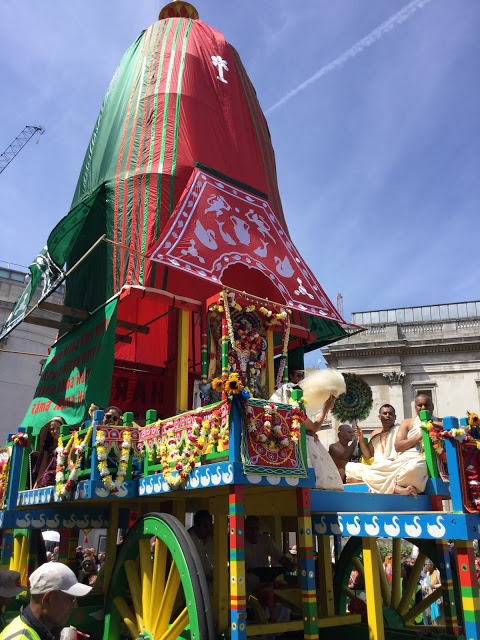
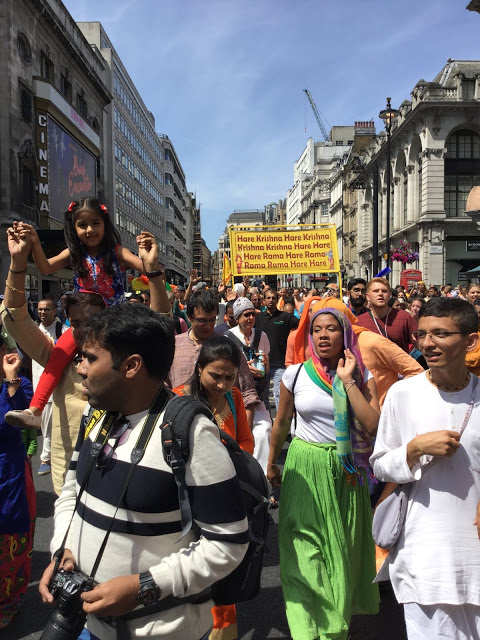
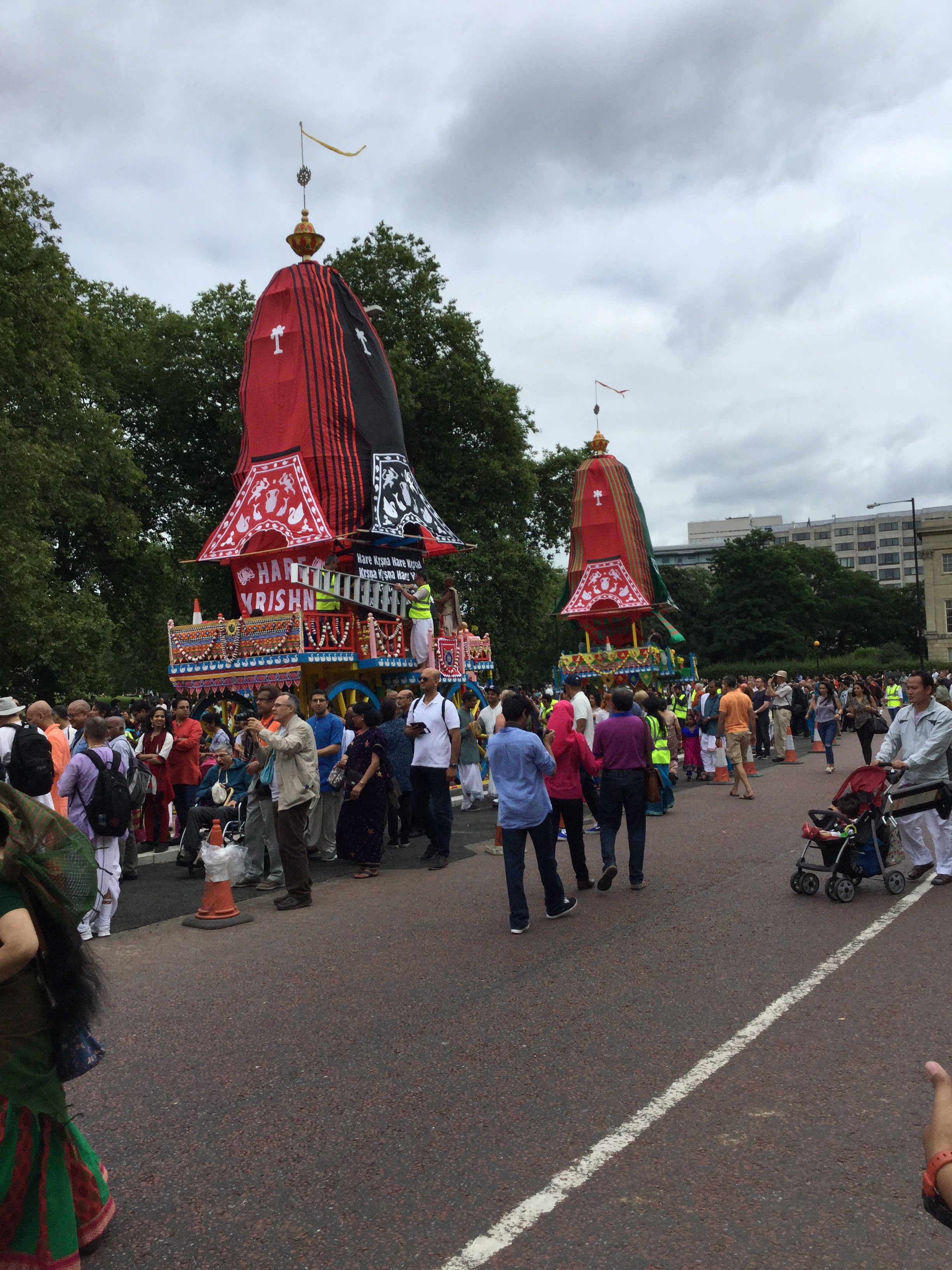
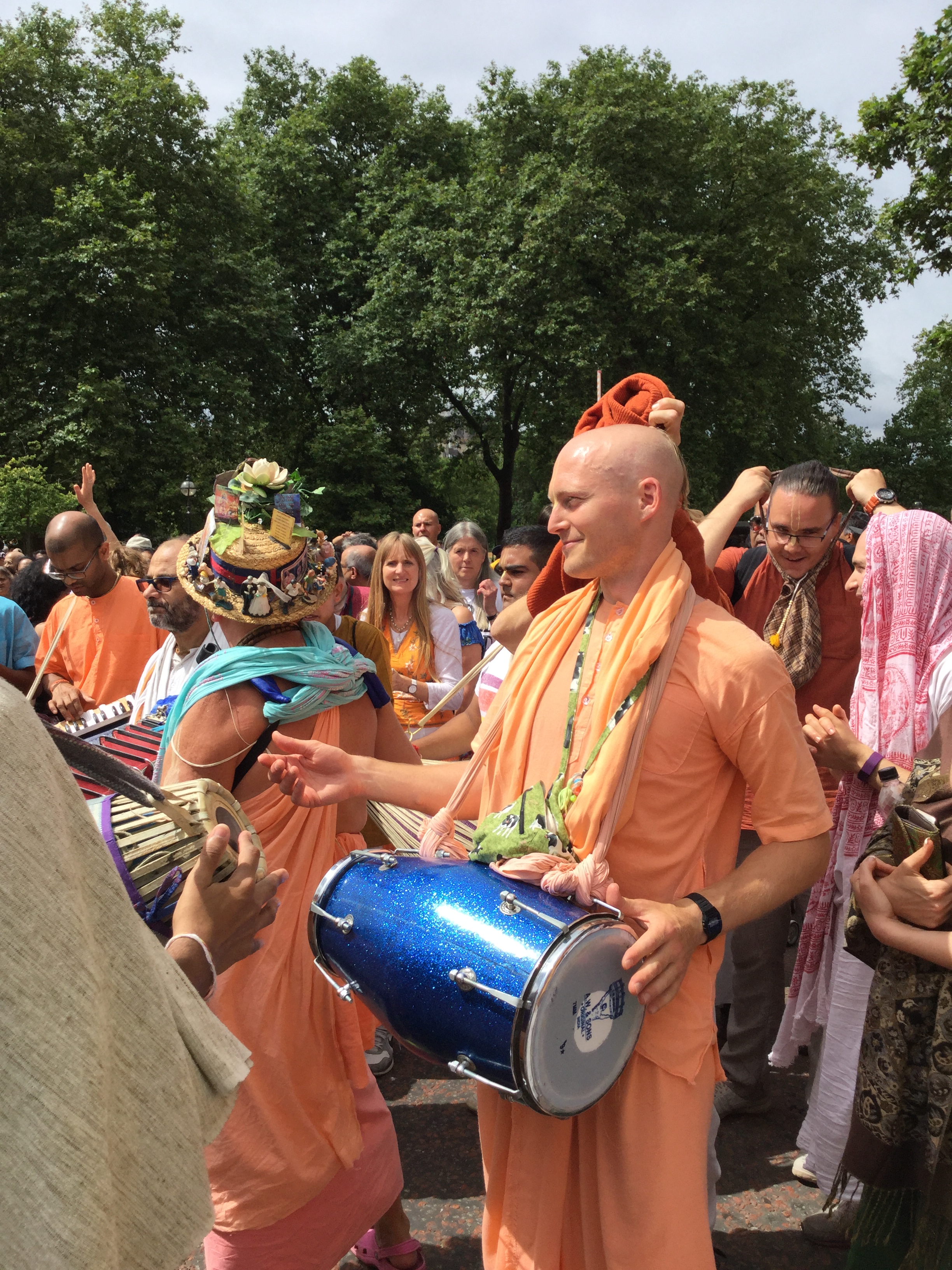
After spending a few weeks with local sponsors, he came to New York. He found accommodation in the Bowery (Lower East Side) section of downtown New York, one of the less pleasant and derelict areas of the city in the 60s.. He found a disused store front and opened his temple of Krishna there. He attracted the notice of some educated youngsters who were disenchanted with the American mainstream. He conducted Kirtan and spoke (preached) if people came. He registered his International Society for Krishna Consciousness ( ISKCON) in 1966 . A temple was opened in San Francisco, then in Los Angeles and other places. He was attracting educated and talented youngsters, though they were dropouts from the mainstream. ISKCON spread to other countries. He traveled across the world 14 times in twelve years, before he passed away on 14 November, 1977. By that time he had established more than 108 Krishna temples worldwide. Today ISKCON has 650 centres and temples all over the world – of them 135 in Europe and 56 in the US..
PRABHUPADA IS SPECIAL
In the annals of Indian swamis and gurus who frequent the West and peddle Indian wisdom, Prabhupada is special- very special. He is unlike any other in the history of India. Let us see some specific points.

CONTRAST WITH VIVEKANANDA
1. His contrast with Vivekananda is striking.
Prabhupada was not a general scholar or orator like Vivekananda. He was more than twice the age of Vivekananda when he went to America. He did not move with the elite. He did not talk about any vague Vedanta or philosophy in general terms. He did not try to please anyone. From the first day, he spoke only of Krishna and Krishna Consciousness without mincing words. He was an Acharya- practising what he preached and believed. He performed Deity (Murti) Puja, chanted, sang Kirtan, distributed Prasadam, preached Krishna Consciousness when occasion arose.. He did not talk in general terms about Indian philosophy. He spoke of Vedic wisdom, of Gaudiya Vaishnava tradition, of disciplic succession, of Krishna as the Supreme Personality of Godhead ( Bhagavan).
In short, he did everything Vivekananda had not attempted to do!
*** to be continued
tags – Sri Prabhupada -1, ISKCON














 Tamil and Vedas
You must be logged in to post a comment.