Caste Issue in Britain; Remove Tamil Word “Pariah” from English Dictionaries!(Post No 3387)

Written  by London Swaminathan


Date: 25 November 2016


Time uploaded in London: 11-59 AM


Post No.3387


Pictures are taken from various sources; they are representational only; thanks.


contact; swami_48@yahoo.com


London swaminathan’s Talk

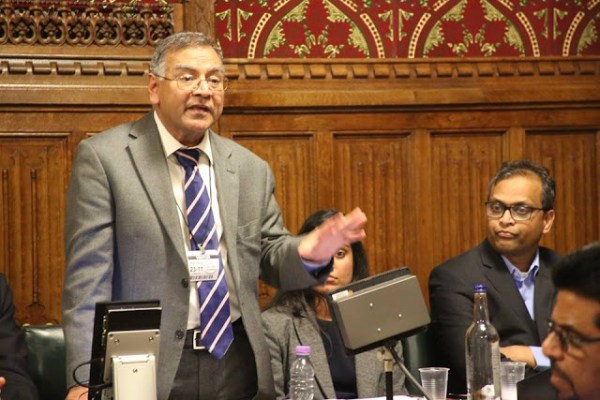
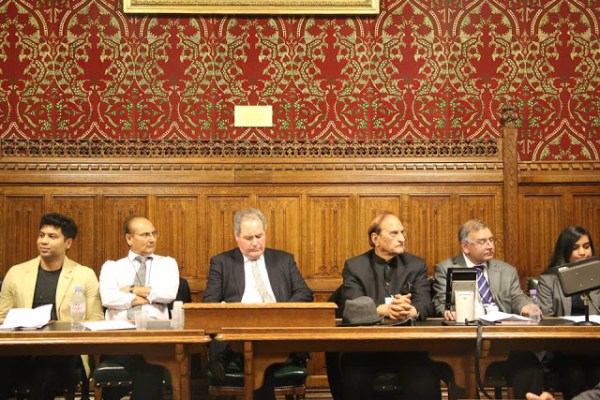
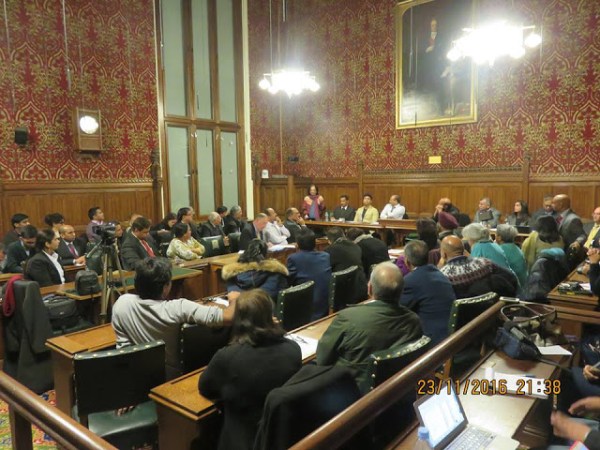
Following is an excerpt of my talk in British Parliament, committee room 12 under the auspices of Indian Forum on British Media. The meeting was held on Wednesday 23rd November inside the British Parliament building. One has to pass through tight security like we see at the airports. I was one of the seven speakers.


“Good Evening and Namaste.

Thanks for inviting me to speak briefly here on the issue of the Equality Act 2010. Like our honourable MP Bob Blackman here said earlier, I also feel there is no need to include the word CASTE as one of the discrimination in the act. There is no need to amend it for the following reasons:


As soon as Mr Prabhakar Kaza asked me to speak on this subject I did a small survey among my friends and family circle in Greater London area.


When I asked about CASTE, they all said they knew about castes in the country. When I asked them whether they knew anything about caste discrimination, immediately they asked me “You mean, in India?”

I said No. I am asking about Caste discrimination in Britain. They were all surprised and raised their eyebrows. They never heard of any caste discrimination.

Friends, please be aware of the difference between the words CASTE and Caste DISCRIMINATION. There is no caste discrimination in the country, at least in Greater Lonodon area. I attend many events organised by the community organisations and temple festivals. No one is discriminated against. But if you believe that there is discrimination let me tell you two stories.
TWO INTERESTING STORIES

As most of you know these stories already I am just giving you the outline of the story to illustrate my point.

There was a king in India whose son was pricked by a thorn. He had very heavy bleeding and the medicine men came and cured the boy. But the king was concerned about future accidents and so he made a proclamation that whoever comes with a solution to this problem will be given 1000 gold coins. Many people came with different suggestions such as spreading a carpet throughout the country or clearing the entire country without thorns. But a wise minister stood up and told them their treasury would be empty if they followed those suggestions. He also told them that he had a solution for it. He told them why don’t you wear a shoe? They wondered what a shoe was. He showed them the design of a leather shoe and that was how the shoes were invented. King was very happy and all his citizens started wearing shoes from that day. A simple solution for a big problem!

Friends,

God gives us problems and solutions as well. One must be wise enough to find the solution. We also have a thorny issue here. Speakers who spoke earlier told us that the Dalits re encountering problems in this country. If it is correct why don’t you find a solution instead of making it bigger and bigger by including it in the Law Book.


When there is a small problem or no problem, you are creating a phantom and fighting with it. Please dont do it.

Let me tell you another story to illustrate my point:-


When the Pandavas were in the forest, Lord Krishna and satyaki took the duty of guarding their tent. Since Hindus have divided the night into four divisions (Jamam), Satyaki suggested to Krishna they could turns. Krishna readily agreed. When Satyaki started his night sentry work, a Brahmarakshas (ghost) fell from the tree and started making funny noises. It teased Satyaki and he could not tolerate that nuisance. So he started crushing a tiny creature which was the size of a mustard seed. But it grew to the size of a foot ball and made more noises. Satyaki kicked it. Now it became like an Indian Pumpkin. Friends, I don’t know whether  you have seen Indian Pumpkin. It is huge. When satyaki attacked it, the ghost became bigger than Satyaki and gave him a punch Satyaki fainted and the ghost/ brahma rakshas went on its way. Thus, ended the first division of the night. Then Satyaki woke up Krishna and told him

“Krishna it is your turn now”. But Satyaki did not tell him anything that happened.

Krishna started his night duty as a watchman. The same ghost came and heckled at Krishna. Krishna smiled at it and patted on its back and said

Oh, my God! What a beautiful creature you are! I have never seen such a beauty. Come on, my darling! Come near. As he started doing this it became smaller and smaller in size and then disappeared.

Thus, ended the second division of the night.


For the third division of the night, Satyaki came, the ghost came again and all that happened in the first division of the night happened again! He got a severe blow and fainted. Fortunately, Krishna’s turn came and he did the same to the ghost and it disappeared.

In the morning Satyaki was surprised to see Krishna as fresh as a rose flower. He started the conversation slowly

“Krishna , how was it last night?

Krishna said smilingly, everything was alright. Since he was omnipresent and omniscient he knew what happened to Satyaki the previous night.

Then satyaki himself said the attacks of the ghost. Krishna laughed and said “My dear friend, whenever there is a small problem, don’t fight it. The more you fight the more problematic it will be”.


Friends! this is what I want to tell you. Even if I agree with you that there is a caste discrimination in the country, please don’t make it bigger and bigger. Don’t create a phantom and fight it.


Pariah and my fight against it!

Let me tell you about the word Pariah in Oxford Dictionary. Pariah is a Tamil word in Oxford English dictionary used by all he British politicians and newspapers almost every week. It is equivalent to dalit in other Indian languages. Even our Foreign Minister Borris Johnson used it last week dubbing “Syria, is an International Paraiah”.

Friends, I was the one who started a Facebook campaign to remove this word; but it is still used. Open any newspaper published in different parts of the world, New York Times, International Herald Tribune or London Times  or other newspapers. Whenever a  politician use the word Pariahit is published. A Tamil word is misused and abused. What we need is educating the British, educating the public. If I use Pariah in my part of the world, Tamil Nadu in South India, I will be sued, I may be imprisoned.

So friends if at all there is an older generation still practising the anti-dalit attitude, please educate them. The current generation do not know anything about caste discrimination.
PARIAH in Oxford Dictionary:

1‘they were treated as social pariahs’

SYNONYMS

outcast, persona non grata, leper, reject, untouchable, undesirable

To be continued………………….



It’s a Beautiful World! (Post No3382)

Written by London Swaminathan


Date: 23 November 2016


Time uploaded in London: 10-11 AM


Post No.3382


Pictures are taken from various sources; they are representational only; thanks.


contact; swami_48@yahoo.com


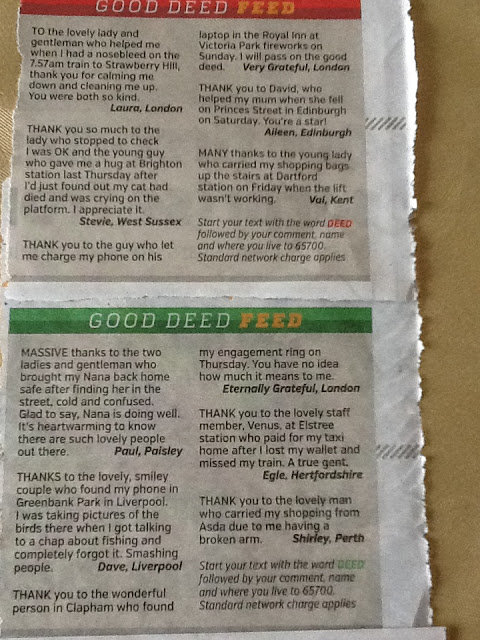
It’s a beautiful world indeed. We may think that the world is full of bad people after reading the first page of the newspapers. They give priority to crime news. All the newspapers report murder and mayhem. London Metro is no exception. But yet it gives positive news as well. Every day it publishes one 60 second interview with a prominent person and gives some space for the good deeds done by people and Thank you messages. Another column is allocated for Love at First Sight messages. Why don’t India newspapers follow this?


Metro newspaper is read by millions of people every day in and around London. It is distributed free of cost. It has been publishing 60 second interviews and good deeds for several years. That means it has published several thousand interviews and good deeds messages.


Here are some examples taken from recent Metro issues:-

Xxx


Tuesday, November 15, 2016 METRO


“THANK you to Ben, the train guard on the 10.12am Trans Pennine train from Liverpool to Newcastle for being so helpful when we forgot our rail card on our wedding anniversary trip and for upgrading us to first class. What a star!- Jo and Roy, Wirral


THANK you to the lady who helped me on Saturday night when I was ‘unwell’ near, Highbury & Islington station and got me safely into a cab. -Dimple, London


forgot our railcard on our thanks to your note. Dimple, London wedding anniversary trip and Gareth And Rebecca, Liverpool


THANK you to staff at Woking station for displaying the lovely poppy tributes made by local children. They are both moving and uplifting- Amanda, Surrey


xxx


THANK you so much to the lovely man who helped me get my car out of a really tight space on Dowanhill Road in Glasgow on Saturday evening. l was in a complete panic and your kind and helpful words calmed me down– Young and Anxious Driver, Glasgow


xxx


Thanks to all those who stopped on the bridge above Queen Street Station last Thursday when my friend had a seizure. He is now fine. Cammie, Glasgow


xxx


Friday, November 4, 2016 METRO


THANK you to the lovely  couple I met on the Sheffield tram. I was running late for the Sheffield 10k and needed to  hand in my bag to the baggage area. They kindly handed it in while I legged it to the start- Chris, Wakefield

xxx


THANK you to the wonderful staff at Wythenshawe hospital. I had a rare visit there with my mum and all I saw were incredible acts of kindness. Thank goodness for these people who are the heart of the NHS- Debbie, Manchester.


xxx


Thank you so much to everyone  who helped me when I fainted on the 7.38am train to Glasgow Central on Thursday, and to the gent for buying me much needed Lucozade tablets – Jillian, Clarkston


xxx


Thank you to the young lad who stuck up for me outside Bath bus station on Friday when I was being harassed by a drunk man and to the bus driver who stopped to let me on — Girl in The Boots Uniform


xxx

 
Friday, November 18, 2016 METRO


HEARTFELT thanks to police officer Gareth and hospital staff who helped save my life after my accident on the East Lancs Road on Monday night. My  calf was sliced in two and I suffered minor head injuries. My cycle helmet saved me, so please always wear one.

—-Grateful cyclist

Xxx


THANK you to the person who witnessed me having a seizure carriage and then carried my Grateful Commuter somewhere between Berkeley Square and Regent Street called an ambulance and stayed to tell them what had happened– Julia, London

xxx


RUSH-HOUR CRUSH LOVE


BEAUTIFUL brunette on the 7.38am from St Albans. I kept glancing and smiled at you as I got off at St Pancras. I was hoping you were getting off too, so we could grab a drink. May be next time?

–Guy with glasses, Luton

xxx


We smiled at the instructions. It will lead kept each other a few times and you to me.

Blonde Lady glancing and smiled at you as I wish I had asked you out. I was Guy in Red Jacket And Jeans


SMALL Blonde In Blue Jacket hoping you were getting off (Metro, Fri), l fit your description but remain doubtful. Any more details?- Guy wearing head phones.


GIRL In Red Dress (Metro, Fri) yes, I did see you on Monday and I do fancy a pint. Is Wetherspoons at Dewsbury  at 6.30pm OK? Guy In Green Jacket, Bradford.

Xxx


BEAUTIFUL girl with brown hair and the world’s best smile on the Northern line at Euston on Saturday. I off Embankment Station. We smiled at each other a few times and I wish I had asked you out- Guy in Red Jacket and Jeans.

And many more like this every day!


–Subham–


Significance of Bangles for Hindu Ladies (Post No.3378)

Written by London Swaminathan


Date: 22 November 2016


Time uploaded in London: 10-14 AM


Post No.3378


Pictures are taken from various sources; they are representational only; thanks.


contact; swami_48@yahoo.com


Hindu Ornaments- Part 2 (Please read first part of this article posted yesterday.)


Glass bangles


Those who, from poverty or any other cause cannot obtain any jewels whatever, have glass bangles. To be without these is a mark of widowhood. It is a universal rule that all Hindu females, from their very childhood should wear these bangles. A widow may wear gold bracelets, but not glass ones. A little infant of a month old has one or two glass bangles on its little wrist by the fond mother, and number increases with the age of the child. Some females wear a few, whilst others have on a dozen or more, nearly covering the arm from the wrist upwards.


An angry woman will sometimes smash all her loved bangles before her husband’s face. such an act is as much as saying, “I would I were a widow”, and it a very dreadful thing to do. Common bangles will sell at about four for one anna (one penny), whilst the better ones are half-an-anna or an anna each (it was written in 1908). The colours vary, black, blue and green being the usual ones. As a rule, the same colours are worn indifferently by all classes, the better class people having the finer and more expensive kinds.


Decking with Bangles

For a pregnant Hindu lady bangles have additional significance. During the first pregnancy of a Hindu woman, she is decked with lot of bangles on a particular day in the seventh or eighth month of her pregnancy. Lot of ladies will come and adorn her with different colour bangles and they will also get new bangles from the house of the pregnant lady. They believe the child could hear the tingling sound of the bangles every day and feel happy. This ceremony is called Valai Kappu in Tamil (Wearing bangles) and Seemantham in Sanskrit.


Bangles and Castes!


There are, however, a few varieties affected by some of the castes. The females of the cowherd caste, for instance, usually wear a peculiar kind in which the ground is black, but ornamented with green spots or streaks. The toddy caste, again, have a kind. In addition to the glass it is usual for coloured ones made of be lac to be worn, two on each arm; that is the first and last bangle is usually one of this kind. The cost of these is more than those made of glass, and ornamented with various colours and bits of glass so as to produce a very pretty effect. The bangle man is a well-known person and may constantly be met, with his strings bangles over his shoulder. He has his usual rounds and appears to meet with a very hearty welcome.


The bangles are put on by the bangle-man, and it seems a very painful process for the poor female, She sits on the ground in front of the manipulator, and he, seated tailor fashion takes her hand in his, and begins the operation, kneading and pressing with practised fingers. He now and then soothes the sufferer by pointing out the beauty that will be the result of the pain. The wonder is, the circles being so small, how they can be got over the hand at all; but the Hindu hand is very supple the operator knows how to press and squeeze so as to accomplish his purpose. The painful operation must, however, be done, and the sooner it is over and the less fuss made about it the better. The lac bangle is not put on over the hand in this way; it is cut and pressed open and, after a piece or two has been snipped off to make it the proper size, the ends are heated and pressed together when they readily join.

The ornaments hitherto enumerated are ordinarily made of gold, the glass bangles excepted. The body or inner part of the jewel may be of copper or lead, especially in the larger sized ones but silver is only worn by poor people. The women of the Lambardi and some other gypsy tribes are ornamented in most profuse and barbarous fashion, Full blown flower like silver ornaments, with numerous small globular pendants tinkling, softly like little bells fall over their hair; large and heavy bracelets of brass, or ivory, even painted wood are on their wrists. Their heavy brass anklets, which are hollow and contain little pellets give out a tinkling sound as they walk along. The dress of these women is quite different from that of ordinary Hindu females; it is very picturesque even grotesque, in its shape and material.


There is a lavish ornamentation of beads and cowry shells sewn on to the close fitting jacket and to “the bag like pockets which dangle at side of their parti-coloured skirts.


The ornaments for the female waist, are more often made of silver than of gold, especially the anklets and toe rings. A broad zone of gold or  silver, with clasps, is worn round the waist by those who can afford it. This is sometimes plain and times ornamented with raised work. The effect is very pleasing in contrast with the bright coloured raiment which picturesquely envelopes the figure. The anklets are of various shapes and sizes. Some are circular, like the bracelets for the wrists, whilst others are formed so as to curve over the ankles. Some are chains, whilst others have attached to them a number of little bells which tinkle tinkle with a soft and pleasant sound, as the wearer moves about.

(Toe ring picture is from Wikipedia;thanks)

Toe rings

Silver rings of various kinds are worn on the toes. There must always be one ring on the middle toe of one or both feet. If  through this extreme poverty a silver ring cannot be obtained  for this toe, then one of bell-metal will be used instead. The shape of these rings for the toes of females differs from that those for men, in that they are usually shaped like two or three twists of wire; hence the Telugu name for  women’s toe rings is tsuttu, which means a twist round. Married women wear a peculiar shaped ring on the fourth toe which has an embossed ornament on the top. Men’s toe rings are more like ordinary finger rings, except that they can be pulled open and pressed again, when put on or taken off.


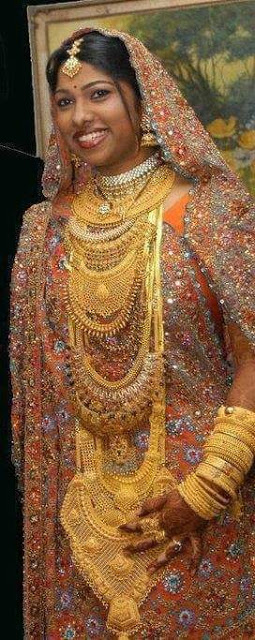
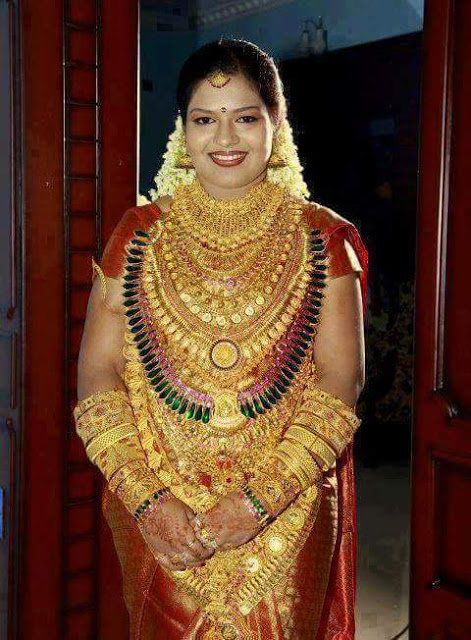
All these ornaments are not worn at one and the same time, but it is astonishing how many jewels can be crowded on to the person. So imperative is it at weddings that the bride should be decked out in jewels, that they are freely borrowed and as freely lent by the neighbours and friends upon so important an occasion.

Source The Hindu at Home , Year 1908.


(Please read my research article about Egyptian Mummies discovered with toe rings, posted last year.)


–Subham–


Jewellery of Hindu Women! 12 for Head and 15 for Ear ! (Post No.3375)

Compiled by London Swaminathan


Date: 21 November 2016


Time uploaded in London: 17-51


Post No.3375


Pictures are taken from various sources; they are representational only; thanks.


contact; swami_48@yahoo.com

 
HINDU ORNAMENTS (Abharanam) -Part 1


“Fathers, brothers, husbands and brothers-in-law who wish for great good fortune should revere women and adorn them -Manu 3-55


“The deities delight in places where women are revered -3-56


“Where the women of the family are miserable, the family is soon destroyed 3-57


“Men who wish to prosper should always revere women with ornaments, clothes and food at celebrations and festivals Manu 3-59


Nowhere in the world women can get such a big support like in India. Manu was the best advocate for women in the ancient world.


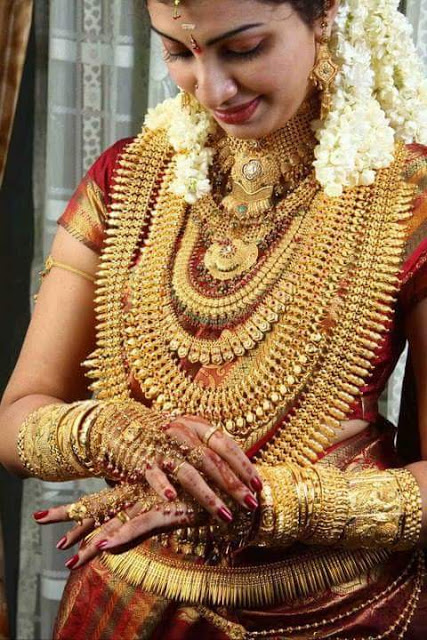
PROBABLY in no country in the world is the love of personal ornament so manifest as it is in India. The sight of the great princes in full gala dress is a dream of brightness and wealth; and even the poorest day labourer manages to possess some ornament, if it is only a silver, or even copper ring for his finger, or toe.


Any little extra gain and savings are almost invariably invested in jewels. The owner is happy if on gala days he can adorn himself, or his family with so much jewellery; and he likes to be spoken of as a man possessing so many rupees worth of the same. A man’s wealth is often spoken of as the possession of so much in jewels.

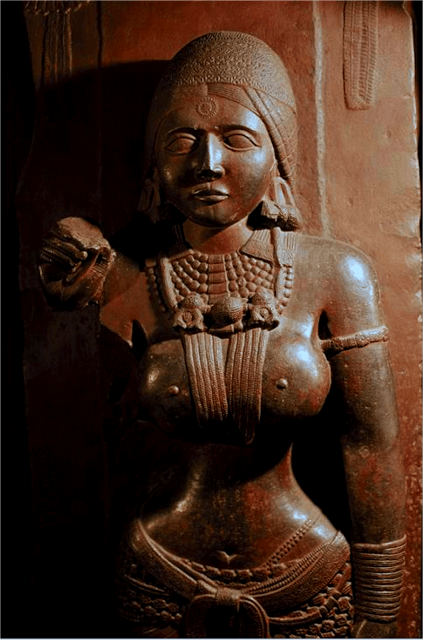
Hidu Jewellery 2300 years ago! Bharhut Yakshi

Proverbs on Jewels and Ornaments


It is an investment for future, the Hindus believe.

A Telugu proverb says,

Jewels worn for ornament will be useful in times of difficulty.


Jewels are often a subject of quarrels in Indian families. If one woman has more than another, the peace in the house is disturbed. There is  a Sanskrit saying current which ironically expresses this,

Namakaram (obeiyance) to gold which which creates enmity between mother and son

And a Telugu proverb says

Even though the brother-in-law has to go to prison, the elder sister must have her anklets.

The ordinary Indian distrusts the goldsmith and takes trusty friends to watch the process of his piece of gold being made into an ornament for his wife.

Popular sayings are,

A goldsmith will steal a scrap of his mother’s nose ring!

The jewel belongs to the wearer, but the gold remains with the jeweller.


The metal employed in jewellery is, as a rule, good of its kind. The gems worn by the lower orders often false, but the setting is almost invariably of pure gold or silver.


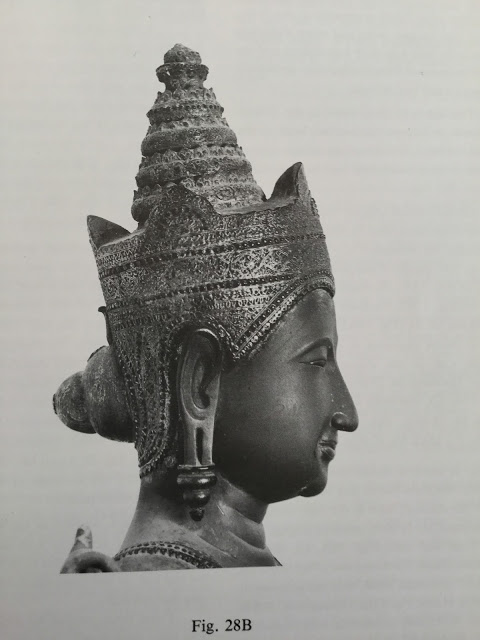
Lord Vishnu’s jewellery, Thailand

Ornaments for Men

Men have the ear, both the different parts of the outer rim and the lobe, pierced for various kinds ornaments. They also have the nose pierced for a small jewel. It may be done in either one of the nostrils, or in the div on between the two. They often wear old or silver beads round the neck which are sometimes used as a rosary. It is very common to wear a silver or gold belt round the waist. This is often made in circular or square plates, joined together each plate being either plain or ornamented with embossed or raised work. Even an ordinary coolie, or labourer, may be seen wearing one of these silver belts. Men wear bracelets on the upper arm and on the wrist; the latter sometimes beautifully ornamented. They wear more rings on the fingers than the females and sometimes thegems in these rings are very valuable.


Probably the most valuable part of a man’s ornaments are the gems in his ear-rings, and finger rings. A man may have very little on in the shape clothing, the lobes of his ears are ornamented with diamonds of great value. Sometimes a man has a ring on his big toe.


There is an idea that it is beneficial to health, for a toe ring is said to benefit impaired energies.


Hindus’ Peculiar custom


There is a peculiar custom prevalent amongst the Hindus, when a child is born to a married pair after a long time, or one survives after several have died in infancy. In such a case, and especially if it be a boy, but also sometimes in the ease of girl, the parents will beg money from their friends and  even from strangers— the money must be obtained this way —  and with what is realized, they get jewels made for the ear and nose, to be worn as amulets. It must at least be enough for one ear and one nostril but if sufficient is obtained to meet cost, both ears and both nostrils are thus ornamented. When these are once put on, they are never removed. Great danger would be incurred by removing these charms. It is very dangerous for a visitor to praise ornaments of a child. Praise of this kind is believed to bring a nemesis with it, or it may suggest envious glance of the malignant,”


12 ornaments for Head alone!

The ornaments for women are naturally far more numerous. There are no less than twelve different kinds for the head alone. Probably this does not exhaust the list, but these are those in ordinary use, either for gala days or for every day wear. There is an ornament called the betel leaf, made of gold, ornamented with little balls along its edges, and worn on the top of the head towards the front. Another ornament made into the shape of the petal of a certain Indian flower is worn just behind it. Next comes a large circular ornament named after the Indian chrysanthemum, and placed at the end of the chignon, which is worn at the side and not at the back of the head. A golden sun-flower, with a crescent attached to it by links, is put on the crown of the bead. These four ornaments are in ordinary wear by well to do females; those hereafter mentioned are, as a rule only worn on gala days.


An ornament, shaped an inverted A, sometimes set with pearls, is worn on the forehead, the angle being attached to the hair the line with the parting. Pendant from is a locket adorned with pearls. On the hair in front and just between the shaped A shaped ornament and the betel shaped one are two jewels; the one on the right is called the sun, and the one on the left, being of a crescent shape, is named the moon. Both of these are sometimes adorned with precious stones.


There is also a kind of gold buckle worn on the side of the chignon, which is used for attaching to it any artificial hair that may be necessary to make the bunch of the approved size and appearance.


An ornament like a chrysanthemum with an emerald in the centre is also worn on the chignon


On great occasions, such as her wedding day or other gala days,  a Hindu lady may have all these ornaments on at the same time. There are two head ornaments that are worn instead of those on the chignon, when the wearers are young girls. Their hair is plaited into a tail, hanging straight down behind, and beautified with a long ornament of gold, often set with precious stones. At the end of this yet another article is attached, consisting of a bunch of gold ball- like ornaments fastened on with silk.

Nose ornaments

Strange as it may seem to Western ideas, ornaments frequently attached to the nose by Hindu ladies. Each nostril and the cartilage between the two are pierced, and one or other of the following ornaments are attached to the nose.

First there is pendant from the centre, hanging down over the upper lip. In the middle of this ornament there is a stone of some kind and pendant from that again is a pearl. Into one of the nostrils a short pin with a precious stone as a head is put. A pendant pearl is attached it. Into the other nostril a flower-shaped jewel of gold and small pearls may be put. These three jewels are in daily wear by those who can afford them. For high days and holidays, a ring, sometimes as large round as a rupee and ornamented with pearls or precious stones, is worn in one of the nostrils; whilst the other may be a flower-like jewel of smaller size. A half-moon shaped ornament is also attached to a nostril.  It is not possible to have all these on at one and the same time; but a number can be thus worn together.

15 Ear ornaments


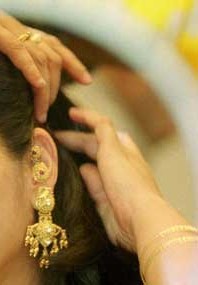
There are at least four parts of the ear, and some times even more, that are pierced to enable the various ornaments to be attached to it.


I have a list of fifteen different kinds of ear-jewels, all known by different names. Some are of ornamented gold, whilst others are richly set with gems and pearls, according to the means of the owner. Some are for the lobe of the ear and some for the tip and middle of the outer rim, each place being pierced for the purpose. There is also a hole pierced in the little prominence in front of the external opening of the ear which is made to serve the purpose of holding a jewel. The variety of neck ornaments is very great. I have the names of twenty-four. The style and quality differ very largely Some are tight bands, fitting close round the neck, usually composed of flat gold beads or tablets strung together on silken or other cord. Amongst poorer people the gold beads are alternated with those of coloured glass. Some of the neck ornaments are loose hanging chains. A very favourite neck jewel is composed of gold coins, or French five or ten francs Australian sovereign pieces, or the old Indian gold mohur.


There are jewels for the upper part of the arm and for the wrists. Those for the upper part are like bracelets of various kinds. Some are like chains and some are merely plain bands, whilst others are beautifully in various patterns. Others are ornamented with precious stones.

Source: The Hindu at Home,  By Rev.Padfield, Year 1908


To be continued……………………………


Why do Hindus dissolve ash in the River Ganges? (Post No.3366)

Compiled  by London Swaminathan


Date: 18 November 2016


Time uploaded in London: 8-28 AM


Post No.3366


Pictures are taken from various sources; they are representational only; thanks.


contact; swami_48@yahoo.com


ADULTS ONLY: THIS SHOULD BE READ ONLY BY THOSE WHO HAVE LOST THEIR FATHER OR MOTHER OR BOTH. YOUNGSTERS SHOULD NOT READ THE FUNERAL POSTS.


13 Day Hindu Funeral Rites- Part 3


Recorded by The Rev. J E Padfield B.D., year 1908, in his book “The Hindu at Home”.


32 different mantras
The party then proceed to a special place, outside the town or village, where such funeral rites are performed. This place is usually a well or is near a tank or river, and is used only for this particular purpose. On  arriving at the place in question, the karta proceeds to bathe and then to cook the food which he has brought. The preta shila/stone is then placed into a little receptacle formed for it of leaves and is then consecrated by the repetition of mantrams portion. A small portion of the cooked food is now waved before the stone as an offering. This is to appease the hunger of the preta, just as water, which is poured over it, is supposed to appease its thirst. After this the remainder of the cooked food is scattered to different sides a thirty-two different mantrams are repeated, calling upon the crows and kites to come and devour what is scattered. The mantras are appeals to the disembodied spirit, in the shape of the various kinds of birds, to come and partake of the food thus provided. All this is repeated every morning for ten days. The following is a specimen of the texts thus said:-


May this préta enjoy this food by means of the mouths of these kites and crows.”

Grdhra vayasa mukhena preto bhujyatam


When this ceremony is over, the scattered food is eaten by the kites and crows which fly around in expectation of the feast.


Nine different grains


After all this is finished the party return home. On entering the house, the karta purify his eyes before looking upon any of the household, by fixing them upon the light which has been placed on the spot where the deceased last lay. He then gets a pot of water which he suspends from a beam over the same place, where the dead breathed his last. A small hole is made in the bottom of this pot and the water is allowed slowly to drip on to the ground near the place, where the head lay. Some earth is also put there in which nine different kinds of grain have been mixed. The pot is left there for the ten days of the nitya karma. in order to quench the thirst of the spirit which is thought to still hover near the spot.


From the time of death up to this moment no food has been cooked in the house; but now a meal is prepared, a small portion of which is carefully placed near to the dripping water for the refreshment of the disembodied spirit. This food is renewed and placed there daily during the ten days of the nitya karma cere monies. This act ends the ceremonies of the funeral day itself, but not all the ceremonies for the dead.


Collecting the bones


On some one day of the ten during which the nitya karma rites are performed, there is a sanchanam (collecting). This takes place usually on the fourth day, and it is performed at the burning ground. It is different from and additional to the daily rite at the préta place.


Bones placed in the Ganges River


The karta and the priest accompanied by a few friends, and probably a few Brahmins, especially if a fee is given to them for so coming, will proceed to the burning ground, taking with them from the house fire, rice, ghee and curds with pots for cooking, and also some of the sacred darbha grass. The karta then gathers some of the pieces of bone that may be left amongst the ashes of the funeral pile. These bones are preserved in a new earthen vessel or urn for a time, after which they are taken and dissolved in some sacred river, or buried in an unfrequented place.


In the case of wealthy people, who can afford to pay the necessary expenses, it is a very common thing for Brahmins to be employed and well payed to take the urn (asthi patra) with the calcined bones all the way to Benares, there to be dissolved into the sacred Ganga (River Ganges).


There is a slokam or verse, which is current amongst the purohitas/priests and extremely popular, showing the benefit which will be derived from the bones being thus cast into the waters of the river Ganges


“How longsoever the bones of a man

Are in the waters of the Ganges

For so many thousands of years

They will be respected in Brahma lokam.


Yavadhasti manushayanam Gangatoyateshu tishtati

Tavadvarsha sahasrani brahmaloke mahipate


The rest of the ashes are carefully gathered together, and put aside or buried. The karta now proceeds to prepare a place for cooking the materials be has brought for the purpose. This is done by sprinkling a spot of ground with water and smearing it with the dung of a cow. He then bathes and cooks the food, after which he performs a homam/ fire sacrifice. This being done he with suitable mantrams, casts food to the crows and kites which have come there for the meal. This food is called prétabaram or food for the spirit.


On the tenth and final day of the mourning, the near relatives, with the family priest and the karta, assemble at the place where the nitya karma rites are performed for the last important ceremony. The food is cooked and scattered to the birds, with the repeating of mantrams for the last time;  after which the chief mourners shave and bathe, so as to be rendered free from defilement. The brass pot in which this food has been cooked for the past ten days, and the preta shila (the small stone), are now thrown into the water by the karta, for they are now done with. This is called shiladhivasam, or placing the stone. The pot is afterwards secured by the purohita as a fee. After this a homam is performed by the karta, alms are to distributed to attendant Brahmins and all proceed to their homes.


What happens to the wife of the deceased?

If the deceased was a married man, it is at this last ceremony that the poor widow is degraded into her state of widowhood. This rite is called sutrachédam or cutting of the cord.


No thought of youth or beauty, no bonds of nature or ties of affection can ward off this inevitable curse. The relatives and friends of the poor forlorn creature assemble at the house and the victim is adorned for the sacrifice. Her festive raiment is put on, and she is beautified with her jewels, flowers and sweet-smelling sandal paste. The beauty intensified with rouge and bright pigments, and all is arranged as for a festive day. For a time her loving friends weep with her and embrace her, condoling with her on her fate. After this is over she is taken in a palanquin to some sort and conveyed to the scene of her degrading. When she arrives, her bright clothing and jewels are taken off. Henceforth she must have only one coarse covering; her beautiful long hair, the glory of her womanhood, is cut off and her head is close shaven. The mangalasutram or marriage token is cut off and she is now a widow indeed. This cutting off of the marriage cord is always done by a woman and then she is taken back to her home.
11th Day

On the eleventh day there are some ceremonies at the house which include the feeding of Brahmins. On this day too, in times gone by, there was a ceremony called Ekahvanam (calling of one) by which a Brahmin for sufficient consideration, took upon himself the sins of the deceased and expiated the same by 21 days seclusion and by repating numberless times the Gayatri, with various ceremonies. This now appears to be an obsolete rite. Instead of it , 32 lumps of rice and ghee mixed together are taken and thrown into a pit near to  which a sacrifice /homam is made.

Bull is dedicated


A young bull is dedicated by being stamped with the mark of vishnu’s wheel or shiva’s trident. By this the sins of the deceased are supposed to be transferred to the animal which is meritorious to feed and care for. Sometimes a cow-calf  is also devoted, and a kind of marriage is performed between the two.

12th day
On the twelfth last of the various funeral ceremonies is performed. It is called the sapindi karanam. A few words should be said about mourning, for the Hindu idea of mourning is not conveyed by the English term. To  the Hindu it means uncleanness, ceremonial defilement and it is quite apart from the natural sorrow caused to survivors by death. The word used for mourning, in the true Hindu sense, is ashushi or sutakam, both which words mean ceremonial defilement. The duration of this mourning varies according to the condition of the deceased. In the case of mere infants the time is about one day. In the case of a boy who has not yet been invested with the sacred thread, or of a girl not yet married, the time is three days and after that, in either case the proper time is ten days. In the case of a married female, whether she has joined her husband or not, her own parents and brothers and sisters observe this ceremonial mourning for three days. During these periods, the near relatives of the deceased are considered unclean, and their touch would ceremonially defile any person or thing. They must not enter their own kitchen or touch any cooking utensil. The food, during the days of mourning, must be prepared by someone not personally connected with the deceased although of equal caste.


13th day

Thirteenth day is called Suba Sweekaram. Everyone in the family bathes and wear new clothes. They go to temple and worship . afer which they don’t go to temple for a year. Elders don’t celebrate the usual festivals but children do celebrate.


(My Comments:– It is not very comprehensive. But it will give some idea about the Hindu way of life. Lot of Dhanams (Gifts), at least 96 gifts are listed in the books. Garuda Puranam is recited on the 13th day or before that. Customs also differ from area to area. It is all done for practical reasons. When people find it difficult to follow certain rules for practical reasons, the elders in the family or in the community guide them to drop some or modify some rules. Hinduism is not rigid. If someone has to write what all happens from the minute of death to the first anniversary of the death, it will be a voluminous book. Every month some ceremonies are done for one year. The first death anniversary also has lot of rituals. Then they do Tarpan on new moon days and other important days throughout their life. Non-Brahmins don’t do all the rituals but they do pay respect to their departed souls twice a year or four times a year during Two Important New Moon Days and two equinox days)


–Subham–


Why do Hindus stop the Funeral Procession at Three Places? (Post No.3362)

Compiled  by London Swaminathan


Date: 17 November 2016


Time uploaded in London: 10-08 am


Post No.3362


Pictures are taken from various sources; they are representational only; thanks.


contact; swami_48@yahoo.com


ADULTS ONLY: THIS SHOULD BE READ ONLY BY THOSE WHO HAVE LOST THEIR FATHER OR MOTHER OR BOTH. YOUNGSTERS SHOULD NOT READ THE FUNERAL POSTS.


13 Day Hindu Funeral Rites- Part 2


Recorded by The Rev. J E Padfield B.D., year 1908, in his book The Hindu at Home.


The wailing of eastern women is proverbial, but must be witnessed or heard to be fully understood. The men are quiet in their grief for it is not seemly for a man to weep and wail; but the females abandon themselves completely to their sort and their lamentations are both loud and long. They  tear their hair, beat their chests and foreheads, roll  their bodies about as if in great agony, when they utterance to their sorrow for the dead.


Light at the head of the Dead body


As soon as death has taken place, a light is put at the head of the body and preparations are at once made for the funeral. The chief person present at it is the near relative, who has to perform the necessary rites, and who is called the karma karta or the one who performs. This is the eldest son, if there is one who is old enough to have received upanayanam. Failing such a son, the ceremonies are performed by the following persons:-

if the dead person is a woman her husband; if a man, his father; if the father is dead, the next brother and so on in order of nearest relationship.


(My comments: Even today Christians follow this Hindu custom. They light the candles at the place of death. I have written a few articles already about the significance of Number 3 and Number 7 in Hinduism and Indus valley Civilization. Please read them to understand this part of the article.)


Usually only a few hours elapse after death before the funeral takes place but there is no fixed rule on this point it seems to depend on circumstances. The dead body is now washed and adorned with the pundrams/ sacred marks, and then, clothed in one long white cloth only, it is put in a sitting posture, leaning against the wall the head alone being uncovered. The karta now performs a mam sacrifice in front of the dead. The fire for the homam is brought from the house fire, and the sacrifice consists of dropping into it ghee, rice, and the green twigs of the peepul tree. Mantrams like this are repeated the while:


O fire do thou turn towards me; look kindly towards me with thy seven tongues (spoken of in the vedas), graciously partake of my offering.

Number Seven!

After the homam, the body, enveloped in cloth, is placed upon the bier. The bier is formed construction of two long bamboos, with seven pieces of wood tied across. It is said that that seven cross pieces are used to represent seven upper worlds. Some of the fire from the homam is placed in a new earthen pot, to be carried in the procession by the chief mourner. The body, wrapped in the new cloth and fastened to the bier has the two thumbs, and the two great toes also tied together with cords. The bier carried by several of the relatives or at least by persons of the same caste.


The procession consists of few of the friends, sometimes even females, with the men carrying bier and the chief mourner, or karta, carrying the pot of fire. Where music is employed, the musicians playing their wild music also form part of the procession. Those who bury their dead always have music; those who cremate have it sometimes.


Three stops on the way! Why?


On the way to the cemetery or crematorium, the procession is stopped three times and the bier is placed on the ground. The face is then uncovered and a mantram is said. This is done from the fear that, owing to the speedy funeral the person may not be really dead after all.

The mantram used is this:

o spirit hast thou returned?

Aum, jiiva punaragacasivaa


The cemetery (shmashanam) is a vacant spot set for this purpose, usually situated to the north east of the town or village. It is generally a mere waste, barren, neglected spot with nothing to distinguish it from any other waste, except here and there a few blackened patches, from the recent or more ancient fires. These blackened places and a few broken pots are generally all there is to mark the “God’s acre” (Shiva Bhumi).


In villages, in the case of poor people, each house- holder gives a little fuel to help to form the funeral pile. This is collected by the vettian who splits the wood and prepares the pyre. He is a kind of public messenger and low official drudge attached to each village. He is always a Pariah. He generally holds a small piece of land which, with certain fees, forms his remuneration. For funerals, part of his fee is the sticks of the cloth wound round the corpse and the sticks of which the bier is made.

Naked we came, Naked we Go!


On arriving at the spot the bier is set down, and the body is put on the pile. The cloth in which it the body was wrapped is then taken off. Any jewels in the ear or elsewhere, the sacred thread and the waist cord are also removed. The body must be completely naked.  As it came into the world so it must depart. The corpse is laid on the pile with its head towards the south and its legs to the north. It is placed on its back, but the face is slightly turned towards the east, In some parts, the body is laid with its head facing the Himalayas.


Why three holes in the Water Pot?

The karta now performs the pradakshina ceremony in the anti clockwise direction. For all auspicious things it is clockwise. For death ceremony it is opposite direction.  He takes an earthen pot full of water and makes a small hole in the bottom of it from which water slowly trickles out. With his hair all hanging down his back he takes the pot of water on his shoulder and, as the water slowly runs out, he walks round the pile, having his right shoulder towards it. It is done three times. Before the second round second hole is made in the pot and in like manner a third hole is made before the third round. After  the three circumambulations, he throws the pot over his head behind him and dashes it to pieces. This is supposed to assuage the thirst the préta (disembodied spirit) during the fiery ordeal.


The karta now performs a homam/ fire sacrifice and then, taking some of the sacred fire, applies it to the right side, breasts and shoulders of the body as it on the pile. Then the supreme moment arrives when, taking some of the sanctified fire, he applies it to the pile, near the head of the body and sets it alight during which all time the priest repeats mantrams of which the following are specimens:


After performing the préta homam, he (the karta), takes brands from the homam, and standing with his face towards the south, places a brand on the right side,breasts and shoulders (of the corpse).


O Fire do not regret that thou art consuming this dead one. Do not sorrow whilst thou art consuming his skin and his whole body.”


After setting fire to the pile the mourners sit somewhat apart, whilst who carried the bier stay near to adjust the fire, until the skull is heard to burst.

The mourner then pours water upon it to cool the spirit. The karta is then shaved by the barber. After this he bathes His head and face must be completely shaved except the sacred top-knot; but  should the deceased be younger than he is, then shaving is put off until the tenth day.


Stone for the Dead!


The chief mourner now returns to the house with his friends, but they do not enter it. The simply go there to get the materials for the nitya karma sacri fice, which must now take place, and before doing of which the karta should not re-enter the dwelling. If it should be dark before the karta arrives, the nitya karma ceremony does not take place until the following morning. This ceremony can never be done after darkness has set in. The karta, accompanied by the purohita and many relatives or friends now takes some fire and fuel, rice, ghee, curds and pulse for a sacrifice. He also receives from the purohita, a small round stone called préta shila, which, when the consecration ceremony is performed with reference to it, supposed to become the personification of the disembodied spirit of the deceased. This stone the karta ties up in a strip of cloth previously torn from the winding sheet of the deceased. This strip of cloth he wears over the right shoulder, during the performance of the nitya karma ceremonies for the ensuing ten days. During all these ceremonies this stone is honoured and treated as though it were really the spirit of the dead.


(Throughout ancient Tamil literature, south is described as the direction of the departed souls. This shows that the culture is one throughout the country. Tamils have Hero Stones for people who did heroic deeds. Brahmins also lay a stone for the dead at the backyard or somewhere in the house. Now a days for lack of space they leave it somewhere. For the saints who are buried they place a Lingam or Tulsi plant on the  place of burial. This is also worshipped like the Tamil Hero Stones).


(The Hindu believes that when the soul leaves the body it assumes the little feeble mannikin,’ exposed to injuries of all kinds. In order to protect it, it is necessary to furnish it with a sort  of intermediate body, interposed, as it were,  between the gross body and the new body which under the law metempsychosis it will by and by assume. If it is not furnished with this intermediate body it will it wander about in the form of a preta or evil spirit. The rites by which the body is prepared are known as sraddha. They usually last ten days—- From Natives of Northern India by Crooke p. 218)

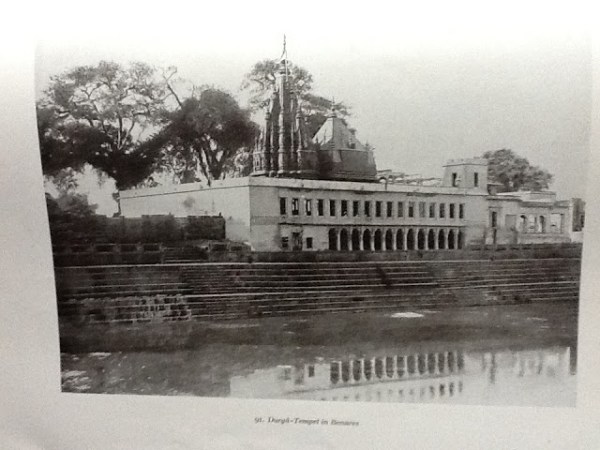
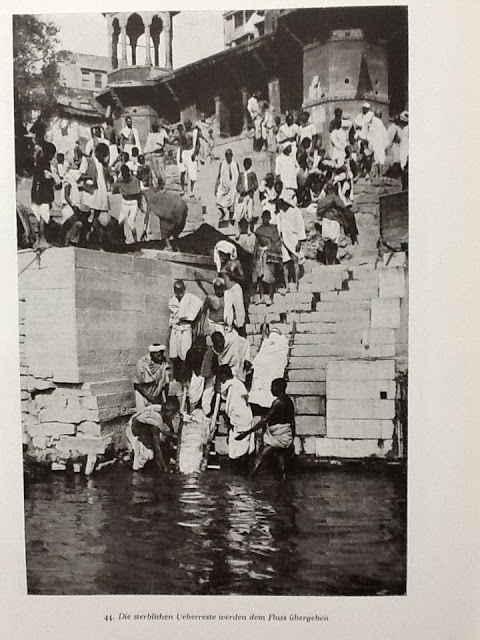
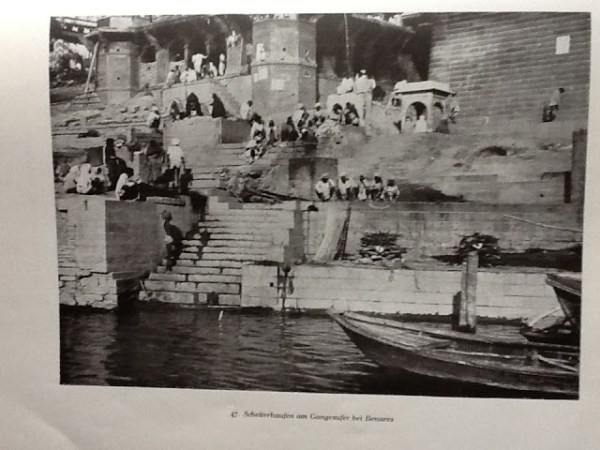
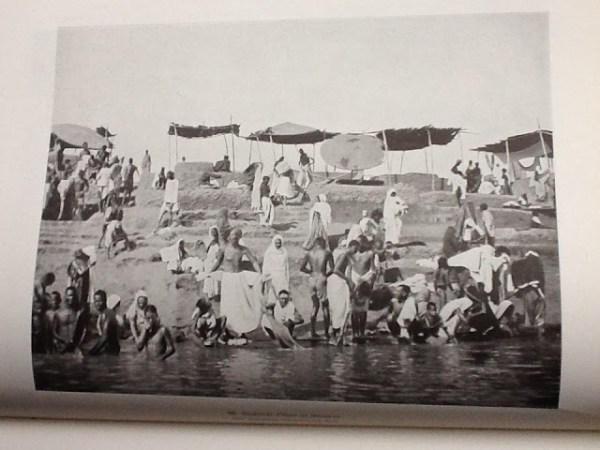
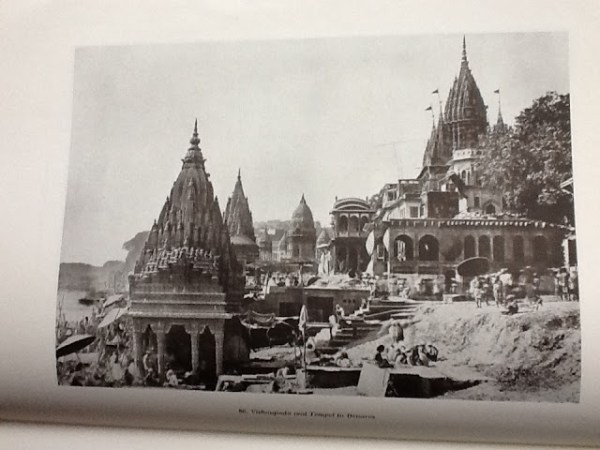
Pictures are from Benares/Kasi/Varanasi

to be continued………………


Single is each man born; Single he dies: Manu (Post No.3359)

Compiled  by London Swaminathan


Date: 16 November 2016


Time uploaded in London: 5-14 am


Post No.3359


Pictures are taken from various sources; they are representational only; thanks.


contact; swami_48@yahoo.com


13 Day Hindu Funeral Rites- Part 1


Recorded by The Rev. J E Padfield B.D., year 1908, in his book The Hindu at Home.


(Uttara Kriya)


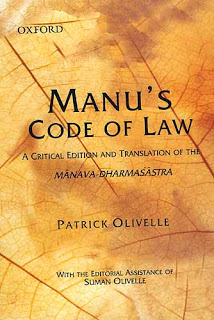
Manava Dharmasastra, the greatest and first comprehensive Law book in the world describes the death of a Hindu in the following couplets:-


“Single is each man born; single he dies: single he receives the reward of his good, and single the punishment of his evil deeds.


When he leaves his corpse, like a log or a lump of clay, on the ground, his kindred retire with averted faces; but his virtue accompanies his soul.” (Manu, iv, 240-1.)


“A mansion with bones for its rafters and beams; with nerves and tendons for cords; with muscles and blood for mortar with skin for its outward covering.


A mansion infested by age and by sorrow, the seat of malady, and harassed by pains, haunted with the quality of darkness, and incapable of standing long; such a mansion of the vital soul let its occupier always cheerfully quit.


As a tree leaves the bank of a river, when it falls in, or as a bird leaves the branch of a tree at his pleasure, thus he, who leaves his body by necessity or by legal choice, is delivered from the ravening shark, or crocodile, of the world.” (Manu vi, 76- 8.)

Why do good people die?


There is a curious passage in Manu where the question seems to be raised as to how death can have any power over such holy beings as Brahmins, especially those learned in the Vedas and who undeviating perform the duties laid down for their guidance. A reason is given for the mortality of a twice-born who may have been remiss performing religious or has offended in the matter of diet.


The fifth chapter of “Manava Dharma Sastra,” which opens with the passage referred to, is largely composed of the most minute rules and regulations as to diet. It is difficult to conceive the possibility of a mortal man’s avoiding some offence named and thus rendering himself amenable to death. The passage is as follows:


“The sages, having heard those laws delivered for the conduct of house-keepers, thus addressed the high-minded Bhrigu, who proceeded in a former birth from the genius of fire.


How, Lord, can death prevail over Brahmins, who know the scriptural ordinances and perform their duties as they have been declared?

Then he, whose disposition was perfect virtue, even Bhrigu, the son of Manu, thus answered the great Rishis (seers):-


‘Hear, from what sin proceeds the inclination of death to destroy the chief of the twice-born’


“Through a neglect of reading the Véda, through a desertion of approved usages, through supine remissness in performing holy rites and through various offences in diet, the genius death becomes eager to destroy them. (Manu, v.1-4)

Panchagavyam, Just before dying!


When amongst the Hindus of all castes and of both sexes est a person the point of death, the family priest is summoned to administer the last sacrament (Jivanamaskaram) which is administered in the following manner:–


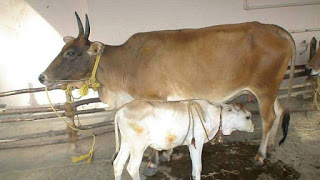
The sick person is lifted from the couch upon which he may be lying, and is made to recline upon the ground, supported by a low stool. A couch is not considered a pure place (madi) and the friends of a sick person will not even feed him whilst lying on it, unless he is too ill to be moved. The priest then approaches with the Panchagavyam. This is a mixture of five products of the cow: milk, curd, butter, urine and dung.


The dying person is first asked to recite after the priest certain Mantras, and if he is too weak to articulate, he is desired to recite them to himself.

Afterwards the vessel containing the Panchagavyam mixture is placed to his lips and some of it poured into the mouth. This whole is called Prayachittam or the ceremony expiation. Of the various texts recited, two are given below as specimens:–


“I take this sacrament of panchagavyam for the absolution of my sins, both those committed voluntarily and involuntarily”

Jnana ajnana krta dosha prayachittartham panchagavyasamskaram karishye


“Whatever sins adhere to the skin and bone now present in this body,

May the partaking of this panchagavyam

Destroy them as fire destroys fuel.”


Yatvagastigatam papam  dehe tishtati mamake

Prasanam panchagav dahatyagnirivendhanam


Must die on the Ground!

The sick person is then replaced upon the couch to await the end though sometimes he may recover. If from sudden death or any other cause, this ceremony cannot be performed, the death is not considered a happy one.


When it is evident that death is very near, the dying person is laid on the ground, which has been previously prepared by smearing it with cow dung and by placing some of the sacred grass (darbha). It is very important that a person should breathe his last on the earth. Indeed, it is a common way of cursing to say, “When you come to die may there be no one to place you on the ground”


Not allowed to die inside the house!


There are certain phases of the moon during which would be considered a serious calamity for anyone to die inside the house. Should death draw near at such a period, the patient is carefully taken outside to die in some outer verandah. If, through a misfortune, he should die inside the house during a period, the whole dwelling is considered polluted. It must be entirely vacated for some time, after which a ceremony called “punyachavachanam” is performed in the place to purify it before it can be re-occupied. Sometimes when such a calamity does befall a house hold, in order to avoid the trouble and cost of moving out entirely, a hole is made in the sidewall of the house, near the room where the death took place, and the body is passed outside through the hole. In such a case, only that side of the house will be impure and need purification; the other part can be inhabited usual. This mode of action, however, is not considered proper or respectable and it is thought to reflect dishonour upon the dead.


When an orthodox Hindu is at the point of death, a Brahmin brings a cow, marks its forehead with vermillion (kunkum) and salutes it. A little Ganges water is poured into the mouth of the dying man. Alms are given to Brahmins and to beggars; and just at the moment of dissolution he is removed into the open air or conveyed to the river bank.


To be continued………………..


Don’t Tax Brahmins: Manu’s Warning! (Post No.3347)

Research article written by London Swaminathan

Date: 12 November 2016


Time uploaded in London: 8-16 AM


Post No.3347


Pictures are taken from various sources; they are representational only; thanks.


contact; swami_48@yahoo.com


Manu in his Manava Dharmasastra gives lot of concessions to Brahmins. At the same time he lays down very strict rules for the Brahmins. He asks the kings nit to tax the Brahmins. Chapter seven of the book contains rules regarding taxation; we get precise rates of taxation from Kautilya’s Arthasastra. But that is a book on Economics. Though Manu also mentions the proportion of tax in some of his couplets, it is not very comprehensive.


Here are some interesting couplets on taxation:

Even if he is dying of hunger, a king must not take taxes from a priest who knows his Veda by heart and no priest who knows his Veda by heart living in his territory should faint with hunger (7-133)


If a priest who knows his Veda by heart faints with hunger, the kingdom of the king in whose territory he lives will also soon faint with hunger (7-134)


The king should always establish the taxes in his kingdom after due consideration, in such a way that both the king and the man are rewarded 7-128

Leech, Calf and Bee

Just as the leech, the calf and the bee eat their food little by little, so the king should take the early taxes from the people little by little 7-129


The king should take a fiftieth part of livestock and god and an eighth or a sixth or a twelfth of crops.7-130


My comments:-

We may think that Manu is unbalanced in his views. But if we replace the word Brahmins with the word “Intellectuals”, then we will understand the significance of his rule. Poor Intellectuals, if exempted from taxes, will work more efficiently to elevate the society.

Thousands of Tamil inscriptions and epigraphs on land donations to Brahmins and the temples talk about the exemption of taxes to Brahmins. So we know that Manu’s laws regarding Tax exemption were followed by the kings for a very long time.

The simile of leech, calf and bee allows us to give a new interpretation: If one is wealthy suck his blood, that means take more tax. We do see such things in most of the countries the rich are taxed up to 60%. If one belongs to the middle income group, be a calf in taxing. If someone is poor be a bee to him.


Tamil Veda Tirukkural says don’t tax the people like a robber (Kural 552)


A sceptered king demanding illegitimate gifts or exhorting taxes beyond approved limit

Is like an armed robber relieving wayfarers of their belongings. (Kural 552)


Kalidasa says be a sun when you tax the people. Take the water with your thousand hands (rays) and return it with million drops of rain (benefits) in his Raghuvamsa Kavya(1-18)

Taxation in Sangam Tamil Literature

Sangam Tamil literature gives details of import tax. When goods were brought in from foreign countries they were taxed.

Pisiranthaiyar, a famous Tamil poet advises his king Panyan Arivudai Nambi to follow moderation in taxing. He gives a beautiful simile to emphasize his point.

If an elephant is fed with cooked food mouth by mouth from a small patch of land, the harvested grains will last for many months. If the same elephant is allowed to graze the fields larger in size, there will be more wastage than the food it took. The crops will be crushed under its feet and left wasted. So be wise in taxing the people. Don’t crush them under your feet like a rash elephant. Take it little by little.(Puram 184)

Later day Tamil inscriptions gives a long list of different taxes.

–Subham-


Man Proposes, Destiny Disposes!(Post No.3343)

WRITTEN by London Swaminathan


Date: 11 November 2016


Time uploaded in London:17-07


Post No.3343


Pictures are taken from various sources; they are representational only; thanks.


contact; swami_48@yahoo.com


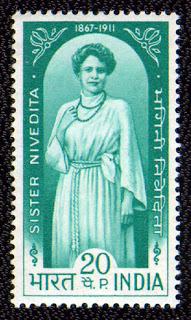
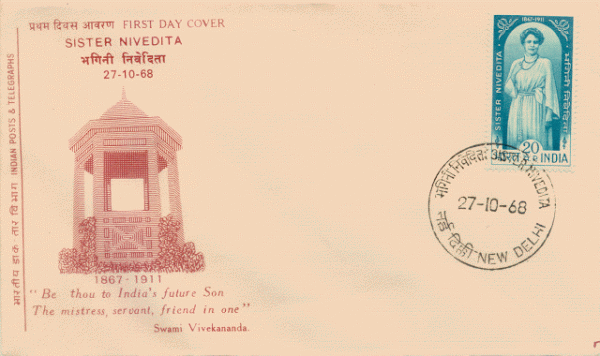
Sister Nivedita in “The Web of Indian Life” tells the story of a great mathematician, Bhaskaracharya, who had but one child, the maiden Lilavati. Casting her horoscope carefully, he discovered that there was only a single moment in her life when she could be married with the fear of widowhood. Preparations were made for the wedding accordingly, and the father himself constructed an instrument by which to regulate the time of the ceremonies. Water would be admitted drop by drop through a certain hole, from one pot to another, and upon reaching a given height was the signal for the sacramental act.


“The marriage rites began, but the child Lilavati grew tired, and went wandering from room to room in search of amusement. In some obscure corner she came upon an unaccustomed looking pot, and leaned over its edge to watch how the inner section was gradually sinking in water which it contained. As she did so a tiny pearl fell all unnoticed from her wedding crown, and stopped the hole through which the water passed! Time went on, but the vessel sank no further, ‘Ah!” exclaimed Bhaskaracharya, sorrowfully, when, the hour already past, he found the jewel that had frustrated all his caution, ‘it is useless for a man to fight against his destiny’.

Tamil poet Tiruvalluvar says,

“What is more potent than fate? It forestalls every expedient one may resort to for averting it”- Tirukkural 380


Fate is Inviolable.


Bhaskaracharya, Great Mathematician

Bhaskara  Acharya was a celebrated astronomer and mathematician. He lived in the early part of the eleventh century C.E. he was the author of the Bhija Ganita on arithmetic, Lilavati on Algebra and geometry and the Siddhanta Siromani on astronomy. He was fully acquainted with the principle of the Differential Calculus.

Lilavati means Charming. He gave this fanciful title to the his mathematical work. Colebrook and Dr Taylor translated into English. Earlier Akbar also arranged for a translation in Persian.


–subham–


FIVE DAY HINDU MARRIAGE- PART 4 (Post no.3340)

COMPILED BY by London Swaminathan


Date: 10 November 2016


Time uploaded in London: 19-06


Post No.3340


Pictures are taken from various sources; they are representational only; thanks.


contact; swami_48@yahoo.com


Fourth and Fifth Day of the Five Day Wedding


The fourth day is passed in the same way, except that one of the proper things to be done is for the bridegroom to pretend to be angry and sulky. He even goes so far as to start off in his palanquin to run away. The father of the bride then goes out to find him and tries to appease his anger promising to give him presents of various kinds. He is supposed to take advantage of this to ask for various things as presents, a house for instance, or cattle or money or lands. The father-in-law then promises to give so and so, upon which the youth shakes off his pretended sulks, and returns to the festivities. This amusing and somewhat ridiculous farce seems to be a peculiar custom kept up as an opportunity for demanding additional presents, by way of dowry to bride.

Good Bye to Gods


In the evening, after the usual feast, the most elaborate and prolonged of the various festal parades take place, with its accompaniments of torches, lime- lights, fireworks, singing of dancing girls and other festivities. Whilst the bride’s home is partly deserted, the inmates being out with the procession, the friends of the bridegroom have some fun by going to the house and removing any useful thing they can lay their hands on;  such as the ropes for drawing water and necessary culinary vessels. The consternation at the loss on the return of the procession is a source of much amusement.


Very early in the morning of the fifth say three o’clock, the last homam is performed (Shesha homam). The gods who have been invoked to be present at the ceremonies are then solemnly dismissed to their several worlds. A  mantra said upon this occcasion is as follows:


O ye gods depart in peace.” F

Gacchantu Devaah yathaa sukham


Naakabali

In the evening of the fifth and last day a finalceremony is performed, called Naakabali or sacrifice to the inhabitants of heaven. The prepared plalce is again adorned  and smeared with the dung of cows and a number of small lights are paced in a square formed of coloured pots. Several mantras are repeated by the priests , in the presence of assembled company, invoking the presence of the wholethree hundred and thirty millions of Gods of the Hindu pantheon. These are duly honoured and worshipped by prayers and offerings of cooked rice. The bride a bridegroom are then tied together with the Brahma knot and marched three times round the burning lights by the priest, who meanwhile repeats certain man trams.


Sometime, after the nakabali, there is more singing and music and betel is again distributed. Various bits of romping and fun are then indulged in. The bride and bridegroom are each seized upon by any two present, and carried about at a run during this, white and coloured powders and coloured water are freely thrown about, and there is a good deal of frolic and amusement.


Mother and Brother weep!

The appaginta, or final delivering over, then takes place. This is always a most sorrowful proceeding, and the bride’s mother, brothers, sisters and other relatives weep much, and in various ways express their grief as they give up their dear one into other hands. The ceremony is as follows. A dish of milk is brought in and the bride places her right hand in the milk; over her hand the bridegroom’s father and mother and sister place their right hands when the priest repeats some verses, of which the following is one.


This damsel has attained her eighth year,

She has been fostered by me like a son,

She is now given to thy son,

Protect her in love.”

Ashtavarsha bhavetkanya

Putravatpaaalitaa mayaa

Idaanim tava putrasya

Dattaa snehena paalyataam


Bye Bye


When this has proceeded far enough, a bundle of rice is tied to the waist of the bride, and she is once more seated in the palanquin opposite her husband. They then set out to go to the village of the bridegroom thus bringing the prolonged and intricate ceremonial to a close.

The bride is supposed to stay for three days in her husband’s house. She is then taken back to her own home, there to remain until she has attained a fit age to discharge the duties of a wife. When the young wife has arrived at a suitable age, notification of the fact is sent to the husband’s parents, and the occasion is celebrated by various feastings and festivities. The parents and friends on both sides consult as to a propitious time for the taking home of the bride. At the time fixed upon, the husband and his friends proceed to the bride’s home where certain ceremonies and feastings take place. There is much distributing of cloths, fruit, betel and other presents. After a few days thus spent, the bride is taken away by her husband to his own home, which she henceforth shares with him.

Sometime in fulfilment of a vow the marriage takes place at or less celebrated place of pilgrimage. In that event, a pilgrimage is made by all concerned to that and are the favoured shrine and the marriage takes place there. In such cases, all the ceremonies are crowded into one day, and some of lesser importance.


In this description of the mode of procedure of procedure followed in the marriages of Hindus I have not mentioned many customary rites, and ceremonies of lesser importance, but I give an account of one.


Peculiar Ceremony


At some stage or other of the proceedings there is a peculiar ceremony, which is one of various minor ones. Some rice, which has been steeped in milk, is brought, and the bridegroom places a portion of this into the hand of the bride. over this he sprinkles some drops of ghee, with betel leaf, saying

May righteousness increase!

Peace be unto you!”

Punyam vardhata shaantirastu


He then takes some of the rice from her hand and puts it on her head. She then takes some of it and puts it upon his head. This is done several times, after which they both do it at the same time, putting some of the rice upon each other’s head.


Whilst the chief ritual are the same amongst all Hindus many minor ceremonies may differ much in different parts of this vast country. It will easily be seen what an expensive affair such marriages are, and what large sums of money are thus squandered.

The presents of cloths, jewels and the and feeding; the elaborate processions, and the necessary hiring of bearers and musicians and dancing girls together with the fireworks and lights all these things swallow up large sums of money and often the chief supply comes from the bags of the money-lenders. It is no matter if the parties concerned are poor, the laws of custom are so inexorable that their demands must be complied with, even though by so doing a millstone of debts is hung around the neck to be a drag and a burden all through life.


Many of the wiser people groan under these and similar bonds and occasionally a feeble voice is raised up in protest; but the Hindu is so conservative and so wanting in firmness of mind that there is not much hope of a radical change in such matters for many long years to come.


Written by The Rev.J.E.Padfield, B.D., Masulipatnam, Year 1908
–SUBHAM–