Science behind Samudra Manthan/ Churning of Milky Ocean!

AB65137

Research paper written by London Swaminathan
Research article No.1405; Dated 11th November 2014.

Hindus knew more cosmology than any other ancient culture. The oldest book in the world, The Rig Veda, has got more hymns about creation than any other book in the world around that period — 1500 BCE or earlier.

Scholars wonder what made the Hindus to sing so many hymns on creation and cosmology and what made them to pass it on to posterity by word of mouth for thousands of years. Thank god the Brahmins kept them intact for us. At that period of time, Europe was a place of primitive tribes. Indians helped Sumerians, Egyptians ,Chinese and Greeks to learn new science according to some Indologists.

Maxmuller said that the Greeks distorted the Hindu stories and Chinese learnt astronomy from Indians. Greeks dependence on India for maths and religion is confirmed by Swami Vivekananda and Greek writers.

Whether any one believes in Hindus spreading this branch of science or not, no one can show us any creation hymn equal to that of the following Rig Vedic hymns:
samudra-mandhan

Rig Veda (from Tenth Mandala)
10-129 Nasadiya Sukta (Big Bang Theory)
10-121 Golden Embryo
10-90 Purusa Sukta (Cosmic person)
10-190 Cosmic Heat
10-81 Architect of the world
10-72 Aditi and Birth of Gods

All these hymns show their quest for scientific answers. Purusa sukta hymn reminds us of the ‘Visvarupa darsanam’ (all pervading form) in Bhagavad Gita. It is amazing that one race in the whole wide world has reached such a height in scientific thinking. Even Bhagavad Gita Viswarupa darsanam can be interpreted as the mysterious Black hole, the latest mystery in science.
483px-Samudramanthan

Churning the Ocean
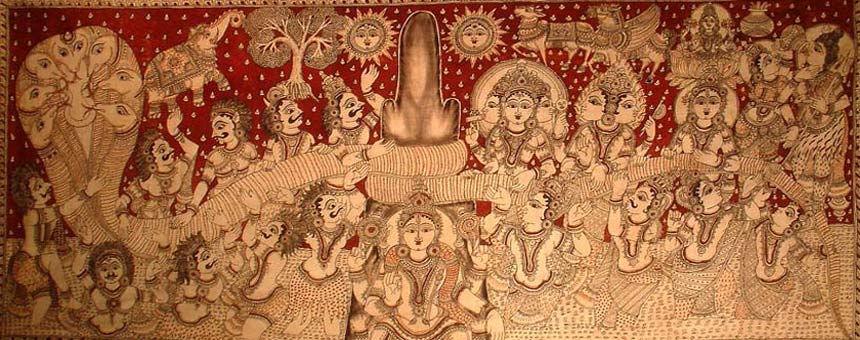
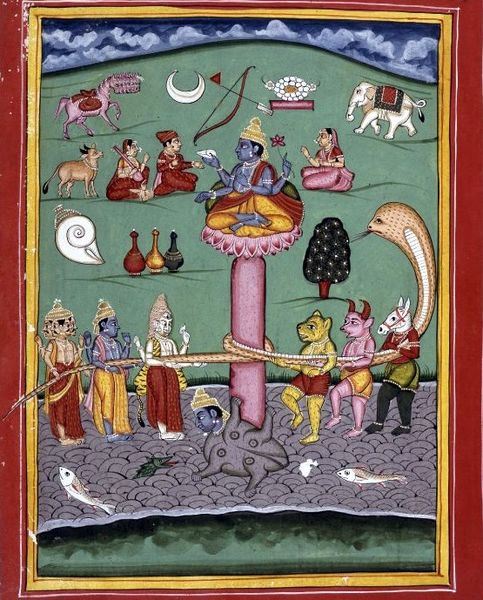
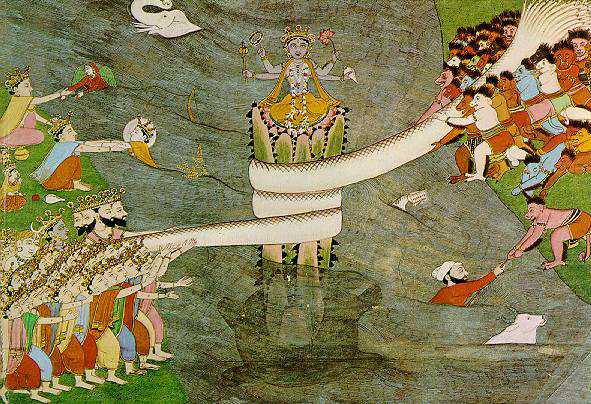
Fourteen “gems” came out of the sea when Devas (angels) and Asuras (demons) churned the Milky Ocean. This is the most popular and prominent story in the Hindu Mythology. The list of 14 gems differs from book to book. But among the common gems, moon known as Soma is one. It is true to say that moon came out of the ocean.

George, son of Charles Darwin, proposed a theory in the 1800s that a big chunk of earth was spurned off when a big collision happened. That chunk became the moon. The hole made out of it became Pacific Ocean. It might have happened millions of years ago. He said that the moon will easily fit into Pacific Ocean and that was the hole created by the giant collision. This is the most popular theory about the origin of moon.

So Hindus are right in saying that moon came from “the ocean”. But other 13 gems from the Milky Ocean may not fit into this story. So we have to interpret each and every object separately.
The objects or people are

59802-Bright-Moon

Varuni = Sura, Soma = Moon, Lakshmi = Goddess of Wealth, Horse =Uchchaisravas , Kaustuba gem, Parijata tree, Poison = Halahala
Doctor Danvantri, Amrita = ambrosia, Divine Cow = Surabhi
Elephant Airavata, Apsaras = Damsels from Heaven, Shanka = Conch
Jyeshta = Goddess of Misfortune, Umbrella, Powerful bow
Earrings, Wish fulfilling Tree Kalapakavriksha

The 14 gems are unrelated objects. One way of interpreting is that all that is useful to men came out of the “churning”, which stands for hard labour. Some people interpret the churning as maritime expedition. Others interpret it as symbolic story. I will interpret it as getting useful things for mankind like cow, horse, elephant, trees, wine and Amrita at various stages in human history. It was a long drawn struggle. The finds like cow, horse, and elephant improved the condition of man. Their discoveries or domestication were important mile stones in human history. Discovery of trees may symbolise agriculture. Discovery of heavenly damsels, conch may symbolise arts- Dance and Music. Umbrella stands for rule of royalty and ear rings stand for fashion and jewellery.
axis2

Among the 14 gems, Amrita and Poison, Wine (Sura/Varuni) and Milk (from Surabhi), Lakshmi and Jyeshta, Asuras and Devas form pairs of opposites. Probably the moral is that any action will result in good and bad. One has to help us by swallowing the bad/poison, an action of great sacrifice like lord Shiva. There will always be positive and negative forces in the world. We have to muster the strength of negative forces (asuras) to produce positive results (Amrita).

Contact swami_48@yahoo.com

Please read my earlier posts:
1.Is Brahmastra a Nuclear Weapon?
2.Science behind Shamudrika Lakshan
3.Great Engineers of Ancient India
4.Time Travel by Two Tamil Saints
5.Amazing powers of Human Mind: Six Stories
6.How did Rama fly his Pushpaka Vimana/air plane?
7.Did Kalidasa fly an Air Plane?

Is your Husband a Leftist or a Rightist?

left_verse_right_brain

Research paper written by London Swaminathan
Research article No.1396; Dated 7th November 2014.

Left and right mean several things in Hinduism. Generally speaking left has a bad connotation. From “Vamachara” to twitching of eyes, it has many interpretations. But it is not all superstition. There is some science behind it. In India, people use left hand for cleaning purposes. That is one of the reasons. Latest science reports say that those who use left hand (left-handed from birth) live nine years shorter than the right handed. It is statistically proved.

But the belief about left and right does goes beyond the geographical boundaries of India. An 1898 book on English phrases by Brewer give some interesting information:

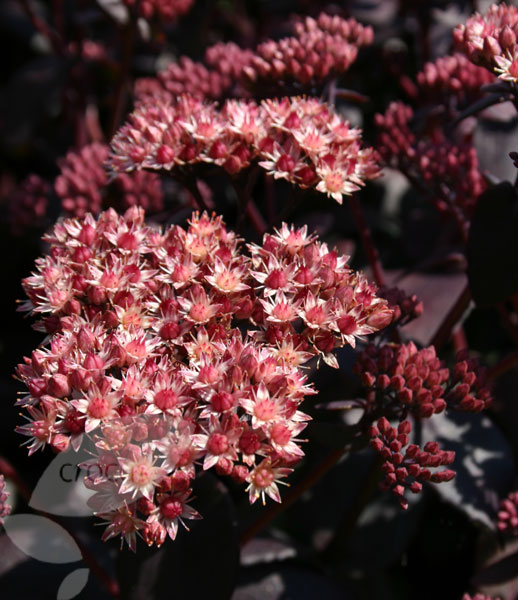
A plant known as Orpine (Sedum telephium) is called midsummer men. It is also known as Live Long and Stone crop (Orpine in French means stone crop). The reason for the name “Midsummer men” is that it was used for finding the loyalty of men. Young women used to hang the potted plant in the house. If their husbands are true the plants’ leaves will bend towards right. If they are not loyal to their wives it will turn left.
The plant is called Live Long because when it is cut and sprinkled with water it lives longer than any other plant.

journal.pone_.0040259.g001

Five “M”
Vamacharam is a sect in Hinduism who practise unconventional mode of worship. Literally translated Vamachara is left handed mode and they value Five “M”s more than anything else: Madhu (wine), Mamsa (meat), Matsya (fish), Mudra (cereal or gestures) and Maithuna (sexual intercourse). The very list will caution every one because of Madhu and Maadhu (women). There is scope for doing wrong half way through the practise.

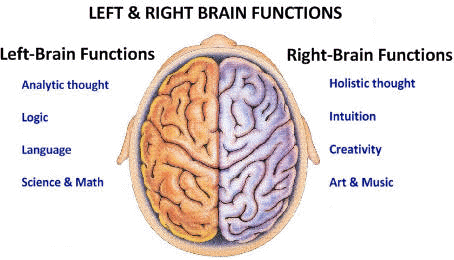
But twitching of eye is a very interesting area where different cultures have quite opposite views. Indians believe that twitching of right eye is good for men but bad for women. Rama says in the Yuddha Kanda of Valimiki Ramayana (6-4-7) that he is definitely going to win the war because of his right eye twitching. Sita sees bad omen when her right eye twitched just before Rama sent her to forest (Uttara Kanda). Scientists also believe that men and women are wired in opposite directions in the brain (Women are right brain dominant and men are left brain dominant creatures)

In Hinduism rightists always win! The clockwise direction was invented by the Hindus. They started using the clockwise direction for all good rituals—in the wedding, in the Graha Pravesa (House warming) etc. When they go to temples they have to circle the temple in the clock wise direction. It is called Pradakshinam in Sanskrit or Valam Varuthal in Tamil. They face east when they do all auspicious ceremonies and then turn to South=Dakshina and go in a circle.

No one is allowed to give or accept anything by the left hand in Hindu houses. It is considered blasphemy. In all the religious ceremonies such as Abhishek or Puja they have to extend their right hand with a great and visible humility. They can use only right hand for eating in the house or rstaurnats. When the temple priest gives the Prasad he will also use only right hand and anyone can take it only with his or her right hand.

Only in the funeral rites and monthly rites for the departed souls they use left. They go round the funeral pyre in anti clock wise direction. The sacred thread lying on the left shoulder (going towards right direction) will be changed to right shoulder so that it goes towards left side during the rites for departed souls (Tarpan, Tithi etc)

traditional_banana_leaf_meal
You can only use right haand for eating

Tamils support Rightists!
Two thousand year old Sangam Tamil poems praise tigers which will eat only when its prey falls on its right side. If it kills a deer and it falls on the left side it wont eat! Valam = right carries more weight than Itam=left in Tamil poems.

Tamil Ref. Puram.190, Akam 238, 252 etc.

Tamil film song says Oh, Bride! Oh Bride! Step into the house with your right foot please! ( Mana Makale! Mana Makale! Va Va! Un Valathu Kaalai (right foot) etuthtu vaiththu Va Va!

Hindus put first right foot into the house on holy occasions. Saints also follow this. In the rituals they have to place anything on the right first and then come to left. When Brahmin boys do Samidhadhana, they have to put the Homa paspa (ash) on their body parts starting from right side of the body. So they do in Sandhyavandana.

There are hundreds of customs like this in Hindu scriptures.

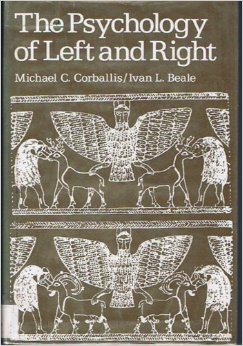
book on left

Only place where left is honoured is the body of Shiva in Ardhanari form where his left side is occupied by the goddess. Half of his body – left side—is given to the goddess. This is the basis of Adam and Eve story in the Bible. Left bone was shaped into a woman. ((Kanchi Paramacharya gave another interpretation that Adam=Atma and Eve=Jeeve Atma quoting the Vedic story where one bird eats the fruit —Adam eating the forbidden Apple — and the suffering followed. That is life and death. Anyone can easily see the similarity in words ATMA=ADAM, EVE=JEEVE Atma. So the first story in the Genesis is taken from the Vedas).

Though left is allotted for woman, during all the religious ceremonies a person’s wife is given prominence by giving the right side. She has to stand on his right side.

left hand

Homer also followed Hindu custom!!
Greek epic poet Homer also refers to such a respect for right in his Odyssey.
He says,
They swooped away on the right through homes and city,
All were dumbstruck, watching the eagles trail from sight (2-172 and 173)

Commentator explains the above lines,

“The lucky side for omens, lucky at least for Telemachus in this case. The idea that signs on the right are lucky and on the left unlucky is common in many cultures and languages”.

Hindus believe that seeing Garuda/eagle on the right is good. Homer refers to god sending eagle on the right side and say it is a good sign in The Odyssey 15-179
The odyssey has more references to auspicious Right 15—588/598; 20—269;24—358/50
left-right-handedness-dominance

Sinister Designs

Following is found in the Encyclopaedia of “Word and Phrase origins” by Robert Hendrickson
“English word sinister comes from Latin and the meaning in Latin is “left”. In English it means that something harmful will happen.

A right hand man in English means an invaluable and trusted aide; the right side was the place of honour in political assemblies and gave its name for royal or conservative parties of the right.
Right foot foremost means putting your best foot forward. (This is Hindu belief. They will use only right foot in all the auspicious ceremonies)

Right in French is adroit which also means cleverly, skilful. Dextrous means right as well as ‘skilful with the hands, body and mind’.

On the contrary left-handed compliment is a thinly disguised insult that poses as praise. When a royalty marries a commoner all that is received by the commoner is a “morning gift” i.e. the gift suddenly got on the day of the marriage. This marriage is called “morganatic” meaning morning gift in Latin. The bridegroom gave his left hand to the bride instead of right hand in such left handed marriages. This is the origin of left handed compliment in English.”

sedum telphinium
Sedium plant

In the above Greek, Latin and English phrases we see the Hindu customs of
1.Using the right hand for all auspicious ceremonies
2.Using the right foot in all auspicious ceremonies
3.Seeing the Eagle (Garuda)on the right as a god sent good omen
4.Believing right is skilful and clever
5.Giving right an honourable place

Though we may call this as a cross cultural belief, Hindus only follow it until today. Hindu scriptures have more references to this custom than any other scripture or book.