By S Swaminathan
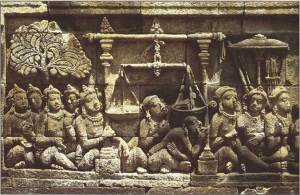 |
| Sibi in Borobudur (Indonesia) |
Tulabharam is a Hindu ritual that has been practised from Dwapara Yuga. Tulabharam means a person weighing himself or herself in a balance and pay in equal weight of gold, fruits or grains to God when one’s prayers are fulfilled. Temples in Tirupati, Guruvayur, Dwaraka, Udupi and several other towns practice such offerings. Recently, Guruvayur temple hit the headlines in newspapers when a businessman from Bangalore gave the temple his weight in gold – 70 kg. Tirupati temple hits the headlines now and then when famous politicians and film stars give something to god measure for measure. This is offered to the gods when their prayers are answered.
The earliest reference to a Tulabharam comes from the Mahabharata, about the great emperor Sibi. He was so famous his name is found in ancient Tamil Sangam literature in four places and later in hundreds of places. He was even praised in Buddhist Jataka stories and Borobudur (Indonesia) sculptures. Emperor Sibi was a just king. Lord Indra and Agni wanted to test him and came in the form of an eagle and a dove. When the dove came to Sibi for protection from the chasing eagle, Sibi was ready to offer anything to save the dove. The eagle asked him to give his flesh measure for measure. Sibi cut himself bit by bit but the pans in the balance were never equal. At last when he himself stood on the pan the Gods appeared in front of him and blessed him. The story is found in other Sanskrit works as well.
The Tamil king who refused to take gold
The worst thing we read in Sangam Tamil literature is the execution of a little girl just because she took a mango fruit from the king’s garden. Tamil poets were so angry that not only they refused to sing about him but also ridiculed him in the Cankam poems. The story is as follows: Nannan was a king who ruled part of Kerala called Poozi Nadu. A mango fell from one of the trees in his garden and it was washed away in the water of a canal. Any little girl or boy who sees a fruit will naturally go for it. So did a little girl in his town. The servants reported this ‘theft’. Immediately Nannan ordered to kill the girl for theft. The whole town rose against him. The girl’s father with the support of the VIP’s of the town met the king and begged to release his daughter. He even came forward to give Nannan 81 elephants as a penalty. Nannan did not budge.
Then her father told him that that he WOULD GIVE GOLD MEASURE FOR MEASURE. But evil Nannan executed the girl refusing to accept the gold. One of the great poets of Tamil Cankam (Tamil Academy) Paranar gave this story in Kurunthokai poem 292. Perunthalai Sathanar who sang a poem long after this incident refused to sing about another king Ilam Vichiko (puram 151) just because he was born in Nannan’s clan. Till this day Nannan was ridiculed as a ‘Murderer of a little girl’. This story shows the practice of Tulabharam in ancient Tamil Nadu. Look at the words – MEASURE FOR MEASURE in gold.
Tulabharam in Silappadikaram
Indian kings used to give sixteen kinds of gifts to Brahmins and poets. The Vijayanagara empire period inscriptions mention Tulabharam as one of them. We have a literary reference to such a practice in the famous Tamil epic Silappadikaram. Cheran Chenguttuvan who went to the holy Himalayas to get a stone for the chaste woman Kannaki washed it in the holy river Ganges and consecrated the statue at a place in modern Kerala. At that time he gifted his body weight of gold to a Brahmin called Matalan. The epic says the king weighed 50 Tulams (not Tola which is only 12 grams).
Periapuranam: Amarneethi Nayanar
Peria Puranam gives the life story of 63 Saivite saints called Nayanmars. Amarneethi Nayanar of Pazaiyarai was one of them. He was running an inn at Thirunalloor. One day a bachelor came to the town and asked Amarneethi to take care of his loin cloth until he comes back from bathing in a nearby river. When he came back the loin cloth was not found at the place he left it. After a frantic search Amarneethi started panicking and offered anything in compensation. The bachelor, who was God himself in disguise, asked him to give some cloth equal in weight to what he was keeping as a spare. When Amarneethi put one loin cloth after loin cloth on the pan, it did not rise even a single inch. Getting ready to sacrifice himself he stood on it. Even then, the scale did not move. When all his family members came and stood on the pan of the balance the pans were equal. God blessed all of them after this Tulabharam.
Krishna Tulabharam
 |
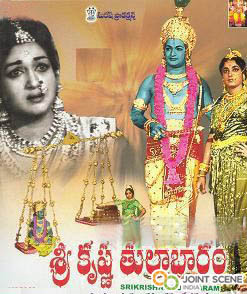
| Telegu film of Krishna Tulabharam |
The most famous Tulabharam story comes from the life of Lord Krishna. Tamil and Telugu films were made using this story long back. Krishna had several wives including Rukmini, Sathyabhama and Jhambavati.
There was a rivalry between the posh, proud, jealous and fashionable Sathyabhama and simple and innocent Rukmini. The heavenly sage Narada wanted to teach Sathyabhama a lesson. When he met her he mooted a plan to attract Krishna towards her. Sathyabhama fell prey to his clever and cunning plan. The plan was to sell Krishna as a slave to Narada and buy him back with gold. Whoever pays more would win Krishna. Sathyabhama was so confident that she would win hands down because Rukmini was not as rich as her. Innocent Rukmini had to accept this when Krishna himself agreed to be sold. When the scene was set, Sathyabhama brought all her gold and diamond jewellery to buy back Krishna. It could not match Krishna’s weight. Seeing Sathyabhama struggling, the mischievous Narada himself suggested that she borrowed some gold from Rukmini. Pure hearted Rukmini knew that nothing was greater than the Tulsi (Holy Basil) leaves and she put some Tulsi leaves onto the pan after removing all of the jewellery. The problem was thus solved. This story also showed the importance of Tulsi in Hindu worship. Tulsi is one of the most powerful medicinal herbs.
Sumerian Tulabharam
Sumerian culture has a lot of similarities with Indian culture. No one can dismiss them as sheer coincidences. (Please read my article DOUBLE HEADED EAGLE: INDIAN SUMERIAN CONNECTION). Clay tablets from the 13th century BC unearthed at Ugarit give some interesting information about a king. His name is given only in consonants KRT (perhaps Kirta or Kurita rather than Keret). The king lost his brothers and seven wives but had no heir. Praying for a son, he was advised in a dream by their chief god El to sacrifice to Baal then march with his army to Udumu to ask for it’s king’s daughter Hurriya as his wife. On the way he VOWED TO GIVE TWICE HER WEIGHT IN SILVER AND THRICE HER WEIGHT IN GOLD TO THE GODDESS ATHIRAT (AHSERATH) of Tyre, if he were successful. When he got her, he did not fulfil his vow to the god Athirat. The god struck him with an illness. This story of Keret was published in the Dictionary of the Ancient Near East. The story continued with what his wife did later etc. We can even see some similarities in the names with Hindu mythological names Kratu (KRT), Surya (Hurriya), Kreeta and many more. But we could clearly see the practice of Tulabharam to gods and goddesses, offering in silver and gold.
*******************


 Tamil and Vedas
You must be logged in to post a comment.