
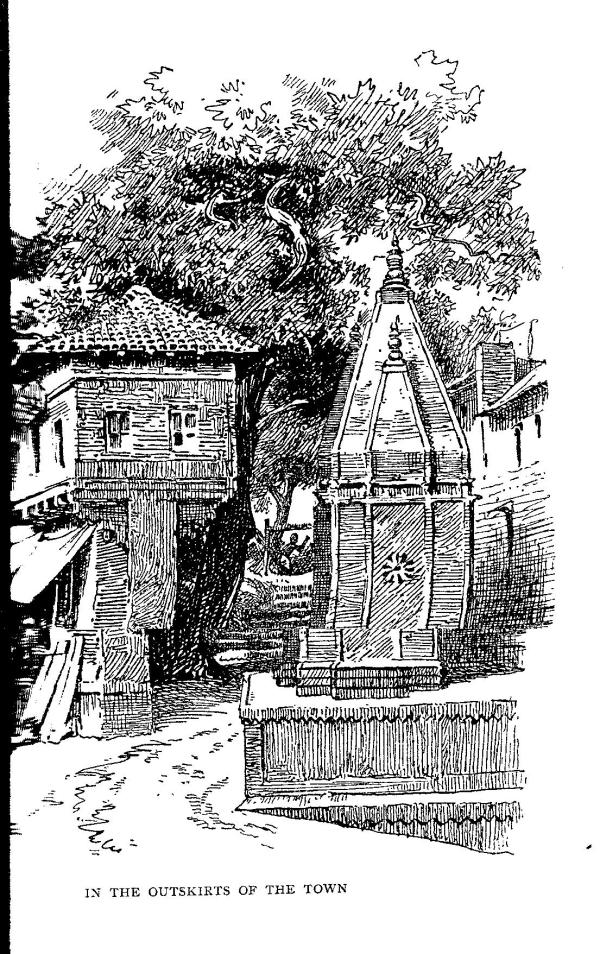
Narrow alleys of Benares/Kasi, painting by Hallam Murray
Compiled by london swaminathan
Date: 4 April, 2016
Post No. 2694
Time uploaded in London :– 19-25
( Thanks for the Pictures )
DON’T REBLOG IT AT LEAST FOR A WEEK! DON’T USE THE PICTURES; THEY ARE COPYRIGHTED BY SOMEONE.
(for old articles go to tamilandvedas.com OR swamiindology.blogspot.com)
(Benares= Varanasi= Kasi)
“It was cold in the train in the early morning; we had been travelling all night, and had exchanged the coast-climate of Calcutta for the colder plains. We were an hour late when we reached Mogul Serai station, and had barely time to catch the Benares train. By 2 p.m. we were in Clark’s Hotel, Benares, a clean, comfortable bungalow in the Cantonment, but unfortunately three mils from the old city.
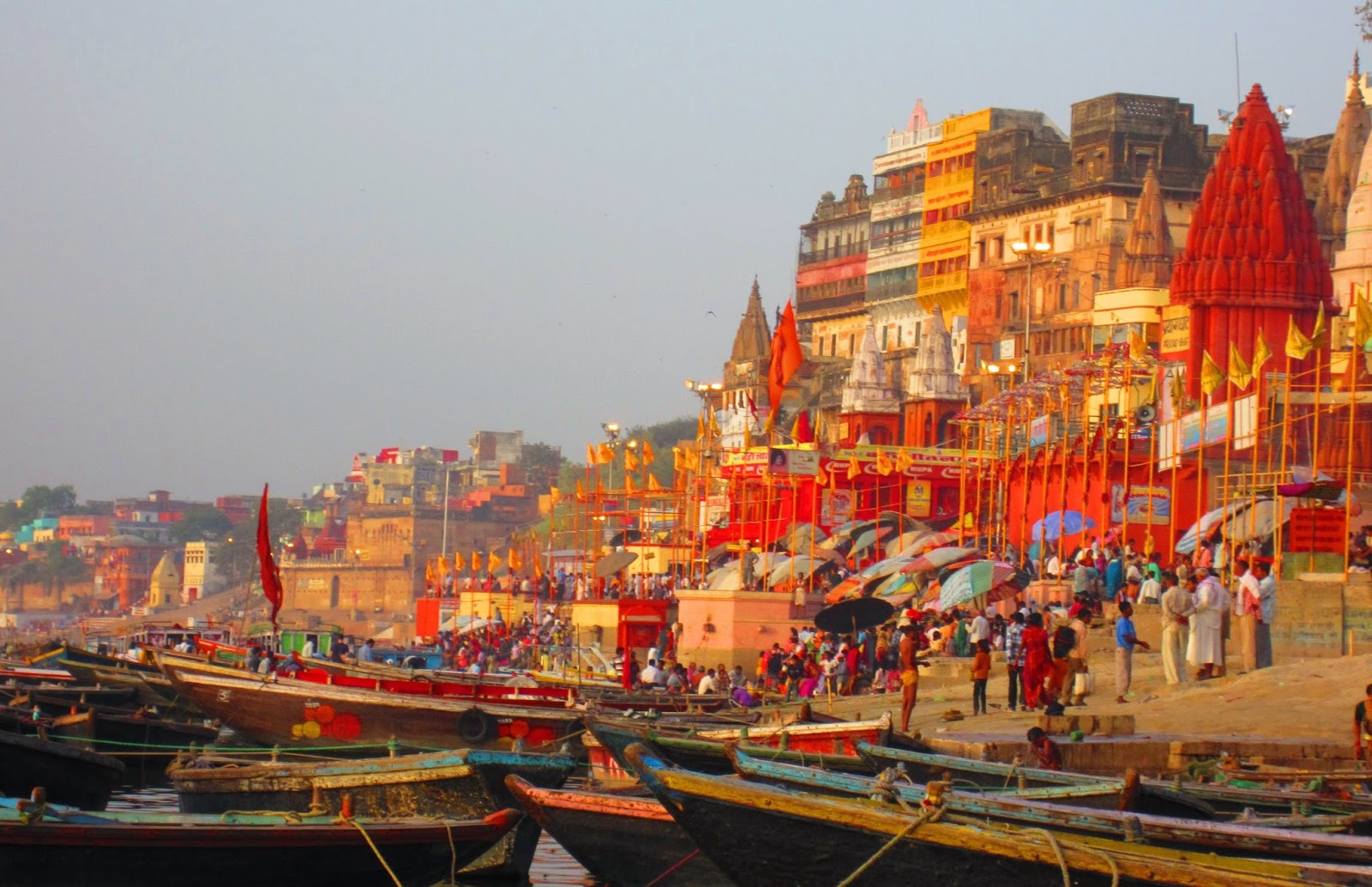
As soon as we had time to turn round we made our way to the centre of the native quarters, and were enchanted with the novelty and vivid interest of the scene. There is no doubt about it, Benares is wonderful; it is marvellously picturesque and as for sketching, a life time would not exhaust the subjects. It is a long narrow town extending in a crescent along the left bank of the Ganges for two miles, overlooking, on the opposite side of the river, a flat and monotonous expanse of cultivated plain; the bank is steep, and about 100 feet high, and is clothed, as it were, with staircases coming down to the water’s edge in wide irregular flights, quite unconnected with one another. Above these flights of steps, or ghats, are huge houses and palaces, temples and the great mosque of Aurangazeb, packed close, with narrow alleys between them. All this, in spite of its attraction, is comparatively modern, and except a few buildings, that is nothing earlier than the time of Akbar (sixteenth century); for like many Eastern towns Benares has shifted its site from time to time, and has left traces of its “dead self” for miles along the Ganges.
No one knows the story of its beginning, at the time of the very earliest Aryan settlement in India, but Benares was the religious centre of India as far back as the sixth century B.C., when it was chosen by Sakya Muni as the first place in which to preach his doctrine of Nirvana. It then had become a strong hold of Buddhism for many centuries, but in the fourth century A.D. reverted to the Hindu faith. In the twelfth century came the Mohammedeans, who conquered it, and converted its temples into mosques, and the story goes that Alu-ud-din boasted of having, here alone, destroyed 1000 Hindu shrines.
After 600 years of Moslem prominence Benares returned to its old faith, and has since continued the sacred city par excellence of the Hindu.

Picture shows Aurangazeb’s mosque over Hindu Temple
In Calcutta and Bombay – though one cannot fail to notice the enormous predominance of the natives over Europeans – yet owing to the modern aspect of the greater part of those cities, with their wide streets and broad spaces, and their law-abiding inhabitants, the Indian population does not impress one by its vast numbers. To all this the appearance of crowded Benares forms a striking contrast. Here is the very heart of India. Here, in this fountain of Hindu fanaticism, beats the quick pulse of the people. To this sacred spot, from the utmost corners of the land, stream in endless pilgrimage thousands upon thousands of devout Hindus, who, through the narrow alleys and dark passages of the city, constantly course along, jostling one another in a seething flow, towards the temples, or the sacred river, to drink or in bathing to wash away their sins, or to die, if need be, in the arms of the od gages, the mother of life.
SHIVA WORSHIP IN ISRAEL!
Here then, above all other places, in this swarming mass of humanity, is one forced to realise, the depth and strength of the national life of India. This was specially impressed upon us in the first place we visited; the Golden Temple dedicate to Bisheshwar, or Shiva, as the Poison God, the spiritual ruler of Benares. In this form Shiva appears with a blue throat, the result of his having magnanimously swallowed the poison evolved in one of the processes of creation. But this deity is worshipped probably by more than half the Hindus as the reproductive power of nature, in the form of a symbol, the lingam. Is there perhaps, some remote connection between this cult and the calf and pillar worship of the Israelites? Shiva’s temple, this holiest of holy places in the sacred city, is in the heart of the town, surrounded by a network of narrow alleys thronged with people, and crowded between other buildings. The roofed quadrangle where it stands is itself crowded with worshippers, jostling one another, sprinkling holy water, and carrying votive offerings of flowers to hang upon the upright black stone, tapering to a cone shape, the symbol of Shiva. Cows are admitted on equal terms, and roaming lazily along have to be passed and to pass; every now and then a palanquin comes along and one has to flatten oneself against the walls of the narrow passages to let it go by.
Shrines, figures of cows, shapeless masses – representing Ganesh, Shiva’s son, the god of good luck, with elephant’s trunk painted red – met our gaze on all sides, and every turn in a bewildering confusion.
PLANET SATURN!
One very curious object of worship specially caught my eye. It was a silver disk with a red apron hanging below it,and represents the planet Saturn, an imporatant object in this city of astrologers.
The gates or the doors of the Golden temple are of beautifully wrought brass, but it takes it name form the fact that one of its conical flame-like towers, and a dome, are covered with plates of gilded copper; we mounted a narrow stair in a side building, in which are kept the great tom-toms, and where temple flowers were being sold, and looked at these towers, and the red conical tower of Mahadeo’s temple from the first floor. The so called priest, with a view to baksheesh, told me that he would pray the gods to give me a son. When I told him I had one already, he kindly offered to pray that I might have five.
Round the court of an adjoining temple are a number of sacred cows in close quarters; this they call the Cow Temple, and a little further on, round the corner of a narrow alley, is the Temple of Annapurna, goddess of daily bread. All along these lanes are small shops for the sale of images and rosaries, and of the celebrated brass work of Benares, especially of ‘lotas’, which are as essential to the existence of a Hindu as a cigarette to a Spaniard. A ‘lota’ is a spherical wide mouthed vessel — of brass for a Hindu, of copper for a Mohammedean- from which the owner never seems to be separated, and to which he clings with tenacity when he has given up all other worldly possessions. Out of it he drinks; with the aid of it, and a bit of soft stick, and much ritual observance, he washes his teeth – a favourite occupation and pastime, especially out of the railway carriage window when travelling – and with the help of it he cooks.
Before dusk we had time to explore some high, narrow streets in the thick of the town; they reminded me of Genoa, but are far more picturesque. The rich colouring (chiefly a deep red), the overhanging storeys, and an occasional bridge thrown over from one side of the street to the other, combine all the elements which an artist could desire.
Every empty space on the brightly painted facades is occupied by a fantastic representation of Hindu mythology, with all its many- handed, many -headed, many- weaponed gods and goddesses in endless variety; and besides the regular temples and shrines with which the town bristles, an uncouth image, or a squarely hewn sacred stone, it is set up at every vacant corner.
To be continued…………

SOURCE:
THE HIGH-ROAD OF EMPIRE
BY
A.H.HALLAM MURRAY
LONDON, YEAR 1905
–subham–


 Tamil and Vedas
You must be logged in to post a comment.