Story of a Bridegroom who changed his mind suddenly!

baraat

Article No. 2096

Written by London swaminathan
Date : 24 August  2015
Time uploaded in London :–  16-22

“All living beings will raise their hands in worship to him who has never taken a living being’s life and has abstained from eating meat: – Tirukkural couplet 260

Nemi was a prince of Shauripur. His father was King Samudra Viajy. Nemi was betrothed to Rajul alias Rajmati, princess of Jungarh. Her father King Ugrasena made elaborate arrangements for the marriage. Both the kingdoms were celebrating the royal marriage with all the usual  decorations and music bands.

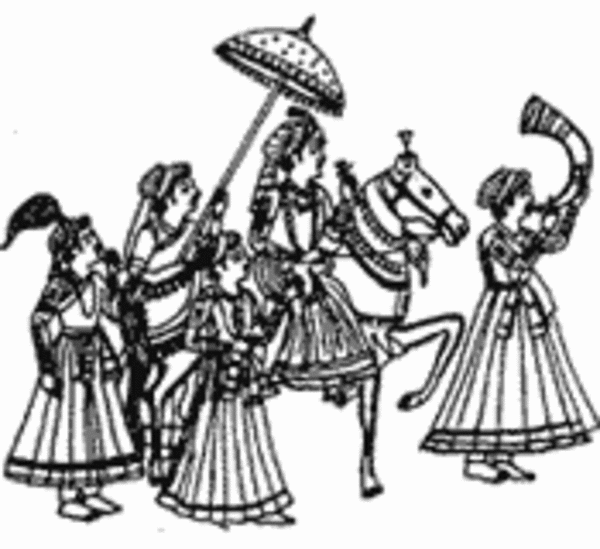
On the day of the marriage, Nemi was taken in a big procession with music, elephants, camels and professional dancers. Nemi was travelling in a decorated chariot. Nearer to the wedding hall Nemi heard lot of cries from the animals. He was very curious to know what was happening. Immediately palace officials told him that the cries came from the animals that were bought for the wedding feast. The very thought of slaughtering those animals for a feast made a big impact on his mind. Suddenly he left the procession saying that he did not want to get married. He asked the charioteer to turn it back and drive towards Girnar Mountains which was a holy site for many people including the Jains.

baraat2

There was a big commotion in the wedding hall. When his would be wife came to know the reason for the commotion, first she felt disappointed and sad. Then slowly wisdom dawned upon her mind. She thought if it could bring happiness and peace of mind to the Prince why shouldn’t I try that too. She also went to Girnar and became a Jain nun.

This Nemi was the celebrated 22nd Tirthankara of the Jain religion Neminath. He is considered to be a contemporary of Lord Krishna. There are many references to Aristanemi (Neminath) in the Vedic literature. Though the story of Nemi-Rajul wedding is not found in the Hindu literature it is found in the Jain Uttaraadhyayan Sutra. His story is illustrated with pictures.

Later Rajul- Nemi story formed the basis of love poetry as well. Later day poets used this story to describe the pains of separation between Nemi and Rajul. According to the later versions Rajul did not become a Jain nun immediately after the bridegroom joined the Digamber sect of the Jains, but waited for long. Some books described that she waited for 51 days and decided to become a Jain nun.

Stories of Rajul and earlier Upanishad stories of Gargi and  Maitreyi show that women saints or nuns were there from time immemorial. Later, other religions followed this system. Emperor Asoka’s daughter Sangamitra was accompanied by hundreds of Buddhist nuns 2300 years ago.
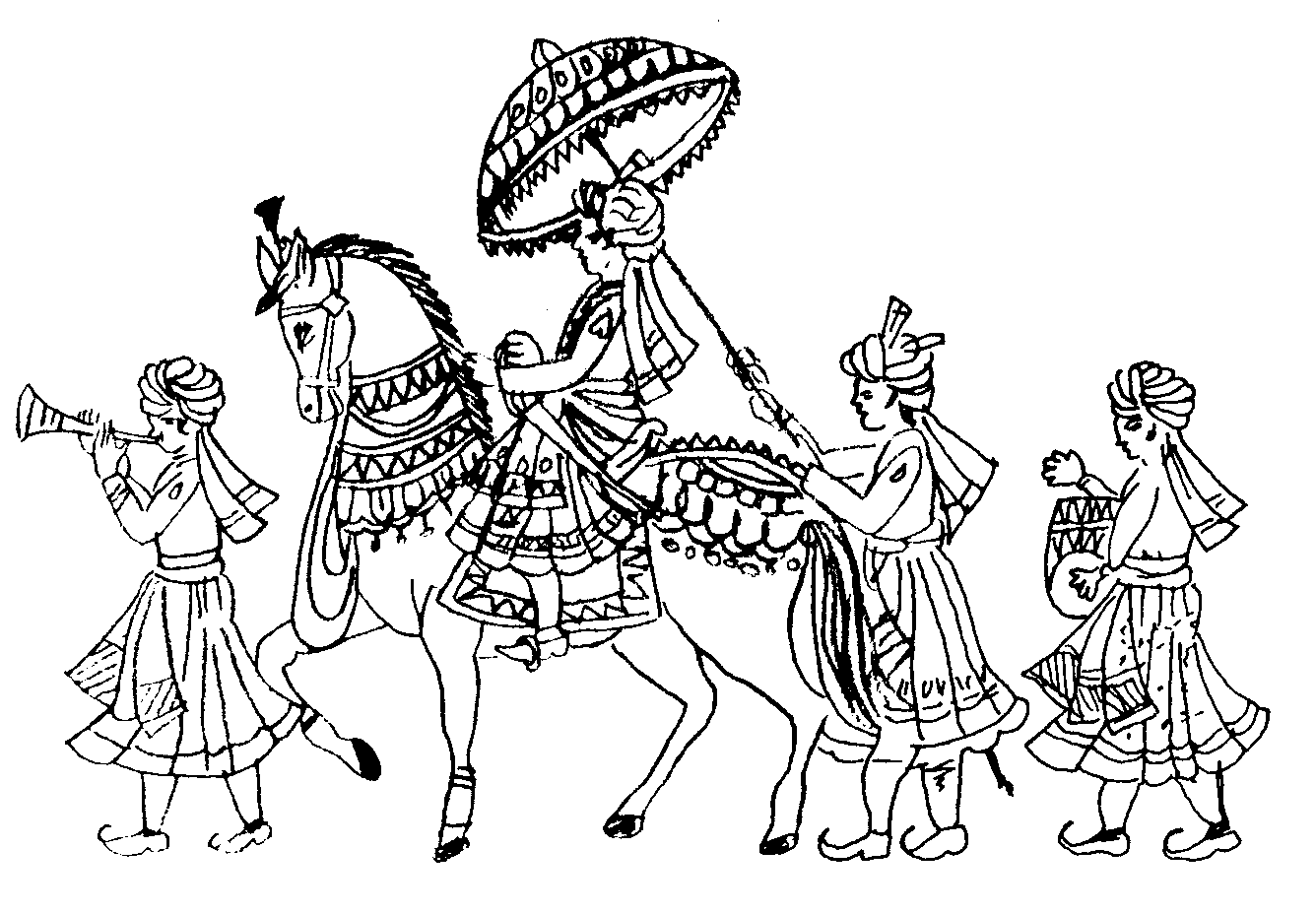
Procession

Nemi’s story also illustrated that vegetarianism is one of the basic principles of ascetic life. Tamil poet Tiruvalluvar in his Tirukkural says,

“How can a man be compassionate who, for the purpose of increasing his own flesh, eats the flesh of other animals” – Kural couplet 231


“Grace or sin results from non-killing or killing respectively; it is sinful, therefore, to eat what is obtained by killing” – Kural 254

But one must remember Tiruvalluvar and other saints prescribe vegetarianism only for ascetics, not for common man. Even Asoka, a Kshatria by caste, never stopped killing after embracing Buddhism. He ordered to reduce the consumption of meat according to his rock edicts.

Hindu and Jain saints were strict about vegetarian food. Hindu ascetics, before taking the saffron robes, stood in the water and took a vow not to harm any living creature by word, thought and deed.

Buddhism was not that strict and Buddha Bhikshus eat meat; according to many of them, killing is not good, but meat eating is not a sin.


You become what you think!

bull big

Article No. 2094

Written by London swaminathan
Date : 23 August  2015
Time uploaded in London :– 15-55

In a school, a teacher was giving lessons to a class. He noticed that one of the boys was not attentive to the lessons taught. His mind seemed to be somewhere else. The teacher asked the boy who he was so inattentive. The boy admitted that he was not in the lessons.

He had a bull in his house which he loved so much that he was always thinking of it alone when away from the house. The teacher then asked the boy to go to the hill nearby, sit there and think of the bull as long as he liked.

The boy accordingly sat on the hill consecutively for seven days, thinking only of his beloved bull. After seven days he felt he had no more to think of the bull and so decided to attend his class. He went and waited outside the class.

red-bull

The teacher from the class-room asked him to enter the class as if he had done with the meditation on the bull. The boy replied that he was not going to the hill anymore but he could not enter the class-room as his horns were too long to allow him to pass through the door. By constant thought of the bull, the boy felt that he had become the bull itself. Such is the power of the concentrated thought. By this concentration on the bull, he came to believe he was the bull. Whereas a man, whose real nature is already divine, can attain Divinity more easily be fixing his mind on god in meditation.

Please read my previous article with six stories:-

AMAZING POWER OF HUMAN MIND, Posted on 5th June 2011

luggage

God alone provides

God is the great provider and supporter of all living beings and creatures in the world. Man in his ignorance thinks that without his initiative and effort nothing could happen. He leaves God totally out of account thinking that he acts and moves by his own will and power. Whereas the universal power of God is responsible for all activities in the world, whether in men, animals, plants or other moving objects.

An ignorant man who was under such an illusion was traveling once in a train with his bag.  As soon as he sat in a carriage and the train started, he took his bag and placed on his head.  He thought his bag would not be with him unless he carried on his head.  Such was his folly. The entire burden of the universe is borne by God and we think that our little burden must be carried by ourselves.

–Subham–

Two Stories: Differences between Donkey’s Work and Dog’s Work!

dog and donkey

Article No. 2088

Written by London swaminathan
Date : 20 August  2015
Time uploaded in London :– 20-39

Each one can perform a particular task better than others. Not all are equal when it comes to work. This is because of their innate abilities or training. Two dog and donkey stories illustrate this point. I posted earlier “can we learn Mantras from Printed books?” Sringeri Shankaracharya answered this question with a story (See at the end)

There are two folk tales in Tamil:

One day a donkey thought, “ I work harder than the dog in this house. But the dog is going in the car with my master. It rests on his lap all the time. It plays with him. He even kisses the dog with all his affection. It goes into every room in the house. But I am not allowed inside the house. I am not given the same treatment. There is no democracy in the house. There is no equality; there is discrimination. I must challenge it. So it keenly watched the behaviour of the dog. It was playing on the bed of his master. Now and then he hugged it, patted it and kissed before he fell into sleep. When the dog went into another room, the donkey entered master’s bed room. He didn’t notice its coming into his room. So it took a bold step. It did not wait for master’s hug or kiss! It went near him and kissed him with his big donkey lips. He woke up and got angry. He took his walking stick and thrashed it. It ran out braying loudly. It felt very sad and decided to have a word with the dog next day.

donkey3

Story 2

In the morning, the dog and the donkey had a friendly chat. “Hey, Doggy! What makes it you closer to our master them me? Yesterday I tried all the tricks I learnt from you but I was beaten blue and black. The dog laughed and said that it may be due to the nature of the job they were doing. Then the donkey said that it wanted to swap the work with him for a day and try what happens. The dog readily agreed. That night the dog went into sleep and the donkey guarded the house. Master of the house was unaware of this new arrangement.

Unfortunately, the thieves broke into the house that night. Donkey faithfully remembered what the dog said to him. Dogs used to bark when strangers come into the house. So I must wake the master now. And so it started braying loudly. Master woke up in the middle of the night and came out. He saw the donkey only. The thieves had run away by that time. Again he took a big stick and thrashed the donkey. Poor donkey couldn’t understand its ‘ungrateful’ master. Next day it handed over the duty of guarding the house to the dog and went to its routine work.

Better is death in one’s own duty (Svadharme Nidhanam Sreyah)– Bhagavad Gita 3-35

Battersea-Commemorative-S-001

Following story is from my post on 5 November 2013

Are the Mantras only for particular Castes?

A gentleman who accepted the efficacy of mantras in helping concentration of the mind had other doubts in the matter.

His Holiness Sachidananda Siva Abhinava Narasimha Bharati Svaminah(33rd Jagadguru) of Sringeri Mutt (from ‘Goden Sayings’) answered his questions:-

Gentleman: I do not understand why certain Mantras are allowed only for members of particular castes or persons in particular stages of life and are prohibited for others.

His Holiness: Only if a person for whom a particular Mantra is prescribed pronounces it, it is a Mantra; otherwise it is mere a sound.

Gent: How can that be? Is not a Mantra only a collection of sounds?

HH: A mere collection of sounds will not be a Mantra. It will be a Mantra only if pronounced by a person qualified to pronounce it.

G: How so?

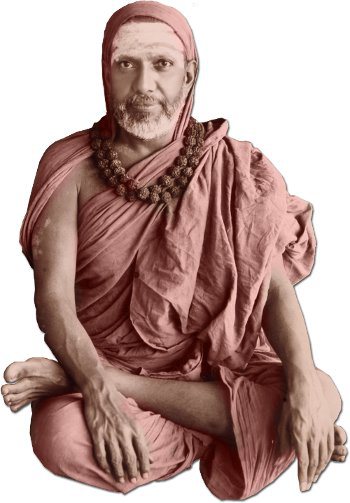
sri_sacchidananda_shivabhinava_nrisimha_bharati_mahaswamigal

HH: In answer to your question, I shall relate a story. In the days of old, a Naik Chief had a petty kingdom of his own and was guided by a Brahmana minister. He learnt that the high intelligence and capacity of the minister was due to his devoted repetition of the sacred Gayatri Mantra and felt impelled to ask him to initiate himself also in that Mantra. The minister however declined to do so. But there happened to be a poor Brahmana cook in the Royal establishment for the benefit of Brahmana guests and the King managed, by threats or bribing, to persuade him to impart to himself the Gayatri.

In a mood of exultation at his success, he proclaimed to the minister in the open court that he had learnt the Mantra. When the minister said that it was not possible, he repeated the words of the Mantra. The minister immediately denied it was the Gayatri. The King grew suspicious of the cook and sent for him and asked him to repeat it. He did so and the King at once pointed out that that was just what he himself pronounced. The minister however persisted in saying that it was not the same thing. The King naturally concluded that the minister was under some temporary mental aberration when he chose to deny a patent fact and attended to his other business.

After some time, the minister suddenly and in loud tones shouted to the bodyguard pointing to the King, “Give him two slaps on his cheek”. This confirmed the king in his opinion about the mental condition of the minister, but when the latter repeated the same command more than once, the king became angry and said to the bodyguard, “Give him two slaps on his cheek”.

The guard immediately gave a strong slap on the minister’s cheek. Then the minister said to the King, “This is the difference. I pronounced the same words as you did but they bore no effect but the same words from your lips had immediate effect and resulted in an injury to me. If a person like myself pronounces the same words, they not only do not amount to a command but have the contrary effect of bringing punishment on myself”.

In the same way, a combination of sounds becomes a Mantra only when it is communicated by an authorised person to another qualified under the Shastras to get it. This explains incidentally why people who claim to have learnt Mantras from printed books are never benefited by them. On the other hand, such procedure has the decided effect of reducing the faith of ordinary people in the efficacy of Mantras. When even qualified recipients have to submit to various restrictions in the repetition of a Mantra, how can we expect any result, other than any undesirable, if it is resorted to by incompetent people in quite a light manner? The Shastras alone are our guide in such matters and must be strictly adhered to.

From ‘Golden Sayings’,1969 publication by Sri Jnanantha Grantha Prakasana Samiti, Thenkarai, Madurai District.

Cut a Diamond with a Diamond!

diamond_israel_1968  diamond_germany_1997

Article No. 2082

by London swaminathan

Date : 18 August  2015

Time uploaded in London :–  20-49


“Wit must be foiled by wit, cut a diamond with a diamond” – said William Congreve.

In Tamil and Sanskrit there is an equivalent proverb, “Use a thorn to take a thorn that pricked you”.

There is a folk tale in South India to illustrate this proverb.

A Brahmin was walking through a forest. He saw a tiger in a cage struggling to come out. When he went near the cage the tiger begged to the Brahmin to release it. The Brahmin first refused to oblige saying that it is a man eater and so he can’t open the cage to release it. The tiger told him that it would not kill him. He opened the cage and expected a ‘thank you’ from the tiger. But to his surprise the tiger was ready to sprig upon him saying that he was going to be it’s food. The Brahmin argued his case quoting scriptures. The tiger was not ready to listen to him. It told him that its natural food was meat from animals or human beings. Immediately he told the tiger that they should go to someone for mediation. At that time, luckily, a jackal came across their way. Both of them put forth their arguments.

The cunning jackal told them, Look! I must be fair to both of you. So I need to listen to you carefully. Moreover I must understand the case from the very beginning. What happened first? The tiger went into the cage and said the it was caged. Then the jackal asked the Brahmin to close the door to see what happened next. As soon as the cage door was closed, the jackal told the Brahmin, “!You fool, run away at once. Never ever help a bad person”. Both the jackal and the Brahmin disappeared from the spot in second.

Emperor-Scorpion  DesrtHairyScorpion

There is another story:

An ascetic was trying to save a scorpion that fell into the river. As soon as it was saved by him he was stung by the scorpion. He saved it again when it fell into the water. And it stung him again. He asked why did it sting him every time he saved it.

“Oh, ascetic, don’t you know it is the nature of men to save and it is my nature to sting”.

The moral of the story is don’t try to change bad people. For some it is their inborn nature. You can’t straighten a dog’s tail!

Vallabhacharya and Python!

720-Mahaprabhu-Vallabhacharya

Article No. 2077

Written by London swaminathan

Date : 16  August  2015

Time uploaded in London :–  19-05


One day Sri Vallabhacarya was going through a forest with his disciple Damodara dasar. When he saw a cruel scene, he stopped there suddenly. There was a dying python unable to move. Thousands of ants were biting it and the python was wriggling in pain. Valabha and Damodara shed tears for the dying creature.
Vallabha breathed heavily and then took some water from his pot and sprinkled it on the python. It died immediately. He prayed for its liberation and then the ants left the body of the python. Both Vallabha and Damodara continued their journey through the jungle.

Still Vallabha looked deeply worried and then Damodara asked him humbly, “Guruji, still you look upset. Has anything gone wrong?”

python malay

Vallabha said to him, “This python was a Mahant (Chief priest) in the temple at Brindhavan in its previous birth. A lot of his devotees donated money for several good causes. But this priest swindled all the money and spent for himself and died. In this birth he was reborn as a python and the ants were the devotees who gave money to him. Now they took revenge upon him. I was thinking about the Mahant who went astray. The thoughts are still in my mind. That is why I am upset.”

Immediately his disciple Damodara asked, “Guruji, how must a perfect Guru should act in such circumstances? Vallabha replied that a Guru should worship God every day without ego, anger and desire. One who has realised God is a perfect Guru.”

Phenomenal Memory Power of Hindu Ascetics!

vivek with rock, kumari

Article No. 2071

Written by London swaminathan

Date : 14  August  2015

Time uploaded in London :– 21-41

(Pictures are used from various sources)

Hindu ascetics are endowed with a phenomenal memory. Swami Vivekananda could read any book and remember it verbatim. He was blessed with a prodigious memory and could memorise a book by reading it once. Once a librarian was annoyed when Swamiji asked for one book after another book. Librarian asked him whether he just looks at the book and return them or read the books. Swamiji quietly told him to ask him any information from any chapter. When the librarian tested Swamiji he was wonderstruck with his memory power.

Swami Vivekananda attributed the memory power to the Medha nadi. Anyone who follows the rule of chastity for twelve years grows this Medha nadi in the body and that gives one this amazing power of memory. In the olden days Brahmin boys went to Gurukula and stayed with the Guru for twelve years and memorised the Vedas and Vedangas. This was possible only because of their Brahmacharya/ chastity. Now the Vedas are considered “Literary Wonders of the World”, which have been passed from generation to generation for thousands of years.

brain

Another Swamiji who lived in our own time was Sri Chandrasekara Indra Saraswati (1894—1994), Shankaracharya of Kanchi Kamakoti Peedam. He could remember all the faces, places, anecdotes, dates etc. There are umpteen anecdotes every devotee narrates about his or her experience regarding  Shankaracharya’ s  memory power. Even though all the Brhmacharis/chaste students have this faculty, unless they don’t develop it or use it practically, it would not reach its peak.

Some are born with photographic memories. Many mathematical prodigies have this gift. We saw Sakuntala Devi in our own times who even defeated the computers. Nobel Prize winning scientist Nikola Telsa was exceptionally gifted with photographic memory.

U S President Theodore Roosevelt could recite entire newspaper pages from memory, and was also a speed reader, often devouring three books a day.

Fillippino dictator Ferdinand Marcos could memorise complicated texts in a single glance and passed his bar examination to practise law in 1939 with a 98 per cent pass. The unusually high score drew suspicion and Marcos was retested; second time he achieved 100 per cent!

Deenadayal

Deenadayal Upadhyaya, President of Jana Sang (now B J P), could remember the names of all the MPs in both the houses of Indian Parliament. He was famous for his memory. My friend Dr Dandapani, who is no more, appeared on Channel 4 in London and amazed the listeners with his memory about Indian Railways. He was the agent of Indian railways in the UK. He remembered all the pages in Indian Railway Time Tables!

So it is not just the Brahmacharya (chastity) alone. There are other factors like practice and some mnemonic techniques.

Interesting Anecdotes

1.Archbishop Ryan was once accosted on the streets of Baltimore by a man who knew the Archbishop’s face, but could not quite place it.

“Now where in the hell have I seen you?” he asked perplexedly.

“From where in hell do you come, sir?” he retorted

2.In order to play in “Rosemary”, John Drew shave off his moustache, thereby greatly changing his appearance. Shortly afterwards he met Max Beerbohm in the lobby of a London Theatre, but could not just then recall  who the latter was. Mr.Beerbohm’s memory was better.

“Oh, Mr Drew,” he said, “I am afraid you don’t recognise me without your moustache.”

3.The woman’s club was listening, entranced, to the lecture being given by a world famous traveller. He concluded his remarks with, “And there are some spectacles that one never forgets….”

At this point a timid old lady in the audience spoke up shyly, “Pardon me, sir, would you tell me where I could get a pair? I am always forgetting mine.”

4.Memory training by association became a fad in a certain school. “For instance”, the English teacher was explaining, “if you want to remember the name of a poet, Bobbie Burns, you might conjure up in your eye a picture of a London policeman in flames. You see, ‘Bobbie Burns’.

“I see,” said one of his pupils, “but how one is to be sure that it doesn’t represent ‘Robert Browning?”.

Source: Swami Vivekananda’s Life History

Thesaurus of Anecdotes

London Metro News Paper

–End—

True Story: Everything happens for good

08smkangeyam_jpg_2332869g

Article No. 2068

Written by London swaminathan

Date : 13  August  2015

Time uploaded in London :–  20-04

(Pictures are used from various sources)

A poor devotee of God was a householder, had his hut near a forest. In his house, besides his wife, there was a bull which was used as a beast of burden. It was the soul means of livelihood for the couple, for on its back articles were carried out for sale by its master. There was also in the house a dog which was useful for keeping guard and protecting them in the woodland. The devotee had in addition a parrot of which he and his wife were very fond, as they had no children. The parrot when the night passed and the day dawned, used to wake up the couple by calling out, “Awake, and pray to God!”

One day, it so chanced, a lion from the forest came and killed the bull belonging to the poor householder. The dog, being afraid of the lion, ran inside the house and hid himself. The householder got up in the morning and when he saw the dead body of the bull, he exclaimed, “It is well done, God does everything for the best. This has happened by his will. Therefore it cannot be but for our good.”

dog

Hearing these words, his wife was greatly displeased, but she did not say anything. Misfortunes, however, never come single. Later on, that day, the parrot somehow came out of its cage and was killed by the dog. When the master of the house heard of the incident, he repeated, “God does everything for the best. This has happened by his will. Therefore it cannot be but for our good.”

On hearing these words, this time his wife became desperate and beat her own head. She became so distressed over these remarks that she did not even try to express her feelings to her husband. A short time afterwards, somebody told them that their dog was rolling in agony in the street. It died soon after.  The master of the hose again said, “God does everything for the best. This has happened by his will. Therefore it cannot be but for our good.”

Seething with anger, his wife now was unable to control herself and told him, “What do you mean by repeating such senseless words? Without any means of livelihood, now remain in the house and starve. Take to your bed and sleep till morning. The bull that gave us food, and the parrot that was waking us up in the morning have both gone. The faithful dog also died.  This night someone will send us also to the cremation ground.  Then you will realise the God’s goodness”

lio buffalo 3

“What has happened cannot be changed,” said the man, who was perfectly calm and cheerful. He took everything as god’s grace. He was quite unperturbed by his wife’s ironical outburst. But his wife was feeling very miserable. She was worried as to how they would eke out their livelihood.

The day passed and the night came. Both slept. When they woke up in the morning and went out, they saw in the whole town dead bodies scattered lying everywhere. In the night, a gang of dacoits had entered the town and had left not a single person alive.  They had looted every house and taken vessels from the homes. A house near the jungle, without a dog, is generally taken to be unoccupied. So, thinking, that the cottage of this couple was vacant and deserted, the dacoits did not enter it. Thus the God had really saved them in his mysterious way.

parrot 4

The man said to his wife now, “if our dog was there with us, the dacoits would have entered the house and surely killed us also. Even if the bull had been seen by them, they would not have spared us. The parrot too would have been a source of danger to us. If it had shouted before dawn to wake us up, the dacoits would have heard it and got scent of us. God, who in all kindness, had arranged the death of all these three beforehand in order to save us. It is on account of this that we are alive today. Do you now doubt that all that happens is for good?”

God ever protects those who rely on him

malaiyum kadum

Article No. 2066

Written by London swaminathan

Swami_48@yahoo.com

Date : 12  August  2015

Time uploaded in London :–  22-11

One day a man, who had not much faith in God, heard from the lips of a saint that god always protects his devotees when they are absorbed in his remembrance and meditation. This protection comes to him in all respects. The man became curious and wanted to test the assurance given by the Saint. So, one day, he went to a forest miles away from the town in which he lived and sat in the midst of a cluster of trees. He had gone into the forest in the morning and continued to stay until midday. All the while, he was unceasingly repeating God’s name with mind fixed on him.

When he was thus engaged, a man passed through this forest intending to visit a neighbouring village by a short cut. He was carrying his meal tied up in a bundle. When the traveller saw the man sitting alone by himself, it evoked sympathy and thought he could offer him the food he was carrying with him. Accordingly going up to the man, he gave the food to him. The man accepted the offer and ate the meal.

A question arose in his mind whether it was God who fed him at the proper time or whether it was a coincidence. He felt that the test he made was not a proper one. His mistake, he thought, was in having selected a spot frequented by human beings. So he planned to take himself off the next day to a distant place where no human beings would go.

Next day, he started early from home and walking a distance of about four or five miles and crossing a river, he saw a pretty tall hill which he climbed up looking out for a suitable lonely place for his prayers. To his pleasant surprise, he saw a hollow on the top of the hill and thought if he sat in it nobody able to find him out. He descended into it and sitting in the middle of it, started chanting god’s name with great devotion. Hours passed.

tirukkurungkudi malaiwampi

Meanwhile from the town in which this man lived, a party of ten to fifteen youngsters started on a picnic. They travelled on a boat to the appointed place up the river referred to above. Merrily the boatman rowed the boat and the young men were quite happy.  But when they neared the place, where on the top of the hill the devotee was sitting, a strong breeze blew from the opposite direction and the boat would not move in spite of strenuous efforts of the boatman. Then the boat man suggested that the party may halt at that place and finish up the picnic programme.  The party had no other alternative. Getting down from the boat they proceeded to the base of the hill.  They proposed to spread a cloth on the sand and, sitting on it, make a good picnic repast of the many fine eatables they had brought with them.

One wise young man of the party warned that it would not be possible for them to eat there since the strong wind would sprinkle the sand on their refreshments. Then another suggested they may go to the top of that hill and find a suitable place there. Soon all of them with the picnic articles, went up the hill. In their search for a place they came across the devotee seated in the hollow of the hill. They, with one voice, declared that the man should be fed first from the food they had brought with them. Accordingly they placed before the devotee palate containing the most delicious preparations. The devotee had a hearty meal of the tasteful dishes. Now he fell to think seriously as to who fed him in that unknown deserted place. It clearly dawned in his mind that God alone provided him with food as he had depended entirely on him.  God ever protects those who rely on him is an incontestable truth.

Source Stories as Told by Swami Ramdas

Also read my previous post:

“God feeds Ant in the Box and Toad in the Stone”, posted on 19 June, 2014.

Hindu Festivals in London!

drum best 2

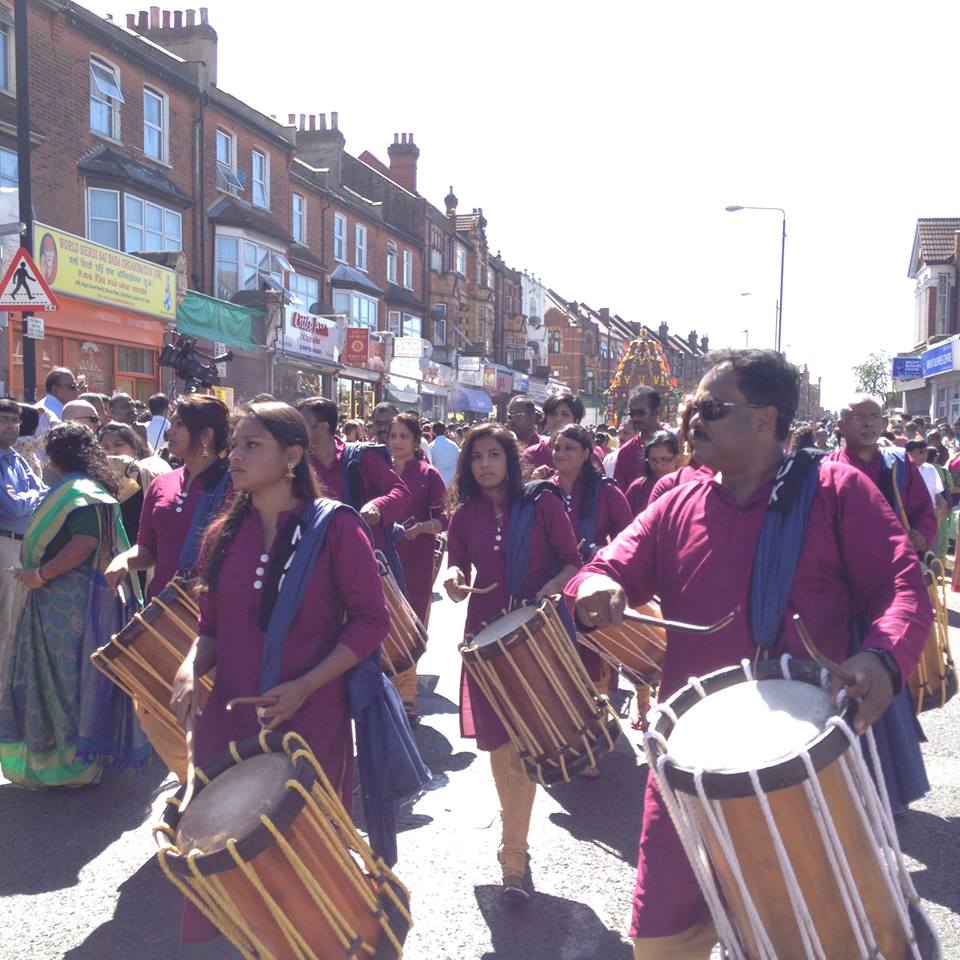
Kerala special Jandai Vadhyam by Malayalees in London in front of the Skanda (Murugan) Chariot

Article No. 2063

Written by London swaminathan

Swami_48@yahoo.com

Date : 11  August  2015

Time uploaded in London :–  14-53

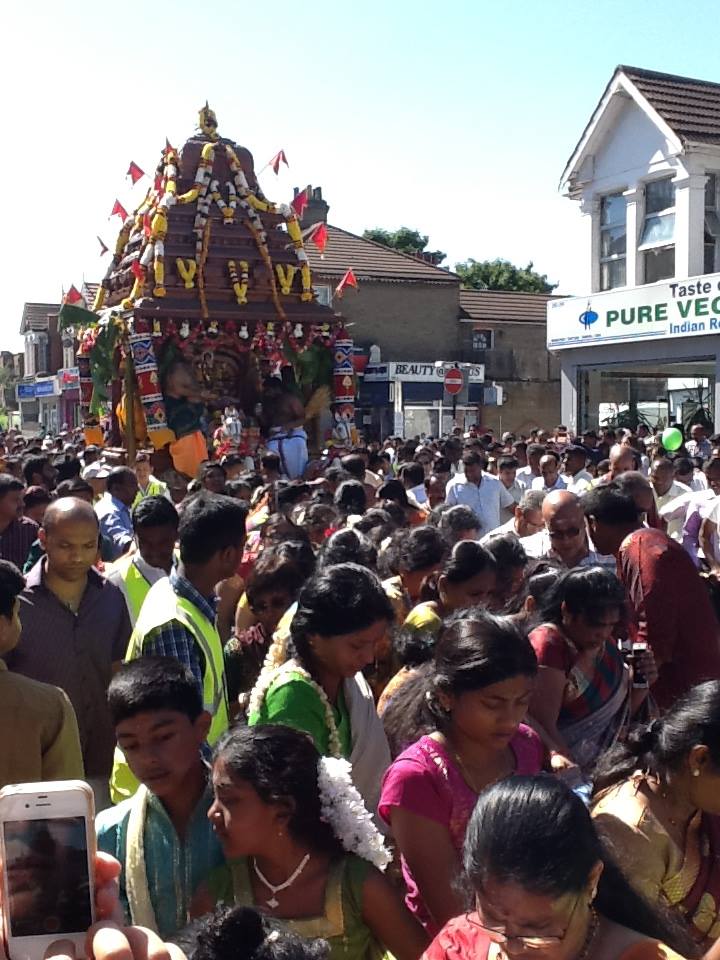
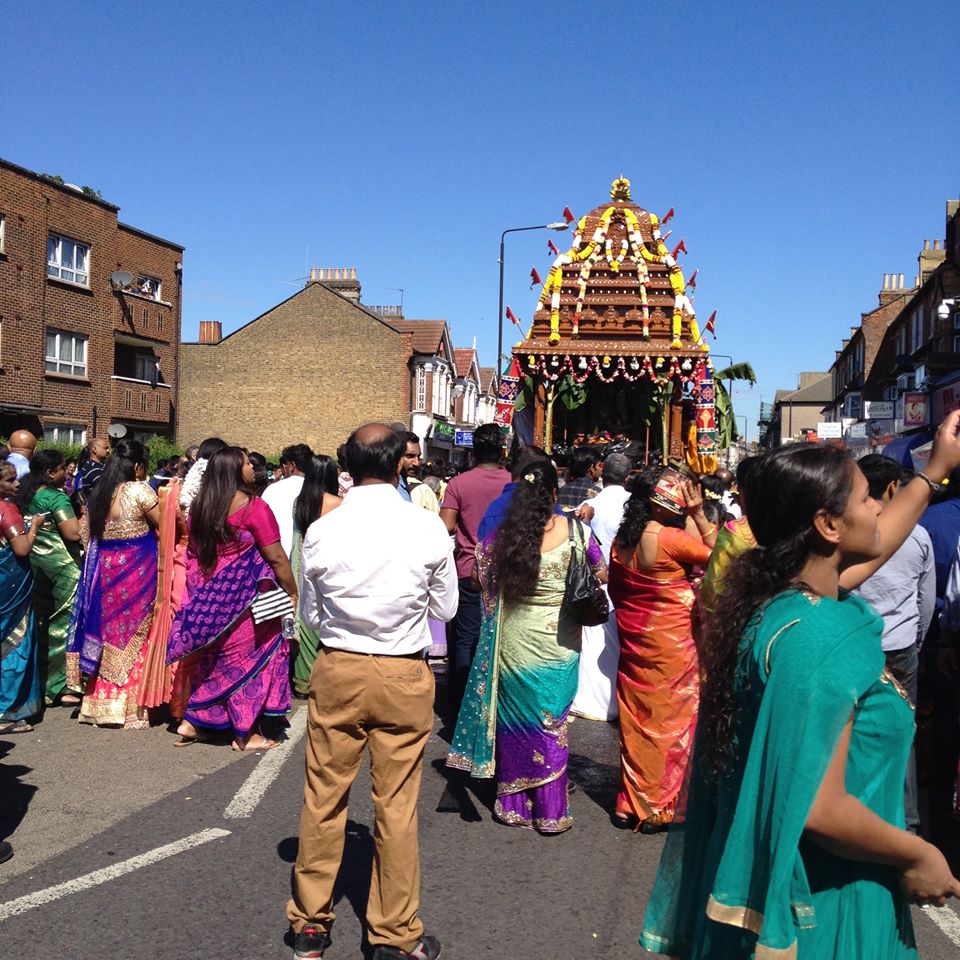
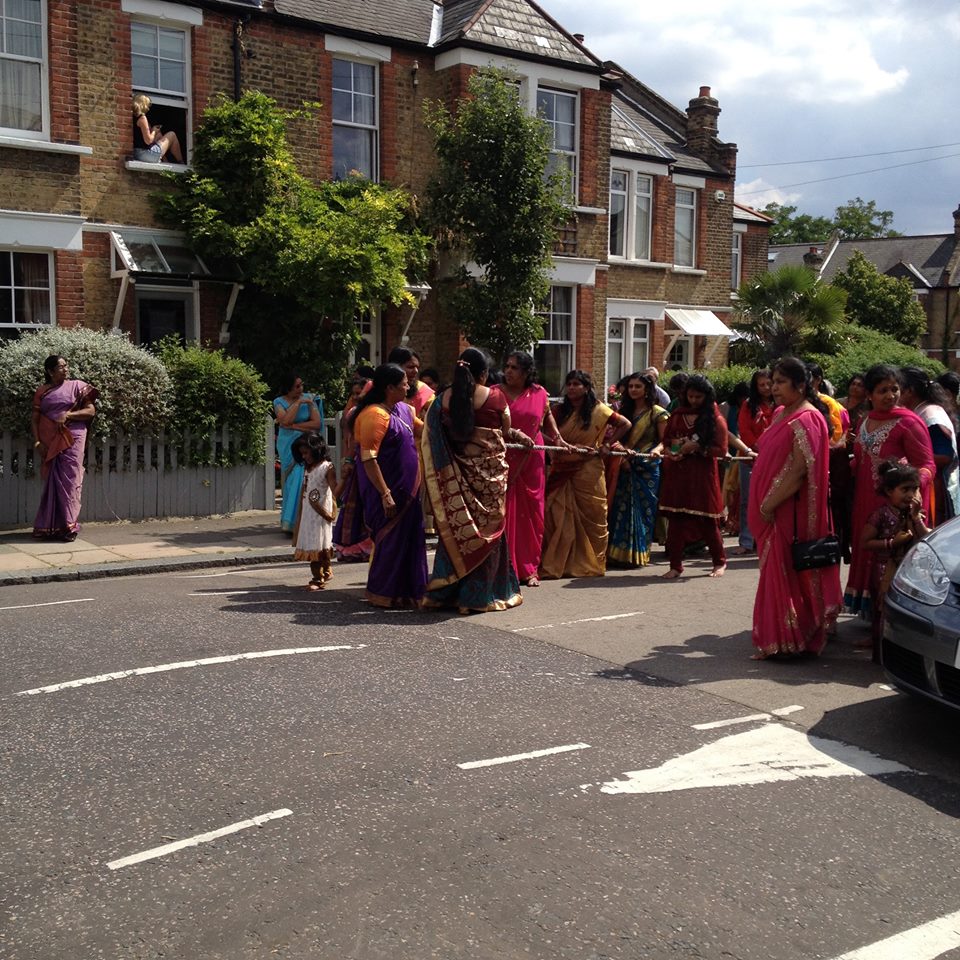
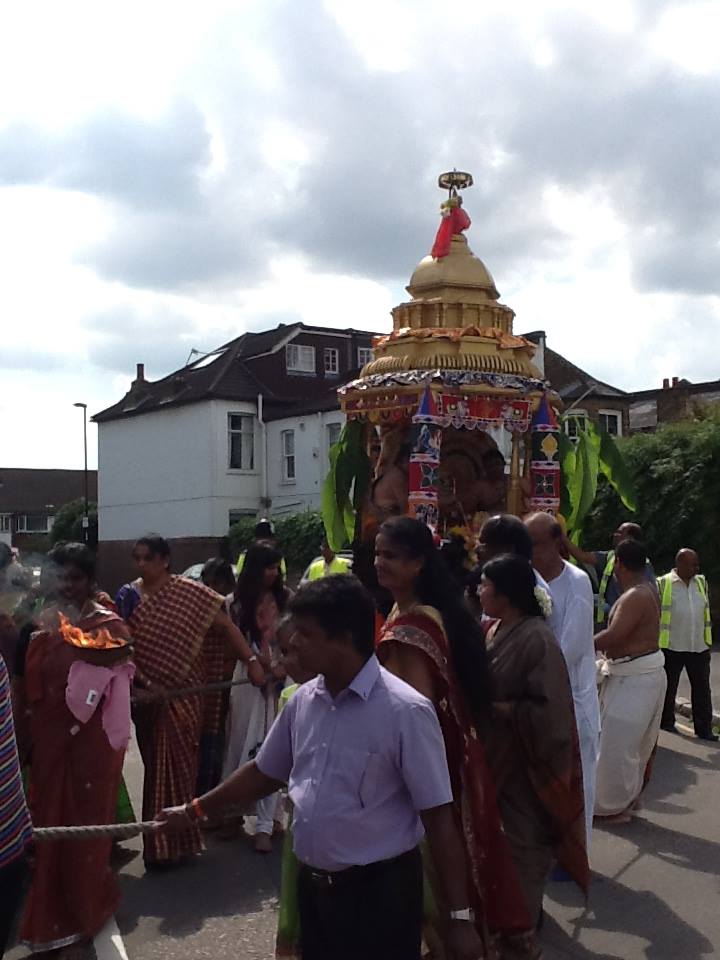
Hindus in London enjoy the four months from June to September. It is not because of summer alone, but because of lot of Hindu festivals organised during that period. From Hare Krishna Rath yatra in June to Janmashtami in September, there are lot of Rath  Yatras (Chariot Festivals) and big festivals. Lot of singers, dancers and speakers come to London and remind the Hindus of their hoary tradition and culture. It gives the Hindus plenty of opportunities to wear their traditional dresses and celebrate it as they celebrate in India, Sri Lanka and Malaysia.

drum best

There are over 25 Hindus temples run by Tamils in London. More temples are there run by Swaminarayan followers. There are other Hindu temples run by speakers of Hindi and Punjabi.

Hare Krishna temple in Watford (Greater London) celebrate Janmashtami when 10,000 Hindus visit the temple. I have already posted the Chariot Festival by ISKCON which was attended by thousands of Hindus in central London. Ram Navami procession in Southall is famous as well. Deepavali procession in Wembley (Brent) attracts a big crowd. Floats and decorated chariots come in the popular procession. Since Diwali falls in winter months, lot of celebrations happen inside the halls. British Prime Minister gives a party. Every Deepavali, Hindu Forum of Britain arranges a meeting inside the Parliament building in London. Ministers and MPs belonging to different parties participate in it with great enthusiasm. The Annakut festival arranged at the famous marble temple of Swami Narayan in Neasden, London attract a huge crowd. In the past few years more Swaminarayan temples have come up in Stanmore, Kingsbury and other places.

IMG_1172

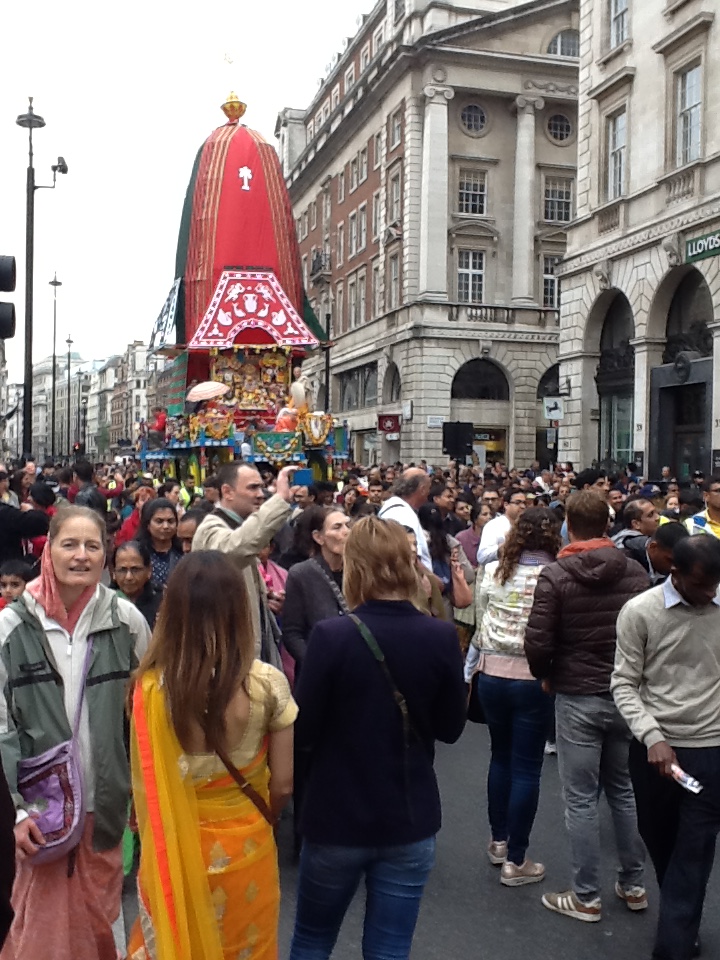
Hare Krishna Rath Yatra in Central London

Apart from London, Balaji temple in Birmingham, Hindu temples in Leicester, Coventry, Manchester and New Castle upon Tyne have their own annual events. Swamijis (Hindu ascetics) belonging to various Gujarati sects visit London to give discourses. Sri Vallabh Trust also has a branch.

Scores of Sathya Sai Bhajan centres are there in every Petah (Council) of greater London. There are at least two Shirdi Sai Temples in Wembley and East Ham.

IMG_1221

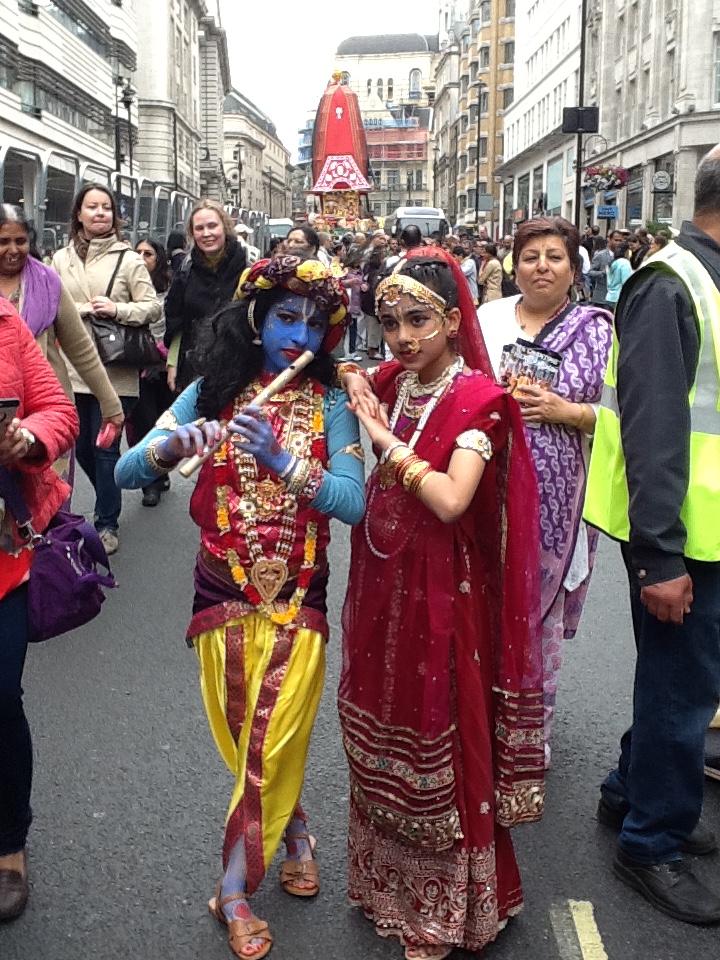
Children dressed as Radha Krishna in front of the ratha/chariot

Mahalakshmi Temple in East Ham has bought a land and building a big new temple in East ham nearby its present location.

Saivaite Hindus have formed an organisation of their own temples and conduct annual festival in London. Scholars from India and Sri Lanka address the Hindus.

Since I have attended almost all the above events, I have the personal experience which is unforgettable. Foreigners also throng these places and taste our food. Every time a Hindu procession or event organised I see thousands of cameras flashing. Curious onlookers ask about the significance of the chariots and our customs.

Missions like Ramakrishna Mutt, Chinmaya Mission, Divine Life Society, Isha Foundation, Art of Living Foundation and hundreds of Yoga Teaching Centres, St James Sanskrit School are doing remarkable work.

IMG_1372 (2)

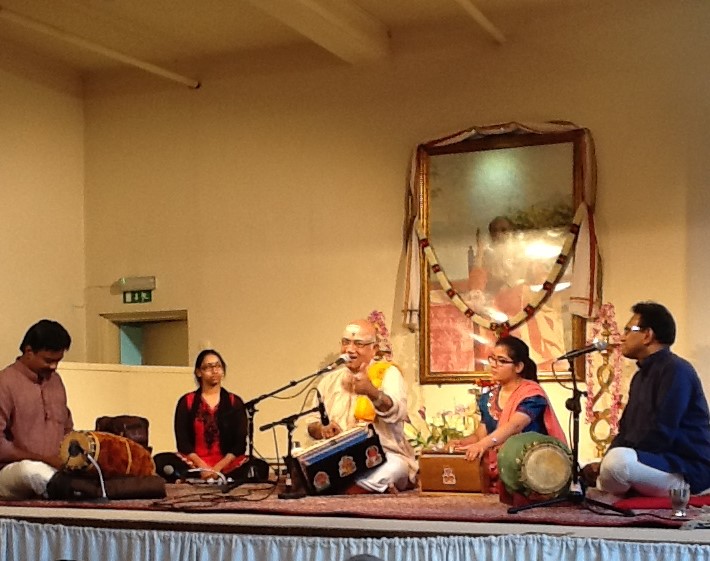
Professor Anantharaman Bhajan at Chinmaya Keerti, London

Since Chinmaya Mission activities are in English with Sanskrit background, lot of youngsters attend their activities. Moreover they are not sect based and so all sections of Hindus attend their events. Swamijis of Chinmaya Mission visit London at least twice a year to give a spiritual feast. At least thousand people listen to them every day.

Swami Narayan temple in Neasden is a big tourist attraction. Since they have huge parking facilities and a restaurant attached to the temple, School children with White and Afro Caribbean backgrounds visit the temple almost every day during school term time.

Durga Puja is organised by the Bengali Hindus on a grand scale and Ganesh Chaturthi is organised by the Maharshtrians every year. They get special permission to do the immersion ceremony of the idols in Thames River outside the city.

madu2

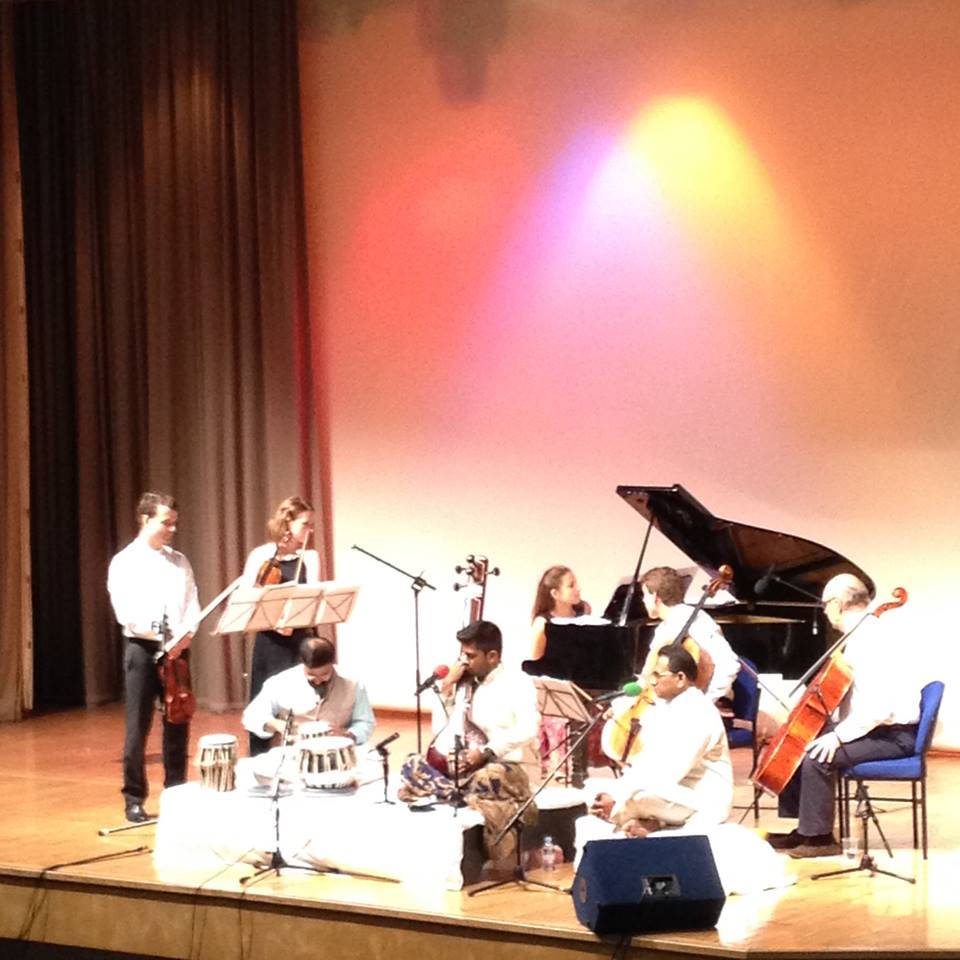
Chinmya Mission Swaranjali group with Sprom from Europe: Mozart to Hanuman Chalisa symphony

IMG_3224

Swami Tejomayananda, Head of Chinmaya Mission Talk on Ram Gita in Central London.

Though one cannot have the same atmosphere of Mahakumbha Mela of Prayag or Janmashtami of Brindhavan or Rath Yatra of Puri or my home town Madurai Meenakshi Temple Chitra Festival, in London, at least we are reminded of our past golden days back home.

(NB. My list above is not comprehensive. I might have left some of the important events or the places.)

All the pictures are taken by me.

pavatta1

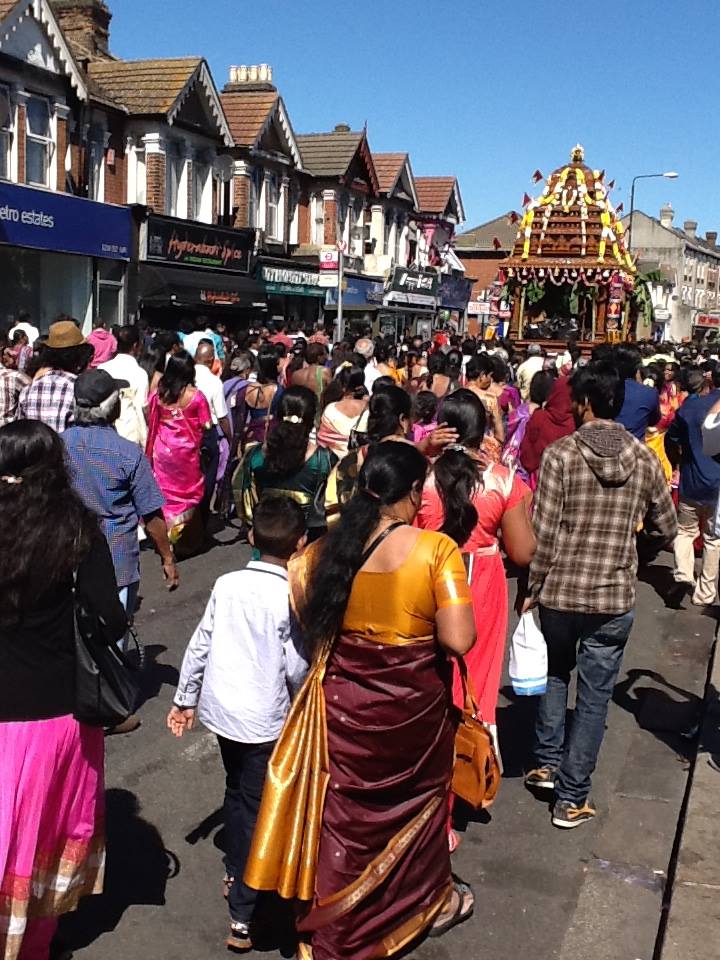
London Murugan/ Skanda chariot in East London

pavatta2

saree1

saree2

ther2

tichatta1

Women used to carry burning pot in their hands as part of their vow, Lewisham Adi Vel Chariot

vadhya1

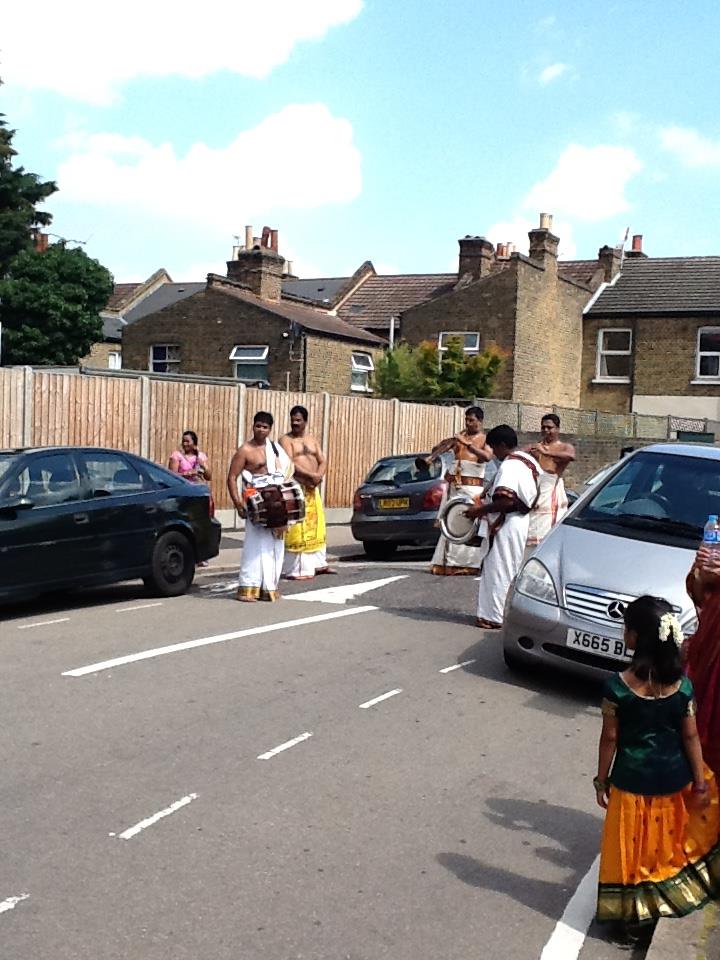
Traditional Tamil Pipes and Drums in front of the Chariot procession, Lewisham, London

volunteer1

women ther1

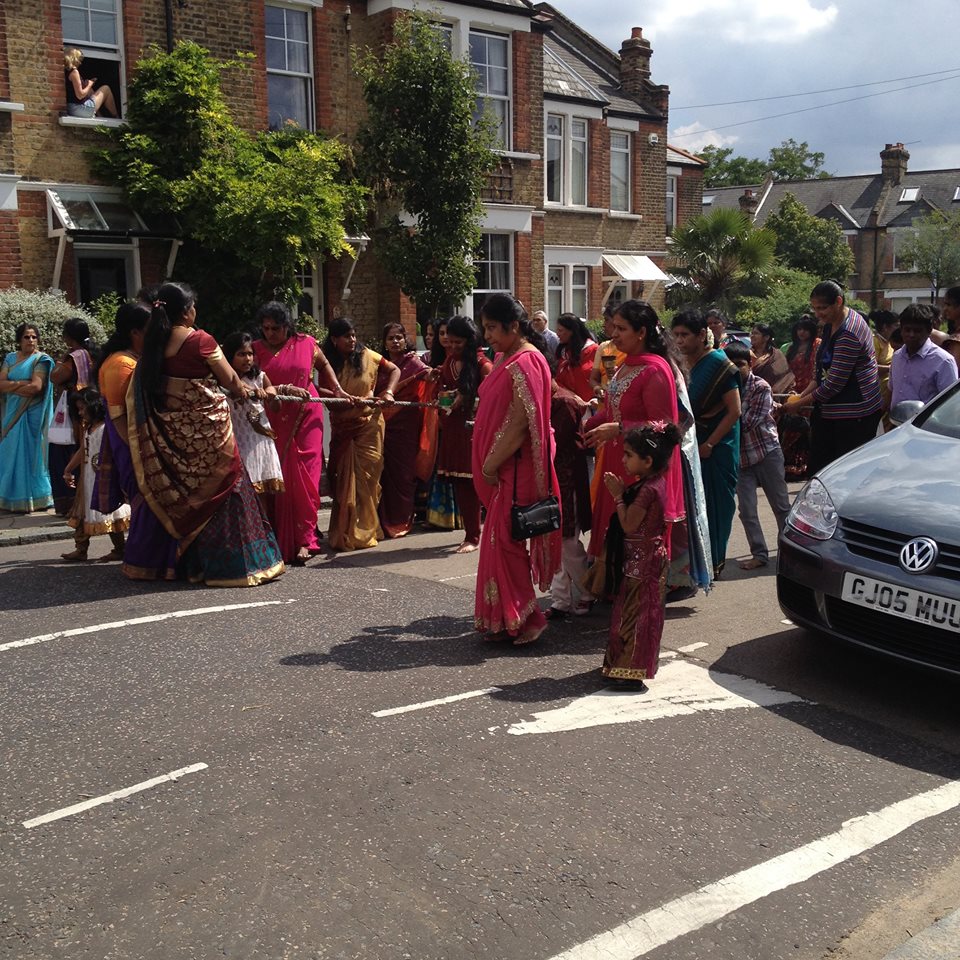
All Women Powered Chariot Procession in Lewisham Adi Vel There (Chariot Procession)

women ther2

women3

IMG_2987

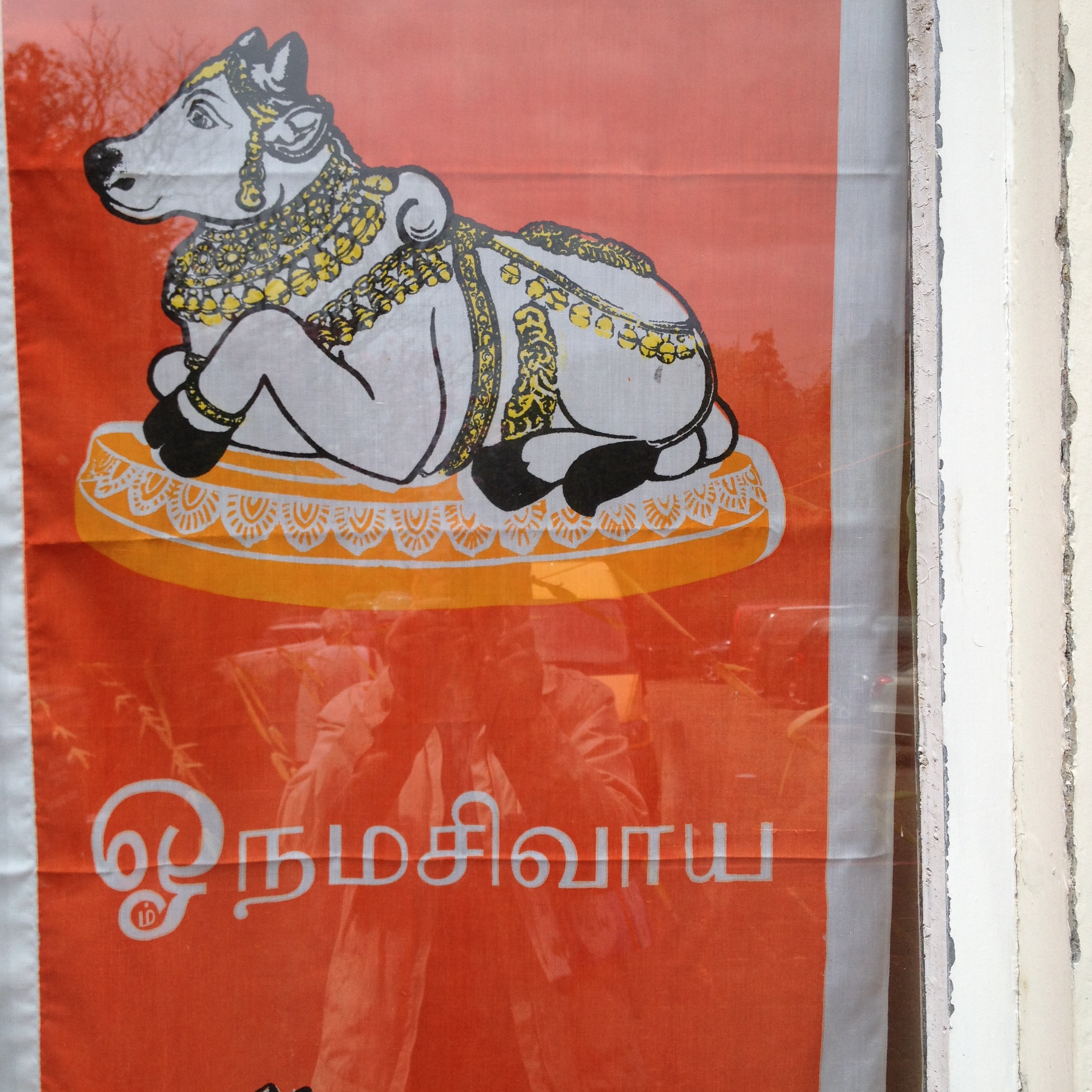
Saivaite Conference Bannaer with Bull and Om Namasivaaya

mangal2

prasad1 managal1

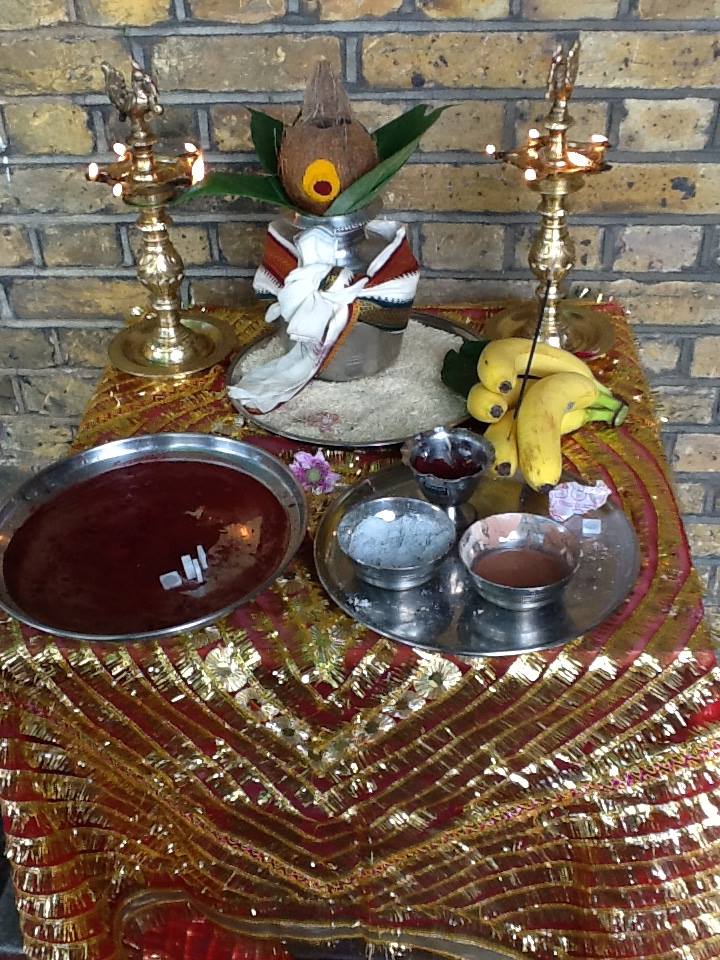
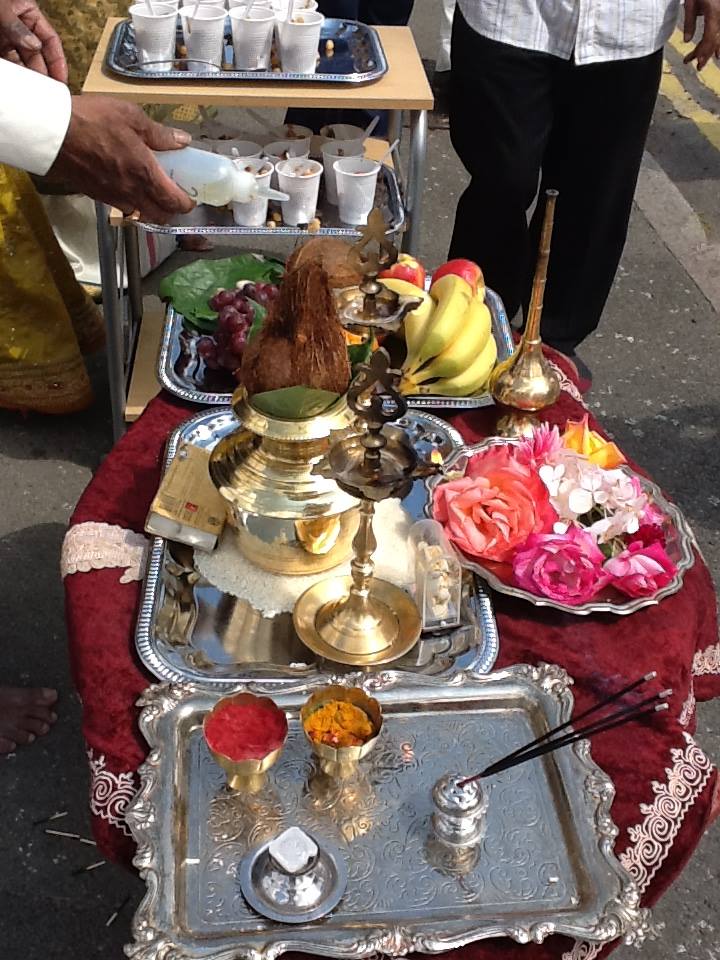
Tamil Hindus offer Coconut, Banana, Betel Leaves and incense Sticks to God.

A Story about Mountain of Worries!

man path

Article No. 2057

Written by London swaminathan

Swami_48@yahoo.com

Date : 9  August  2015

Time uploaded in London :– 17-08

“Distance lends enchantment to the view” is the English saying and the equivalent proverbs exist in almost all the languages in the world. In Tamil “Ikkaraikku Akkarai Pachai” = The cow on one side of the river thinks the other side is greener. There is another saying in Tamil meaning “Green at a distance is cool to the eyes.”

There is a story told by Swami Ramdas to illustrate this proverb/saying.

There was a time when discontent seized the souls of men in the world to such an extent that they unitedly raised a wail to the throne of God for relief. Everyman, dissatisfied with his own lot, felt he would gladly exchange places with his neighbour.

God heard their cry and appeared before them. All the aggrieved people assembled around Him on a vast plain. God now said, “O men, in response to your prayers, I have come here. I give each of you power to throw down on this plain the particular disability or the woe which is the cause of your discomfort and misery.”

At once, in hot haste, all he people divested themselves of their burdens of sorrow and flung them on the plain. The accumulated heap of woes formed a veritable mountain. “Now, O men,” exclaimed God, “You may pick up from this heap any burden which you prefer in exchange for the one you have given up.”

29VZMP_PAPIKONDALU_2294921g

Immediately, there was a furious scramble and each man grabbed the burden of woe belonging to his neighbour. The blind man exchanged his blindness for a broken leg vice versa. The poor man exchanged his state with the man of riches. The barren women became fruitful and vice versa – so on and so forth. Thus in a short time, the mountain of worries disappeared. All the people felt for the moment happy and relieved. God left them and they returned to their homes.

What happened the next day? Louder lamentations, a hundred times more than what it was the day before, rose from the people. God again presented Himself before them. Now all the people cried out “ O Lord, give me back my own woe, for I cannot endure the pains and grief which I have taken in exchange.” God granted their prayer and they returned perfectly satisfied.