One more Mystery in the Rig Veda: Who are the Pancha Janah?

5 hands

Research paper No 1956

Written by London swaminathan

Date: 26 June 2015

Uploaded in London at  19-20

There are lots of unsolved mysteries in the Rig Veda, the oldest book in the world. One of the unsolved mystery is the word “PANCHA JANAAHA”. It means FIVE PEOPLES. As usual the foreign “scholars” stood like Nava Grahas looking at different directions with different views. Even among the Hindu scholars Yaska and Sayana, there is a difference of opinion. It is very interesting to study various explanations.

The Vedic Index by Keith and Macdonell says:

Panca-janaah, the five peoples, are mentioned under various names in Vedic literature. Who were meant by the five is very uncertain.

The Aitareya Brahmana explains the five to be gods, men, Gandharvas and Apsarasses, snakes/Nagas and the Fathers/departed souls.

Aupamanyava (in the Yaska’s Nirukta 3-8) held that the four castes and the Nisadas made up the five, and Sayana (on RV 17,9)is of the same opinion. Yaska thinks that the five are the Gandharvas, Fathers/departed people, Gods, Asuras and Rakshasas (Nirukta).

No one of these explanations can be regarded as probable.

number-5

Foreigners’ interpretations

Roth and Geldner think that all the peoples of the earth are meant; just as there are four quarters, there are peoples to the four quarters with the Aryan folk in the middle.

Zimmer opposes this view on the ground that the inclusion of all peoples in one expression is not in harmony with the distinction so often made between Aryan and Dasa. After long explanation he concludes that they are five tribes of the Anus, Druhyus, Yadus, Turvasas, and Purus who are all mentioned in one or two hymns of the Rig Veda (1-108-8; 7-18).

Hopkins has combated Zimmer’s view, but his own opinion rests mainly on his theory that there was no people named Turvasa, but only the King of the Yadus called Turvasa and that theory is not very probable.

My comments: No two clocks agree; no two foreigners agree on Vedic matters. So we must rely on Yaska the earliest person to explain the word. He lived around 850 BCE. Moreover he was the one who knew the culture and lived nearer to the Vedic times. Another point is that the meaning may change in course of time. For instance we in our Panchayajna, give offerings to Brahma/ Vedic recitation, Deva/god, Manusya/guests, Pitru/ departed souls,  and Bhuta/Living beings (animals).

More over the very grouping of five tribes or five sets of people show that they have been living together for long in the same place. Otherwise the phrase “five peoples” is not possible to use in so many places.

In the Satapata Brahmana and the Aitareya Brahmana, the five people are opposed to the Bharatas, and in the former work seven people are alluded to.

five

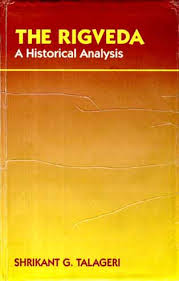
Shrikant G.Talageri in his book The Rig Veda – A Historical Analysis makes a passing reference:

“Traditional history knows of many different streams of peoples, but the two main streams are of those belonging to the Solar race of the Ikshvakus, and those belonging to the Lunar race of the Ailas. The Ailas are further divided into five main branches: the Yadus, Turvasas, Druhyus, Anus and Purus (but Talageri did not mention anything about Pancajanah here).

A.Kalyanaraman in his scholarly work “Aryatarangini”, says

“Apart from the Bharatas, four other principal Aryan clans inhabited the Sapta Sindhu and were collectively known as Panchajanah. These were Trustus, the Anus, the Druhyus and the Turvasas or Yadus.

Kalhana’s Rajatarangini says

Commentary on verse 3-353 (ruler of Pacajanah)

This is an intriguing word with many possible meanings. It may mean

1).The four castes with the barbarians as the fifth, see the exposition in Saarirabhaasya on Brahmasutras 1-4, 2-13

2).The Five classes of beings viz. the gods, men, Gandharvas, Nagas and the Pitr (departed souls)

3).Or does it possibly mean the Panchayats as we know them.

(it shows that even in the 12th century CE, people were not sure about the meaning)

people_icon

P T Srinivasa Iyengar in his book, “The History of the Tamils” has a long shot at this word:

“One Vedic phrase seems reminiscent of the division of the people into five regional tribes and that is Pancajanah. This mysterious phrase has been attempted to be explained by various writers, ancient and modern, but by none satisfactorily. I have made the conjecture that it must refer to the five tribes of pre-Aryan times, but scholars who know nothing of Tamil literature and who refuse to consider the necessity of historical continuity between pre Aryan India and Arya India have been unable to appreciates the value of this conjecture.

LET-5R

Panchajana and Paanchajanya

Krishna’s victorious conch has a special name PANCHAJANYA. It is in the Bhagavad Gita. The story is that there was a demon called Panchajana in the sea. He lived in the form of a conch shell. He seized the son of Sandipani under whom Krishna had his School education. He learnt the use of arms in Sandipani School. When he learnt that his teacher’s son was abducted, he swung into action, killed the demon and rescued Sandipani’s son. Then he used the conch shell of the demon. That is called Paanchajanya. Krishna had fought several naval battles from his naval base at Dwaraka in Gujarat. I have explained his naval battles with sea pirates, Nivata kavachas in another article (See Hindu Gods’ Naval attacks against Pirates, posted by me on 26 April 2012).

Panchajanah still remains a Mystery!

Pictures are taken from various websites; thanks.

Oldest Bribery in the World! Rig Veda speaks of Bribes!!

bribery_2

Research paper No 1954

Written by London swaminathan

Date: 25 June 2015

Uploaded in London at 14-23

I wrote about the Vedic Dog Sarama and the story’s occurrence in various cultures in mutilated or corrupted forms. The hymn in the Rig Veda (10-108) is very interesting in various ways. Here we read about

1.Corruption

2.Inducement to change party loyalty

3.Ambassadorial role

4.Dog as human pet

5.Dog employed in detective work

All these show that the Vedic society is well advanced. Earlier I wrote about the Rig Vedic Sabha and Samitis, oldest democratic institutions in the world. All these are my observations.

Bribery01

Here is the Sarama hymn (RV.10-108):–

The hymn, as Griffith notes, “is a colloquy between Sarama, the messenger of the Gods or of Indra …… and the Panis or the envious demons who have carried off the cows or Rays of Light which Indra wishes to recover”.

But, according to Macdonell, the hymn is about “the capture by Indra of the cows of the Panis ….. (who) possess herds of cows which they keep hidden in a cave far beyond the Rasaa, a mythical river. Sarama, Indra’s messenger, tracks the cows and asks for them in Indra’s name, but is mocked by the Panis”.

Clearly there is a basic difference in the above descriptions of the myth, says Shrikant Talageri in his book—“The Rig Veda – A Historical Analysis”.

From Griffith’s translation (R V 10-108):–

“I come appointed messenger of Indra, seeking your ample stores of wealth, O Panis

This has preserved me from the fear of crossing; thus I have made my way over Rasaa’s waters (Sarama said this) 10-108-2

Wat is that Indra like, what is his aspect whose envoy, Sarama, from afar thou comest?

Let him approach, and we will show him friendship; he shall be made the herdsman of our cattle (Panis said this) 10-108-3

Even thus, O Sarama, hast thou come here by celestial might to make the journey

Turn thee not back, for thou shalt be our sister; O Blest One, we will give thee of the cattle (10-108-9)

bribe 2

My comments:


1.From the above three stanzas we come across the word MESSENGER/ENVOY.

This shows that the dogs have detective power to find the hidden cows and the hymn says the dog travelled long distances, even crossed a river. Nowadays we hear amazing animal stories where the dogs travel hundreds of miles to go back to their owners. Probably this is the oldest dog story. Dogs have powerful smelling – 3000 times more powerful than human beings.

2.The second point is that sending an animal as AMBASSADOR. We come across swan as a messenger in the Nala – Damyanti story and later great poet Kalidasa sings about Cloud Messenger in his poem Meghaduta. In the 2000 year old Sangam Tamil poetry and later devotional poetry we see lot of animal and bird messengers to their lovers or God. Probably Rig Veda has the oldest reference to such ambassadors (apostrophes to birds etc).

3.The third point is that Panis were ready to bribe Sarama with some cattle and ready to take her their sister. But Sarama rejected the bribe. Panis were the bad people in this episode.

Later Vedic literature Jaiminiya Brahmana (2-440/442) has a slightly different story, according to Talageri. Here, the cows and are clearly referred to as the cows of the Gods stolen by the Panis. This time, the Gods first send Suparna, the eagle or the Sun Bird. However the Panis BRIBE him into silence, and he accepts their gifts and returns without any information. The enraged Gods strangle him, and he vomits out the curds etc. received from the Panis.

Then the Gods send Sarama. She crosses the River Rasaa and approaches the Panis. She is also offered BRIBES, but (as in the Rig Veda), she refuses their bribes and returns to Indra with the information that the cows are hidden (DETECTIVE WORK) inside the Rasa. She and her descendants are then blessed by a grateful Indra.

bribe3

4.Dogs are grateful animals. Sarama stick to her loyalty in spite of temptations. Dogs are kept as pets from the Vedic days.

According to Talageri, the myth appears in Brhatdevata (8-24/36). Here the myth develops a curious twist. The same sequence of events take place, but this time Sarama accepts the bribe of the Panis, and apparently transfer her loyalty to them. When she returns to Indra and refuses to disclose the hideout of the cows, Indra kicks her in a rage she vomits out the milk she received as a BRIBE and then goes back trembling to the Panis (Ayaram, Gayaram stories in Indian political field).

We know that all these are symbolic stories of what is happening in Nature. But even if we accept it, the similes such as bribe etc used reflects the ways of life in Vedic days. But the good thing about the bribe is, it is offered by the bad people (Panis). Moreover good people reject it or get punishment for accepting it.

prison-cell-phone-bribery2

5.Two other notes won’t be out of context here:

Chanakya, the author of Arthashastra, says that like the fish that lives in water drinks water, the government officers take bribe!

There is a Tamil Proverb, “Wont the person who extracted honey (from the honeycomb) lick his fingers?”

So, taking bribes has been there from Vedic days, but it is condemned in the Vedas.

(Bribery pictures are used from various sites;thanks)

Vedic Sarama and Greek Hermes!!

dog3

Research paper No 1952

Written by London swaminathan

Date: 24 June 2015

Uploaded in London at 20-50

Who is Sarama?

In the Rig Veda (10-108) the dog of Indra is called Sarama. It has got two children and they are called Sarameyas. They were the watch dogs of Yama, the god of death. Panis (who are identified with Phoenicians) stole the cows of Indra. Sarama was sent as a messenger who warned the Panis.

Who is Hermes?

Sarama became Hermes in Greek mythology and Panis became Pan. Greeks borrowed lot of Hindu stories and mutilated them beyond recognition. Hermes is the son of Zeus and Maiya. From the day of birth Hermes was cunning and stole the cows of Apollo. He became the herald of the gods and escort of the shades of the dead. He was the God of Travellers, patron of music and wore a hat and the caduceus (a serpent twined wand).

Letter S changed to H in Greek. They changed Sindhu River into Hindu (S=H) via Persia (Iran).

Both the Vedic and Greek stories have some similarities:

a) Accompanying the dead

b)Stealing the Cow

c)Messenger of the Gods

d)Panis=Pan

But who borrowed it from whom? Definitely the Greeks borrowed it from us and jumbled it with attributes of several other Vedic Gods. Then Romans identified their god Mercury with Hermes. Mercury is connected with Mercantile like Pani is connected with Vanik (business)

So the new equation is

Sarama= Hermes = Mercury

But in Vedic story the lines are clearly demarcated, while in Greek and Roman stories, they got mixed up.

Who is Aesir and Vanir?

These are two races of Gods in Teutonic myth (Scandinavian). Aesir is ASURA and Vanir is PANIS. Once again the same Vedic story! But to understand the links between these Gods one must go to the Rig Veda. All are Sanskrit words get corrupted and stories changed Ulta (upside down)! Rig Veda is the oldest scripture and other myths came at least 1000 years later.

Now the equation IS

Sarama= Hermes = Mercury= Aesir/Vanir

Though the connection between Sarama and Hermes is known for long, Shrikant G Talageri has analysed the story by comparing them with Persian, Teutonic and Greek stories. The conclusion is that we are the original source. The dates of Greek, Teutonic and Persian myths are later than the Rig Veda.

indra

Indra on his elephant

My comments:

This shows that the Hindus migrated to various parts of Europe long ago. Talageri points out that without our Vedas no one could know the links between the Gods in four different cultures. All have a common thread and the Vedic story is changed in every culture. For instance Pusan is the God of Travellers in Vedas.

Now I give below Talageri’s view on this episode from his book ‘The Rig Veda, a Historical Analysis’:–

1.Griffith and Mac donell give different translations!

2.In course of time, a regular phenomenon of nature was converted into a single mythical incident:-

Sarama is at first, the dawn who recovers the rays of the sun that have been carried away by the night; then

The hound of Indra and mother of the two dogs called Sarameyas who are the watch dogs of Yama; then

The messenger of the Gods or Indra

sarama_and_her_chil

3.The Panis are at first,

Merchants or traders; then

A class of envious demons watching over treasure; then

The fiends who steal cows and hide them in mountain caverns

4.The cows are at first

The Rays of Light carried off and concealed by the demons of darkness, the Panis; then

The rain clouds carried off and kept concealed by the Panis; then

The Panis hoarded the wealth, the cattle and the wealth in horses and in kine.

5.The myth starts off with the idea of the Panis, the demons of darkness, stealing the rays of light and hiding them away at night, and Sarama, the dawn, recovering them in the morning, as a matter of daily routine. A regular phenomenon gradually becomes a single incident.

6.Apart from the Rig Veda, the story is in Jaiminiya Brahmana (2-440) and Brhatdevata

7.The gist of the Rig Vedic Hymn is

a)Sarama makes her way over long paths and over the waters of Rasaa (River) and conveys to the Panis, Indra’s demand for their ample stores of wealth

b)The Panis refuse, and tauntingly make an offer to make Indra the herdsman of their cattle

c)Sarama warns them of the consequences

d)The Panis express their willingness to do battle with Indra. But they offer to accept Sarama as their sister

e)Sarama however rejects the offer.

  1. Panis variant Vani is also found two places in the Rig Veda. A range of words pertaining to trade, commerce, economics and business activity are derived from Pani: Apana/market, Apanika/mercantile, Pan/money,coin, Vani/Bania/Trader, Vanijya/commerce etc.

9.Teutonic mythology has the cognate word Vanir and Aesir (asura). The rivalry between the Aesir and Vanir is reflected throughout Teutonic Mythology. But in Teutonic mythology Vanir are a second race of Gods. Aesir are first race of Gods.

talagheri book

Conclusion

1.Practically all the elements in any reconstructed proto Indo European Mythology are found in Vedic Mythology, whereas only a few of them are found in any other  Indo European Mythology.

2.The common elements are found in Vedic Mythology in their most primitive forms, closest to the original nature myths; while fragments of the original myths, in later developed versions, are found in other  Indo European Mythologies.

3.Each of the other Indo European Mythologies has several elements in common with Vedic mythology, but hardly any with any of the others (not counting historical borrowings, such as Greek Apollo in Roman mythology)

4.In respect of common elements, the Vedic version provides the connecting link, often the only one, between the versions in other mythologies.

5.Iranian Mythology has no connection with any other mythology except Vedic.

6.If the word Pani in the Rig Veda, which is pre cursor of the Teutonic Vanir and the Greek Pan, originally meant a merchant or trader in the earlier part of the Rig Veda, then it certainly means that the VEDIC PEOPLE WERE ALREADY A SETTLED AND A COMMERCIALLY PROSPEROUS PEOPLE IN THE GEOGRAPHICAL REGION INDICATED BY THE RIG VEDA BEFORE THE DEVELOPMENT OF THE MYTHICAL CONCEPT OF THE PANIS.

Four Stories: GOD’S LOVE FOR HIS DEVOTEES

sivaji   sivaji2 indian-stamp

Post No 1948

Written by London swaminathan

Date: 22 June 2015

Uploaded in London at 20-16

If anyone is a sincere devotee and surrenders to God completely, God helps that person without fail. All of us know the story of Draupadi who was helped with endless metres of saris when Dussasana tried to disrobe her in public. There are similar stories in Hindu devotional literature.

In the following four anecdotes, three different saints with the same name Ramdas appear:  Samartha Ramadas, Bhadrachalam Ramadasa and Swami Ramdas of Anandashram.

1.Samarth Ramdas

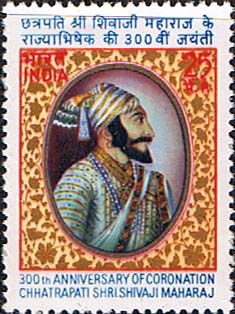
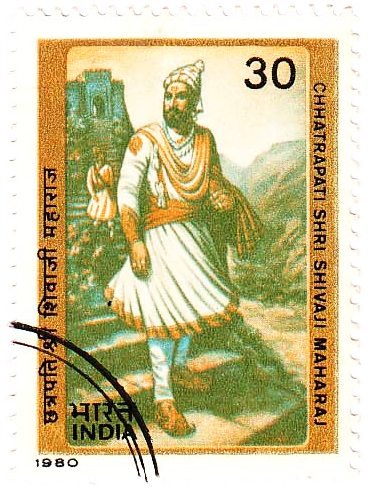
Shivaji, the greatest of the Hindu kings in the Moghul period, was a great devotee of Saint Samartha Ramadas and Saint Tukaram. Very often he attended the Bhajan sessions and discourses of saint Tukaram. Moghuls who were after Shivaji tried to attack him wherever it was possible. Once they came to know that Shivaji was attending a discourse of Saint Tukaram. They surrounded the hall where the saint was lecturing. The saint also knew by Jnan Dhrsti (through the eye of wisdom) that the Muslim soldiers were waiting outside to kill Shivaji. Saints can do many things simultaneously. He prayed to god to distract the soldiers. Immediately god came in the guise of Shivaji and jumped on the horse like Shivaji and sped towards the jungle. Seeing that fanatical soldiers followed the horse and were led into the thick jungle. They lost their way and god disappeared! When Shivaji was about to leave he came to know what happened in that area through his spies. He thanked the saint and the god.

When you are in Gods service it is his duty to give you security.

rama young

2.Bhadrachalam Ramadasa

Following was posted by me last year:

“Hindu saint jailed for 12 years”, posted on April 8, 2014

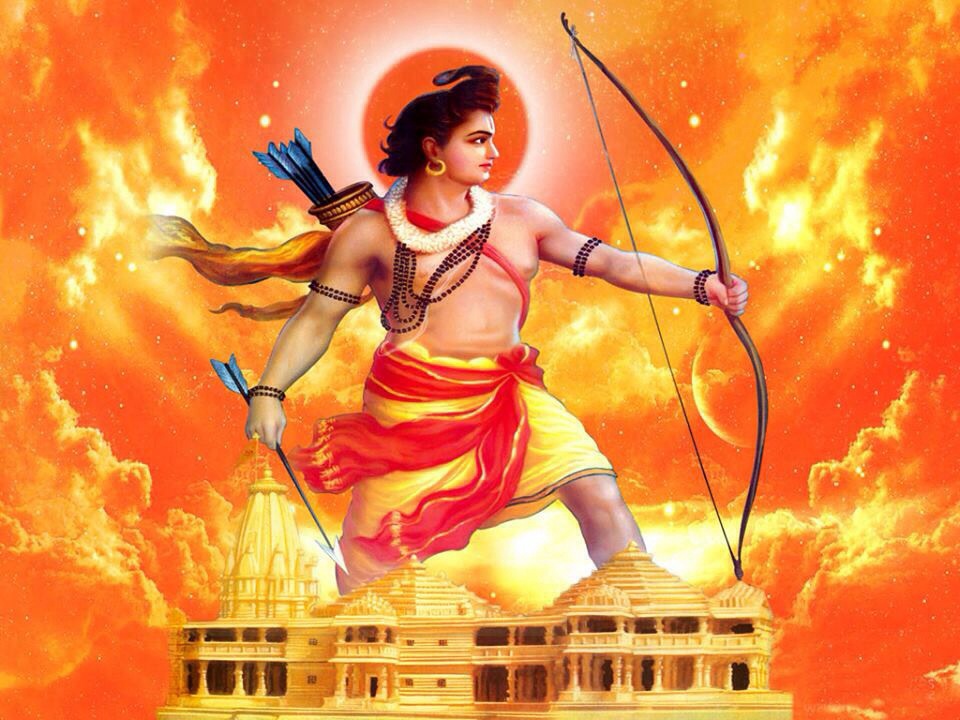
Bhadrachalam Ramadasa built a temple for Lord Rama with the tax money due to the king Tani Shah. Though Ramadasa’s intention was good, he violated the law of the land. God never asks anyone to go out of the way to propitiate him. He says in the Bhagavad Gita that even leaves or flowers or water is enough for him to bless a devotee. Ramadasa was jailed for 12 years. But yet lord Rama answered Ramadasa’s intense prayers after twelve years! He and Lakshmana dressed as guards of a revenue officer went to the king and paid the big amount that was due. Both of them asked the king to release Ramadasa and disappeared. When Ramadasa came to know about it he told the king that he did not send anyone with the money. Tani Shah was happy that he had the darshan of Lord Rama. Those were the days when Hindus and Muslims lived supporting one another. Tani Sha’s ministers were Brahmins.

Ramadasa was very sad that Lord Rama and Lakshmana appeared before the Muslim king but did not give ‘Darshan’ to him. He sang in Telugu naming the Muslim king Tani shah in one of his compositions. Later he also had ‘darshan’ of Lord Rama.

3.Story Told by Swami Ramdas

There was a soldier in the service of a State. He was put on duty as guard at night. One night, when he was as usual on duty as a sentry, he saw at a distance devotees going in a procession singing God’s name. At this the soldier was overcome with devotional fervour. He ran giving up his duty, and joined the Kirtan party and started singing God’s name in their company. The whole night was spent in the Kirtan and the soldier returned to duty only in the morning. Soon after, he was ordered to appear before the commanding officer to answer the charge of absence from duty the previous night. The soldier explained what had happened. Though the charge was a serious one, he was let off with a warning.

The following night also he was on duty and again the same Kirtan party was seen passing nearby. The soldier could not resist joining the Kirtan party again. The next morning he returned to duty. He thought it would be better for him to report it to the officer before he called him. But the commanding officer could not understand what the soldier was saying. He said, “Why do you say you were absent from duty? Thinking that last night also you would absent yourself from duty and join the street singers, I myself came at midnight to the security post to check if you were there. And I saw you there on duty. So where is the question of absence?”

At this the soldier was stunned. He could guess how God was so gracious to him as to stand sentry, assuming his form, so as to save him from punishment. This incident completely changed his vision and life. He renounced everything and dedicated his life entirely to God.

rama,hampi_2445924g

Rama, recently discovered in Hampi, Karnataka

4.British Collector who saw Lord Rama

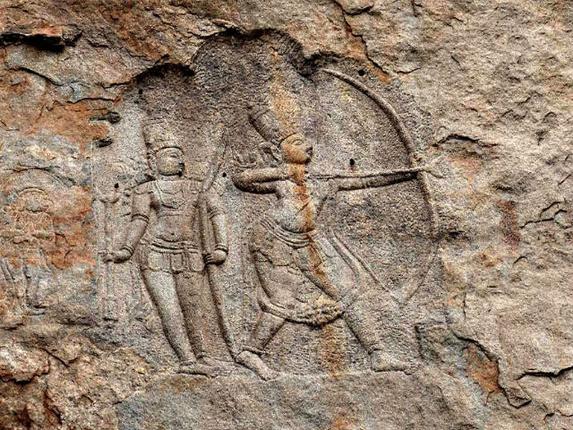
During the British rule, Colonel Lionel Blaze was the collector of Chengalpattu District near Chennai. Madurantakam, a nearby town has a huge lake. Every year the monsoon rains filled the lake and many a time it overflew or its banks breached. During his collectorship between 1795 and 1799, Col. Blaze camped there to oversee the repairing of the banks. When he saw big granite pillars in the famous ancient Rama temple he told that it could be used for strengthening the banks of the lake. The priests objected to the proposal saying that Rama would protect the town. But the collector insisted that if God could protect the lake why it breached several times. But he wanted to wait and see what happens in the next few days’ rain. The lake was full to the brim. Worried collector was supervising the banks at the dead of night. Suddenly he saw a flash of light and there stood two people with bow and arrow walking on the banks of the lake. The rain also stopped and nothing untoward happened. The collector knew that it was Lord Rama and his brother Lakshmana who were guarding the lake. He had seen those pictures in the local temple. Collector Blaze’s name is in the inscription in the temple and the temple was renamed as Eri Kaatha Ramar in Tamil meaning ‘Rama who saved the Lake’ temple. It is on record that Col. Blaze along with Robert Clive had donated jewellery to the temples in that area including Kancheepuram.
Photos are used from news papers and face book friends;thanks

Reward for beating Guru!

Samarth-Ramdas-Shivaji-Maharaj

Post No 1942

Date: 19 June 2015

Compiled by London swaminathan

Uploaded from London at 10-36 am

Samarth Ramdas was once going with his disciples to meet Shivaji. On the way they rested under a big tree. The disciples feeling hungry, entered the sugar cane fields nearby without the owner’s permission, cut some sugarcanes which they brought for their Guru. Hearing about the trespass and not knowing who the saint was, the landlord came there and in a fit of anger, took hold of a sugarcane and thrashed the Guru and his disciples, who took the blows coolly and proceeded on their way. Reaching Sivaji’s palace, they did not mention this incident to anyone.

When Samarth Ramdas was given a bath by Shivaji, he saw red stripes on saint’s back and enquired of him about it. The saint brushed aside the topic. But the royal disciple pursued his enquiry and learnt the truth from others. He sent for the owner of the sugarcane fields, who was soon brought before Shivaji and Samarth Ramdas when they were sitting together.

On seeing the landlord, the saint asked the king why he was ordered to come there. Shivaji replied that the wrong-doer who inflicted injury on the saint and his disciples must be punished.

Samarth Ramdas then said: “The owner of the sugar-cane field has done no wrong. He was quite right in belabouring us as he did. We had no right to enter his field and cut the canes without his permission as we did. So he must not be punished; nay, as compensation for his loss of sugar-cane, for the trouble of coming here and the anxiety caused by the fear of punishment, you must grant him a gift of five villages”. Thus he who expected punishment for beating the saint was not only forgiven but also given a rich reward.

saint-ramdas-shivaji

Saints always forgive! They are full of mercy!!

Wonderful Chariot Festival in London

Written by London swaminathan

Article No.1931

Date :14th June 2015

Time uploaded in London: 18-33

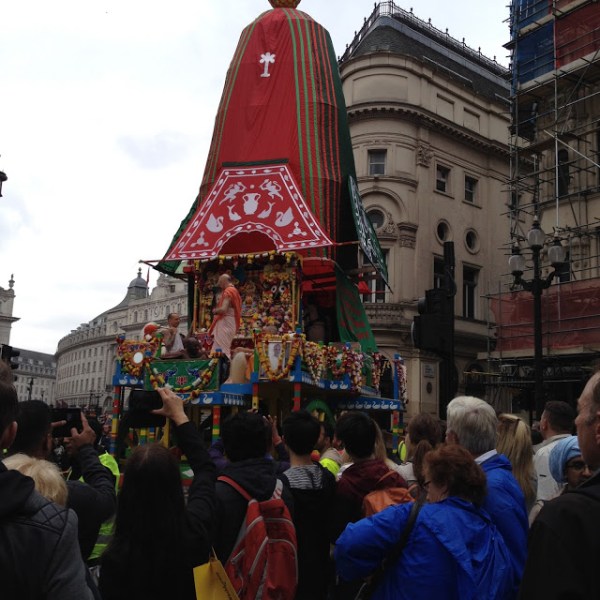
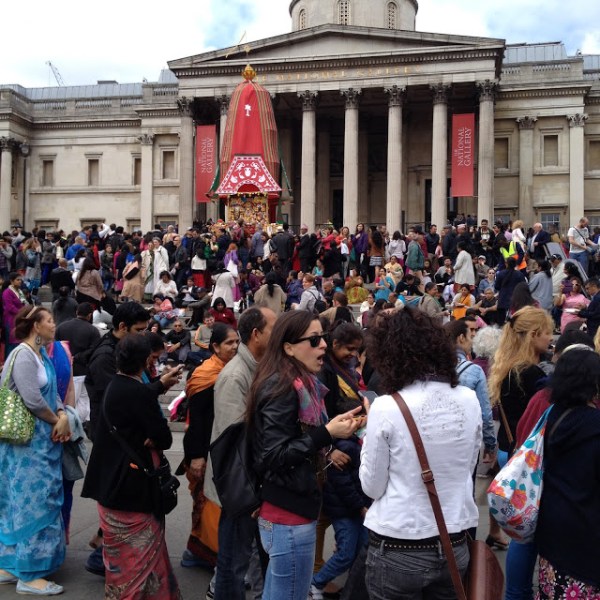
Hare Krishna movement (Iskcon) is organising Rath Yatra like Puri Jagannatha Ratha Yatra (chariot festival) in  big cities around the word. I have attended one such event 25 years ago in London. Today I went again to participate in the Chariot festival held in London. It was a marvellous event attended by thousands and thousands of people. There was a big difference between today’s Ratha Yatra and the one that happened 25 year ago.

Then there were not many people as devotees. Now it has grown and I could see followers themselves in thousands. And then there were people like me who support all Hindu causes in London.

Though Tamil Temples in London also condcut chariot festivals, nothing is comparable with Hare Krishna Ratha Yatra. The reason being this is done in the heart of London. Other festivals are not allowed to do it in the city centre.

Now to what happened today:

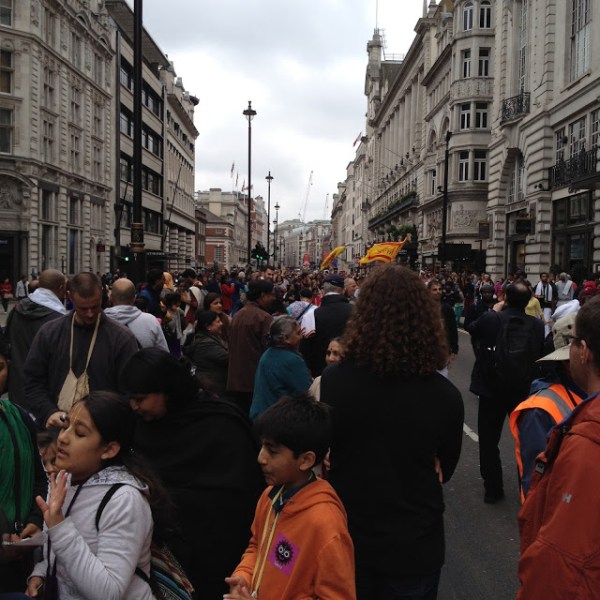
Thousands of people had stood in the Queue for free food and enjoyed the Prasad. When I go to teach at the University of London (SOAS), I used to watch students queuing up for Hare Krishna free food at lunch time. It was done once a week during term time. Students from all ethnic backgrounds stand there to get the food. But at today’s Central London chariot festival, tourists from 200 different countries also stood in the Q and enjoyed the food! A lot of Hindus and Hare Krishna devotees did a very good service. Food was served continuously from 12 noon to 5 pm.

Once I was invited to Buckingham Palace for lunch with the queen. Every year this garden party is organised by the palace and 1000 people are invited. Only thousand people will be invited. Though we had twenty different ice creams 20 types of drinks, 20 different cakes and twenty different main dishes, they fed only 1000 people. But ISKCON feeds thousands and thousands at their annual Rath Yatra. I haven’t seen anything like this in London.

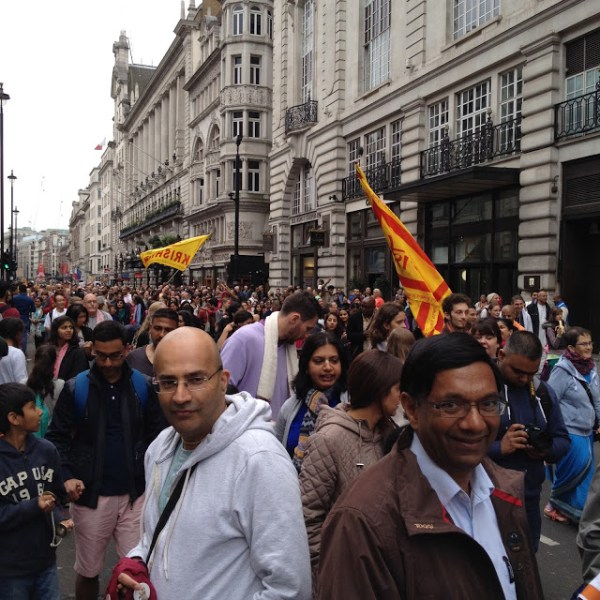
The whole atmosphere was surcharged with devotion. Tufted “white Brahmins” (foreign devotees) danced in the streets. One furlong long procession took half hour to cross each point. Several chanting groups attracted a big crowd around them. Since it covered important tourist spots of London such as Hyde Park, Piccadilly Circus, main Shopping Streets and Trafalgar Square, thousands of tourists watched it with wonder. Amazed by the sight, millions of cameras clicked for good pictures. Young children dressed as Krishna and Radha attracted more photographers. Each one vied others to take photos with them. Even the watching tourists repeated the holy chant Hare Krishna, Hare Rama.

Apart from blaring music, free food, lot of Bhagavad Gita copies were distributed. They never sell the books in public events but accept donations. One conspicuous thing is the absence of police. Normally I see police vans in the front and in the back of other processions. Here everything was done by the dedicated volunteers.

Though I don’t see eye to eye with their teachings their adherence to self-discipline of not using liquor, cigarettes, non- vegetarian food is appreciated by all the Hindus. In spite of these strict conditions they are able to attract more foreigners to the movement. They shave their head like Hindu priests and wear saffron clothes. Other family people in the movement wear just special tilaks.
Every Hindu must participate in such events to draw inspiration. It spreads positive vibrations. Most of the foreigners took their leaflets politely. Only few said no.  in India such events are common and it is easy to feel the atmosphere. But in Western Countries it is not that easy. I enjoy such events celebrated in the heart of London. I will wait for June 2016 Rath Yatra.

Dakshina Meru! 216 ft. Tall Brihadeeswarar Temple !!

Thanjavur_Big_Temple

Compiled by London swaminathan

Article No.1919; Dated 8 June 2015.

Uploaded at London time: 19-22

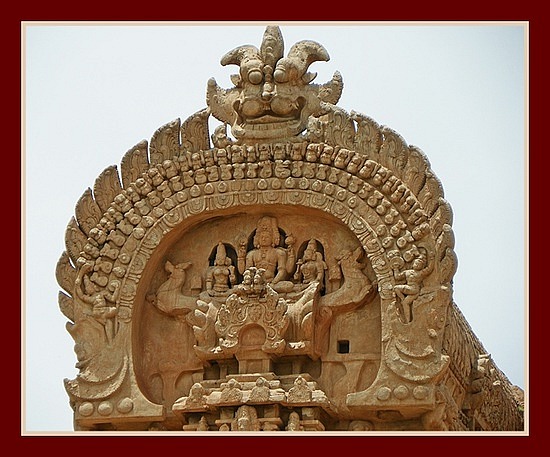
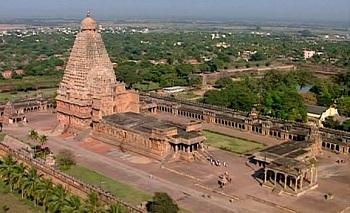
The Shiva temple in Thanjavur, Tamil Nadu (South India) is full of wonders. It was built 1000 years ago by Raja Raja (985-1014 CE), one of the great Choza kings.

The name of god in the temple is Brihadeeswarar meaning Great Lord or Lord of the World. Raja Raja rightly named it as Dakshina Meru—the Meru Mountain of the South. It is also known as Big Temple.

The Brihadeeswara temple represents the climax of south Indian temple architecture. The pyramidal tower that rises above have 13 storeys that steadily diminish in size. The temple is built entirely with granite blocks, laid one upon another without any mortar!  The temple stands in the middle of a vast rectangular walled courtyard lined by colonnades accommodating smaller shrines.

Rajaraja_mural-2

Painting of Raja Raja and his spiritual Guru Karuvur Thevar

There are five wonders in the temple:

a)The tall tower

b)The colossal Shiva Lingam which is 13 foot tall  (Lingam means formless shape)

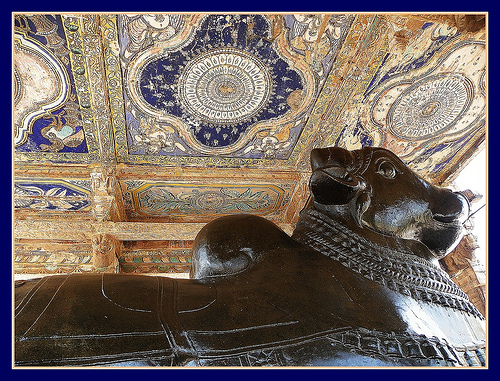
c)Colossal Bull (Nandi, Shiva’s Vehicle) 12 feet  tall

d)Top most stone weighing over 80 tonnes

e)Thousand year old paintings

Scholars have speculated about how the blocks were lifted to the upper storeys of the sanctuary tower. Some 9 miles North West of Thanjavur is a village called Sarapallam. Here they began a ramp supported on bamboo scaffolding that led to the summit of the sanctuary tower. Another theory postulates a spiral earthen ramp winding upwards around the tower, along which blocks were hauled.

The plaster work that ornaments the granite tower elements was added in 18th-19th centuries under the Maratha rule. Nayaks of the 17th century added the outer wall, Subrahmanya shrine, goddess shrine and some mandapas. But the greatest achievement rests with Raja Raja and his master architect.

lord-shiva-linga-

Colossal Shiva Linga

The sculptures of men guarding the door to the main sanctum – the Dwarapalakas  – demonstrate the Choza sculptor’s versatility in creating masterpieces regardless of size. To emphasize their scale, the sculptor has used an innovative imagery, a serpent swallowing an elephant. The serpent, which then must have been of monstrous proportions, is curled around the mace of the Dwarapalaka/gatekeeper, like a small worm. For all this incredible size, the guardian is holding his hand in Vismaya Mudra, which suggests that still he is not the tallest amongst all that is within the temple. The sculpture is 12 feet high, but he indicates that the taller being was the deity in the sanctum of the temple!

There are some beautiful paintings from the Choza period.

Names of some of the dancers, found in inscriptions, who lived around the temple 1000 years ago: Cheran Mangai, Chozakula Sundari, Thillai Azaki, Ravikula Manikkam, Thennan Mahadevi, Thilaka Chudar, Aaraa Amuthu, Kamakoti, Mazalai Silambu, Chithira Valli, Sundara Chozi, Uttama Sundari, Kunjara Malli

top

Top of the temple

Factfile

1)Height of the Tower – 216 feet tall

2)Unique feature – unlike other temples, tower is just over the sanctum sanctorum

3)Over 85 inscriptions starting from Raja Raja period are in the temple

4)Inscriptions give us the names of 600 staff with their salary details!

5)Four hundred of them are dancers! We have all the 400 names!

6)Over 50 singers were employed by the temple

7)Sanctuary tower 25 m sq. 60 m hig

nandi2

8)Hemispherical roof 7 m diameter, 7 m high

9)Walled courtyard 241X 121 m

10)Materials – dry stone masonry of granite blocks

11)Decoration – carved granite covered with polychrome plaster work

12)Plinth of the central shrine – 45-72 sq.mts

13)Shikara – the top most circular stone weighs 81-284 tonnes!

14)Shivalinga – 4 mtrs high and 4-5 mts diameter (13 feet tall)

15)The Nandi/Bull is 3-66 mts tall (12 feet high), weight 12 tonnes!

Big_Temple-Lingam_Painting

Big temple paintings

16)Total volume of masonry work – 49000 m3

17)No mortar was used in the construction!

18)Sculptors – Kunjaramallan and Raja Raja Perunthchan

19)Spiritual force behind the temple – A saint by name Karuvur Thevar

20)Family inspiration for the temple – Kundavai, Raja Raja’s sister

21)Military force behind the Temple – Chief Commander Krishnan Raman

22)Renovations – 17th and 19th centuries.

birdseye view

Source:

The Seventy Architectural Wonders of Our World

Thanjavur – A Cultural History by Pradeep Charavarthy with phtos by Vikram sathynathan

Thanjavur Inscriptions by Dr R Nagasamy

Tamil Nadu, Madura welcome

Sanskrit and Tamil Words in Cambodian Language

RIMG2835

Compiled by London swaminathan

Article No.1906; Dated 2 June 2015.

Uploaded at London time: 20-39

(All photos are taken by Mr K Natarajan,Sydney,Australia. Thanks for allowing us to use the pictures).

I read two interesting books written by Judith M Jacob who worked Senior Lecturer in Cambodian at SOAS, University of London. The titles of the books are 1)The Traditional Literature of Cambodia and 2) Cambodian Linguistics, Literature and History. I a summarising only the interesting points.

Cambodians or Khmers are a race of people occupying the Mekong (Ma Ganga) River basin what was known as Indo-China but now is South East Asia. The racial and linguistic family to which the Cambodians belong is known as the Mon-Khmer family. Indians came from the second century CE to trade and later to settle on the west coast of Indo China.

RIMG2480 - Copy

Funan= Panavan=Punal: Tamil Connection

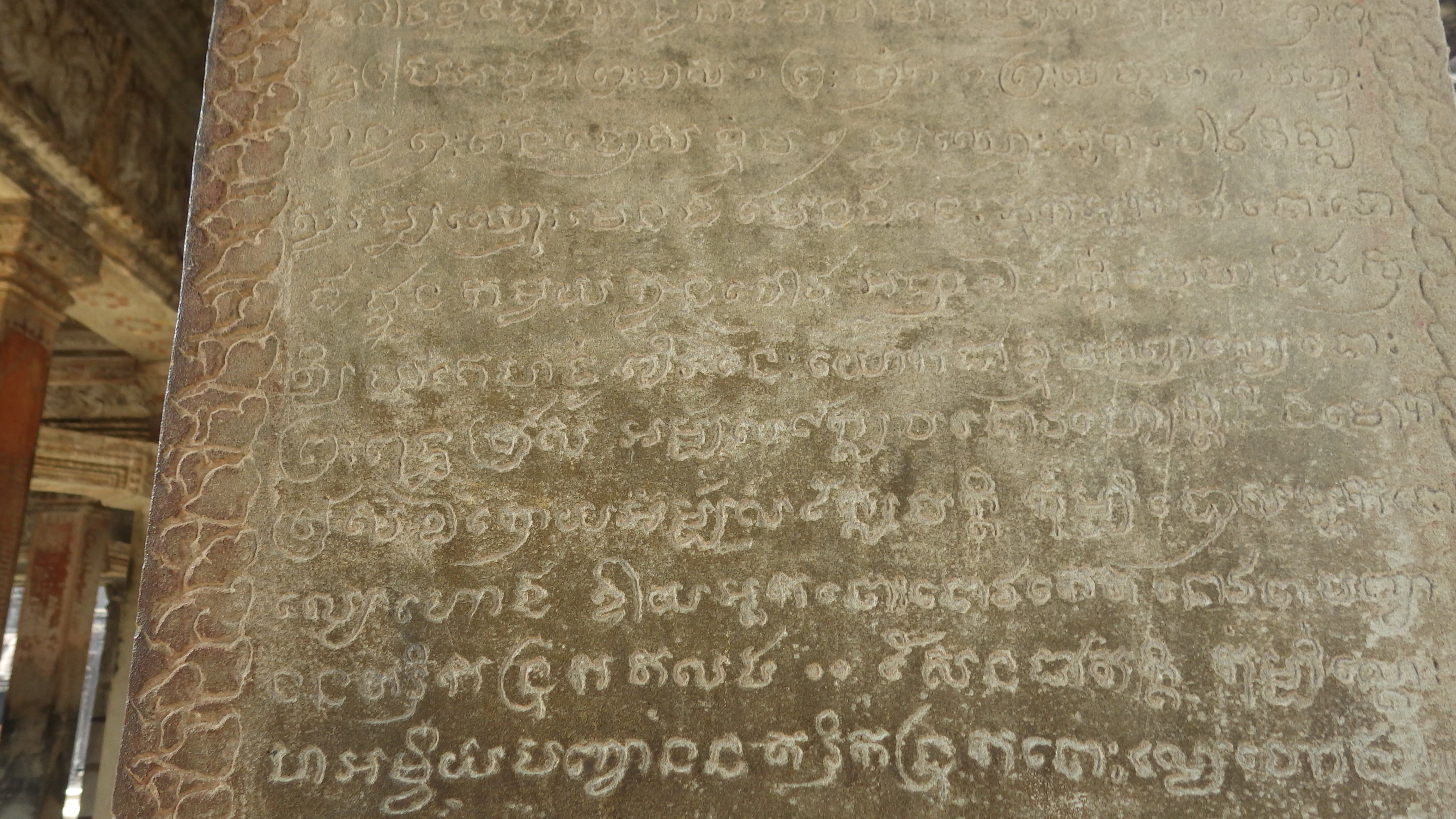
1)The first Khmer texts, inscriptions of the 7th and 8th centuries CE gave practical information about religious foundations while Sanskrit was used for composing the panegyrics of Gods and kings. Khmers regarded Sanskrit as the language of literature.

2)From the Chinese annals we learn that there was an indianized state called Funan in south of Cambodia.

(My comments: The word Funan may mean Panavan (Pandya title) or Punal Nadu (water country in Tamil). The reason for my conclusion is the first king of Vietnam (Champa) was Sri Maran, a Pandya king (Tiru maran in Sangam literature)

3)The Indian connection is reflected in the legend which tells how an Indian, the  Brahmin Kaundinya, came to Cambodia and married Soma, the daughter of the king of the Nagas.

(My comments: Tamil and Sanskrit literature describe all lands lying beyond east of India or South of India as Nagalokam. If it is further away from South East Asia they called those lands Patala Lokam (Under world).

RIMG2534 - Copy

Reason for the name Kamboja/Cambodia

4)Another legend relates that the hermit Kambu Swayambuva married the heavenly nymph Mera, a gift of the god Siva. This gave them the name Kambojas for the people.

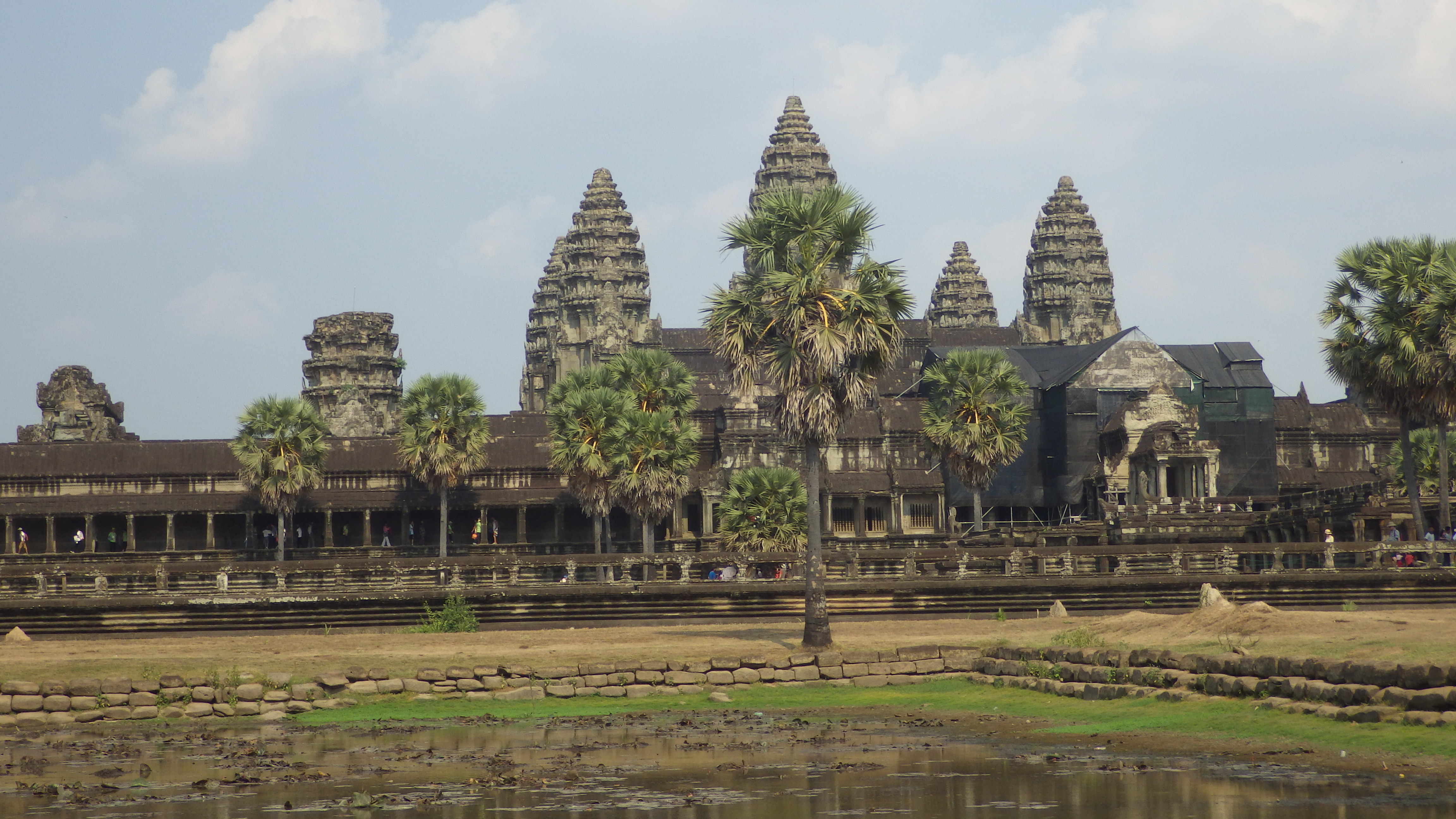
5)Finally at the end of ninth century CE there was the beginning of the Angkor kingdom which built the world famous monuments including Angkorwat. The earliest dated inscriptions are 611 CE (Khmer) and 613 (Sanskrit) but there were earlier dated Sanskrit inscriptions in Champa/Vietnam

6)We know the names of six poets who wrote in Sanskrit during Angkor period. Indian epics were read even before this period.

RIMG2587

New Ramayana

7)The Ramakerti (16th century CE) presents Ram as the Buddha, but lot of Hindu gods are referred to. Like Indians, Cambodians also worshiped the spirits inhabiting the rocks and trees.

8)Apart from writing on stone, the Khmers wrote on palm leaf. The Latania palm leaves were first treated to make them supple. An iron stylus was used to engrave the writing. The oldest manuscripts were preserved at a monastery in Battambang.

9) The Khmers have lively interest in the use of words. They were praised fr their riddles.  The hero of the folk tales and riddles was Thmenh Chey (Sanskrit name Dhananjaya). He was like the great Tenali Rama, court jester of Vijayanagara emperor Krishna Deva raya. Dhanajaya saves Cambodia from the Chinese by answering all the three riddles sent by king of China. There are hundreds of stories about Dhanamjaya.

The names in Ramakerti are Rab for Ravana, Laks for Lakshmana, Hemavant for the Himalayas. The end of Ramayana is changed in this work. Ram asked Lakshmana to execute Sita in the forest. When Lava and kusa went to Rama’s court one was arrested and released later. Sita was asked to go to Ayodhya. She refused and went to the underworld when falsely told that Rama was dead!!!)

RIMG2822

Khmer Dictionary

10)The Khmer lexicon includes a large body of fully integrated loan words, principally from Sanskrit and Pali languages of India.

First period covers Pre Angkor and Angkor periods (7th to 14th centuries CE): we find inscriptions on stone in Sanskrit and Pali.

Second period covers the Middle period (16th to 19th centuries CE): Inscriptions on stone are in Pali. Verse novels are in Sanskrit and Pali.

Early modern period covers 19th and early 20th century: Prose and poetry are in Sanskrit, Palai, French , Thai and English.

11.In the inscriptions the first part and the last parts are in Sanskrit. First par contains prayer to Hindu gods. Last part contains warnings of punishment to marauders. All types of hells are mentioned for those who destry the inscriptions or the properties.

RIMG2853

Sanskrit Names

12.The educated elite of Cambodia read and wrote Sanskrit. It became the practice of to use Sanskrit for all elevated linguistic activities. Names of dancers, singers, musicians and officials were in Sanskrit. Few examples: Vasantamallika/Spring jasmine, Tanvangi/Slender limbed,Sakhipriya/Beloved lady friend , officer Dharmaraksa/Protector of the Law.

  1. Like Dhananjaya, Vikram and Vetal type stories are also prevalent. Satra kin Kantrai is a collection of legal tales known also in Laos, Thailand and Burma. In each case the dispute cannot be solved by a mere judge and has to be referred to the king. His judgements are wise and fair. When two women claim to be the mother of a child, he settles the case very much as Solomon the wise did.

(My comments: These stories show that even the stories were borrowed from India and improved later. If we compare all the folk tales of Cambodia, it will be a very interesting comparative study.)

14.Indra figures as the helping god in many stories. This shows that the cultural contacts began at a very early date than the inscriptions show.

RIMG2493 - Copy

Tamil Names

15.Dhananjaya goes to China and he dupes even the emperor of China like Tenali Rama duped the Emperor of Vijayanagara. He says to the king that he has an Indri bird (Which is really a toy kite). The emperor heaps handsome presents upon him.  References to Thais and Vietnamese are noticeably lacking in the folk tales. But a proverb explains this

The monkey is constantly occupied with chewing

The Thais with their text books

The Vietnamese with their pretences

The pure Khmers with the truth.

  1. My comments: We already know that the script used in all the South East Asian countries went from South India. All the scripts are based on Pallava Grantha. Even the early architecture looked like Pallava cave temple where from it went to South America. Brahmin Kaundinya must have gone from Tamil Nadu. The famous Tamil Saint Tirunjana Sambandha also belonged to Kaundinya Gotra and we have a few Kaundinya Brahmins in the list of Tamil Sangam poets. In the folk tales we have typical Tamil name Kandhan as the captain of King Brahmadutt. Other names of interest in the stories are Kamaraj, Aruna Raj, Krishnakumar etc. Feminine Saskrit names like Chandra, Chitra, Padma etc are common to both parts of India.

17.The Pre Khmer inscriptions looked exactly similar to South Indian inscriptions; the order of the matter was

  1. a) The date or name of the reigning king
  2. b) The title and name of donors
  3. c) The name of the God

d)Names of the people from whom the donor obtained the land to offer to the religious foundation

e)Details of the price paid to those who relinquished the land

f)The extent, location and the capacity of the donated rice fields

g)The names of the slaves/workers donated with an indication of their duties

h)details of the subsistence to be given to the religious personnel

i)details of other lands given to the religious institution: orchards, gardens etc.

j)The list of the precious objects given to the foundation

k)the statement that the revenues are to be combined with those of another foundation

l)Warning of punishment for anyone using or abusing the belongings of the religious foundation.

RIMG2571 - Copy

More research will bring out more interesting connections.

Battle of Ten Kings in Vedic Times

Compiled by London swaminathan

Article No.1903; Dated 1 June 2015.

Uploaded at London time: 22-13

The first great war in Indian History is not the Mahabharata war. Nowhere in the ancient history we have wars where many kingdoms participated. As we know from Vyasa’s Mahabharata, over 29 kingdoms are named in the Mahabharata. They took part in the war directly or indirectly. This is unique in the world history. Whether we believe the traditional date, just before Kaliyuga, i.e. 3102 BCE, or the majority of the scholar’s date 1500 BCE, we have no parallel in the world history. But before the Mahabharata war, there was another great war where ten kingdoms participated. It is mentioned in the Vedas several times.

But the foreign translators couldn’t believe that Hindus had ten kingdoms during Vedic times and so they dubbed them as tribal chiefs!!! But immediately after the Vedic Samhitas we read about Asvamedha Yajnas conducted by emperors to win the neighbouring countires/kingdoms. The change couldn’t have happened overnight. So the fact of the matter is Dasa Rajna Yuddha (Ten Kings War) is really a war between ten kingdoms. The reason for this is that the 20 plus foreigners who translated the Vedas into European languages strongly believed that the world was created at 9 am on 23rd October 4004 BCE. All the foreigners who scrutinised the Rig Veda never said a single world about Semetic (Abrahamic ) religions.

All through their translations they translated the Rajna as tribal chief. But till this day the Raja is used only for kings from the Himalayas to the southernmost point of Sri Lanka. Foreigners believed that Egyptians can have kings and big kingdoms from 3100 BCE, Sumerians can have several kingdoms in the Midlle East from 3100 BCE, Chinese can have kingdoms from 3000 BCE but stupid slaves, Hindus, couldn’t have kings until Buddha’s time, sixth century BCE!!!!!. According to them there was no king in India until Buddha’s time, not even in Indus Valley. Even Mayans can have kings in South America. But Indians couldn’t have kings! They have a reason to believe so because a person who was considered a scoundrel in England, Robert Clive, came with a handful of people and established an empire in India. If Indians were that stupid then there couldn’t be any king in ancient times! They believed Greece and Greek literature because they were not able to rule them. And so they commanded respect.

Had they been petty tribal chiefs the story would not have survived for this long period.

Now let us look at the details of the Ten Kings War.

The Dasarajna or the Battle of the Ten Kings, is an important historical event alluded to in various hymns of the Rig Veda.

Sudas was the king of Bharata Kingdom. He belonged to Trstu family. At first Visvamitra was their priest. He led him to victorious campaigns on the banks of Vipas and Sutudri. Later there was some misunderstanding and Vasistha was appointed as the priest and Visvamitra was sacked. Thereupon a long and bitter rivalry ensued between the two priests and, in revenge, Visvamitra led ten kings against the Bharata kingdom.

The ten kings were from the kingdoms of Puru, Yadu, Turvasa, Anu and Drhyu, Alina, Paktha, Bhalanas, Siva and Visvanin. In the bloody and decisive battle on the banks of River Parusni, the Bharats emerged victorious, utterly routing the ten kings. The kings of Anu and Druhyu kingdoms were drowned, while Purukutsa, King of the Puru Kingdom met his death.

There was another battle in which Sudas fought with Ajas, Sigrus and Yaksus who had united under King Bheda; but these new assailants also met the same fate and were defeated, being slaughtered on the River Jamuna.

By the time of this war, the Vedic Hindus covered a vast territory, from the banks of Jamuna to Iran in in the west. In modern terms it covers the North India ,Pakistan ,Afghanistan and Iran! The earliest part of the Rig Veda sings about Ganges. So the ten people can’t be tribal chiefs. When it comes to Chera, Choza and Pandyas of Tamil kingdoms we don’t dub them as tribal chiefs. There were umpteen tribals and chieftains, but yet these three were called kingdoms. In the same way all the ten names gave big dynasties in India. Even Morton Smith’ conservative estimate gives a long list of Yadava (Yadu) kings from 1800 BCE and Puru Kings from 1800 BCE. Even when he placed Krishna around 1000 BCE and Rama around 1060 BCE, other dates are pushed back; the earlier kings from 1800 BCE. If we believe in the traditional dates the Vedic kings must have ruled several thousand years before our time.

All the foreign authors wrote only piece meal histories. If we put all the twenty plus foreigners’ statements together we would know that they were just bluffing. No two clocks agree; no two foreigners agreed! They believed in only one thing, that all of us came from outside, that there was no king in India from Indus valley time! Even at the rate of five kings per century Indus valley alone should have at least 100 kings for 2000 years! As we know the world history now, each “territory” had one king. In the Middle East six or seven kings were ruling different territories at the same time. Indian tradition says there were 56 kingdoms. By the time Buddha 16 emperors were in India. They could not have jumped from heaven. There is a long tradition of kingship which is confirmed by the Sabhas and Samitees in the Rig Veda (corrupted as committee in English). In my earlier article on Sabhas and samitees I have explained they helped the kings to run the administration efficiently.

Migration from India after the Ten Kings War

All the names of these people were found in Iran, Afghanistan, Turkey, Albania, Greece and many more countries. They all migrated after the defeat at hands of Sudas. Shrikant talgeri gives the following list in his book  The Rig Veda- A Historical Analysis:–

Iranian:

Prthus or Parthavas (RV 7-83-1) Parthians

Parsus or Parsvas (7-83-1) Persians

Pakthas (7-18-7) Paktoons

Bhalanas (7-18-7) Baluchis

Sivas (7-18-7) Kivas

Visanins  (7-18-7) Pisachas/Dards

Simyus (718-5) Sarmatians(ancient Albanians)

Alinas (7-18-7) Alans /Hellennes/ Ancient Greeks

Bhrgus (7-18-6) Phyrgians

In Tamil, the people of Pandya country are called Pandyas and Choza country as Chozas. In the same way these people were called after the country of their origin. For instance Brahmins who migrated from Saraswati River are called Sarasvats even today. Brahmins from Telugu Desa are called Dhillons, Dravida desas are called Dravids, Brahmins from Pandya desa are called Pandyas (in Gujarat), Choza Desa are called Chozias. These are few examples to show that they are the names of territories but not tribal names.

Views of Indian Scholars on Translations of the Vedas

vedavyasa2

Compiled by London swaminathan

Article No.1901; Dated 31 May 2015.

Uploaded at London time: 18-18

“The Rigveda is not only the oldest and hoariest religious text of the oldest living religion in the world today- Hinduism, but also the most authentic record of the Vedic Hindus.

The entire text was kept alive over a long period, almost without change of a tone or a syllable, in oral form recited and memorised from generation to generation. A text which is alive in this manner, as part of a living tradition, cannot be analysed without reference to what that tradition has to say about it”.

About twenty foreign scholars tried their hands on translating the Vedas into European languages from Sanskrit. All of them failed miserably. Indian scholars are able to identify the blunders in foreign translations. Since the foreign “scholars” were not sons of the soil, they could not understand the culture. They came with a motive to undermine the country and Hindu religion. And they believed that the world was created at 9 am on 23rd October 4004 BCE!!!

To understand the foreign psyche, one must read the estimate of Indian scholars:

P Subrahmanya Aiyer, Sanskrit Curator, King’s Library, Bangkok, Siam (Thailand)

Today when the Vedic literature, though venerable as ever, has ceased to offer solace and inspiration to suffering millions, ignorant as they are of its language; when the western scholarship alone – all honour be to them – have taken the trouble of explaining our religious scriptures , imperfectly of course owing to their lack of faith in it , and still more because of their defiance for such accredited scholars as the great Sayana and others; when the weight of controversial religious literature and meaningless babbling for reforms embarrass every sensible man , your translations of a  religious literature which needs no expatiation upon it, marks, I swear with truth, a red letter day in our national history.

(Sent on the occasion of publication Vidhyanandatirtha Maharishi’s Translation of Rig Veda into Tamil, Year 1937).

Following extract is taken from The Rigveda- A Historical Analysis by Shrikant G.Talageri :–

About B K Gosh: The first Mandala falls naturally into two parts: the first fifty hymns have the Kanvas as authors like the eighth Mandala……

Actual fact: 1-1-12, 24-30 (nineteen hymns) are by Viswamitras

1-31-35 (five hymns) are by Angirases

1-12-23, 36-50 (26 hymns ) are by Kanvas

About D D Kosambi: The principal Vedic God is Agni, the god of fire; more hymns are dedicated to him than to any other. Next in importance comes Indra”

Actual fact: The ratio between number of hymns and verses to the two gods, by any count is Indra: Agni=3:2

About Maurice Bloomfield: Under the title “Untrustworthiness of Anukramani statements shown by the repetitions”, Bloomsfield remarks that the statements of sarvanukramani….. betray the dubiousness of their authority in no particular more than in relation to the repetitions………………….

However, the repetitions do not disprove the authenticity of the Anukramanis. The repetitions in the Rigveda are representative of a regular phenomenon in classical and liturgical literature throughout the world.

About Rajesh Kochar: There is even an extreme lunatic fringe which would like to suggest that the Ganga and Yamuna of the Rig Veda are rivers in Afghanistan. A political ‘scholar’, Rajesh Kochar, as part of a concerted campaign to show that the events in the Ramayana took place in Afghanistan, transfers the entire locale of the epic to Afghanistan: Ravana’s Lanka can be a small island in the midst of River Indus…by Vindhyas is meant Baluch Hills, and by sea the Lower Indus. He does this under the cover of examining the geography of the Rig Veda.

mahati vedapatasala

About Griffith’s blunders

Jahnavi is another name of River Ganges. Griffith translates it as as Jahnu’s children (1-116-19) and the house of Jahnu (3-58-6)

The evidence, however, admits only one interpretation. It is River Ganga.

In RV 7-5-3, Griffith mistranslates the name of the River Asikni as dark hued people, thereby killing two birds with one stone: the people of Askini become the dark hued races, thereby wiping out the sense of direction inherent in the reference, while at the same time introducing the racial motif.

Griffith again mistranslates names of the tribes as “armed with broad axes” and the word “praca” as “forward”

(In my post “Conspiracy of Foreign Scholars”, posted on 18th April, 2015, I have given more details of T H Griffith’s mistranslation of the word Arya in Valmiki Ramayana)

Griffith in his foot note to RV 6-61-2, suggests that perhaps Sarasvati is also another name of Sindhu or the Indus.

Griffith, in his footnote to 10-75-5, takes pains to suggest that the poet addresses first, the most distant rivers.  Actual fact is the Eastern most river (Ganga) is the first river.

Bhagwan Sing in his book “ Vedic Harappans”

“No commentator or translator of the Rigveda can be relied upon blindfold; this is more so because both traditional and modern scholars have committed serious blunders in determining the socio- cultural milieu of the Rigveda which had a great bearing on the correct interpretation of a passage. Traditional commentators, working in an age when the social position of merchants had played a hegemonistic role. Western translators could not get reconciled to the fact that a civilization we meet in the disruptions of the Rigveda could have prospered at such an early period. They therefore started with  reductive interpretations—a mistake which was not rectified even after the discovery of Harappan civilization.

VEDAPARAYAN

Marxist View of Indian History

The trouble with some of the Marxist scholars was that they lifted abstract and absolutist theories from Marxist text books and thrust them on the Vedic society without attaching any importance to the specific character and exclusive features of that society. Before lifting extracts from Morgan and others it should have been seen how many tribal societies governed by chiefdoms had created and cared to preserve in bulk a literature approximating the level of the Rigveda or how many of them had cared to remember the poets of each of the compositions popular in their society, or how many of them living on predatory enterprise had evolved a moral code in which a theft, violence, aggressiveness, arrogance, dependence on unearned income, lying, immodesty in speech and behaviour including even the sins contemplated but not committed, are condemned in the most disparaging terms and propitiated by conscientious persons.

No doubt the Vedic language is terse and almost fossilised. But its terseness is more due to misconceived notions in regard to the cultural level of its authors. If Max Muller wanted to read “the first beginnings of our society” and “the earliest deposit of the Aryan speech” in it, he had on the one hand to treat it as a product of early childhood of our society which it is not, and on the other to eulogize it –“few understand children and still fewer understand antiquity” – and finally to hold that “large number of the Vedic hymns are childish in the extreme; tedious, low, commonplace” as well as “ dead letter to us”.

An overdose of poetry in history can ruin the charm of both. But we do agree with Max Muller when he says that, “No translation in any modern language can do them justice”, and adds that translation in a foreign tongue, and more so in metrical limitations, can compound the plight by new dimensions to inaccuracy.

But the Rigveda is neither a dead letter nor a living word one has to grapple with the text with the help of Sayana and modern translators, though both of them fall short of  our requirement as we have stated at the outset. We find even key words like Devata and Rsi to have been misinterpreted by scholars like Macdonell who had also translated the Brhatdevata in which the terms have been defined.

yajur veda

According to Saunaka, he who speaks in a dialogue is rsi of that verse. In other words Rsi is not necessarily the poet but the character, whether human or sub human or superhuman who is made to utter the dialogue.

Likewise Devata is not a divinity but the subject of the verse, and so it could be a deity, or an action, or an object, or even a vice. That is why we have such entities in the list of rsi names as Indra, Garuda, Vaisvanara, Sarama the dog, Vrsakapi, Indrani, Masa, marbles for gambling, Panis, Atma or soul, Jara or paramour, rivers, fish, Yama, Yami Saptarsi, Snake/sarpa, Sarparajni/chief  female snake, Soma etc. likewise we find in the list of Devatas such objects as Isu/arrow, Jya/bow string, Varma/armour, Grava/pressing stone, Ulukhala/mortar, Musala/pestle, Krsi/agriculture, Dhanu/bow, Asva/horse etc.

If Macdonell mistook them for divinities or gods, we can well understand the state of Vedic studies and the limitations of modern scholars. Likewise, we find in Griffith translating Samudra as ‘flood’ even in contexts where it clearly means ocean, ‘sena’ as host and bhisag as leech. We can imagine how misleading the translations may be, if we do not our selves read the original carefully.

In most of the studies, scholars ignore information which is inconvenient to them lest their thesis gets demolished. Sometimes they dismiss an entire development in one sentence without going into its merits.

So reconciliation of all the crucial points is the real challenge and there lies the key to correct conclusions.

–SUBAM—