Vedic Echo in Sumer and Egyptian Concept of Dreams

gilgalouvre

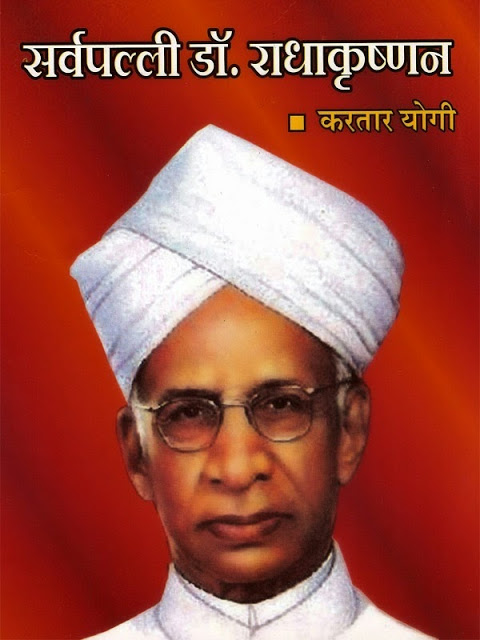
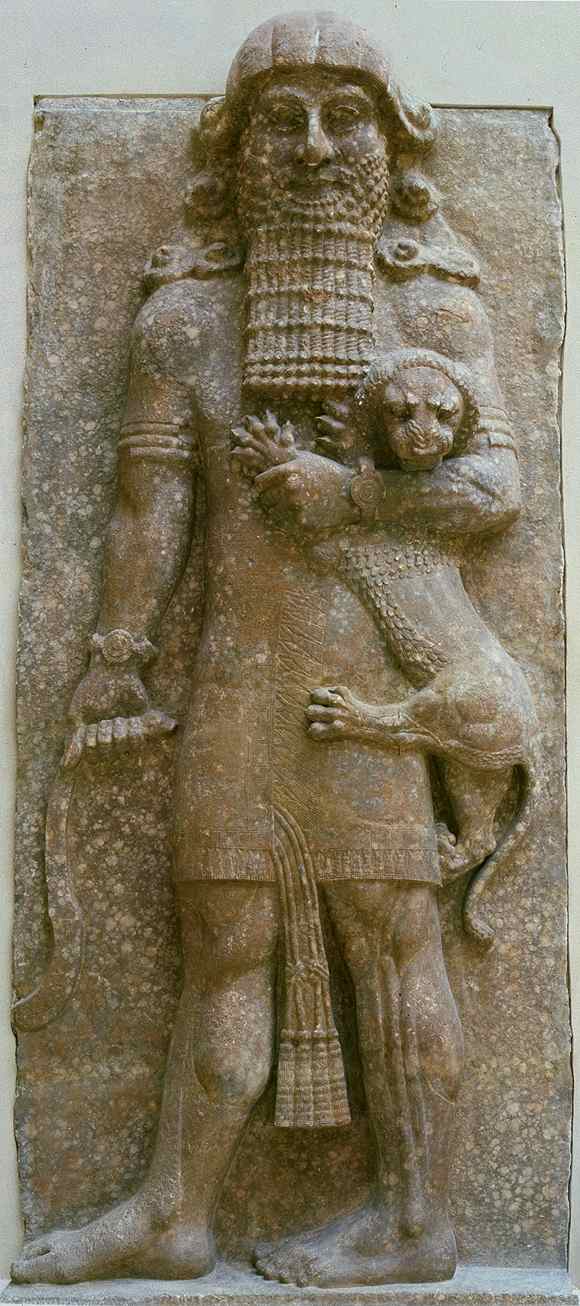
Statue of Gilgamesh of Sumer

Research Article No. 2031

Written by London swaminathan

Swami_48@yahoo.com

Date : 31 July 2015

Time uploaded in London : 8-29 am


Jungian psychologists believe that the symbols in myths, legends, religions and arts have their roots in the subconscious human psyche. Analytic psychologists interpret dreams on the basis of this belief. But ancients believed differently. Now I can conclude that neither Jung and Freud nor the ancients are cent percent correct.

Vedas interpreted dreams, particularly nightmares, differently. I have given it in my previous articles:–

My previous Research Articles on Dreams:

Role of Dreams in Tamil Saivite Literature (posted on July 4, 2013)

Do our Dreams have Meaning? (Posted on December 29, 2011)

God’s Note Book (posted on March 16, 2014)

STRANGE DREAMS, (POSTED ON 27TH JULY 2015)

“Inauspicious Dreams”: Dreams in Vedas and Upanishads (POSTED ON 28TH JULY 2015)

freud jung

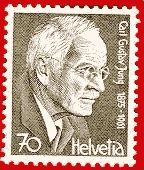
Stamps of Freud and Jung

Sumerian culture and Egyptian culture had similar beliefs. Probably they derived it from the same source. My belief is that they got it from the Vedas after the Vedic Hindus dispersed from the banks of Ganga, Sindhu and Saraswati. The reason for my conclusion is not just the dreams alone. Various fields show that they had contact with the Vedic Hindus or one branch of Vedic Hindus spread as far as Sumer, Egypt and Mayan lands in South and Central Americas (I have written several articles on these connections)

Interpretations of dreams is in the Vedas. That is the oldest reference. It is followed by Sumer and Egypt. We have separate books on the interpretations. Greeks have some books like the Hindus.

Five books of the Oneirocriticon by Artemidorous of Daldis (2nd century CE) interpret dreams. He divides the dreams as thereomantic (directly foretelling the future) and allegoric (requires interpreting or decoding). Hindu literature has both the kinds.
ramesses

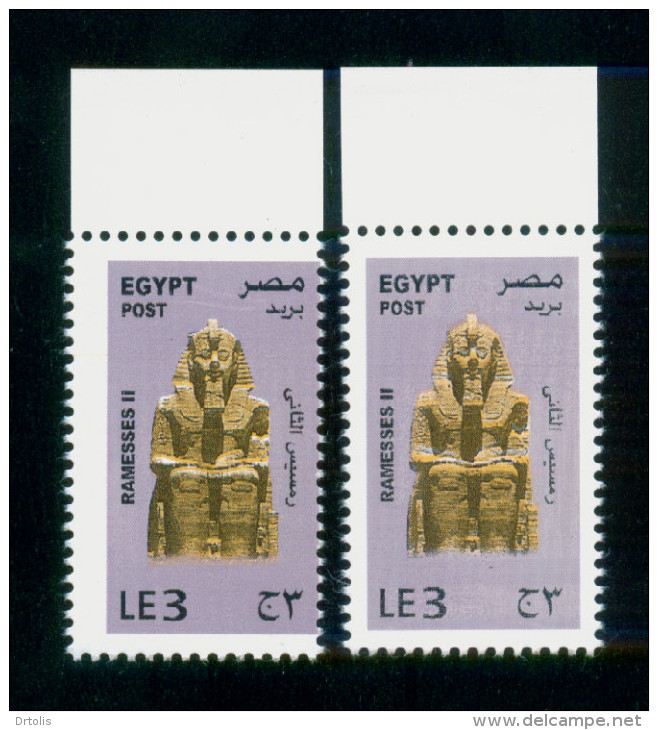
Stamps of ramesses of Egypt

Egyptian Dream Interpretation

The following dream directory is taken from the Chester Beatty III Papyrus, which dates from the Ramesses Period (1292- 1075 BCE):-

“If a man sees himself in a dream slaughtering an ox with his (own) hand, good; it means killing his adversary.

Eating crocodile flesh, good; it means acting as an official among his people.

Submerging in the river, good; it means purification of all evils

(This is a Hindu custom followed until today. Hindus submerge in millions on all auspicious days)

Burying an old man, good; it means flourishing.

Working stone in his house, good; fixing a man in his house.

Seeing his face in a mirror, bad; it means another wife.

Shod with white sandals, bad; it means roaming the earth.

Copulating with a woman, bad; it means mourning.

Being bitten by a dog, bad; it means he will be touched by magic.

His bed catching fire, bad; it means driving away his wife.

Dreams were considered as god’s messages. Egyptians thought that gods use dreams to contact his devotee. They slept in a temple to receive prophetic dreams.

Hindus, Buddhists and Jains believed that their women dreamt of auspicious things before prophets were born to them. Saivaite saints dreamt prophetic things when they slept inside the temple.

In ancient China, dreams were interpreted differently. They were thought as predictions of events opposed to their contents; death in a dream, for example, predicted longevity in the waking world.

In the Bible certain dreams were taken seriously, in accordance with the ancient Middle Eastern tradition that understands them as divine inspiration (e.g. the dream of Pharaoh, interpreted by Joseph in Genesis 41), but a dream can also be a mere fantasy of wish fulfilment (Psalm 73:20). Solomon received a message from god in a dream (1King 3:5).
gudea

Gudea of Sumer

In Sumer

According to texts from Mesopotamia, dreams were seen as channels for divine messages. “Gudea, ruler of the Sumerian city of Lagash,(Gudea=Gurudeva) describes god Ningirsu appeared to him in a dream and gave instructions for building a temple.

(This is a Hindu belief. Many of the famous temples were built after God instructing his or her devotee. Sumerian prefix NIN=sri, GIRISU= Gireesan=Lord Shiva)

People who fell asleep in the temples received divine messages according to Mari archive (Tamil Saivaite Saints had similar experience).

In the Epic of Gilgamesh, the hero receives a notice of the appearance of his companion Enkidu in series of dreams. In addition, dreams were seen as a method among the wider techniques of divination. Several dream omen lists survive, but it is possible that the foretelling the future through dreams became more important in Mesopotamia during the first millennium BCE.

Large fragments of a dream book were found in the library of Ashurbanipal at Nineveh. In this text, the associations that link the dream to the prediction are rarely understandable and cover all sorts of dreams; loosing teeth, receiving gifts, flying. Ashurbanipal himself explains how he had a dream in which the goddess Ishtar appeared to him and it is possible that he is the prince, described in another text, who had a dream revealing the underworld filled with demonic creatures. The Mesopotamian god Mamu was associated with dreams and had a temple at Imgur Enlil  (modern Balawat).

The interpretation of dreams found in the Vedas, Bible, Sumer and Egypt show that we had only one culture before Moses, Jesus and Mohammed appeared. That was Sanatan Dharma, what is now known as Hindu Dharma.
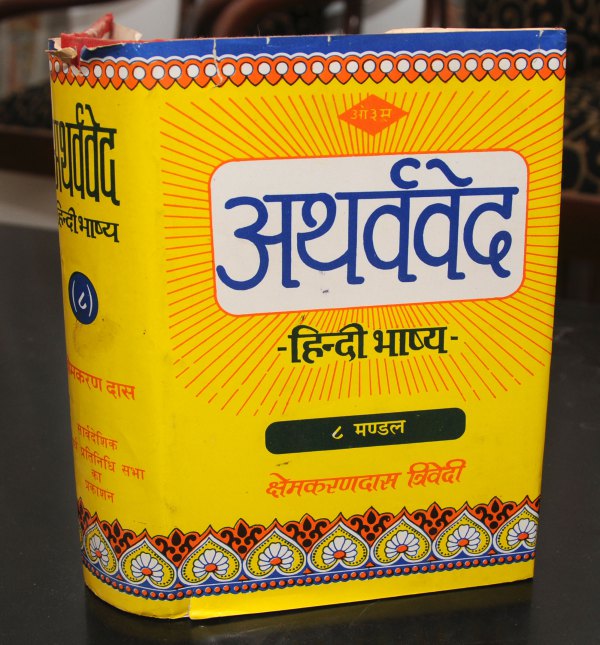
atharva-veda

Source:

Dictionary of the Ancient Near East by British Museum

Ancient Egypt by David.P.Silverman

Dictionary of Symbolism by TSP

TEN “INAUSPICIOUS DREAMS”; DREAMS IN VEDAS AND UPANISHADS!

Sleep-training

Research Article No.2025

Written by London swaminathan

Swami_48@yahoo.com

Date : 28  July 2014

Time uploaded in London : 16.19

Hindus stand out in understanding TIME, Working of MIND and Explaining DREAMS. Western scientists have not reached the level of Hindus In these fields. They still lag behind.

Dreams find a place in a Hindus’ everyday life. They knew about the REM sleep and the unavoidability of dreams. Brahmin Hindus pray to Sun thrice a day to kill the nightmares (Dus Swapna Nasanam). This shows how much they have understood about the dreams.

Adi Shankara, greatest philosopher of India, use dream hundreds of time in his hymns and commentaries. Mandukya Upanishad use it to explain the state of mind. Varahamihira, author of Brhat Samhita and several others before him dealt with the dreams. Hindus have several books interpreting dreams. Poets of Sangam Tamil literature even sing about the dreams of birds and animals. Tamil encyclopaedia Abidhana Chintamani has a summary of the interpretation of dreams over six pages. It is the summary of Sanskrit book on dreams attributed t Deva Guru Brhaspati. Like the dream of a dumb person is a popular simile used in Hindu literature.

FRANCE - CIRCA 2005: A stamp printed in France shows sleeping baby in a rose, circa 2005

FRANCE – CIRCA 2005: A stamp printed in France shows sleeping baby in a rose, circa 2005

Ten Bad Dreams in Vedic Literature

The meaning of dreams was an interesting part of Vedic literature. It is dealt with in various passages, including an Athrvan Parisista. The Rig Veda regards as ominous the making of a garland or neckband in a dream.

Ten dreams which presupposed death are recorded in Aitareya Aranyaka (3-2-4); they are

When a black man with black teeth kills you

When a boar kills you

When a wild cat springs on you

When one eats and spits out gold

When one drinks honey and eats lotus roots

When one goes to a village with asses or bears

When one drives south a black cow with a black calf

Wearing a garland of nard (Spikenard plant; Death of Jesus Christ is also associated with nard!)

If one has a dream one should wash one’s mouth.

Dreams in Rigveda:–2-28-10; 10-162-6; evil dreams – RV 2-28-10;

Atharvaveda :– 7-101-1; 10-3-6 (evil dreams)

Vajasaneyi Samhita :– 20-16

Satapata Brahmana:– 3-2-2-23

In classical Sanskrit literature we have several references to dreams.

Separate book on dream interpretation is attributed to Deva Guru Brhaspati.

Svapna is the Sanskrit word for dream. In Sanskrit hymn books there special slokas/hymns to avoid nightmares.

Sleeping-Beauty

Sleeping Beauty Stamp of USA

My previous Research Articles on Dreams:

Role of Dreams in Tamil Saivite Literature (posted on July 4, 2013)

Do our Dreams have Meaning? (Posted on December 29, 2011)

God’s Note Book (posted on March 16, 2014)

STRANGE DREAMS, POSTED ON 27TH JULY 2015.

Einstein’s Hindu Connection!

usa e=mc2

Article No.2017

Written by London swaminathan

Swami_48@yahoo.com

Date : 25  July 2014

Time uploaded in London : 6-48 am

Where did Einstein get this E= mc2 formula from? Did he get this concept after reading Hindu scriptures? We can’t say anything for sure. But there are two important clues.

Einstein was a Jew. Jews are Yadavas who migrated to Middle East during Rig Vedic days. Yadu became Juda. J=Y is linguistics. But it won’t give any clue to his discovery.

The concept of time in Hindu scripture is very different from the old Western concept. Hindu concept is very scientific. Hindu sages are called Tri Kala Jnanis= who can go beyond Past, Present and Future. Like we see TV serials and films on VCR by ‘Fast Forwarding’ and ‘Rewinding’ they saw TIME!

We are the one to tell the world first about Big Bang and Big Crunch/Shrink. We are the one to tell the world that time is different for Brahma in Celestial Worlds and Brahmins on earth. We are the one who spoke about very big numbers in astronomical terms where as other books were able to count 40 to 120. We are the one who told the world about Zero without which no scientific invention was possible. We are the one who taught the world to write numbers 1,2,3 etc. They were using complicated Roman script to write numbers until a few centuries ago.

india eistein

First clue

Einstein had several books about Hinduism in his library. One of them was ‘The Secret Doctrine’ published by the Theosophical Society. He has met Hindu scholars including Tagore. Does it say anything about what Einstein said? No. it might have helped him to think scientifically. For instance the Viswarupa Darsanam (Arjuna’s Vision of Universal Form of God) in Bhagavad Gita explains the cyclical nature of time. Even Black holes may be explained with that description. Everything is sucked into this Universal Form in an amazing speed. Arjuna was shown a parallel universe. And I am not the first one to see nuclear science in Bhagavad Gita. Even the Father of Atomic Bomb Robert Oppenheimer recited Gita sloka in great excitement when he witnessed the first atomic explosion (Please read my Atomic Bomb to Zoology in Bhagavad Gita article).

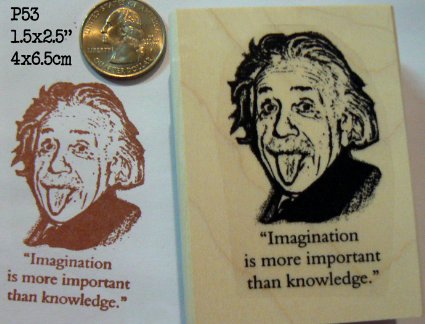
eistein quote

Second Clue

The following anecdote is found in a very old book of anecdotes:

This story is told of, and possibly by, Alfred Einstein, who was asked by his hostess at a social gathering to explain the theory of relativity. Said the great mathematician,

“Madam, I was once walking in the country on a hot day with a blind friend, and said that I would like a drink of milk.

“Milk? Said my friend, ‘Drink I know; but what is milk?

“’A white liquid’, I replied.” ‘Liquid I know; but what is white?’

“’The colour of swan’s feathers.’

“’Feathers I know; what is a swan?’

“’A bird with a crooked neck’

“’Neck I know; but what is this crooked?’

“Thereupon I lost patience. I seized his arm and straightened it. ‘That is straight’, I said; and then I bent it at the elbow. ‘That is crooked’.

“’ ‘Ah!’ said the blind man, ‘Now I know what you mean by milk!’”.

(Thesaurus of Anecdotes, page 198)

albert-ajnstajn-velika

This story is found in the Hindu ‘Katha Sarit Sagara’, which is the largest Story collection in the ancient world. All the seeds or plots of old stories such as Arabian Nights are found in it. If Einstein has said it, then he must have read several Hindu stories and scriptures. This might have given some new idea for his lateral thinking on TIME!

Brahmano Bhojana Priyah!

thalai vazai ilai

Article No.1976

Date: 5  July 2015

Written by London swaminathan

Uploaded from London at 17-48

Brahmano Bhojana Priyah! is a well-known saying. Lot of people interpreted as Brahmins are gluttonous. The reason being the Sanskrit dramas show the jesters, who are Brahmins, as gluttonous. Brahmins are given different roles from Vedic days: Priests, Ambassadors, Teachers, Ministers, Jesters, Commanders (Drona, Krpa, Aswattama, Parasurama etc.). Apart from this Brahmins are fed everywhere in the first batch. In those days they were not supposed to have food provisions for more than three days. They are made dependent on kings, lords, philanthropists and well-wishers. This gave the wrong impression.

There is funny way of interpreting this sayings as :Brahmana, Bho! Janapriya: meaning Hey Brahmin You are Dear (priya:) to people.

But the true meaning of the saying is

Vishnu Alankara priyah

Shiva Abhisheka Priyah

Suryo Namaskara Priyah

Devi Pradakshina Priyah

Brahmanah Bhojana Priyah

The meaning is

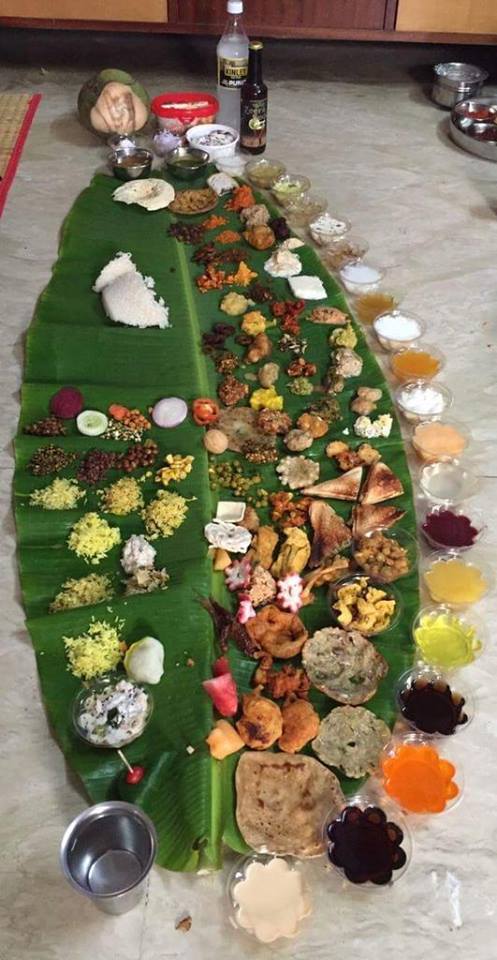
Idli Parade

You can easily satisfy Lord Vishnu by dressing his idol/statue beautifully and get whatever you ask for.

You can easily satisfy Lord Shiva by bathing his idol/statue with water, milk, honey, sandal paste, ash/Vibhuti etc., and get whatever you ask for.

You can easily satisfy Lord Surya/Sun by prostrating before the sun in the morning and get whatever you ask for (health wise).

You can easily satisfy Goddess (Devi) by going around her temple and get whatever you ask for.

You can easily satisfy Holy men (Brahmins) by feeding them well and get whatever you ask for (they will bless you with louder Vedic mantras surcharging the entire atmosphere with big and positive vibrations).

This is confirmed by another saying in Chanakya Neeti darpanam:

Tushyanti Bhojane Viprah (Brahmins feel happy and contented with the food)

Viewed in this context, we get a clearer picture about the Brahmins and Bhojana (food).

Who is not interested food? All of us go to parties and weddings expecting a big feast.

surya darsanam

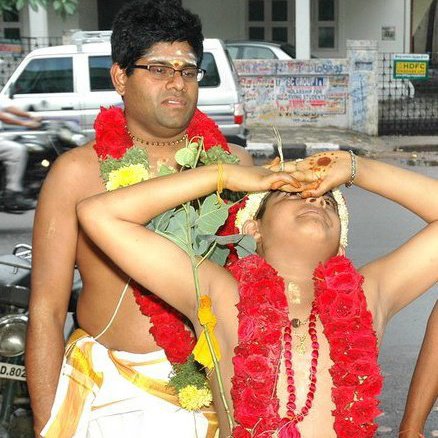
London priest Chandru Kurukkal with his son looking at the sun

Vitamain D and London Muslim Women!

In the first quotation the third line says

Suryo namaskara priyah

There is another famous saying

Arogyam Bhaskarath Ichet

Ask Sun for healthy life.

That is, the Hindus knew it for thousands of years that Sun Light is the energy boosting tonic. In the olden days every Hindu started his life with Surya Namaskar in the early morning. Now RSS is popularising it. Sun light gives us Vitamin D. We get very less sunlight in western countries. Recent studies have shown that lot of health problems can be avoided by giving Vitamin D tablets. The NHS (British National Health Service) has made it compulsory for all the pregnant women in the UK. The problem is more in East London hospitals where the Muslim women cover their whole body with purdah and veil and get less exposure to sun light. So doctors in the UK prescribe them Vitamin D tablets.

Brahmin boy is taught to look at the sun in the safest way!

Hinduism and Science

Vedic Mantras have become more relevant with the latest scientific studies about the necessity of Vitamin D.

Since Indians get lot of exposure to sun light they have taken it for granted. Now the West has realised the power of sun light. Hindus are right in worshipping sun every day in the morning with Surya Namaskar.

Looking at the sun every day around noon, a Brahmin recites this mantra:-

Pasyema saradhassatam

For a hundred autumns may we See (with foresight/prudence)

Jiivema saradhassatam

For a hundred autumns may we Live (healthily)

Nandhaama saradhassatam

For a hundred autumns may we Rejoice (with our friends and relatives)

Modhaama saradhassatam

For a hundred autumns may we be Happy (spread happiness)

Bhavaama saradhassatam

For a hundred autumns may we Be there (with name and fame)

Srunavaama saradhassatam

For a hundred autumns may we Hear (good things)

Prabravaama saradhassatam

For a hundred autumns may we Speak (good things)

Ajiitaasyaama saradhassatam

For a hundred autumns may we be Invincible

Jyok cha suuryam drse

Thus we want to see for a Long time.

This means you will live for hundred years without seeing an optician or a dentist or an audiologist or a psychiatrist or a doctor. All your faculties will remain intact till you die!

Pictures are from my face book friends;thanks

contact:  swami_48@yahoo.com

Oldest Bribery in the World! Rig Veda speaks of Bribes!!

bribery_2

Research paper No 1954

Written by London swaminathan

Date: 25 June 2015

Uploaded in London at 14-23

I wrote about the Vedic Dog Sarama and the story’s occurrence in various cultures in mutilated or corrupted forms. The hymn in the Rig Veda (10-108) is very interesting in various ways. Here we read about

1.Corruption

2.Inducement to change party loyalty

3.Ambassadorial role

4.Dog as human pet

5.Dog employed in detective work

All these show that the Vedic society is well advanced. Earlier I wrote about the Rig Vedic Sabha and Samitis, oldest democratic institutions in the world. All these are my observations.

Bribery01

Here is the Sarama hymn (RV.10-108):–

The hymn, as Griffith notes, “is a colloquy between Sarama, the messenger of the Gods or of Indra …… and the Panis or the envious demons who have carried off the cows or Rays of Light which Indra wishes to recover”.

But, according to Macdonell, the hymn is about “the capture by Indra of the cows of the Panis ….. (who) possess herds of cows which they keep hidden in a cave far beyond the Rasaa, a mythical river. Sarama, Indra’s messenger, tracks the cows and asks for them in Indra’s name, but is mocked by the Panis”.

Clearly there is a basic difference in the above descriptions of the myth, says Shrikant Talageri in his book—“The Rig Veda – A Historical Analysis”.

From Griffith’s translation (R V 10-108):–

“I come appointed messenger of Indra, seeking your ample stores of wealth, O Panis

This has preserved me from the fear of crossing; thus I have made my way over Rasaa’s waters (Sarama said this) 10-108-2

Wat is that Indra like, what is his aspect whose envoy, Sarama, from afar thou comest?

Let him approach, and we will show him friendship; he shall be made the herdsman of our cattle (Panis said this) 10-108-3

Even thus, O Sarama, hast thou come here by celestial might to make the journey

Turn thee not back, for thou shalt be our sister; O Blest One, we will give thee of the cattle (10-108-9)

bribe 2

My comments:


1.From the above three stanzas we come across the word MESSENGER/ENVOY.

This shows that the dogs have detective power to find the hidden cows and the hymn says the dog travelled long distances, even crossed a river. Nowadays we hear amazing animal stories where the dogs travel hundreds of miles to go back to their owners. Probably this is the oldest dog story. Dogs have powerful smelling – 3000 times more powerful than human beings.

2.The second point is that sending an animal as AMBASSADOR. We come across swan as a messenger in the Nala – Damyanti story and later great poet Kalidasa sings about Cloud Messenger in his poem Meghaduta. In the 2000 year old Sangam Tamil poetry and later devotional poetry we see lot of animal and bird messengers to their lovers or God. Probably Rig Veda has the oldest reference to such ambassadors (apostrophes to birds etc).

3.The third point is that Panis were ready to bribe Sarama with some cattle and ready to take her their sister. But Sarama rejected the bribe. Panis were the bad people in this episode.

Later Vedic literature Jaiminiya Brahmana (2-440/442) has a slightly different story, according to Talageri. Here, the cows and are clearly referred to as the cows of the Gods stolen by the Panis. This time, the Gods first send Suparna, the eagle or the Sun Bird. However the Panis BRIBE him into silence, and he accepts their gifts and returns without any information. The enraged Gods strangle him, and he vomits out the curds etc. received from the Panis.

Then the Gods send Sarama. She crosses the River Rasaa and approaches the Panis. She is also offered BRIBES, but (as in the Rig Veda), she refuses their bribes and returns to Indra with the information that the cows are hidden (DETECTIVE WORK) inside the Rasa. She and her descendants are then blessed by a grateful Indra.

bribe3

4.Dogs are grateful animals. Sarama stick to her loyalty in spite of temptations. Dogs are kept as pets from the Vedic days.

According to Talageri, the myth appears in Brhatdevata (8-24/36). Here the myth develops a curious twist. The same sequence of events take place, but this time Sarama accepts the bribe of the Panis, and apparently transfer her loyalty to them. When she returns to Indra and refuses to disclose the hideout of the cows, Indra kicks her in a rage she vomits out the milk she received as a BRIBE and then goes back trembling to the Panis (Ayaram, Gayaram stories in Indian political field).

We know that all these are symbolic stories of what is happening in Nature. But even if we accept it, the similes such as bribe etc used reflects the ways of life in Vedic days. But the good thing about the bribe is, it is offered by the bad people (Panis). Moreover good people reject it or get punishment for accepting it.

prison-cell-phone-bribery2

5.Two other notes won’t be out of context here:

Chanakya, the author of Arthashastra, says that like the fish that lives in water drinks water, the government officers take bribe!

There is a Tamil Proverb, “Wont the person who extracted honey (from the honeycomb) lick his fingers?”

So, taking bribes has been there from Vedic days, but it is condemned in the Vedas.

(Bribery pictures are used from various sites;thanks)

Plato used Hindu Microcosm and Macrocosm!

earth

Research paper No 1944

Written by London swaminathan

Date: 20th June 2015

Uploaded in London at 21-50

‘Yat Pinde tad Brahmaande’

It is a well-known fact that Alexander the Great developed great interest in Hindu ascetics because of his mentor Aristotle who was trained in Plato’s Academy. Plato and his Guru Socrates were interested in Hindu Upanishads. Vegetarianism, Rebirth, Upanishadic question and answer method (which the westerners named as Socratic Method later) and several other Hindu principles entered the Greek world through these people. Since Hindus migrated to Greece and other European countries long before Socrates and Pythagoras, we find lot of Sanskrit and Tamil words in Greek language (I have already given the list of Tamil words in Greek in my earlier post).

Vedic dog story (Sarama=Hermes), Five elements (Pancha Bhuta, Earth is Mother (Gaia = Atharva Veda—Mata Bhumi Putoham) and hundreds of things were borrowed by the Greeks from India. Max Muller also acknowledged it. But not many people know the concept of microcosm and macrocosm also went to Greece from India.

Tamils say that “Andaththil Ullathu Pindathilum Ullathu” = What is found in the Universe is in your Body.  Yat Pinde Tad Brahmaande is the Sanskrit saying. Sufi Muslims, who are 50 percent Hindus in their approach to spiritualism, also had similar principle.

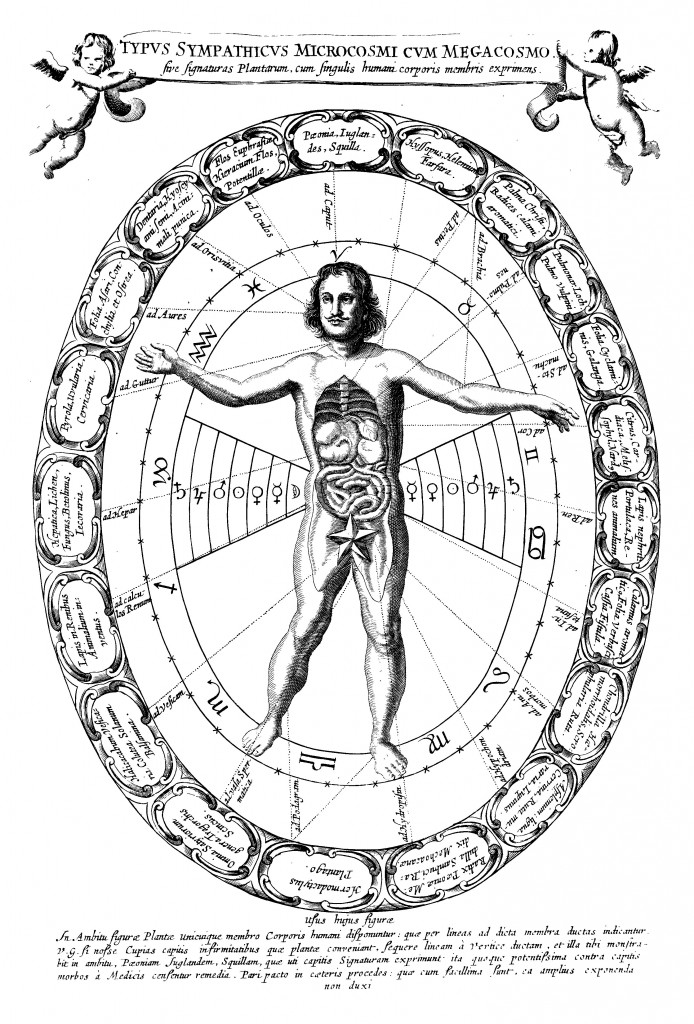
kircher_079-694x1024

Microcosm and Macrocosm

Microcosm means ‘little world’. Greeks applied it to man. They considered man as a world in miniature like the Hindus. Macrocosm means the earth or the whole universe.

Sanskrit scholar Radha Vallabh Tripathi, in his article ‘Vedic World View and Modern Science’, says,

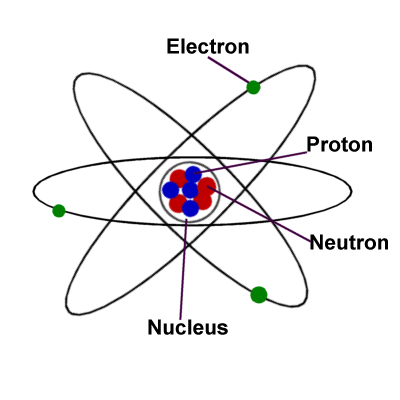
“The scientists who attempted to see the atom found a world within it that could not be described in ordinary language. They saw everything within the atom – the speed, energy, waves and matter all mixed. They found that if they could know the atom, they could know the whole truth of the cosmos. Yat pinde tad Brahmande  – that which is in microcosm is in the macrocosm – that is what the ancient seers of the Upanishads had said  — One is in all, All is in one. This is the essence of Quantum theory also. The entire universe is inter- connected, inter-related and inseparable. In the same way, connection between modern physics and Indian mysticism has also become inseparable.

The matter inside an atom cannot be said to be moving nor can it be said to be static. This is how the Upanishads describe the Ultimate reality. “It is neither gross, nor fine, neither short nor long, neither growing red like fire, nor fluid like water, neither shadow, nor darkness, neither air nor space, unattached, without taste, without smell,  without eyes, without ears, without voice, without mind,  without radiance, without breath, without mouth, without measure, having no within and no without. It eats nothing, nothing eats it (Brihad Aranyaka Upanishad III.8.8, translated by Dr S Radhakrishnan). This is the oldest of the Upanishads dated to 850 BCE.

It says

“It is full, this is full, from fullness, fullness proceeds. If we take away the fullness of fullness, even fullness then remains (ibid.V.2.1)

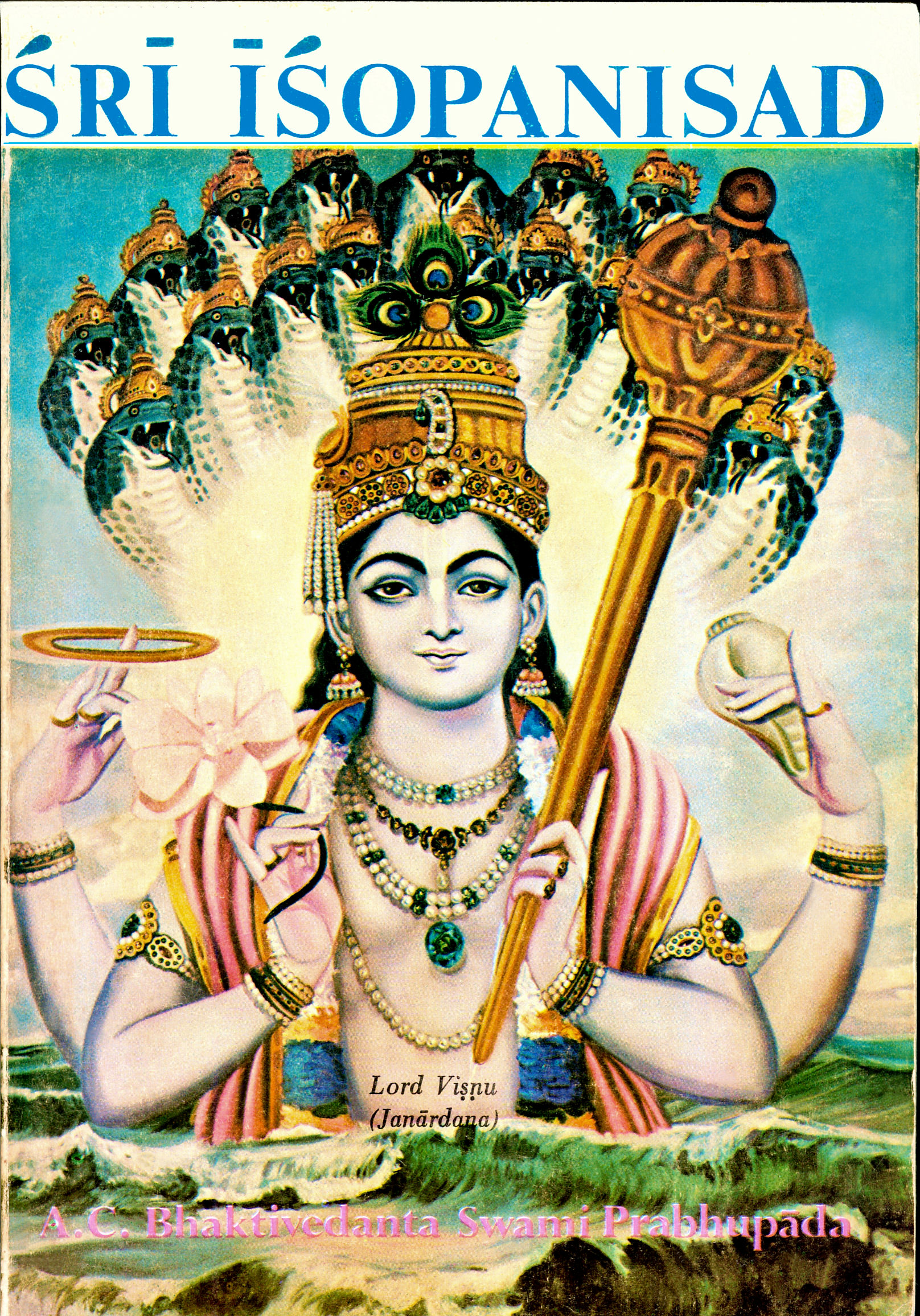
It is unmoving; it is one and it is faster than mind. (Isopanishad)”.

The more we understand science the better we understand our Vedas. Light is the fastest thing in the universe according to physics. But Hindus believe that Mind is faster than anything else. Mind can travel to a star 500 million light years away in a fraction of a second. The power of thought is not fully understood by the western scientists yet.

Global human chain

Chandogya Upanishads:

1.   Om. There is in this city of Brahman an abode, the small lotus of the heart; within it is a small akasa. Now what exists within that small akasa, that is to be sought after, that is what one should desire to understand.

  1. “As far as, verily, this great akasa extends, so far extends the akasa within the heart. Both  heaven and earth are contained within it, both fire and air, both  sun and moon, both lightning and stars; and whatever belongs  to him (i.e. the embodied creature) in this world and whatever  does not, all that is contained within it (i.e. the akasa in the  heart).”

-Chandogya Upanishad, 8-1-1/3

“Indian thought conceived an intimate unity between the macrocosm of nature and microcosm of the human body, between the ‘Adibhautika’ and the ‘Adhyaatmika’ aspects of nature; the latter is an epitome of the former. The gods thus represent not only the forces of external nature mythically conceived, but also the sensory and thought forces within the man” – says Swami Ranganadananda (The Message of the Upanishads).

Vedanta upholds the unity of the macrocosm and the microcosm. Swami Vivekananda says,

“The whole of the universe is built upon the same plan as a part of it.  So, just as I have a mind, there is a cosmic mind. As in the individual, so in the universal. There is the universal gross body; behind that there is a universal fine body; behind that a universal mind; behind that universal intelligence. And all this is in nature, the manifestation of nature, not outside of it”.

In another talk, he says,

Truth may be one and yet many at the same time, that we may have different visions of the same truth from different stand points. Just as nature is unity in variety an infinite variation in the phenomenal – as in and through all these variations of the phenomenal runs the infinite, the Unchangeable, the Absolute Unity, so it is with every man; the microcosm is but a miniature repetition of the macrocosm; in spite of all these variations, in and through them all runs this eternal harmony, and we have to recognise this”.

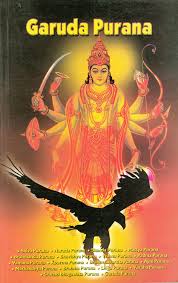
garudapurana

Garuda Purana

In layman’s term we can compare the rivers on the earth to blood vessels in the human body, mountains to chest and plants to hairs etc.

Garuda Purana has a lengthy comparison:

Garuda Purana compares the 14 lokas – 7 worlds under and 7 worlds up – to parts of the body from foot to head; E.g.sole-Atalam, head- Satya lokam.

Then it compares it 7 Dwipas – from Jambu Dwipa to Pushkara Dwipa to other parts of body.

Then it compares the seven seas to seven liquids in body such as urine to salt sea, water to milky ocean, blood to curd sea etc. These seven seas are listed in all our Puranas/ mythologies.

It continues comparing the two chakras in the body Nada Chakra to sun and Bindu chakra as moon. Other seven planets are also compared with eyes ( Mars), Heart (Mercury), Mouth (Jupiter), Semen (Venus), Belly Button (Saturn), Face (Rahu) and Leg (Ketu).

We may not know the link between each part of the body and different things. But the interesting thing is that Hindus saw the entire universe in human body. The universe is divided into 14 worlds in Hindu mythology. Neither the Greeks nor any other culture has gone to this extent in the subject of microcosm and macrocosm. Since Upanishads were written before the Greeks started writing, it is certain that they borrowed this idea from us along with the principle of Panchabhuta/five elements.

Sufi Saints

Philosopher and ex President of India Dr S Radhakrisnan says (on Sufism),

“The one aim of all the orders was to lead men along the path whose goal is the realization of the unitive state. The theory is that man is the microcosm, in contrast to the universe the macrocosm, contains within himself the elements of the world of command (Alam-I-amr) and the world of creation (Alam—Khalq). The first is the world of spirit and the second of matter. The five spiritual elements in man are heart, soul, consciousness, the hidden, the deeply hidden. The five material elements are ego and the four elements – earth, water, fire and air (History of Philosophy: Eastern and Western, Edited by Sarvapalli Radhakrishnan)

Amazing Medical Information in Hindu Vedas!

CHANDI YAGAM

Post No 1940; Date: 18  June 2015

Written  by London swaminathan

Uploaded from London at 21-53


Vedas are not medical books. They are the oldest religious scriptures in the world; but yet we find lot of information about various secular subjects. By reading such information we come to how advanced the Hindu civilization was around 1700 BCE. They are in Sanskrit language. Some people call it as Vedic Sanskrit. But there is no need for that name. Because all old languages including Tamil had different grammar and different structure in the olden days. There is no exception.

A word of caution: not much practical use is there in this study. But we get a better picture of their scientific approach towards herbs and their curative powers. Their classification of plants and diseases place them in the higher ladder of civilization. When we compare them with other cultures, we must place them with the cultures that existed around that period.

I give below the important points from the articles written by two Sanskrit scholars in the book VEDIC WORLD VIEW AND MODERN SCIENCE, Edited by Radhavallabh Tripathi (year 2006):

yaga,NSW

Korada Subrahmanyam writes

1.One can get a lot of material related to herbs and hygiene from the Atharva Veda. Initially the herbs are divided into two groups depending on the place of production: Hilly areas and Plains (pravatiiya and samatala ksetriiya)

Four kinds of trees/herbs are mentioned: Vanaspati (big trees), Vaanaspatya (small trees), Viiruudha (Creepers and bushes) and Oshadi (Herbs)

According to Kalapa there are four types of herbs:

Aatharvanii: useful in Saantis and Paustika karmas

Anngiirasii : Useful for killing and anaesthesia

Daivii: Useful to keep humans out of the influence of old age and death

Manusyajaa: Useful in general medicine

(My comments: Cynical and crooked foreigners wrote that Vedic Hindus were nomads, primitive and pastoral; but the above classification show that they were people with scientific bent of mind. When I joined B.Sc. Botany course 45 years ago, I was taught the Linnaeus classification of plants. In the olden days different classifications were there and slowly they were replaced by better classification systems. So Vedic people were the first in the world to do such classification. Then Greeks improved it, but only 1000 years after the Atharva Veda)

srivili yaga 2

NINE KINDS OF FEVERS

There are nine kinds of fevers described in the seventh kaanda of Atharva Veda:-

1.Ruurah :Fever in which there will be burning sensation

2.Cyavana: In which body trebles

3.Nodanah: By which the person turns mad

4.Dhrnuh: In which the person becomes worried

5.Siitaah: Caused by cold

6.Purvakratvaat: Due to which all the limbs become numb

7.Anyeduuh: That repeats every alternate day

8.Ubavedyuh: That repeats every third day

9.Avratah: That which is unsystematic

(My comments: Ignorant foreigners read only Greek Literature and attributed all the medical advancements to the Greeks. There were other reasons as well: All the European colonial forces could not subjugate the Greeks. So they were heroes in their eyes! The other reason was they did not know the wealth in Sanskrit literature. So they named Hippocrates (4th century BCE) as the Father of Medical Science. The fact of the matter is Dhanvantri and other great people are mentioned in our scriptures earlier than the Greeks. The above classification of nine types of diseases show that we began the Medical science at least 1000 years before the Greeks. The first few chapters of Caraka and Susruta books show how they approached the patient.)

srivili yagam

Satyapal Narang writes:

Who Discovered the Circulation of Blood?

The meaning of the word Hrdaya (heart) is derived from the roots;hr,da and ya arbitrarily to bring out their own meaning of the functioning of the heart. Definitely, the Rig Veda is not a work of mature science but all those who try to propound that Vedo Akila Dharma Mulam (Source of all darma) are trying to interpret the hymns of the RV in the light of Modern Sciences.

(My comments: What Satyapal mentions here is that we are all taught in the schools that William Harvey discovered the circulation of blood in 1578. But the meaning of the Sanskrit word Hrdaya means “blood circulation part”. English word Heart is derived from Hrdaya in Sanskrit. All languages in India including Tamil use this word. “Hr” means ‘in’ and “da” means ‘out’ and “ya” means circulate. So Hindus knew that Hrdaya is the part that which lets in blood and pumps it out. Sanskrit is the only language in the world where every word is scientifically constructed on the basis of 2000 roots listed by Panini 2700 years ago. At that time, no language knew anything about Grammar!Tamil Grammar Tolkappiam came around 1st century BCE according to the majority of the scholars. The third chapter Porul Adikaram was added later)

GODS AND MEDICINES

Satya Pal Narang adds:

Agni :

By its intense power it destroys organisms and other agents which are harmful to the body. Agni has been prayed for destroying evil agents to provide health and happiness. Agni is called Bhisak (Physician/Doctor) and maker of drugs (Bhesaja kartaa). As Bhisak, he is preventing diseases by destroying pathogenic agents (Raksoha) as well alleviator of diseases and thus effecting cure (Amiivacaatana). This hymn (7-15-10) has been employed in the sacrifice in Asvalayana Srautasutra.

(My comments: No religious book in the world calls God as Medicine man. Only Hindu scriptures call Agni, Rudra and others as doctors. This has got two meanings: one who cures physical diseases and one who releases the soul from the disease of birth and death. Whatever the meaning, the subject is Medicine man. This shows that they had concerns about disease and cures around 1700 BCE. No culture had advanced to that level in 1700 BCE. Greeks started writing after 800 BCE; Tamil started writing after 300 BCE, that too few words in Prakrit and Sanskrit)

Indra:

Indra is depicted as a Bhisak (physician) and destroys krimis affecting the children; he healed the patient eaten by the worms (vamri). He cured the skin disease and sterility of Apaalaa, daughter of Atri. Her father was cured from the disease of loss of hair. It appears to be a prayer and not an event

(My comments: Vedas contain amazing information about diseases and cures. Crooked, jaded and cynical foreigners projected Indra as a murderer; but the Vedic hymns give a different picture and they are not talking about any particular man or God. Indra was a title)

yaga salai, chidambaram

First Artificial Leg in the World

Asvin

They had a relation to sea-medicines as well. Medicine from the foam of the ocean was mixed up with the hoof of the horse at a later stage due to the change of the meaning of the word asva which once upon a time had the meaning ‘water’. It is equal to samudraphena, which is mostly used in diseases of ear.

Asvins are the gods of Vedic Age and physicians of gods in Ayurveda tradition.

They are depicted as doctors (Bhisaja) who changed the body of Cyavana, rejuvenated Cyavana, made change in Vandana from old age and provided them a sight, knew the art of healing the wounds, provided eyes to blind, provided an artificial leg to Vispala and begot milk to a barren cow.

(My comments: Asvins had the highest number of achievements including fixing an artificial leg; probably the first in the world)

Maruts

Maruts, the deities of the air, are invoked for the remedy of disorders of the air(Vaata). It became one of the principles in Ayurveda. They have been praised as the knower of all drugs available in mountains and has been prayed to collect them and treat the disorders with them. They also restore the limbs affected by rapas(papa-yoga). They have been prayed to protect the human being and make them happy

Rudra

Rudra is, perhaps the first divine physician who is earlier than Asvins he is definitely related to the medicines where coolant (Hima) medicines are also referred to. He is referred to as the remover of the divine diseases. His frequent association with the aquatics particularly the leeches, as material medical (Jalaasah) is noteworthy.

Varuna

Varuna is the lord of cosmic order who controls the rhythmic movement of nature and incessant flow of rivers. He has been praised as the knower of hundreds and thousands of drugs, physician and the master of physicians and has been prayed to protect the human kind and bring forth happiness on it. He is the lord of the ocean and a large number of medicines were provided from the ocean.

Surya

Surya is the source of cosmic energy. He is invoked for healthy and powerful long life. He destroys the diseases like heart disease and blesses women with male progeny. He is also depicted as the destroyer of Krimis (pathogenic organisms).

Soma

Soma plant has been recognised as a remedy for a number of diseases from the very antiquity.

(For all the above matter, references are given by the author in the book)

(My comments: all the above references show the Vedic Hindus’ concern for diseases and cures. Most of the above deities are called physicians and they are all prayed for human welfare. Though jungle tribes also had medicine men their approach is not scientific and they are engulfed in magic (voodoo) rites.

(Vedic Ritual pictures are sent by face book friends;thanks)

Science and Religion in Upanishads

atom

Compiled by London swaminathan

Article No.1925

Date :11th June 2015

Time uploaded in London: 21-24

I have read an interesting book titled “Vedic World View and Modern Science”, edited by Radhavallabh Tripathi. I wanted to share with you some of the points raised by the authors of various articles in the book. After reading it, I felt that there is a need to rewrite our science books as well. Along with the world view, we must give the Vedic seers’ views as well. Let the students decide who is right and who is wrong.

The second thing that we should do is to convene a conference on Futurology where the scientists and the Vedic scholars may predict what will happen in the next 50 years in the field of science, environment, medicine etc. Let the future generations tell the world who is right and who is wrong.

Youths with scientific bent of mind may ridicule us if we always talk about the past. We must be able to tell them what will happen in future on the basis of our scriptures. I have already written two articles about Hindus’ Future Predictions.

 TV1-05-QuantumMechanics

Atman is Motionless, yet it runs Faster!

In one of the articles S C Goswami says,

To say that a thing is stationary and yet it moves faster than mind sounds totally illogical. But logic proves to be a very poor instrument while dealing with the depths of truth.

The Atman (soul) is motionless, yet it runs faster than mind, thus asserts the Isopanishad.

The self is one, unmoving, and faster than mind. It moves, moves not (verse 4 and 5)

Being infinite and all-pervasive, the Atman does not move, but it appears to move because of its association with the moving mind and the senses.

Subtlest and Biggest

How can a thing be smaller than the smallest and bigger than the biggest? But the Kathopanishad says

Anoraniyam mahato mahiyanatmasya jantornihito guhayam

(1-2-20)

Subtler than the subtle, huger than the huge, the self is lodged in the secret heart of every creature.

Big and small are physical concepts which arise from spatial determination. An object in the gross, physical world is big or small in the relative sense. In the quantum world, however an object is small in the absolute sense if the effect of the disturbance caused by the act of observation is not negligible. On the other hand if the disturbance has negligible effect on the state of the object, the object is termed big in the absolute sense.

The moon is a big object because looking at it, observing its motion has no effect in the motion of the moon. An electron or an atom is a small object in the absolute sense, because the unavoidable disturbance (inherent in an act of observation) drastically alters the state under observation.

The small objects exhibit another unique characteristic, viz, wave-particle duality. An electron is a particle that is an object confined to a small volume (anoraniyan). It is also a wave, a probability wave extending to infinity (mahatomahiyan). Incidentally, the core of an atom, that is, the nucleus, occupies a very small space inside the atom (nihito guhayam). By describing Truth as the tiniest of tiny and also the biggest of the big, the Upanishadic Rishi (seer) conveys that even the minutest space conceivable s permeated by the All-pervasive.

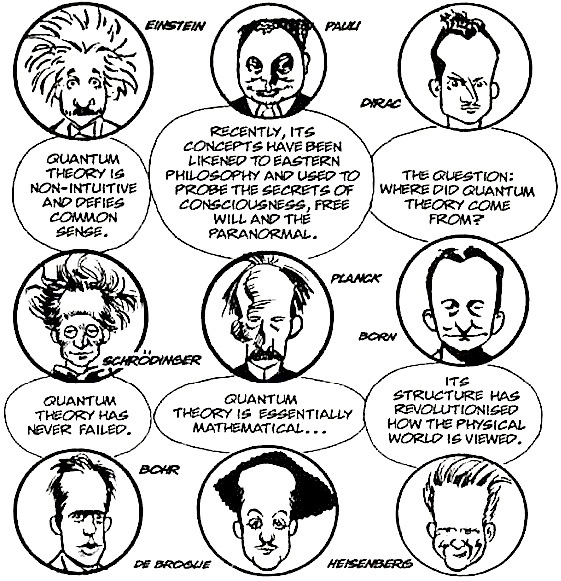
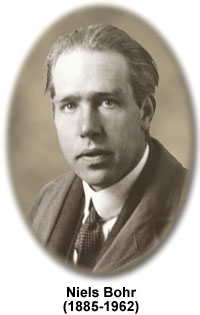
strange-albert-einstein          bohr

Localized and Delocalized

Atman permeates all objects which have shape and form itself remaining formless and changeless in the phenomenal world, asserts kathopanishad,

Bodiless in the embodied, changeless in changeful entities; Swami Vivekanada has beautifully described the relation between man. i.e. localized Self and God i.e.delocalized self. Man, according to him, is a circle whose circumference is at infinity but the centre is located in the body. And god is like a circle whose circumference is at infinity but the centre is located everywhere. This idea is again echoed in the Kathopanishad

What indeed is here is there, what is there is here likewise

Self, which associates itself with limiting adjuncts, viz, body and senses, becomes localized in the individual and appears as being possessed of physical or worldly attributes to the ignorant. That very self, devoid of all physical attributes, a mass of pure consciousness, established in its casual condition as Brahman, is present here, there, everywhere.

Being and Becoming

Being and Becoming and One and Many are both the same thing. One is Brahman and Many is manifest in nature. The immense diversity exhibited by Nature is , in fact, the manifestation of the underlying Unity. All that exists in Nature, animate and inanimate, is the Becoming of the one Self. We must experience the One Being but at no point of time should we cease to see the many Becoming. How is it possible? Through ignorance we identify ourselves with ego, which as Buddha said, does not exist. This false identification leads to a sense of separateness and contradiction. Once we get rid of it we immediately experience our oneness with all beings, we expand to infinite dimension as it were.

The Upanishads are unique in their approach towards seemingly opposite concepts, some of them described above, because they assert simultaneous validity of such opposites. Life in the world, according to them, and life in the Spirit, are not incompatible. Work or action is not contrary, is rather means to knowledge of God. By renunciation it meant the renunciation of the ego, not of life.

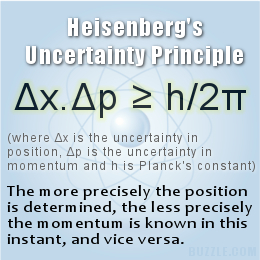
heisenberg

Neil Bohr Quotation

Bohr dedicated thirty years of his life in spreading, the message of complementarity in fields outside of physics. One of his favourite maxims was, as told by his son Hans, the distinction between two sorts of truth: trivialities where opposites are obviously absurd, and profound truths, recognised by the fact that the opposite is also profound truth.

The Upanishads do not deal with trivialities. They deal with profound truths.

Who discovered Gravity? Newton or Aryabhatta?

Radhavallabh Tripathi says,

The Vedic seers could visualise many things through their observation or by their intuition, which the latter

Scientists discovered. For example Aitareya Brahmana (III-4) says that the Sun neither rises nor sets, it is the earth which rotates around it.

Yajur Veda further mentions (20-23) that the whole cosmos is rotating, it also suggests that the moon does not have its own science, it reflects the light from the Sun (ibid18-40 and Nirukta 2-6). Authors of Vedic Samhitas were clearly aware of seven colours in sun rays. The gravitational force is hinted upon.

Aryabhatta clearly propounded the theory of gravity eight hundred years before Newton.

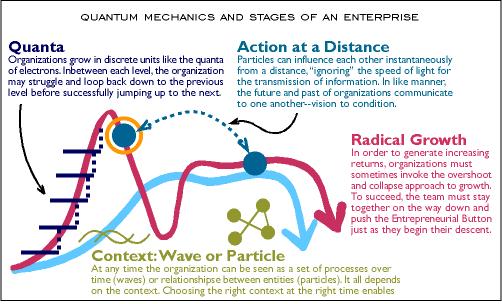
quantum_enterprise

Pythagoras Theorem or Vedic Seer Theorem?

Vedic altars were constructed in different shapes and sizes for the performance of Yajna. Strictly set measurements were prescribed for construction of different types of altars for different rituals. This lead to the discovery of a geometrical theorem around 1500 BCE, which after quite a centuries was discovered by a philosopher and mathematician Pythagorus in Greece. The theorem along with several other principles of geometry has been explained in detail in Sulvasutras, the Vedic texts on rituals. They were composed around 1000 BCE.

Cosmology and Carl Sagan

Cosmology is one of the areas in which the ancient seers were particularly interested. Carl Sagan, one of the most brilliant cosmologists said that Indian cosmology gave for the first time a time scale for the earth and for the universe a time scale which is consonant with that of modern scientific cosmology. The Hindu tradition has a day and night of Brahma is 8-4 billion years.

The Vedas are the oldest literary records of ancient Hindu wisdom. Atharva Veda records brilliant thoughts on Time in two of its hymns, both entitled as Kalasuktas (Hymns on Time)

The Upanishads provide in depth analysis of the concepts of time and space.  The terms dik and akasa have been used for space in the Upanishads. Even present, past and future percolate akasa/space and at the same time, are imbued in akasa.

katho        iso1969a

Potter’s Wheel and the Universe

The circuitous movement of this cosmos has been compared by the author of Sri Bhagavata to a potter’s wheel. The potter’s wheel is rotating and hundreds of ants are going on the wheel just as the potter’s wheel rotates, along with it rotate the lump of clay placed by the potter on it and along with rotate the ants. But the ants moving on the wheel also move by own speed and at the same time also rotate with the circuitous movement of the wheel. In the same way the cosmic wheel of time and space is rotating, along with it are rotating infinite number of stars and planets and each of these ants or planets is moving by its own momentum also – Srimad Bhagavatam V-22-2

Einstein Quotation

Physists like Fritzof Capra find the image of Cosmic Dance of Siva a very suitable metaphor to describe atomic reality.

Ken Wilbur, himself a scientist, says that every one of the greatest physicists of 20th century, Einstein, Schrodinger, Heisenberg etc. were spiritual mystics  of one sort or another. “The most beautiful emotion we can experience is mystical” says Einstein.

Source: VEDIC WORLD VIEW AND MODERN SCIENCE, Edited by Radhavallabh Tripahi, Pratibha Prakashan, Delhi, Year 2006

Murder of a Beautiful Mathematician

HypatiaQuote

Compiled by London swaminathan

Article No.1915; Dated 6 June 2015.

Uploaded at London time: 18-52

India was the only country in the ancient world where women were well educated. Very rarely we see educated women in other parts of the ancient world. 3700 year old Rig Veda has names of scores of poetesses. 2000 year old Sangam Tamil literature has scores of poetesses. As proofs of their existence we have their verses today. Gargi Vachaknavi attended the All India Philosophical Conference convened by the King Janaka 2850 years ago. Asoka’s daughter Sangamitra travelled to Sri Lanka by ship and spread Buddhism 2350 years ago. Draupadi argued her case like a lawyer before she was dragged into Duryodhana’s court. We have at least 100 reputed names of women who lived 2000 years ago. In the other parts of the world, we read lot about Queen of Sheba and Cleopatra but we haven’t got their writings to prove or estimate their intelligence.

There was one woman who was beautiful and intelligent in Alexandria (Egypt), but was brutally murdered by a fanatical gang. Her name was Hypatia. She was so beautiful that she had to teach from behind a curtain so that her students won’t be distracted. She was born between 350 and 370 CE and was murdered in in 415 CE by a Christian mob.

When alexander invaded Egypt in 332 BCE, he founded the city of Alexandria at the mouth of River Nile in Egypt. Within a century it had one million residents including Indian scholars and businessmen. Among the professors who taught at the famous Museum cum University was Theon, a Greek scholar. He was a Pythagorean and educated his daughter Hypatia at a time, when it was comparatively rare for women to receive any sort of intellectual education at all.

Hypatia was appointed Professor of Mathematics and Philosophy in the same prestigious institute as her father.

In India, apart from the women named in the Rig Veda, Upanishads and Sangam Tamil literature, we had a beauty Sarasawani who was asked to be the judge in the debate between Adi Shankara and Mandanamishra. There was intellectual freedom. Women could be the judge where two intellectual giants of the day clashed. Whoever was defeated accepted the opponents teaching and followed him. But the Christian church crippled discussion of intellectual matters, substituting faith for reason as the criterion of truth. Expectation of the imminent Second Coming of Christ, as promised to his disciples, made people intellectually lazy; what was the point or need of further intellectual inquiry?

Hypatia, a neo Platonist, had no truck with such attitudes. She also had the habit of engaging casual passers-by in dialectical explanations or philosophical questions. Hindu philosophers also stood in street corners in Benares and challenged the intellectuals to come for a debate.

hypatia 2

Hypatia was caught in a feud between Cyril the fanatical patriarch of Constantinople and her ex pupil and friend Orestes, the Roman Governor of Alexandria. According to the historian Socrates Scholasticus, a mob of ‘cock brains’, supporters of the fanatical patriarch, came across Hypatia during an anti- Roman demonstration in Alexandria. They were against the pagan philosophy. They dragged her into a church, stripped and murdered her and then burned her corpse.

Hypatia wrote a number of books, intended as texts for students. Unfortunately, none of her works have survived. She is credited with several inventions like Hygrometer and a water level instrument.

Her murder by a Christian mob was taken as symbolic by generations of European free thinkers, scientists and anti-Catholics. She was the last of the pagan scientists. Her death coincided with the last days of Roman Empire and the beginning of the Dark Ages. For 1000 years or so there were no significant advances in Christian Europe.

In 640 CE, the city was Alexandria was attacked by Muslim invaders and they destroyed the great library in Alexandria like they set fire to Nalanda University library in India. In both places most of the ancient works were destroyed and lost for ever. Some were rescued by scholars and later the Arab scholars translated them. Intellectuals suffered a lot at the hands of religious fanatics!

Source for Hypatia story: Number by John McLeish, Bloomsbury, 1991.

30 Beautiful Quotations from Philosopher Dr Radhakrishnan

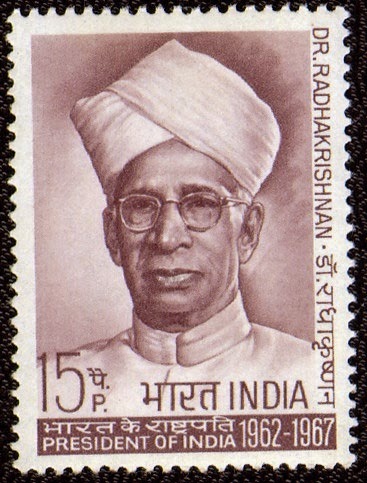
sarvapalli

Compiled by London swaminathan

Post  No.1890

Date: 26 May 2015; London Time 12-23

June 2015 Good Thoughts Calendar

June 1 Monday –Vaikasi Visakam, 19- Ramzan month begins, 24-

Ani Uththaram Natarajar Abhishekam.

Auspicious days – June 4, 7, 8, 12, 26, 29; June 2 Tuesday-Pornami /Full moon day; June 12 and 28 – Ekadasi; June 16 – Amavasya/ New moon day

June 1 Monday

Philosophy is understanding, contemplation, insight, and a philosopher can find no rest until he gains a view or vision of the world of things and persons which will enable him to interpret the manifold experiences as expressive, in some sort, of a purpose.

June 2 Tuesday

If we ask religious leaders on what their claim to be believed is based, we receive three answers – They deserved to be believed, firstly,  because our primal ancestors believed them; secondly, because we possess proofs which have been handed down from this period of antiquity; and thirdly, because it is forbidden to raise the question of their authenticity at all.

June 3 Wednesday

The golden age is in the future vision, not in the fabled past.

June 4 Thursday

Our scientific theories which supersede earlier ones are only links in a long chain of progressive advances. They are temporary resting places in the search for truth and there is nothing absolute about them. Religion on the other hand claims to be absolutistic. Its truths are said to be unalterable and our only duty is to defend them.

June 5 Friday

Science demands induction from facts and not deduction from dogmas. Science insists on the reign of law. If law works everywhere and though all time, there is nothing mysterious or miraculous about the world.

Dr Radhakrishnan’s Birth Day September 5 is celebrated as Teachers day

June 6 Saturday

Reasoning in religion is only a rearrangement of our prejudices. The tendency of religion to mistake desires for facts, to take the world to be what we should like it to be, to reserve a certain part of life as falling outside the scope of ordinary knowledge is the direct opposite of empirical science.

June 7 Sunday

A non-functioning, ornamental deity cannot remain for long a vital force. Deism lapsed into scepticism. If a god is unnecessary for working the world machine, he does not seem to be quite necessary for starting it.

June 8 Monday

We cannot believe that the earth was brought into existence by a divine fiat on a certain Tuesday in the year 4004 BCE.

June 9 Tuesday

Man is nothing more than the latest of a long series of living creatures, and he did not arrive on this planet faultless and finished but is being slowly ground in to shape by the shocks of circumstance. We cannot be certain that man is the last utterance of life. Even if the evolution of life on earth does not proceed higher than the human species, science threatens us with a possibility of its extinction.

June 10 Wednesday

Call it destiny or collective soul, an immutable law governs the rise and fall of races and cultures.

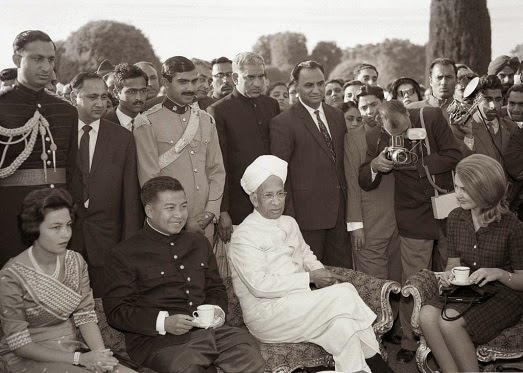
With King of Cambodia

June 11 Thursday

Language is a series of muscle twitchings. Emotions are visceral reactions. Man is an animal among animals. He is the most cunning of the animals.

June 12 Friday

We are grown-up infants and god is a sort of “wet nurse” to humanity.

June 13 Saturday

Psychologists are interested in the discovery of conditions that lead to the acceptance of fancies as facts but not in their truth vale. We do not debate the truth of a detected illusion.

June 14 Sunday

Our mental pictures of god are as varied as we are. If oxen and horses and lions had hands and could produce works of arts as men do, horses would paint the forms of the gods like horses, and oxen like oxen, and make their bodies in the images of their several kinds! Ethiopians make their gods black and snub nosed, the Thracians say theirs have blue eyes and red hair”(Dr Radhakrishnan gave the quote from Xenophanes).

June 15 Monday

The history of religion is the record of the conflicts of contradictory systems, each of them claiming dogmatic finality and absolute truth, a claim made apparently absurd by the plurality of claimants.

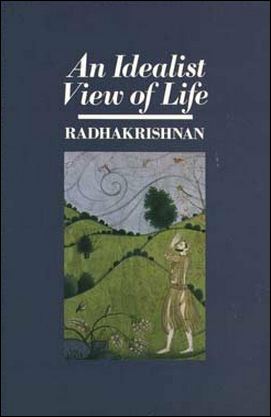
An-Idealist-View-of-Life-Radhakrisnan

June 16 Tuesday

Salvation is interpreted as having a reference to the next world and not he building of kingdom of god on earth. Religion is more world-fleeing than world-seeking or world-penetrating.

June 17 Wednesday

Religion is not doctrinal obedience or ritualistic display, but is self-sacrificing love and redemptive might. Religion believes that all needful truth is given to man and there is no need for further enquiry and search.

June 18 Thursday

Religion engenders a great love for a great hate. Every religion has its Popes and Crusades, idolatry and heresy hunting. The cards and the game are the same, only the names are different. Men are attacked for affirming what men are attacked for denying. Religious piety seems to destroy all moral sanity and sensitive humanism.

June 19 Friday

Greek mind had not a clear perception of the distinction between politics and religion, public duty and individual perfection. To it, Athens and Athena , later Caesar and god ,were identical terms. The individual’s highest good is in the service of the state.

June 20 Saturday

Scepticism does not cost us much. It is faith that requires courage nowadays.

With US President John F Kennedy

June 21 Sunday

We need the assistance of creative minds. The prophet souls and the priest minds, the original men of understanding and not the mechanical imitators of the inherited habits, are needed to help our wandering generation to fashion a goal for itself. Prophesy is insight. It is vision. It is anticipating experience. It is seeing the present so fully as to foresee the future.

June 22 Monday

We cannot live if we do not recover our faith in life and the universe. Rationality is essential, but so is religion if disintegration to be averted. Loyalty to life requires us to know the creative mystery and serve it to the best of our power.

June 23 Tuesday

Happiness is not to be confused with pleasure. It consists in harmony, in unity with oneself, in the consciousness of an affirmative attitude to life, in the peace resident in the soul.

June 24 Wednesday

Agnosticism admits the mystery and holds that we do not know and cannot know. That which transcends us is none of our affair.

June 25 Thursday

There is a story that the visit of an Indian philosopher to Socrates. Aristoxenes reports that Socrates tod the India stranger that his work consisted in enquiries about the life of men, and the Indian smiled and said that none could understand things human who did not understand things divine.

June 26 Friday

Humanism is a protest against naturalism on the one side and religion on the other. Against religion, humanism contends that this world is our chief interest and perfection of humanity is our ideal. We can realise the humanist’s ideal by means of the inner discipline without reference to any supernatural power. Humanism seems to be religion secularised. Life is a great gift, and we have to bring to it a great mood; only humanism does not induce it.

June 27 Saturday

Socialism cannot remove human selfishness. A religion whose centre is man and not god is never a strong one. Religion today has to fight not only unbelief and secularism, but also the subtler rival in the guise of social reform.

June 28 Sunday

God is not what a man wishes to be true for the sake of an easy time, but what he knows to be true, even though it means sacrifice and self-denial.

June 29 Monday

Liberty and reason are no doubt great ideals, but there can be no liberty without discipline and no reason without faith.

June 30 Tuesday

It takes centuries of life to make a little history, and it takes centuries of history to produce a little tradition, and we cannot lightly set it aside. There is a body of accepted knowledge, a deposit of faith on which we can all draw. Though religion in a sense is each individual’s personal affair, it is dependent on past tradition and grows out of it

Quotations are taken from AN IDEALIST VIEW OF LIFE, lectures of Dr Radhakrishnan in the United Kingdom in 1929 and 1930. Later he became President of India.