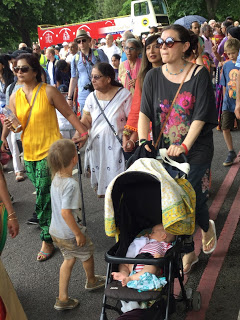
Hindu’s Life according to Atharva Veda

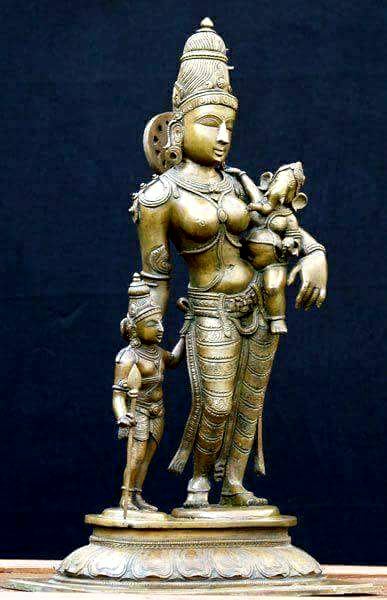
Image of Vedic God Varuna

compiled by London Swaminathan
Date: 8 July 2017
Time uploaded in London- 15-43
Post No. 4062

 
Pictures shown here are taken from various sources such as Facebook friends, Books, Google and newspapers; thanks.


The life of a Vedic Hindu may be introduced by the following graphic sketch by Griffith:

“Setting aside the rivalries, wars and conquests of kings princes, and the lofty claims and powers of the hierarchy, we may follow the course of the middle-class Hindu’s life from the cradle to the funeral pile, and even accompany him to his final home in the world of the Departed.

We hear the benedictive charm pronounced over the expectant mother before her child is born, and in due time on the darling’s first two teeth. We attend the solemn ceremony in which the youth is invested with his new garment whose assumption signifies his recognition as an adult member of the family with new responsibilities and new duties to perform.


As his fancy turns to thoughts of love, we hear him murmuring the charm which shall win him the maiden of his choice, and the lullaby which shall seal every eye but hers in his beloved’s house and enable him to visit her without detection or suspicion.
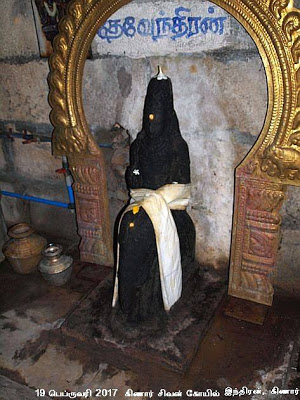
Picture of Vedic God Indra


We follow him in his formal and somewhat unromantic wooing of a bride through a friend who acts as match-maker; we see the nuptial procession and the bride’s introduction to her new home; we hear her benediction on the bridegroom, and the epithalamium pronounced over the wedded pair.


The young husband is an agriculturist, and we see him supe rintending the ploughmen and praying to Indra and Pushan and the Genii of agriculture to bless their labours. Anon, with propitiatory prayer, he is cutting a new channel to bring the water of the brook to the land which is ready for irrigation; or he praying for rain or an abundant crop.


Again, when the corn is ripe he is busy among the men who gather in harvest, invoking the aid of good natured goblins, and leaving on the ground some sheaves the to remunerate their toil.  At sunset he superintends the return of the cows who have been grazing under the protection of the Wind-God in the breezy pastures and their return under Divine guidance, and the reunion of all the members of the household are celebrated with symbolical mixt oblation, with milk and a brew of grain.


His wealth and family increase in answer to his repeated prayer for children and riches, and a new house must be built on a large scale. The building is erected under the careful eye of the master and blessed and consecrated with prayers to the Gods and to the Queen of the Home. The mistress of the house brings forth the well filled pitcher, all present are rele gated with the stream of molten batter blent with nectar and the householder enters and takes formal possession his dwelling with fire, the two most important necessaries of human life. The house, moreover- a wooden building with a thatched roof has been specially assured against fire by a prayer to Agni the God of that element with the additional security afforded by the immediate neighbourhood of good stream of pool of water.
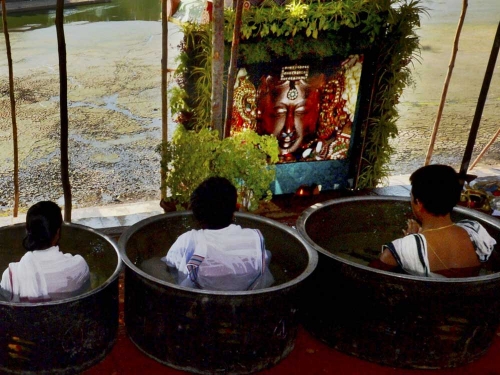
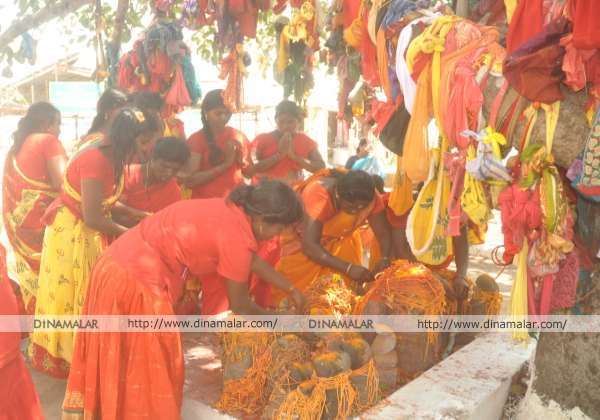
Image of praying for rains and it is called Varuna Japa.


Such or something like this, was the ordinary life of the agriculturist. A devout believer in the gods, he did not spend his substance on the performance of costly sacrifices, but was content with simple ceremonies and such humble offerings as he could well afford. His chief care was for the health and well-being of himself, his wife, children and dependents for plentiful harvests and for thriving and multiplying cattle; and these were the blessing for which he most frequently prayed. His chief troubles were an occasional touch of malarial fever or rheumatism, a late or scanty rainfall, a storm that lodged his ripe barley, lightning that struck his cattle, and similar mischances caused by the anger of the gods or the malevolence of demons; and he was always armed with prayers and spells against the recurrence of such disasters.


……………………continued in second part
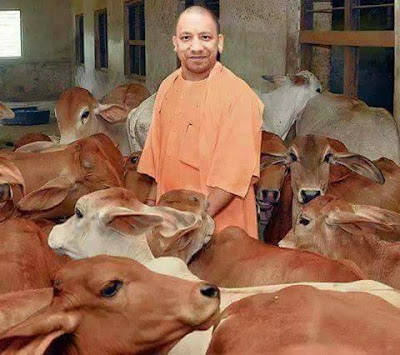


How did Cow get Hoofs and Horns? A Vedic Story (Post No.4059)

Written by London Swaminathan
Date: 7 July 2017
Time uploaded in London- 6-47 am    
Post No. 4059

 
Pictures shown here are taken from various sources such as Facebook friends, Books, Google and newspapers; thanks.


The Aitareya Brahmana (4-3-17) explains how the cows got their hoofs and horns.


“The cows being desirous of obtaining hoofs and horns, held a sacrificial session.

in the tenth month of their sacrifice, they obtained hoofs and horns.

We have obtained fulfilment of that wish for which we underwent the initiation into the sacrificial rites.

Let us rise, the sacrifice being finished. When they arose they had horns. They however, thought, let us finish the year. and recommenced the session.

On account of their distrust their horns went off; and they consequently became hornless.


They continuing their sacrificial session, produced vigour. Thence after sacrificing for twelve months, and having secured all the sessions,  they arose again at the end. For they had produced the vigour to reproduce hoofs and horns. Thus the cows made themselves beloved by all the whole world and are beautified (decorated) by all. He who has such a knowledge, makes himself beloved by everyone, and is decorated by everyone”.


The symbolic meaning is very clear in this story. If some one leaves a job in the middle without reaching the goal, he loses his name and fame. Name and Fame are described as horns in Vishnu Sahasranama and Tamil literature (Komban= horned; Srnga = horn, Chatvari srnga:; Na Eka Srnga etc). Vishnu Sahasranama and Vedas describe the Indus Valley God (so called Pasupati seal) as Komban. We can see the horns on the figure.

Till this day, cows are decorated and worshipped, particularly on Krishna’s birth day (Janma Ashtami). Tamils decorate the cows and bulls on Maattu Pongal Day (Cattle Pongal is celebrated one day after Makarasankaranti/Pongal Day)


Foreigners’ Ignorance!

In primitive parts of Africa there are some folk tales such as how did the cheetah get its spots? How did the tiger get lines on its body? Why did the elephant’s hand is long like a snake? Why did the giraffe has a long neck? In India we have some stories in Ramayana that squirrel got three lines because of Rama’s touch, crow’s one eye was blind because Rama’s arrow pierced it etc.


In Vedic literature, we have some stories such as cow getting the hoof, horn and skin. But there is a big difference between these stories and primitive folk tales. Our Vedic stories are religious stories where as others are folk tales. They are not used in rituals. Our stories have been kept alive for thousands of years by word of mouth (now in writing). Our stories have symbolic meaning and that is the reason they are embedded in between other religious rituals. Folk tales are just folk tales, no other significance is attached to it.


Foreigners who did not understand the symbolic meaning compared them with the folk tales of primitive tribes. They couldn’t say why they are absent in Europe and other parts of the world. If Hindus have come to India from other parts of the world these cow stories must exist there; cows must be venerated as we do in India for thousands of years. The fact of the matter is, we went to various parts of the world and taught the value of cows and bulls. Those ignoramuses forgot all those good things and started eating cows and blunted their brains. They fought two world wars and killed millions of people. They called themselves ‘civilised’ but in heart they are ‘uncivilised!’


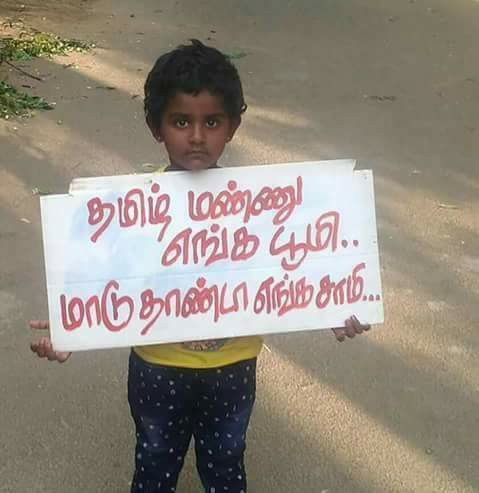
-The placard says Tamil land is our land; cattle is our God.


-Subham–

Sacred Cow in Tamil Veda ‘Tirukkural” (Post No.4057)

Written by London Swaminathan
Date: 6 July 2017
Time uploaded in London- 19-59     
Post No. 4057

 
Pictures shown here are taken from various sources such as Facebook friends, Books, Google and newspapers; thanks.


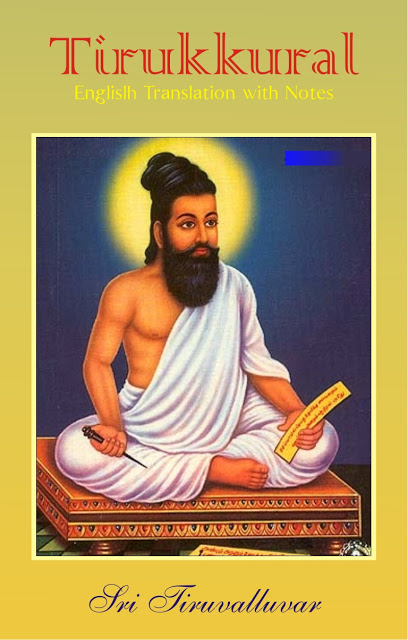
Hindu culture has been practised by the people of India from the Northern most Himalayas to the southernmost Kanyakumari for thousands of years. Sacred cow is mentioned in the Sangam Tamil literature in several places. One of the post Sangam books is Tirukkural written by Tiruvalluvar. Like the Vedas always pair the Brahmins and Cow, Tiruvalluvar also does.


“Go brahmanebya subamastu nityam lokas samasto sukino bhavantu” is the daily prayer of the Hindus. From the Brahmins and cows all living beings must live happily is the meaning. The reason for placing Brahmins and cow in the beginning is that they are pure and selfless. This pairing continued from the Vedic days and we see that in the oldest part of Tamil Literature – Purananuru verse 9. Poet Nettimaiyar sang this poem in praise of the ancient Pandya king Mudukudumi Peruvazuthi. His epithet is that one who did innumerable Yagas (Fire sacrifices). The poet says before waging any war, he will first request that Brahmins, Women, Cows, invalids, sick people and those who has not given birth to child must keep away. Kannaki, the Tamil heroine of Silappadikaram also did the same. Before burning the city of Madurai she commanded the God of Fire (Agni Deva) not to burn the Brahmins, women and cows. Tamil Miracle boy and one of the four Tamil Saints Jnana Sambandar also sang Long Live the Brahmins, Long Live the Cows.
Tamil Purananuru verse lists the worst sins and one of them is killing the cow (verse 34 by Alathur Kizar)


Now let me quote two couplets from Tirukkural, considred Tamil Veda by the Tamils (actually it was one of the poets who sang the praise of Tiruvalluvar, used these words Tamil Veda).

“If the guardian of the country neglects to guard it, the produce of the cows will fail and the men of six duties (shad karmana: = brahmins) will forget The Book (Vedas)” (Kural 560).

Here we see the Go+Brahmna pairing.


in another couplet (1066) “It is most heinous to beg for a bucketful of water even to quench the feverish thirst of a sinking cow”.


Being cow the most sacred animal, Tiruvalluvar used the cow here. feeding the cows, worshipping the cows are part of Hinduism. In Tamil Nadu, Go Puja (worship of cow) and Gaja Puja (worship of elephant) are done in all the temples and mutts in the early morning.


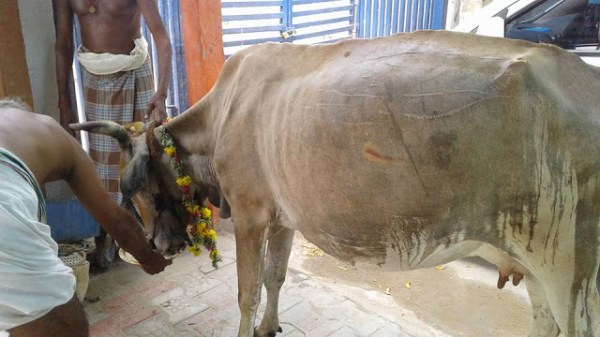
In front of the temples, cows are tied to the poles and the devotees used to feed them with the Agathi leaves (Agathi grandiflora) to earn good merits (Punya).

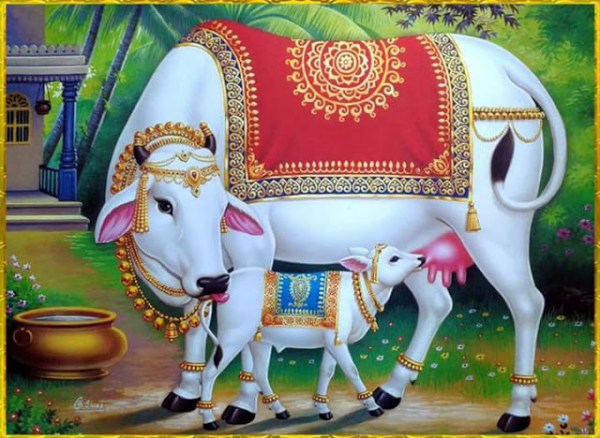
Of late the picture of wish fulfilling cow Kamadhenu’s picture is displayed in many houses and shops as a symbol of good luck.

–Subham–


Sacred Cow in Satapata Brahmana (Post No.4050)

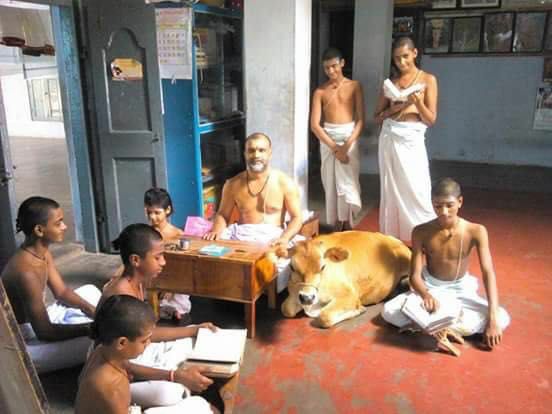
Cow attending Veda class

Written by London Swaminathan
Date: 4 July 2017
Time uploaded in London- 10-41 am
Post No. 4050

 
Pictures shown here are taken from various sources such as Facebook friends, Books, Google and newspapers; thanks.


Satapata Brahmana is one of the Brahmana books of Vedic period. Foreigners date it to 800 BCE to 1000 BCE. Hindus date it to thousands of years before that. Foreigners spread a false story that Hindus adopted vegetarianism only after Mahavira and Gautama Buddha appeared in India. Those stories are exploded by the Satapata Brahmana passage.

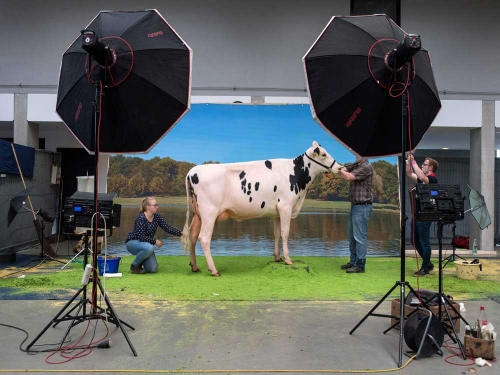
Cow photographed in Oldenburg ,Germany

Through out the Vedas cow and calf are used as the symbol of love and affection between a mother and her child. This is the oft used simile in the oldest portions of the Vedas. That shows that cow was equated to mother. Vaatsalyam is a Sanskrit word coined out of it (Vatsa=calf)


The biggest contribution of the Vedic Hindus to the world civilization are the DECIMAL SYSTEM and the COW’S MILK. In no other world literature, we come across such references or similes as we see in the Vedas. Until today the world has not found an alternative to the Decimal system and the Cow’s milk. These are used everyday. This shows at they are the oldest and highly advanced civilization. These type of concepts can evolve only after thousands of trial and error methods or experiments.

Here are some passages from the famous Satapata Brahmana (3-1-2-3):

“Let him not eat the flesh of either the cow or the ox; for the cow and the ox doubtless support everything on earth. The Gods spake: ‘Verily the cow and the ox support everything here; come let us bestow on the cow and the ox whatever vigour belonged to other species of animals; and, therefore, the cow and ox eat the most. Hence were one to eat the flesh of an ox or cow, there would be, as it were, an eating of everything, or, as it were, a going on to the end. Such a one, indeed, would be likely to be born again as a strange being, as one of whom there is evil report, such as, “He has expelled the embryo from a woman’ He has committed a sin; let him therefore, not eat the flesh of the cow and the ox”.

Most valuable fuel and manure– cow dung

Foreigners are so cunning and divisive that they quote from different sources (very old and the latest) to support their arguments. It may be from the latest books, which they would never mention. But if they see any good things, they will say that they are from the latest books. It was because of…………. They will bluff.


Atharva Veda talks about a huge geographical area from West Bengal to Iran. No ancient civilization had such a sway over a large region. When such things come they will say Atharvana Veda was the latest addition. How latest – no two scholars agree! They try to cramp the development of a huge civilization within a span of 200 to 400 years. It is not possible to any civilization even in the modern period.


Usefulness of the Cows:

Sale of Cow for the Soma plant

In Vedic times barter trade was practised. They exchanged cows for Soma herb. Here is a passage about it:

“He bargains for the King Soma; and, because he bargains for the king, therefore any and everything is vendible. He says,

Soma seller! is your King Soma for sale?

Soma seller: He is for sale

I will buy him from you.

Buy him

I will buy him of you for one sixteenth of the cow;

King Soma is surely worth more than that.

From the cow comes the fresh milk; from the boiled milk boiled milk comes ghee/butter cream, clotted curds, whey etc.

Soma seller: King Soma is worth more than that; but surely is the greatness of the cow

Adhvaryu Priest:-

Gold is yours;  a cloth is yours;  a milch cow, a pair of kine,  three other cows are thine.


They buy the Soma plant for a cow and then the cow is also taken back.

This type of conversation shows the importance of cow and they are shown as equal to mother and Soma plant.

Foreigners quote certain passages to show that a cow was sacrificed in the yaga; but there are also it is explained that a cow made up of dough or flour is sacrificed.


The very concept of sacrifice is uniquely Hindu. It shows that all you desire, all that you want, all you consider valuable are not yours—Idam Na Mama – it is not mine.


from this ritual ‘Idam na mama’ they take humans to a higher stage i.e. everything thing belongs to God – Isavaasyam Idam sarvam i.e.

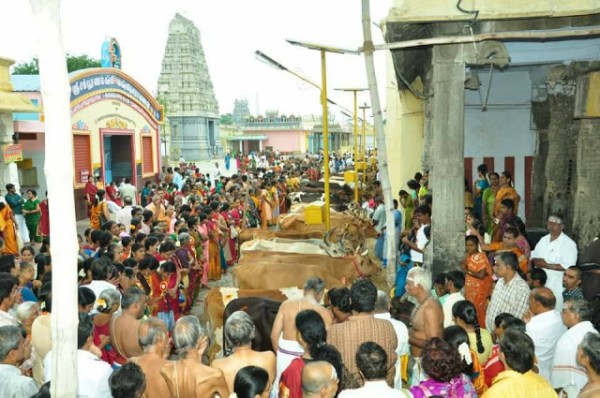
Cow Puja at Kanchipuram

MANTRA ONE of Isavasya Upanishad


isavasyam idam sarvam

yat kinca jagatyam jagat

tena tyaktena bhunjitha

ma grdhah kasya svid dhanam


isa–by the Lord; avasyam–controlled; idam–this; sarvam–all; yat kinca— whatever; jagatyam–within the universe; jagat–all that is animate or inanimate; tena–by Him; tyaktena–set-apart quota; bhunjithah–you should accept; ma–do not; grdhah–endeavor to gain; kasya svit–of anyone else; dhanam–the wealth.
 

TRANSLATION


Everything animate or inanimate that is within the universe is controlled and owned by the Lord. One should therefore accept only those things necessary for himself, which are set aside as his quota, and one should not accept other things, knowing well to whom they belong. 


(This is the favourite hymn of Mahatma Gandhi)


–subham–


More Stories from the Brahmana Literature (Post No.4045)

Compiled by London Swaminathan
Date: 2 July 2017
Time uploaded in London-15-05
Post No. 4045

 
Pictures shown here are taken from various sources such as Facebook friends, Books, Google and newspapers; thanks.

Extra Terrestrials in Tandya Maha Brahmana

The Lord of creatures offered himself a sacrifice for the benefit of the Devas. The Devas were mortals who thus became divine or glorified.

Apastamba (2-7-16) comments on this are interesting:

“Formerly men and gods lived together in this world. Then the gods in reward of their sacrifices went to heaven, but men were left behind. Those men who perform sacrifices in the same manner as the gods did, dwell (after death) with the gods and Brahma in heaven.

“Whatever sins we have committed by day or night, you are the annulment thereof. Whatever sins we have committed sleeping or awake you are the annulment thereof. Whatever sins we have committed knowing or unknown you are the annulment thereof. You are the annulment of sin.

xxxx

Why Asvamedha is performed?

Prajapati, having created all living beings, through affection entered within them. But afterwards he could not get out of them. He said, “whoever will extricate me from this confinement will become wealthy. The Devas performed an Asvamedha and thereby extricated him; thus they became wealthy. Whoever performs an Asvamedha attains profusion of wealth by extricating Prajapati—Taittiriya Brahmana

xxx

Why a cow immediately on calving should not be milked?

Certain descendants of Angiras, the expounder of the fourth Veda, had a lean white milch cow, which for want of grass lived on the pressed stalks of Soma vine. The sight of this grieved the owners much, and they performed a sacrifice which brought on plenteous rain, every drop of which grew up into nutritious vegetables. The Pitris (manes) besmeared them with poison when the cow was affected, and appeared before the sacrificers. They enquired who had caused the evil, whereupon the pitris (departed souls) said, we co -sharers of the ceremony, have caused this.

The sacrificers then gave a share of the sacrifice to the Pitris who benignantly removed the poison. When the cow was fattened by profusion of fodder, the calf was let loose  and requested by  the sacrificers  to drink a little milk and leave the rest for the sacrifice. The calf refused to do so unless they would engage to milk the cow for the first ten days after calving, and to allow the calf to suck for a period equal to one fifth of the day or night after morning and evening milking. The calf which drinks for a longer period is cursed by Rudra.

My comments:

Even a cursory reading will tell us that the story is symbolic.  Literally it may look like a meaningless story. Moreover, stories like this must be read in their contexts.

–subham–


THREE INTERESTING STORIES FROM THE BRAHMANAS (Post No.4042)

THREE INTERESTING STORIES FROM THE BRAHMANAS (Post No.4042)

Compiled by London Swaminathan
Date: 1 July 2017
Time uploaded in London-15-59
Post No. 4042

 
Pictures shown here are taken from various sources such as Facebook friends, Books, Google and newspapers; thanks.


Vedic literature has four parts: 1.Samhita/hymns, 2.Brahmanas, 3.Aranyakas and 4.Upanishads; following are some stories taken from the Brahmanas:-


How Bharadvaja studied Vedas!

There is a story in the Taittiriya Brahmana (3-10-11-3) about  Bharadvaja studding the Vedas

Bharadvaja lived through three lives in the state of a religious student (brahmachari). Indra approached him when he was lying old and decrepit and said to him,

“Bharadvaja, if I give you a fourth life how will you use it?”

Bharadvaja said, I will be a Brahmachari studying the Vedas”

Indra showed him three mountain like objects, as it were unknown. From each of them he took a handful, and, calling to him, Bharadvaja!

“these are the three Vedas. The Vedas are infinite. This is what you have studied in your three lives. Now there is another thing which you have not studied. Come and learn it. This is universal science. He who knows this conquers a world as great as he would gain by the triple Vedas.


Tamil has a saying “What you have learnt is a handful of sand and what you have not learnt is the size of the earth” This must have come from the Bharadvaja episode, though there is verse attributed to Tamil poetess Avvaiyar. There Sarasvati, Goddess of Learning, says what she has learnt is only a handful…. etc.


xxx


Name Aitareya!

Sayana in his introduction to Aitareya Brahmana gives the reason for the name of the  Aitareya Brahmana. An ancient Rishi (seer) had among his many wives one who has coaled Itara. She had a son Mahidasa Aitareya by name. The rishi preferred the sons of other wives to Mahidasa, and went even so far as to insult him once by placing all his other children in his lap, except Mahidasa.

His mother felt very sad and prayed to her family goddess, who appeared in her celestial form in the assembly of people, placed him on a throne, and gave Mahidasa, as a token of honour, a boon which had the appearance of a Brahmana. This was given to him because he surpassed all other children in learning. The boon having been received a Brahmana, consisting of 40 sections, came through the mind of Mahidasa, and its Aranyaka was revealed in the shape of the vow of a hermit. Hence these books are named after him, Aitareya Brahmana and Aitareya Aranyaka.


According to Hindu scriptures, vows, curses and blessings can assume visible forms as stated in the story. But the real meaning is that Mahidasa was inspired and he poured out this Brahmana. In short divine inspiration created this Brahmana.
xxx

How to Deal with a Mistake?

The following story from the Kaushitaki Brahmana, declaring how to deal with a mistake, is not given in the Aitareya Brahmana:–

“King Pratardana sat down in the presence of the Rishis of Nimisha and asked the question,

“If the Sadasya should make known a past blunder, how would you be free from sin?”

The priests were silent. Their Brahman said, “ I do not know this, alas! Let us ask our teacher of our fathers, the elder Jatukarnya.

He asked him, “How the blunder could not become a blunder? by saying the passage again, or by an offering?

Jatukarnya said, “The passage must be said again.

The Brahman asked him again, “Should he say again the Shastra.. or whatever else it may be, from beginning to end?

Jatukarnya said, “As far as the blunder extends, so far let him say it agai., whether a verse or a half verse, a foot, a word, or a letter.

Then said Kaushitaki, “Let him not say the passage again, nor let him perform a penance offering”

“it is not a blunder”, so said Kaushitaki; for whatever blunder the Hotris commit at the sacrifice without being aware of it, all that Agni, the divine Hotri, makes whole; and this is confirmed by a verse from the Rig Veda” – Kaushitaki Brahmana 6-11


My Comments:

King Pratardana is in Mitanni civilization dated around 1400 BCE; the name Pratardana is in Vishnu Sahasranama as well. Since we find the King Pratardana name in Turkey inscription (1400 BCE), all the Aryan migration theory gets exploded. In fact, the Hindus from India migrated to different parts of the world including Turkey and Iran before 1500 BCE; that is why we find archaeological evidence in Turkey (Bogazkoy inscription) and Dasaratha letters in Egypt (Amarna letters).

There is another interesting point; in the Vedas, if someone finds a grammatical mistake no one should or could correct it. It is taken as a true statement. Such is the sacredness and infallibility attributed to the Vedas.


It is same in the field of religion. If a wrong is done to a devotee, not even god can interfere in it. God advise the wrong doer to fall at the feet of his devotee. The underlying thread in all these stories is “Truth”, in Sanskrit Rtam; English words Truth and Rhythm are derived from Sanskrit. Hinduism believes in Order and Truth. Not even God can go back in his words whether it is a curse or boon. He can only prescribe an exit strategy but could not go back on his words.Hindu Gods must obey the Vedic order i.e. Rtam and Satyam That is how all the Asura and Rakshasa Hindus got boons and curses form the Gods. This explodes another myth concocted by the foreigners that Asuras and Rakshasas are Non Aryans. They are part and parcel of Hindu society. That is why they prayed to Hindu Gods and got all the boons. The deeper you study the Vedas, the more you know the foreigners’ conspiracy against Hinduism.

One must read a Hindu scripture  in its original; foreigners take one or two passages and misinterpreted it according to their whims and fancies and mislead us.


-Subham–


31 Beautiful Quotations from Brahmanas -July 2017 Calendar (Post No.4040)

Compiled by London Swaminathan
Date: 30 June 2017
Time uploaded in London-16-35
Post No. 4040

 
Pictures shown here are taken from various sources such as Facebook friends, Books, Google and newspapers; thanks.


Festival days:- Vivekanada’s Samadhi Anniversary- July4; Guru Purnima-8; Dakshinayana Punya Kala- 17;  Adi Amavsya-23; Adi Puram -26; Naga Panchami-27.

Auspicious Days:- 3, 16;  Ekadasi Fasting Day:- 4, 19; Full Moon Day- July 8;

New Moon Day- 23.


July 1 Saturday

Vedas are the hair of Prajapati’s beard (Taittiriya Brahmana 3-39-1) it means it is recited by Brahma

July 2 Sunday

Prajapati created King Soma. After him the three Vedas came TB 2-3-10-1)

July 3 Monday

Vach is called the Mother of the Vedas (TB 2-8-8-5); it means the word is god.

July 4 Tuesday

Mind is the ocean; from the mind ocean, with speech for a shovel, the gods dug out the triple Vedas; may the brilliant deity today know where they placed that offering which the gods dug out with sharp shovels. Mind is the ocean; speech is the sharp shovel—Satapata Brahmana (this shows Vedas were received by the Rishis after deep meditation).

July 5 Wednesday

Prajapati reflected: all beings are comprehended in the Triple Vedas; come let me dispose myself in the shape of the triple Vedas (TB 3-12-9-1)

July 6 Thursday

Prajapati desired: May I become, may I be propagated. He toiled in devotion, he performed austerity. From him when he so toiled, and performed austerity, there worlds were created – earth, air and sky- Bhur Bhuva:, suva:


July 7 Friday

Rig Veda came from Agni; Yajur Veda came from Vayu and Sama Veda from Surya/sun – SB11-5-8-1


July 8 Saturday

The Brahman is the foundation of everything here (SB.6-1-1-18)


July 9 Sunday

There are five great sacrifices, which are great ceremonies. The fifth is the Veda Offering. This means the study of Vedas. In this veda sacrifice, the speech is juhu, the soul upabhrit, the eye the Dhruva, intelligence the sruva (these four words indicate spoons or ladles used in the Yajna), truth the ablution and paradise the conclusion SB 11-5-6-1


July 10 Monday

He who, knowing this, daily studies the Vedas conquers an undecaying world more than thrice as great as that which he acquires who bestows this whole earth filled with riches –SB


July 11 Tuesday

Verses of the Rig Veda are milk oblations to the gods. He who, knowing this, daily reads these verses, satisfies the gods with milk oblations; and they being satisfied, satisfy him with property, with life, with fertility,with sound body, with all excellent blessings. Streams of butter, streams of honey flow as swadha oblations to the Fathers/departed souls—SB


July 12 Wednesday

Verses of the Yajush are butter offeringss to the gods. He who, knowing this, daily reads these verses, satisfies the gods with butter offerings; and they being satisfied, satisfy him with property, with life, with fertility, with sound body, with all excellent blessings. Streams of butter, streams of honey flow as swadha oblations to the Fathers/departed souls—SB

July 13 Thursday

Verses of the Sama Veda are Soma offerings to the gods. He who, knowing this, daily  reads these verses, satisfies the gods with Soma offerings; and they being satisfied, satisfy him with property, with life, with fertility, with sound body, with all excellent blessings. Streams of butter, streams of honey flow as swadha oblations to the Fathers/departed souls—SB

July 14 Friday

Verses of the Atharva Veda are fat offerings to the gods. He who, knowing this, daily  reads these verses, satisfies the gods with fat offerings; and they being satisfied, satisfy him with property, with life, with fertility, with sound body, with all excellent blessings. Streams of butter, streams of honey flow as swadha oblations to the Fathers/departed souls—SB


July 15 Saturday

There are four Vashatkaras in Vedic sacrifices- when the wind blows, when it lightens, when it thunders, when it rashes; wherefore when it blows, lightens, thunders or crashes, let the man, who knows is rad, in order these Vashatkaras may not be interrupted. He who does so is freed from dying a second time, and attains to union with Brahman- SB


July 16 Sunday

Study and teaching are loved. He who practises them become composed in  mind. Independent of others, he daily attains his objects, sleeps pleasantly, becomes his own best physician. Control of his senses, concentration of mind, increase of intelligence, renown, capacity to educate mankind, are the results of study.–SB

July 17 Monday

On every occasion when a man studies the Vedic hymns, he in fact performs a  complete ceremonial of sacrifice

July 18 Tuesday

And even when a man perfumed with unguents, adorned with jewels, satiated with food, and reposing on a comfortable couch, studies the Veda, he has all the merit of one who performs penance felt to the very tip of his nails—SB


July 19 Wednesday

Hotri priest:-There will be a Soma sacrifice of such and such a one.; you are respectfully requested to as Hotar at it. The priest’s question:- What is the reward for the priest? and the reply “one hundred and 12 cows”

(It has a symbolic meaning)


July 20 Thursday

All enemies and foes of him who knows this ceremony die round about him. Round him five deities are dying, viz. lightning, rain, moon, sun, fire. The rain when fallen is absorbed by the moon which disappears; the moon at the time of the new is absorbed by the sun which disappears; and out of fire the sun is born and out of sun the moon is born. From the moon the rain is born. In this way he puts his enemy down even should he wear a stone helmet (AB ends with this spell)

July 21 Friday

The Lord of Creatures offered himself a sacrifice for the benefit of the devas. The Devas were mortals who thus became divine (Tandya Brahmana)

July 22 Saturday

Whatever sins we have committed by day or night, sleeping or awake, knowing or unknowing, remove them (Tandya Maha Brahmana)

July 23 Sunday

One half of him was mortal and the other half immortal and that which was mortal, he (Prajapati) was afraid of death – SB

July 24 Monday

For whatever blunder the Hotris commit at the sacrifice, without being aware of it, all that Agni the divine Hotri makes whole; and this is confirmed by a verse from the Rig Veda (Kaushitaki Brahmana)

July 25 Tuesday

Prajapati, having created all living beings, through affection entered within them. But afterwards he could not get out of them. Whoever performs an Ashvamedha attains profusion of wealth by extricating Prajapati – TB


July 26 Wednesday

Prajapati alone existed here in the beginning. He generated Agni (fire) from his mouth. Agni is the consumer of food; he who thus knows agni, becomes himself a consumer of food -SB2-2-4-1

July 27 Thursday

When they had sung praises, they went towards east saying, We will go back thither! The gods came upon a cow which had sprung into existence -SB

July 28 Friday

They said, Auspicious indeed, is what we have produced here, who have produced the cow; for truly she is sacrifice, and without her no sacrifice is performed; she is also the food, for the cow, indeed,  is all food (meaning is without milk and ghee, there is no sacrifice)-SB


July 29 Saturday

Prajapati was alone. He created a man from his soul (mind), a horse from his eye, cow from his breath, sheep from his ear and a goat from his voice (SB and PB 7-5-2-6)

July 30 Sunday

The same skin which belongs to the cow originally was on man. The gods speak, “Verily the cow supports everything here on earth; come, let us put on the cow that skin which is now on man; therewith she will be able to endure rain and coat and heat

July 31 Monday

The cows being desirous of obtaining hoofs and horns, held a sacrificial session. In the tenth month of their sacrifice, they obtained hoofs and horns. (AB)


(Stories in the Brahmanas are symbolic; statements can be interpreted only by seers; foreigners couldn’t understand the symbolism and bluffed through their translations)


—-subham–


Hinduism in Different Colour Capsules! (Post No.4034)


Written by London Swaminathan

Date: 28 June 2017
Time uploaded in London- 21-11
Post No. 4034

 
Pictures shown here are taken from various sources such as Facebook friends, Books, Google and newspapers; thanks.


Problems facing the Hindu society were discussed by the members of the Hindu Forum of Europe in its Annual General bod y meeting held in Lisbon (Portugal) on 23rd of June 2017. Sri Mahaprabhudasa, General Secretary, listed the burning issues facing the community:

1.Text Books on Hinduism in different countries give wrong information

2.Sufferings of Hindus in countries such as Bangladesh, Pakistan, Afghanistan etc

3.Hindu Forum Branches where it is not yet organised

4.Hinduism presented by different Hindu groups in public forums confuse everyone.


5.Earlier the Yoga presented by different groups was discussed ( I have already given it under “Yoga without Religion is dangerous”).


Sri Mahaprabhudasa pointed out that in any multi faith meeting, other religious speakers first tell their denomination he or she represents and then present their point of view from that angle. A catholic or a protestant clearly says : according to my faith…………… But Hindus from different groups or sects speak as if they represent the religion. It confuses our children and people belonging to other faiths.”

When I spoke on these points I dealt with only one issue in the above list, i.e. Hinduism presented by different groups:-

“The biggest strength of Hindusim is Diversity; the biggest weakness is also Diversity. We give complete freedom to follow our religion in different ways. But it is better to tell the people from which group they have come and then explain their point of view. Even in the earlier discussion we could not agree on a single method of Yogasana practice and each one supported a different method of Yoga and Asana. We need to tell the Hindu leaders to speak clearly in public forums.


Some of the members in private discussions told me the following points:

Texts books on Hinduisn gave lot of wrong information about Hinduism. Shiva Linga worship is misrepresented ( I pointed out that Kanchi Shankaracharya has spoken about it and explained that it represents God is formless. I have also written about it in my blog)

When the British Census was taken lot of people tod that they belong to this sect and that sect without saying that they are Hindus. Because of their ignorance and the ignorance of the census officers, they were not listed as Hindus. Since all those sects were not in the British census form they marked such Hindus as “other faiths”. As a result of which Hindu population was less than the actual figure. Now Hindu Forum of Britain is searching for a solution and one of them is to write Hindu -Swaminarayan, Hindu- hare Krishna sect etc. But it should be approved by both the government and the respective group. It is very important that Hindus unite on this issue and project them as one group.


My new comments on this:


Hinduism is presented in different colour capsules though the contents are the same. We all believe in rebirth, Karma theory, Symbol Aum and One god who can be worshipped in different ways and forms. But one cult or sect is criticising the other sect. This wont help any Hindu group in public forums.

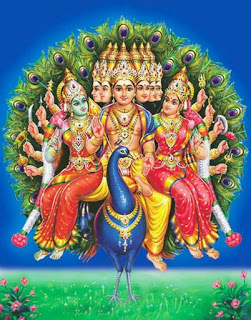
Several years ago I met a young boy in a London hospital with worried face. I approached him and started the conversation deliberately so that I could help him. When I asked him for what health problem he had come to the hospital, he told me that he was hale and healthy and the reason he came to the hospital was for a job interview. I wished him all the best and continued the conversation. When I asked his name, the country of his origin, it was a Hindu name! Oh you are a Hindu like me, I said. He refuted me at once saying that he worships Lord Murugan (Hindu God Skanda). Smilingly I explained to him that my name also Murugan’s name and he is one of the main Hindu gods. But that young boy couldn’t digest it and he repeatedly told me that he was a Muruga worshipper and in Mauritius, where from he comes, only Muruga is worshipped as main god. I told him to go back to his parents for clarification on the matter I told him.

I knew the problem with youngsters like him. Hindus living in remote areas such as Fiji, Mauritius, Guyana, South Africa are generations away from the Hindu mainland. Their names are “Non hinduized” or “dehinduized”. Many of them were taken by the British and French from the lower strata of the society and treated them as slaves. They lost or forgot their culture completely. When they were struggling for their survival as human beings, religion is relegated to the back. They don’t have good religious teachers or preachers who can attract youths. Whatever they have now as religion is the major festivals with bizarre local stories. Books on Hinduism written by the French and the English give distorted pictures. Hindus have an enormous task of supporting, educating and elevating those people. This is an internal problem, internal threat. Someone has to write proper, uniform text books with reasonable, simple explanation for the festivals, Siva Linga worship and umpteen other issues. Though thousands of Hindu cults, groups, sects, sub sects, Sath Sang groups, Ashrams, Yoga centres, Babas, Swamijis and Mutts exist, not many are bothered about uniting them under one banner. Each one is promoting his or her own organisation.


Even in Face book I see several people put several quotations in the name of Bhagavad Gita. Like Einstein is quoted in several hundred quotes which he never said, Lord Krishna’s name is dragged into several statements. I react to such posts immediately saying that ‘could you please give me the chapter and sloka number.?’ Then they keep quiet. So, we must first create awareness amongst our own people.


-Subham–


Highlights of London Ratha Yatra 2017 (Post No.4033)


Written by London Swaminathan
Date: 28 June 2017
Time uploaded in London- 18-16
Post No. 4033

 
Pictures shown here are taken  by me.


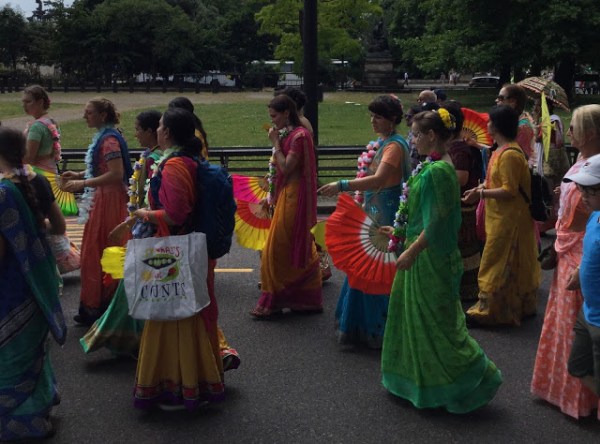
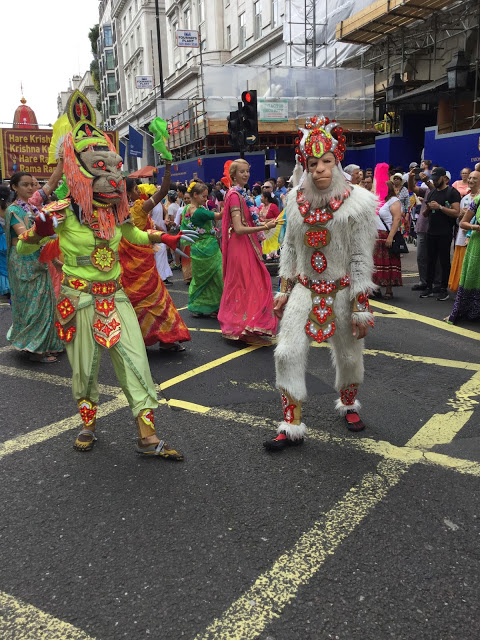
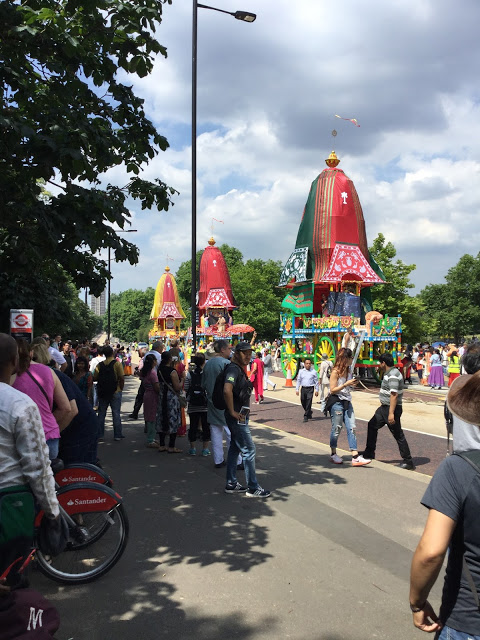
London Ratha Yatra, chariot procession organised by ISKCON, was held in London on 18th June 2017. It started at Hyde Park corner and finished at Trafalgar Square. Since it went through the heart of London thousands of tourists watched from their buses or from the hotels. As usual thousands of devotees took part in it. Several hundred-people travelled from far off places.


Every year at least one or two people dress them selves as Radha and Krishna. This year also two youngsters came in that disguise. Normally they attract more attention than anyone else. All the devotees and tourists pose with them and take photographs.


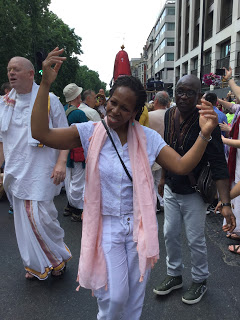
Dancing and singing by the devotees evoked good response from the general public. I saw severa hotel staff who watched it along with the tourists from the gates of their hotels also sang Hare Krishna,

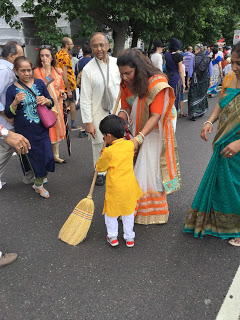
There was a good rush to sweep the floor with the holy broom. The idea is to clean the street of dust where the Lord’s Rathas come. Three chariots were pulled by hundreds f volunteers with great enthusiasm.

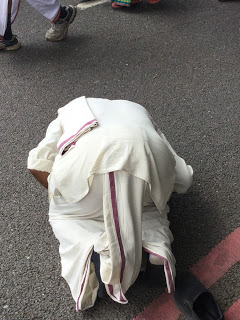
Krishna Devotees  fell (prostrated) on the roads to do the traditional namaskaram. Lot of youngsters in colourful dress added colour to the show. At the end of the procession free food was distributed. The crowd is increasing steadily every year.


Krishna devotees were distributing leaflets, books and Prasad (nuts and fruits) all along the route. If it is a political or other religious procession there will be high security and visible police presence. With Hare Krishna Ratha Yatra I have never seen police or security. Everything was maintained by the dedicated volunteers.


When the chariots (Rathas) were going through roads with heavy traffic, volunteers stood at the edge of the procession and see that the crowd not spilling over. It was an orderly crowd.

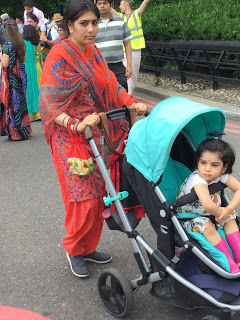
I have seen at least 15 mothers wheeling their prams with babies. Though it was a hot sunny day they were following it for over three hours!

Spectators, particularly tourists, joined the dancing and singing Some black couple joined the devotees and danced for some time. Though all the 25+ Tamil temples do the traditional chariot processions in their respective areas, this is the only procession allowed through Central London. When I came to London in 1987, I just watched it from the point it started. Nowadays I walk with the rathas and take photographs. Please see the photos taken by me posted with this write up.


–Subham–

Yoga without Religion is Dangerous! (Post No.4026)

Written by London Swaminathan
Date: 26 June 2017
Time uploaded in London- 11-15 am
Post No. 4026

Pictures shown here are taken  by me in Lisbon, Portugal on 25th June 2017; They are taught Yoga by a genuine swamiji Sri Amrta Suryananda Maharaja.

International Yoga day is celebrated on 21st June around the world. Though Jagatguru Amrta Suryananda Maharaja of Lisbon, Portugal proposed this in Bengaluru and got the consent from other famous and popular Yoga Gurus of India in 2011, it is Narendra Modi, Prime Minister of India who made it more popular.


Yoga is a multibillion dollar business today. But one unfortunate thing about Yoga is that it has been hijacked by bad elements in some parts of the world. They do business with the ‘Yoga seal’ (Mudra). Some of them are moving away from the ideals of yoga. We see Yoga Mudra in Indus seals and Egyptian statues. It originated in India. Buddha who was born as a Hindu followed the traditional Yoga taught by Patanjali and attained wisdom under the Bodhi tree. Both Mudra and Bohi (Peepul tree) are important for the Hindus. Brahmins who recited Vedas used Bodhi sticks (Peepal or Ficus religiosa) for their fire rituals every day and it is seen in Indus seals as well. Brahmins who recited Vedas followed Asana postures during their ‘thrice a day ritual called Sandhya Vandhanam’. Buddha whose first Gurus were Hindus taught him these things. So his famous posture with fingers showing different Mudras became very attractive.


From Hindusim it went to Buddhism and now all people have started Yoga schools around the world. They have adapted it to suit their business needs. Nowadays Tom, Dick and Harry and Mary, July and Samantha are running YOGA schools!!!


Big exhibitions are held in the Olympia hall in London every year, attracting lot of Yoga businesses. There are umpteen Yoga magazines published around the world. Someone in America started wrestling yoga, another one started selling Yoga beer; in short the word YOGA is misused and abused. There is no central authority to control this. Some religions banned Yoga because it is basically Hindu. Very true. It is Hindus’ property.


If some says Yoga has nothing to do with religion, please don’t believe it. It is based on religion. If there is no religion in Yoga and Asanas it will leads to many dangers.


Hindu Forum of Europe Discussion

Hindu Forum of Europe held its AGM in Lisbon on 23rd of June 2017. Mr Radj Bhondoe (of Nethrlands) who has done lot of research in this filed spoke on this topic and emphasized that we should create awareness about Yoga. He pointed out Yoga without dharma is just gymnastics. Yoga without religion is just circus.


There can be different types of Yoga, different schools of Yoga. There is nothing wrong in it. We can adapt it according to our own needs. It is not possible to use just mats made up of grass in Western countries; we may use Yoga mats made up of recyclable materials. But if someone says that anyone can do Yoga without the traditional controls, it is dangerous.

Yoga is taught with the Yamas and Niyamas, in short physical and mental controls. Without these controls, it will open up a Pandora’s Box –other dangers.

Yoga Murder, Yoga rape, Yoga Robbery!

In the Hindu Forum meeting, I was invited to make some comments on Radj Bhonde’s talk. I readily agreed with him. I pointed out we read several news items about saints and ascetics, Babas and Swamijis involved in Rape, murder and theft cases. I warned that the same thing would happen in this field. If there is no control over our physical and mental behaviour it will be disastrous. We may even hear about Yoga murder, Yoga Rapes, Yoga robberies and Yoga thefts. We must warn all the Hindu organisations to create awareness. We don’t need to insist the slogan ‘Yoga without Hinduism is dangerous’; but we must say ‘Yoga without Dharma is dangerous’. Physical and mental controls are essential for yoga practisioners


What I have not told in the Hindu Forum meeting is given below:


Sabarimala, the famous pilgrim centre in Kerala, India attracts 20 million pilgrims within a short span of time- just 40 days. In the olden days, only genuine devotees went to have darshan of Sri Ayyappa alias Dharma Sasta. The very word Sasta gave the English word System. It was a disciplined movement at one time. Now it has become a fashion to wear black/blue dhotis or and black shirts with a Tulsi or Rudraksha mala (garland ); after forty days of fasting their behaviours becomes obnoxious. Some even abused the uniform and robbed people or raped women according to newspaper stories. Fortunately, it was not widespread and now under good control. But Ayyappa devotees don’t command the respect they commanded at one time. Some of them are disciplined only for FORTY DAYS or a Mandala. Yoga may go that way if there is no control.

According to my statistics, there are more Non-Hindus practising “yoga” than the Hindus in the western countries. There are more “Yoga”schools run by westerners than Hindus in European countries. A non-vegetarian or a drinker of alcohol can’t be a Yoga practitioner.  Unless they have the body control and mind control, it is just physical exercise they do. Let them do it for their own health. But it is NOT Yoga. Yoga aims to give a long life in a sound body so that the body can be used to reach spiritual heights. Please spread this awareness. Never ever repeat the words “Yoga has nothing to do with religion”. It is religion; religion of Dharma; religion of self control; religion of good qualities (Satva Guna). Let others tell they teach breathing exercises or Postures for flexible body movements. Don’t abuse or misuse the words ‘Yoga’ and ‘Asana’. Hindus living in Western countries must proclaim this to the world.


(My sincerer thanks to Radj Bhondoe for bringing up this subject for discussion).

I will write about how genuine Yoga that is spread in Portugal by Swami Amrta Suryananda Maharaja tomorrow; I have just returned from Portugal to London)


Mrs Nandini K.Sigla, Indian ambassador to Portugal, is doing Yoga with swamiji’s disciples

–Subham–