Three Books on a ‘Deity with a Thousand Names’: Vishnu Sahasranama

Compiled from London swaminathan

Post No 1806; Date 17th April 2015

Uploaded in London at 15-24

The first book review is from my old paper cuttings file; before I destroy the paper cuttings, I want others to read it. Published on 9-11-99; probably in The Hindu

Sree Vishnu Sahasranama – A Treatise: Kalluri Suryanarayana;Sankhyayana Vidhya Parishad, H No.2-12-34, Annapurna Colony, Uppal, Hyderabad- 500039, Rs.153

The religious importance of Vishnu Sahasranama can be gauged from the nearly forty commentaries by saints and scholars for this most popular hymn; three of them have been rendered by the leaders of the three different systems of Hindu philosophy.

Of them Adi Shankara’s was the first and a version says how when he wanted to write his commentary on another Sahasranama, this work was placed before him.

His was based on Advaita, while the Dwaita approach was by Sri Satya Sandha Tirtha whereas the “Bhagavad Guna Darpana” was by Parasara Bhattar as per Vishishtadwaita school. The entire work, as contained in the Mahabharata, refers to the glory of Vishnu.

The treatise by the author, with Sanskrit text and English annotation, explains the significance of the 1000 names. Since the English meaning of this hymn is given in this work, many in this country and those living abroad, will welcome it. The author points out that the commentary of Sankara is like that of River Ganges, of Bhattar’s like Yamuna of the Madhwa saint’s as Saraswati. Every name is a mantra by itself, some with two and some ranging up to eight words. The hymn is an antidote for all ills.

The author mentions the benefits which will accrue by  by reciting the various name of Vishnu. One gets immortal ecstasy by chanting the names.  He connects twenty four Bhijaksharas of Gayatri mantra to the 24 names of Vishnu. In his commentary, Sankara has explained the glory of Visnu in Saguna and Nirguna forms, fit for meditation to attain the merger of Jeeva with the Paramatma.

The brief meaning of each name is simple as for instance for “Kshamaya”, the author says that for devotees who could not realise him earlier, Vishnu will confer liberation immediately when they start meditating on Him. The hymn can be chanted by everyone and for this, , no special ritual is prescribed. The book will quench the thirst of people who wish to achieve progress in the realm of spiritualism. The name of Koorattazhwan has been mis-spelt in the book giving an unsavoury meaning—DVV

Two More Books on Sahasranama

Thousand Ways to the Transcendental by Swami Chinmayananda

Central Chinmya Trust, Mumbai -400 072, 2009, Price Rs 115

“There is a deep connection between the name and the named. The name brings to our mind the image of the person thought of and the more one thinks, the more consistent the impressions. Eg. When I say flower, you immediately conceive a mental picture of the flower. This is the sole principle behind association.

“The 1000 names of Lord Vishn are meant to invoke a sense of bonding with the Lord, who’s the most intimate one, whether we recognise it or not. Yet how often and how deeply do we call out to him? The meanings of the names given out here will help in understanding the magnitude and depth of Godhood.

Vishnu Sahasranama was taught by Bhisma lying on a Bed of Arrows to Yudhisthira. It bought joy and solace to both. May t do the same to you as well”

“In the Thousand Names, 90 names have been repeated; and of them 74 are repeated twice, 14 are repeated thrice, and again two of them repeated four times.

“There are exactly 1031 single “Names” of Lord in the 1000 Name Chant (Sahasranama). The extra 31 names to be considered each as an adjective qualifying (vishesana) the immediately following noun”.

(This book contains how to use the names in Archana)

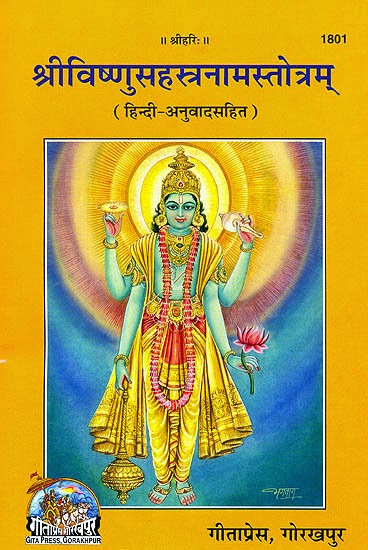
SRI VISHNU SAHASRANAMAM by Swami Tapasyananda, Sri Ramakrishna Math, 16 Ramakrishna Math Road, Mylapore, Madras – 600 004

From Introduction:

Vishnu Sahasranama is part of the Santi Parva of the Mahabharata. Tradition says that it was composed by Sanaka, one of the Kumaras (eternal living youths) and was transmitted to Bhisma who recied in the presence of Sri Krishna to the Pandava brothers when he was questioned by Yudhisthira “Who is the Being who is the Supreme Lord of all and by praising and worshipping whom man gains what is good and attains salvation?” The Thousand Names of Mahavishnu is the answer Bhisma gives to this enquiry. Besides its inherent quality, the importance of the Stotra is enhanced by the fact that no less than a personage than the great Sri Sankaracharya thought it worthwhile to write a commentary on it, expounding the meanings of the various names that find a place in it.

My comments: Read Vishnu Sahasranama every day and solve all your problems the easy way!

PUN IN SANSKRIT LITERATURE

lang_tree

Picture of language tree

Written by S Nagarajan

Article no. 1721; dated 16  March 2015

Up loaded at 8-25 am London time


PUN IN SANSKRIT LITERATURE

By S.NAGARAJAN


The book under review titled Pun In Sanskrit Literature – A New Approach is a fantastic book.

All Sanskrit lovers and pun lovers should read this book without fail.

The book was first published by Mysore University, India in 1982. The author Gurupad K Hegde is a great scholar and has written this book after intense study of Sanskrit literature for many years.

The book has nine chapters.

sanskrit

The first chapter deals with the pun as alankara in Sanskrit literature.

The origin of pun starts with the first kavya (adi kavya) of the world written by the world’s first poet, sage Valmiki.

The origin of Ramayana is from a sloka of pun! The verse starts with ‘ma nisada’ is a curse on the hunter that he should never attain salvation for he killed the beautiful krauncha bird which was absorbed in love. And wonderfully, the verse also means that the great Lord Vishnu may attain a position for ever as he killed the demon Ravana and Vali.

The author describes in detail the root cause of the concept of fun, the nature of the words in pun and objects of the pun in the second chapter.

The author gives numerous examples to explain the figurative combinations in the great and beautiful language Sanskrit in chapter three.

Chapter four of the book deals with the role of pun in classical Sanskrit literature. The author indicates Shakespeare’s lines in Othello (III-2) The word ‘lies’ in the conversation of Desdemona and Clown is a witty use of pun to mean ‘lodging’ as well as telling a lie!

TREES

The great poets Sri Harsha, Bhavaputi, Asvaghosa, Bharavi, Magha, Dandin have used Slesha or pun in their works.

And it is to be noted that the only language which has kavyas where two or more stories are narrated throughout the full length of a poem is Sanskrit. Thus we have kavyas which describes Ramayana and Mahabharata in the same verse!

Needless to say that the author has dealt the Mahabharata kuta slokas which means the slokas with knots!

While the fifth chapter deals with functional pun and the sixth chapter deals with perceptional pun and the seventh with situational pun! The eighth chapter of the book deals with the impact of pun in iconography.

The author concludes in his concluding chapter that pun is everywhere starting from vedic literature to the modern literature which gives the experiences of day to day business of life.

Over three hundred selected verses are given as examples to understand the pun in Sanskrit literature.

On completing the book we are wonderstruck with the author’s deep reading as well as with the vastness of the wonderful t Sanskrit literature!

Index of subject and index of 300 verses will be useful to the readers.

Finally, we may pray that more such books should come to enlighten us!

*******************