Karma Theory-Buddha and Valluvar Think Alike -Part 6 (Post No.3935)

Research article written by London Swaminathan


Date: 23 May 2017


Time uploaded in London: 21-19


Post No. 3935


Pictures are taken from various sources such as Face book, google and newspapers; thanks.


contact: swami_48@yahoo.com


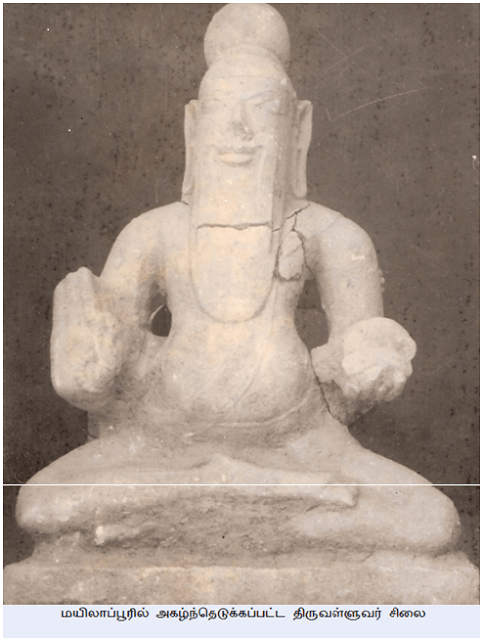
Thiruvalluvar , the author of the Tamil Veda Tirukkural has confirmed his belief in Karma Theory in hundreds of his couplets. There is one chapter on Fate as well; here are two important couplets from Tirukkural:

Toil not through sacred books to what the fruits of virtue/Dharma are; but pause and look at the palanquin bearer, and him that proudly rides in it Kural 37).

Loss and gain come about because of one’s own previous actions;

But an unswerving rectitude of mind is the ornament of the great (Kural 115)


By oneself the evil is done, and it is oneself who suffers; by oneself the evil is not done, and by one’s Self one becomes pure The pure and the impure come from oneself: no man can purify another (Dhammapada 165)

Only a man himself can be master of himself; who else from outside  could be his master. When the Master and the servant are one, then there is true help and self possession (Dhammapada 160)


The most famous poem of Sangam Tamil Literature verse 192 of Purananuru explains Karma Theory beautifully well:

“Every town our home town; everyman a kinsman.
Good and evil do not come
From others
Pain and relief of pain
Come of themselves.
Dying is nothing new.
We do not rejoice
That life is sweet
Nor in anger
Call it bitter.
Our lives, however dear,
Follow their own course,
(like) Rafts drifting
In the rapids of a great river
Sounding and dashing over the rocks
After a downpour
From skies slashed by lightning’s
We know this
From the vision
Of men who see
So,
We are not amazed by the great
And we do not scorn the little”
————————-Kaniyan punkundran (Pura Nanuru, verse 192)


Another translation of the same poem:

To us all towns are one, all men our kin,
Life’s good comes not from others’ gifts, nor ill,
Man’s pains and pain’s relief are from within,
Death’s no new thing, nor do our bosoms thrill
When joyous life seems like a luscious draught.
When grieved, we patient suffer; for, we deem
This much-praised life of ours a fragile raft
Borne down the waters of some mountain stream
That o’er huge boulders roaring seeks the plain
Tho’ storms with lightning’s flash from darkened skies.
Descend, the raft goes on as fates ordain.
Thus have we seen in visions of the wise !
We marvel not at the greatness of the great;
Still less despise we men of low estate.
Kaniyan Poongundran, Purananuru – 192
(Translated by G.U.Pope, 1906)

xxxxx

Refraining from eating Meat

All living beings will raise their hands in worship to him who has never taken a living being’s life and has abstained from eating meat (Kural 260)

How can a man be compassionate who, for the purpose of increasing his own flesh, etas the flesh of other animals (Kural 251)

All beings tremble before danger, and fear death. When a man considers this, he does not kill or cause to kill (Dhamma 129)

Also see Vegetarianism in earlier post of Buddha and Valluvar thnk alike.

xxx


Friendship with Great men

Weigh the worth of the men of ripe wisdom and seek their fellowship (Kural 441)

Cherish with ardour the friendship of those who remedy your present ills and guard you against future ones. (Kural 442)


Cling to men of heroic mould and make them your kin; verily there is no greater blessing to you on earth (Kural 443)

Is there any force mightier to the sovereign than the alliance of the men of superior wisdom? (Kural 444)


If you find a man who is constant, awake to the inner light, learned, long suffering, endowed with devotion, a noble man – follow this good and great man ever as moon follows the path of the stars  (Dhammapada 208)


He who has to walk with fools has a long journey of sorrow, because to be with a fool is  as painful as to be with an enemy; but the joy of being with the wise is like the joy of meeting a beloved kinsman  (Dhammapada 207)


Adi Shankara’s Satsangatve nissangatvam…………

Greatest philosopher of India, Adi Shankara, says,
“ Satsangatve nissangatvam
Nissangatve nirmohatvam
Nirmohatve nischalatattvam
Nischalatattve jeevanmuktih” –Bhajagovindam (9)

“Through the company of the good, there arises non-attachment; through non-attachment there arises freedom from delusion; through freedom from delusion there arises steadfastness; through steadfastness, there arises liberation in life”- Bhajagovindam

He who knows not and knows not………………………

An ancient saying from the Middle East says:

He who knows not, and knows not that he knows not, is a fool. Shun him.
He who knows not, and knows that he knows not, is simple. Teach him.
He who knows, and knows not he knows , is asleep. Wake him.
He who knows, and knows that he knows is wise. Follow him.


–Subham–


Go Higher and Higher- Buddha and Valluvar Think Alike! -Part 5 (Post No.3931)

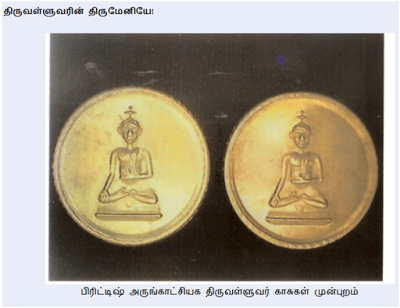
Valluvar coins in the British Museum

Research article written by London Swaminathan


Date: 22 May 2017


Time uploaded in London: 14-52


Post No. 3931


Pictures are taken from various sources such as Face book, google and Wikipedia; thanks.


contact: swami_48@yahoo.com


Lofty Thoughts

Valluvar:

Think lofty thoughts always; even if you fail your aspirations keep you on a higher plane (Kural 596)


Those who have high thoughts are ever striving; they are not happy to remain in the same place. Like swans that leave their lake and rise into the air, they leave their home for a higher home ( Dhammapada verse 91).

Buddha:

Swans follow the path of the sun by the miracle of flying through the air. Men who are strong conquer evil and its armies; and then they arise far above the world ( Dhammapada verse 175).

Aim high is one of the concepts or ideas that Hindu saints put forth before their disciples. First we found it in the great scripture Bhagavad Gita and then in a Sangam Tamil verse. Later Tamil poet Tiruvalluvar also repeated this.

Lord Krishna

Let a man lift himself by himself; let him not degrade himself, said Lord Krishna in the Bhagavad Gita (6-5)

Buddha also said the same in the Dhammapada: The Self is the Lord of the Self (verse 380)

xxx

Who is a Brahmin?

Valluvar:

It is the virtuous that are called Brahmins; for it is they that scatter kindness towards all living beings (Kural 30)

Buddha:

Because he has put away, he is called a Brahmin, because he lives in peace, he is called a samana; because he leaves all the sins behind he is called a pilgrim (Dhama. verse388)

He who hurts not with his thoughts or words or deeds, who keeps these three under control – him I call a Brahmin ( Dhamma.391)

Dhammapada chapter 26: verses from 383 -423 are about Brahmins

xxx


Don’t Postpone Good Things

Valluvar:

Do the deeds of charity now without postponing them to your old age; for they will be an unfailing help to you in the hour of death (Kural 36)

Buddha:

Make haste and do what is good; keep your mind away from evil. If a man is slow in doing good, his mind finds pleasure in evil (Dhammapada 116)


xxx

Evil Thoughts destroy you!

Valluvar:

Do not wish for another’s ruin even absentmindedly. If you do, your own ruin is certain to befall (Kural 204)

There is a way of escape from the wrath of every other foe; but the evil deeds of a wicked man relentlessly pursue him down to utter ruin (kural 207)

If a man cares for the well- being of his own self he should do no harm whatever to others (209)


Buddha:

The fool who does an evil to a man who is good, to a man who is pure and free from sin, the evil returns to him like the dust thrown against the wind (Dhamma.125)

xxx

Harsh Words

Valluvar:

A burn caused by fire may heal; but a scar caused by a fiery tongue will never heal (Kural 129)

Buddha:

Never speak harsh words, for once spoken they may return to you. Angry words are painful and there may be blows for blows (Dhammapada 133)

xxx

Don’t Invite Yama-God of Death

Valluvar:

The weak who insult and offend mighty men of wisdom only invite death with their own hands (Kural 894)

Should they who stand (as high) as the hills look with disfavour, even men of firm standing in the world perish with all race (Kural 898)

Buddha:

The fool because of his view scorns the teaching of the holy, those whose soul is great and righteous, gathers fruits of his destruction, like the kashta reeds whose fruits mean its death (Dhamma 164)


–Subham–


‘For the Many, Not the Few’-Who said it? (Post No.3920)

Written by London Swaminathan


Date: 18 May 2017


Time uploaded in London: 17-56


Post No. 3920


Pictures are taken from various sources such as Face book, google and Wikipedia; thanks.


contact: swami_48@yahoo.com

Britain is holding a snap election on 8th June 2017. Ruling Conservative party and the opposition Labour party are launching their election manifestoes with attractive new slogans. The Labour party’s slogan “For the Many and not the Few” have hit the headlines in newspapers.


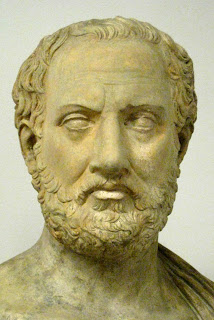
There is a very lively discussion to find out who uttered these words for the first time. They have traced it to Greek historian Thucydides (460-400 BCE). Some argue that English poet P B Shelley is the one who popularised it. Here is the news item from Evening Standard newspaper.


“We’ve found Labour Party Leader Jeremy Corbyn’s inspiration: Romantic poet Percy Bysshe Shelley. Corbyn launched his manifesto in Bradford yesterday with the stirring slogan “For the many, not the few.” 

The Times’s Philip Collins says the phrase comes from Greek historian Thucydides, from around 400 BC. “Its origin is the Funeral Oration of Pericles [by Thucydides]”, he writes, talking about the foundations of democracy.

But UCL English professor John Sutherland says no. “‘For the many not the few’ actually comes from Shelley’s poem The Masque of Anarchy,” he told The Londoner when we called yesterday.

Over to Corbyn’s election guru James Schneider. Was it, in fact, Shelley? Schneider was thrilled to be asked and show his fine education at Winchester College and Oxford. He recited the poem word perfectly down the phone.


“Rise, like lions after slumber 

In unvanquishable number!

Shake your chains to earth like dew

Which in sleep had fallen on you

Ye are many — they are few.”


He said, cheerfully. On the competing theories, Schneider went on to say: “Thucydides is interesting,” he said. “I didn’t know it , so I doubt it comes from there. Shelley is more well-known. It would be a stretch to say that it is directly taken from Shelley [though] Jeremy does know Shelley.

“The slogan very simply sums up our programme to change Britain.”

Romantic poet Shelley wrote his poem following the Peterloo Massacre of 1819 in Manchester, in which around 15 protesters, fighting for democracy and against poverty, were killed by cavalry. The work is read as an early modern statement of nonviolent resistance, and is popular with JC’s supporters: in Corbyn’s second Labour leadership campaign last year, former Labour MP Chris Williamson suggested it as a slogan. “Let’s use that as our battle cry,” he said at a public meeting.


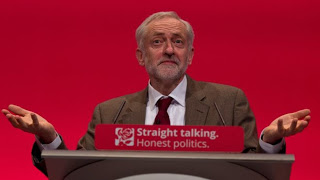
Picture of Labour Party leader Jeremy Corbyn


Corbyn is known to be well-read, saying he has finished James Joyce’s Ulysses four times.

Does the phrase make Jeremy a Romantic, we asked Sutherland? “Yep. Romantic not Modernist,” he said. “The poets are with Jeremy but who ever paid any notice to them.”

–Subham–


Buddha and Valluvar on Vegetarianism and Hypocrisy: Great men Think alike (Post No.3913)

Written by London Swaminathan


Date: 16 May 2017


Time uploaded in London: 10-55 am


Post No. 3913


Pictures are taken from various sources; such as Face book, Wikipedia; thanks.


contact: swami_48@yahoo.com


Please read the First part published on “Buddha and Valluvar: Great Men Think alike”, posted on 13th May


Tirukkural was written by Thiruvalluvar

Dhammapada is the Holy Book of the Buddhists.

VEGETARIANISM


Better to refrain from killing and abstaining from eating the flesh obtained thereby, than kindlin a thousand sacrifice fires (Kural -259)

All living beings will raise their hands in worship to him who has never taken a living beings life and has abstained from eating meat (Kural -260)


And Buddha in Dhammapada says

A man is not a great man because he is a warrior and kills other men; because he hurts not living beings he in truth is called a great man (270)


HYPOCRISY


It matters not whether a man shaves his hair or allows it to grow in flowing locks if he could refrain from what the world shuns (Kural -280)

And Buddha in Dhammapada says,

Not by the tonsure, a shave head, does a man become ‘samana’, a monk. How can a man be a samana/monk if he forgets his religious vows, if he speaks what is not true, if he still has desire and greed (264).

He says the same in couplets 141 and 393 of Dhammapada.


Adi Shankara in his Bhaja Govindam also echoes his views,

Adi Shankara’s Bhaja Govindam says,

“The ascetic with matted locks, the one with his head shaven, the one with hairs pulled out one by one, the one who disguises himself variously with the ochre coloured robes – such a one is a fool who, though seeing does not see. Indeed, this varied disguise is for the sake of the belly”.
This verse in the hymn is attributed to Totaka, a disciple of Shankara.


CHARITY

The ability of those who perform penance to endure hunger is not equal to that of the householder to appease the hunger of others (Kural 225)

The graceless misers who hoard up their wealth and eventually lose it, do not know the pleasure which the wise derive in giving to the poor (Kural 228)

And Buddha in Dhammapada says,

Speak the truth, yield not to anger, give what you can to him who asks: these three steps lead you to the gods.-(Dhamma 224)


TRUTHFULNESS


If a man could conduct himself true to his own self he would be in the heart of all in the world (Kural 294)

Buddha says,

He who has virtue and vision, who follows Dhamma (Dharma= righteousness) the Path of Perfection, whose words are truth, and does the work to be done – the world loves such a man (217)


—–to be continued


–Subham—

Courage and Reputation! Zen Story (Post No.3909)

Written by S NAGARAJAN


Date: 15 May 2017


Time uploaded in London:-  5-35 am


Post No.3909


Pictures are taken from different sources; thanks.


contact: swami_48@yahoo.com


Courage


There is an inspirational Zen story on Courage:


There was a boy who was born without a right arm. On his ninth birthday he asked his parents if he could join a karate club. They were delighted by the idea and the boy quickly became a regular at the local dojo. The boy wanted to compete in a tournament and asked his master if this was possible. The master said he could but only if he listened carefully to his master and trusted him.


The master taught the boy one move and one move only. The boy practised it diligently but after a while he was worried that the other boys were learning a range of moves and he only had one. He asked the master to teach him other moves but the master said no. The master just urged the boy to keep practising that one move.


The boy won the first round of the tournament and then the next round and the one after that until he found himself winning the entire tournament. The boy was baffled. How did he do it? He asked the master how a boy with only one arm and only one move could win a karate tournament against these other boys. The master smiled and told the boy that there is only one defence against the move the boy learned and that defence involves grabbing the attacker by the right arm.


Have courage. Do not run as a coward when you are facing inevitable problem.


There is an anecdote about an Athenian.


An Athenian, who was lame in one foot, was laughed at by the soldiers on account of lameness.


“I am here to fight,” said he, “not to run.”


xxx


Reputation


Before checking anybody’s reputation please check your reputation and how others view and think about you.

The following anecdote will throw insight on reputation.


One of the powerful figures in Wall Street fell in love with an actress and for many months danced constant attendance upon her and squired her about in the fashionable circles of town. Deciding  to marry her, he first prudently put a private detective to the job of looking into her antecedents in order to guard himself against any rash mistake.


At last he received his agent’s report. “Miss Blank enjoys an excellent reputation. Her past is spotless. Her associates have been irreproachable. The only breath of scandal is that, in recent months, she has been much seen in the company of a business man of doubtful reputation.


Check yourself first before checking others!

***


Buddha and Valluvar: Great Men Think Alike! (Post No.3905)

Written by London Swaminathan


Date: 13 May 2017


Time uploaded in London: 20-30


Post No. 3905


Pictures are taken from various sources; thanks.


contact: swami_48@yahoo.com


Buddha and Thiru valluvar were great men Dammapada of Buddha and Tirukkural of Thiru Valluvar have amazing similarities in several couplets.


SAINT

He who controls his five senses by his will gain heavenly bliss (Kural 24)

They take trained elephants to battle, kings ride on royal trained elephants. The best of men are self trained men , those who can endure abuse in peace. (Dhamma 321)


xxx

KNOWLEDGE

It is folly not to fear what should be feared;

to fear that which should be feared is the way of the wise (Kural -428)

Better to do nothing than to do what is wrong, for wrong doing brings burning sorrow. Do therefore what is right, for good deeds never bring pain (Dhamma 314)


Lord Krishna also said,

For never does any one who does good, tread the path of woe (Bhagavad Gita 6-40)


CONSIDERATION

It is ruinous to do what should not be done.

and ruinous also to omit what should be done (Kural -466).

xxx

PURITY and ADULTERY

The man who commits adultery can never escape enmity, sin, fear in infamy (Kural -146) .

Four things happen to the thoughtless men who takes another man’s wife: he lowers himself, his mind is restless, he is blamed by others, he goes to hell (Dhamma 309)

Yes. The degradation of the soul, a frightened pleasure, the danger of the law, the path of hell. Considering these four let not a man go after another man’s wife(Dhamma 310)


xxx

IMPARTIALITY

Like scales that always remain just and fair, wise men remain impartial and do not take sides (Kural -118).

If a man is silent because he is ignorant or a fool, he is not a silent thinker, a Muni/sanit who considers and think. But as one who taking a pair of scales, puts in what is good and rejects what is bad, if a man considers the two worlds, then he is called a Muni/saint of silence, a man who considers and thinks (Dhamma 268, 269)

Lord Krishna also said the same,

Sages see with an equal eye a learned and humble Brahmin, a cow, an elephant or even a dog  o an outcast ( Bhagavad Gita 5-18)


to be continued…………………..


–Subham–
Duelling Anecdotes (Post No.3902)

Compiled by London Swaminathan


Date: 12 May 2017


Time uploaded in London: 17-45


Post No. 3902


Pictures are taken from various sources; thanks.


contact; swami_48@yahoo.com


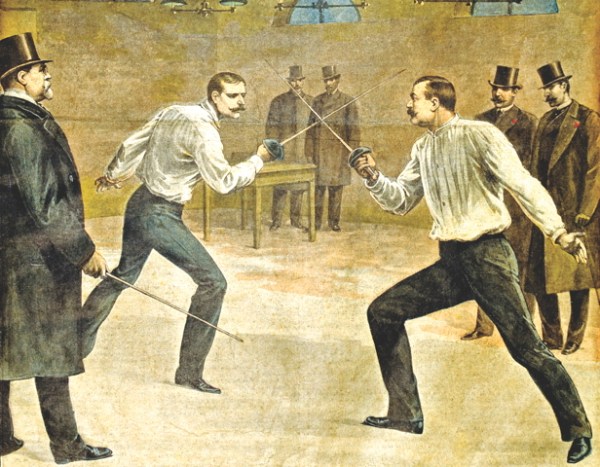
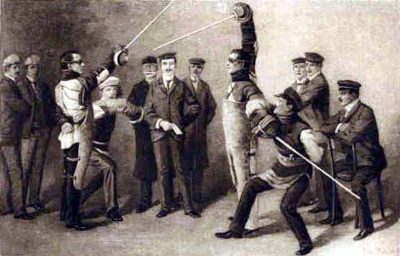
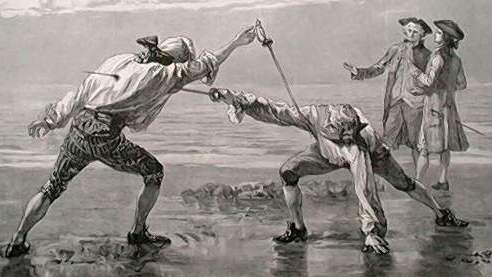
On one occasion Lord Alvanley fought a duel with Morgan O Connell on Wimbledon common. It appears that several shots were fired without effect, and the seconds then interfered and put a stop to any further hostilities. When his hackney coach drove up to his door Alvanley gave the coach man a sovereign. Jarvey was profuse in his thanks and said

“It is a great deal for only having taken your lordship to Wimbledon”.

“No, my good man”, said Alvanley ,

“I give it to you, not for taking me, but for BRINGING ME BACK”.


Xxxx

BISMARCK

When Professor Rudolf Virchano, famous German scientist, criticised Bismarck severely in his capacity as chancellor, Bismarck challenged him to a duel.

“Well, Well”, said the scientist to the Iron Chancellor’s seconds ,

As I am the challenged party , I suppose I have the choice of weapons. Here they are”. And he held up two large sausages which looked exactly alike.

“One of these, he continued, is infected with the deadly germs of trichinosis, the other is perfectly sound. Let his Excellency do me the honour to choose whichever he wishes, and eat it, I will eat the other

Within an hour the Iron Chancellor had decided to laugh the duel off.


Xxxx

MIRABEAU

Mirabeau, the French statesman received many challenges to duels. He always answered this way

Sir your favour is received, and your name is on my list, but I warn you that the list is long and that I give no preferences”.

—SUBHAM–

Two Words Please! ‘You Lose’ (Post No.3898)

Compiled by London Swaminathan


Date: 11 May 2017


Time uploaded in London: 21-11


Post No. 3898


Pictures are taken from various sources; thanks.


contact; swami_48@yahoo.com


Talking Anecdotes – part two


A lady stepped into a taxicab at Grand Central (New York). The driver swung out into traffic, and at the same time asked,

“Do you want the radio, lady, or shall we just talk?”


Xxx


YOU lose!


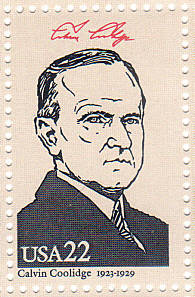
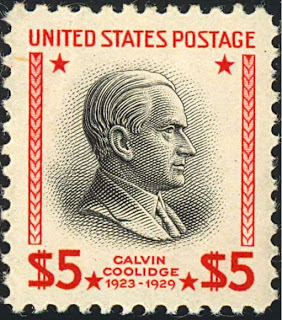
A prominent Washington society woman was sitting next to President Coolidge at a smart party.

“Oh! Mr President, she said gushingly,

“You are so silent. I made a bet today that I could get more than two words out of you”.


“You lose”, the president replied

xxxx

LACK OF PRACTICE!

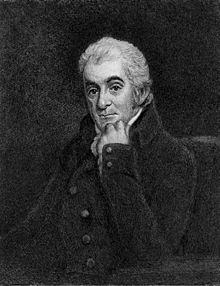
Samuel rogers had a reputation for quiet, venomous wit. Knight was a great talker and a bad listener. When Rogers was told that Knight was going deaf, he remarked,

“It is from lack of practice”.


Xxxx


NICE WEATHER!

It was Mark Twain , on a balmy day of spring, who was hailed by every passing acquaintance with some observation on state of the weather . Upon arriving at his destination and being greeted with

“Nice day”, Mr Twain, he replied drily,

“Yes, I have heard it very highly spoken of”.


Xxxx

A MAN HAS TO SOMEWHERE!

When Coolidge was Vice President, he was invited to attend many dinners. Always he was the despair of his hostess because of his utter disregard of the art of conversation. One lady felt that she had solved this problem by placing him next to Alice Roosevelt Longworth who was a most brilliant conversationalist .


Mrs Longworth began to chat in her usual charming fashion,  but failed to elicit any response from the silent Mr Coolidge.


Finally, exasperated out of her generally calm demeanour she acidly asked,

“You go to so many dinners. They must bore you a great deal”.

Calmly Coolidge replied without lifting his eyes from the contemplation of the plate before him,

“Well a man has to eat somewhere”.


Xxxx

RUDE WORDS!

A debutante went to visit her grandmother. The old lady was distressed by what she considered the girls wild and unruly manners and speech. Not wishing to appear stern and demanding she decided nevertheless that she should reprimand her granddaughter.


One evening as they were sitting together the old lady said gently,

“Dear, there are just two words I want you to refrain from using. One is swell and the other is lousy”,

“Alright” ,replied the debutante agreeably, “what are they?”


Xxx

CATHERINE THE GREAT

Diderot came to Catherine the Great in 1773 and remained for five months. On certain afternoons, he conversed with her from three to five.

I listened more than I talked, she said.

Discoursing vehemently, he would gradually draw his chair up to her knees. In his excitement, he would pound them until they were blue, compelling her to place before her a table on which he could vent his punctuation.


Xxxx. Subham xxxxx


Women! I like their Beauty, their Delicacy, their Vivacity and I like….(Post No.3895)

Compiled by London Swaminathan


Date: 10 May 2017


Time uploaded in London: 20-13


Post No. 3895


Pictures are taken from various sources; thanks.


contact; swami_48@yahoo.com


Talking Anecdotes -Part 1


Dr Johnson was one day in conversation with a very talkative lady, of whom he appeared to take very little notice.

“Why, Doctor, I believe you prefer the company of men to that of the ladies?”

Madam, replied he, I am very fond of the company of ladies, I like their beauty, I like their delicacy, I like their vivacity and I like their silence.


Xxxx

Mark Twain and Winston Churchill


Mark Twain met Winston Churchill in 1900, when the latter was just coming into prominence as a young statesman. The occasion was a dinner in London   Churchill and Twain went out for a brief time to have a smoke. Sir William Vernon Harcourt observed, as they departed, that whichever one got the floor first would keep it. He speculated that inasmuch as Twain was an older and more experienced hand, Churchill’s  voice would get the first good rest that it had had in years .

When the two men returned, Harcourt asked Churchill whether he had enjoyed himself, and the young man replied, “Yes”, most enthusiastically.

Turning to Twain, Sir William put the same question.

Twain hesitated and said,

“I have had a good smoke”.


Xxx

In Silence!


A talkative barber was trimming the hair of King Achelous ,and asked, “how shall I cut?”

“In silence”, replied the King.

Xxx

Hush Money to Barber!

King Archelaus , perpetrator of that ancient joke about replying, in silence, to the barber who asked him how he should cut his hair, would be pleased to know that his tradition is being carried on in the modern era.

A man who might well stem from this kingly line, handled the barber a coin and then climbed into the chai .

“Why, sir, thank you”, said the astonished barber,” never before have I been tipped in advance”.

“That is not a tip”, snarled the customer. “It’s hush money”.


Xxx

Need to Talk to Someone

The need to talk to someone finds its expression in everything from friendly confidences, to the confessional, to the psychoanalyst. Recently it has been commercialised by an organisation calling itself The Southern Listening Bureau of Little Rock, Arkansas.

Their advertisement proclaims

“We offer well trained and experienced listeners who will hear you as long as you wish to talk, and without interruptions, for a nominal fee. As our listeners listen, their faces portray interest, pity, fellow feeling, understanding; where called for, they exhibit hope despair, hate, sorrow or joy.  Lawyers, politicians, club leaders, reformers can try their speeches on us. You may talk freely about your business or domestic problems without fear of having any confidence betrayed. Just let off steam into the discreet ears of our experts and feel better”.


Xxxx

At a party, someone observed to Dorothy Parker that their hostess was outspoken

“By whom?”, asked Miss Parker.


—Subham–

More Brains in Your Belly than in your Head! (Post No.3893)

Written by London Swaminathan


Date: 9 May 2017


Time uploaded in London: 21-41


Post No. 3893


Pictures are taken from various sources; thanks.


contact; swami_48@yahoo.com


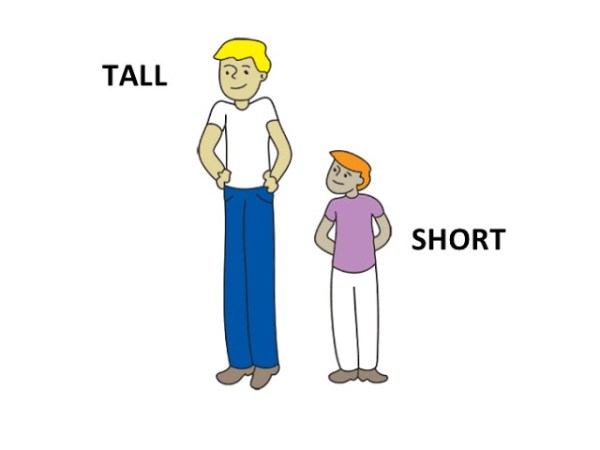
Shortness Anecdotes

Alexander H Stevens, Senator from Georgia (USA), and subsequently< Vice President of the Confederate States, was short of stature and weighed less than 80 pounds. A big Congressman from the West, in a heated debate, once said, “Why, I could swallow you and never know II had eaten a thing.”

“In that case, you would have more brains in your belly than you ever had in your head”, snapped Stevens.


xxx

Size of the Body and Brain


Dr Busby of Westminster, who was very short, was one day accosted in a public coffee-room by an Irish baronet of colossal stature with: “ May I pass to my seat, O Giant?”

When the doctor politely making way, replied, “Pass, O Pigmy! the baronet apologised.

“Oh, sir, my expression alluded to size of your intellect”.

“And my expression, Sir”, retorted the doctor coldly, “ to the size of yours”

xxx

Dismissed for a Joke!

Archbishop Laud was a man of very short stature. Charles the First and the Archbishop sat down to dinner one day when it was agreed that Archie, the King’s jester, should say the Grace for them,

“Great praise to be given to God, but little Laud to the Devil!”

For this sally, Archbishop Laud was weak enough to insist upon Archie’s dismissal!

xxx


Lincoln’s Long Legs!


A group of men were discussing Stephen Douglas and his physical peculiarities, Abraham Lincoln happened to join the men at this point and turning, from the specific subject under discussion, one of them asked the President how long he thought a man’s legs should be.


Well, drawled Lincoln, “I should think a man’s legs ought to be long enough to reach from his body to the ground.”


xxx

Tallness Anecdote

When Lincoln heard that a General who was supporting Mc Clellan’s Presidential candidacy had been relieved of his command the President countermanded the order saying,

“Supporti ng General Mc Clellan for the Presidency is no violation of army regulations, and as a aqustion of taste in between him and me – well I am the longest, but he is better than looking.”


xxx Subham xxxx