VEDIC GODS INDRA, VARUNA, YAMA IN THAILAND (Post No.5055)

Written by London Swaminathan 


Date: 28 May 2018


Time uploaded in London – 18-59


Post No. 5055


Pictures shown here are taken from various sources such as Facebook friends, Books, Google and newspapers; thanks. Pictures may be subject to copyright laws.


WARNING: PLEASE SHARE MY ARTICLES; BUT DON’T SHARE IT WITHOUT AUTHOR’S NAME AND THE BLOG NAME. BE HONEST; OTHERS WILL BE HONEST WITH YOU


HINDU GODS IN THAILAND-2

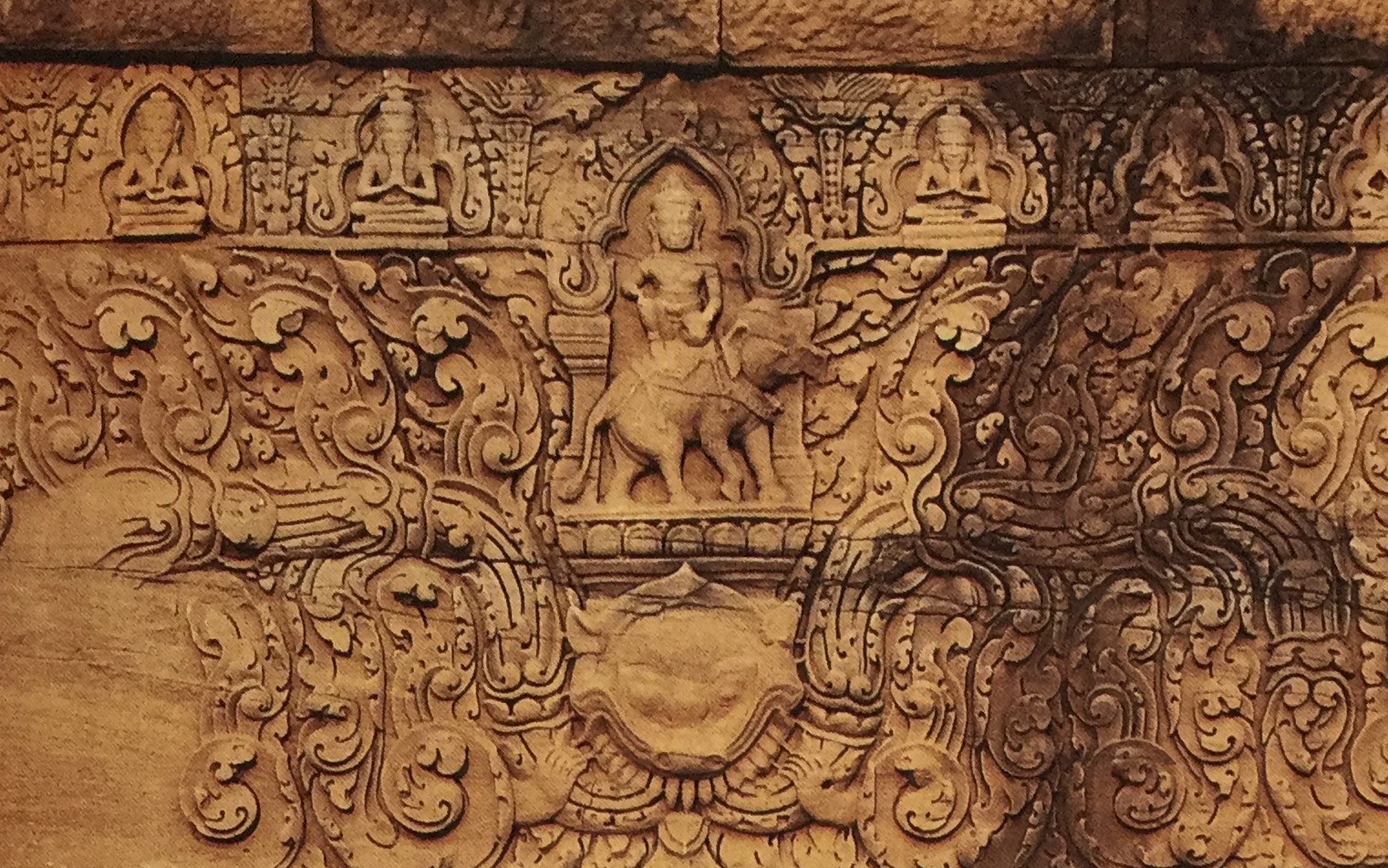
Sculptures of Vedic Gods Indra, Varuna, Yama and Kubera are found in many temples in Thailand. They are sculpted on the panels, gable and bas reliefs. Indra is more prominent than other gods. In some places he is portrayed with three headed Airavata, his elephant vehicle. In other places he is riding Airavata with one head. Varuna is sculpted with three Hamsas/swans. In India his vehicle was Makara (Crocodile or fish). Yam is riding his vehicle buffalo. It is very rare to see Kubera in India in temples. In Thailand we see him with goddess.


Along with the trinities Brahma, Vishnu and Shiva we see the Vedic Gods. But there is no temple for them. Kala, a strange figure is also found in Thai temples. Let us look at some beautiful sculptures of those Vedic Gods.


Indra

Indra with mysterious Kala with a big mouth


Indra with three headed Airavata


Varuna with three swans

Kubera with goddess of wealth

Locations

Varuna: Prasat Phimai, 12th Century

Kubera: Temple at Mo Ee Daeng

Yama:Prasat Phnom Rung

Indra: Prasat Narai Jaeng Waeng, Prasat muang khaek, Khao Phra Viharn and many more places

Source book for pictures: Palace of Gods


–Subham–

TAMIL BRAHMINS IN THAILAND (Post No.5004)

Written by London Swaminathan 


Date: 12 May 2018


Time uploaded in London – 13-0 (British Summer Time)


Post No. 5004


Pictures shown here are taken from various sources such as Facebook friends, Books, Google and newspapers; thanks. Pictures may be subject to copyright laws.


WARNING: PLEASE SHARE MY ARTICLES; BUT DON’T SHARE IT WITHOUT AUTHOR’S NAME AND THE BLOG NAME. BE HONEST; OTHERS WILL BE HONEST WITH YOU


Satya Vrat Shastri of Delhi University gives very interesting details of Tamil Brahmins settled in Thailand, probably 1000 years ago. They still recite the famous Tiruppavai of Andal and Tiruvempavai of Manikka vasagar, the Tamil saints who lived 1500 years ago. Though the Brahmins  speak only Thai language now, they still do the Tamil poems. Buddhism is the main religion of Thailand now; but Hinduism and Sanskrit are at all levels of the society.


Now I give below some facts about the Brahmins in Thailand from Shastri’s book ‘Sanskrit and Indian culture in Thailand’:-

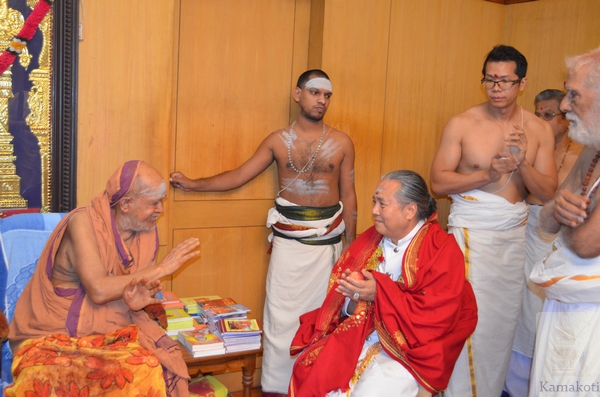
Thailand Rajaguru with Kanchi Shankaracharya

Rajaguru

Not everyone born in a Brahmin family is called a Brahmin. Those who are initiated i.e. those who have Diksha are called  Brahmins.

Raja guru gives the initiation and he is selected from among the Brahmins. Next to him is Huana Phram. They get a very meagre grant from the king.


Annual Worship

It is of two kinds. One is Triyampavaaya and another is Tripavaaya (The first is Thiruvempavai on Lord Shiva and the second Thiruppaavai is on Lord Vishnu; both are popular in Tamil Nadu)


Tiruvempavai is celebrated in three stages: Invoking the god, placing the idol in the swing and the third is bathing the idol. Prasad offered to the deities is distributed to the public. An annual festival is held in December. At the time those who want initiation takes a vow. They stay inside the temple, eat vegetarian food and lie on the floor.

During Tiruvempava festival, they worship Ganesh, Uma and Shiva for ten days.


Tamil Brahmins wear only white clothes head to foot. Some wear dhotis.

During the Swing ceremony Lord Siva is placed in between two pillars with a cup of water. There is a story behind it. Brahma who created the world asked Isvara (Shiva) to protect it. Siva thought that the earth was not strong enough to support the living beings. To test its strength, he just set one of His feet on it. He then asked the Nagas to shake the mountain at the ends of the oceans. The Nagas did shake it but nothing untoward happened. Siva was pleased. Here the two pillars stand for the two mountains and the cup of water represents the ocean.


Tiruppavai in praise of Lord Vishnu is also celebrated in the similar way. People wear new clothes and decorate their houses during the festival period. In Tamil Nadu it is celebrated for 30 days during the Tamil month Markazi corresponding to December/ January.


THE PLOUGHING RITE

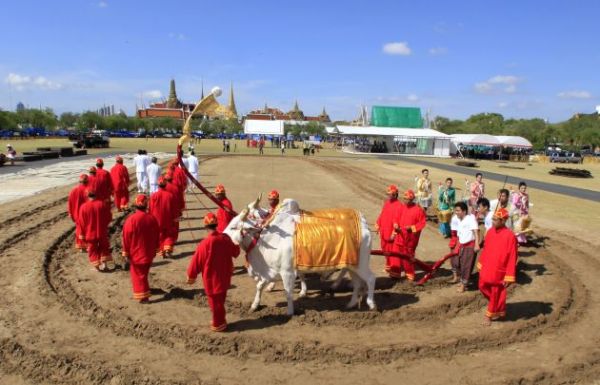
The Ploughing rite is an ancient Hindu rite practised from the  Vedic days. Tamil literature also has references to this rite. Sita Devi was discovered and received by Emperor Janaka during such a rite. Brahmins play a main role in it.

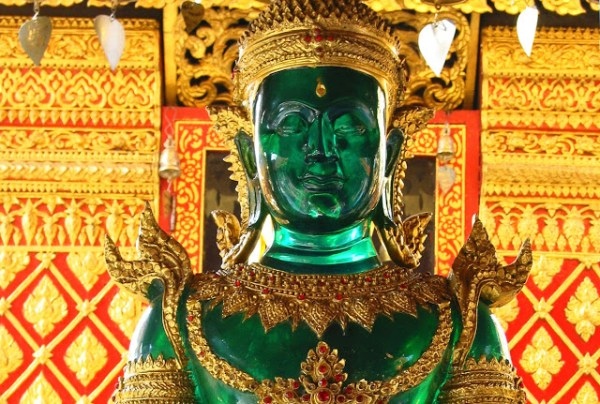
Brahmins fix a date after consulting the almanac (Panchang). They do the Puja after the Buddhists start it in the Temple of Emerald Buddha (Wat Phra Keao). The king comes at the appointed time and he sends his deputy to act on his behalf. The priest worships Gauri, Ganga and Dharani (earth). Brahmins sprinkle water with the grains. Auspicious things are carried by the women. Bulls are also brought with the plough. The king’s nominee does the symbolic ploughing after worshipping the bulls. When all the ploughing finished, the bulls are sent to its place. In front of them seven things are placed: Paddy, Pulses, Corn, Sesame seeds, Water, Wine and Grass. When they show them to the bulls, naturally they run towards them ; the priests watch what they eat first.

If the bulls eat the corn or paddy or the pulses first, it is believed that the crops would be good the year round. If they eat grass or sesame seeds first, it is said that the crops (harvest) world be moderate. If, however, the bulls take to water first, the belief is that there would be floods and the crops would be damaged. If by chance, the bulls take to wine the belief is that drought conditions would prevail leading o unrest everywhere. After the announcement of the future position of the crops, the ceremony comes to an end.

Temple of Emerald Buddha

There are many more rites the Brahmins perform.


— SUBHAM–

SWAMI RAMTIRTHA’S Q AND A (PART 3)- POST NO.4992

Compiled by S NAGARAJAN


Date: 9 MAY 2018


Time uploaded in London –  6-45 AM   (British Summer Time)


Post No. 4992


Pictures shown here are taken from various sources such as Facebook friends, Books, Google and newspapers; thanks. Pictures may be subject to copyright laws.


WARNING: PLEASE SHARE MY ARTICLES; BUT DON’T SHARE IT WITHOUT AUTHOR’S NAME AND THE BLOG NAME. BE HONEST; OTHERS WILL BE HONEST WITH YOU


ஸ்வாமி ராமதீர்த்தரின் குறிப்பேடுகள் சிலவற்றின் தொகுப்பு – 3


ச.நாகராஜன்


7

QUESTIONS ANSWERED (Continued)


Q 25 : How can you get rid of callers who don’t know when to go?


A       : Do as Longfellow used to do, invite them out to see the view from the piazza, after which it is easier to go than to return the house.


Q 26 : A good- hearted man is more apt to become dissipated than a mean man, because —

A      : Sweet things spoil more easily than sour things, and warm things more easily than cold things.


Q 27 : We say ; “Strike while the iron is hot; But what did Cromwell say?”

A       : Not only strike while the iron is hot, but make it by striking Don’t simply improve a chance when you have it, but make a chance.


Q 28 : Why are newspapers reliable?

A       : They lie, then they lie again, or they re lie and so are reliable.


Q 29 : Variety is the spice of life. What then is the food of life?

A       : Uniformity, regularity order.


Q 30 : What poet does everybody want?

A       : Moore (more)

Q 31 : What is the difference between a soldier and belle?

A       : The one faces the powder and the other powders the face.


Q 32 : What does everybody gave and few take?

A       : Advice


Q 33 : What gives a cold, cures the old and pays a doctor?

A       :  A draught


Q 34 : Difference between a book and cat?

A       : The one has the claws at the end of the paws; the other has the pause at the end of the clause.


Q 35 : I often murmur but never weep;

Always lie in bed, but never sleep.

My mouth is larger than my head,

And much discharges though never fed

I have no feet, yet swiftly run;

The more falls I get, move faster on.

A      : River


Q 36 : When is it right to lie?

A       : When you are in bed.


Q 37 : Is life worth living?

A       : It depends on the liver.

(From Notebook 10)

8

John Knox

Had he been a poor Hulf and half, he could have crouched into the corner like so many others, Scotland had not been delivered; and Knox had been without blame.

Knox, Buddha, Mohammad, Cromwell commenced their apparent work after 40.

(From Notebook 11)


9

Manu Eternal Law

“Let him say what is true, let him say what is pleasing, but utter no disagreeable truth, let him utter no agreeable falsehood, that is eternal law. “ –  Manu

(From Notebook 11)


10

Relgious Leaders

The religious leaders, they begin to kick when you prick.

(From Notebook 11)


11

Garibaldi


Garibaldi while living in hotel in Italy heard that a man was running amuck with a sword in hand and threatening the lives of all he saw and met. There were hundreds of persons, but none could venture forth and put him down.

Garibaldi hearing of it came out of his room, when all the rest were flying away and without sword or stick in hand ran up to the man and said, “Stop there and throw down your sword. “

The man stopped and threw down the sword instantly.

(From Notebook 11)

***

Hindu Sankaranti Festival in Thailand and Laos! (Post No.4990)

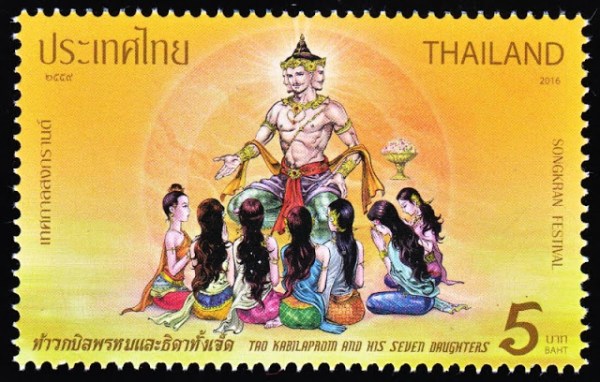
Kabilaprom and his seven daughters, issued by Thailand on April 7,2016


Hindu Sankaranti Festival in Thailand and Laos! (Post No.4990)


Research article Written by London Swaminathan 


Date: 8 May 2018


Time uploaded in London – 18-24 (British Summer Time)


Post No. 4990


Pictures shown here are taken from various sources such as Facebook friends, Books, Google and newspapers; thanks. Pictures may be subject to copyright laws.


WARNING: PLEASE SHARE MY ARTICLES; BUT DON’T SHARE IT WITHOUT AUTHOR’S NAME AND THE BLOG NAME. BE HONEST; OTHERS WILL BE HONEST WITH YOU


Two South East Asian countries celebrate Hindu festival Sankaranti with a Buddhist legend. Tamils in South India celebrate it as Pongal- Harvest Festival. Other parts of India celebrate it as a solar festival. All over India worship Sun God on that day.


Thailand and Laos have different stories associated with it.


In Thailand there lived a wise man who can speak with birds. His name was Dharmabarn (Dharma abarana- one who wears the jewel Dharma/Virtues). He was born in a wealthy family. He was wise even when he was seven years old.


The king was the other intelligent man in the country and his name was Kabila Brahmana. He had seven daughters. Kabila heard about Dharma and challenged him with three questions. That was a riddle. The loser in the competition should lose his head was the condition put forth by Kabila. Dharma agreed to it.

The riddle was: In the morning, at noon and in the evening, where is the human wheel of life?
Since Dharma could understand birds’ language, he heard two eagles talking about the wheel of human life.


The birds revealed to him that: In the morning, the wheel of life is on its face- that is why we wash our faces every morning.

At noon, the wheel of life is at its chest- that is why we wear perfume on our chests.

In the evening, the wheel of life is at its feet- that is why we wash our feet before going to bed.

Dharma gave these correct answers and hence Kabila cut off his own head. His seven daughters feared that if the head fell into the earth, a great fire will engulf the planet. If the head is hurled in the air, the planet will suffer a drought. If the head fell into the ocean, it would dry up. They decided to keep the head suspended in a cave of a mountain. Every year, one of the daughters would retrieve the head and parade around with it.


SANKARANTI (PONGAL) FESTIVAL

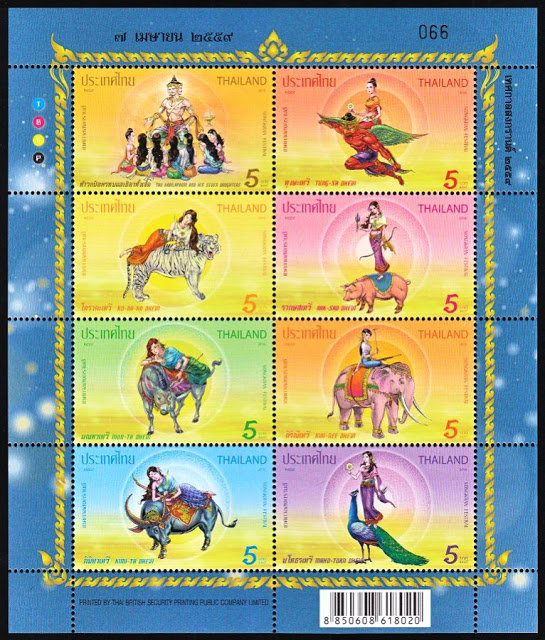
Evidently, the King had assigned his seven angel daughters to take turns carrying his head clockwise around Phra Sumane Mountain. And if Songkran Day (13 April) falls on any day of the following, that year would be honoured by that Nang Songkran. SONGRAN= SANKARANTI


In Madurai in South India there is a belief that depending upon the colour of god’s dress during Chitra festival the harvest would be predicted;they forecast if it is green colour that Lord Vishnu (Kalla Azakar is the local name of Vishnu) wears when he enters the River Vaigai, then the harvest would be good so on and so forth.

In the same way Thai people believed if the Sankranti falls on a particular day of the week certain things will happen. Those seven days are the seven daughters of Kabila.


  • Sunday: TungsateveeRed dress, preferred wild fruit, discus in the right hand, shell in the left hand, garuda as the vehicle.


  • Monday: Korakatevee Yellow dress with pearl ornaments, preferred butter oil, dagger in the right hand, walking cane in the left hand, tiger as the vehicle.


  • Tuesday: Ragsotevee Light red dress with agate ornaments, preferred blood, trident in the right hand, arrow in the left hand, pig as the vehicle.


  • Wednesday: Montatevee Emerald green dress with cats eye ornaments, preferred milk and butter, sharp iron in the right hand and walking cane in the left hand, donkey as the vehicle.


  • Thursday: Kirineetevee Greenish yellow dress with emerald ornaments, preferred nuts and sesame seeds, elephant hook in the right hand, gun in the left hand, elephant as the vehicle.


  • Friday: Kimitatevee White dress with topaz ornament, preferred banana, dagger in the right hand, Indian vina in the left hand, buffalo as the vehicle.


  • Saturday: Mahotorntevee Black dress with onyx ornaments, preferred hog deer, discus in the right hand, trident in the left hand, peacock as the vehicle.


Evidently, the prediction for the New Year will be made according to that particular day of the Nang Songkran. For example, if the preferred food of Miss Songkran is nuts and sesame seeds, it is predicted that the year will be productive, prosperous and healthy. And if the preferred food is blood, the prediction would go for a bloody year with quarrels. And if Miss Songkran prefers to carry a gun, it is predicted that the weather would be full of thunderstorms, etc. Also, at the venue where the grand Songkran Festival is organized, a procession of the Miss Songkran is indispensable for the people to appreciate the festival.

songran= Sankranti


Sankaranti is celebrated through out South East Asia. In Laos the people build Sand dunes. The sand dune symbolises the Hindu Holy Mountain Mount Meru. Kabila’s head was kept aloft on this mountain.. Since Buddhism celebrate yellow colour Laos people sprinkle scented water on the sand dune ,decorate it with festoons and flags and put yellow cloth on it. The offerings offered to the Stupas or sand dunes are distributed to Buddhis monks. It shows the mix up of several old customs. Hindu customs and Buddhist customs got mixed up with local beliefs.

Thailand and Laos released stamps to celebrate these festivals.

–Subham—

RAMA IS GREEN, LAKSHMANA IS GOLDEN & HANUMAN IS PURPLE! (Post No.4984)

RAMA IS GREEN, LAKSHMANA IS GOLDEN & HANUMAN IS  PURPLE! (Post No.4984)


Compiled by London Swaminathan 


Date: 6 May 2018


Time uploaded in London – 15-39 (British Summer Time)


Post No. 4984


Pictures shown here are taken from various sources such as Facebook friends, Books, Google and newspapers; thanks. Pictures may be subject to copyright laws.


WARNING: PLEASE SHARE MY ARTICLES; BUT DON’T SHARE IT WITHOUT AUTHOR’S NAME AND THE BLOG NAME. BE HONEST; OTHERS WILL BE HONEST WITH YOU


French historian Michelet described Ramayana as “ a great poem, as vast as the Indian Ocean, a book of divine harmony. A serene peace reigns in it, in the midst of conflict, an infinite sweetness, a boundless fraternity which spreads over all living beings, an ocean of love, of pity, of clemency” (from Jawaharlal Nehru’s Discovery of India)


Ramayana is very popular in Thailand. It is called Ramkien. Scholars believe that is the changed form of Ramakiirti or Ramaakhyaana.


During a particular period, Kings called themselves Rama and their capital was Ayuththaya (Ayodhya of Ramayana)

The original name of Siam is Shyama desa. During the commercial contacts, Indian business men called this region Swarnabhumi (Land of Gold).


We know for sure the Indo-Thai contact began at least 2300 years ago when Emperor Asoka sent two Buddhist emissaries to spread the message of Buddha. The reason he sent those people to Thailand was that  the people of the country are known to India.


Ramayana was introduced in art forms in the thirteenth century.

Though Ramayana was known to Thais for a very long period, King Rama I only gave it a shape. Takshin the Great , King of Thonburi wrote some verses of Ramakien and Rama I (1782-1880) produced a voluminous work of 10,000 stanzas. King Rama II (1809-1820) developed it into a drama.


Before this literary master piece was composed the firs Ramayana literature for the mask came about in 1349 CE. Only solitary evens from Ramayana were used. But long before the stage drama, certain kind of play known as Hnang (hide or skin) was shown. Ramayana characters were painted in different colours. Rama is green, Lakshmana is golden, Hanuman is in purple and Ravana is in dark colours.  When they were staged, they were similar to marionettes, but instead of strings, characters were controlled by hands. Hnang was introduced from Java (Indonesia) and it is an adaptation of the Sanskrit Chayanataka.


The Thai version was adapted to reflect Thai sentiments. Thai dressing, colouring was used. Even the story was changed from Valmiki’s original Sanskrit version. Here is a strange story which is not found in Indian versions of Ramayana.


Hanuman Ruled from Lavapuri in Thailand!

After the victory over Ravana Rama decided to reward all his allies who had helped him. He gave the Kingdom of Lanka to Vibhisana, Kishkinda to Sugreeva, Paatalaa to Jhambavat, Buriram (Rama Puri) to Guha and so on.  Last came the turn of Hanuman. He told Hanuman that he would shoot an arrow and hanuman should follow it. Wherever it falls that area would be his. Hanuman also faithfully followed Rama’s arrow. The arrow fell at Lopburi.


(Lava Puri= Lop Buri; Lava was one of the two sons of Rama. it is 150 kilometres from Bangkok) .

A lot of towns will have Buri suffix; it is the changed form of Puri which means a town or city in Sanskrit.

Lopburi was very uneven and Hanuman levelled it with his tail to make it habitable. Visvakarma helped Hanuman to build a beautiful city and Hanuman ruled from there.


An account of the story made the people to pick up mementoes from that place and ultimately government has to declare it a protected monument. The story was that the land was scorched by the falling arrow of Rama but a green patch was left where Rama’s arrow touched the ground. This account made the people to take everything from the green patch area as sacred objects. Then government introduced measures to protect it. In fact, Lopburi is abound in chalk and it is exported.

A lot of places in Thailand are associated with Ramayana as if Ramayana episodes took place in that country. The people have absorbed the story completely and believed Rama walked the length and breadth of Thailand!!

Source book: Studies in Sanskrit and Indian Culture in Thailand with my inputs.

–Subham–


SWAMI RAMA TIRTHA’S QUESTIONS AND ANSWERS (Post No.4953)

Compiled by S NAGARAJAN


Date: 27 April 2018


Time uploaded in London –  13-10  (British Summer Time)


Post No. 4953


Pictures shown here are taken from various sources such as Facebook friends, Books, Google and newspapers; thanks. Pictures may be subject to copyright laws.


WARNING: PLEASE SHARE MY ARTICLES; BUT DON’T SHARE IT WITHOUT AUTHOR’S NAME AND THE BLOG NAME. BE HONEST; OTHERS WILL BE HONEST WITH YOU


Swami Rama Tirtha’s Answers


7


QUESTIONS ANSWERED

Question 1 : What is the greatest riddle?

Answer : Life, for we all have to give it up.


Q 2 : Safest Banks, fast stock – most profitable share?

A    : The farmer’s earth banks, live stock and ploughshares.


Q 3 : How can you always have what you please?

A    : If you will be pleased with what you have.


Q 4 : What is matter?

A    : Never Mind

What is Mind?

No matter.


Q 5 : What man is born with three hands?

A    :  The man who gets a right hand, a left hand and a little behind hand.


Q 6 : I tremble at each breadth of air and yet can heaviest burden bear?

A    :  Water


Q 7 : What does the worthy man think is more blessed to give than to receive?

A    : Kicks, pills and advice


Q 8 : What common thing is very uncommon?

A    : Common sense


Q 9 : Why are people very generous when they hear a sermon?

A    :  They give it all away.


Q 10 : Which is the largest room in the world?

A      : Room for improvement

Q 11 : What is that a king can do and God cannot?

A      :  A king can banish or deport man of his subjects from his kingdom, God cannot.


Q 12 : What does a man see everyday and God never see?

A      : His equal


Q 13 : What is better than an idea?

A      : You dear!


Q 14 : Why does a preacher have an easier time than a Doctor or Lawyer?

A      : Easier to preach than practice.


Q 15 : What low-born ill-bred fellow had noble blood in him?

A      : A flea when it bites lords and ladies.


Q 16 : An Englishman to Abraham Lincoln : What was your family coat of arms?

A      : Shirt sleeves.


Q 17 : This side of the river is “the other side”?

A      : That is one side, therefore this is the other side.


Q 18 : When is the new birth reliable?

A      : When the second birth precedes the first one.


Q  19 : What did Adam first plant in the garden of Eden?

A       : His foot.


Q 20 : Why are potatoes and corn like the Pharisees ?

A      :  They have eyes and see not, and ears and hear not.

Q 21 : Zeno said, “Motions is impossible.”  A body cannot move in the place where it is, for the place is no larger than the body, and it cannot move in another place, because it is not there.

A      : But it can move out of one place into another.


Q 22 : A cat has nine tails?

A      : One cat  (1)   one tail

No cat  (8)   eight tails

————-    ————-

therefore one cat      nine tails

——————–        ———–


Q 23 : Palindromes ?

A      : According to Sidney Smith, How did Adam introduce himself to Eve.

Madam I’m Adam

Napoleon speaks of himself :

“Able was I ere saw Elba”

Q 24 : Squraing the circle?

A      :

C I R C L E

I C A R U S

R A R E S T

C R E A T E

L U S T R E

E S T E E M


( To Be Continued)


Treat this article as second part of the Tamil/English article -Part 1 posted day before yesterday


ஸ்வாமி ராமதீர்த்தரின் குறிப்பேடுகள் சிலவற்றின் தொகுப்பு – 2


–SUBHAM–


WHERE WERE THE HINDU SEERS AND SAINTS BORN? (Post No.4952)

Research Article Written by London Swaminathan 


Date: 27 April 2018


Time uploaded in London – 7-45 am


Post No. 4952


Pictures shown here are taken from various sources such as Facebook friends, Books, Google and newspapers; thanks. Pictures may be subject to copyright laws.


WARNING: PLEASE SHARE MY ARTICLES; BUT DON’T SHARE IT WITHOUT AUTHOR’S NAME AND THE BLOG NAME. BE HONEST; OTHERS WILL BE HONEST WITH YOU


Kalhana, the greatest poet of Kashmir who wrote Rajatarangini, makes a thought provoking statement:

“The reputation of the great does not by any means conform to their birth place”. Rajatarangini 4-41

If we go deeper into his statement we ourselves wonder seers and saints strange places, particularly unknown and remote villages. Some villages where they were born have become big towns now. Here is a list I have compiled:

Annamacharya- Tallapaka in Andhra Pradesh

Aravindar (Aurobindo)- Kalighat (Kolkatta)

Anandamayee Ma-  Kheora (Bangladesh)

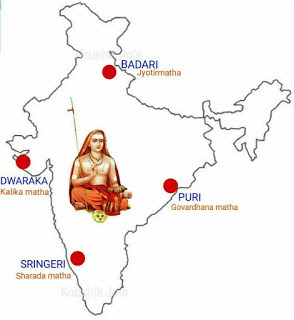
Adi Shankara- Kaladi in Kerala

Andal- Srivilliputtur in Tamil Nadu

Arunagirinathar- Thiruvannamalai

Alvars (12 Tamil Vaishnavite saints)

–Poykai Alvar- Tiruvegga (part of Kancheepuram now)

–Bhutatalvar- Mahabalipuram

–Peyalvar- Mylai (Part of Chennai)

–Tirumazisai alvar- Tirumazisai

–Madurakavi Alvar- Tirukkolur

–Kulasekara alvar- Tiru Vanchi

–Periyalvar- Sri Villiputtur

–Andal- Sri Villiputtur

–Tondardippodi alvar- Mandankudi

–Tiruppanalvar- Uraiyur

–Tirumangai alvar- Kuraiyalur
 

Bhaskara (Mathematician)- Bijapur

Bhakti Vedanta Prabhupada-  Tollygunje (Suburb of Calcutta)

Buddha- Kapilavastu


Ekanath- Paithan


Gurunanak- Nankhana Sahib (Pakistan)

K B Hedgewar (RSS Founder)- Nagpur


Jnanadev (Dyaneshwar) – Apegaon

Kabirdas- Varanasi

Kanakadasa- Baada Village in Karnataka

Kamban – Therazunthur in Tamil Nadu

Kulandaiyanandar- Samayapuram near Madurai


Mahaveera (Mahavira)- Kundagrama in Bihar

Madhava Sadasiva Golwalkar (Guruji)- Ramtek

Madhva- Paajaka near Udupi

Mahatma Gandhi – Porbandar

Manikkavasagar – Tiruvathavur

Meera/ Mirabhai – Chaukari village in Rajasthan

Muthuswamy Dikshitar (Composer)- Tiruvarur

Muktabhai- Apegaon near Paithan

Narasinh (Narasimha) Mehta- Talaja in Gujarat

Nammazvar- Tirukkurukur (Alwar Tirunagari)

Nivrutti- Apegaon in Maharshtra

Nayanmars- Most of the 63 Nayanmars, the Tamil Saivite saints were born in villages)

Namdev- Floating in a river


Paramahamsa Yogananda – Gorakpur in Uttarpradesh

Purandaradasar- Tirthahalli in Karnataka
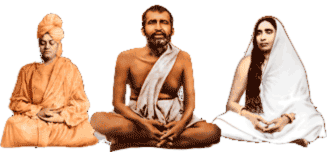
 

Ramakrishna Paramahamsa- Kamarpukur in West Bengal

Ramana Maharishi- Thiruchuzi

Ramanuja- Sriperumbudur near Chennai

Ragavendra- Bhuvanagiri in Tamil Nadu

Ramadas (Samartha)- Jamb Village

Ramadas (Bhadrachalam)- Nelakondapalli in Andhra

Ramdas (swami)- Kanhangad in Kerala

Ramathirtha- Muraliwala in Punjab

Ravidas- Seer Goverdhanpur near Varanasi

Sarada Devi- Jayrambhati in West Bengal

Sathya Sai Baba- Puttaparthi in Andhra Pradesh

Seshadri Swamikal- Associated with Thiruvannamalai and Unjalur

Shirdi Sai Baba- near Shirdi

Shyama Sastri – Tiruvarur

Sivananda- Pathamadai in Tamil Nadu

Sopana- Apegaon

Subrahmanya Bharati- Ettayapuram in Tamil Nadu

Sundarar- Tirunavalur

Surdas- Siri near Delhi

Swaminarayan- Chapaiya in Uttarpradesh


Siddhas 18- Only Samadhis (places where they died) are popular. See Tirumular


Thirujnana Sambandar – Sirkazi

Tirumular (Tamil Siddha)- Kashmir

Tiruvalluvar- Mylapore (now part of Chennai)

Tulsidas-Sukar Kshetra Soro in Uttar Pradesh


Thirunavukkarasar (Appar)

Thygarajar (Composer)- Tiruvarur

Tukaram- Dehu near Pune
Vallabacharaya- Varanasi

Sri Vallabh- Pithapuram

Vyasa – Island in River Ganges

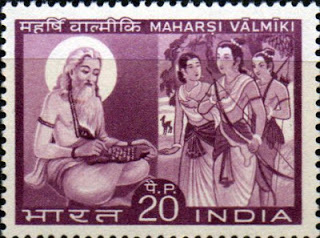
Valmiki- in a forest

Vivekananda Swami- Calcutta


You can keep on adding more saints; it is not a comprehensive list. It is just to draw your attention to this fact and remind you that next Avatar or reincarnation of Lord Vishnu as Kalki may be in a remote village! who knows!


–SUBHAM–
 

MILTON AND RIG VEDA ON LIGHT (Post No.4921)

WRITTEN by London Swaminathan 


Date: 16 April 2018


Time uploaded in London –  15-51 (British Summer Time)


Post No. 4921


Pictures shown here are taken from various sources such as Facebook friends, Books, Google and newspapers; thanks. Pictures may be subject to copyright laws.


WARNING: PLEASE SHARE MY ARTICLES; BUT DON’T SHARE IT WITHOUT AUTHOR’S NAME AND THE BLOG NAME. BE HONEST; OTHERS WILL BE HONEST WITH YOU.


GAYATRI Mantra/hymn is the most powerful mantra in the Rig Veda and it is found in other Vedas as well. It is a great wonder that mantra which reverberated on the banks of River Sarasvati and later Sindhu (Indus) and Ganges is still chanted by millions in India. While Brahmins only were chanting in those days and in recent years, great saints like Chinmayananda and Sathya Sai baba made it popular among other communities as well.


The meaning of the Mantra is

Let us meditate on that excellent glory of the divine vivifying Sun (light) and May He enlighten us.

There are lot of Mantras/hymns on Ushas (the dawn):

Immortal Ushas, please by praise

What mortal may enjoy they days!

Who, mighty one, can reach thy place!

Rig Veda 1-30-20


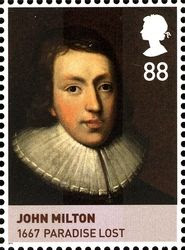
The parallelism of thought is very remarkable, between the general Vedic concept of Ushas with the lines of blind poet Milton.


Compare the following lines on Ushas (Dawn)


English poet, though blind, sings about light in the following lines:


“Hail, holy light, offspring of Heaven first born,

Or of the eternal, co-eternal beam

May I express thee unblamed? since God is light,

And never but unapproached light

Dwelt from eternity, dwell thou in me,

Bright effluence of bright essence increate

Or hear’st thou rather, pure ethereal stream,

Whose fountain who shall tell? Before the sun

Before the heavens thou wert, and at the voice

Of God, as with a mantle, didst invest

The rising world of waters dark and deep

Won from the void and formless infinite.

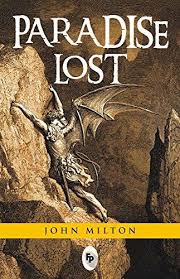
Paradise Lost, Book 3


The Rig Veda says

Fair as a bride embellished by her mother thou showest forth thy form that all may see it

Blessed art thou, O dawn. Shine yet more widely. No other Dawns have reached what thou attainest.


Rich in cattle, horses, and all goodly treasurers, in constant operation with the sunbeams,


The Dawns depart and come again assuming their wonted forms that promise happy fortune.

Obedient to the reins of Law Eternal give us each thought that more and more shall bless us.

Sine thou on us today, Dawn, swift to listen. With us be riches and with chiefs who worship.

RV 1-123


Upanishads say,

To the illumined soul the Self is all. For Him, who sees everywhere oneness, how can there be delusion or grief?

–Isha Upanishad 7

The whole world is illumined by His ilight.

–Sveteshvatara Upanishad 6-14


Milton also said God is Light (see above)


–Subham–


JEWISH (RABBIS) JOKES ! (Post No.4918)

WRITTEN by London Swaminathan 


Date: 15 April 2018


Time uploaded in London –  21-54 (British Summer Time)


Post No. 4918


Pictures shown here are taken from various sources such as Facebook friends, Books, Google and newspapers; thanks. Pictures may be subject to copyright laws.


WARNING: PLEASE SHARE MY ARTICLES; BUT DON’T SHARE IT WITHOUT AUTHOR’S NAME AND THE BLOG NAME. BE HONEST; OTHERS WILL BE HONEST WITH YOU.


Converted to New Religion and yet No Office!


A place hunter in Prussia (part of Old Germany and Poland), having asked the Frederick the Great for the grant of some rich Protestant Bishopric (office), the king expressed his regret that it was already given away, broadly hinted that there was a Catholic abbacy at his disposal.


The applicant managed to be converted in a week and to be received in the bosom of the true church; after which he hastened to his friend, the king, and told him how his conscience has been enlightened.

“Ah”, exclaimed Frederick, “how terribly unfortunate! I have given away the abbacy. But the chief rabbi is just dead, and the synagogue is at my disposal; suppose you were to turn Jew?”


xxx

Rabbis in Zoo!

Applying for a post as keeper at the Bronx Zoo, a burly Irishman came to the question,

What is rabies and what can you do about it?

The applicant wrote: :Rabies is Jewish priests, and you cant do anything about it.”


(Rabies= a contagious and fatal viral disease of dogs and other mammals; transmissible to humans through the saliva to humans causing madness and convulsions;

Rabbis= Jewish religious leader, scholar, teacher).


xxx

Rabbi is Stupid!

A certain Jewish man had left Pinsk to go to work in Minsk. For six months, he had been away. He had a short vacation and was very anxious to get back home to see his wife and children It was late on a Friday afternoon, however, and his friend said,

Look, you shouldn’t travel on the Sabbath. It is against religion. Stay over with me until the Sabbath is over. Be my guest.”

No said the other, I am anxious to get back to Pinsk. Six months I have been away.

Six months, said his friend, so what is another day? You shouldn’t travel on the Sabbath. Stay with me. I have got a nice house. I will give you nice Jewish meals.

After much argument, the man yielded against his better judgement, and remained over the Sabbath. Even then his friend would not let him go ad insisted on detaining him yet another day, entertaining him practically to exhaustion. At last he announced his departure.

I can’t stay another minute. I am going right away.

All right, said his host at last, and as his friend was about to leave the house he presented him with a bill for food and lodging. Outraged, the man cried, What kind of a business is this? You make me stay against my will; you won’t let me go. You insist that I should be your guest. You keep me overtime – then you give me a bill! I won’t pay it.


Equally firmly, his host insisted that he must pay. Finally he said, All right. We will consult the Rabbi.

They sought out the Rabbi. He heard the whole story, stroked his beard and pored at length over the Books of Law. At last, after recapitulating, the whole case, he delivered his verdict: you must pay.


The victim flew into a rage. They thrashed the case back and forth many times. But the rabbi was adamant: you must pay.

At last, weary and desirous only of getting to Pinsk, the man drew out his wallet and paid the money, demanding a receipted bill. His friend took the money, receipted the bill, and then handed the money, receipted bill back again saying ‘Forget it!’


What! screamed the other in despair. You force me to be your guest; you wont take no for an answer; you keep me there; you give me a bill; you drag me to the rabbi; he tells me I must pay; I pay. Now you give me back the money. What is this?

Ah, said his fried, I just wanted you to see what kind of a stupid person we have got for a rabbi n Minsk.

–subham–


FAMOUS TREES OF TAMIL NADU (Post No.4899)

Written by London Swaminathan 


Date: 9 April 2018


Time uploaded in London –  20-43  (British Summer Time)


Post No. 4899


Pictures shown here are taken from various sources such as Facebook friends, Books, Google and newspapers; thanks. Pictures may be subject to copyright laws.


WARNING: PLEASE SHARE MY ARTICLES; BUT DON’T SHARE IT WITHOUT AUTHOR’S NAME AND THE BLOG NAME. BE HONEST; OTHERS WILL BE HONEST WITH YOU


There are many famous trees in Tamil Nadu. Some are famous because of its age or due to its holiness. The banyan tree in Adyar, Chennai is famous because of its huge size. It is damaged in several storms.

There are two holy trees in Perur near Coimbatore. They are called Iravap Panai and Piravaap Puli. In Tamil it rhymes very well. The rough translation of the words is The Palmyra Tree that never dies and the Tamarind Tree that is never born.

The story about the Palmyra tree is that its bark is used in medicines which will give one a long-life span. There is another explanation about its never dying nature.


The story about the Tamarind tree is that its seeds never grow. Even if it is sown it never germinates. It looks like both are not tested scientifically. But the belief is strong that the devotees visit the trees when they visit the temple.

There is a philosophical explanation as well. One would never be born again if he sees the Perur Lord Shiva like the Tamarind seed in the temple. And similarly devotees believe that those who worship Lord Shiva at Perur Temple will live for long.

So whether the trees have miraculous properties or not, the philosophy behind the trees teaches more than many philosophical works.

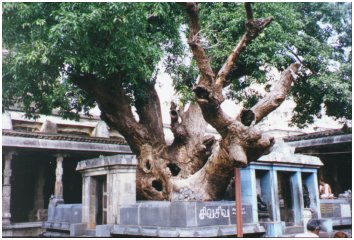
Neem Tree by Lalgudi Veda

In other words, William Wordsworth’s words have come true:

One impulse from a vernal wood

May teach you more of man,

Of moral evil and of good,

Than all the sages can.


Kadamba Tree


Inside the world famous Meenakshi Sundareswar Temple in Madurai, still a tree is preserved inside a fence. It is a Kadamba tree, the local temple tree (sthala Vrksha). Once upon a time Madurai area was a forest of Kadamba Trees and then a Pandya king built a temple in the area when the devotees reported some miracle inside the forest.


Mango Tree Inside Kanchi temple.

At the Ekambareswar temple in Kancheepural there is a livin mano tree which is considred very old. Its age is given between 3500 and 5000 years. Though it is not possible scientifically one tree after another might have been planted using the seeds of the same mango tree.


Vridhachalam: 1700 year old Vanni Tree

In Vridhachaam there is a Vanni Tree inside the Pazamalainathar Temple which is said to be 1700 year old. It is possible they used the same tree for continuous propagation.


Every temple in Tamil Nadu has a holy tree known as the Sthala Vrksha (local Temple Tree). It is heartening to note that Tamils had this custom of cultivating or raising a particular tree in every temple.


Famous Tamarind Trees

I have already written about the famous Tamarind Tree of Nammalvar, another tree associated with Tirumanagai Alvar, real ghost in Tamarind tree according to Sri Anantharama Dishitar and the Tamarind tree associated with Tansen (See below for the links to my old articles.)


Tansen and Tamarind Tree! Ghosts in Tamarind … – Tamil and Vedas

https://tamilandvedas.com/…/tansen-and-tamarind-tree-ghosts-in-ta…

26 Mar 2016 – STORY OF FAMOUS TAMARIND TREES. 1.There is atamarind tree in Gwalior at the tomb of Tansen, the great singer of Moghul period. People believe that whoever chew the leaves of the tree will get a sweet voice. This, they believe due to the presence of the tomb of Tansen.Nammalvar and Tamarind …

Nammalvar | Tamil and Vedas

https://tamilandvedas.com/tag/nammalvar/

People believe that whoever chew the leaves of the tree will get a sweet voice. This, they believe due to the presence of the tomb of Tansen.Nammalvar and Tamarind Tree. 2.There is another famous tamarind treeat Azvar Tirunagari in the far south of Tamil Nadu. Maran Sadagopan, later known as Nammazvar, one of the …


Trees of Wisdom | Tamil and Vedas

https://tamilandvedas.com/tag/trees-of-wisdom/


Magic of Trees! Picture shows Newton under Apple Tree. Hindu Saints composed Upanishads under the Himalayan Trees. Buddha attained wisdom under the Bodhi Tree. Vaishnavite saint Nammalvar attained wisdom under a Tamarind tree. Sanatkumaras attained wisdom under the banyan tree. Saivaite saint …


sacred trees | Tamil and Vedas

https://tamilandvedas.com/tag/sacred-trees/

6 Nov 2017 – The famous Bodhi tree in Gaya (Bihar, India) and its sister trees in Sri Lanka, Tamarind tree of Tansen and Nammalvar, Banyan Tree of Lord Krishna and Panchavati (five Banyan trees) of Lord Rama are some examples. There are hundreds of trees like these throughout India Every Tamil temple has a tree …

tree worship | Tamil and Vedas

https://tamilandvedas.com/tag/tree-worship/

The famous Bodhi tree in Gaya (Bihar, India) and its sister trees in Sri Lanka, Tamarind tree of Tansen and Nammalvar, Banyan Tree of Lord Krishna and Panchavati (five Banyan trees) of Lord Rama are some examples. There are hundreds of trees like these throughout India Every Tamil temple has a tree worshipped in its …


Adi Shankara & Alangium hexapetalum | Swami’s Indology Blog


https://swamiindology.blogspot.com/2013/08/adi-shankara-alangium-hexapetalum.html

20 Aug 2013 – Adi Shankara, the greatest philosopher of India uses lot of similes from nature to illustrate Advaita philosophy. In one sloka he used four birds. I have written about it in my earlier post. One of his interesting observations is about a tree called Ankola in Sanskrit, Alinjil in Tamil andAlangium hexapetalum in …


Adi Sankara and Andal | Tamil and Vedas


https://tamilandvedas.com/tag/adi-sankara-and-andal/

But there is a strange coincidence between Andal and Adi Shankara.Andal has

composed two poems Thiruppavai and Nachiar Thirumozi. Adi Shankara mentioned a plant known as Azinjil in Tamil and Ankola in Sanskrit, in his hymn Sivananda Lahari. Though Andal did not mention this plant in her hymn Nachiar …


—SUBHAM—