Oldest Riddle in the World! Rig Veda Mystery –3

rishi_vedas_text03

Research Paper written by London Swaminathan
Post No. 1330; Dated 6 October 2014.

Rig Veda is the oldest religious book in the world. Even if we agree with the date given by the Western Scholars –1200 BCE, there was no other book at that time with huge a volume hymns on Gods like the Rig Veda in any part of the world. Modern Indologists in western countries slowly moving up the date of the Vedas to 1700 BCE. And archaeological proof for the Rig Vedic hymn is available from 1380 BCE from Bogazkoy in Turkey. Freedom fighter and great scholar B G Tilak and German scholar Jacobi have independently arrived at a date of 6000 BCE for the Vedas.

Vedas are full of mysteries. No scholar was able to interpret them in full. All the western scholars did not agree on a single hymn. Each hymn was interpreted differently by them. Some were honest to admit that the meaning was obscure, unintelligible, uncertain or not understood.

The first Indian scholar who tried a full commentary on it was Sayana who did write it around 14th century CE. By that time there was a big gap between the original “composition” and the commentary (Composition: Hindus never believe that they were composed like the Smritis. They were ‘heard’ like radio wavelengths by the sages). So he couldn’t know what the sages said or meant. But one positive thing was that Sayana was a believer in the Vedas. Other western scholars were like spectators in a film or a circus. Some wanted to have fun in reading the Vedas, some more wanted to belittle or denigrate them and a very few wanted to actually understand the meaning.

They all believed in their own religious books and thought the world was created in 4100 BCE. Their knowledge was shallow ss far as other religions were concerned. They saw Hindus as Kafirs and Pagans. They did NOT believe that the Hindu gods were GODS. They thought GOD can be reached ONLY through their religion. They were very narrow in their outlook. They did not follow Hindu values or respect Hindu values. They never criticized their own religions or other religions except Hinduism. They never scrutinised their religious books the way they did with Hindu scriptures. Their motive was very clear which they expressed it in articles without any hesitation (Please read what Max Muller said about Vedas in the beginning and what Macaulay said about English education in India).

Vedas flow chart

What is the Riddle?
Vedas can be interpreted at different levels: symbolic, allegorical, didactic or mythical. Many people believed that the sound effect of the Mantras is more important than the meaning. There are many puzzles and riddles in the Vedas. In fact all the minor deities have umpteen interpretations. I will give one hymn which puzzled many scholars:

Four are his horns, three are the feet that bear him; his heads are two, his hands are seven in number.
Bound with a triple bond the steer roars loudly; the mighty god hath entered in to mortals (R.V.4-58-3)
Translated by Ralph T H Griffith

There are ten Mandalas (divisions) in the Rig Veda (RV). The fourth Mandala is Vamadeva Mandala. Sage Vamadeva was the son of Gautama. Many scholars dated it as the oldest part of RV or one of the oldest Mandalas in the RV. Hymn 4-58 (quoted above) is in praise of Grta, clarified butter or oil used in sacrifices, but a choice of deities is offered in the Index – Agni or Surya, Waters, Cows or Ghrtra.

Prof. Wilson observes, “it is a good specimen of Vaidik vagueness and mystification, and of the straits to which commentators are put to extract an intelligible meaning from the text”.

Professor Ludwig says, “it would be fruitless to repeat all the various explanations which Sayana gives of the first line of this stanza – they only show the utter uncertainty of tradition in reference to the passage. For instance ‘samudrd’ ocean, is said to mean, sacrificial fire or celestial fire or the firmament or the udder of the cow; and ‘urmi’ wave or reward or rain or butter.
A .Gillebrandt explains it differently, says Griffith.

So far I have used four names of foreign “ scholars” . Griffith who summarised other three views did not say anything.

vedas music
What do we know from this one Rik of a hymn?

1. Vedic Hindus are not “barbaric Aryans” or illiterate cowherds. In the previous hymns by the same sage/Rishi we read about agriculture. This type of number symbolism is used by Tamil Siddhas a lot in very late periods. Tirumular who lived around seventh century used it in hundreds of verses. Without a proper commentary no one will know what they are saying.

2. The second point is Vedic hymns are very difficult to interpret. Even Hindu Sayana gives different possibilities adding OR, OR several times.

3. Foreign “Scholars” were very confused and make their own guesses according to their own whims and fancies. So they are NOT scholars and they are most unreliable.

4. Vedas have lot of hymns like this or hymns totally not understood by anyone. Hindus should not believe some half baked statements on Dasas, Dasyus, Sisna Devah etc. Many of the kings had names like Sudasa, Divodasa, Dirga Tamas (long or total dark or darkness) like we had Kalidasa and Tulsidasa in later periods.

5. The words in the given passage like Samudra (ocean), Urmi (woman’s name ‘Wave’) are used even today. So Vedic Sanskrit is not dead. It is a living language. Thousands of words in The Rig Veda, the oldest scripture in the world, are used by Tamils and others from Kashmir to Kandy in Sri Lanka. I have already pointed out the use of Indra and Indrani in nook corner of Indian subcontinent including tribal communities in one of my posts on Indra. Those who read the Vedas without any bias can ‘enjoy’ the rubbish jokes of Foreign, Marxist and so called Dravidian scholars!!!

vedic-mathes-001

Sayana’s Commentary
Now let me give Sayana’s two different explanations for the above Rik:
Four horns of Agni, if identified with sacrifice, are said by Sayana to be the four Vedas.
The three feet are the three daily sacrifices
The two heads are the Brahmaudana and the Pravargya ceremonies
Seven hands are explained as seven metres of the Vedas.
Triple bonds are Mantra, Kalpa and Brahmana

If identified with Aditya, the four cardinal points.
Three feet are Morning, Noon and Evening
The two heads are Day and Night
Seven hands are Seven Rays of Sun
Three bonds are Heaven, Firmament and Earth.

Mahidhara’s explanation differs from that of Sayana
Vedic commentator Mahidhara lived in the sixteenth century.

The four horns:— are priests or nouns, verbs, prepositions and particles
The three feet:— are the three Vedas or the first, second and third person or the past, present and future tenses.
The two heads:– are tow sacrifices or the agent and the object
The seven hands:– are the metres or the cases of the nouns
The three bonds:– are the three daily sacrifices or the singular, dual and plural numbers.

Contact swami_48@yahoo.com

vedas-by-the-great-priests-

My previous research articles on RV and AV:-
1.The Mysterious Vedic Homa Bird: Does it exist? – posted on 10-12-2011
2.Vedic Hymn better than National Anthems
3.Vedas and Egyptian Pyramid Texts – posted on 29-8-2012
4.Kapinjala Bird Mystery –posted on 23-5-2014 (Post No 1060)
5. Most misinterpreted words : Asva and Ayas
6.Confusion about Vedic Soma Plant –posted on 5-5-2013
7.Horse Headed Seer: Rig Veda Mystery- 1 -posted 27-8-2-14
8.Cucumber in the Rig Veda – posted on 2-42014 (post no 950)
9.Origin of Horse race and Chariot Race –posted 25-8-2014
10.Creation: Vedic Hymn and Babylonian Hymn –posted 6-8-2013
11.Sex Mantras and Talismans in Egypt and the Atharva Veda –posted 26 Sept. 2012
12.Gems from the Atharva Veda – posted 27 Sept. 2013
13.Mysterious Atharva Veda: Part 1 –posted 30 Sept. 2013
14. Mysterious Atharva Veda: Part 2 – posted 7 Oct 2013
15).27 Similes in one Vedic Hymn! – posted on18-8-2012
16) 107 Miracle Herbs in Rig Veda – posted on16-9-2013
17)Vedic Origin of 1000 Pillar Halls in Indian and Mayan Culture – 5 July 2014
18.Two seers saved by Asvins: Stories from the Rig Veda – posted 7 Aug. 2014.
19.Herbs and Diseases in the Veda – posted on 1 July 2014.
20) 31 Quotations from the Vedas – posted on 26 June 2014.
21.Talismans in Atharva Veda and Ancient Tamil Literature — posted on 17 June 2014.
22)Why did Indra kill Brahmins? – posted on 25 May 2014.
23)Ode to Sky Lark: Shelley, Kalidasa and Vedic Poet Grtsamada– posted on 3/5/14
24)Vedic Poet Medhathithi’s Quotations — Posted on22/5/2014
25)Pearls in the Vedas and Tamil Literature –posted on 18/5/2014
26.Important Vedic Quotations on Rivers and Water –posted on 8/5/14
27) 40 Important Quotations from the Atharva Veda –posted on 2-5/14
28.Oldest and Longest patriotic Song – 20 Sept. 2013
29)King and 8 Ministries in Vedic Period – posted on 28 May 2013
30)Numbers in the Rig Veda: Rig Veda Mystery – 2 –posted on 3rd Sep.2014
31) Mystery about Swan: Can it separate Water from Milk? (6 July 2014)

And several other articles regarding Vedic Gods Agni, Varuna and Indra in the oldest Tamil book Tolkappiam and the Indus Valley Civilization. Please read my 1000+ articles.
Contact swami_48@yahoo.com
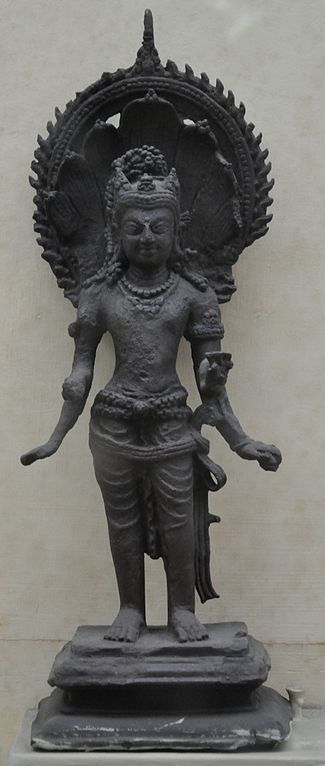
Yellow clad Krishna and Blue Clad Balarama!

-Balarama_kolkatta8
Balarama in Kolkatta Museum

Research Paper written by London Swaminathan
Post No.1323; Dated 2nd October 2014.

Our forefathers were very clever and honest. They did not have anything to hide. They called a spade a spade. Whenever there was scope for criticism, they did not hesitate to do it just because it is your own relative is involved. Life history of Balarama is the best example to elucidate this point. His life was very colourful and controversial. Let us look at some interesting facts about Balarama, who was Krishna’s elder brother.

Puranas describe Balarama wearing a blue clothe and Krishna a yellow clothe: Neelambaradhari, Peetambaradhari.

Puranas describe Balarama as a Madhu priya (fond of wine) and Krishna as a Maadhu Priya (interested in women such as Gopis).

Hindus were very colour conscious. I have demonstrated this fact elsewhere in my articles. They allocated five different colours for Lord Shiva’s five faces and Mayas and Buddhists followed the Hindus in allocating colours to four directions.

Balarama had a white complexion and Krishna had a black complexion!
Both were brothers but had divergent views on current issues! They were very affectionate. Though openly fought for different things, they never lost the brotherly affection.

Both of them were worshiped from Kashmir to Kanyakumari together as Avatars (incarnation) of Vishnu.

Two thousand year old Sangam Tamil literature praises both of them together (Puram Verse 56 by Nakkirar). They followed Kalidasa (Megaduta 61) in this. Kalidasa lived in first century BCE which I have proved using the Sangam Tamil verses.

bala big
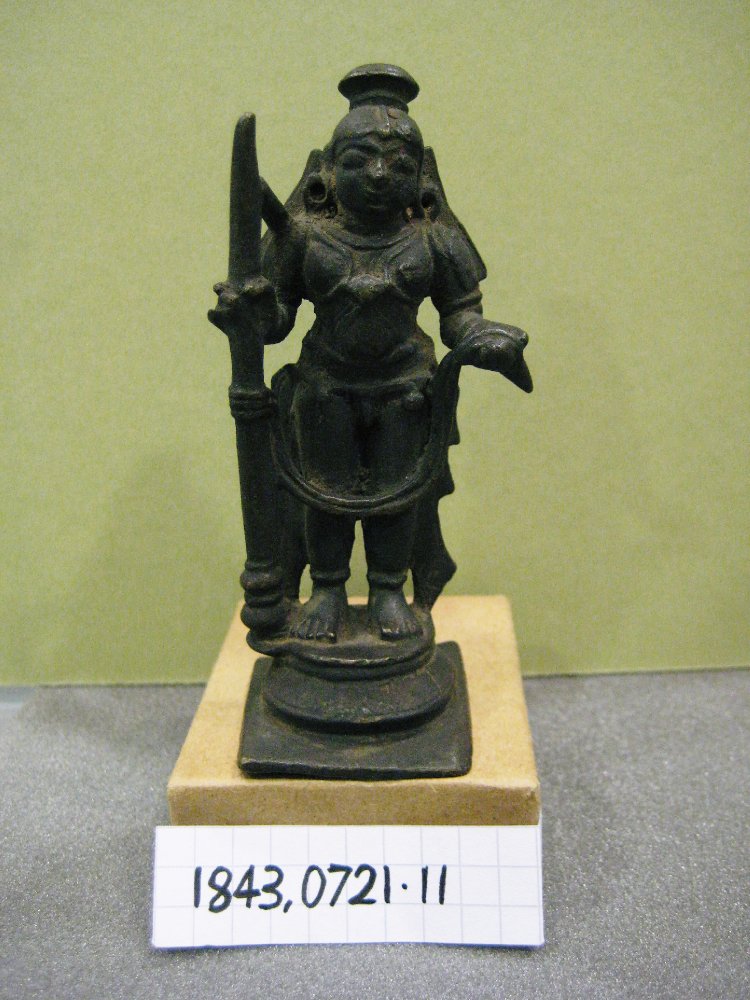
Balarama in British Museum, London

Sangam age Tamils describe Balarama as a Palmyra Flag bearer and Krishna as an Eagle Flag bearer.
Ancient Tamil Nadu had temple for Krishna and Balarama together, but in course of time Balarama worship was dropped.

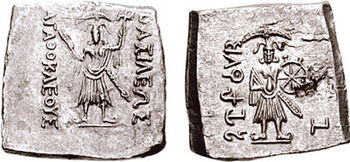
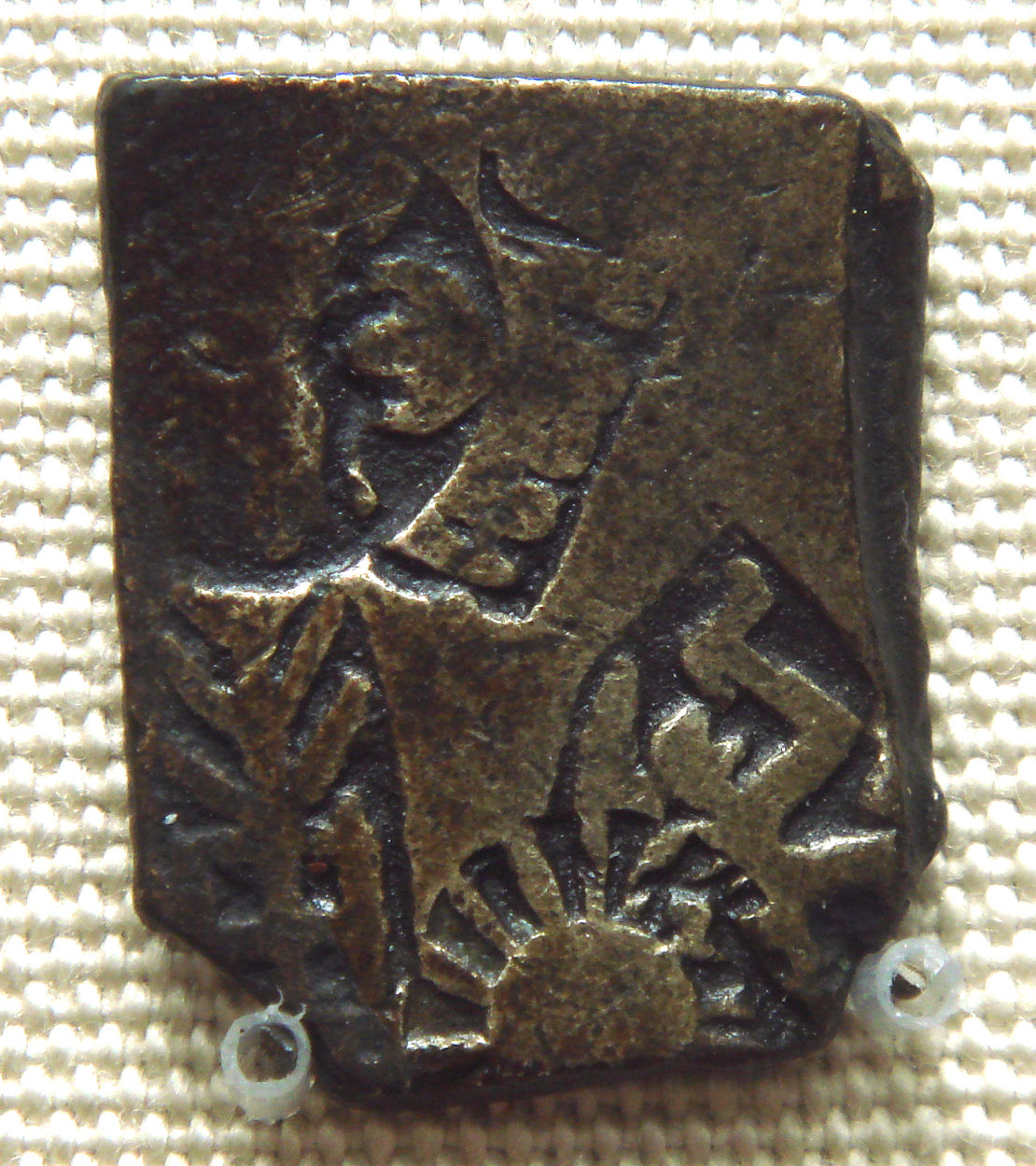
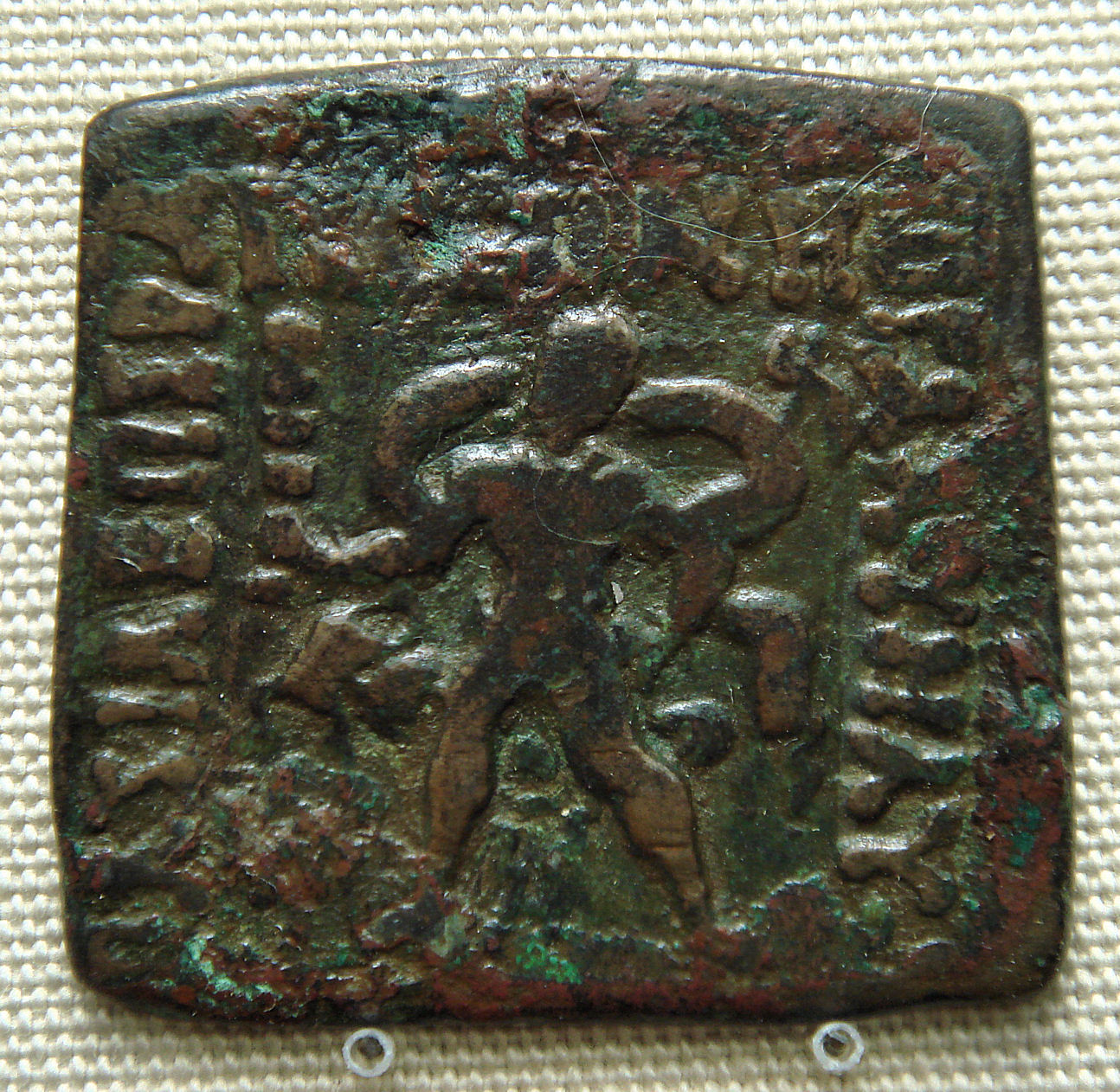
Balarama image is beautifully portrayed on coins along with Krishna .
Krishna supported Pandava side in the Great Indian War Mahabharata war; but Balarama was neutral.
When Krishna abducted Rukmini Balarama supported, but when Arjuna abducted Subhadra he objected.

Balarama taught mace fight to both Duryodhana and Bhima. But when Bhima hit Duryodhana below the belt violating the rules, Balarama was furious; but Krishna calmed him.
What a contrast among brothers!!!

This proved that our scriptures were 100 % honest in reporting everything. Moreover the authors like Vyasa, Valmiki and Sukar were very good observers. They did not miss anything good or bad!

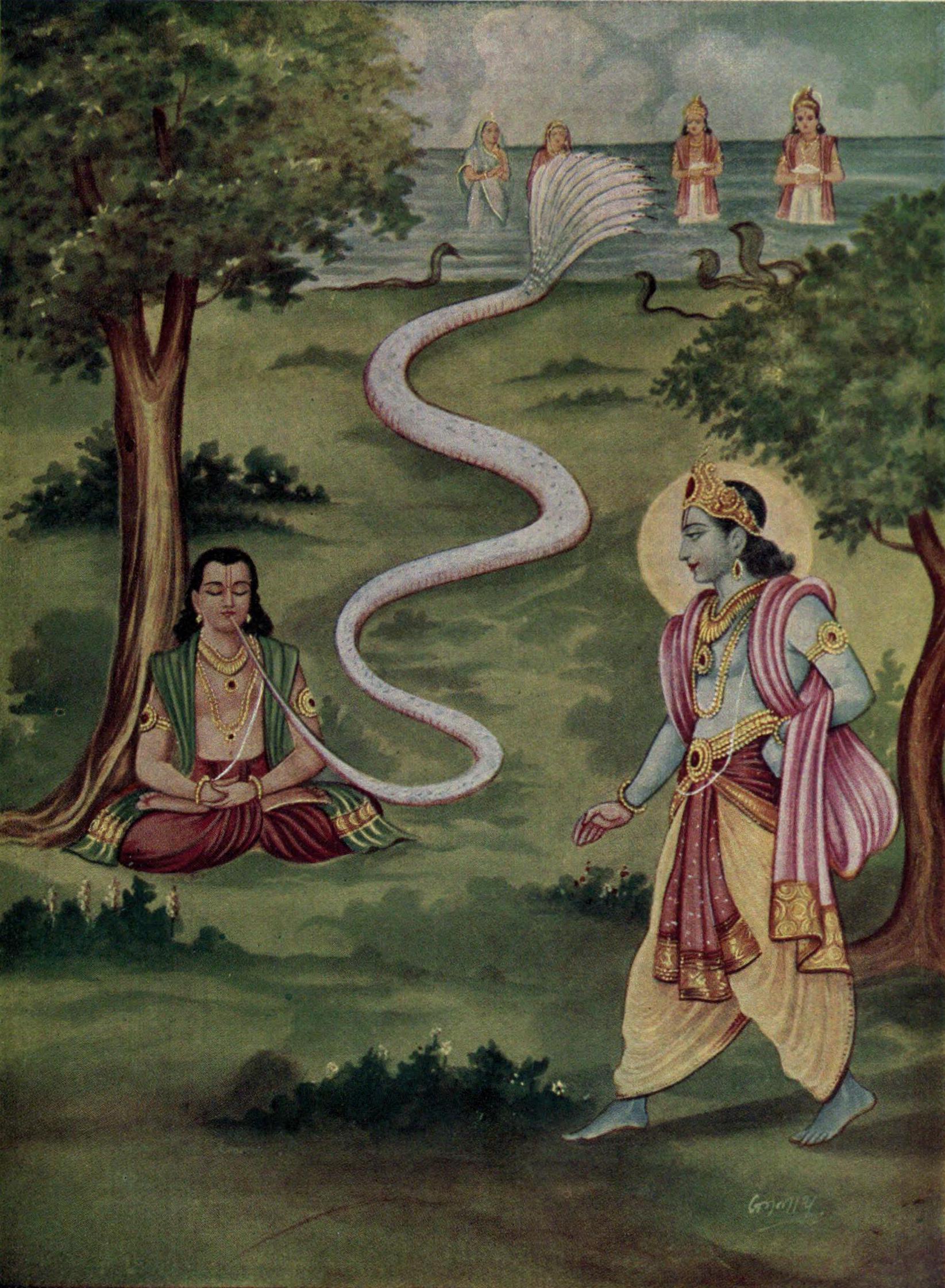
Mahabharata gives an interesting story about Balarama and his brother Krishna. It says Vishnu took two hairs , a white and a black one and left them in Devaki’s womb which became Balarama and Krishna. When Balarama was born he was taken to Gokula to preserve his life from Kamsa, the tyrant king. He was raised by Nanda as a child of Rohini. Balarama killed several demons. He carried his plough always. He killed Rukmin in a drunken brawl.

baladevakrishna
Indo Greek Coin of Balarama and Krishna

He used his ploughshare as a magic wand twice. When he was intoxicated with drinks, he called River Yamuna river to come to him. When it did not come he had used his ploughshare to drag the river towards him and used this water. So he was called Kalindiharshana or mardhana. He killed Romaharshana out of anger, though he repented. When Krishna’s son Samba was imprisoned by Duryodhana , Balarama forced him to release Samba and his lady love. He threatened that he would use his ploughshare.
Balarama was a great wrestler and he killed Dhenukasura, Mushtika and Dwivida

Death_of_Bala_Rama
Blarama’s death

Facts about Balarama :

Wife’s name: Revathi (Daughter of King Raivata)
Person who raised him : Rohini (foster mother)
Father and Moher : Vasudeva and Devaki
Younger Brother: Krishna
Weapon he was holding Halayuda/ploughshare and Musala/pestle
Flag : Palmyra (Taldwaja)
Sons: Nisatha and Ulmuka

Krishna_meets_parents
Krishna and Balarama meet parents

Favourite drink: Madhu (wine)
Favourite pastime: Pilgrimage (went on a tour during war)
Killed: Dhenuka, Mushtika, Pralamba, Dwivida, Romaharshana and Rukmin.
Love marriages he opposed or supported: Krishna – Rukmini, Arjuna—Subhadra and Samba – Laxmana (Duryodhana’s daughter)

Avatara of Adisesha: Balarama is described as one of the ten incarnations of Vishnu. Some people believed that he was Adi Sesha came to help Krishna.
Worship Record: From Kautilya’s Arthasastra period:3rd Century BCE

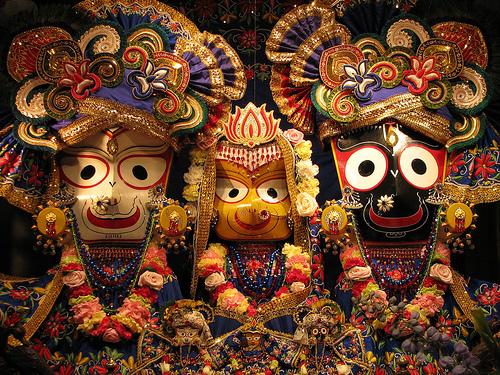
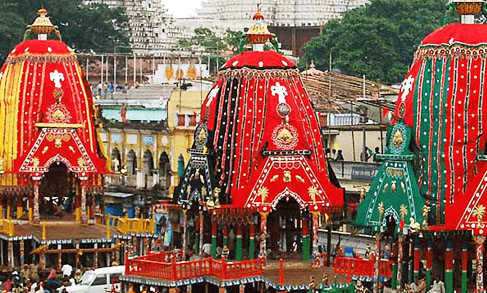
Puri Chariot Festival: Of the three chariots of Puri , the chariot of Balabhadra is called ‘Taladhvaja’ – has 16 wheels and is 22 cubits in height. Baladeva’s cart is blue, with a palm tree insignia, and four black horses. The protecting deity is Sesa.

Temples: in Odisah and Tamil Nadu (In Tamil Nadu the statues are not there anymore; proof comes from Alwar Hymns)

Oldest Agricultural Engineer!
My research shows that he was a great agriculturist. He spread agriculture everywhere. That is the reason he held a ploughshare always. Since he was interested in drinking he had Palmyra on his flag. His name Kalindikarshana, Yamuna bhid show that he dug out canals from Yamuna for irrigation. He was a great wrestler that is why he had the prefix Bala in his name. The white colour may be due to albinism.

MauryanBalaramaCoin3rd-2ndCenturyCE
Mauryan Balarama Coin ,3rd Century BCE

15 Names of Balarama
Amarakosa, the oldest thesaurus, gives 15 names for Balarama!
Balabhadra = Strong
Pralambagna = killer of Pralamba
Baladeva= strong
Achyutagraja= elder to Krishna
Revathiramana = one who loves Revati & loved by Revati
(Bala) Rama-=strong and attractive
Kamapalah= who gets what he wanted
Halayudhah= ploughshare bearer

Balabhadra_Subhadra_Jagannath
Balabhadra, Subhadra, Jaganatha, Puri

Neelambarah= wearing blue clothes
Rohineyah= Rohini raised him
Talaangah= Palmyra Flag bearer
Musalihali= pestle holder
Sankarshana= who had two mothers or who attracts his Yadava clan
Kshirapani= ploughshare bearer
Kalindhibedanh= one who diverted River Yamuna
His other names: Halabhrit=Plughbearer, Langali+ ploushare holder, Guptas chara= who goes secretly, Mahupriya or Priya madhu= wine loving, Yamuna bid, Kalindi karshana = breaker or dragger of Yamuna, Musali=pestle holder.

BalaramaMauesCoin1stCenturyBCE
First century BCE coin

My previous Post:
Rama, Balarama and Parasurama in Ancient Tamil Literature (posted on First June 2014)

Contact swami_48@yahoo.com

rath-yatra-and-appliqua

Balarama chariot along with other chariots in Puri, Odissa

Hymn to Saraswati

09TH_SARASWATHI__1481666f

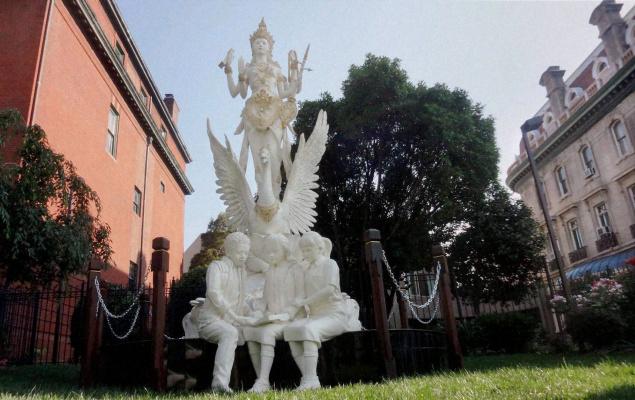
Saraswati Statue in Washington D C ,USA

Compiled by London Swaminathan

Post No. 1322; Dated 1st October 2014.

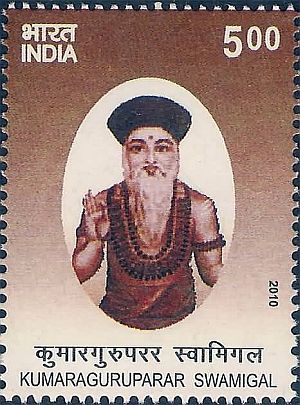
Sakala Kala Valli Malai by Tamil Poet Kumaragurupara Swami

Author of the poem Kumaraguruparar
Life History of Kumaraguruparar

Tirunelveli district saw the birth of many scholars and saints. It was also the birth place of Kumaraguruparar, a great 17th century poet. Shanmukha Sikhamani Kavirayar and Sivagama Sundari Ammaiyar had no children, and the devout couple prayed for a child. They were then blessed with a son, whom they named Kumaraguruparar, who was born near Sri Vaikuntam.

Unfortunately, the child could not speak, even after it attained the age of five. The parents visited Tiruchendur and prayed that their child be blessed with the power of speech. And with the blessings of Lord Muruga, the child immediately broke into verse, and sang ‘Kandar Kalivenba,’
Kumaraguruparar, in the course of his travels, came to Dharumapuram. Masilamani Desikar presided over the mutt there. Kumaragurparar wanted Masilamani Desikar to become his spiritual guru
Kumaraguruparar studied Tamil from his scholar father and became a minister in the court of the Madurai Nayak King.

He composed the Sakalakalavalli Maalai , in praise of Goddess Saraswathi in Kasi/ Varanasi. By the grace of the Goddess, he acquired knowledge of the local language and was thus able to spread the message of Saivism.

It is said that while at Kasi, he also gave discourses on the Kamba Ramayanam , and that Tulsidas, who wrote the Ram Charit Manas , was greatly inspired by these Ramayana discourses. Kumaraguruparar breathed his last in Kasi.

In Chidambaram, he composed ‘Chidhambara Mummanik Kovai,’ ‘Chidhambara Cheyyul Kovai’ and ‘Sivakami Ammai Irattai Mani Malai’ in praise of the God and Goddess of Chidambaram.

Kumaraguruparar was the author of many religious works, including ‘Muththu kkumaraswami Pillai Tamil,’ ‘Tiruvarur Nanmani Malai,’ ‘Maduraik Kalambakam,’ and ‘Meenakshi Pillai Tamil,’ which was listened to by Goddess Meenakshi of Madurai in person (based on news paper cuttings from The Hindu).

kumaraguruparar-1
Kumaraguruparar stamp

Sakala Kala Valli Malai: English Translation from The Tanjore Art Gallery Guide Book, year 1954

1.Saraswathi, Goddess of Learning! While the Lord of Preservation is asleep and the Lord of Dissolution has gone crazy and the Lord of Creation is happy in you- his sweet consort. Your abode is in the white lotus. But can you not condescend to rest your feet on the cool lotus of my simple heart?

thailandfiscal saras
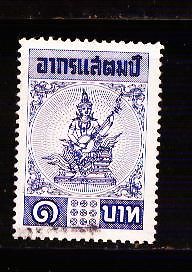
Thailand stamp on Saraswati

2. Goddess of all Learning! Goddess of beautiful breasts and five styled hair! Goddess of slender golden figure who rests in the lotus throne! May you graciously make me sing songs in the four genres, songs with beautiful ideas, couched in sweet language.

(Five Different styles of Hair Do are known as Aimpal Kunthal in Tamil: The five different hairdos are Kondai , Surul , Kuzal, Panichai, Mudi in Tamil.

Four different genres are 1. Asu Kavi: extempore poetry, 2.Madura Kavi= sweet poems set to music, 3.Chitra Kavi= poems composed which will fit into the drawn figure such as Chariot, Snake, Peacock etc. and 4.Visththara Kavi= detailed compositions.

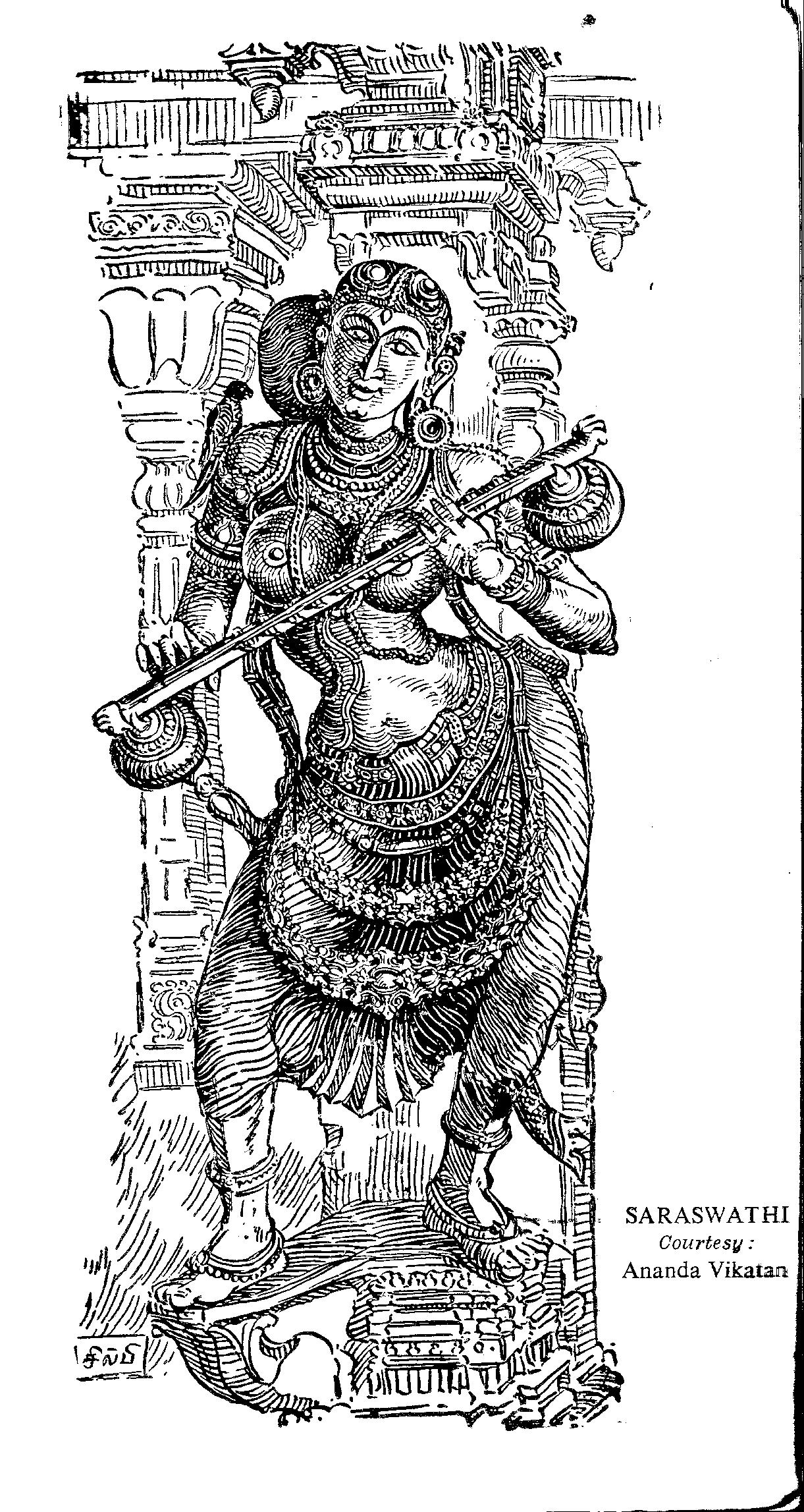
sarasvathy

3. Goddess of all Learning! The peacock dances in ecstasy on the approach of showers. So also you rejoice when the poets rain showers of song of deep thinking and clear expression. When shall I experience the beauty of Tamil, the crystalline nectar that you can bestow? When shall I immerse myself in the ocean of Your Grace?

4. Goddess of all Learning! Ocean of Mercy! You rest on the grateful tongues (lips) of poets and preserve the sea of Sanskrit scholarship and the rich heritage of Tamil songs. May you grant that I become proficient in the deep and varied branches of Learning! May you grant me the gift of singing felicitous songs!

Saraswati_by_bpresing

5. Goddess of all Learning! You rest, as on the lotus throne, on the tongue (lips) and the heart of Brahma, the Creator whose banner depicts the Swan which rests on the lotus with long stalk. Your beautiful soft lotus feet are painted with rouge. Cannot those lotus feet bloom in the cool waters of my heart?

6. Goddess of all Learning! You pervade everything: you pervade the Vedas, the five elements, namely, ether, air, water, fire and the earth; you fill the vision and the hearts of Your devotees. Grant me this boon; make me proficient in all the arts whenever I wish. Make me proficient in music, in dance, in learning and in singing sweet poems.

saras green

7. Goddess of all Learning! Like the white swan which separates water from milk, you also show discrimination in approving of the songs sung poets. Grant me Your benign look: vouchsafe unto me this boon that all song, meaning of song and the goal of all singing, namely, righteousness, wealth and happiness, be integrated in my life.

8. Goddess of all Learning! You are the giver of the supreme everlasting wealth, namely the imperishable wealth of wisdom through learning. The Goddess of Wealth, Lakshmi, who has her abode in the red lotus, cannot bestow this wealth. Grant me eloquence of tongue, skill of attending to many things simultaneously, and the art of singing good songs. Grant me this boon and make me your servant.

saras

9. Goddess of all Learning! The female elephant and the queen swan are celebrated for the beauty of their gait. But they pale into insignificance before the graceful gait of your lotus feet. You are the Manifest form of True Wisdom that pervades all word and thought. Who can comprehend you?

10. Goddess of all Learning! There are myriads of Gods, and celestial beings like the Creator. But is there one to equal you? Grant me this boon that all monarchs, who rule over the earth, bow unto me the moment I sing my poems.
sarastelegu
saras hindi

Saraswati stamps of India

contact swami_48@yahoo.com

700 Temples for ‘Hindu Mitra’ in Rome!

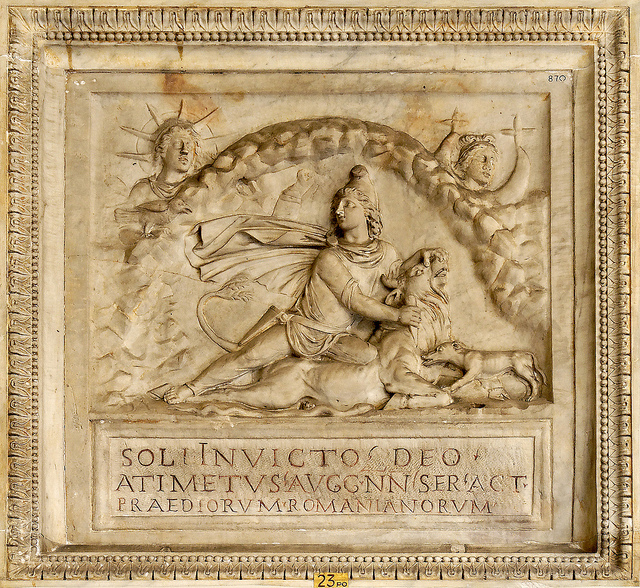
vatican mithra
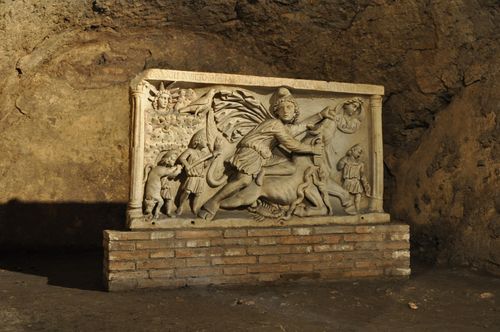
Mithra in Vatican Museum

Compiled by London Swaminathan
Post No 1308; Dated 24 September 2014.

Mitra is a Vedic god. He is associated with the Sun. Mitra is another name of Sun as well. This Vedic god was worshipped throughout the Roman empire 2000 years ago. At one time there were 700 temples for Mitra in Rome. The worship reached Rome from Iran in a degenerated form. Wherever the rule of the Romans was extended there the cult of Mitra was also practised. Even in London they have excavated one Mitra temple sixty years ago. Because of construction of big companies were involved when they dug out the heart of London, they could not install the temple in its original place. Some of the statues were removed from its original site. Now there is a plan to build the temple in the same place as it was during the Roman rule of Britain.

London’s name came from the Roman Londinium. Places of Mithra worship were called Mithraeums. A third century structure was discovered in London. Following this discovery, some Roman artefacts are discovered in London every year. Last year a delicately carved stone sculpture of a Roman eagle with a snake in its beak was discovered in the Tower of London area. Last year alone they dug out 10,000 Roman objects including 250 leather shoes, hundreds of plates and timber writing tablets near the London Mitra temple. Romans ruled Britain in the first four centuries of the Common Era. Roman soldiers worshipped Mithra and accorded high status like an emperor.

In London an inscription dated to 310 CE was discovered. It said, “For the salvation of our Lords, the four emperors and the Caesar, and to the God Mithras the invincible sun from the east to the west”. Most of the British Christian churches were built in the model of Mithraeums.

Mithras in bath
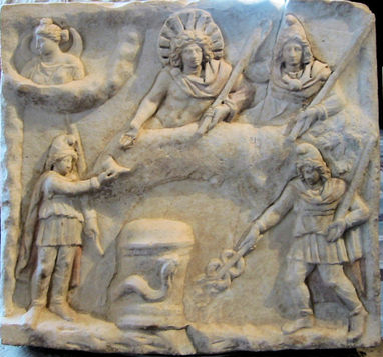
Mitra coming out of rocks

Historians have discovered scores of human skeletons badly injured and mutilated. They were gladiators who were fighting wild animals such as lions bears and tigers. Thousands of Romans enjoyed watching people torn to pieces by wild animals. They even watched people fighting one another till one of them was killed. Huge crowd cheered them to kill one another. Most of the victims were prisoners of war or slaves. They were all young and under 30!

God Mitra in Vedas (1380 BCE Inscription of Turkey)

Even today Mitra is worshipped as Sun by millions of Brahmins in their daily ritual called ‘Sandhyavandhanam’ and by the practisers of ‘Surya Namaskara’. The first mantra is Om Mitraya Nama:.

The archaeological evidence for Mitra goes back to 1380 BCE. He was invoked in a contact between two kings. Mitannian king swore in the name of Mitra, Varuna, Indra and Nasatyas. Mitannians ruled over an area covering Syria and Turkey. The clay tablet inscription with a peace treaty was discovered in Bogazkoy in Turkey.
mithraism-carvings-ancient-rome
Mithra in museums

Mitra and Varuna are the sons of Aditi or Adityas. They are called kings/ Rajas and they possess power/Kshatram. This is the reason for worship by the roman soldiers. Both Mitra and Varuna were endowed with universal power/ Samraj. They maintain universal order/ Rita=rhythm. Mitra presides over friendship and ratifies contracts. This is the reason for Mitannian king to invoke him in the contract. Sanskrit word Mitra means sun and a friend. One of the Pancha Tantras of Vishnu Sarman in ‘Mitrabedham. Zoroaster who went from Saurashtra area of Gujarat to Iran around 800 BCE also used this name Mitra who is considered very close to Asura Mazda.

In the Vedas, Mitra is the ruler of the day and Varuna the ruler of the night like sun and moon. Both maintain the order in the world and this is the reason for Vedas always pairing them as Mitra-Varuna. People with a scientific bent of mind see them as the positive and negative nodes in an electric battery. They together uphold and rule the earth and the sky, guard the world, encourage religion and punish the sinners
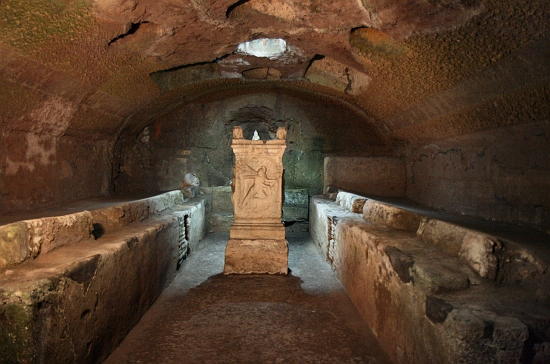
mithraeum-san-clemente-8966p40
Mithraemple under San clemente Church

Mithra Cult of the Romans
Mithra in Persia was a god of war, justice and the sun. As a god of war he rode in a golden chariot drawn by four horses to combat the demons.

Under the Roman empire, Persian Mithra became the focus of a mystery cult particularly popular among the roman soldiers. Mithraic shrines were characterised by an image of Mithras slaying a bull. The slaying of bull was an ancient Persian rite said to have been established by the first man Yima. For the followers of Mithraism this rite symbolised the renewal of creation. In killing the bull it was believed that Mithras brought back Yima’s rule over a world where hunger and death were yet unknown. Romans sacrificed bulls, but to different mother goddess.

Note how the spelling changes from Vedic India to Iran to Rome. Mitra becomes Mithra and then to Mithras.

(In Hindu mythology, Yama was the man said to have died as the first person. Hindu mythology is distorted in Persian and Greek mythologies).

mithraeum in Rome hidden
Mysterious Mithra temples are always in under ground locations.

Sources for the article:
Daily Telegraph (London),
Encyclopaedia of Gods by Michel Jordan,
Dictionary of World Myth by Roy Willis and
New Larousse Encyclopaedia of Mythology

பட்சிகள் அருள் பெற்ற அபூர்வ ஸ்தலங்கள்

cock_sidenew
Cock at Trafalgar Square, London (Photo by london swaminathan)

எழுதியவர்: ச.நாகராஜன்
கட்டுரை எண் 1307; தேதி செப்.24, 2014

(This article is written by my brother S Nagarajan and published in the Tamil magazine Jnana Alayam: London swaminathan)
If you want to read similar subject in English please see my posts: 1 Gods and Birds posted on Feb..3,2013 (2). Hindu Eagle Mystery Deepens, posted on Feb.16, 2013 (3). Who rides What Vahana (Animals or Birds)? posted on Oct.26, 2012; Interesting Facts about Vahanas, posted on oct. 2012; (4) Four Birds in One Sloka (5) Kapinjala Bird Mystery (6) Mysterious Vedic Homa Bird: Does it exist) (7) என்ன கடவுளுக்கு என்ன வாகனம்? (8) கா….கா…….கா……கா……

cock1
படைப்பில் அனைவரும் சமம்

“காக்கை குருவி எங்கள் ஜாதி – நீள்
கடலும் மலையும் எங்கள் கூட்டம்
நோக்கும் திசையெலாம் நாமன்றி வேறில்லை

நோக்க நோக்கக் களியாட்டம்” என்று பாடினார் மஹாகவி சுப்ரமண்ய பாரதியார். பறவைகளை மனிதருடன் சேர்த்த அத்வைத பாவனையை அவர் ஒரு சிறந்த ஹிந்துவாக இருந்ததனாலேயே பெற முடிந்தது.

வானத்தின் மீது மயிலாடக் கண்டேன்
மயில் குயில் ஆச்சுதடி – அக்கச்சி
மயில் குயில் ஆச்சுதடி என

சிதாகாச நடனத்தை வள்ளலார் அற்புதமாக்ச் சித்தரித்தார்.

அருணகிரிநாதரோ “ஆன தனி மந்திர ரூப நிலை கொண்டது ஆடு மயில்” என்று பிரணவமே மயில்ரூபம் கொண்டு அற்புதமாக ஆடுகிறது என்று (வாதினை அடர்ந்த என்று தொடங்கும் பாடலில்) விளக்குகிறார். இப்படிப்பட்ட அற்புதமான பரவசமூட்டும் ஆன்மீக விளக்கங்களை அறிந்து கொள்ள பரந்த பாரத தேசமெங்கும் பரவிக் கிடக்கும் தலங்களில் தான் எத்தனை பட்சிகள் பற்றிய ஸ்தலங்கள்.

Peacock cry

அன்னை மயிலாக வழிபட்ட மயிலை
அன்னை உமாதேவி, மயிலாக உருக்கொண்டு சிவபிரானை வழிபட்டதால் திரு மயிலை என்ற பெயர் பெற்ற மயிலையின் பெருமையை மயிலையே கயிலை கயிலையே மயிலை என்று அருளாளர்கள் கூறுவதால் அறிய முடிகிறது.

ஈக்களும் வண்டுகளும் பூஜிக்கும் தலம்
ஈவேங்கை மலை என்னும் ஈங்கோய்மலை ஈக்களால் பூஜிக்கப் பெற்ற தலம். நக்கீரர் திரு ஈங்கோய்மலை எழுபது என்னும் நூலை இயற்றியதால் மகிழ்ந்த அரசன் ஒருவன் அவரது உருவத்தை இங்கு பிரதிஷ்டை செய்து பூஜை நடத்தும் படி நிபந்தம் அமைத்ததை இந்தக் கோவிலின் சிலாஸாசனம் தெரிவிக்கிறது. இதன் இன்னொரு பெயர் மதுகிரி.

பட்டீச்சுரத்தில் இறைவனை வழிபட்ட மதுவல்லி என்ற தாசியும் அவள் வளர்த்த கிளியும் முத்தி பெற்றதாக பட்டீச்சுரப் புராணம் தெரிவிக்கிறது.

பட்டிச்சுரத்திற்கு மேற்கே மணல் மேடு ஒன்று இருக்கிறது. அதற்கு நந்தன் மேடு என்று பெயர். இங்கு ஏழரை லட்சம் பொன் இருப்பதாக அறிவிக்கும், “எழுவானுக்கும் தொழுவானுக்கும் இடையே ஏழரை லட்சம் பொன் இருந்த தாக” அறிவிக்கும் ஒரு கல்வெட்டைக் கண்டார் சரபோஜி மஹாராஜா. (எழுவான் என்றால் சப்த கன்னிகள் (மேற்கே) இருக்கும் இடம் என்றும் தொழுவான் என்றால் முகமதியர் தொழும் இடம் என்றும் அறிந்து கொண்ட அவர், சோழன் மாளிகையில் புதையல் இருக்கும் இடத்தில் வெட்ட முயல்கையில் கதண்டுகள் (கருவண்டுகள்) வெளிப்படவே தன் முயற்சியைக் கைவிட்டதாக சுவையான செய்தி ஒன்றை வரலாறு தெரிவிக்கிறது. கருவண்டுகள் புதையலைக் காக்கின்ற அபூர்வ தலம் இது..
பட்டீச்சுரமும், திருச்சத்திமுற்றமும் கருடன் பூஜித்த தலங்களாகும்!

Funny animal picturesSource: Fimca Grey fgrey@lancashire.newsquest.co.uk

கழுகு வழிபடும் கழுக்குன்றம்
வேதமே மலையாய் விளங்கியமையால் வேதகிரி என்ற பெயருடன் திகழும் திருக்கழுக்குன்றத்தில் 500 அடி உயரமுள்ள மலையில் தினமும் உச்சிப்போதில் கழுகு வந்து உணவு பெற்றுச் செல்வதை அனைவரும் அறிவோம். இதனால் பட்சி தீர்த்தம் என்ற சிறப்புப் பெயரைப் பெற்ற இந்த தலத்தில் மார்க்கேண்டேயர் இறைவனை வழிபட பாத்திரம் இல்லாமல் தவிக்க இறைவன் சங்கு ஒன்றைச் செய்து அருளியதையும் இங்குள்ள குளத்தில் பன்னிரெண்டு ஆண்டுகளுக்கு ஒரு முறை சங்கு உற்பத்தி ஆவதையும் கோவில் வரலாறு தெரிவிக்கிறது!

ராவணனை எதிர்த்த ஜடாயுவின் இறக்கைகளை அவன் அறுக்க, கீழே விழுந்து இறக்கும் தருவாயில் இருந்த ஜடாயு ராமரிடம் தன்னை வைத்தீஸ்வரன் கோவில் என்று இன்று அழைக்கப்படும் திருப்புள்ளிருக்கு வேளூரில் தகனம் செய்யுமாறு வேண்டியதை வைத்தீஸ்வரன் கோவில் தல வரலாறு கூறுகிறது. இங்குள்ள ஜடாயு குண்டத்தை பக்தர்கள் தரிசிப்பது மரபு.

கல் கருடனின் ஸ்தலம்
கருடனுடன் தொடர்பு கொண்ட தலங்களோ ஏராளம். கும்பகோணத்திற்கு அருகில் உள்ள நாச்சியார் கோவிலில் உள்ள கல் கருடன் அதிசய வரலாற்றைக் கொண்டவர். சிற்பி ஒருவர் கருடனைச் செதுக்கி பிராணபிரதிஷ்டை செய்த போது அது பறக்க ஆரம்பிக்கவே அதன் மீது ஒரு கல்லை எறிய அது அலகில் பட்டு கருடன் விழுந்த தலம் இது! திருநறையூர் எனச் சிறப்பிக்கப்படும் இந்த தலத்தில் கருடனை மண்டபத்திலிருந்து வெளியே கொண்டு வரும் போது நால்வரும் பிரகார வலத்தின் பொது எட்டுப் பேரும் கீழே கொண்டு வரும் போது முறையே 16,32,64, 128 என்ற கணக்கில் தூக்கும் படி கருடனின் எடை அதிகரித்துக் கொண்டே போவது இன்றும் காண முடியும் ஒரு அதிசயம்.

bird then chittu

பட்சிகளின் ஸ்தல பட்டியல்
இப்படி நூற்றுக்கணக்கான தலங்களில் பட்சிகளின் தொடர்பு உள்ளதை அந்தந்த தலத்தின் புராணம் மூலம் அறிய முடிகிறது. ஆர்வமுள்ளவர்கள் இதை இன்னும் அதிகமாக நன்கு அறிய விரும்பலாம். அவர்களுக்கு உதவும் ஒரு பட்டியல் (உ.வே.சுவாமிநாதையர் ஓலைச் சுவடிகளிலிருந்து குறிப்படுத்துத் தொகுத்த்து) இதோ:-

பூஜித்த பட்சி தலம்

பெட்டைப் பருந்து வேளூர் தேதியூர்
அன்னம் அம்பர்
மயில் மாயூரம், மயிலை, திருமயிலாடி
சாதகப் புள் திருவஞ்சிக் களம்
எண்காற்புள் திருபுவனம், தாராசுரம்
சக்கரவாகம், திருப்பள்ளியின் முக்கூடல்

12_YT_SPARROW_1391748f

குருவிகள் சேர்ந்து பூஜித்த தலம் குருவி, ராமேஸ்வரம்,முக்கூடல்
வலியான், மதுரை
கூகை கொடுங்குன்றம்
கோழி ஐந்தூர் (திருச்செந்தூருக்கு அருகில் உள்ள இடம்)
காக்கை சிதம்பரம்,அம்பர்மாகாளம்,திருப்பனந்தாள்,
இடைமருதூர்,குரங்கணில் முட்டம்
வண்டு திருவண்டுதுறை
வாவல் புகலூர், ராம நந்தீஸ்வரம்
தேனீ ஈங்கோய்மலை,நன்னிலம், கந்தங்குடி

13TH_ARREST_Swan,Vijayawada
குளவி கோளிலி
சாதகப்புள் திருவஞ்சிக்களம்
நாரை திருநாரையூர்
மாடப்புறா வல்லம்
கிளி கீரனூர், கிளியனூர்

பறவைகளும் முக்தி பெறலாம்

இந்தப் பட்சி ஸ்தலங்கள் உணர்த்தும் உண்மை என்ன? பெறுதற்கு அரியது மனிதப் பிறவி என்றாலும் அதில் பிறந்தால் மட்டுமே முக்தி அடைய முடியும் என்பது கிடையாது. இறைவன் அருளுக்கு முன் சகல ஜீவராசிகளும் சமம். பட்சிகளாக இருந்து இறைவன் அருள் வேண்டி பூஜித்து முக்தி பெற்ற பட்சிகளும் உண்டு. பட்சிகளைச் சுற்றிப் படரும் திவ்யமான சரிதங்களைக் கேட்கும் போதும் அவற்றுடன் தொடர்புள்ள தலங்களைத் தரிசிக்கும் போதும் சிந்திக்கும் பகுத்தறிவு ஆற்றல் இல்லாமல் இருந்தும் கூட அவை இறைவனின் அருள் பெற்ற அதிசயங்களை உணர்ந்து நம்மை இறையருளுக்குப் பாத்திரமாக ஆக்கிக் கொள்ள வேண்டும் என்ற உத்வேகம் பெற முடிகிறதே, அதற்காகவே இந்தத் தலங்களுக்கு நாம் விஜயம் செய்யலாம். இறைவனை வணங்கி இக பர சௌபாக்கியம் பெறலாம்!

ஞான ஆலயம் செப்டம்பர் 2014 இதழில் பிரசுரமாகி உள்ள கட்டுரை

contact swami_48@yahoo.com
**********************

Palmyra Tree Worship in India and Sri Lanka!

battocaola branched palmyra
Rare branched palmyra trees in Batticaloa in Sri Lanka.

Research paper written by London Swaminathan
Post No 1306; Dated 23rd September 2014.

Tree worship is practised around the world. We see it in Sumer, Indus and Maya civilizations to name a few. But India is a country where it is practised till today with same fervour as it was 2500 years ago. Vishnu Sahasranamam gives three trees as Gods names : Asvatta, Udumbara and Nyagrodha. All these trees belong to the genus Ficus (Pipal, Fig and Banyan Trees). We have even people named after these trees in our old literature- both secular and religious. But the surprising thing is the Worship of Palmyra Trees!

Palmyra’s botanical name is Borassus flabellifer (Family: Arecaceae or Palmae). It is indigenous to India. Lord Krishna’s brother Balarama had it on his flag. It is strange that he chose this tree when there were hundreds of beautiful flowering and fruit laden trees in India. The oldest Tamil book Tolkappiam mentioned the Palmyra flag of Balarama. Nakkirar in Purananauru verse 56 also praised Balarama carrying Palmyra flag and plough. The tree and its parts are used in hundreds of ways. No part of this tree is useless. So it is called Karpaga Taru (Wish Fulfilling Tree).

Major temples in Tamil Nadu have “Sthala Vrkshas” meaning the local tree of the temple. This is the tree of the temple in Tiruppanandal, Tiruppanangkadu, Tiruppanaiyur, Tirumazalpadi and Tirukkurungkudi. Both Buddhists and Hindus worshiped this tree. Some people thought it was because the palm leaf that was used for writing the scriptures and preserving them. But it is not convincing. Moreover the 2000 year old Sangam Tamil literature and Sri Lanka’s chronicle Mahavamsam specifically say that these trees are abodes of Gods!!

It is called Panai or Pennai in Tamil and Tal or Tad in most of the Indian languages. In a few temples in Tamil Nadu Adi Shankara and his followers did Tadanga Pradhista to Goddesses. It was used as an earring of women at one time. That is why it was called Thadanga ( In Tamil Thodu).

palmyra with 8 branches
Palmyra tree with 8 branches

In Mahavamsa

During the reign of Pandu abhayan in Sri Lanka he built several buildings and made several facilities for the public. One of them was the erection of a Palmyra tree surrounded by a fence which was the God of the Hunters (See chapter 10).

In Sangam Tamil literature Palmyra tree is said to be worshipped by the residents of Neithal landscape (sea shore and its surrounding area). Alamperi Sathanar of Natrinai verse 303 says that there was a Palmyra tree in the meeting place of the village and the tree had a huge stem where God resides. The commentator adds that it is common for the people of the littoral land to invoke family deity and city deity in the Palmyra tree.

Indian temple sculptures from second century BCE show Palmyra tree in at least eight places. In many of them Balarama’s killing of Dhenukasura is portrayed with the tree. I have already written about Vibhishana’s gift to Rama in the Ramayana Wonders series where Vibishana presented Ram, a momento with seven golden Palmyra trees. It was a puzzle and I commented that it may be due to Rama’s heroic act of piercing through seven trees with one arrow. Now my guess is proved right.

palmyra 7
Amriteshwara temple, Karnataka

At the Amriteshwara temple in Amritapura, Karnataka, there is a sculpture with seven Palmyra trees. There are markings on the tree to show that it was pierced by an arrow and Sri Ramachandra is standing on the left with his bow. The arrow having pierced through the trees is denoted by a downward moving line. There is a snake under the trees. Lakshman, Hanuman and Sugreeva are all watching the scene (See page 200 of Plants in Indian Temple Art by Shakti M Gupta). So this is the reason for Vibishana donating a Seven Golden Palmyra trees memento to Rama. Ramayana refers to a different tree. Palmyra tree is Tala tree. There may be some confusion in the transcription of the word. There is scope for more research here.

In my Tamil article Long Live Palmyra Tress posted on 27th January 2014, I have listed the Tamil proverbs on Palmyra trees and the important Tamil verses where Palmyra is used as a simile.

Palmyra Tree Miracle
When the famous Saivite saint Sambandhar visited Tiruvothur he saw a devotee crying. The devotee raised some Palmyra trees so that he can use the income for his community service in the Shiva temple. By rare coincidence all the trees were male trees and did not yield fruits. Atheists were mocking at him and teased him asking when his god would yield him fruits. When Sambandhar asked him the reason for his sad face, he told him about the ‘male only Palmyra trees’. Later Sambandhar visited the Shiva temple and looked at the Palmyra trees and he sang ten verses in praise of the Lord and said the male trees will yield (Kurumpai Aan Panai Eenum in Tamil). Next minute all the trees bloomed and bore plenty of Palmyra fruits! Dr R Nagasamy, renowned historian and archaeologist, has quoted the Sanskrit lines from the Upamanyu Bhakta Vilasam giving the same meaning: Tala: pumamsa: sruthvai they bhavanthu paritha: palai:
OLYMPUS DIGITAL CAMERA
Fruits of Palmyra Tree

Talisman and Tale Tree
I guess the English word Talisman and Tamil word Tali came from the Sanskrit word Tala for Palmyra leaf. In the ancient India, Hindus wore ornaments made up of Palmyra leaf in which they wrote mantras. Adi Shankara and his followers installed Thadanga in Kanchi Kamakshi Temple and Trichy Akilandeswari Temple. But that is worn on the ear as ear studs.

During lunar and solar eclipse times the Brahmin priests visited my house and asked us to wear the Palmyra leaf with written mantra on our foreheads. This is to ward off the evil effects of the planets, if the eclipse occurred on the day of your birth star etc. This custom shows that wearing the palm leaf with written mantra has been there for ages.

Tamil Youths Ride on Toy Palmyra horses
In ancient Tamil Nadu, Tamil youths who fell in love with girls used to make a horse toy with Palmyra leaves and used to ride on it along the streets to make it public. Then the parents of the girls were forced to marry them. Though it was practised only by the Tamils in ancient India, the association of horse in this ritual show that it also came from the north. Horses came to India from outside. The oldest reference is in the Rig Veda.

Star Anuradha is called Mudai panayam in Tamil meaning stunted Palmyra tree.
Countries like Cambodia have Palmyra trees as their national emblem. In Tamil Nadu and Palakkadu area of Kerala the tree plays a big role in common man’s life. It may be due to the toddy tapped from these trees.

122 Amruteshwara temple Rama Sita Lakshmana Golden Deer
Ramayana in Karnataka Temple

My earlier Ramayana and Tree related posts:

1.Where is Rama Setu (Rama’s Bridge) ? 2. Did Sita Devi Die in Earth Quake? 3. Ramayana Wonders Part1 (4) . Ramayana Wonders Part2 :How many miles did Rama walk? (5) Ramayana Wonders Part 3: Rama and Sanskrit G’ramma’r (6) Part 4: Who can read all 300 Ramayanas? (7) Ramayana Wonders part 5: Indus Valley Cities in Ramayana (6) Indian wonder: The Banyan Tree (7) Ramyana Wonders Part 6 (8) Where there is Rama, No Kama and many more

Contact swami_48@yahoo.com

Pictures are taken from different websites;thanks.

3000 Gods in Mesopotamia! Similar to Hindus!!

adad01on bull

Adad on Bull like Shiva or Indra

Research paper written by London Swaminathan
Post No.1296;Dated 18th Sept. 2014.

There are some amazing similarities between the Hindus and Mesopotamians ( covering Sumer, Babylonia) in the number of Gods and sculptures. In my previous articles on Sumer, I have given a long list of similarities. Now I have found out something new!
Mesopotamia is modern Iraq.

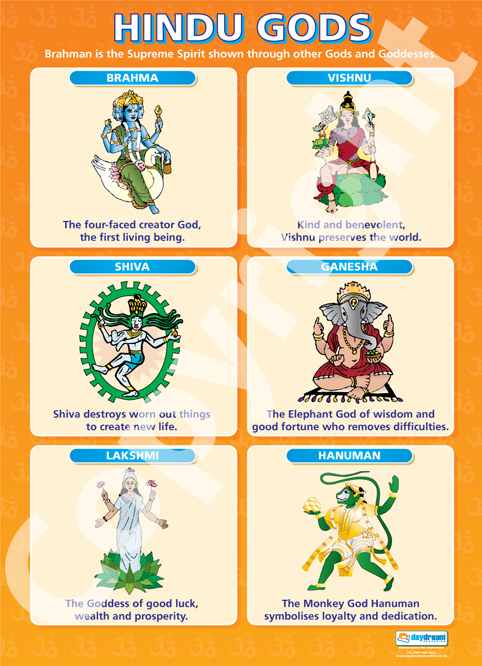
Hindus are the people who have the highest number of Gods in the world! But the oldest religious book The Rig Veda made it very clear that One God is worshipped in these different forms: Ekam Sath Vipra: Bahuda Vadhanthi (Truth is one, sages call them by different names (RV 1-164-46). Sumerians and Babylonians also called their God with 3000 names!

Dictionary of the Ancient Near East published by the British Museum in London has beautifully summarised the Mesopotamian concept of god:-
“ The gods of the Ancient Near Eastern peoples, in historical times, were almost without exception anthropomorphic, male or female. They were imagined as of gigantic size and exuded a terrifying splendour, with super human powers, although the power of all the gods was by no means equal; some were relatively minor or of restricted influence. They shared the emotions and foibles of human kind. Generally speaking they were immortal, although there were certain gods about whom myths were recounted which involve their deaths or visits to the underworld. Although they lived in heaven or the underworld, an extension of their personality also inhabited the various cult statues erected to them by humankind”.
Every word of the above paragraph is true with the Hindu Gods. If we simply replace the words “Near eastern peoples” with the “Hindus”, it will still be correct.

inanna  triumphant
Inanna on lion like Devi

In every culture Gods are slowly “created to satisfy a number of people”. The number slowly increases, but those who created know that they are one and the same. At the highest level there is only one God. For the layman’s satisfaction new gods or new names with particular attributes are created.

The second reason for the increase in the number of Gods is different cultures have similar stories about their Gods. Then they slowly merge but retain their names. We have already seen in one of the posts how Indra is worshipped with different names in different cultures. Sumers and others in the Near East had names of 3000 deities!
ashtart on lion

Ashtart on lion like Durga

Second Amazing Similarity! “Nayanonmilanam”
One more amazing similarity about sanctifying the sculpted statue is “Opening the eye” ceremony in Hinduism. The sculptor who makes a statue of a god or goddess will chose an auspicious day and auspicious time to open the eyes of the statue. Once it is done it is not stone anymore. It is God incarnate. So much importance and so much sanctity are attached to the ceremony. It is called Nayanonmilanam in Sanskrit (Opening the Eyes of New Idols).

Babylonians also had a similar ceremony! It is called “Washing the Mouth of New Idols” and “Opening the Mouth of the New Idols”. It is one and the same! In certain languages the idioms change and in certain other languages the words for certain body parts do not exist. Sanskrit is a ‘Mouthless’ language and Tamil is a ‘Faceless’ language. That is in Tamil there is no word for ‘face’ and so they use Sanskrit word Mukam for face. Sanskrit has no word for mouth and so they use Mukam for mouth. Tamil is a ‘heartless’ language!! That is to say that there is no word for heart in Tamil and so Tamils use the Sanskrit word Hrudaya. English word Heart is also derived from Hrt of Sanskrit.

448px-Burney_Relief_Babylon_-1800-1750
Lilith of Hebrews is like Devi and Lakshmi with owl

So “opening the mouth washing the mouth” of Babylonian Gods are the same as Opening the Eye of Hindu Gods. After opening the eye of the statue, Hindu sculptors lower the idols into water for some time and then in the heap of grains for some time and then they ask all the general public to anoint the idol with special oil.

According to British Museum dictionary “Babylonians did this ritual in order to enable it to become imbued with the divine presence”. This is exactly Hindu Sthapathis (Temple sculptors ) say about the Hindu rituals!!

British museum dictionary adds “ The largest group of gods are the deities of the various city pantheons. Local deities were particularly important in the heterogeneous Hittite religion. There were also gods and goddesses representing natural forces, birth goddesses, groups of anonymous gods and minister deities who attend more important gods and goddesses. Some human rulers were also deified. More than 3000 names of deities have been recovered from Mesopotamia alone”.

yazidi_symbol
Yazidi peacock is like our Subramanya’s vahana

My comments on the above paragraph:
We also had various pantheons: Kula devatas, Ishta Devatas, Dushta Devatas, Parivara Devatas, Nagara Devatas and Guradian Deities. Major Gods like Brahma, Vishnu, Shiva and lots of minor gods are worshipped by the Hindus from time immemorial. We also deified human rulers Rama and Krishna as Avatars (incarnation). We also had Sahasranamam (1000 names) for each major god and goddesses. Hindus also worshipped gods in the form of natural forces.

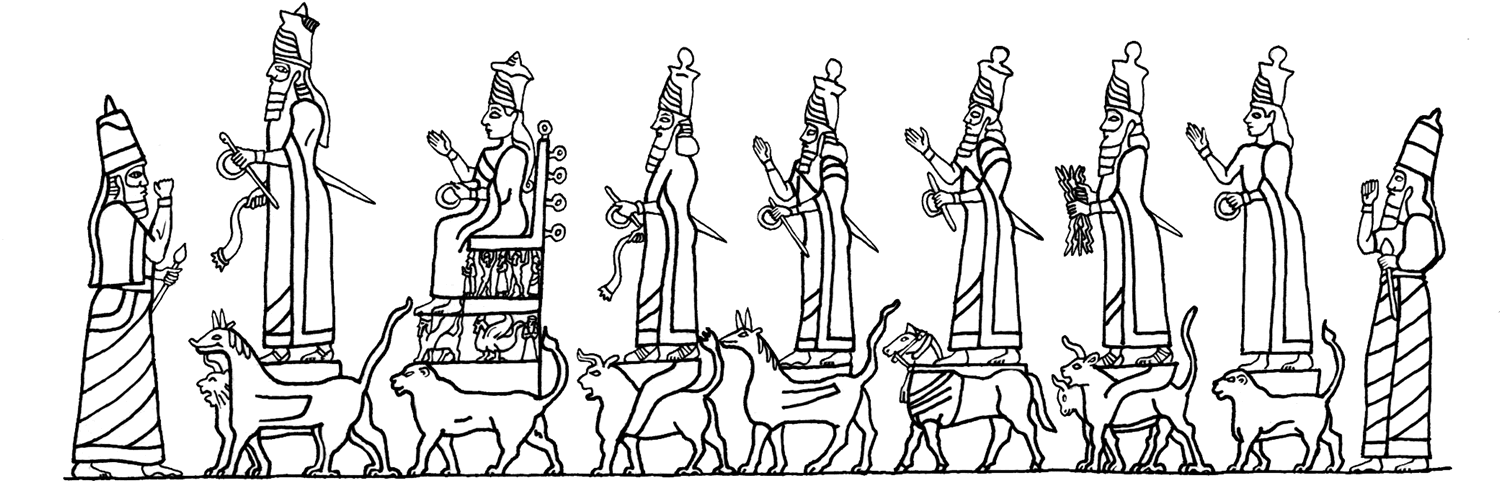
British Museum Dictionary adds “ In art, Mesopotamian gods are generally sworn wearing the horned cap with up to seven super imposed sets of bull’s horns, described as a mark of divinity”.

Throughout the Rig Veda Indra is called a bull and the Bull seals are more in number in the Indus Valley than other seals. God is called a “Horned person” in Hindu Vedas. Vishnu Sahasranamam alone had three words for God as Horned one (Maha Srngan, Chatvari Srngan, Na Eka Srngan etc). I have explained them in my post “Vishnu seal in Indus Valley”.
procession-lg
Seven God processions on Vaganas in Iraq is like our Saptarishis

If we approach the Ancient Near East Gods in a chronological order we can see the development of number of Gods. Since Encyclopaedias give all the names together we get confused. In Hinduism, we see new gods get sudden prominence because one Swamiji said something about that particular God or an actor praised that God!

Tamil actor M G R made Goddess Mookambika worship popular. Another actor Rajinikant made Saint Ragavendra popular. In Bombay Siddhi Vinayak temple became more popular because of Bollywood actors and actresses. Sabarimala was visited by famous actors and singers and it attracts millions of people now. One hundred years ago not many people visited the temple. Hinduism is a growing religion, but the basic truths have not changed for at least 5000 years!!

In short, Hindu concept of God was propagated to the Near East by the Hittites, Kassites and Miamians. All these groups were practisers of Vedic Hinduism. Hittites are Khattis or Kshatrias, say Mr Kalyanaraman in his book Arya Tarangini. He has identified all these groups with the Vedic Hindus. Foreign scholars also admit all these groups spoke a language belonging to Indo-European group, in other words a language related to Vedic Sanskrit. I have already supplied the archaeological evidence from Turkey, Syria and Egypt.

Sometime ago I posted “Fish Gods Around the World” from which the following matter is lifted:
Apart from Matsya Avatar of Lord Vishnu, we hear about other Fish Gods such as Oannes, Dagon and Sindhi saint. Berossus (Vararuchi ?) was a scholar/priest who lived in Babylon in 3rd century BC. He wrote the history of Babylonia. He gave us the story of Oannes.

tammuz01
Tammuz from Mesopotamia (Iraq)

Oannes was a mythical being who taught mankind wisdom. He had the body of fish, but underneath the figure of a man. He taught arts, science and writing. Oannes came from the Uanna, another name for Adapa. Akkadian connects this word to Um Manu. I guess this name as Indian Law Giver Manu. Adapa was a sage according to Sumerian legends. Going by this version I will take it as Manu or a sage from India who taught them Manu Dharma.

(Oya in Sri Lanka, Oannes in Babylonia were all related to Thoya= Sanskrit word for water).
Berossus said that the half man-half fish (Matsyavatar of Lord Vishnu) creature was attended by other monsters called Apkallu. Apkallus are Sapta Rishis of India. The Sumerian legend says Seven Apkallus (sages) were created by Enki to establish culture and give civilization to mankind.

In Egypt, First King Narmer ( Nara Meru also knowns as Menes=Manu) was called Catfish Chisel. In other words he was also called a fish.

Please read my earlier posts on Sumer- India link

Hindu Vestiges in Iraq ( Posted on 12th August 2014)
Indus Valley to Egypt: Lapis lazuli Export (posted 0n 6th Sept.2014)
Why did Sumer and Egypt worship Indra? (Posted 14th Sept.2014)
Double Headed Eagle: Indian—Sumerian Connection (18th December 2011)
Birds for Finding Direction: Sumeria to Tamil Nadu via Indus Valley (Posted 8th April 2013)
Cremation: Sumerian – Hindu Similarities (Posted on 14th May 2014)
Sanskrit Words in Sumerian: Sumukan Mystery (Posted on 12th May 2014)
A Hindu Story in Sumerian Civilization (Posted on 11th May 2014)
Mysterious Fish Gods around the World (Posted 27-10-2012)
Tulabharam: Indian – Sumerian Connection (Posted on 2nd January 2012)
Serpent Queen: Sabarimalai to Indus Valley
Hindu Vahanas around the World
Hindu Vahanas in Iraq (Posted on 21st October 2012)

(Most of these articles are published in Tamil as well around the same dates)
Contact swami_48@yahoo.com

Hindu Gods and other Ancient Gods

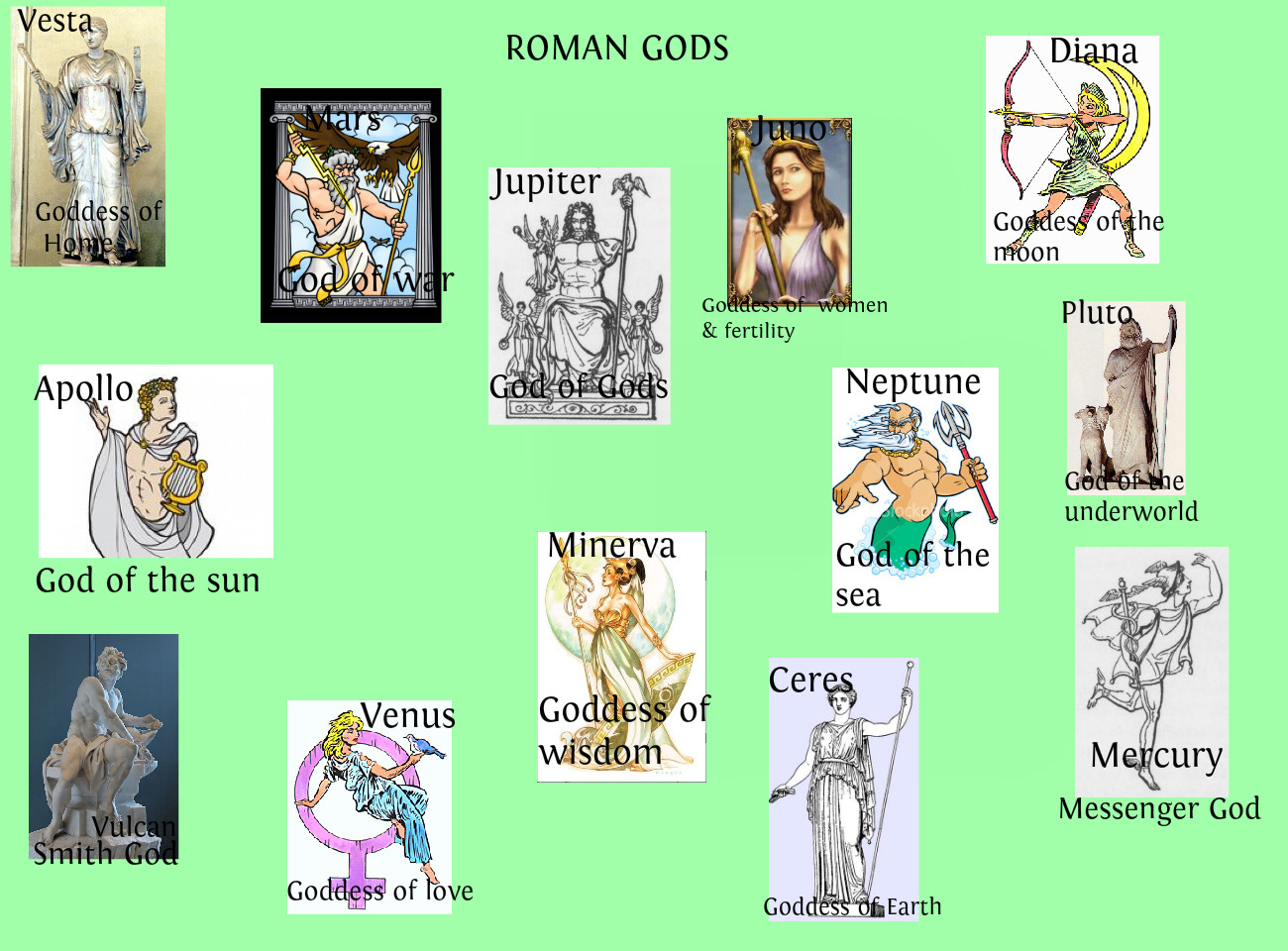
roman-gods-and-goddesses-source
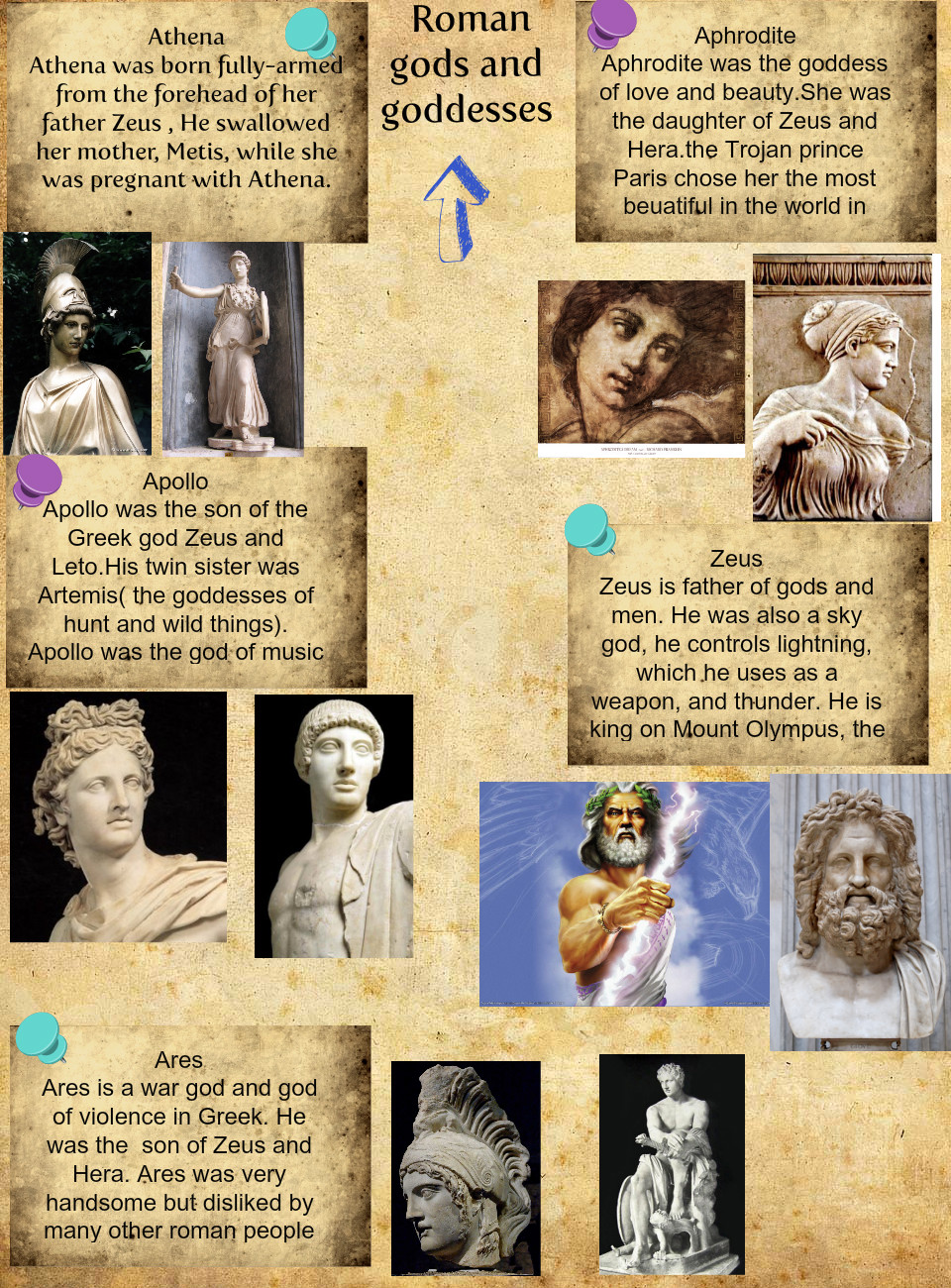
Roman Gods

Compiled by London swaminathan
Post No 1275; Dated 8th September 2014.

No two clocks agree, they say. And no two Gods agree in full. But we can see similarities between two cultures in the comparative mythology. This shows that the thinking of human beings works in the same way. It may also reveal another fact that we all lived under one roof long ago. The third point is that Hindu gods were there in the beginning, what they call as pagan gods and slowly other cultures absorbed them. When new Semitic religions were founded those gods were sent to museums. Hindu Gods alone survived this onslaught.

For some Hindu gods and goddesses we see two names and this is because the Greek Gods were slowly absorbed in to Roman religion and got new names. But these foreign gods are not worshiped anymore and found their place in the museums around the world.

Ancient-Greek-Gods
Greek Gods

Hindu – Slav
Varun – Perun
Haridasva Hors / sun
Surya Hors / sun
Moksha Mukosh / death

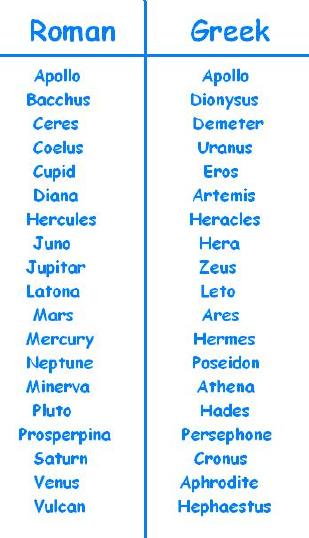
Roman or Greek Gods & Hindu Gods
Zeus – Indra (Taranis, Thor)
Jupiter – Indra
Saturnus – Brahma
Minas – Yama
Neptune – Varuna
Sol -Surya
Lunus – Chandra
Hercules – Krishna (Hari kula esa)
Janus – Ganapathy
Hephaestus/ Vulcan – Visvakarma /Tarkhan/Takshan
Plutarch – Kubera
Apollo – Krishna (also Hercules)
Mercury – Narada
Burgos – Rama
Mars – Skanda
Juno – Durga (also Diana & Artemis)
Minerva – Sarasvati (Also Athena)
Venus – Rambha
Aurora -Usha
Cybele -Prithvi
Ceres – Sree /Lakshmi
Cronos – Kashyap (Father of Asuras and Devas)
Zeus, Poseidon, Hades -Trimurti
Hera – Lakshmi
Hades -Yama
Poseidon – Varuna
Ares – Skanda
Kronos -Shiva
Pleiades – Kritika stars
Hera, Hestia, Demeter- Durga, Lakshmi, Sarasvati
Demeter – Devamata (same as Tiamath in Sumer)
Bacchus –Shiva
Hermes – Sarama
Cybele – Sribali
Gaiya – Jaya
Uranus – Varuna
Hestia – Vastu
Diana /Artemis – Durga

old gods

Other cultures:
Gilgamesh – Sri kamesa
River Congo/River Mekong – River (Ma) Ganga

hindu-gods

Hindu Gods and Foreign Gods
Indo European gods –page 13—the sun goddess Sheena Mc Grath

India -Ireland -Iceland -Italy
First -Mitra -Nuada -Tyr -Jupiter
Varuna – Lugh -Odin -Dius Fidus*

Second -Indra -Ogma -Thor -Mars

Third -Asvins -Bres -Freyr -Quirinus

Goddess -Sarasvati -Macha -Freya -Juno

*My comments: Dius Fidus is Dyaus Pita in the Vedas, Zeus in Greek and Ptah in Egypt.
From page 178 table 2

roman-gods-source

Some suggested correspondences for the deities who appear in the rituals

Deities -herbs -colours -runes -trees
Sun -juniper – red -siegel -bay
Moon -mugwort – white -lagu -willow
Sky -basil -blue -tyr -ash
Twins -vevain -orange -ehwaz – hazel
Thunder -leek -brown -thorn -oak
Maiden -mint -rose -gyfu -plane
Earth -crocus – green -odal -linden

Table 3 – page 179

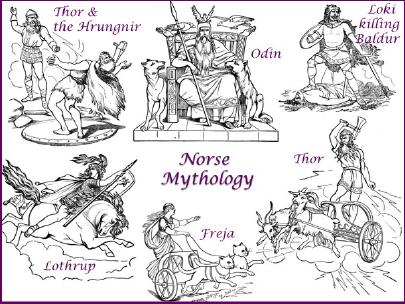
norsegods

The relations of sun and moon
Sun– moon
Red– white
Female– male
Hot — cold
Blood– semen
Fire– water
Summer –winter

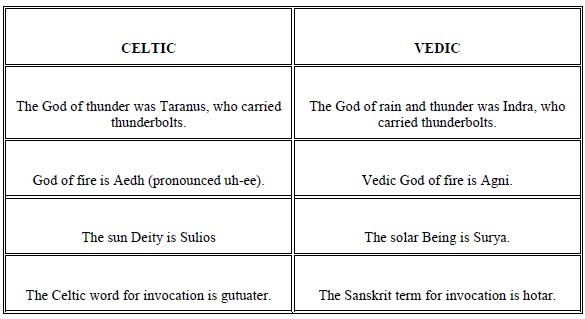
celtic gods

sky– thunder– fire
dievas– perkumas– ugunsmate
nuada — taranis– aine

tyr — thor– loki
svarog — perun– istie

zeus — zeus– Hestia
dsius — teshub– –?

armazd — vagahn– -sister fire
dyaus — parjanya– agni

roman,greek chart

Sun — dawn — moon — twins
Saule — auszrine– menuo — dieva deli
Grian — der greine — manannan– emain macha

Sol — svanhild– mani — alcis

Solnste — zorya — myesyats– cosmas and
Damien

Heliosa — Helen — mene — dioscouroi
Arinitti– hulla and kushukh — sheri and hurri
Mezulla

Arev– arevhat — amins — ?

Surya – suryaa– soma — Asvins

From the sun goddess page178

Hope these charts will help future researchers.

Contact swami_48@yahoo.com
Pictures are taken from various sites;thanks.

Numbers in the Rig Veda! Rig Veda Mystery-2

Vedas 9

Research Paper written by London Swaminathan
Post No. 1265; Dated 3rd September 2014.

There are as many bluffers in the field of Rig Vedic study as we have in the study of Indus Valley script. The so called Vedic “scholars” from foreign countries bluffed us into believing that they were real scholars. Actually they used Sanskrit Pundits for translation into colloquial English and then interpreted the hymns in English and German according to their whims and fancies. They dubbed some characters as demons and some as devas, Mundas, Aryas, Dravidas etc. The same thing happened in the study of Indus valley Civilization. They interpreted the script according to their imagination. The day the script is deciphered, thousands of books will be burnt as rubbish. They are like circus clowns and buffoons!

Numbers occur in the Vedas in innumerable places. Vedic numbers are mysterious. The Vedic seers had an obsession with the numbers. They used number symbolism making it difficult for interpretation. This led to a new genre of obscure poetry in later day Tamil literature.

I submitted two Research papers at the World Tamil Conference in 1995 in Thanjavur: 1.NUMBER IN SAGAM TAMIL LITERATURE and 2.COLOUR IN SAGAM TAMIL LITERATURE. Since they were submitted after the deadline they did not enter the books. But I attended seminars for two days in different rooms and distributed them personally. From that day I have a fascination about numbers. Here are some facts about numbers in the Vedas. The only oldest religious book in the world used till today is the Rig Veda. It has got decimal numbers 10, 100, 1000, 100,000 in hundreds of places. Hindus discovered the decimal system and the biggest numbers.

vedas8

Following is only a sample of the numbers in the Rig Veda:
RV 5-29-8 3X100 =300 No of offerings of Soma
8-85-8 63 No of Maruts
10-34-8 53 No of Dice 50+3
10-114-6 36 No of Saucers 33+3
10-53-3 34 No of Lights 33+1
8-28-1 33 No of Gods
3-4-9 33 No of Gods

vedas7

How many People did Indra kill?

RV 6-26 100,000 number of people killed by Indra
RV 6-26 60,000 number of people killed by Indra
RV 4-30 100,000 number of people killed by Indra
RV 1-53 10,000 20 captains+60099+10000
RV6-27 3000 number of people killed by Indra
RV 2-14-6 100X 1000 persons killed
2-13-9 100X10 Dasas killed
2-14-6 100,000 100X1000 killed
7-19-14 6666 No of Dasas killed 3300+3300+33+33
(AV9-5-2) 6333 No of Gandharvas
RV3-9-9 3339 No of Gods (3003+303+33)
((Satapata Brahmana 3306 No of Gods (3003+303) )
RV4-27-6 3000 No of Warriors killed 3X1000

vedas6

How many Forts did Indra destroy?

RV 2- 14 100 Ancient castles
RV 1-130 90 forts
RV 1-53 100 forts

RV10-98-10 99000 No of wagon loads (100 000—1000=99000)
RV 1-54-6 99 Forts of Sambara 100-1
2-19-6 99 Forts of Sambara 100-1
10-98-11 99000 No of wagons 100000—10000
1-130-7 90 forts of Dasas
8-1-24 1100 steeds of Indra 1000+100
10-97-1 107 No of Herbs 100+7
10-130-1 101 No of ministers 100+1
10-93-15 77 No of horses 70+7

vedas5

8-6-46 100,000 No of Gifts
8-5-37 100+10,000 100 camels and 10,000 cows gifted
8-46-32 100 100 camels donated
10-93-15 77 Number of horses 70+7
8-85-8 7X9 No of Maruts
5-52-7 7X7 No of Maruts
10-55-3 5×7 No of Gods
10-90-15 3X7 Maruts
7-9-11 21 persons killed 7X3

2-12 40 shambara was found after 40 autumns
7-18 10 Dasa Raja yuddha
5-62-1 1000 Thousand Pillar Hall
1-116-3 100 Hundred oared ship saves Bhujyu

RV 1000 many contexts

vedas4

1) We can see a pattern in using the numbers here. So they don’t mean it literally.
2) 99, 99,000 and such numbers are symbolic.
3. Killing 100, 000 may mean killing a lot of people; not necessarily exactly one lakh!
4.The word “Kill”– itself may have different meaning
5.Look at the camel and Cow donations. So they are not nomads from snow clad Siberia!
6.Look at the 1000 pillared Mandap (Hall). Vedic seers are great architects.
7.Look at the 100 oared huge ship. They are marine engineers and navigators!
8.Look at the wagon loads. You can imagine the great transport in those days
9.Look at the decimal system throughout the Vedas. It shows that they are all sons of the soil and not from outside because neither Bible nor Sumerian nor Egyptian has such uniform decimal numbers. Semitic people did not know big numbers.

vedas3

Vishnu Sahasranamam of Mahabharata says Sahasra Koti Yugadharine Nama: (Ten thousand Million Yugas! Yuga itself a very big number!). Semitic literature is obsessed with number Forty or 3X40=120– not above that!

My previous research articles on RV and AV:-
1.The Mysterious Vedic Homa Bird: Does it exist? – posted on 10-12-2011
2.Vedic Hymn better than National Anthems
3.Vedas and Egyptian Pyramid Texts – posted on 29-8-2012
4.Kapinjala Bird Mystery –posted on 23-5-2014 (Post No 1060)
5. Most misinterpreted words :Asva and Ayas
6.Confusion about Vedic Soma Plant –posted on 5-5-2013
7.Horse Headed Seer: Rig Veda Mystery- 1 -posted 27-8-2-14
8.Cucumber in the Rig Veda – posted on 2-42014 (post no 950)
9.Origin of Horse race and Chariot Race –posted 25-8-2014
10.Creation: Vedic Hymn and Babylonian Hymn –posted 6-8-2013
11.Sex Mantras and Talismans in Egypt and the Atharva Veda –posted 26 Sept. 2012
12.Gems from the Atharva Veda – posted 27 Sept. 2013
13.Mysterious Atharva Veda: Part 1 –posted 30 Sept. 2013
14. Mysterious Atharva Veda: Part 2 – posted 7 Oct 2013
15).27 Similes in one Vedic Hymn! – posted on18-8-2012
16) 107 Miracle Herbs in Rig Veda – posted on16-9-2013
17)Vedic Origin of 1000 Pillar Halls in Indian and Mayan Culture – 5 July 2014
And several other articles linking Vedic Gods Agni, Varuna and Indra in Tolkappiam and the Indus Valley Civilization. Please read my 1000+ articles.
vedas2

Contact swami_48@yahoo.com
Why do Hindus Worship the Sun?

horse head nebula by NASA
Horse head Nebulain the universe;photo by NASA

Research Article written by London Swaminathan
Post No.1261; Dated 30th August 2014.

Most beautiful poetry in the Rig Veda comes from the wedding hymns of the Hindus. Seers burst into ecstasy when they sing about Dawn (Ushas) and the Sun. Only a few lines from Surya’s Bride (RV 10-85) are given below. This hymn/poem has got 47 Riks like this:
“Truth is the base that bears the earth; by Surya are the heavens sustained.
By law the Adityas stand secure, and Soma holds his place in heaven” (10-85-1)

Sun worship has been in practice in India from the Vedic days. Surya/Sun plays a great part in Vedic mythology and religion. Surya is praised as a beneficent power in all the four Vedas. Hindu Brahmins worship sun thrice a day facing in the direction of the sun. In the afternoon they see the sun through the finger hole and pray for long life of 100 years. They recite the following beautiful Vedic mantra everyday in the noon:

Pashyema sharadas shatam = may we see for 100 years
Jeevema sharadas shatam = may we live for 100 years
Nandaama sharadas shatam = may we be delighted for 100 years
Modaama sharadas shatam = may we be happy for 100 years
Bhavaama sharadas shatam = may we excel in our work for 100 years
Shrunvaama sharadas shatam= may we hear (good things) for 100 years
Prabravaama sharadas shatam= may we speak (good things) for100 years
Ajeetaasyama sharadas shatam= may we live invincible for 100 years
Jyok cha suuryam drushe=in this way, let us enjoy seeing sun (for 100 years)

surya1
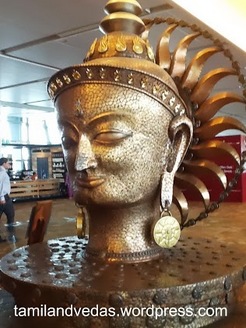
Surya in Delhi Airport;photo by london swaminathan

In the Rig Veda wonder is expressed that the sun does not fall (RV 4-13-5). There are several references to eclipses in the Rig Veda. Hindus knew the calculations for predicting the eclipses.
Astronomy had advanced to such an extent that the Vedic Rishis said that the moon shines by the borrowed light of the sun (RV 9-71-9;76,4;86,32 and 1-190-3).

Makra Sankaranti (Pongal), in praise of Sun, is celebrated from Kashmir to Kanyakumari. Hindus ruled South East Asian countries for over 1000 years and Sankaranti (Sun Festival) is celebrated in those countries as well.

Surya and Science
When white light is passed through a prism we get seven colours VIBGYOR (Violet,Indigo, Blue,Green,Yellow,Orange and Red). We see it in the rainbow after the rains. Hindus called the seven colours as seven horses of the Sun Chariot. Surya is represented in a chariot drawn by seven horses. For the same reason Agni (Fire God) is also described as a god with seven tongues.

Surya’s Charioteer is Aruna or Visvawat.
His city is called Viswavati or Bhasvati.
Surya’s wives are Savarna, Swati, Maha Virya and Sajna
Surya/Sun has got various names in the Hindu scriptures: Following are his important epithets:
Savitri= the nourisher
Viswavat = the brilliantBhaskara = light maker
Dinakara = day maker
Arha pati = lord of the day
Loka Chakshu = Eye of the World
Karma Sakshi = Witness of the deeds (of human beings)
Grha raja = King of the celestial bodis
Gabastiman = possessed of rays
Sahasrakirana = having 1000 rays
Vikarttana = shorn of his beams
Martanda = descended from Mritanda

surya2

Surya cut down to size!
There is a very interesting story about sun. Probably it is some scientific phenomena that which the science is yet to discover. His effulgence was so powerful that his wife couldn’t bear it and so retired to forest. The sun approached her in the form of a mare. She gave birth to Asvin twins and Revanta. Surya brought back his wife Sajna to his home and her father, the sage Viswakarma placed the luminary on his lathe and cut away an eighth of his effulgence, trimming him in every part except his feet.

The fragments that were cut off fell blazing to the earth and from them Viswakarma formed:–
The Discus of Vishnu
The Trident of Shiva
Weapon of Kuvera
Lance of Kartikeya and
The Weapons of other Gods.

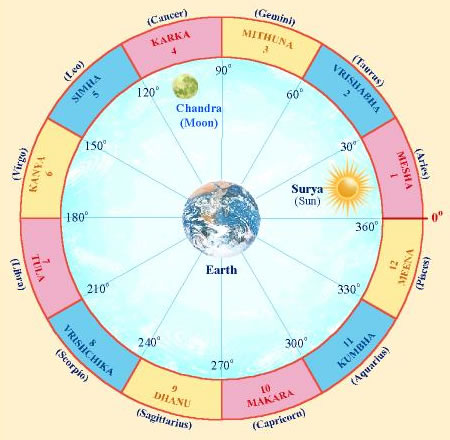
jyotish_rashis

Twelve Suns
Following is taken from New Larouse Encyclopaedia of Mythology:-
A passage in the Brahma Purana alludes to Surya’s twelve names, each of which was followed by special epithets as if they referred to twelve different divinities:
The first form of the sun is Indra , lord of the gods and destroyer of their enemies;
The second is Dhata, creator of all things;
The third is Parjanya, who dwells in the clouds and with his rays sends down water on earth;
The fourth is Tvashta, who lives in all corporal forms;
The fifth is Pusan, who provides food for all living things;
The sixth is Aryama who brings sacrifices to fruition;
The seventh derives his name from alms giving and rejoices all beggars by his gifts
The eight is named Vivasvan and causes good digestion;
The ninth is Vishnu who constantly manifests himself to destroy the enemies of the gods;
The tenth is Ansuman who keeps all vital organs in good health;
The eleventh is Varuna who dwells in the heart of the waters and gives life to the universe;
And the twelfth is the Mitra who lives in the orb of the moon for the welfare of the three worlds.
Such are the twelve splendours of the Sun, the Supreme Spirit, who by their means plunges into the universe and irradiates even the secret souls of men.

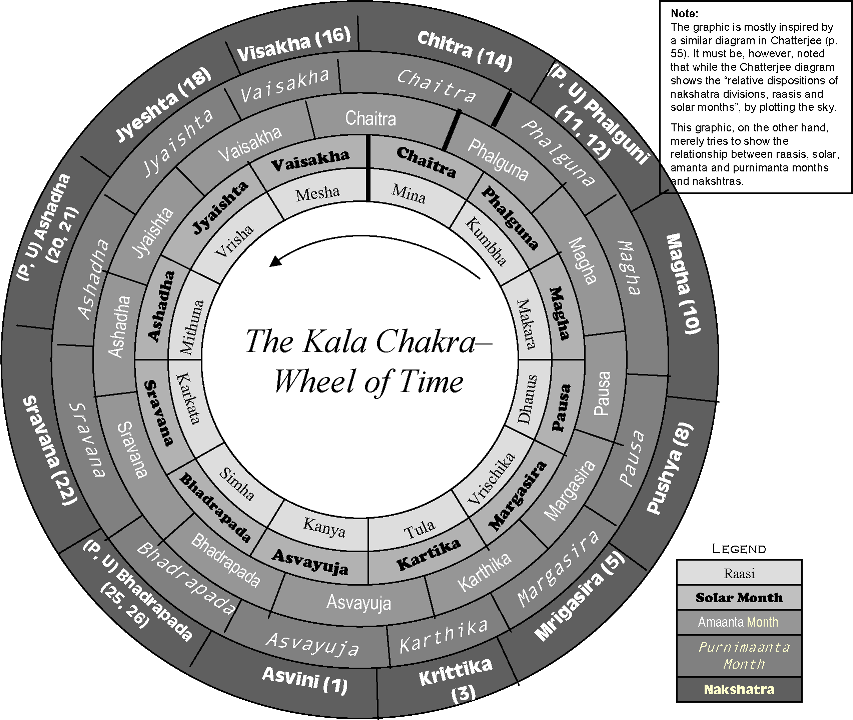
Wheel_of_Time-s

12 Adityas
Bhagavatha Purana gives the names of twelve Adityas as follows: Dhata, Aryama, Mitra, Varuna, Indra, Vivasvan, Tvashta, Vishnu, Amshuman, Bhaga, Pushya, Parjanya.

In the earlier Brahmanas the twelve Adityas are listed as follows:
Amsa, Aryaman, Bhaga, Daksa, Dhatr, Indra, Mitra, Ravi, Savitr, Surya/Arka, Varuna and Yama.

Surya Namaskar
In the Surya Nmaskar, sun is worshipped with the mantras Mitra, Ravi, Surya, Bhanu, Kaga, Pushan,Hiranyagarbha, Marica, Aditya,Savitra, Arka, Bhaskara. All the mantras have Om as prefix and Nama: as suffix:
E.g. Om Mitraya Nama:

In short number 12 is associated with the Sun denoting twelve months. In the Vedic time the month names were different. They are as follows:
Madhu,, Madhava (Vasanta Rtu)
Shukra, Shuchi (Grishma Rtu)
Nabha, Nabhasya (Vrsha Rtu)
Isha,Urja (Sarad Rtu)
Saha, Sahasya ( Hemanta)
Tapa, Tapsya (shisira).

Please read my articles
Origin of Horse Race and Chariot Race — posted on 25th August 2014.
Sun Chariot in Denmark: Hindu Calendar—posted on 29th August 2014.

Contact swami_48@yahoo.com