Great Secret from Mahabharata

Great Secret from Mahabharata: Bharatha Savitri

Santhanam Nagarajan

Mahabharata authored by the great maharishi Ved Vyasa is the greatest epic the world has ever seen. The original name of this ithihasa is Jaya which means victory. It consists of 18 parvas meaning 18 books or episodes. Ved Vyasa has composed Mahabharata in one lakh slokas (verses) and till this date  these verses are available.

The greatness of this great epic is narrated in the epic itself.

It is advised thus: “One should listen to the Bharata every day. One should proclaim the merits of the Bharata every day. One in whose house the Bharata occurs, has in his hands all those scriptures which are known by the name of Jaya. The Bharata is cleansing and sacred.”

As there are 18 parvas which consist of one lakh verses it would be difficult to read or recite all the slokas in a day. So Ved Vyas suggested to recite main four slokas composed by him. This is called as ‘Bharata Savitri’


The meaning of the four verses of Bharata Savitri is given below: Thousands of mothers and fathers, and hundreds of sons and wives arise in the world and depart from it. Others will (arise and) similarly depart.

There are thousands of occasions for joy and hundreds of occasions for fear. These affect only him that is ignorant but never him that is wise.

With uplifted arms I am crying aloud but nobody hears me. From Righteousness is Wealth as also Pleasure. Why should not Righteousness, therefore, be courted? For the sake neither of pleasure, nor of fear, nor of cupidity should any one cast off Righteousness.

Indeed, for the sake of even life one should not cast off  Righteousness. Righteousness is eternal. Pleasure and Pain are not eternal. Jiva is eternal. The cause, however, of Jiva’s being invested with a body is not so.

Good will triumph over evil is the main message given by Vyasa. Righteousness alone is eternal and one should at any cost follow it. The gist of Mahabharata explained in one lakh verses is given in the above four verses. And hence it is suggested to read at least these four verses daily so that one could have the benefit of reading all the one lakh verses.

The Mahabharata itself reveals this great secret thus in the Book 18-Svargarohanika Parava –“That man who, waking up at dawn, reads this Savittri of the Bharata, acquires all the rewards attached to a recitation of this history and ultimately attains to the highest Brahma.”

The secret of Mahabharata lies in Bharata Savitri!

Summary:

The great epic Mahabharata consists of one lakh slokas. It would be difficult to read all these verses daily and hence Ved Vyasa has himself composed four verses called Bharata Savitri for daily recitation, It reveals the eternal secrets. One should read the Bharata Savitri everyday.

( S. Nagarajan is a vehicle body engineer by profession. He has written more than 2000 articles in 16 magazines and published 18 books. He is revealing Eastern Secret Wisdom through T.V. Programmes, magazine articles, seminars, courses. His email address is: snagarajans@gmail.com. His articles on Yoga, laughter, efficacy of mantras and sound, Hypnotism, Tele Kinesis, Power of Prayer, Vastu and Feng Shui, Auto suggestion, Success Formula, Out of Body Experience etc are regularly appearing in EzineArticles.com.)

Indra Festival in the Vedas and Tamil Epics

By London Swaminathan (my posts are simultaneously uploaded into five websites)

(This article is available in Tamil as well in my blogs.)

Worship of God Indra was popular in ancient Tamil Nadu. The oldest Tamil Book is Tolkappiyam, which is dated to 1st century BCE. Vedic gods Indra and Varuna were among the four Gods mentioned by Tolkappiam as Gods of the Tamils. Interestingly, Shiva was not one of them. That book was written by a Brahmin by name Trundadumagni and launched in the court of Pandya king under the chairmanship of Athankottu Asan, who was well versed in the four Vedas. Today we see the amazing continuity of Indra worship in India and Nepal. Brahmins worship Indra and Varuna three times a day in their Sandhya vandhana. Nepalese celebrate Indra Festival every year. Hindu Temple priests around the world invoke all the Vedic Gods in their day to day rituals.

Indra Festival was a very popular festival in ancient Tamil Nadu according to twin Tamil epics Silappadikaram and Manimekalai. It was first mentioned in Mahabharata and Ramayana. But in the Vedas we have some information which is interpreted by scholars as Indra festival. Atharva Veda mentioned Indra Dwaja (banner or flag of Indra). Rig Veda hinted at it.

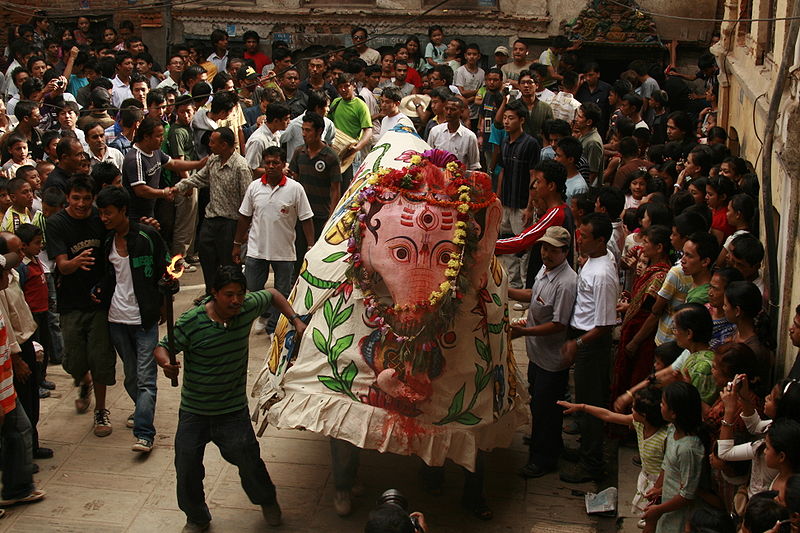
At present Indra festival is celebrated as a grand Royal festival in Nepal. Gunabhadra, a king of 10th century CE started this festival in Nepal. They call it Yenya or Indra Jatra. Bengalese also celebrated it.

Raksha Bhandan celebrated all over India and the Water Festivals celebrated in Laos, Cambodia, Thailand and Burma has got some links with Indra, the god of rain.


Picture: Elephant dance in Indra Festival,Kathmandu, Nepal

All the important Hindu scriptures like Bhagavatha, Ramayana and Mahabharata and Jain and Buddhist scriptures refer to Indra festival. This shows that Indra was held in high esteem from the southernmost tip of India up to Nepal in the Himalayas. Jains and Buddhists competed with each other in praising Indra by saying that “even Indra” worshipped the Buddha or Jain Tirthankara. Ramayana used the simile of Indra Dwaja in many places. Bringing down Indra Dwaja (flag)on the last day of the festival was a ritual used very often by Valmiki.

2000 year old Sangam Tamil literature refers to Indra (Pura Nanuru 182 and 241, Ainkuru. 62, Tirumurugu. 155-59 ) and Amruta (ambrosia of Indraloka) in a lot of places. Didactic books including Tirukkural also refer to Indra and Amruta.

The rare coincidence between the Tamils and the Nepalese is that both of them install a pole and hoist the Indra flag. In Nepal it is celebrated for 8 days but in Tamil Nadu it was celebrated for 28 days.

Another rare coincidence of Indra Festival in north and south is that they believed stoppage of the festival would result in a natural catastrophe. When Krishna stopped it, it was raining incessantly and Krishna had to lift the Govardhana Hill to protect his people. When the Choza king stopped it, the harbour city of Kaveripumpattinam in Tamil Nadu was devoured by the sea. Both of them believed Indra was in charge of rains and water.


Who Started the Festival?

Mahabharata says it was started by Uparichara Vasu. The life story of Uparichara Vasu itself is interesting. He was given an aeroplane and a garland of never fading lotus flowers by Indra. He married Girika but he was asked to go to a forest where his seed (semen) fell at the thought of his wife. It was devoured by a fish and Matsya (satyavati) was born to the fish. Each one of his sons started a separate dynasty in India. He was credited with some engineering feats  such as breaking down a hill to create a new river (Please read my post GREAT ENGINEERS OF ANCIENT INDIA).

Jain scriptures link Indra festival with Rishabadeva, the first Thirthankara. Tamil epic Silappadikaram (Kathai 5) says that one choza king Thungeyil  Erintha Thodithot  Sembiyan started this festival. Both may be correct if we take one started it in the north and another started in the south of India. Interestingly Chozas themselves claimed that their ancestors ruled north India. All their ancestors were mythological characters mentioned in Mahabharata and Ramayana. The very word Sembiyan came from Sibi Chakravarthy of the famous pigeon story  (Sibi=Saibya=Sembiya). The story of Sibi is in Sangam Tamil literature, Pancha Tantra and Tamil epic Silappadikaram.

The details of the celebrations were given in Silappadikaram  (5: 141-4) and Manimekalai (1:27-72, 2:1-3, 1:1-9, 24: 62-69, 25: 175-200). The drummer will announce that the festival began and then people will assemble to hoist the Indra Dwaja (Banner). The whole town wore a festive look with lot of decorations. Indra was bathed with holy water. It started on a full moon day in Chitra month (coinciding with April). Other deities were also decorated. Dance and Music were the highlights.

According to Maimekalai, Agastya asked the Sembian (Choza) king to start this festval. In Nepal, it is celebrated in September. In Tamil Nadu, the festival Bogi, celebrated on the eve of Makarasanranti/ Pongal also linked with Indra. Bogi itself means Indra.


In the Vedas

Indra is said to have shaken in front of Maruts in the Vedas. Actually it means that Indra Flag was fluttering in the Wind (Maruts are wind gods; The word Maruti/ Anjaneya came from it). Vedic scholars Dange and Meyer have written about the festival in detail.

In the Rig Veda it is said that Indra shook in the company of his followers. His companions Maruts were the wind god. Vedas also say, “ priests have raised you up on the high, O, Satakratu like a pole” (RV 1.X.1). Vedic poets used symbolic language to convey the message that the Indra flag was hoisted and it was fluttering in the wind. Meyer gives more evidence from Atharva Veda.

In Kuchipudi and other dance performances a victory flag and staff are installed in the name of Indra. In ancient Tamil Nadu a big honour in the name of Indra’s son Jayanta was given to the court dancer. It was called Talai kol.

Tamils celebrate Bogi festival on the eve of Pongal (Makara Sankaranti). Bogi is another name of Indra. Indra and Varuna are worshipped by the Brahmins in their day to day Sandhayvandana (thrice a day water oblation to Sun God) and in all the temples during Puja and Abhisheka (ritual bathing of Gods). It is amazing to see the same custom is followed for more than at least 3500 years.


Nivedita and Indra Flag

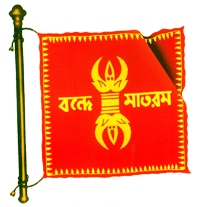
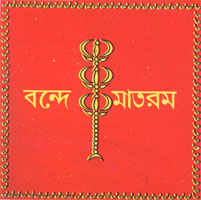
Swami Vivekananda asked his Irish disciple Nivedita alias Margaret Noble to design a Hindu flag. She came with a design of Indra’s  weapon Vajrayutha and word “Vandemataram” in Bengali language. South East Asian countries had Indra’s vehicle Iravatha elephant on their flags or on their national emblems. Now we see lot of Indra Idols and statues in the museums around the world.

Now we realise that the theory of Aryan Dravidian divisions proposed by the Western “scholars”  were utter lies. Indians had one culture from time immemorial though out India. We have seen the same festival celebrated from Vedic days to modern days in Nepal via Krishna of Mathura and Chozas of Tamil Nadu.

(Read other posts Indra Seal in Indus Valley, Vishnu Seal in Indus Valley by Swaminathan. Contact for more information: swami_48@yahoo.com or swaminathan.santanam@gmail.com)

***************

330 Million Gods !

From London Newspaper’s Q and A column

How many gods and goddesses are there in the Hindu pantheon?

Depending on how you look at it, the Hindu pantheon may consist of one Supreme Being and 330 million gods. In ancient times, it was held that there were 330 million living beings, given rise to the idea of 330 million deities or gods.

Of course, this vast number of gods could not have been worshipped, since 330 million names could not have been designed for them. The number was simply used to give a symbolic expression to the fundamental Hindu doctrine that God lives in the hearts of all living beings.

The misunderstanding arises when people fail to grasp the symbolism of the Hindu pantheon. For just as a single force in space can be mathematically conceived as having various spatial components, the Supreme Being or God, the personal form of the Ultimate Reality, is conceived by Hindus as having various aspects.

A Hindu deity (god or goddess; note the small “g”) represents a particular aspect of the Supreme Being. For example, Saraswati represents learning and knowledge. So if a Hindu wants to pray for knowledge and understanding, he prays to Saraswati.

Just sunlight cannot have an existence independent of the sun itself, a Hindu deity does not have a separate and independent existence from the Supreme Being.

Thus, Hindu worship of deities is monotheistic polytheism and not simple polytheism.

-Marion Kinder, Manchester ( Daily Mail, Saturday, 3rd Feb. 2001; Answers to Correspondents)

NAVARATRI IN JAPAN AND GREECE


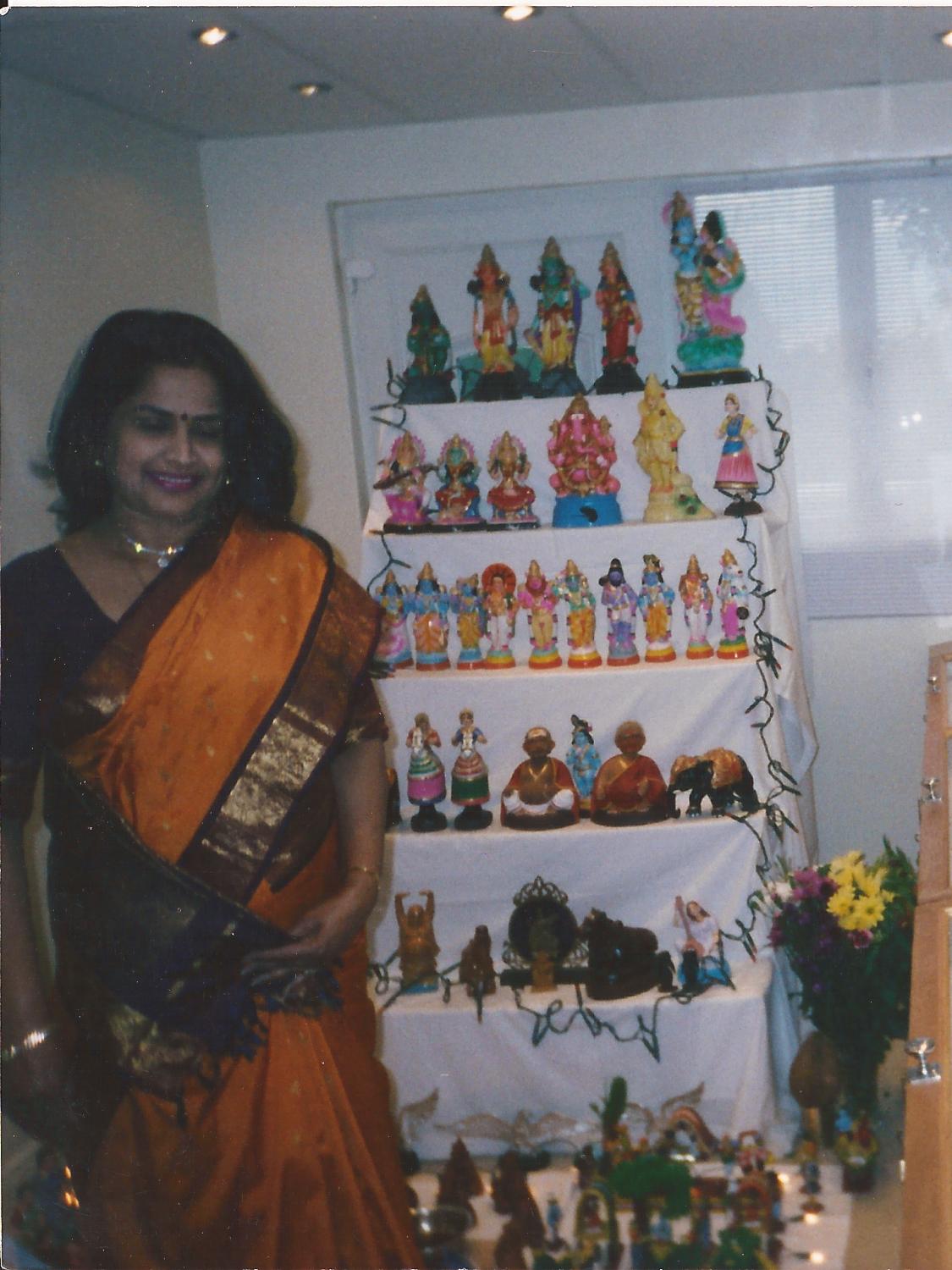
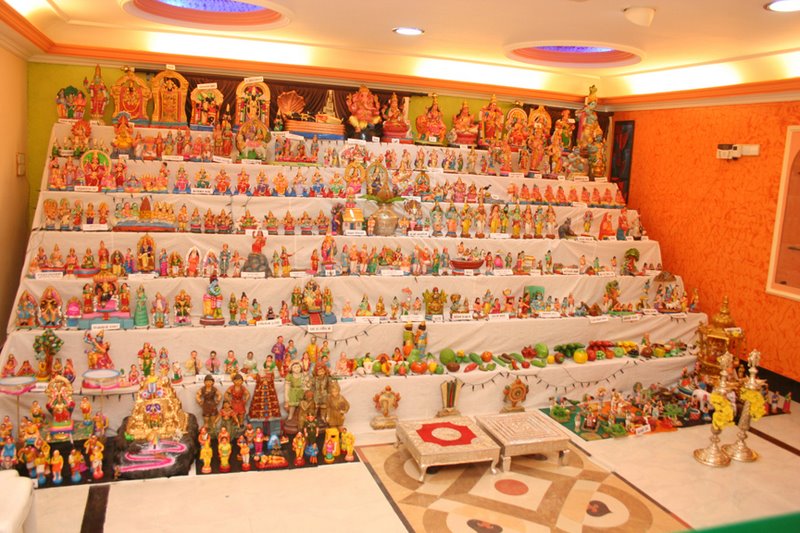
Picture: Kolu at Raji Vijayakumar’s residence, United Kingdom

By London swaminathan

Nava Ratri, literally NINE NIGHTS, is the most popular festival among South Indian Hindu women. It is equally famous in Bengal where the last day of Nava Ratri is celebrated as Durga Puja. Dasara, literally ten day, is the biggest show in Karnataka.

Festivals similar to Navaratri were celebrated in different parts of the world including Japan, Rome and Greece. Indian temples are great centres of Arts. They were doing what Opera Houses are doing today in Sydney, London, Paris and New York. Even today South Indian Temples organise big music concerts and dance performances during Navaratri festival. Hindu women throng to temples during nine nights to see the illumination and decorations of temple idols.


In Tamil Nadu, Nava Ratri is a Toy and Doll Festival. They arrange toys in steps made up of wooden boxes or steps (look at the picture).

Doll Festival in Japan

Japanese celebrate a Doll Festival like Hindu Navaratri. It is celebrated every year on 3rd March as Girl’s Day. Navaratri is celebrated as Girl’s Day In India too. Young girls who are called Kanyas receive special box or bag full of Tilak/Kumkum, Turmeric powder, Mirror, Comb, jewels etc. with fresh coconut, betel leaves, fruits and flowers. Girls are treated as representative of Goddess. Girls come dressed in their new clothes.

In Japan they arrange dolls like Hindus arrange clay toys, dolls and other items. Japanese spread a red cloth on the steps and arrange the dolls. This festival is called Hina Matsuri (Girl’s Day). In India, the dolls represent mythological characters, shop owner (Chettiyar/shresti/Bania)with his saleable items, kings, national leaders, saints, musicians and ordinary men. In Japan they arrange the dolls of emperor, empress, servants and musicians.


Japanese have been celebrating this for over one thousand years. Indians have been celebrating it from time immemorial. Japanese started this as river festival of floating reed toys. Then they changed it to arranging dolls at home. It started after the spread of Buddhism. India might have influenced them in this matter. Japanese celebrate it for health and happiness of the girls. They also make special snacks like Hindus. They also invite friends to their houses and give them food.

In short we see amazing similarities in three things: 1) Arranging dolls on steps 2) Celebrating as girl’s/women’s day 3) Inviting girls home and giving them special food and gifts.

Hindus see God in everything, whether it is music or dance or drawing (Rangoli,Henna) or Food (Prasad. So Hindu Navaratri is more of a religious festival where as Japanese and Greek celebrations are more of secular things.


Nine Muses in Greece

Greeks have also chosen Goddesses for the arts and poetry like Hindus.

The Muses are the nine goddesses of the arts, history and astronomy in Greece. The muses were not highlighted in mythologies, but writers and poets invoke them like Hindus before writing a book or performing dance and music. They are the source of inspiration for them like Goddess of Knowledge Saraswati or Goddess of wisdom, Ganesh.

Muses were among the retinue of the god Apollo, the patron of music and the arts. They were said to reside on Mount Helicon near Thebes or on Mount Parnassus near Delphi (Like Kailash or Mount Meru of Hindu Mythology).

Their names and branches of arts they preside over are as follows:


Name                        Meaning                              Arts

Calliope         Beautiful voice                    Epic Poetry

Clio                 Fame                                      History

Erato              Lovely                                    Lyric Poetry

Euterpe         Joy                                          The Flute

Melpomene Singing                                  Tragic Drama

Polyhymnia Many Songs                         Mime

Terpsichore Joyful dance                                    Dance

Thalia             Good Cheer/Plenty            Comic Drama

Urania                       Celestial                     Astronomy


Though we don’t see many similarities between these Gods and Hindu Gods, each Hindu artiste worships different gods for different arts: e.g Sculptors-Viswakarma, Flutists –Krishna, Dance- Nataraja/Shiva and Poets-Saraswati.

Hindu Goddess is worshipped as Kumarika, Trimurthy, Kalyani, Rohini, Kali, Chandika, Sambavi, Durga and  Sambadra during nine nights in north india.

Hindu women in South India divide the nine nights in to three X three  (3X3) and allocate them to Lakshmi, Saraswati and Durga. In Bengal they worship Goddesses in different forms. South Indian temples decorate Goddesses in nine different ways during nine nights. If we go deeper we may see more similarities. But Romans and Greeks keep them in museums nowadays, where as Hindus keep them in temples and continue the tradition.

Hindu women make snacks with boiled pulses such as Channa dhal, Bengal gram, green gram or black gram, peas, peanuts etc and distribute them to the visitors.

Vijayanagara kings celebrated Navaratri on a grand scale. Coorg people celebrate Dasara with great enthusiasm.

For more of the same, contact swami_48@yahoo.com or Swaminathan.santanam@gmail.com


Please read other posts by London Swaminathan on

1)Bull Fighting from Indus Valley to Spain via Tamil Nadu

2)Sugarcane Mystery: From Ikshvaku Dynasty to Indus Valley

3)Vedic Bird Homa in India and Iran

4)Sahasralinga in Karnataka and Cambodia

5)Delphi Oracle and Tamil oracles (In Tamil)

6)Naga –Mayan similarities (3 parts in Tamil)

7)Serpent Queen in Indus Valley and Minoan

8)Tamil Words in Greek ( 3 parts in Tamil)

9)Madagascar-India link via Indonesia

****************

Tamil Saint’s Mad Experiment

By S Swaminathan

Picture: Appaiya Dikshitar hands over manuscripts to Neelakanta Dikshitar

Appaiya Dikshitar (1520- 1593) was a big name in Tamil Saivaite circle. He was a great devotee of Lord Shiva. He wrote 104 books on various subjects. He was an erudite scholar and an authority on Vedas, Ithihasas, Puranas (epics and mythologies) and Sanskrit grammar. He has composed poems, hymns and commented on many scriptures. He lived in different towns of Tamil Nadu including Kancheepuram, Vellore, Chidambaram, and Tiruvanmiyur.

He was born in a place called Adayapalam near Arani. His name was Vinayaka Subramaniam. He challenged anyone who opposed Advaita philosophy (Non duality). He countered several peoples’ arguments and they were all published as books.

One day he was very much worried. He thought about the day of his departure from the world.  He was wondering whether he would think of Shiva at the time the messengers of death arrive from Yamaloka. So he thought of a mad experiment, literally a mad one. Would I think of my weakening body or diseases that may afflict at old age or Lord Shiva on the last day?

He called his devoted students and told them, “Look I am going to eat poisonous Datura seeds  (umaththan kay in tamil). Them I am going to blabber. Please note down every word I utter till I am under the influence of that poison. Don’t forget to record my actions as well”.

His students were puzzled, but yet they can’t say no to their guru. He ate the poisonous seeds and the disciples gave him the antidote after some time according to his instructions. He did blabber when he had gone mad under the influence of those seeds. His students faithfully recorded everything he said. He was very anxious and could not wait to see what he said under the influence of poison.  To his surprise what he said was nothing but new hymns on Lord Shiva. There were 50 hymns which themselves became a beautiful book under the name Unmatha Pralapam (mad man’s sayings)or Atmarpana Stuti.

Hindus believe that whatever one does throughout one’s life would come at the end. A good man or woman would get only good thoughts on the day of death. Even Lord Krishna in Baghavad Gita (Chapter 8-sloksa 8) says,” He who meditates on the God with his thought attuned by constant practice and not wandering after anything else, he, O Partha,  reaches the God (paramam purusham diyam).

Appayya Dikshitar’s grand nephew Neelakanta Dikshitar was another famous scholar and minister during Madurai King Tirumalai Nayak’s rule. (Please read the moving story about Neelakanta Dikshitar in my post The Wonder That is Meenakshi Temple).

Books authored by both the Dikshitas were published in English and some in French.

Datura seeds would make one go mad. In the olden days people used to give it to their enemies in milk or food. There were many stories of mothers in law giving it to daughters in law or vice verse.

For further details contact swami_48@yahoo.com or swaminathan.santanam@gmail.com


Sanskrit in Bible

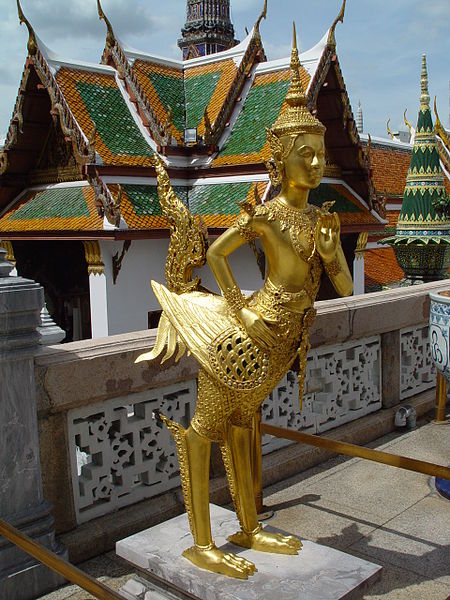
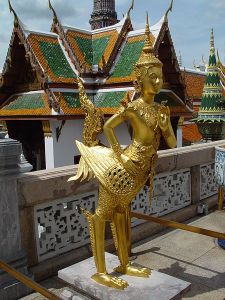
Picture shows Kinnara (celestial musician) in Bangkok, Thailand

By S Swaminathan

Annam (Manna=food) ,Kinnara (Kinnor=musical instrument/celestial musician), Mandrake( Mantra Korai), Om (Amen), Mass (namaz=namaskaram),Adam and Eve (Atma and Jeevatma), Tukum (Sukam=parrot),Kapi (ape=monkey), Ibha (elephant), Abraham (Ibrahim=Abi Raman) , Nava (Nova=new) are some of the Sanskrit words in The Bible, the holy book of Christians.

There are lot of striking similarities between Hindu and Christian scriptures. They cannot be discounted as coincidences because such similarities are too many. There is good evidence to show that they are borrowed from other sources.

1.The Bible begins with a story from the Upanishads. It is the story of two birds eating the fruits, but instead of two birds the Bible says Adam and Eve.

The very name betrays its Hindu origin of the story.  In the Upanishads the two birds are the symbolic representation of Athma (athma=Adam) and the Jeevatma (Jeev-Eve). Any Student of linguistics can easily recognise the transformation of Athma into Adam and Jeeva into Eve. This Parallel has been pointed out by Sri Chandrasekarendra Saraswathy, Sankaracharya of Kanchi Kamakoti Peetam 60 years ago (I have already written it in my post “Three Apples That Changed the World”)

2)The Bible says Eve was created from Adam’s left rib. This is once again the Hindu story of Uma/ Parvathy forming the left part of Shiva. Nowadays we call our wife as the other half. It is very interesting to note that this expression has come from the Vedas. Kalidas and other Sanskrit poets also use this expression freely. Hindus still worship as Ardha Nareeswara (Half Woman +Eswara).

3.The expressions found in the Bible such as ‘Honey and Milk’ are used by the Sanskrit and Tamil poets hundreds of times in their 2000 years old Sangam literature and Sanskrit literature.

The Upanishadic phrases ‘the blind leading the blind’,‘  He or She lived as many days as the number of sands on the river/sea bank’ etc, are found in the Bible. The Saiva Siddhanta principle of Pasu, Pati, Pasam (Father, Son and Holy Spirit) and the Adwaita principle are also found in the Bible. Jesus Teaches ‘DWAITA’ first. Then he teaches Adwaita by saying I and Lord are one. Swami Vivekananda has also pointed out this in his talks.

4.Kinnar: Kinnaras are celestial musicians according to Sanskrit literature. The Bible mentions Kinnor 47 times to mention a stringed musical instrument. Even today the Malayalees in south India use this word for musical instruments which is a pure Sanskrit word. It is similar to Greek lyre. Sometimes called David’s Harp, the Kinnor is not a true harp. The word David’s harp sounds like Dravidian Harp. Sangam Tamil literature is of full of praise for the Yaz (lyre or harp). Dravida meant South India in those days.


5.Ramayana in the Bible: Lord Rama’s name is mentioned in the Bible a number of times and the most important of these is the core story of Ramayana found in Genesis. Only a few lines are given to this story. (Genesis 18- The Story of Abraham and Sarah).

A Tamil leaflet detailing the facts in a lengthy article was published in Sankara Krupa, a magazine brought out by Sringeri Shnkaracharya Mutt.

Ram, Ramah, Ramiah, Rameses, Abraham, Abiram, Ahiram, Amram, Adoram, Adoniram, Hiram, Horam, Huram, Hadoram, Jehoram, Joram, Malchiram- are used in at least 21 places.

Beside this there are many towns with the name of Ram in Madagascar Island and in and around Middle East. (Please see my article Madagascar-India link via Indonesia).

Abraham and Ibrahim are one and the same name. Abba in Hebrew means father. Even today we name our sons Rama-Iyah or Rama-Appa (father). But in Hebrew language the suffix Appa-father- will come only as a prefix. That is how they get the names Abba+ram=Abraham. (PLEASE SEE NO 10 FOR OTHER INTERPRETATION OF ‘ABRAHAM’)

Cuneiform inscriptions giving the names of Tushrata/Dasaratha and Pratardhana were found in Syria and they are dated as 1500 BC. No part of Bible was written before this date. The oldest part of the Bible was written in 900 BC according to Hutchinson Encyclopedia.

Egyptian Kings with Ram’s name

Egyptian Kings also bear the name of Rama and we find at least 17 kings with Rameses as their names. It can be interpreted as Rama Seshan (Vishnu) or Ramesan (Shiva). All those kings have snakes on their heads like Lord Shiva. Rama’s story was so popular that even Buddhists used Dasaratha Jataka as one of their stories. To reciprocate their good gestures, Hindus gave avatar status to the Buddha. THUS BUDDHA WAS ONE OF THE TEN AVATARS OF VISHNU ACCORDING TO GITA GOWINDA OF JAYADEVA.

6.Teak wood, ivory and birds are mentioned in the Bible with Sanskrit and Tamil words. The names of all the articles brought back by Solomon’s fleet are pure Sanskrit words. The names are Sen-habim or teeth of elephant, Kophim or apes and Tukum or parrots. The equivalent Sanskrit words are Ibha (elephant), Kapi (Ape/monkey) and Sukam (parrot) with the mere addition of Hebrew plural termination.

7.The oral tradition in Kashmir says that the Biblical king Solomon visited Kashmir. Jesus Christ was said to have spent his last days in Kashmir after resurrection. Some scholars have even pointed out that Jesus spent 20 years in the Himalayas. The Bible did not say where he was between age 13 and 33. The present Bible was redacted in 3rd century AD in Constantinople and lot of different versions were burnt at that time. Like Hindu Puranas they had various versions of the Bible. To avoid confusion they were burnt by the king Constantine.

There is a grave in Kashmir, which is considered Jesus’ grave. The epitaph on the grave says, “The messenger of peace rests here”. Several scholars have pointed out the similarity between the parables of the Upanishads and Christ.

8.Vibhuthi (Holy Ash) which is used by the Saivaite Hindus everyday was used by the Christ. Ash Wednesday is the celebration of the holy ash. Ash is mentioned in the Old Testament as well.

9.Jesus fasted for 40 days in the desert at the beginning of his ministry.

Even today 40 day fasting period leading up to Easter was followed by orthodox Christians. This 40 day period is called a Mandalam in Hindu scriptures. Even today millions of Hindus visiting Sabarimalai in Kerala and Murugan temples in Tamilnadu (Skantha Shasti) follow this custom.

10.       Following words are used by Hindus, Christians and Moslems which have nearly the same meaning:

Hindus     : Namaskar-            Om-     Brahma

Christians : Mass-       Amen- A braham

Moslems   : Namaz-    Amin-  I brahim

All the first three words mean “worship”. All the important Veda Mantras like Gayathri pray for many instead of a single man. This shows that group prayer evolved in India, which is followed by others.

The Christian interjection Amen and The Hindu interjection Om mean the same thing viz. ‘It is so’ or ‘So be it’ or Yea’ or Verily’ or ‘Truly’. The only difference between the two is whereas the Christian Amen is pronounced at the end of the prayer, the Hindu Om is usually pronounced at the beginning of a prayer.

11.We come across Image worship in the Old Testament which is very common among Hindus. Only Moses put an end to this practice.

12. ‘NAVA’ IN SANSKRIT MEANS ‘NEW’

The story of the Great Floods (deluge) is found in all the ancient cultures and the very word ‘NOVA’ is itself a Sanskrit name meaning ‘New’. The flood story is the first of the 10 avatars of Vishnu. According to Hindu mythology a NEW (nova) Manu comes to power after every deluge.

13.The word rutham (Rig veda) meaning Truth, Right, Order and law gave the Biblical name RUTH and the English words Right, Rhythm and Truth. Moses, Abel and several other Biblical names can be traced to their Sanskrit roots:

Yadu-Yada, Jew-Juda. (YADAVAS=YUDA= JEWS). Yayathi-jayathi (Jewish Rabbi’s name).

14.Swami Vivekananda in his conversations with the disciples told them about his strange dream about the Chirst. One day when Swamiji’s ship was nearing the Crete Island he dreamt of a saint who came in the guise of a Buddhist monk. He called himself Thera Buddha and told Swamiji that there was no Chirst but people called himself the Christ. Swamiji did not pursue this matter for obvious reasons. (For more details see Vivekanandar Sambashanikal (Tamil) published by Ramakrishna Mutt, Madras.)

15.Like Sermon on the Mount and the Buddhist Dhammapada, the Hindu scriptures also teach men to return good for evil. This is what said to have uttered by Vidura, the wise man of Mahabharata in the Vidura Neethi.

Thiruvalluvar, the great Tamil saint in his Thirukkural says:

‘The best way to punish those who harm you is to make them feel ashamed by doing them good and thinking no more of it’ (couplet 314).

16.Washing the feet: When Dharma alias Yudhistra performed the Rajasuya Yagna he allocated the tasks to different people. Krishna chose the work of washing the feet of the worthy Brahmins. One but cannot recall to mind an identical incident in the Life of Jesus, who when he ate the Passover meal with his 12 disciples went round washing their feet. This custom of washing the feet existed in Ancient India even today when great men like Sankaracharyas visit any one, it is done.

(in the next part we will see manna (annam) that fell from the heaven, Mandrake (Mantra Korai, a root with magical properties like Ginseng).

To be Continued………..  


Secrets of Vishnu Sahasranama

By S Swaminathan

Vishnu Sahasranama is the most popular sahasranama (sahasranama means 1000 names of the Lord) in India. South Indians don’t know much about Sri Ramcharithamanas  or Hanuman Chalisa of Tulsidas. North Indians don’t know much about the great Thevaram (saivaite) and Divya Prabhandham (Vaishnavaite) hymns of Tamil saints. But like Bhagavad Gita, Vishnu Sahasramnamam became popular due to the great works of Swami Chinmayananda, Acharya Vinobha Bhave,  Anandamayi and other religious leaders.

Adi Sankara was a passionate commentator. He wrote commentaries on many Hindu scriptures. When he was in Kashmir, he asked his disciple to bring one book from the book shelf to start some new work. He brought Vishnu Sahasranama. But Sankara was not happy. He sent another disciple to get a book. He also brought the same Sahasranama. When he was thinking about it, Goddess Saraswati appeared before him and asked him to go ahead with the commentary (Source for this anecdote: Anna’s commentary on Sahasranama in Tamil by Ramakrishna Mutt).

Second Anecdote

Kuthanur in Tamilnadu is famous for its ancient Saraswati temple. This is one of the rare temples for Goddess Saraswati. A boy by name Purushothaman went to Kuthanur for Vedic studies. But he was the dullest boy in the class. His father Sarangapani Dikshithar of Kumbakonam was a great scholar. This hurt him more. Being the son of a big pundit he wanted to learn at least the basics. One day a Vaishnavite saint noticed that he was very sad advised him to recite Vishnu sahasranama. Suddenly he got a big boost in his studies and went to the temple for more prayers. There Goddess Saraswati appeared as a woman and asked him to stick out his tongue to give her betel leave and supari. When he was hesitant to accept the spit from a woman’s mouth, a poet came that way and realised she was goddess Saraswati herself. He accepted her Prasad and became a great Tamil poet by name Ottakkuthan. He gave the town the name Kuthanur. Though Purushothaman did not become that famous he also studied well and became a scholar. That is why we remember him after one thousand years today.

Three Commentaries

Adi Sankara, Parasara Bhatta and Sri Madhwa wrote commentaries on it. When Bhisma was lying on the bed of arrows after the great war, Krishna asked Yudhistra to get Sahasranama from the mouth of Bhisma. It Is in the Anusasana Parva of Mahabharata. Scholars of ancient India used to recite Upanishad, Gita ,Rudram, Purushasuktam and Vishnu Sahsranama every day.

This stotra is like a cure for all sorts of problems. Anyone under the evil influence of 27 stars, 9 Grahas or 12 zodiac signs will get rid of the evil influence once one reads it.

The stotra was originally done by Sanakathi Rishis. Bhisma got it from them. It has got ancient names of gods. Some of the names like Vrsakapi, Suparna etc are from ancient Vedas. One who reads it will find lots of similarities with Bhagavad Gita. Names of all Hindu Gods are there in it. Some names have links with Indus Gods (Please read my article Vishnu seal in Indus Valley civilization).

Ayurveda books prescribed it as a medicine for diseases. Astrology books have prescribed it for Graha peetas. Dharma Sastra scriptures have prescribed it to get rid of nightmares and inauspicious signs or bad omens.

It is believed particular slokas are effective for solving particular problems. Astrologers and priests are experts in this field

(Contact for more details: swami_48@yahoo.com or Swaminathan.santanam@gmail.com ).


Four Birds in One Sloka: Adi Sankara and Nature

S.Swaminathan

Kill two birds with one stone, goes the English saying. But Adi Sankara got four birds with one stone, nay, in one Sloka. The greatest exponent of Advaita philosophy was very close to Nature and none of his hymns goes without a simile about nature. His famous simile, rope and snake, occurs in scores of places in his Viveka Chudamani. He mentioned innumerable birds, animals, insects and plants. Some of them are very interesting because nobody knows the truth about those animals and plants. A superman, as he was, travelled several thousand miles by walk through the length and breadth of India.

Here is a hymn from his Sivanandalahari:

Lord of Gauri! As the swan loves the lotus bed, the Chataka bird the dark cloud, the Koka bird the sun every day and the Chakora bird, the moon –even so, O Lord of beings, my mind desires your lotus feet, which are to be reached through the path of knowledge, and which yield the bliss of perfection.

–Sivanandalahari-59

The longing of the devoted mind for god is compared to the longing of the Swan for the lotus tank, of the Cataka bird for the rain bearing clouds, of the Chakravaka bird for the sun and of Cakora bird for the moon. Swans feed on lotus stalks. Cataka birds are believed to drink only rain water. Chakravaka looks for sun light eagerly and Cakora birds are believed to live on moon light.

In another sloka of Viveka Chudamani (sloka 76) he says:

The deer, the elephant, the moth, the fish and the black bee—these five have died, being tied to one or other of the five senses, viz. sound etc., through their own attachment. What then is in store for man who is attached to all these five senses. (Deer by sound, elephant by skin, moth by light, fish by bait and bee by honey are trapped)

Green Cockroach

Shankara says some interesting thing about cockroach turning green in Viveka Chudamani sloka 358. The man who is attached to the Real becomes Real, through his one pointed devotion. Just as the cockroach thinking intently on the bhramara is transformed in to a brahmara. This is a popular belief that the cockroach, through fright, does actually turn green when caught by the worm known as Bhramarakita.

Ankola Tree

In Sivanandalahari (sloka 61),he says:

Just as the seeds of Ankola tree (azinjil in Tamil, Alangium hexapetalum)  go and attach themselves to the tree, the needle sticks to the magnet, the chaste woman to her lord, the creeper to the tree and the river to the ocean, even so if the flow of mind reaches the lotus-feet of the Lord of souls and remains there always, that is called devotion.

Snake and Rope

Since the philosopher Pyrroh, who accompanied Alexander the Great to India and Kalidasa used Sankara’s favourite simile about rope and snake, Adi Sankara must have lived before these people. Sangam Tamil Literature also had indirect references to Sankara.

Sankara used Crocodile, Python, Silk worm, Cockroach, Fire fly, Tiger in addition to ocean, river and mountain to illustrate his teachings.

Contact authorat : swami_48@yahoo.com or Swaminathan.santanam@gmail.com

Please read my other articles on the same subject:

  1. Let Nature be your teacher: Wordworth and Dattatreya
  2. Adi Shankara’s date through Tamil Literature (in Tamil)
  3. Lie Detector in Upanishads
  4. Animal Einsteins-part 1 and part 2

*****************

ஸ்ரீ ருத்ர மஹிமை (நமகமும் சமகமும்)

Athi Rudra Maha Yagna organised by Sri Sathya Sai Baba

ருத்ரம் என்னும் துதி யஜுர் வேதத்தில் உள்ளது. இது நமகம், சமகம் என இரண்டு பகுதிகளை உடையது. இறைவனிடம் என்ன வேண்டுவது என்று திணறுபவருக்கு இது ஒரு பெரிய பட்டியலைத் தருகிறது. இது பற்றிய மிகவும் அற்புதமான விஷயம் என்னவென்றால் நல்ல தூக்கத்தையும் தருக என்று இறைவனை வேண்டுவதாகும். மேலை நாடுகளிலும் இந்திய நகரங்களிலும் வாழ்பவருக்கு இன்று அரிதான பொருள் நல்ல நிம்மதியான உறக்கம் ஆகும். பலவித கவலைகளாலும் இயந்திரம் போன்ற வாழ்வாலும் மனிதர்கள் கஷ்டப் படுகிறார்கள். இதை ஆயிரக் கணக்கான ஆண்டுகளுக்கு முன்பே உணர்ந்த நம் முன்னோர்கள் அழகாக வரிசையாக சமகம் என்னும் பகுதியில் பட்டியல் இட்டுவிட்டார்கள்.

நமகம் என்னும் பகுதியில் சிவ பெருமானை நூற்றுக் கணக்கான பெயர்களால் நமஸ்கரிக்கிறோம். இதனால் இதை சத ருத்ரீயம் என்று அழைப்பர். சமகம் என்னும் பகுதியில் நமக்கு வேண்டியவற்றை எல்லாம் கேட்கிறோம். இதைக் கேட்டாலேயே போதும். அத்தனையும் கிடைத்துவிடும். சிவன் கோவில்களில் அபிஷேக நேரத்தில் இதைப் பாராயணம் செய்வார்கள். இந்துக்களின் முக்கிய சடங்குகள் அனைத்திலும் ருத்ர பாராயணம் நடைபெறும்.

நமகம் என்னும் பகுதியில் 194 நம: வரும்

சமகம் என்னும் பகுதியில் 328 சமே வரும்.

நமகம் பகுதியில் சிவனை 300 பெயர்களால் வணங்குகிறோம்.

ருத்ரத்துக்கும் 11 என்ற எண்ணுக்கும் தொடர்பு மிக அதிகம்.ஏகாதச ருத்ரர்கள் என்று ருத்ரர்களின் எண்ணிக்கை கணக்கிடப்படுவதால் குறைந்தது 11 தடவையும், அதிகமாக இதன் பல மடங்குகளிலும் பாராயணம் செய்வர்.

ஸ்ரீருத்ரம் 174 ரிக்குகளைக் கொண்டது. இதில் 32 மஹா மந்திரங்கள் இருக்கின்றன. ருத்ரத்தில் 11 பிரிவுகள் (அநுவாகங்கள்), சமகத்தில் 11 பிரிவுகள் இருக்கின்றன. ருத்ரத்தின் 11 அநுவாகங்களில் எட்டாவது அநுவாகத்தில் நமச்சிவாய என்ற மஹா மந்திரம் வருவதால் அந்த இடம் வரும் போது முழுக் கவனத்தையும் செலுத்தி உரத்த குரலில் கூறுவர். 11ஆவது அநுவாகத்தில் மரண பயத்தை நீக்கும் ம்ருயுஞ்ஜய மந்திரம் (ஓம் த்ரயம்பகம் யஜாமஹே——–) வருகிறது.

ஸ்ரீ ருத்ரத்திற்கு சாயணர், பட்ட பாஸ்கரர், அபிநவ சங்கரர் ஆகிய பெரியோர்கள் பாஷ்யம் (விளக்க உரை) எழுதியிருக்கிறார்கள்.

பெரிய புதிர்

உலகிலேயே பெரிய கணித வல்லுநர்கள் இந்துக்கள்தான். இது பற்றி நான் பல கட்டுரைகளில் தந்திருக்கிறேன் (மீண்டும் இந்தியா உலக செஸ் சாம்பியன் என்ற கட்டுரையைக் காண்க). சின்னக் குழந்தை முதல் பெரியோர் வரை தினசரி துதிகளில் கூட “டெசிமல்” முறையை (தசாம்ச) பயன்படுத்தி சூர்ய கோடி சமப் ப்ரபா என்றெல்லாம் வேண்டுவதைக் குறிப்பிட்டிருக்கிறேன்.

சமகத்தில் 11ஆவது அநுவாகத்தில் ஒற்றைபடை எண்களாக 33 வரையும் இரட்டைப் படை எண்களாக 44 வரையும் எண்கள் மட்டுமே மந்திரமாக உச்சரிக்கப்படுகின்றன. இது வரை இதற்கு எத்தனையோ தத்துவ விளக்கங்கள் கொடுக்கப்பட்டபோதிலும் ஒன்றுகூட எல்லா எண்களையும் விளக்குவதாக இல்லை.

ஆயிரக் கணக்கான ஆண்டுகளுக்கு முன் இப்படி வெறும் எண்களை மட்டுமே மந்திரமாக்கிய இந்தியர்களின் கணிதப் புலமையையும் ஆர்வத்தையும் என்னவென்று புகழ்வது. உலகில் வேறு எந்த கலாசரத்திலும் இறைவனைத் துதிபாடும் மந்திரங்களில் இப்படி எண்கள் வருவதில்லை. ஒரு இடம் அல்ல, இரண்டு இடம் அல்ல. உலகின் மிகப் பழமையான சமய நூலான ரிக்வேதத்தில் நூற்றுக் கணக்கான இடங்களில் பெரிய பெரிய எண்கள் வருகின்றன. வேதங்களின் முழு அர்த்தம் புரியாத வெளிநாட்டுக்காரர்கள் இதற்கு மனம் போன போக்கில் பொருள் செய்திருக்கிறார்கள்.

( இத்தனை கோட்டைகளை ஆரியர்கள் அழித்தார்கள், இத்தனை திராவிடர்களை ஆரியர்கள் கொன்றார்கள் என்றெல்லாம் ஒரே கதைதான்! அந்த எண்கள் எல்லாவற்றையும் கூட்டிப் பார்த்தால் சிரிப்புதான் வரும். சுருக்கமாகச் சொல்லப் போனால் திராவிட என்ற ஒரு இனத்தைக் கற்பித்து அதற்கு கோழைப் பட்டத்தையும் சூட்டிவிட்டார்கள்! காட்டுமிராண்டி ஆரியர்களிடம் செமை அடிவாங்கி, கோழைகள் போல தெற்கே ஓடிவந்து காடுகளிலும் மலைகளிலும் ஒளிந்துகொண்டார்கள் திராவிடர்கள் என்று வெள்ளைக்கார அறிஞர்கள் எழுதிவைத்தனர். இது தவறு. ஆனால் சங்கத் தமிழ் இலக்கியமோ வேதங்களையும் வேள்விகளையும் புகழோ புகழ் என்று புகழ்ந்து தள்ளுகிறது!)

வேதங்களைப் பாடிய ரிஷி முனிவர்கள் தாங்கள் ரகசிய மொழியில், சங்கேத மொழியில் பாடுவதை விரும்புகிறோம் என்று பாடுகிறார்கள். சங்கத் தமிழ் புலவர்களும் இதை அறிந்து வேதத்துக்கு மறை (ரகசியம்) என்ற அழகிய தமிழ் சொல்லைச் சூட்டியுள்ளனர்.

*******************

இந்துமதம் பற்றிய 200 பழமொழிகள்- பகுதி 2

Picture: Goddess Kali

ராம ராம ராம

இராம பாணம் பட்டு உருவினாற்போல
இராமர் இருக்கும் இடம் அயோத்தி
இராம லெட்சுமணரைப் போல இசைந்திருக்கிறது
இராம வாக்குக்கு இரண்டு உண்டோ?
அனுமார் வால் போல நீளுகிறதே
இராமனைப் போல ராசா இருந்தால் அனுமாரைப் போல சேவகனும் இருப்பான்
இராமன் ஆண்டால் என்ன? இராவணன் ஆண்டால் என்ன?
இராமன் மங்கையோடு இணங்கியது அவம்
இராமாமிர்தமே சீவனம் என்று பட்டினியாய் இருக்கலாமா? (110)
இரா முழுதும் இராமாயண்ம் கேட்டு சீதைக்கு ராமன் என்ன வேண்டும் என்ற கதை (சீதைக்கு ராமன் சித்தப்பன் என்ற கதை)
இராமேசுரத்துக்கும் காசிக்கும் போயும் என்னைப் பிடித்த சநீசுரன் தொலையல்ல
தம்பி உடையான் படைக்கஞ்சான் ( லெட்சுமணன் பற்றிய மொழி)
இராவண சந்யாசி போல இருக்கான்
இராவணன் குடிக்கு மஹோதரன் போலும், சுயோதனன் குடிக்கு சகுனி சுக்கிரீவ ஆக்கினையாய் இருக்கிறது
போலும்

சந்நியாசி புராணம்

சந்நியாசி கோவணத்துக்கு இச்சித்து சமுசாரம் மேலிட்டது போல
சந்நியாசி கோவணம் கட்டினது போல
சந்நியாசம் சகல நாசம்
சந்நியாசிக்குப் பழைய குணம் போகாது
சந்நியாசிக்கு சாதி மானம் போகாது (120)
சந்நியாசி பயணம் திண்ணையை விட்டுக் குதிப்பது தான்
சந்நியாசி பூனை வளர்த்தது போல
சந்நியாசியைக் கடித்த நாய்க்கு பின்னாலெ நரகமாம், சந்நியாசிக்கு முன்னாலெ மரணமாம்
சந்நியாசியை நிந்தித்தவனுக்கு பின்னாலெ நரகமாம்
சந்நியாசி வீடு திண்ணைல
சபையிலெ நக்கீரன் அரசிலே விற்சேரன்
சப்தப் பிரம்மத்திலே அசப்த பிரம்மம் பிரகாசிக்கிறது
சப்தப் பிரம்மம் பரப் பிரம்மம் இரண்டையும் அறிய வேண்டியது
பழமொழிகளில் அவதாரம்
கள்ளனை நம்பினாலும் குள்ளனை நம்பக் கூடாது (வாமன அவதாரம்) (130)
தூணிலும் இருப்பான் துரும்பிலும் இருப்பான் (நரசிம்ம அவதாரம்)
வல்லவனுக்கு புல்லும் ஆயுதம் (காகாசுரன் கதை-ராமாவதாரம்)
சாத்திரம் கற்றவன் தானே காசு
சாத்திரம் பாராத வீடு சமுத்திரம், பார்த்த வீடு தரித்திரம்
சாத்திரம் பார்த்துப் பெண்ணைக் கொள், கோத்திரம் பார்த்துப் பெண்ணைக் கொடு
சாத்திரம் பொய் என்றால் கிரகணத்தைப் பார்
சாபமிட்டருண்டோ? தலையில் திரு எழுத்தோ? வேக விட்டருண்டோ? எழுத்தின்படி தானோ?
சுவர்க்கத்திலே தோட்டியும் சரி, தொண்டமானும் சரி
சுவர்க்கத்துக்குப் போகிறபோது கக்கதிலே கூத்தியரா?
சுவர்க்கத்துக்குப் போகிறபோது கக்கதிலே ஒரு பிள்ளை ஏன்?
சுவர்க்கத்துக்குப் போனாலும் கக்கதிலே அட்சய பாத்திரமா?
சுவாமி வரங் கொடுத்தாலும் முன்னடியான் வரங் கொடான்
சூட்சுமத்தில இருக்குது மோட்சம்
சூட்சுமம் அறியாதவனுக்கு மோட்சம் இல்லை

14 லோகங்கள்

கீழேழு லோகமும் மேலேழு லோகமும் கண்ட காட்சியா?
குபேர பட்டணம் கொள்ளை போனாலும் கொடுத்து வையாத பாவிக்கு ஒன்றுமில்லை
ஒண்டவந்த பிடாரி ஊர்ப் பிடாரியை விரட்டியதாம்
ஒண்டவந்த பிடாரி ஊர்ப் பிடாரி ஆனது போல
நாம் ஒன்று நினைக்க தெய்வம் ஒன்று நினைக்கும்
ஒன்று தெரிந்தவனுக்கு எல்லாம் தெரியாது (150)
ஒன்றைத் தொடினும் நன்றைத் தொடு
காவியுடுத்தவர் எல்லாம் விவேகானந்தரா?

ஏகாதசி மஹிமை

ஏகாதசிக்கு மா இடித்தாற் போல
ஏகாதசித் திருடியை ஏற்றடா ரததின் மேலே
ஏகாதசி மரணம் துவாதசி தகனம்
ஏகாதசி மரணம் நல்லதென்று நாக்கைப் பிடுங்கிக் கொள்வார்களா?
எறும்பு முதல் எண்ணாயிரம் கோடிக்கும் தெரியும் நாராயணன் என்னை காப்பாற்ற மாட்டானா?
ஓமப் பிண்டத்தை நாய் இச்சித்தாற் போல
வடக்கே போன வாலியும் வரக் காணோம்
அவன் தம்பி அங்கதன் (160)
ரிஷிப் பண்டம் ராத்தங்காது
ஆண்டியே அன்னத்துக்கு அலையறச்சே லிங்கம் பால் சோற்றுக்கு அழுகிறதாம்
ஆதி முதல்வனே பாய்ந்தோடும் போது ஐயர் மணி ஆட்டுவாரா?
ஆத்தாள் அம்மணம், அன்றாடம் கோ தானம்
ஆயிரம் உளிவாய்ப் பட்டுத்தான் ஒரு லிங்கம் ஆகவேண்டும்
சரியான சாப்பாட்டு ராமன்
அண்டத்தை சுமக்கிறவனுக்கு சுண்டைக்காய் பாரமா?
அண்ணாமலையாருக்கு 64 பூசை, ஆண்டிகளுக்கு 74 பூசை
அண்ணாமலையார் அருள் உண்டானால் மன்னார்சாமி மயிர் பிடுங்குமா?
வசிட்டர் வாயால் பிரம்ம ரிஷி (170)
பகீரதப் பிரயத்தனம் செய்தான்
அகாரியத்திலே பகீரதப் பிரயத்தனம் ஆகாது
அகோர தபசி, விபரீத நிபுணன்
அக்கிரகாரத்தில் பிறந்தாலும் நாய் வேதம் அறியுமா?
அக்கினி தேவனுக்கு அபிடேகம் செய்தது போல இருக்கிறது
அங்காளம்மைத் தெய்வம் அகப்பைக் கூறு வழியாக வரும்
அச்சாணி இல்லாத தேர் முச்சாணும் ஓடாது
வீட்டுக்கு வந்த வரலெட்சுமி
லெட்சுமி இருக்கும் இடத்தில சரசுவதி இருக்க மாட்டாள்
பெருங்காயம் இருந்த பாண்டம் வாசனை போகாது (பாவம் செய்தவர்கள் நிலை) (180)
பிறவிக் குருடனுக்குத் தெய்வம் கண் கொடுத்தாற் போல
வைகுண்டம் என்பது திரு மாநகரம்
குழந்தையும் தெய்வமும் கொண்டாடின இடத்தில்

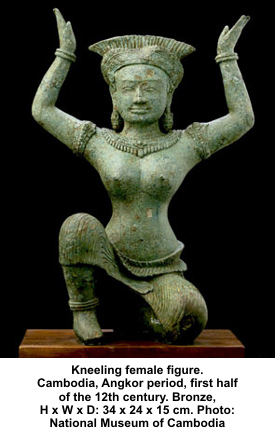
Picture: Kneeling figure from Cambodia

வேத மகிமை

வேதியர்க்கு அழகு வேதம் ஓதுதல்
வேதத்தில் நாலு விதம் உண்டு
வேதத்திற்கு உலகம் பகை, உலகத்திற்கு ஞானம் பகை
வேதத்திற்கும் விக்ரகபக்திக்கும் பகை
வேதத்தை அறியாத கிழவன் வீண்
வேதம் ஆய்ந்து ஓதல் போதகர் முறைமை
வேதம் ஏன், நியாயம் ஏன், வித்தாரம் கள்ளருக்கு (190)
வேதம் ஒத்த மித்திரன்
வேதம் கேடவரை, வேதம் கேடவர் என்பான் ஏன்?
வேதம் பொய்த்தாலும் வியாழம் பொய்யாது
உருத்திராக்கப் பூனை உபதேசம் பண்ணினது போல
ஐயப்பன் குதிரையை வையாளி விட்ட கதை
ஐயர் ஒன்றே கால் சேர் அவர் அணியும் லிங்கம் அரை சேர்
ஐயானாரே வாரும், கடாவைக் கொள்ளும்
ஐயனார் கோவிலிலே ஆனை பிடிக்க வேண்டும் (200)
ஐயனார் கோவில் செங்கல் அத்தனையும் தங்கம்
ஐயனார் கோவில் மண்ணை மிதித்தவர் அத்தனை பேரும் பத்திரகாளி
கஞ்சி வரதப்பா என்றால் வாயில் வாரப்பா என்றானாம்
காசிக்குப் போனால் காலாட்டிப் பிழைக்கலாம்
கண்ணைக் கெடுத்த தெய்வம் மதியைக் கொடுக்கும்
சுடலை ஞானம் திரும்பி வரும் மட்டும்தான் (ஸ்மசான வைராக்யம்)
தவசிச்சிக்கு தயிரும் சோறும் விசுவாசிக்கு வென்னீரும் பருக்கையும்
தவசிப்பிள்ளை நமசிவாயம் கையாசாரம்
தவசுக்குத் தனிமையும் தமிழுக்குத் துணையும்
தவசே அணிகலன், தாழ்மையே மேன்மை (210)
தவத்திலிருதால் தலைவனைக் காணலாம்
தவத்துக்கொருவர் கல்விக்கிருவர்

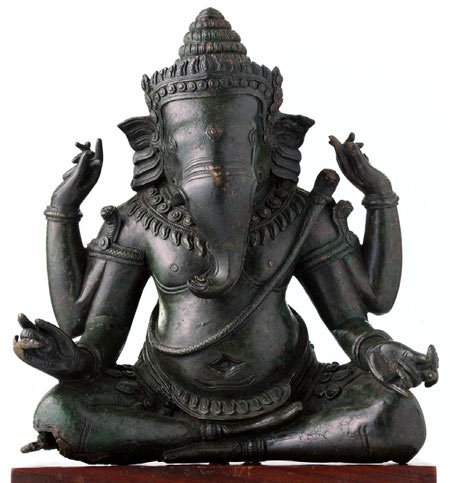
Picture: Ganesa in US Museum

உன்னையே நீ அறிவாய்
எல்லாம் தலை விதி (கர்ம வினைக் கொள்கை)
உடலில் உள்ள அழுக்கைப் போக்கிடலாம் உள்ளத்திலுள்ள
அழுக்கைப் போக்குவது கஷ்டம்
ஆடி கழிஞ்ச அஞ்சாம் நாள் கோழி அடிச்சுக் கும்பிட்டானாம்
மலையத்தனை சுவாமிக்கு கடுகத்தனை கற்பூரம்/ சாம்பிராணி

பெருமாள்

பெருமாளைச் சேர்ந்தோருக்குப் பிறப்பில்லை, பிச்சைச் சோற்றுக்கு எச்சல் இல்லை
பெருமாள் இருக்கிற வரையில் திருநாள் உண்டு
பெருமாள் இருந்தால் அல்லவோ திருநாள் நடக்கப் போகிறது?
பெருமாள் என்கிற பெயரை மாற்றி பெத்த பெருமாள் ஆச்சு (220)
பெருமாள் செல்கிற வழியில் புல்லாய் முளைத்தாலும் போதும்
பெருமாள் நினைத்தால் வாழ்வு குறைவா? பிரம்மா நினைத்தால் ஆயுசு குறைவா?
பெருமாள் புளிச்ச தண்ணீருக்கு அலைகிறான், அனுமார் ததியோதனம் கேட்கிறார்
பிச்சை எடுக்கிறதாம் அதைப் பிடுங்குகிறதாம் அனுமார்
பிள்ளையாரைப் பிடிச்ச சனி அரசமரத்தையும் பிடிச்சதாம் (225)

(பழமொழிகளில் இந்துமதம் என்ற எனது கட்டுரையில் கண்ட 14 பழமொழிகளையும் சேர்த்துக் கொள்க)