Date: 9 OCTOBER 2019 British Summer Time uploaded in London – 20-52 Post No. 7077
Pictures are taken from various sources; beware of copyright rules; don’t use them without permission; this is a non- commercial, educational blog; posted in swamiindology.blogspot.com and tamilandvedas.com simultaneously. Average hits per day for both the blogs 12,000.
Pictures are taken from various sources; beware of copyright rules; don’t use them without permission; this is a non- commercial, educational blog; posted in swamiindology.blogspot.com and tamilandvedas.com simultaneously. Average hits per day for both the blogs 11,000.
I HAVE
COVERED UP TO 9-55 SO FAR. LET ME CONTINUE FROM 9-56 TODAY. Last post was on 18th
July 2019.
INTERESTING
POINTS IN THIS SECTION—
SLOKAS 56 TO
70
Appointing another
man to get a child- it is called Niyoga or in Latin levirate. We see such
practice in Mahabharata when Vichitravirya died without children. But commentators
point out the confusion and contradictory statements in this section.
My comments
: There are interpolations in this section.
Sloka 71
When you
promise a girl to a man don’t go back on your words
Sloka 74
Very interesting;
if you don’t arrange for food and basic
things for your wife while you go on a long journey, she will runaway with
someone.
Divorce rules
If a man
doen’t come back within 8 years , she is free
If your wife
hates you for more than a year kick her out.
Oldest Tamil
book Tolkappiam also ban Tamil women going overseas with her husband. So there
is a waiting period, beyond which she can do what she wants to do.
Sloka 80-84 Drinking
and Violent Wives
Interesting .
If your wife
is barren for 8 years, you may leave her;
If all her
children died , leave her in tenth year.
If your wife
gives birth only to daughters, you may leave her in the eleventh year;
If a woman
drinks and extravagant, leave her immediately.
88-94 Marriageable
Age
Love marriage
is not wrong – sloka 91
Age limits –
sloka 94
WIFE IS GIFT
FROM GOD; SUPPORTING A WOMAN PLEASES GOD- SLOKA 95
BRIDE PRICE –
DON’T SELL YOUR DAUGHTER- SLOKA 97 TO 100
Chastity for
men and women – slokas 101 and 102
Property rights
– from sloka 9-104
What did
Daksa do with 10+13+27= 50 daughters? sloka -129
He gave 10 daughters
to Dharma;
13 daughters
to Kasyapa;
27 daughters
to Soma/ Moon
Sloka 137 to
139
Role of son,
grand son and great grand son
Sloka 140-
142 – adopted son
DIVISION OF
PROPERTY WITH FOUR WIVES- SLOKA 140
Rest of the
slokas gives minute details of division of property.
GETTING A CHILD THROUGH ANOTHER PERSON
9-57. The wife of an elder brother is for his younger (brother) the wife of a Guru; but the wife of the younger is declared (to be) the daughter-in-law of the elder.
58. An elder (brother) who approaches the wife of the younger, and a younger (brother who approaches) the wife of the elder, except in times of misfortune, both become outcasts, even though (they were duly) authorised.
59. On failure of issue (by her husband) a woman who has been authorised, may obtain, (in the) proper (manner prescribed), the desired offspring by (cohabitation with) a brother-in-law or (with some other) Sapinda (of the husband).
60. He (who is) appointed to (cohabit with) the widow shall (approach her) at night anointed with clarified butter and silent, (and) beget one son, by no means a second.
61. Some (sages), versed in the law, considering the purpose of the appointment not to have been attained by those two (on the birth of the first), think that a second (son) may be lawfully procreated on (such) women.
62. But when the purpose of the appointment to (cohabit with) the widow bas been attained in accordance with the law, those two shall behave towards each other like a father and a daughter-in-law.
63. If those two (being thus) appointed deviate from the rule and act from carnal desire, they will both become outcasts, (as men) who defile the bed of a daughter-in-law or of a Guru.
64. By twice-born men a widow must not be appointed to (cohabit with) any other (than her husband); for they who appoint (her) to another (man), will violate the eternal law.
65. In the sacred texts which refer to marriage the appointment (of widows) is nowhere mentioned, nor is the re-marriage of widows prescribed in the rules concerning marriage.
66. This practice which is reprehended by the learned of the twice-born castes as fit for cattle is said (to have occurred) even among men, while Vena ruled.
67. That chief of royal sages who formerly possessed the whole world, caused a confusion of the castes (varna), his intellect being destroyed by lust.
68. Since that (time) the virtuous censure that (man) who in his folly appoints a woman, whose husband died, to (bear) children (to another man).
69. If the (future) husband of a maiden dies after troth verbally plighted, her brother-in-law shall wed her according to the following rule.
70. Having, according to the rule, espoused her (who must be) clad in white garments and be intent on purity, he shall approach her once in each proper season until issue (be had).
71. Let no prudent man, after giving his daughter to one (man), give her again to another; for he who gives (his daughter) whom he had before given, incurs (the guilt of) speaking falsely regarding a human being.
72. Though (a man) may have accepted a damsel in due form, he may abandon (her if she be) blemished, diseased, or deflowered, and (if she have been) given with fraud.
73. If anybody gives away a maiden possessing blemishes without declaring them, (the bridegroom) may annul that (contract) with the evil-minded giver.
74. A man who has business (abroad) may depart after securing a maintenance for his wife; for a wife, even though virtuous, may be corrupted if she be distressed by want of subsistence.
75. If (the husband) went on a journey after providing (for her), the wife shall subject herself to restraints in her daily life; but if he departed without providing (for her), she may subsist by blameless manual work.
76. If the husband went abroad for some sacred duty, (she) must wait for him eight years, if (he went) to (acquire) learning or fame six (years), if (he went) for pleasure three years.
HATEFUL WIVES
77. For one year let a husband bear with a wife who hates him; but after (the lapse of) a year let him deprive her of her property and cease to cohabit with her.
78. She who shows disrespect to (a husband) who is addicted to (some evil) passion, is a drunkard, or diseased, shall be deserted for three months (and be) deprived of her ornaments and furniture.
79. But she who shows aversion towards a mad or outcast (husband), a eunuch, one destitute of manly strength, or one afflicted with such diseases as punish crimes, shall neither be cast off nor be deprived of her property.
80. She who drinks spirituous liquor, is of bad conduct, rebellious, diseased, mischievous, or wasteful, may at any time be superseded (by another wife).
81. A barren wife may be superseded in the eighth year, she whose children (all) die in the tenth, she who bears only daughters in the eleventh, but she who is quarrelsome without delay.
NEVER LEAVE A SICK WIFE WITHOUT HER CONSENT
82. But a sick wife who is kind (to her husband) and virtuous in her conduct, may be superseded (only) with her own consent and must never be disgraced.
83. A wife who, being superseded, in anger departs from (her husband’s) house, must either be instantly confined or cast off in the presence of the family.
84. But she who, though having been forbidden, drinks spirituous liquor even at festivals, or goes to public spectacles or assemblies, shall be fined six krishnalas.
MY COMMENTS- GOLD WEIGHING SIX KRISHNALAS??
85. If twice-born men wed women of their own and of other (lower castes), the seniority, honour, and habitation of those (wives) must be (settled) according to the order of the castes (varna).
86. Among all (twice-born men) the wife of equal caste alone, not a wife of a different caste by any means, shall personally attend her husband and assist him in his daily sacred rites.
87. But he who foolishly causes that (duty) to be performed by another, while his wife of equal caste is alive, is declared by the ancients (to be) as (despicable) as a Kandala (sprung from the) Brahmana (caste).
88. To a distinguished, handsome suitor (of) equal (caste) should (a father) give his daughter in accordance with the prescribed rule, though she have not attained (the proper age).
89. (But) the maiden, though marriageable, should rather stop in (the father’s) house until death, than that he should ever give her to a man destitute of good qualities.
90. Three years let a damsel wait, though she be marriageable; but after that time let her choose for herself a bridegroom (of) equal (caste and rank).
NOTHING WRONG IN LOVE MARRIAGE
91. If, being not given in marriage, she herself seeks a husband, she incurs no guilt, nor (does) he whom she weds.
92. A maiden who choses for herself, shall not take with her any ornaments, given by her father or her mother, or her brothers; if she carries them away, it will be theft.
93. But he who takes (to wife) a marriageable damsel, shall not pay any nuptial fee to her father; for the (latter) will lose his dominion over her in consequence of his preventing (the legitimate result of the appearance of) her enemies.
94. A man, aged thirty years, shall marry a maiden of twelve who pleases him, or a man of twenty-four a girl eight years of age; if (the performance of) his duties would (otherwise) be impeded, (he must marry) sooner.
WIFE IS A GIFT FROM GOD
95. The husband receives his wife from the gods, (he does not wed her) according to his own will; doing what is agreeable to the gods, he must always support her (while she is) faithful.
96. To be mothers were women created, and to be fathers men; religious rites, therefore, are ordained in the Veda to be performed (by the husband) together with the wife.
97. If, after the nuptial fee has been paid for a maiden, the giver of the fee dies, she shall be given in marriage to his brother, in case she consents.
98. Even a Sudra ought not to take a nuptial fee, when he gives away his daughter; for he who takes a fee sell his daughter, covering (the transaction by another name).
99. Neither ancients nor moderns who were good men have done such (a deed) that, after promising (a daughter) to one man, they have her to another;
100. Nor, indeed, have we heard, even in former creations, of such (a thing as) the covert sale of a daughter for a fixed price, called a nuptial fee.
101. ‘Let mutual fidelity continue until death,’ this may be considered as the summary of the highest law for husband and wife.
102. Let man and woman, united in marriage, constantly exert themselves, that (they may not be) disunited (and) may not violate their mutual fidelity.
103. Thus has been declared to you the law for a husband and his wife, which is intimately connected with conjugal happiness, and the manner of raising offspring in times of calamity; learn (now the law concerning) the division of the inheritance.
PROPERTY RIGHTS
104. After the death of the father and of the mother, the brothers, being assembled, may divide among themselves in equal shares the paternal (and the maternal) estate; for, they have no power (over it) while the parents live.
105. (Or) the eldest alone may take the whole paternal estate, the others shall live under him just as (they lived) under their father.
106. Immediately on the birth of his first-born a man is (called) the father of a son and is freed from the debt to the manes; that (son), therefore, is worthy (to receive) the whole estate.
107. That son alone on whom he throws his debt and through whom he obtains immortality, is begotten for (the fulfilment of) the law; all the rest they consider the offspring of desire.
108. As a father (supports) his sons, so let the eldest support his younger brothers, and let them also in accordance with the law behave towards their eldest brother as sons (behave towards their father).
109. The eldest (son) makes the family prosperous or, on the contrary, brings it to ruin; the eldest (is considered) among men most worthy of honour, the eldest is not treated with disrespect by the virtuous.
110. If the eldest brother behaves as an eldest brother (ought to do), he (must be treated) like a mother and like a father; but if he behaves in a manner unworthy of an eldest brother, he should yet be honoured like a kinsman.
111. Either let them thus live together, or apart, if (each) desires (to gain) spiritual merit; for (by their living) separate (their) merit increases, hence separation is meritorious.
112. The additional share (deducted) for the eldest shall be one-twentieth (of the estate) and the best of all chattels, for the middlemost half of that, but for the youngest one-fourth.
113. Both the eldest and the youngest shall take (their shares) according to (the rule just) stated (each of) those who are between the eldest and the youngest, shall have the share (prescribed for the) middlemost.
114. Among the goods of every kind the eldest shall take the best (article), and (even a single chattel) which is particularly good, as well as the best of ten (animals).
115. But among (brothers) equally skilled in their occupations, there is no additional share, (consisting of the best animal) among ten; some trifle only shall be given to the eldest as a token of respect.
116. If additional shares are thus deducted, one must allot equal shares (out of the residue to each); but if no deduction is made, the allotment of the shares among them shall be (made) in the following manner.
117. Let the eldest son take one share in excess, the (brother) born next after him one (share) and a half, the younger ones one share each; thus the law is settled.
118. But to the maiden (sisters) the brothers shall severally give (portions) out of their shares, each out of his share one-fourth part; those who refuse to give (it), will become outcasts.
119. Let him never divide (the value of) a single goat or sheep, or a (single beast) with uncloven hoofs; it is prescribed (that) a single goat or sheep (remaining after an equal division, belongs) to the eldest alone.
120. If a younger brother begets a son on the wife of the elder, the division must then be made equally; this the law is settled.
121. The representative (the son begotten on the wife) is not invested with the right of the principal (the eldest brother to an additional share); the principal (became) a father on the procreation (of a son by his younger brother); hence one should give a share to the (son begotten on the wife of the elder brother) according to the rule (stated above).
122. If there be a doubt, how the division shall be made, in case the younger son is born of the elder wife and the elder son of the younger wife,
123. (Then the son) born of the first wife shall take as his additional share one (most excellent) bull; the next best bulls (shall belong) to those (who are) inferior on account of their mothers.
124. But the eldest (son, being) born of the eldest wife, shall receive fifteen cows and a bull, the other sons may then take shares according to (the seniority of) their mothers; that is a settled rule.
125. Between sons born of wives equal (in caste) (and) without (any other) distinction no seniority in right of the mother exists; seniority is declared (to be) according to birth.
TWINS
126. And with respect to the Subrahmanya (texts) also it is recorded that the invocation (of Indra shall be made) by the first-born, of twins likewise, (conceived at one time) in the wombs (of their mothers) the seniority is declared (to depend) on (actual) birth.
SUBRAHMANYA VERSES ARE IN AITAREYA BRAHMANA 6-3
127. He who has no son may make his daughter in the following manner an appointed daughter (putrika, saying to her husband), ‘The (male) child, born of her, shall perform my funeral rites.’
128. According to this rule Daksha, himself, lord of created beings, formerly made (all his female offspring) appointed daughters in order to multiply his race.
129. He gave ten to Dharma, thirteen to Kasyapa, twenty-seven to King Soma, honouring (them) with an affectionate heart.
130. A son is even (as) oneself, (such) a daughter is equal to a son; how can another (heir) take the estate, while such (an appointed daughter who is even) oneself, lives?
131. But whatever may be the separate property of the mother, that is the share of the unmarried daughter alone; and the son of an (appointed) daughter shall take the whole estate of (his maternal grandfather) who leaves no son.
132. The son of an (appointed) daughter, indeed, shall (also) take the estate of his (own) father, who leaves no (other) son; he shall (then) present two funeral cakes to his own father and to his maternal grandfather.
133. Between a son’s son and the son of an (appointed) daughter there is no difference, neither with respect to worldly matters nor to sacred duties; for their father and mother both sprang from the body of the same (man).
134. But if, after a daughter has been appointed, a son be born (to her father), the division (of the inheritance) must in that (case) be equal; for there is no right of primogeniture for a woman.
135. But if an appointed daughter by accident dies without (leaving) a son, the husband of the appointed daughter may, without hesitation, take that estate.
136. Through that son whom (a daughter), either not appointed or appointed, may bear to (a husband) of equal (caste), his maternal grandfather (has) a son’s son; he shall present the funeral cake and take the estate.
ROLE OF SON, GRAND SON, GREAT GRAND SON
137. Through a son he conquers the worlds, through a son’s son he obtains immortality, but through his son’s grandson he gains the world of the sun.
138. Because a son delivers (trayate) his father from the hell called Put, he was therefore called put-tra (a deliverer from Put) by the Self-existent (Svayambhu) himself.
139. Between a son’s son and the son of a daughter there exists in this world no difference; for even the son of a daughter saves him (who has no sons) in the next world, like the son’s son.
140. Let the son of an appointed daughter first present a funeral cake to his mother, the second to her father, the funeral to his father’s father.
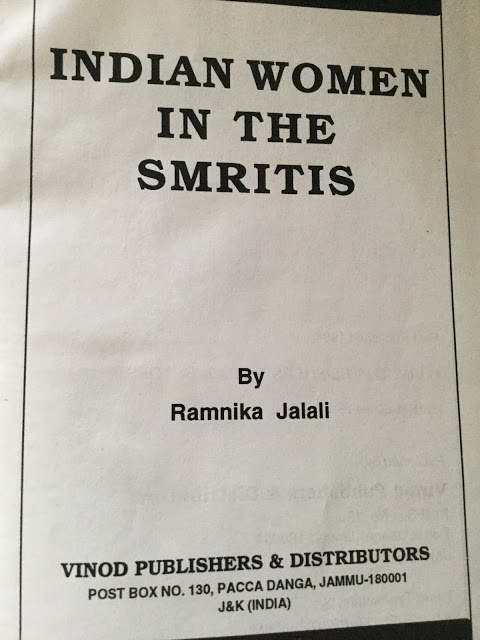
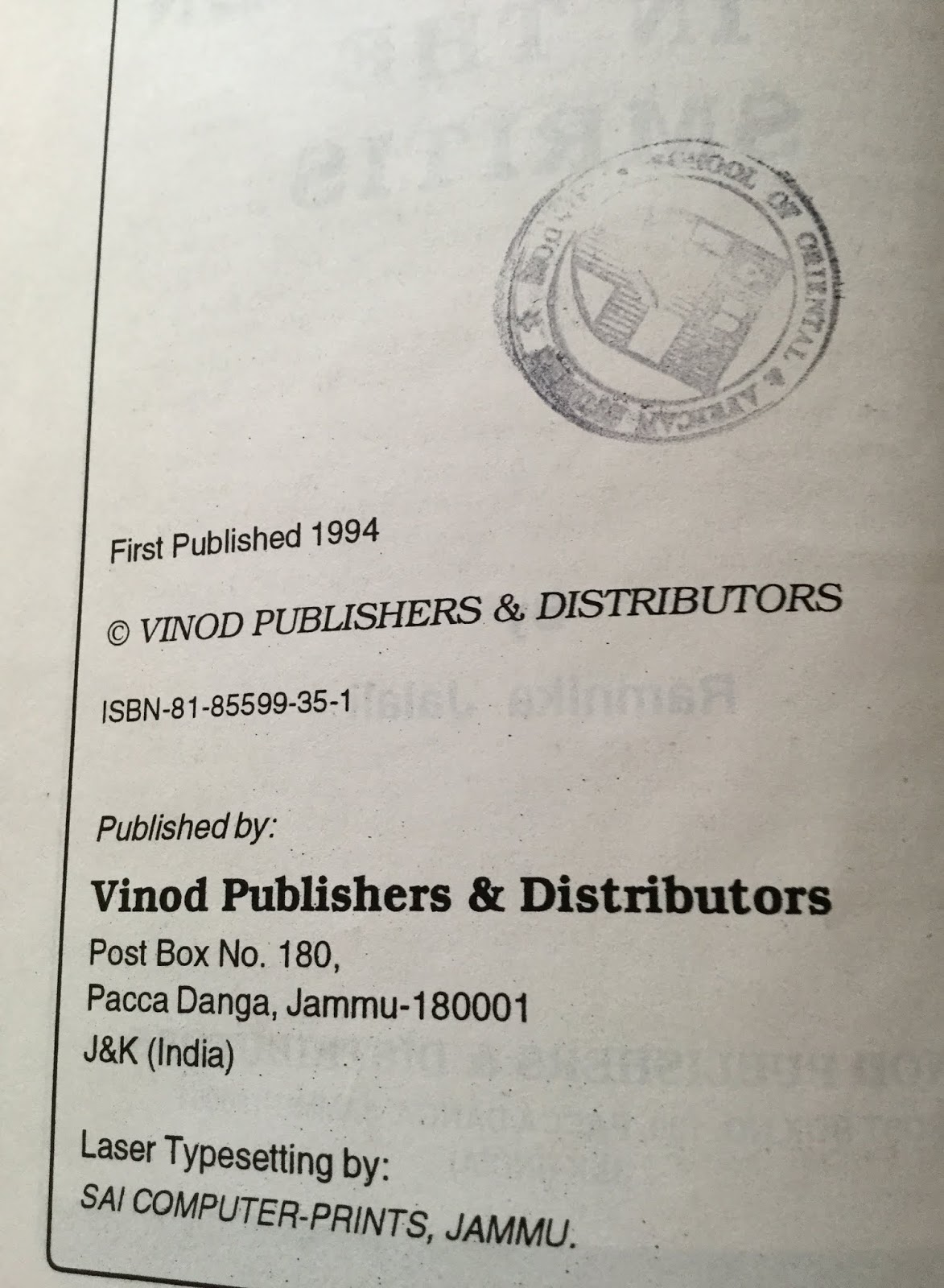
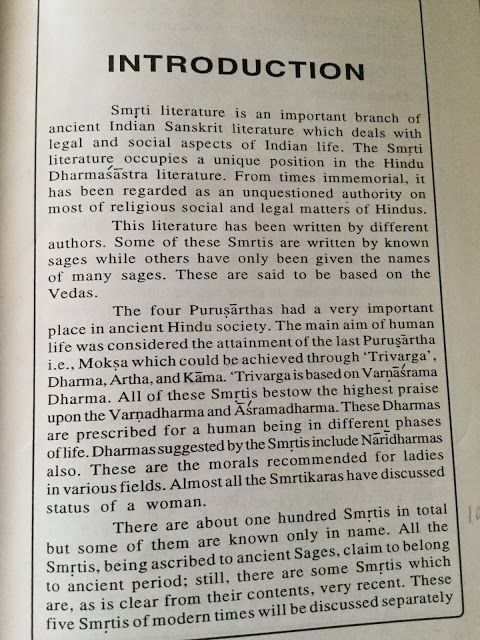
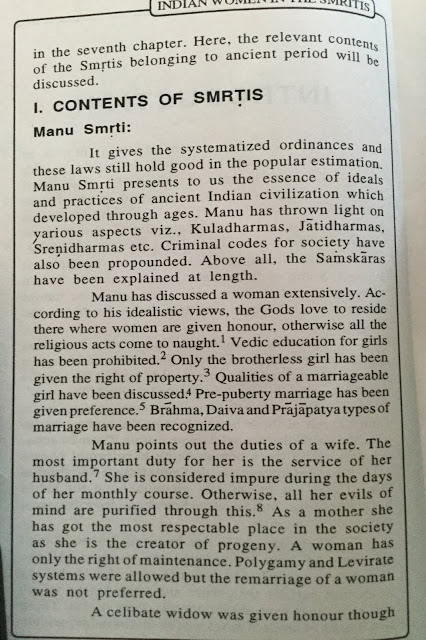
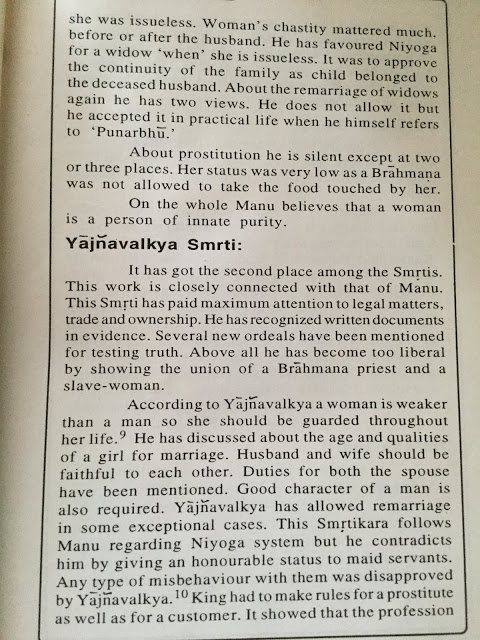
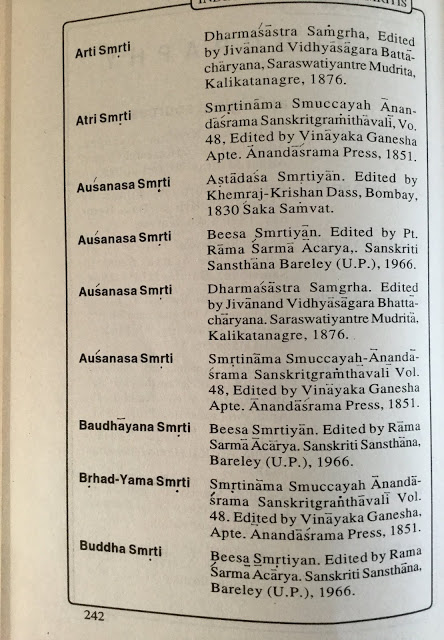
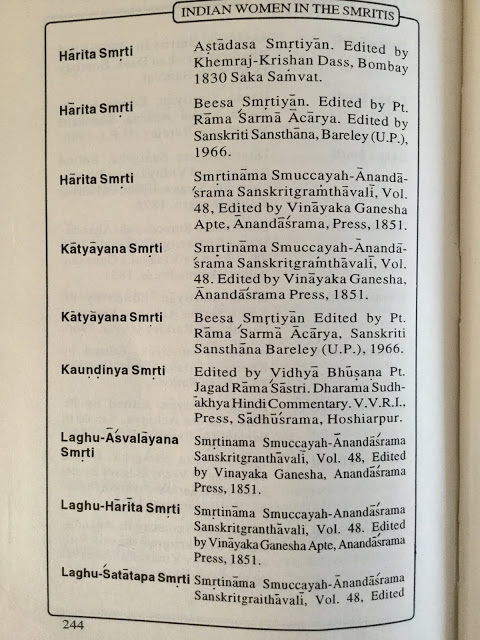
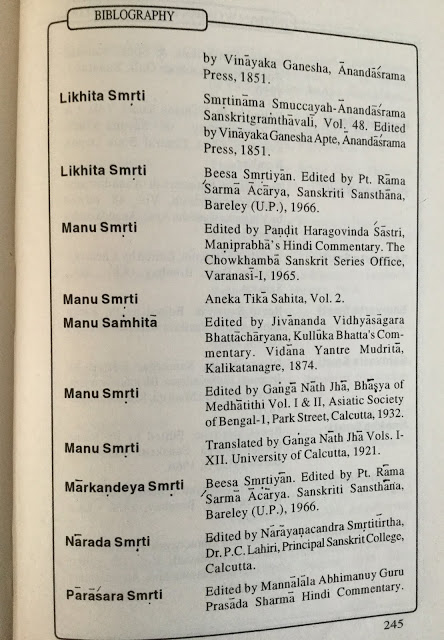
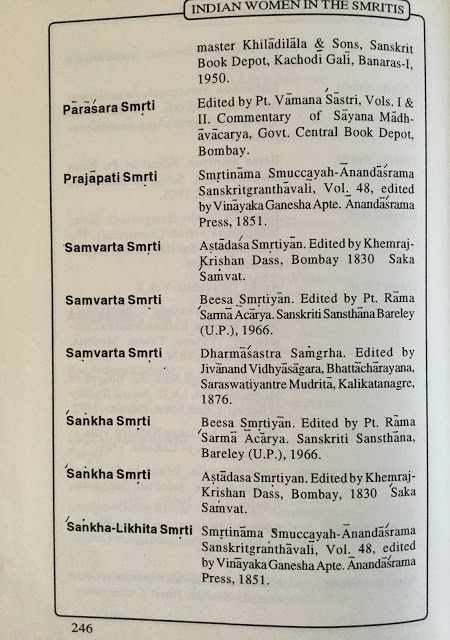
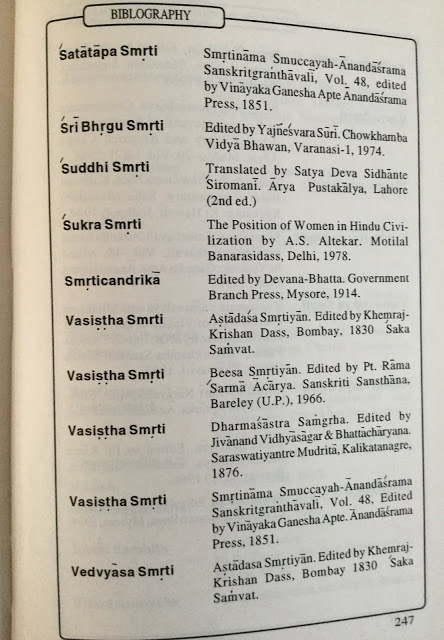
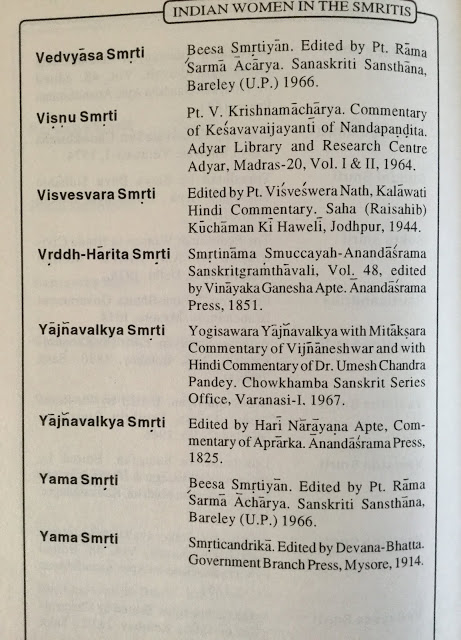
MS RAMNIKA JALALI’S BOOK INDIAN WOMEN IN THE SMRITIS is a
good book. In 248 pages she has listed nearly 100 law books, what are called
Smritis in Sanskrit. She has compared the status of women in 37 important law
books and listed another 57 law books.
She has dealt with woman
As a girl
As a wife
As a mother
As a widow
As a prostitute
It is a balanced book and gives a long list of reference
books.
It is treasure house for researchers.
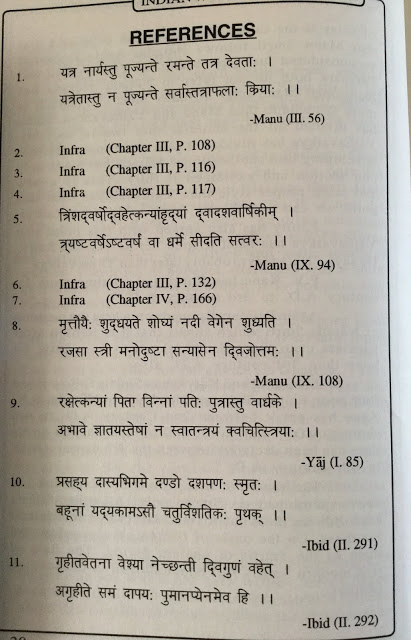
She has given the famous sloka of Manu smrti in the very
beginning:
Yatra naaryastu puujyante ramante tatra devataah
Yatretaastu na puujyante sarvaastatraaphalaah kriyaah
Manu 3-56
The deities delight in places where women are revered, but
where women are not revered all rites are fruitless – Manu 3-56
Here some pages from the book
Full list of Hindu Law Books called Smritis is in the book.
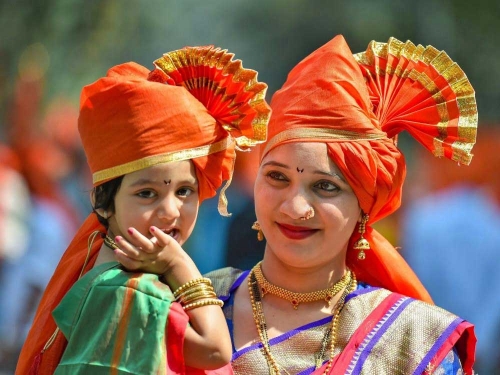
Hindu woman in Toronto, Canada Hindu Temple Festival from Facebook
I have already
covered the first 8 chapters of Manava Dharma Sastra, also known as Manu Smrti.
Ninth chapter is used by Anti Manu lobby saying that Manu was anti women. But
the lobbyists chose the slokas they like and hide the more important statements
of Manu. There is no book in the ancient world that supports women like Manu.
Even in this
chapter he compared women to Goddess Lakshmi (Goddess of Prosperity) and praised
them as Lamps of Houses.
Manu’s
statement in this chapter is translated by Tamil poet Tiruvalluvar in one or
two couplets. Manu’s description of women as lamps is translated by Sangam Tail
poets as well.
Manu’s words
against bad women are found in all literatures and scriptures of the world. In
fact we see such warnings even in the teachings of Sri Ramakrishna Paramahamsa
in his warning about Kamini- Kanchana (temptation of women and gold).
Throughout
Kamba Ramayana (in Tamil) also we read anti women statements. And in the verses
of Arunagirinathar and Pattinathar we see more of such statements.
All those who
criticised Manu hide all his praises for women:
“All body parts
of women are pure.
If a woman
cries in a family that family will be destroyed completely.
Brothers must
buy their sisters clothes and jewels and keep them ever happy.
Husbands can’t
do any rituals without wives.
Killing women is
never allowed”.
There are many
more such praises heaped on women by Manu. So one must read the slokas and
interpret them in the right context. Following sloka/verse is oft quoted by
anti Hindu politicians and socalled scholars.
पिता रक्षति कौमारे भर्ता
रक्षति यौवने ।
रक्षन्ति स्थविरे पुत्रा न स्त्री
स्वातन्त्र्यमर्हति ॥ 9-३ ॥
The father guards/protects her during virginity, the husband
guards/protects her in youth, the sons guard/protect her in old age; WOMEN
SHOULD NEVER BE LEFT UNGURADED/UNPROTECTED (literal translation- the woman is
never fit for independence.—(9-iii)).
In the above verse ‘Rakshati = protected’ is used thrice. That
shows that a woman should never be left un protected, should not be left in the
lurch.
In fact, Tamils go further and say that the same man should be
her husband in her following births.
(One Facebook friend joked on this- Oh my God; I have trained
him all these years; that should not go waste; Please make him my husband in
the next birth also!)
Tamils also say that a chaste woman who worships her husband can
command nature. If a woman goes to bed later and gets up before her husband and
worship him like God, she can command rain.(Tirukkural 55)
This is an echo of Manu 5-155
Tirukkural couplet 56 in Tamil is a translation of Manu 9-12
Now let us look at the verses in order and I will highlight the important ones.
MANU -Chapter- 9
9-1. I will now propound the
eternal laws for a husband and his wife who keep to the path of duty, whether
they be united or separated.
2. Day and night woman must be
kept in dependence by the males (of) their families, and, if they attach
themselves to sensual enjoyments, they must be kept under one’s control.
9-3. Her father protects her
in childhood, her husband protects her in youth, and her sons protect her in
old age; a woman is never left without support.
4. Reprehensible is the father
who gives not his daughter in marriage at the proper time; reprehensible is the
husband who approaches not his wife in due season, and reprehensible is the son
who does not protect his mother after her husband has died.
5. Women must particularly be
guarded against evil inclinations, however trifling they may appear; for, if
they are not guarded, they will bring sorrow on two families.
6. Considering that the highest
duty of all castes, even weak husbands must strive to guard their wives.
7. He who carefully guards his
wife, preserves the purity of his offspring, virtuous conduct, his family,
himself, and his means of acquiring merit.
Son is husband’s replica
9-8. The husband, after
conception by his wife, becomes an embryo and is born again of her; for that is
the wifehood of a wife (jaya), that he is born (jayate) again by her.
9. As the male is to whom a wife
cleaves, even so is the son whom she brings forth; let him therefore carefully
guard his wife, in order to keep his offspring pure.
10. No man can completely guard
women by force; but they can be guarded by the employment of the following
expedients:
11. Let the husband) employ his
wife in the collection and expenditure of his wealth, in keeping everything
clean, in the fulfilment of religious duties, in the preparation of his food,
and in looking after the household utensils.
9-12. Women, confined in the
house under trustworthy and obedient servants, are not well guarded; but those
who of their own accord keep guard over themselves, are well guarded.
(Tirukkural 56 in Tamil say the same)
Six causes for women’s ruin
13. Drinking (spirituous liquor),
associating with wicked people, separation from the husband, rambling abroad,
sleeping (at unseasonable hours), and dwelling in other men’s houses, are the
six causes of the ruin of women.
14. Women do not care for beauty,
nor is their attention fixed on age; thinking), ‘It is enough that he is a
man,’ they give themselves to the handsome and to the ugly.
15. Through their passion for
men, through their mutable temper, through their natural heartlessness, they
become disloyal towards their husbands, however carefully they may be guarded in
this world.
Women are frail; men must
protect them
16. Knowing their disposition,
which the Lord of creatures laid in them at the creation, to be such, every man
should most strenuously exert himself to guard them.
17. (When creating them) Manu
allotted to women a love of their bed, of their seat and of ornament, impure
desires, wrath, dishonesty, malice, and bad conduct.
18. For women no sacramental rite
is performed with sacred texts, thus the law is settled; women who are
destitute of strength and destitute of the knowledge of Vedic texts, (are as
impure as) falsehood (itself), that is a fixed rule.
19. And to this effect many
sacred texts are sung also in the Vedas, in order to (make) fully known the
true disposition (of women); hear (now those texts which refer to) the
expiation of their (sins).
20. ‘If my mother, going astray
and unfaithful, conceived illicit desires, may my father keep that seed from
me,’ that is the scriptural text.
21. If a woman thinks in her
heart of anything that would pain her husband, the (above-mentioned text) is
declared (to be a means for) completely removing such infidelity.
(Verses 20,21 are based on Grhya
sutras and Srauta sutras)
22. Whatever be the qualities of
the man with whom a woman is united according to the law, such qualities even
she assumes, like a river united with the ocean.
Lowest caste woman became the
most respected woman in the world
Arundhati is the most praised
woman in Sangam Tamil literature and Puranas. She was known as Akshamala
9-23. Akshamala, a woman of
the lowest birth, being united to Vasishtha and Sarangi, (being united) to
Mandapala, became worthy of honour.
24. These and other females of
low birth have attained eminence in this world by the respective good qualities
of their husbands.
25. Thus has been declared the
ever pure popular usage which regulates the relations between husband and wife;
hear (next) the laws concerning children which are the cause of happiness in
this world and after death.
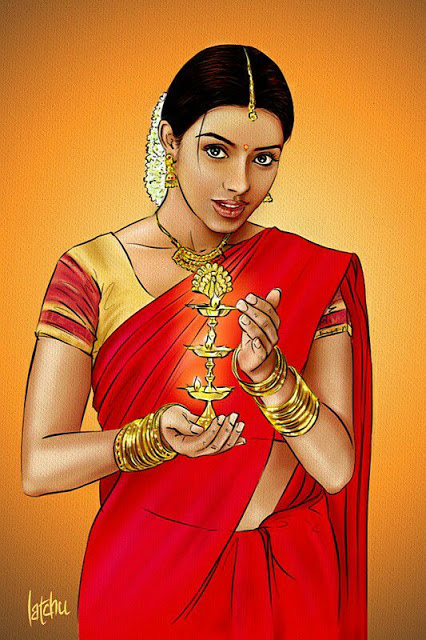
Women are lamps of houses;
women are Goddess Lakshmi
9-26. Between wives (striyah)
who are destined to bear children, who secure many blessings, who are worthy of
worship and irradiate their dwellings, and between the goddesses of fortune
(sriyah, who reside) in the houses of men, there is no difference whatsoever.
Another translation of 9-26
There is no difference at all
between the Goddesses of good fortune who live in houses and women who are the
lamps of the houses, worthy of reverence and greatly blessed because of their
children.
27. The production of children,
the nurture of those born, and the daily life of men, (of these matters) woman
is visibly the cause.
Wife is foundation
28. Offspring, the due
performance on religious rites, faithful service, highest conjugal happiness
and heavenly bliss for the ancestors and oneself, depend on one’s wife alone.
29. She who, controlling her
thoughts, speech, and acts, violates not her duty towards her lord, dwells with
him (after death) in heaven, and in this world is called by the virtuous a faithful
(wife, sadhvi)
30. But for disloyalty to her
husband a wife is censured among men, and (in her next life) she is born in the
womb of a jackal and tormented by diseases, the punishment of her sin.
31. Listen (now) to the following
holy discussion, salutary to all men, which the virtuous (of the present day)
and the ancient great sages have held concerning male offspring.
32. They (all) say that the male
issue (of a woman) belongs to the lord, but with respect to the (meaning of the
term) lord the revealed texts differ; some call the begetter (of the child the
lord), others declare (that it is) the owner of the soil.
Men are seeds- women are
fields
33. By the sacred tradition the
woman is declared to be the soil, the man is declared to be the seed; the
production of all corporeal beings (takes place) through the union of the soil
with the seed.
34. In some cases the seed is
more distinguished, and in some the womb of the female; but when both are
equal, the offspring is most highly esteemed.
35. On comparing the seed and the
receptacle (of the seed), the seed is declared to be more important; for the
offspring of all created beings is marked by the characteristics of the seed.
36. Whatever (kind on seed is
sown in a field, prepared in due season, (a plant) of that same kind, marked
with the peculiar qualities of the seed, springs up in it.
37. This earth, indeed, is called
the primeval womb of created beings; but the seed develops not in its
development any properties of the womb.
38. In this world seeds of
different kinds, sown at the proper time in the land, even in one field, come
forth (each) according to its kind.
39. The rice (called) vrihi and
(that called) sali, mudga-beans, sesamum, masha-beans, barley, leeks, and
sugar-cane, (all) spring up according to their seed.
9-40. That one (plant) should
be sown and another be produced cannot happen; whatever seed is sown, (a plant
of) that kind even comes forth.
41. Never therefore must a
prudent well-trained man, who knows the Veda and its Angas and desires long
life, cohabit with another’s wife.
42. With respect to this
(matter), those acquainted with the past recite some stanzas, sung by Vayu (the
Wind, to show) that seed must not be sown by (any) man on that which belongs to
another.
43. As the arrow, shot by (a
hunter) who afterwards hits a wounded (deer) in the wound (made by another), is
shot in vain, even so the seed, sown on what belongs to another, is quickly
lost (to the sower).
Prithivi/ husband and Pruthu/ wife
9-44. Sages, who know the past
call this earth (prithivi) even the wife of Prithu; they declare a field to
belong to him who cleared away the timber, and a deer to him who (first)
wounded it.
45. He only is a perfect man who
consists (of three persons united), his wife, himself, and his offspring; thus
(says the Veda), and (learned) Brahmanas propound this (maxim) likewise, ‘The
husband is declared to be one with the wife.’
46. Neither by sale nor by
repudiation is a wife released from her husband; such we know the law to be, which
the Lord of creatures (Pragapati) made of old.
47. Once is the partition (of the
inheritance) made, (once is) a maiden given in marriage, (and) once does (a
man) say,’ I will give;’ each of those three (acts is done) once only.
48. As with cows, mares, female
camels, slave-girls, buffalo-cows, she-goats, and ewes, it is not the begetter
(or his owner) who obtains the offspring, even thus (it is) with the wives of
others.
49. Those who, having no property
in a field, but possessing seed-corn, sow it in another’s soil, do indeed not
receive the grain of the crop which may spring up.
Bull and Calves Simile
50. If (one man’s) bull were to
beget a hundred calves on another man’s cows, they would belong to the owner of
the cows; in vain would the bull have spent his strength.
51. Thus men who have no marital
property in women, but sow their seed in the soil of others, benefit the owner
of the woman; but the giver of the seed reaps no advantage.
52. If no agreement with respect
to the crop has been made between the owner of the field and the owner of the
seed, the benefit clearly belongs to the owner of the field; the receptacle is
more important than the seed.
53. But if by a special contract
(a field) is made over (to another) for sowing, then the owner of the seed and
the owner of the soil are both considered in this world as sharers of the
(crop).
Seed and Field Simile
54. If seed be carried by water
or wind into somebody’s field and germinates (there), the (plant sprung from
that) seed belongs even to the owner of the field, the owner of the seed does
not receive the crop.
55. Know that such is the law
concerning the offspring of cows, mares, slave-girls, female camels, she-goats,
and ewes, as well as of females of birds and buffalo-cows.
56. Thus the comparative
importance of the seed and of the womb has been declared to you; I will next
propound the law (applicable) to women in times of misfortune.
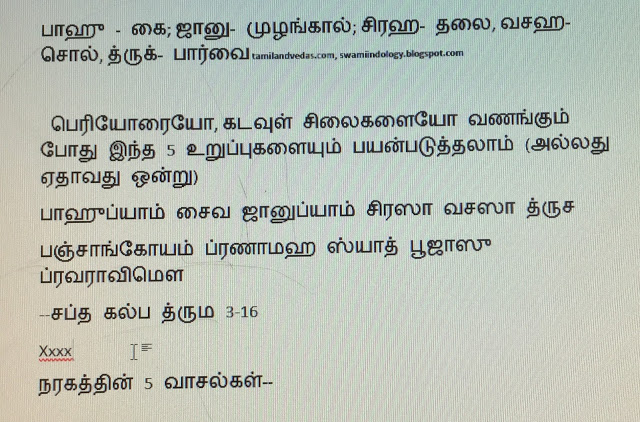
பஞ்சாமிர்தம், பஞ்சாங்கம், பஞ்சகவ்யம்பஞ்சயக்ஞம் என்றால் என்ன?(Post No.2596) …
BY SOMEONE. (for old articles go to tamilandvedas.com OR
swamiindology.blogspot.com; contact.
The five
ingredients of pachamrta are: Dugdham – milk. Sarkara – sugar. Ghrtam – ghee or clarified butter. Dadhi – curd. Madhu – honey. (in some places
fruits …






























 Tamil and Vedas