WHY SHOULDN’T YOU TELL A WOMAN A SECRET? A NAGA STORY (Post No.4877)

WRITTEN by London Swaminathan 


Date: 3 April 2018


Time uploaded in London –  7-43 am (British Summer Time)


Post No. 4877


Pictures shown here are taken from various sources such as Facebook friends, Books, Google and newspapers; thanks. Pictures may be subject to copyright laws.


WARNING: PLEASE SHARE MY ARTICLES; BUT DON’T SHARE IT WITHOUT AUTHOR’S NAME AND THE BLOG NAME. BE HONEST; OTHERS WILL BE HONEST WITH YOU


There are lot of stories in India about the Naga race. They were the people who wore snake charms or totem symbols or perhaps their leaders wore Naga/snake crowns. But in course of time people started believing they were real snakes or serpents. All stories develop like this in all parts of the world. Facts are hidden in myths. Let us look at some stories: –


The conflict between the snake and garuda/eagle have given birth to several stories around the world. Lot of countries have flags or emblems or coins or currencies showing the enmity between the Garuda/eagle and the snake. India has such stories from the Mahabharata to Puranas


The Naga who revealed the secret to a woman!

Once a Naga fleeing in fear of a Garuda/ eagle assumed human shape and took refuge in a house. The lady of the house agreed to hide the person for a fee of 500 elephants.  After sometime the lady asked the Naga how and where from he was going to get 500 elephants. The Naga fell in love with her and revealed his real identity. The lady revealed this secret to another woman. That woman disclosed this to Garuda who was in the human form. Garuda took the human form to search for the fleeing Naga. The result was the poor serpent / naga was killed by the eagle. The moral of the story is NO WISE MAN SHOULD DISCLOSE A SECRET TO A WOMAN. This is a folk tale told along with the Naga stories


KING UDAYANA OF VATSA AND THE LUTE
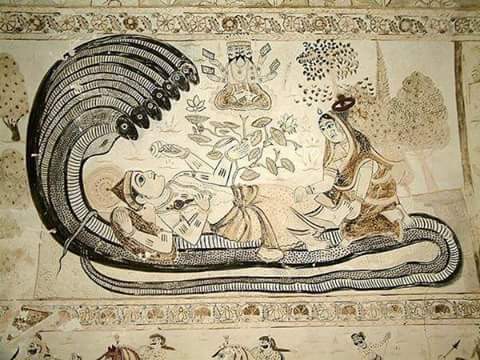
Once Udayana , the king of Vatsa kingdom, was roaming in a forest  in pursuit of a deer. At that time he saw a serpent caught by a hunter. Moved with pity the king asked the hunter to release the serpent and promised him to give something else. The hunter replied, “My Lord, this is my livelihood. I maintain myself by exhibiting snakes. I ma a snake charmer. They dance to my tunes. On hearing this Udayana gave him his costly golden bracelet and then the hunter released the snake. The serpent was very much pleased with the king and it gave him a wonderful lute.


The hunter saw the name of King Sahsranika on the bracelet and so he took it to the king. This lead to the reunion of the consorts Sahsranika- Mrgavati who were separated for 14 years. Mrgavati was Udayana’s mother.


It is said that Vatsa raja used the lute to capture wild elephants.


STORY OF JIMUTA VAHANA

The feud between the Garuda and Naga has found a place in most of the Sanskrit literature. The fairy tale of Jimutavahana is very popular and Katha Sarit Sagra narrates this story twice.   Brhat Katha Manjari and 25 tales of Vetala also narrate this story. King Harsa has dramatized this story in his play Nagananda. Nagas freed from the danger of Garuda due to the sacrifice of Jimutavahana is the theme in the story.
PANCHATANTRA HAS TWO STORIES ON NAGAS


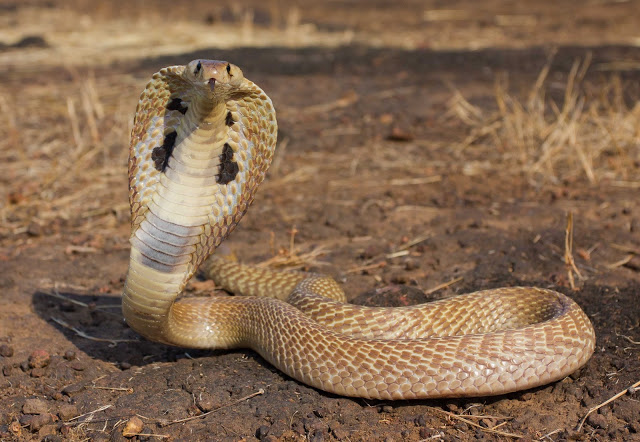
Pancha tantra, the oldest fable book in the world has two stories on Nagas

In the Story of Poor Brahmana and the Gold Granting serpent, we find the following story:-


Haridatta was a poor agriculturist and he had very little production in his field. One day he saw a snake in his field. He worshipped it and offered it milk. Next day when he came to the field he found a gold coin where he saw the snake the previous day. He started offering milk to the snake every day. And he obtained a gold coin every time he went to the field. Haridatta’s son, knowing this miracle, became very greedy. He thought the ant hill where the snake lives must be full of gold coins. So he planned to kill the snake and dug out the ant hill. The snake bit him and he died. His father felt very sorry. The snake gave Haridatta a costly jewel and asked him not to come again.


Different versions of the story are found in western literature as well. They have copied it from India. Greek story teller Aesop also copied lot from Pancha Tantra fables.
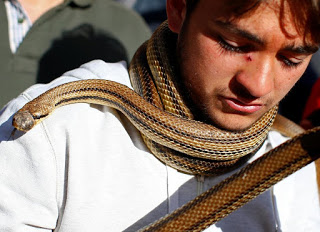
There is another story in Panchatantra where the snake appears as the son of human parents. On the day he was married to a woman, he assumed human form in the wedding night. His father burnt the snake’s skin and prevented him from returning to animal form again.


Such stories present Nagas as humans and animals.


–subham–


SERPENT WORSHIP IN GREECE AND ITALY (Post No.4874)

WRITTEN by London Swaminathan 


Date: 2 April 2018


Time uploaded in London –  13-34  (British Summer Time)


Post No. 4874


Pictures shown here are taken from various sources such as Facebook friends, Books, Google and newspapers; thanks. Pictures may be subject to copyright laws.


WARNING: PLEASE SHARE MY ARTICLES; BUT DON’T SHARE IT WITHOUT AUTHOR’S NAME AND THE BLOG NAME. BE HONEST; OTHERS WILL BE HONEST WITH YOU


Worshipping snakes is a very common sight in India. From Kashmir to Kanyakumari we have thousands of towns and villages named after the snakes. Sanskrit words Naga and Sarpa gave birth to English words such as S +naga (snake) and Serpent (serpent). Thousands of snake (Naga) statues are worshipped in almost all famous temples in South India. Kashmir’s History book Nilamata purana and Kalahana’s Raja Tarangini give lot of stories about Naga Kings. Naga Panchami and Varuna Panchami, celebrating the snakes, are followed by devoted Hindus even today. Nilamata Purana CONTAINS AN EXTENSIVE LIST OF THE NAGAS. IT GIVES THE NAMES OF 527 NAGAS. It surpasses in length of all lists from Sanskrit literature.


Abul- Fazl, Prime Minister of Moghul Emperor Akbar, had collected interesting notes from Kashmir snake worship. He also mentioned the miraculous powers of Nagas.


Naga rani (snake queen) Naga worship were found in the Vedas and Indus valley (Please read my previous article)

Snake worship in Greece

In Greece serpent became the guardian of the city and healing god. Similar to Hindu myths of Krishna subduing Serpent Kaliya, Greeks have Apollo destroying dragon Python. Cadmus fought and killed the dragon that devoured his men.

Though Hercules is said to be the destroyer of serpents, he was the progenitor of snake race through Echidna.


Like Hindus feeding snakes living in ant hills, Greeks fed the snakes in the caves of Delphi and Trophonius. The serpents figure in Greek mythology as the representative of gods, or as delivering oracles, or guarding sacred places.


The great centre of Serpent worship was Epidaurus where the serpents were kept and fed until the time of Pausanias (second century CE).

Plutarch tells us that Olympias, mother of Alexander, kept tame snakes in her house. Philip and Lucian believed that Alexander was born of a serpent.


Tiberius imported Snakes from India!

Lanuvium, 16 miles from Rome, had a large and dark grove, where there was a temple of Argive Juno. Aelian tells us that virgins of Latium were taken in to the cave annually to ascertain their chastity, which was indicated by the dragon. If the serpent accepted their offering, not only was their purity  confirmed but also a fertile harvest was assured.


Two snakes sent by Minerva to destroy Laocoon for his attempt to undeceive the fated Trojans. Two serpents were painted on the walls to indicate the palace was sacred.

Roman Scipio Africanus believed that he was nursed by a snake.

Emperor Tiberius kept a tame serpent for his amusement but one morning when he found it was eaten by ants, he procured a large serpent from India and placed it in the temple of Jupiter Olympias at Athens.

My old articles on Nagas:–

Serpent Queen:Indus Valley to Sabarimalai | Tamil and Vedas

Serpent Queen:Indus Valley to Sabarimalai

17 Jun 2012 – British archaeologist Arthur Evans excavated at the palace of Knossos in Crete and revealed to the world the fascinating details of a new civilization that existed between 2700 BC and 1500 BC coinciding with theIndus Valley Civilization. The famous serpent queen figure is of a priestess holding two snakes …


Nagas from Meera Rai Post

Snakes and Snake Bites in Mahabharata! | Swami’s Indology Blog

swamiindology.blogspot.com/2015/03/snakes-and-snake-bites-in-mahabharata.html

10 Mar 2015 – The stories in Hindu scriptures are real life stories. They are not concocted. The best examples are stories of snake bites. From the story of Parikshit to down south Tamil stories of Periya Purana and Tiruvilaiyadal Purana, we hear about several deaths due to snake bites. In some stories gods or saints came ..


included the Olmec, the Mixtec, the Toltec, the Aztec, and the Maya.

snake miracle | Tamil and Vedas

https://tamilandvedas.com/tag/snake-miracle/

(for old articles go to tamilandvedas.com ORswamiindology.blogspot.com). sesha … Though there is no religion or culture without a snake in it, Hindus are the only community who worship snakes from the Vedic days until today. There are millions of … All the Hindu gods are linked with a snake in one way or another. All the .


Are Mayas, Indian Nagas? | Tamil and Vedas

Are Mayas, Indian Nagas?

28 Apr 2012 – Maya calendar begins on 11th August 3114 BC. Indiancalendar Kaliyuga begins in 3102 BC. But Hindu mythology is very clear about their existence long before Kali yuga. Kaliyuga is the last of the four yugas. But Mayas are silent about their existence before this date 3114 BC. The amazing co incidence …

Amazing Similarities between Mayas and Hindu Nagas | Tamil and …

https://tamilandvedas.com/…/amazing-similarities-between-mayas-and-hindu-nagas/

28 Apr 2012 – Amazing Similarities between Mayas and Hindu NagasAmazing Similarities between Mayas and Hindu Nagas ( The first part of this article is Are Mayas, Indian Nagas?) 1. Strange co incidence: Kali Yuga 3102 BC and Maya Yuga beginning 3114 BC 2. Maya appearance:Maya people of Central America …


Naga Yakshi | Tamil and Vedas

https://tamilandvedas.com/tag/naga-yakshi/

We have Nagapanchami celebrations celebrated throughout India where live snakes are worshipped. Hindus respect Nature and Environment and use the natural resorces to the minimum. Snake Goddesses such as Manasa Devi and Naga Yakshi are worshipped in India. The Vedas has an authoress named as Serpent …

Gondwana | Tamil and Vedas

https://tamilandvedas.com/tag/gondwana/

They celebrate Hindu festivals such as Dasara and Naga Panchami. Like any other village community they have their own stories for everything. They are well versed in arts and building. They have divided themselves into four different castes lie the four divisions of work in ancient Hindu society. They form the biggest tribe …


–subham–


IF YOU SALUTE ELDERS YOU GET FOUR BENEFITS- MANU’S ASSURANCE (Post No.4872)

WRITTEN by London Swaminathan 


Date: 1 April 2018


Time uploaded in London –  18-18 (British Summer Time)


Post No. 4872


Pictures shown here are taken from various sources such as Facebook friends, Books, Google and newspapers; thanks. Pictures may be subject to copyright laws.


WARNING: PLEASE SHARE MY ARTICLES; BUT DON’T SHARE IT WITHOUT AUTHOR’S NAME AND THE BLOG NAME. BE HONEST; OTHERS WILL BE HONEST WITH YOU


FOLLOWING VERSES ARE FROM THE SECOND CHAPTER OF MANU SMRTI ALIAS MANAVA DHARMA SHASTRA


MY COMMENTS:

The interesting points in this section of the Second Chapter of Manu Smrti are:

1.Why should one stand up before elders?

When a person who commands, respect comes suddenly into your room, you get a shock. If you stand up and show respect, you slowly come out of the shock. The reason being the person who is shown respect says something nice to you.

2.How to greet?

Hindu way of greeting a person is very unique. You say Hello by introducing you fully with the details of your Kula, Gotra (clan) who are your forefather seers, what Veda you learn and then say I salute you by touching his feet. This is unique to Hindus. But they never say all these things before of a sanyasi (an ascetic)because he considers everyone equal irrespective of his Kula or Gotra.

  1. Elders always greet the youngsters Long Live (with health and wealth).
  2. Priests, Vedic scholars and educated get respect even if they are young.

5.Friendship rules are interesting. Artists get more value. Verse 2-134

6.Five Criteria for Respect is very interesting: Educated are more respected than aged or relationship, wealth etc. Verse 2-136

  1. Right of way rules, road transport rules are very interesting- verse 2-138

8.Definition of Acharya, Upadhyaya, Guru etc is also interesting

9.Mother is 1000 times more respectful than father (verse 2-145) –shows the highest respect for women.


Manu Smrti- Second Chapter


WHY SHOULD YOU STAND UP BEFORE ELDERS?

2-119. One must not sit down on a couch or seat which a superior occupies; and he who occupies a couch or seat shall rise to meet a superior, and afterwards)salute him.

2-120. For the vital airs of a young man mount upwards to leave his body when an elder approaches; but by rising to meet him and saluting he recovers them.

  1. He who habitually salutes and constantly pays reverence to the aged obtains an increase of four things, (viz.) length of life, knowledge, fame, and strength.
  2. After the word of salutation, a Brahmana who greets an elder must pronounce his name, saying, ‘I am N. N.’ Also announce that I belong to this clan, learning this Veda, Shaka, his forefather seers etc.
  3. To those persons who, when a name is pronounced, do not understand the meaning of the salutation, a wise man should say, ‘It is I;’ and he should address in the same manner all women.
  4. In saluting he should pronounce after his name the word bhoh; for the sages have declared that the nature of bhoh is the same as that of all proper names.


Long Live Greeting!

  1. A Brahmana should thus be saluted in return, ‘May’st thou be long-lived, O gentle one!’ and the vowel ‘a’ must be added at the end of the name (of the person addressed), the syllable preceding it being drawn out to the length of three matras.

e.g swaminathaaa, kartikeyaaa

  1. A Brahmana who does not know the form of returning a salutation, must not be saluted by a learned man; as a Sudra, even so is he.
  2. Let him ask a Brahmana, on meeting him, after (his health, with the word) kusala, a Kshatriya (with the word) are you free from diseases?, a Vaisya (with the word) are you getting enough money?, and a Sudra (with the word) are you healthy?.

Even Young Vedic Scholars must be respected

2-128. He who has been initiated (to perform a Srauta sacrifice) must not be addressed by his name, even though he be a younger man; he who knows the sacred law must use in speaking to such (a man the particle) bhoh and (the pronoun) bhavat (your worship).

  1. But to a female who is the wife of another man, and not a blood-relation, he must say, ‘Lady’ (bhavati) or ‘Beloved sister!’
  2. To his maternal and paternal uncles, fathers-in-law, officiating priests, (and other) venerable persons, he must say, ‘I am N. N.,’ and rise (to meet them), even though they be younger (than himself).
  3. A maternal aunt, the wife of a maternal uncle, a mother-in-law, and a paternal aunt must be honoured like the wife of one’s teacher; they are equal to the wife of one’s teacher.
  4. (The feet of the) wife of one’s brother, if she be of the same caste (varna), must be worshipped every day; but (the feet of) wives of (other) paternal and maternal relatives need only be worshipped on one’s return from a journey.
  5. Towards a sister of one’s father and of one’s mother, and towards one’s own elder sister, one must behave as towards one’s mother; (but) the mother is more venerable than they.

Who can be Your Friends? Friendship Rules

2-134. Fellow-citizens are called friends and equals though one be ten years older than the other, men practising the same fine art though one be five years older than the other, Vedic scholars though three years but blood-relations only if the difference of age be very small.

  1. Know that a Brahmana of ten years and Kshatriya of a hundred years stand to each other in the relation of father and son; but between those two the Brahmana is the father.


Five Criteria for Respect

2-136. Wealth, kindred, age, the due performance of rites, and, fifthly, sacred learning are titles to respect; but each later-named cause is more weighty than the preceding ones. That is the educated are the most respectful

  1. Whatever man of the three (highest) castes possesses most of those five, both in number and degree, that man is worthy of honour among them; and (so is) also a Sudra who is ninety years old.

Right of Way, Road Rules

2-138. Way must be made for a man in a carriage, for one who is above ninety years old, for one diseased, for the carrier of a burden, for a woman, for a Brahmana, for the king, and for a bridegroom.

  1. Among all those, if they meet at one time, a Brahmana and the king must be most honoured; and if the king and a Brahmana meet, the latter receives respect from the king.


Teacher

  1. They call that Brahmana who initiates a pupil and teaches him the Veda together with the Kalpa and the Rahasyas, the teacher.

Upadhyaya

  1. But he who for his livelihood teaches a portion only of the Veda, or also the Angas of the Veda, is called the sub-teacher (upadhyaya).

Guru

  1. That Brahmana, who performs in accordance with the rules (of the Veda) the rites, the Garbhadhana (conception-rite), and so forth, and gives food (to the child), is called the Guru (the venerable one).

Officiating Priest

  1. He who, being (duly) chosen (for the purpose), performs the Agnyadheya, the Pakayagnas, (and) the (Srauta) sacrifices, such as the Agnishtoma (for another man), is called (his) officiating priest.

Equal to Parents

  1. That (man) who truthfully fills both his ears with the Veda, (the pupil) shall consider as his father and mother; he must never offend him.

MOTHER 1000 TIMES MORE VENERABLE THAN FATHER

2-145. The teacher  is ten times more venerable than a sub-teacher (upadhyaya), the father a hundred times more than the teacher, but the mother a thousand times more than the father.

  1. Of him who gives natural birth and him who gives the knowledge of the Veda, the giver of the Veda is the more venerable father; for the birth for the sake of the Veda ensures eternal rewards both in this life and after death.
  2. Let him consider that he received) a (mere animal) existence, when his parents begat him through mutual affection, and when he was born from the womb (of his mother).

TO BE CONTINUED…………………….

Three curses on Ravana! (Post No.4869)

WRITTEN by London Swaminathan 


Date: 31 MARCH 2018


Time uploaded in London –  20-24 (British Summer Time)


Post No. 4869


Pictures shown here are taken from various sources such as Facebook friends, Books, Google and newspapers; thanks. Pictures may be subject to copyright laws.


WARNING: PLEASE SHARE MY ARTICLES; BUT DON’T SHARE IT WITHOUT AUTHOR’S NAME AND THE BLOG NAME. BE HONEST; OTHERS WILL BE HONEST WITH YOU


Ravana, the king of Lanka and the villain in the Ramayana did lot of penance ruled as an unconquerable man. But his inherent weakness was that he thought men can never kill him. He was suffering from superiority complex and so he ignored human beings from the list of potential threats. He always ridiculed men He thought he was a big mountain and the human beings are mosquitoes.


Apart from this wrong notion he had three big curses on him:

Curse 1


At one time Ravana waged a war against Anaranya. He did lot of atrocities against him and received a curse from him. From my  race of Ikshwaku kings, a man will  be born named Rama and he will kill you in battle. Ravana remembers the curse as he does many other curses he reived in his life (Vi-60-8/10)


Curse 2

I once ravished  a woman, Vedavati, and she said, “some how I am going to be your end. I think  she has been born as Sita and I have brought this danger into my palace and all this trouble upon me in consequence.@ Then he recalls some of the other curses he had received. VI-60-10-11


Curse 3

Uma nad Nandi cursed him as well. Once he went to Kailasa and tried to lift the sacred Hill and displeased Mahadeva himself. At that time he was stopped by Nandi when he went in. Ravana turned round, and looking at his oddface he laughed loudly. Nandi was very angry, but not liking to do battle in the palace of Shiva, that too without his permission. So Nandhi cursed Ravana.


“As you have set up this laughter as loud as thunder, there will born in the world, a race of monkeys having my look and also having my strength, in order to kill you and your whole family. As big as hills they will be, and they will fight with nails and teeth.”


–subham-

Poor Preacher, Baptist Fish, Fool’s Signature- More Interesting Anecdotes (Post No.4866)

Poor Preacher, Baptist Fish, Fool’s Signature- More Interesting Anecdotes (Post No.4866)


COMPILED by London Swaminathan 


Date: 30 MARCH 2018


Time uploaded in London –  7-45 am (British Summer Time)


Post No. 4866


Pictures shown here are taken from various sources such as Facebook friends, Books, Google and newspapers; thanks. Pictures may be subject to copyright laws.


WARNING: PLEASE SHARE MY ARTICLES; BUT DON’T SHARE IT WITHOUT AUTHOR’S NAME AND THE BLOG NAME. BE HONEST; OTHERS WILL BE HONEST WITH YOU


Poor Preacher!

Jerome D.Engel, the famous Baptist preacher, was once vacationing at a well -known shore resort. One of the local churches had expected to have its pulpit filled on Sunday morning by a “supply” or visiting minister. At the last minute, the visitor was unable to appear, and the church found itself with no one to conduct the services.


The leaders of the church scurried around distractedly in search of a preacher, and were unable to find anyone. At last to chancing to hear of the presence in town of the eminent divine, one of the church members sought out Engel and begged for his

services.


Delighted and relieved, the committeeman said, “You know, Dr Engel, we’d have been willing to accept a poorer preacher, but it was impossible to find one.”


xxx

Fool’s Signature

Reverend Henry Ward Beecher entered Plymouth Church one Sunday and found several letters awaiting him. He opened one and found it and contained the single word, “Fool”. Quietly and with becoming seriousness he announced to the congregation the fact in these words:

“I have known many an instance of a man writing a letter and forgetting to sign his name, but this is the only instance I have ever known of a man signing his name and forgetting to write the letter”.


xxx


More Repentance!!


xxx Bursting with her news, Mrs Meadows hurried to her neighbour’s house.


Have you heard, Mrs Smith? The minister’s son has decided to become a jockey. Of course you know that he was supposed to go to the Theological Seminary this year.


Mrs Smith, more of the woman of the world than her friend, replied drily,

Well, I must say that he will bring a lot more people to repentance that way than he would as a minister.


xxx


Baptist Fish

Jerome D Engel, the famous Southern Baptist divine, was strolling along the sea walk during a Church Convention at Charleston. He came upon an old colored man who was fishing from the pier. For some time Engel watched the Negro patiently waiting for a bite. At last he pulled in a fish of repulsive appearance, seeming to be something between a toad and a bullhead. Knowing little about so worldly a matter as fishing, Engle asked,

What kind of fish is that, George?

“Dey call it a Baptist fish”, croaked the old man.

“A Baptist Fish? inquired Engle sceptically.

“Sho”, answered the fisherman, throwing his catch back into the sea,

“ Dey calls dem dat ‘cause dey spoils so fast after dey is taken out of water”.


xxx

Specifications of a Good Minister!

The Reverend Doctor Edgar Dewitt Jones propounded the specifications of a good minister (preacher):

“He should get religion like a Methodist;

experience it like a Baptist;

be sure of it like a Disciple;

stick to it like a Lutheran;

pray for it like a Presbyterian;

conciliate it like a Congregationalist;

glorify it like a Jew;

be proud of it like an Episcopalian;

practise it like a Christian Scientist;

propagate it like a Roman Catholic;

work for it like a Salvation Army lassie;

enjoy it like a colored man.”


–Subham–



STRANGE BELIEFS OF SANGAM TAMIL POETS AND CHANAKYA (Post No.4802)

Written by London Swaminathan 


Date: 2 MARCH 2018


Time uploaded in London – 16-56


Post No. 4802

Pictures shown here are taken from various sources such as Facebook friends, Books, Google and newspapers; thanks.


WARNING: PLEASE SHARE MY ARTICLES; BUT DON’T SHARE IT WITHOUT AUTHOR’S NAME AND THE BLOG NAME. BE HONEST; OTHERS WILL BE HONEST WITH YOU


India is one country; Indian culture is one culture from Himalayas to Kanyakumari. India has been united for several thousand years. Even before the foreign invaders came, it was one country with one culture. It is amazing to see the people in the north and the south shared the same beliefs about fish, tortoise and crocodile for over 2000 years. What Chanakya said in a sloka/verse 2300 years in Bihar (Magada Samrajya) is in  2000 year old Sangam Tamil literature. And this belief is unique to India!

Chanakya said in Chanakya Niti

“Just as a female fish rears its offspring by sight, a female tortoise by thinking about it and a female bird by touching it, so does contact with good people (the human beings)”

The message is that good people’s thought, contact and sight influence a person. It helps a person.

darsana dyaanasam sparsair matsii kuurmii ca pakshnii

sisum paalayate wityam tathaa sajjanasangatih

4-3


In south India goddess Meenakshi of Madurai is called Fish eyed goddess. She protects her devotees like the fish. Sangam Tamil literature say that the tortoises and turtles always think about the eggs they have laid and this only hatches them.

Sangam Poets say,

The hero’s love is as essential to the life of the heroine as is the tender care of the mother turtle to the growth of its young ones.

-Kuruntokai 152


Like the young ones of turtles  looking towards their mother’s faces.

–Ainkurunuru 44, Akam.160

In several places around the world, the turtles lay eggs in thousands in the coastal areas and when the turtle eggs are hatched they swim towards their mother turtles by instinct. Probably this led to the belief that the turtle and its young one always think about each other.

Fish Eyed Goddess Meenakshi of Madurai Temple.


xxx

Education

(I have already given part of the following passage)


“One should accept nectar even from poison, gold even from filth, knowledge even from a lowly person and a jewel of a woman even from a lowly family”

Chankaya niti, chapter 1, sloka/verse17

Vishaadapyamrutam graahyamedhyaadapi kaancanam

Niicaadapyuttamaam vidhyaam striiratnam dushkulaadapi

Tamil Poet Tiruvalluvar says,

Men with learning, even of lower birth, are of greater worth,

Than ignorant men though high born (Kural 409)

Parimel Azakar, the most famous commentator of Tirukkural says,

“This means that the superiority of the understanding born of learning, which gets attached to the soul for ever, is greater than the superiority of one’s caste which dies along with one’s body” (K M Balasubramaniam’s translation of Parimel Azakar’s comment)


Tamil king Nedunchezian in Purananuru  verse 183 says that the king would call for service one from the lowest of the four Varnas if he is more educated.

Manu says that a person can learn from the lowest caste and treat him like Guru. He also says women can be married from any caste if they are good. Vasistha’s wife Arundhati is shown as an example.


Manu Smrti says in second chapter

2-238. He who possesses faith may receive pure learning even from a man of lower caste, the highest law even from the lowest, and an excellent wife even from a base family.

2-239. Even from poison nectar may be taken, even from a child good advice, even from a foe (a lesson in) good conduct, and even from an impure (substance) gold.

(This verse is in Chanakya  Niti as well)

2-240. Excellent wives, learning, the knowledge of the law, the rules of purity, good advice, and various arts may be acquired from anybody.

2-241. It is prescribed that in times of distress a student may learn the Veda from one who is not a Brahmana; and that he shall walk behind and serve (such a) teacher, as long as the instruction lasts. (This shows Vedas were memorised by other castes as well; Brahmins, Kshatriyas and Vaisyas wen to Guru Kula to learn the Vedas)

Great Men Think Alike!


–Subham–


PLAN YOUR DAY- CHANAKYA’S ADVICE (Post No.4798)

Written by London Swaminathan 


Date: 1 MARCH 2018


Time uploaded in London – 20-54


Post No. 4798

Pictures shown here are taken from various sources such as Facebook friends, Books, Google and newspapers; thanks.


WARNING: PLEASE SHARE MY ARTICLES; BUT DON’T SHARE IT WITHOUT AUTHOR’S NAME AND THE BLOG NAME. BE HONEST; OTHERS WILL BE HONEST WITH YOU


It is amazing to see that Chanakya advised us 2300 years ago on the things what we read in hundreds of Self Improvement books today. How to Win Your friends? How to live your life? How to make money? How to plan your day? and books like these decorate the bookshelves at our home and in the book shops.

Here are a few slokas/verses from Chanakya Niti:

One should think about these again and again:

What time it is?

Who are friends?

Which country/town/place it is?

What are the income and expenditure?

Who I am?

How is my strength?

In short, we should take into account the time, place, our aim/purpose/goal in life, our friends and money matters.

kaha kaalaha kaani mitraani ko desaha kau avyayaa agamau

kaschaaham kaa ca me saktiriti cintyam muhurmuhuhu

Chanakya Niti 4-18

xxx


Don’t Worry Too much

Which family is there that does not have its loopholes?

Who is there who has not suffered ailment?

Who is there who has not met with an adversity?

Who has had happiness endlessly?

3-1

kasya doshah kule naasti vyaadhinaa ko na piiditah

vyasanam kena na praaptam kasya saukhyam nirantaram – 3-1


xxx

Who are your Six Relatives?

Truth is mother, knowledge is father, Dharma is brother, compassion is sister, peace is wife, forgiveness is son – these six are my relatives.

satyam maataa pitaa njaanam dharmo brataa dayaa svasaa

saantih patnii kshamaa putrah shadete mama bhandavaah – 12-11


xxx

Sacrifice One Person!

One should surrender one person for the sake of the family;

the family for the sake of the village;

the village for the sake of the country and

the earth for one’s own sake

3-10

tyajedekam kulasyaarthe graamasyaarthe kulam tyajet

graamam janapadasyaarthe aatmaarthe pruthviim tyajet

xxx

All Alone!

One takes birth and dies alone, alone one experiences what is good and bad, goes to hell alone and attains the highest goal alone.

5-13

Who is your Friend?

Knowledge acts as friend in foreign visits;

Wife is friend at home;

Medicine is the friend of the sick;

Dharma is the friend of the dead

vidhyaa mitram pravaaseesu bharyaa mitram gruhesu ca

vyaadhitasyausadham mitram Dharmo mitram mrutasya ca

5-15

xxx

Don’t live


One should not live there which does not have the following five:–

the means of livelihood, fear (about rules, regulations) , modesty, civility and charity (the nature to give or relinquish)

lokayaatraa bhayam lajjaa daakshinyam tyaagasiilataa

panca yatra na vidyante na kuryaat tatra samsthatim


Chapter 1, Sloka 10

xxx

Earth rests on Truth

The earth rests on Truth, through truth the Sun radiates the heat, through truth blows the wind. Everything rests on truth


Satyena dhaaryate pruthvii Satyena   tapate ravih

Satyena vaati vaayusca sarvam Satye  pratishtitam

5-19


–Subham—


ANIMALS IN HUMAN FORM; ATTACK ON MEAT EATERS AND DRUNKARDS (Post No.4791)


Image result for image of chanakya niti book

ANIMALS IN HUMAN FORM; ATTACK ON MEAT EATERS AND DRUNKARDS (Post No.4791)

Written by London Swaminathan 


Date: 27 FEBRUARY 2018


Time uploaded in London – 21-26


Post No. 4791

Pictures shown here are taken from various sources such as Facebook friends, Books, Google and newspapers; thanks.


WARNING: PLEASE SHARE MY ARTICLES; BUT DON’T SHARE IT WITHOUT AUTHOR’S NAME AND THE BLOG NAME. BE HONEST; OTHERS WILL BE HONEST WITH YOU


Parallel Verses from Chanakya Niti and Tamil Tirukkural


Great men think alike! Look how Chanakya and Tiruvalluvar agree on many important topics:-


ON SONS and WIVES

Chanakya Niti

They are the real sons who are devoted to their father, father is one who brings up the off spring, a friend is one who can be trusted, a wife is one who gives happiness.

Chanakya Niti 2-4

ON WIFE

If the wife possesses a noble soul, what more does a man want? Tiruvalluvar in Tirukkural 53

A good wife brings beauty and happiness to family life- Tirukkural 60

ON SONS

What a father is expected to do his son is to make him fit to hold the foremost place among the learned – Kural 67

The duty of the son to the father is to make others exclaim ‘what penance has he done to blessed with such a worthy son’- Kural 70

ON FRIENDS

There is nothing so rare to achieve as a good friendship

And no better armour against enemy machinations.- Kural 781

xxxx


ON BAD FRIENDS

one should keep away from a friend who harms the mission in one’s absence, but talks sweetly when face to face. He is a jar of poison with milk in its top.

Chanakya Niti 2-5


Persons who feign great friendship but full of hatred inside,

Should be crushed, while humouring them –Kural 829

xxx

ON MINISTERS

Trees on the banks of a river, a woman in the household of others and kings with no ministers come to naught, for sure, in all quickness.

Chanakya Niti ,2-15

Without courageous counsellors to point out his faults and so protect him

A king will ruin himself, even without foes – Kural 448

xxxx


FOLLOW A CRANE/HERON

A wise man should accomplish all things with a brake on his senses like a crane waiting for the proper time, place and his own capacity.

Chanakya Niti, 6-16

In adverse time, feign peace and wait like a heron. Strike like its peck when  the time is opportune – Kural 490


xxx

ON MEAT EATERS AND DRUNKARDS

The earth is weighed down with animals in human form who are meat eaters, drunkards, the unlettered fools.

Chanakya Niti, 8-21


How can a man be compassionate who, for the purpose of increasing his own flesh, eats the flesh of other animals? – Kural 251

The wise will not eat flesh from which the life has departed- Kural 258


The sleeping and the dead are in no way different; those that drink are always like them that eat poison – Kural 926

The learned alone have eyes on their face; to the ignorant, they are two sores- Kural 393


xxx

ON MEANNESS

Those vile men who speak about or disclose each other’s secrets come to naught, for sure like a snake in the ant hill.

Chanakya Niti, 9-2

The mean are like the drum that is beaten, for they hear secrets and betray them – Kural 1076


to be contined………………….

POETS’ CLOSE OBSERVATION ON BEES! (Post No.4782)

Time uploaded in London- 19-48

Written by London swaminathan

Post No. 4782

PICTURES ARE TAKEN from various sources. They may not be directly related to the article. They are only representational.

WARNING: PLEASE SHARE MY ARTICLES; BUT DON’T SHARE IT WITHOUT AUTHOR’S NAME AND THE BLOG NAME. BE HONEST; OTHERS WILL BE HONEST WITH YOU.


Tamil and Sanskrit poets are keen observers of nature. We have already seen how Dattatreya and others observed the nature and learnt from them. Crows and snakes are used by the poets and saints to teach us lot of things. Two poets warn us not to accumulate money so that we would not lose like the bees. William Wordsworth said, ‘Let Nature be your Teacher’; Hindu poets have been following it for over two thousand years. Here are two verses about the bees:

Chanakya says,

The pious people should always give food and money in charity, never should they accumulate them. The glory of the illustrious Karna, Bali and Vikramditya persists unabated even now. Look, the honey bees rub their hands and feet because of the despondency of losing honey that they had gathered for long.

–Chanakya Niti 11-18


deyam bhojyadhanam sadaa sukruthirbinaa sanchitavyam sadaa

sriikarnasya nhaleerasca vikramateradhyaapi kiirtihi sthithaa


asmaakammadhu daanabogarahitam nashtam chiraat sanchitam

wirvaanaaditi paanipaathayugale garshantyaho makshikaahaa

xxx

A Tamil poet in Naladiyar says………………

Naladiyaar is a Tamil didactic book composed by Jain saints in Tamil. The poet Padumanaar, who compiled 400 verses, says,

“Those who vexing their own bodies by stinting in food and clothing, perform not acts of charity that ever remain undestroyed, but avariciously hoard up a great wealth, will lose it all. O Lord of the mountains, which touch the sky, the bees that are driven away from the honey they have collected bear testimony to this.


—-Subham–


No Make-up, No Drama, No Song—Chanakya Strict with Students! (Post No.4768)

Date: 20 FEBRUARY 2018


Time uploaded in London- 16-59


Written by London swaminathan


Post No. 4768


PICTURES ARE TAKEN from various sources. They may not be directly related to the article. They are only representational.


WARNING: PLEASE SHARE MY ARTICLES; BUT DON’T SHARE IT WITHOUT AUTHOR’S NAME AND THE BLOG NAME. BE HONEST; OTHERS WILL BE HONEST WITH YOU.


CHANAKYA ON STUDENT-TEACHER RELATIONSHIP

Very few poets or law makers talk about the relationship between students and teachers. But we have lot about it in Manu Smrti and Upanishads.


Here are some verses from the Chanakya Niti translated by Satya Vrat Shasri (formerly Professor in Delhi University and JNU, Delhi)

A student should shun the following eight: Passion, Anger, Greed, Relish, Make-up, song and drama shows, too much sleep and flattery.

Chankya Niti, Chapter 11, verse 10

kaamam krodham tathaa svaadam srungarakautuke

atinidraatiseve ca vidhyaarthii hyaashta varjayet


xxx

Don’t Teach Dull Students

Even a wise man comes to grief by teaching dull students, by looking after bad women and by keeping company with the miserable.

Chanakya Niti, Chapter 1, verse 4


muurkhasishyopadesena dushtastriibaranena ca

dukkitaihi samprayogena panditoapyavasiidati

xxx


Bookish Knowledge!

Those who have read books but have not studied with teachers, create no impression in an assembly like women carrying through illicit contact.

Chanakya Niti, Chapter 17, verse 1


pustakesu ca yaaadhiitam naadhiitam gurusannidhau

sabhaamadhye na sobhante jaaragarbhaa iva striiyaha


xxx


Even a single syllable that a teacher teaches a pupil, there is no object in the world by offering which he can repay the debt.

Chanakya Niti, Chapter 15, verse 2

ekamevaaksharam yastu guruhu sishyam prabodayet

pruthivyaa naasti tada dravyam datvaa caanrunii bhavet

xxx

Manu on Students attending Veda Class

2-117. (A student) shall first reverentially salute that (teacher) from whom he receives (knowledge), referring to worldly affairs, to the Veda, or to the Brahman.

2-119. One must not sit down on a couch or seat which a superior occupies; and he who occupies a couch or seat shall rise to meet a (superior), and (afterwards) salute him.

2-120. For the vital airs of a young man mount upwards to leave his body when an elder approaches; but by rising to meet him and saluting he recovers them.

2-121. He who habitually salutes and constantly pays reverence to the aged obtains an increase of four (things), (viz.) length of life, knowledge, fame, (and) strength.

2-122. After the (word of) salutation, a Brahmana who greets an elder must pronounce his name, saying, ‘I am N. N.’


This is from second chapter of Manu Smrti.

xxxx

Following Mantra is from the Taittiriya Upanishad, recited just before the class begins:-

 सह नाववतु 
सह नौ भुनक्तु 
सह वीर्यं करवावहै 
तेजस्वि नावधीतमस्तु मा विद्विषावहै 
 शान्तिः शान्तिः शान्तिः 


Om Saha Naav[au]-Avatu |
Saha Nau Bhunaktu |
Saha Viiryam Karavaavahai |
Tejasvi Naav[au]-Adhiitam-Astu Maa Vidvissaavahai |
Om Shaantih Shaantih Shaantih ||

Meaning:
1: Om, May God Protect us Both (the Teacher and the Student) (during the journey of awakening our Knowledge),
2: May God Nourish us Both (with that spring of Knowledge which nourishes life when awakened),
3: May we Work Together with Energy and Vigour (cleansing ourselves with that flow of energy for the Knowledge to manifest),
4: May our Study be Enlightening (taking us towards the true Essence underlying everything), and not giving rise to Hostility (by constricting the understanding of the Essence in a particular manifestation only),
5: Om, Peace, Peace, Peace


This shows the highest stage Hindus reached around 1000 BCE. No other culture even thought about such a thing at that time.


xxxx SUBHAM xxx