The Mysterious link between Karnataka and Cambodia


By S Swaminathan


It is very interesting to find out a mysterious link between the Indian state of Karnataka and a South East Asian country Cambodia. This is an ancient link but existing till today. In both these places we find the sculptures SAHASRA LINGA, literally translated one thousand Lingas. Linga is the shapeless form of Hindu God Shiva.

Cambodia is famous for its Angkor Watt temple. This is the largest Hindu temple in the world outside India. The temple is dedicated to Lord Vishnu and full of beautiful sculptures. It is a historical fact that the Hindus ruled various parts of South East Asia for 1300 years from 1st century AD. But not many people noticed the mystery of Sahasra Linga.

Sahasra Linga is located seventeen kilometres from Sirsi In the northern part of Karnataka known as Uttara Kanara. One can see hundreds of Shivalingas carved in stones and rocks in the middle of the river. The river is called Shalmala.  All the statues are washed by this holy river water for ever. During Hindu festival Shivratri thousands of pilgrims visit this place and offer pujas. One advantage of visiting this place during Shivratri is the water level in the river is low and most of the Lingas are visible with their bases called Yonis. No one knew when and who carved them. People visit this spot for its scenic beauty as well. This place is situated in the middle of forest in the Western Ghats.

There is another place in Cambodia with the same name Sahasra Linga and there also the carved Shiva Lingas are in the middle of a river. The only difference is nobody worships it in Cambodia but tourists visit his place out of curiosity and to enjoy nature.

Cambodian Sahasralinga is located 25 kilometres from Angkor watt. There are statues of Hindu gods Lakshmi, Rama and Hanuman in addition to the Lingas. The place is called Kbal Spean and its meaning is ‘the Head  Bridge’. Unlike Karnataka this place is not easily accessible. Tourists have to climb very hard and rough rocks. They have to go via a stone bridge. Animal figures are also carved on the side rocks. The river Slung Kbal Spean is flowing from Kulen mountains. There is a fifty feet high water falls which adds beauty to this holy spot. Long ago the kings used to come here for holy bath. No one knew who carved these lingas and for what purpose. But the tourists are told that the Lingas are symbols of creative energy and the river water that flows on the lingas will make the Cambodian paddy fields more fertile. A lot of Hindu symbols were destroyed during the civil war in Cambodia. But these Sahasra Lingas were not affected because of the surrounding thick forest. Those who wanted to travel to this place leave from Banteasy Srei and travel 12 kilometres and then walk for 45 minutes through rough terrain. The area is closed for tourists around 3 pm.

One of the remarkable sculptures here is of Maha Vishnu and Brahma emerges from his belly on a lotus flower. It is very heartening to see Brahma, Vishnu and Shiva, all the three greats of the Hindu Trinity at the same place.

Any one who wants to see the pictures can see them on You Tube and images through google websites. Just type Sahasralinga in Karnataka and Sahasralinga in Kbal Spean you will see the beautiful images and videos.

Now the question is how come the same name and the same sculptures exist in two different places which are wide part by thousands of miles? Who and Why did they carve them? Neither the Indians nor the Cambodians knew. But if we dig deeper we can find the answers. I have shown somewhere  (Please read my articles Did Agastya drink theocean under Brahamastra – a nuclear weapon? And my other article The PandyaKing who ruled Vietnam) that Agastya was associated with the Pandyas in many copper plate inscriptions of the Pandyas and the famous Raghuvamsa Kavya of Kalidas. He led the Pandyas and other South Indian kings to South Asian countries two thousand years ago. He was the torch bearer of Hindu culture. Since those people were without a religion and culture Sage Agastya civilised them. This was not invasion but cultural expansion.  As a token of gratitude Agastya statues were installed by the local people in different countries in South East Asia. Even before the British reached these areas French archaeologists and historians went to do a lot of research and published books on the temples. Anyone who has access to those  French books can see the pictures of Agastya statues.

It is a well recognised fact that all the South East Asian scripts are evolved from Indian Brahmi. All Indian scripts also evolved from the same Brahmi. The Pallava script contributed to most of the S E Asian scripts. If one places the pictures of  Pallava temples and S E Asian temples the similarity can’t be missed . And if one places more pictures from the Central American Maya temples the link can be easily established. So we can assume that the culture travelled from South India towards S E Asia and then to Central and South America. There is even mention of 1000 pillar Hall/Mandap in the Maya culture.

There are more Sahasralingas in India. For instance Pathan in North Gujarat has one Sahasralinga. But because of the foreign invasions followed by destructions only a 48 pillar mandap exists today with few lingas.

Sahasralinga also means one thousand linga forms on the face of a single big linga. The best of the Sahasralingas of this type is seen in Parasurameshwara Temple in Bhuvaneswar,Orissa.
 

 Please send comments and feedback to: Swami_48@yahoo.com. Follow me on Twitter @Swami_48. Find me on Facebook.

The Connection between William Wordsworth and Dattatreya

“ Let Nature be Your Teacher ’’–William Wordsworth and Dattatreya

William Wordsworth was an English poet who lived from 1770 to 1850 in England. He was the first and the greatest of the English Romantic poets. He was born in Lake District .The region’s magnificent landscape gave him a love of nature that deeply affected his life. Wordsworth lived 200 years ago.

Dattatreya was an incarnation of Lord Vishnu and Shiva. Dattatreya must have lived at least 2000 years ago .We did not know when exactly Dattatreya lived. But his name was mentioned in Valmiki Ramayana and Mahabharata, the two great epics of India. Bhagavata Purana has Dattareya’s teachings in the form of Uddhava Gita. Both Dattatreya and Wordsworth advocated let nature be our teacher. So it is worthwhile comparing both of them.

The most interesting thing about Dattatreya is that he mentioned 24 natural objects or living beings as his teachers. Dattatreya was the divine child of Anusuya and sage Atri Maharishi.

One day a king asked him why he was so cheerful and asked him who his Guru was. When he mentioned he had 24 Gurus (spiritual teachers) the king was surprised because he was very young.

Wordsworth was known for his poems on nature. His poem on ‘Daffodils’ was taught at school level all over the world. In one of his poems Wordsworth asks us to throw away the boring books and get outside to enjoy nature. He is very confident that nature can teach us more than all the sages.

In his poem ‘The Tables Turned’ he says

“And hark! How blithe the throstle sings!He, too, is no mean preacher;Come forth into the light of things,Let nature be your teacher”
“One impulse from a vernal woodMay teach you more of manOf moral evil and of goodThan all the sages can.”

Let us now look at Dattareya’s 24 Gurus:

  1. Mother Earth,
  2. Water,
  3. Fire,
  4. Air
  5. and Space(Pancha Bhuthas/five elements);
  6. Then comes the Moon,
  7. the Sun
  8. the Ocean;
  9. later he lists many living creatures :Pigeons,
  10. Python,
  11. Bumble bee,
  12. Moth,
  13. Honey bee,
  14. Elephant,
  15. Deer,
  16. Fish,
  17. Snake,
  18. Spider,
  19. and a Bird with a worm……etc

Among the human beings it is very interesting that he even mentions a prostitute as his guru, the others being an arrow maker, a young woman and a baby.

What did he learn from the nature? Let us read the answer in his words:

The earth taught me patience and generosity.

The ocean taught me to remain calm in spite of storms.

The fire taught me to give myself so that I would shine brightly.

The air taught me to move freely anywhere and not to stay in one place.

The water taught me how much purity is needed for one’s good health.

The sky taught me to be above everything and yet embrace all things.

The moon taught me the Self remains the same even when the appearance changes.

The sun taught me that a luminous face is reflected by all smooth surfaces.

The flock of pigeons taught me that love and attachment mean entanglement.

The bee taught me to collect sweet wisdom from no one suspected it to be.

The arrow maker taught me to be purposeful and always concentrate to one point.

The fish taught me never to take the bait and so destroy myself.

The bird taught me to sit peacefully and be content with little food.

The moth taught me to plunge in to the flame of knowledge.

The python taught me how to be content.

The elephant taught me to be careful with my passions and desires.

If one has read the Indian mythologies and the fables like Panchatantra the answers will be clearer and easily understood.

Love for nature and kindness towards animals are two common themes that run through ancient Sanskrit and Tamil books. Kalidasa’s portrayal of Princess Shakuntala was beautiful when he says that Shakuntala was so careful not to disturb the birds when she watered the plants. Once again the poet describes the reaction of the deers and the plants when she left the forest for good.

A great Tamil devotional poet of modern era Ramalinga Swamigal, popularly known as Vallalar says he was withering (became very upset) whenever he saw withering plants ( “vaadiya payirai kanda pothellaam vaadinen”).

One of the anthologies of Tamil Cankam (Sangam) period is Natrinai where in a beautiful poem describes how a girl raised a Punnai tree by watering it with milk and ghee. Her mother described the tree as her own sister. When the lover comes to date her, the girl refused to date him and said that she felt very shy in front of her “ sister”- the Punnai tree! Nature was part of ancient Tamils’ life.


Please send comments and feedback to: swami_48@yahoo.com. Follow me on Twitter @swami_48 and find me on Facebook.

My Blogs are: swamiindology.blogspot.com and tamilandvedas.wordpress.com


Pradeep’s Talk on Saraswathy Mahal Library

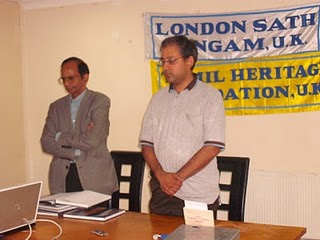
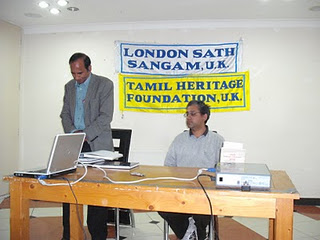
Mr Pradeep Chakravarthy of Leadership Institute at Infosys,Chennai addressed an elite audience in London on 9th August 2011 . He is seen with the president of London Sath Sangam Mr Balaji. Mr S Swaminathan, Secretary of London Sath Sangam and Tamil Heritage Foundation, UK welcomed the gathering.  Chakravarthy’s talk on the Saraswathy Mahal Library of Thanjavur was very interesting and informative.

His book “Thanjavur-A cultural History “was a well researched work. It has got a lot of very rare photos unpublished so far. All the books he brought to London were sold like hot cakes. Mr Chakravarthy is a historian and columnist.

His articles are published in reputed dailies like The Hindu ,Chennai.


How Old is Indian Civilization?


“We owe a lot to the Indians, who taught us how to count, without which no worthwhile scientific discovery could have been made” -Albert Einstein

“If there is no one place on the face of the earth where all the dreams of living men have found a home from the very earliest days when man began the dream of existence, it is India”– French scholar Romaine Rolland.

Western scholars always underestimate anything Indian (of course except a few like Einstein, Romiane Rolland, Max Muller). They would give all credits to anything Greek or Roman. After the excavations in Egypt, Sumerian and Babylonia (Iraq & ,Syria) they slowly shifted the credits to the Middle East. When Indians point out that they were all in Indian books, they say that they were all written later and we borrowed from them. We have a long list of Indian kings in the Puranas and Ithihasas (Mythologies and Epics). But they simply ignore them.  Indian scholars who always long for foreign trips and foreign awards must play second fiddle to them otherwise they will be rejected or dubbed as extremists.

We have very clear proof in Tamil and Sanskrit literature to show that we lived for thousands of years on the same soil and we never said anywhere in our literature that we came from outside. But westerners say that the Tamil/ Dravidians came from the Mediterranean and the Northern Aryans came from Central Asia. According to them Indian History begins from 2500 BC in the Indus valley and the first king they say historical belongs to sixth century BC. Bimbisaran ruled  around 600 BC. That means we did not have any king for 1900 years from the beginning of the Indus period. Though we have a long list of kings in our scriptures they did not consider them historical. Indus valley has no King!

Following proofs are enough to say that we have history supported by literature:

Kapila, the greatest of the Tamil Cankam (Sangam) poets, sings about a king called Irunkovel in Purananuru poem 201.He praises him as the 49th king in the lineage of kings who have migrated from Dwaraka after Krishna’s death. Even if we give 20 years for one generation according to western calculations, it will take us back to nearly 1000 years. Kapila lived around 100 AD. That means the first king of Irunkovel’s dynasty must have ruled around 1000 BC
  1. Tamil and Sanskrit books always use the simile of stars in the sky and sand particles on the sea shore to compare with the kings who ruled the earth. This shows their historical sense.
  2. Siru Ven Theraiyar who composed poem 363 in Pura Nanuru says that the kings who ruled this earth are more than the number of sand particles on the sea shore. He also lived around first century AD. When he sang this song he must have studied Indian History or heard from his fore fathers.
  3. Brihad Aranyaka (Big Forest ) Upanishad, which is dated by the westerners to eighth century BC ,gives a long list of teachers explaining who taught to whom ,generation after generation. They were not kings. They were all sages, around sixty names. So they wouldn’t have died young like kings in the battle fields. They would have lived for at least fifty to sixty years. Even if we allocate thirty year period for each teacher that would take us back by another 1800 years from 8th century BC. i.e 2600 BC
  4. A Greek writer who visited India around 3rd century BC says that India had over 140 kings before his time. Probably he was talking about the Magadha dynasty (Bihar area). Even if we have allocated 20 years each it would take us back to 2800 years from his time i.e. the day kali yuga started.
  5. Tamil and Sanskrit sources give the date of Kaliyuga without any doubt. Parthivasekapuram Copper plates of Ay Dynasty in Tamilnadu was dated 865 AD. The inscription says that it was written in the Kali year 3967. The beauty of the inscription is, it mentions the Kali year in days 14,49,087. This shows the mathematical genius of Tamils and their strong belief in Kali Yuga calculations.
  6. Panini was the first grammarian of the world. The greatest genius the world has ever seen. He wrote a grammar for Sanskrit which made Sanskrit the fittest language for computers. With every addition of a prefix or suffix to a word the meaning changes. He was not a Brahmin. But yet Patanjali who wrote a commentary on his grammatical treatise Ashta Adhyaye (Eight Chapters) praised him as Baghavan (God) Panini. Panini in his Sutra 2.1.19 explains a custom in India. Talking about the lineage and number he gives examples as “Eka Vimsathi Bharatwajam” meaning 21st generation of Bharatwaja, “tri panchasat Gowthamam meaning 53rd generation of Gowthama. This custom is followed in all the Mutts in India. When they say who heads Sringeri or Kanchi at the moment, they always say his lineage.
  7. Brahmin priests who perform puja on important days start it with a sankalpa (Intention to do—) where in they clearly say which part of the world they do it, when they do it and for what purpose they do it. They clearly say the year in Kali yuga under which Manvantara even today. This historical and geographical sense has no parallel in any part of the world.
  8. The entire Indian history is balancing on a single rock-the date of Buddha’s death. Western scholars calculate everything from this back and forth. If one can tilt this balance everything will change. That is to say Indian history is on shaky grounds. But even the date of Buddha  differs from country to country. In Sri Lanka 483 BC, in Burma 544 BC ,in Tibet 835 BC and in China 11th century BC is the date of death (nirvana) for Buddha. If anyone can prove one is better or truer than others, we have to rewrite the Indian history. The shame is present day Indians have no time to do all these. They are happy to earn more and enjoy life and leave all the research to jaundice eyed western scholars.

    I can give many more examples from other epigraphs (Aihole Incription) and scriptures.Scholars like Bala Gangadhara Tilak ,Jacobi have used astronomical calculations to date our scriptures.

  9. Over forty thousand year old human remains have been discovered in various parts of India. Human beings have been living here for thousands of years.

I want to remind you of two Tamil proverbs before concluding. “For a scared person anything dark is a ghost” (Arandavan Kannukku Irundathu Ellam Pey). “For a person afflicted with jaundice, everything he looks at is yellow”. (Kaamaalai kannanukku kandathu ellam manjal).


When India’s status as a super power is fully recognised, these scholars will eventually listen to us. Unless one has political or economic power nobody listens to that person.


Please Help to Find our Father’s Tamil Translation of Anna Karenina

By S Swaminathan


Anna Karenina was written by the famous Russian author Leo Tolstoy. My father Venkatraman Santanam translated it in to Tamil in the 1940s and it was published even before India became independent. It ran in to 1500 pages a monumental work for that time. I think no one else had embarked on such a Himalayan task. Unfortunately neither I in London nor my brothers in India have a good copy. The copy we have got has many pages missing. I request the Tamil enthusiasts to find us a copy of the Tamil translation.

For the sake of an easy flow, my father titled the book as ANNA KARINA in Tamil instead of the original title Anna Karenina. Please see the Tamil introduction written by my father. He was praised by leaders like K Kamaraj and writers like Manikkodi B S Ramiah (Please see Ramiah’s book Manikkodi Kalam). My father was detained in Vellore jail with K Kamaraj during the freedom struggle. After release he became a journalist and worked as the News Editor of Dinamani, Madurai for over forty years.

The book was priced Rs10 which must be an expensive book at that time. Had anyone invested that ten rupees and it doubled every five years it would have grown to Rs 81000 today. One surprising thing is that no writer of History of Tamil Language has mentioned this translation. Probably the copies were sold out as soon as they were published or few hundred copies only were printed. So I request future writers to include this book which will be a fitting tribute to his Tamil contributions. My father’s big contribution to Tamil language, I would say, is the development of Patti Mandapam (debate) and spiritual writing in Tamil.

Great speakers like Solomon Pappiah, SSM Sundaram, Mrs Saraswathy Ramanathan, Late Kundrakkudi Adigalar have got huge publicity due to these Patti Mandapams. When people ridiculed religious discourses (Upanyasam), my father published page after page in Dinamani summarising the discourses. No one of that age would have missed the speeches of  Variyar Swamikal, Keeran, Kanchi Maha swamikal, Anantharama Deekshithar to mention a few.

Please read the Tamil intro of the book and help us to find a complete copy.


Please send feedback to: swami_48@yahoo.com; through Twitter (@Swami_48) or Facebook.


The scans are below:


Free Tamil Lessons now on YouTube!

Please visit: http://www.youtube.com/user/swaminathansantanam  to view my Free Tamil Lessons on YouTube!

The accompanying print-outs are available at my blog: studytamil.wordpress.com


Vishnu Seal in Indus Valley Civilization

By S Swaminathan

The Dilmun Bahrain Seal

The Dilmun-Bahrain Seal

From the very beginning the westerners who excavated the Indus valley civilization misled the general public by attributing their personal opinions to the seals and objects. Because of their misleading interpretations, we couldn’t decipher the Indus script till today. They put forth some divisive theories such as Aryan Invasion theory. The Aryan –Dravidian theory was   rejected by Swami Vivekananda, Mahatma Gandhi and the great Harijan leader Dr B.R Ambedkar. The other prominent people who rejected the Aryan invasion theory include Kanchi Sankaracharya Swami Sri Chandrasekarendra Saraswathy and Sri Aurobindo.  When the foreigners saw the so called Pasupathy seal they jumped to conclusion that the Indus people were Shaivaites. They never got of this grew and started inventing ‘Lingam’ and ‘Yoni’ in other objects

.


The Indus seal with a figure (god) surrounded by animals was interpreted as Lord Shiva or Proto Shiva (please see the picture). It is true that Shiva was called Pasupathy meaning Lord of the animals. But we could not read the words Shiva or Pasupathy on the seal. What is written on the seals remains a mystery till today. The day the seals are deciphered to the satisfaction of world scholars, most of the Indian History books will be thrown in to Indian Ocean and a new chapter will be written in Indian history.
The godly figure surrounded by the animals can be interpreted as Vishnu or any god. We have found seals of gods surrounded with animals even in the Middle East and Denmark. It was common in many ancient cultures (Please see the pictures of Gundestrup cauldron and the Middle Eastern god).

The Gundestrup Cauldron

Indus god has crowns made by horns. In Sanskrit and Tamil, a horned person means a great person. Tamils have a saying ‘Are you a big Komban (horned person) to expect a royal treatment?’ (Tamil: Nee Enna Periya Kombano?). Sanskrit poets also have used this expression. They call horned person as a Sringan. The greatest of the Indian poets Kalidasa even plays pun on this word in his Raghuvamsa Kavya. Kings are described as Veerya Sringan. (Komban in Tamil has another meaning i.e. a single male elephant with big tusks).
Vishnu  Sahasra Namam ( 1008 names of Lord Vishnu) describes Lord Vishnu as Maha Sringan (Name 536) meaning the great horned one.  Adi Sankara commenting on this word quotes another name from Rik Veda  4.38.3 and Taitriya Aranyaka 1.10.17 which describe god as ‘Chathwari Sringa: ‘meaning a person with four horns. Name 139 ‘Chathur Dhamstraya’ means four horns or one who with four teeth. Adi Sankara mentions both in his commentary.
In another place in the Sahasranama (1008 names) Vishnu is described as god with more than one horn ( Name 763 ‘Na Eka sringaya ‘meaning not with one horn).
One who looks at the Indus god with horns after reading Kalidasa, Rik Veda and Vishnu Sahasra Nama along with the Tamil saying ‘Nee Enna Periya kombano’ can’t but think of Lord Vishnu.  The figure of an Irish God and the Middle Eastern God were also surrounded by the animals. No one had commented upon them as Shiva!
Indus Fish symbol and Vishnu
Another interesting coincidence is ‘Vishnu Sahasra nama ‘ describes Vishnu as a Red Colour Fish –‘Rohithaya’ (name 364). More over Lord Vishnu’s first incarnation was a Fish ( Matsya Avatar) and many Indus scholars agree that the Indus fish symbol denotes god.
Interestingly the peepal leaf (Arasa Maram in Tamil,Aswatha in Sanskrit, Ficus Indica in Latin) is drawn on many seals and objects in the Indus valley. This tree is worshipped by the Hindus for thousands of years. In Tamilnadu most of the Ganesh temples are under the Peepal tree (arasa maram). Vishnu Sahasranama associates Lord Vishnu with three trees and one of them is Aswatham (name 824 ‘Aswathaya Nama:).
In the Viswarupa Darshan chapter of Bagawat Gita, Lord Krishna says that he is Surabhi among the cows, Lion among the animals, Airavatam among the elephants, Uchairsravas among the horses, Garuda/eagle among the birds and shark among the fishes. Among the Avatars, fish, tortoise, pig and goose (Hamsa) figure. This proves the link between the animals and Lord Vishnu.
In conclusion we see Lord Vishnu in the Fish symbol, in the tree symbol and in the animal seal symbol of Indus valley.
How many horned Gods are in Indus?
My study shows there are at least three different horned gods in the Indus valley. Apart from the ‘pasupathi seal’ there are other seals where the gods or the godly men sit in yogic posture. Their horns are different. We have to study them closely to identify them. The writing on the seals is also different. May be they are different gods. The fish symbols in all the three seals also differ in one or two details.
Vishnu Sahasranama in Cankam Literature
Tamil Cankam (also spelled Sangam) literature mentions Hindu Gods and the Vedas in hundreds of places. The oldest Tamil book Tolkappiyam even mentions Indra and Varuna as gods of the Tamil lands. (Ref. ‘Mayon meya kadurai ulakamaum———-‘).
Vendhan (Indra) is the god of Marutham and Varunan is the god of NeithalMarutham is cultivated field and its surrounding areas and Neithal means sea and its surrounding areas.
Old Tamil scholars have already pointed out that Natrinai,one of the Tamil anthologies of Cankam period has a verbatim translation of a Vishnu Sahasranama sloka. The Sahasranama dyana sloka starting ‘’bu padau yasya nabir————‘’ compares Lord Vishnu to earth and the heavenly objects. The same lines appear in the prayer song of Natrinai starting with ‘’Maanilam sevadiyaaka——————–‘’.Both describe sun and moon as the eyes of Lord Vishnu. The Natrinai prayer song was composed by Bharatham paadiya perunthevanaar.
Pictures sourced from Wikipedia.
Please email me at: swami_48@yahoo.com with comments or feedback. Alternatively, follow me on Twitter @swami_48 and through Facebook.

Every old One Rupee Fetches Rs 2,000, Old 1,000 Rupees Gets You Rs 30,000

By S Swaminathan
Believe it or not, If you have one old one rupee (Indian )currency note in good condition you may get up to Rs2,000. If you have one old Rs1,000 currency note in good condition you may get up to Rs30,000. How?
I had been to India recently and bought the Stamp and Coin Catalogues. There is another catalogue just for Indian paper money (currency notes). When I was browsing through them, some amazing facts came out.
Mahatma Gandhi’s Rs 10 mint (not used) stamp is worth Rs 13,000. If it is in good condition even after it is used it may get you up to Rs 6,500. (The Stanley Gibbons catalogue price for mint  is £140.).I am not going to talk much about the rare stamps. The price for the rarest Indian stamp is around Rs2.5 lakhs.
Indians are becoming richer and richer now. My son earns in one year more than what my dad earned in his life time! There are two reasons. After the boom in computer industry and the exodus of Indians to foreign countries they earn a big fat salary abroad. When foreign companies started investing in India they started giving salary equal to foreign pay. When one earns abroad and converts it to Indian currency that person’s salary will be a big sum.
The moment one becomes rich and all the basic needs are fulfilled, one turns to arts. That is what we saw in the age of Guptas which is known as the Golden Age in Indian History. They minted a lot of gold coins which can be seen in big museums around the world. Literature, Arts and Sculptures reached its peak during that time. Now we see the repeat of History. When antiques of great value are auctioned in London and New York Indian s are buying those antiques. The reason is simple. They have money and the time to appreciate it. Probably they may think it is good investment as well. The increase of price of Gandhi stamps and Indian currencies may be attributed to this trend.
I used to buy Indian paper money guide book, Phila India( stamps) guide book and  Indian coinage books at periodical intervals updating the prices. You will be surprised to find that the prices are going up rapidly. Old Indian one rupee issued in 1949 and signed by KRK Menon is priced as 2,000. It is in green colour. The later ones in bluish green colour can fetch you up to Rs300. But the last paper one rupee issued in 1994 will fetch you only Rs15. So the price depends upon whose signature (Governor of Reserve Bank) it carries, how old it was and what condition it is now.Rs 2 signed by B Ramarau may get between Rs 150 and Rs 750. Old Five Rupees with B Ramarau’s signature are priced  up to Rs 1,200. Rs 100 of Ramarau’s days up to Rs8,000 and Rs1,000 currency up to Rs 30000. So if you have any old Indian currency save it for your children. Rummage through your attic and there may be a g fortune waiting for you. When in doubt contact me or go through the catalogues.
Good Luck!
Please send feedback and comments to: Swami_48@yahoo.com
I am also Facebook and Twitter (@Swami_48).

Strange Link between Lord Shiva, Socrates and Thiruvalluvar

By S Swaminathan 

Lord Shiva is one of the Hindu Trinity, a great god worshipped by millions of Hindus. Socrates was a great Greek philosopher who lived between 469 BC and 399 BC. Thiruvalluvar was a great Tamil poet and philosopher who lived approximately 1,600 years ago. The mysterious link between the three is the word POISON.
Thiruvalluvar who composed 1,330 couplets (forming the Tirukkural) speaks about ‘friends giving poison to one’. Did he know Socrates? Because Socrates was sentenced to death for his teachings and was given poison. Lord Shiva also took poison for the sake of the Devas (the demigods in Hindu tradition). Now let us look at it in detail.
Thiruvalluvar in his couplet 580 says ‘Men of refined courtesy accept even a cup of poison and look cheerfully calm’. Probably he knew what happened to Socrates. Greeks and Romans were doing a lot of trade with the Tamils two thousand years ago. There is a big gap between the age of Thiruvalluvar and Socrates and so there is every possibility Thiruvalluvar heard about him. Socrates was sentenced to death for corrupting the minds of Athenian youths and not believing in the Gods of the State. He was given a cup of hemlock poison. (Nowadays Americans also execute the prisoners on death sentence by giving poison by injection).
Or did Thiruvalluvar refer to an episode in mythology referring to Lord Shiva? Lord Shiva drank the poison that came out during the ‘Churning of the Ocean’ according to Hindu mythology. But he did not swallow the poison and kept it in his throat. Thus he became ‘blue throated’. So Shiva was known to his devotees as Neelakanta (meaning one who has a blue throat). When the Ocean of Milk was churned, 14 good/auspicious things emerged. Both the Devas and Asuras (demons) were ready to share only the good things. But everyone refused to deal with the poison which threatened the whole of the universe. Shiva came forward and took it. One story goes that his wife Parvathi stopped him swallowing it by grabbing his neck – and there it stayed.
Great Tamil poets like Subramanya Bharathi and Manikkavasagar also refer to this poison given by friends. Probably they just imitated Thiruvalluvar. (Bharathi’s lines ‘’Nachchai vaayile konarnthu nanbar uuttumpothinum…). Manikkavasagar says about this in Potri Thiru Agaval (‘Nanje amuthaay nayanthaai potri’).
Natrinai, one of the 18 books of Tamil Cankam (also spelled as Sangam) has these lines as well. Poem 355 refers to friends giving poison (‘munthai irunthu nattor koduppin nanjum unbar nani naagarikar’).
Strictly speaking poison was not ‘given’ to Lord Shiva by ‘friends’. In the case of Socrates it was such a clear betrayal.
I will leave the judgement to the readers!
Please send your feedback to: swami_48@yahoo.com, or through Facebook or Twitter (@swami_48).

Indiahhhhh—-RICHEST country – Part 6

 By S Swaminathan

Please note this is part of an ongoing series on Why India is the Richest Country in the World. See the links below for the prior parts:

Part 1

Part 6 – latest


Mysore gold

Mysore palace is a very big tourist attraction in Karnataka. Examples of its wealth include a pair of large silver doors in one of the rooms. But the best attractions are the throne and howdah of the Mysore Maharajah. The throne is made up of 200 kilos of gold. The howdah, which is mounted on the elephant, is made up of 80 kilos of gold. All these are displayed on Dasara (Vijaya Dasami) day.
Politicians hold more gold than anyone else. In 1996 Ms Jayalalitha Jayaram, current chief minister of Tamil Nadu was arrested in a corruption case followed by the seizure of a diamond studded piece of gold jewellery weighing 29 kilos.
Janardhana Reddy, former BJP minister of Karnataka, who owns several mines, donated Rs 45 crore worth golden crown to Lord Venkateswara of Tirupati. He donated another golden crown worth Rs 12 crores to Kalahasti temple. It weighs 30 kilos and the height of the crown is 2.5 feet.
Tirupati gold
Sri Venkateswara (Balaji) temple receives 500 kilos of gold and 4000 kilos of silver every year through its donation boxes (hundi). Balbir Sing Uppal, an industrialist, donated seven puja items worth Rs 1.5 crores to the lord. Strange objects including golden handcuffs, golden camera, body parts made up of gold are received now and then. Tirupati temple owns 3,500 kilos of gold and they are deposited in the banks. The temple donates gold for poor people during weddings. Apart from this, the temple has very precious diamond crowns and rare gems
India bought 200 tonnes of gold from the International Monetary Fund recently and the gold reserve of the Reserve Bank of India is approximately 555 tonnes. But the golden reserves of the temples are far higher than the banks.
Guruvayur gold
Guruvayur temple deposited 400 kilos of gold in the banks. Instead of keeping the stock idle, they now they earn interest from the banks.
Thiruvananthapuram Temple
Thiruvananthapuram Sri Anantha Pathmanabhaswamy temple was on the news all over the world after the discovery of incredible wealth in its underground chambers.  If we go by newspaper reports this must be the richest institution on earth. ‘What the Lord of Tirupati can’t achieve by standing, the Lord of Trivandrum achieved by lying’ [down] – reported a newspaper in a lighter vein. The Lord of Tirupati is in standing position and the lord of Trivandrum is in a reclining position.
The following is the list of items found in the temple according to newspapers:
1.     17 kilo gold coins
2.     One tonne gold in the form of rice trinkets (Aval)
3.     Golden necklace weighing 2.5 kilo
4.     A sack full of diamonds
5.     Golden crowns
6.     A gold statue weighing 30 kilo
7.     Golden vessels
8.     A lot of gem stones (Emeralds, Rubies, Sapphires)
9.     Lot of items with antique value
The last press reports estimated the value of treasure trove as one lakh crores (22 billion U.S. dollars).
The Supreme Court of India ordered not to open the last (sixth) chamber for security reasons and ordered those involved not to talk to the press about the findings. The court also asked the authorities to use video recordings. If we are able to see the videos one day, all the Indiana Jones films will be pygmies before that!
Every month the famous auction houses of the world auction a lot of Indian antiques worth millions of dollars. Most of them are bought and smuggled out of India. Talking about the antique value of Trivandrum treasure it will be huge. The treasure includes a lot of Roman and East India Company gold coins.
MGR’s Diamond Sword
Mookambika temple near Mangalore in Karnataka has priceless jewels. The golden mask of Sri Mookambika weighs one kilo. Sapphires, rubies and emeralds decorate the crown. The Shivalinga statue is covered with two kilos of gold. Sanskrit and Tamil literature talk about the Gajamuthu (pearl from the head of an elephant). This temple has a Gajamuthu, which is very rare. Keladi Kings have donated a big green stone of great value (the size of your palm!). Mysore king has donated Navratna garland. M G Ramachandran (MGR), the great Tamil actor and former chief minister donated a diamond studded sword weighing over a kilogram. A golden chariot weighing 80 kilos was recently made for the temple.
Tamil temples flooded with gold
Tamil Nadu temples deposit with State Bank of India alone is as follows
·        Samayapuram Mariaaman Temple – 200 kilos of gold
·        Palani Murugan Temple – 78 kilos
·        Tiruchendur Temple – 41 + 60 kilos
·        Madurai Meenakshi temple – 35 + 40 kilos of gold
Did you notice?
Indian news papers, particularly Tamil News papers, report thefts and robberies, almost every day. The big difference between the olden and modern days is the amount of gold lost. Even the wife of an ordinary worker loses 100 sovereigns in a theft. If it reflects the real condition of Tamil Nadu, just imagine how many gold sovereigns our rich people and the richer politicians would have.
Prominent jewellers and financial experts agree that the Indian general public hold the biggest reserve of gold in the world.