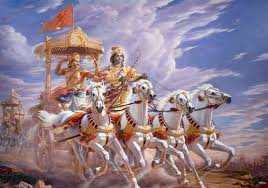
Krishna’s Restaurant in Dwaraka – Hot Satwic Food Sold!

By S.Swaminathan

Sri Krishna and Arjuna

Imagine Lord Krishna is running a restaurant called Panchajanya in the city of Dwaraka. What he would sell?

He has given the menu in the Bhagavad Gita in several places. He advocates vegetarianism. So you would only get vegetarian dishes. He would never sell you old food which was made overnight or unsold from the previous day.

Let us look at Chapter 17 of Gita for more details on the menu; if you still don’t understand his policy don’t forget to read the two interesting stories at the end!


The Menu

Only Sattwic food available:

“The foods which increase life, purity, strength, health, joy and cheerfulness (good appetite) which are savoury and oleaginous (oily), substantial and agreeable are dear to sattwic people”

Bhagavad Gita Chapter 17-8

Not available: Rajasic food:

“The foods that are bitter, sour, saline, excessively hot, dry, pungent and burning are liked by the Rajasic and are productive of pain, grief and disease”.

Chapter 17-9

Banned Food: Tamasic

“That which is stale, tasteless, putrid, rotten and impure refuse is the food

liked by the Tamasic.”

Chapter 17-10

MOTTO of our restaurant :”Eat to live; don’t live to eat!”

HOLIDAYS: Ekadasi (twice a month) and Shivratri -Complete closure; half-day closure on full moon and new moon days; days of eclipse and Navaratri.


Rules for Customers

Customers, please note the following rules are strictly followed in the restaurant:

1.Salt ban: On fasting days food will be made without salt. Food with salt is considered meat according to the scriptures.

2. “Verily yoga is not possible for him who eats too much……..” Chapter 6-16

So we will serve only set meals. Unlimited meals or Buffets are not available here

3. “The righteous, who eat of the remnants of the sacrifice, are freed from all sins; but those sinful ones who cook food (only) for their own sake, verily eat sin”- Chapter 3-13

Please note whatever we serve in this restaurant is Prasad from the nearby temple.

4. We provide you four types of food  Chapter 15-14   Gathyam-food that has to be eaten by chewing, Soshyam-Drinks that which has to be sucked, Lehyam – food that which has to be licked and last but not the least Peyam –that which has to be drunk.

This is what Lord Sri Krishna said to Arjuna in the Gita.


Salt ban in New York

In March 2011 The New York Assembly proposed to ban salt in the restaurants. Those who violate the ban would be fined one thousand dollars. This news sent shock waves across the Western restaurants around the world. New York Mayor Bloomberg is opposed to display of salt bottles on the tables of the restaurants .The research showed that salt was the cause for blood pressure, heart disease and stroke. They believe that 100,000 lives a year could be saved by cutting the salt intake. Lord Krishna said it thousands of years ( Gita 17-9) before the western scientists. Salt was banned in religious food and on fasting days. Salty dishes were considered Rajasic.

The problem with the modern diet is not one of deficiency, but one of excess. We eat too much and become obese. Obesity leads to diabetes, heart problems, hypertension and other complications. A lot of us live to eat, but it should be other way round. We must practise to eat to live. When the stomach says ‘enough’ and the tongue says ‘more’ we must follow what the stomach says. This is what Lord Krishna said about too much food (Gita 6-16).

Sri Sathya Sai Baba rightly said, “As the food, so is the head. As the head so is the mind. As is the mind, so is the conduct. As is the conduct so is God’s grace”.


Story #1

Food influences our thoughts. Good food gives us good thoughts. Sri Ramakrishna Paramahamsa said a story to illustrate this point. A saint approached him one day and told him that he gets violent thoughts for some unknown reason. Ramakrsishna asked him what he read, what he saw and who he met the previous day. None of the answers to these questions solved the puzzle. Then he asked him where and what he ate – he found out the food he ate was the cause for the violent feelings. If we eat food cooked by bad people our very thoughts will be polluted.

Story #2

Osho tells us a beautiful story about Sri Ramakrishna. He had a great passion for food. His attachment for food was so much it bewildered every one of his followers. When people asked about this he did not give a clear answer. Now and then he popped in to kitchen to see what his wife was cooking- that too half way through his satsang. Now she also became very curious and insisted for an answer. Then he told her the truth. All his Praraptha karma was already over and once he discards this passion for food (attachment with the world) he would have to leave the mortal frame.

He did not stop there. He told her that he would stop eating three days before his death. He would refuse the food even if it was forced upon him. In course of time even his wife forgot what Sri Ramakrishna told her. That big day came. He refused to take food for three days. He turned his face away from the food for those three days. His wife suddenly remembered what he told her about food. Now she realised a great soul never lived for eating. They ate only for the survival- survive to redeem the world. That is what Sri Ramkrishna did. He created a Vivekananda out of an atheist Narendra to enlighten the Western world with reverberating English speeches about the glories of Hinduism.

Let us eat to live and not live to eat.

The Sugarcane Mystery: Indus valley and the Ikshvaku Dynasty

Ikshvaku was the founder of the Solar Dynasty. Lord Sri Rama, Bhageeratha and other great kings of the solar dynasty are well known to the Hindus. What is interesting is that we get more and more evidence to link him with the Indus Valley Civilisation, first Jain Thirthankara, Rishabadeva, the Rik Veda and a Tamil king called Adhiyamaan.

Ikshvaku was mentioned in Rik Veda. The meaning of his name is SUGARCANE. The plant sugarcane (Saccharum officinarum) is mentioned in the Atharva Veda. Ayurvedic authors Charaka and Susruta mentioned the sugarcane in many places. The word ‘sugar’ and the words for sugar in other European languages came from the Sanskrit word ‘Sharkara’. Columbus introduced the sugarcane to the Americas in 1439. Arabs took it from India to other parts of Asia around 8th century AD.

Encyclopaedias say that the people of New Guinea were the first to cultivate sugarcane around 6000 BC. But they did not extract sugar from it. They just chewed it to get the juice out of it. But King Ikshvaku was the first one to show the people of extracting sugar from the sugarcane. That is how he got this name Mr Sugarcane.

Who was Ikshvaku?

Ikshvaku was the son of Vaivasvata Manu who is equated with the King Satyavrata of Dravidian country in whose time the first avatar of Lord Vishnu- Matsyavatara (Fish incarnation) – took place. So all the facts lead us to the remotest period. Ikshvaku was more famous for his just rule rather than sugarcane juice.

Jains have another interesting story about the sugarcane. Their first Thirthankara Rishabadeva (Adi Nath) was the one who taught the people of extraction of sugarcane juice. So he was known as Ikshvaku. Another version is that he took sugarcane juice after a year of fasting. Both the Hindu and Jain Ikshvakus are probably one and the same.

Indus Valley civilisation has evidence to show that they knew sugarcane and sugar extraction. Crystallised sugar was used by the Indus Valley people. Hindu Gods and Goddesses such as Lalitha (Ref. Lalitha Sahasranamam), Kamakshi, Tripura Sundari and the Hindu Cupid Manmatha are depicted holding a sugarcane in one hand. The Sanskrit word Sharkara and these Hindu goddesses prove that sugarcane was very much Hindu and Indian.

Tamil King Adhiyamaan Nedumaan Anji

Another interesting fact about sugarcane is in Tamil literature. The word for sugarcane in Tamil is ‘Karumbu’.The grand old lady of Tamil literature Avvaiyar praised chieftain Adhiyamaan  Nedumaan Anji of Thagadur (modern Dharmapuri in Tamil Nadu)  for his philanthropy in Puranaanuru verse 99. Avvaiyar lived two thousand years ago. While praising him she made a passing remark. She said that the forefathers of Adhiyamaan were the one who introduced sugarcane to the people. If we get all these facts together we get a good picture of sugarcane cultivation in India. Ikshvaku or Rishabadeva was the one who taught people how to get the juice and make sugar. But if Indus valley had it by 3000 BC then we had to push the date of Ikshvaku dynasty or Rishabadeva to 3000 BC as well. Tamils also say indirectly that Adhiyamaan was related to him. The South Indian Tamils corroborate what their North Indian counterparts said about the sugarcane. The idea that it was ‘introduced’ by some king is undeniable. The sugarcane mystery pushes back the date of Ikshvaku dynasty and the Jain Thirthankara to the remotest periods of Indian history.

Other Sanskrit words for sugarcane are Mahashira, Mahapushpaka and for jaggery ‘Gur’ or ‘Gud’ (Tamil word Vellam).

Send comments and feedback to swami_48@yahoo.com.


Why Do Hindus Practise Homeopathy?

By S Swaminathan

Health is Wealth

Health is wealth is a popular saying in many Indian languages. The message is same, but they convey it in different ways. The Tamils developed a medical system called Siddha therapy 2000 years ago. Siddha is a person who has attained some extraordinary powers – both mental and physical. Siddha system is similar to Ayurveda – another old medical system of India. Like Ayurveda, Siddha also treats the imbalances of the three body humours called vatha/wind, pitha/bile and kapha/phlem. Siddha men used herbs and minerals to treat the sick patients.

Both Ayuerveda and Siddha believed in the principles of ‘a sound mind in a sound body’ and ‘prevention is better than cure’. The Hindu Upanishads say ‘the soul can’t be reached by a weak person’ (na ayamathma balaheenena labya – Mundakopanishad).

These indigenous systems create an awareness of diseases and emphasize the importance of healthy life. Unlike western medicines they guide you through your everyday life- literally from morning till night. They tell you what to eat and what not during a particular day or a particular time of the day. They tell you with what you should brush your teeth and which direction you should lay your head in the bed. The proverbs, similes, sayings and actual medical writings in Sanskrit and Tamil supply enough evidence for it.

Who gave the world Homeopathy?

We are told that Homeopathy was developed by the German physician Samuel Hahnemann (1755-1843).But Indians know the principle long ago and are practising it in their day to day life.

The basic principles of Homeopathy are:

(1) ‘Like cures Likes’;

(2) ‘Symptoms of diseases are body’s self healing processes’ and

(3) ‘If one is administered with very dilute dose of what causes the disease, one will be cured of the disease’

When Hindus go to a holy place, they won’t drink or bathe in the water at once. Even when they go to temple tanks or holy rivers they will take three sips of water and sprinkle it on their head. Then they will use it for washing their feet and hands ,bathing etc. This small dose of three sips of water (Brahmins call it Achamana) will help them to avoid all the diseases from that particular water source. In those days, water was the main source of diseases. The mineral contents, temperature, taste and quality of water were different from place to place. There was no chlorination or protected water supply for the public. Even today one can practise this ‘achamanam’ and avoid getting diseases from water. The diluted water-in small quantity- gives immunity to us from the germs and other impurities. So Hindus know the principle of Homeopathy ‘Like cures Likes’. No need to say that we should remeber other basic rules about hygiene.

The rule for doing ‘achamana’ (sipping of water) is that the amount of water you take should submerge only one black gram seed (Urad Dhal in Hindi and Masha in Sanskrit). So when you do it three times you would have taken water that submerges only three seeds-so little. When Hindus did it they recite Lord Vishnu’s names: 1.Achyutaya Namaha 2.Ananthaya Namaha 3.Govindaya Namaha

Tamil book Tirukkural 1102 and Natrinai 140 also talk about this principle but in the context of a love sick woman’s look. “For the disease caused by this beautiful maid, she herself is the cure”-says Tirukkural. Like cures Likes!

What is the secret of black hair? 

Stress triggers or complicates most of the diseases is a modern discovery. But a Tamil Cankam poet called Pisiranthaiyar who lived 2000 years ago gives the secret of his black hair at a ripe old age in a beautiful Tamil poem.

When Pisiranthaiyar went to see the great Chola king Kopperun cholan (who was starving himself to death following an ancient Tamil rite) all were amazed to see an old poet without any grey hair. When they asked about the secret of his black hair, he sang;

“How can it be you don’t have any grey hair, through you have lived for many years?

You have asked the question and I will give you an answer!

My children have gone far in learning. My wife is rich in her virtue!

My servants do what I wish and my king, who shuns corruption, protects us!

And in my city there are many noble men who through deep knowledge, have acquired calm, have become self controlled, and the choices they make in their lives are built on the quality of restraint.”

-(Purananuru 191 by Pisiranthaiyar)

To put it in a nutshell:

My son is well educated

My wife is very cooperative

My servants are obedient

My king is a good ruler

My town is full of scholars

If one has all these, one need not worry. If you lead a care free life, you won’t get stressed. You will be ever young like Markandeya. Modern science says that stress triggers blood pressure, heart diseases, cancer and diabetes .

You are what you eat is in all our scriptures. Lord Krishna speaks in detail about the three kinds of food (Bhagavad Gita –chapter 17) and what qualities one gets from those. There is a beautiful saying as well:

“One fourth of what you eat keeps you alive and three fourths of what you eat keeps your doctor alive”

(From an Egyptian Inscription)

1,2,3,4 Out! 

Similar to this, there is a very good poem in he Tamil book ‘Neethi Neri Vilakkam’:

If one eats once a day he is a YOGI.

If anyone eats twice a day, that person is a BOGI (enjoyer of life)

If one eats three times a day, that person is a ROGI (sick person)

If one eats four times a day, that person is a Pogi (Tamil word for gone for ever/dead)

We know very well that indigestion is the root cause of all problems. Too much food leads to indigestion or obesity. This leads to other complications.

Tirukkural written by Tiruvalluvar has a full chapter (Chapter 95-Medicine) on the basic principles of Tamil medical science.

Send comments and feedback to: swami_48@yahoo.com

Please visit my blogs: tamilandvedas.wordpress.com and swamiindology.blogspot.com


How Did a Pandya King Get a Golden Hand?

By S Swaminathan

It is a well known fact that the Ancient Indians made tremendous advancements in the field of medical sciences. The Ayurveda and Siddha medical systems were widely practised for the benefit of the general public. Charaka and Susrutha wrote great treatises. A lot of surgical instruments, surgeries like rhinoplasty (plastic surgery for nose), hundreds of medicinal plants and thousands of medicines were listed by them. They were not only appreciated in India but reached western world through Arabic translations nearly one thousand years ago. The old medical books in Sanskrit and Tamil run in to several thousand pages.

Though Charaka, Susrutha,Vagbhata and Agastya are known to many even in the western world, one important surgery went unnoticed by many scholars. There is a very interesting story about a Pandya king in ancient Tamil literature. The king lived two thousand years ago is known from the Tamil epic Silappathikaram (Ref.Mathurai Kandam-Katturai Kaathai) dated around second century AD. A Pandya king was fitted with an artificial hand made of gold; he was known only as the Golden Handed Pandya. Nobody knows his real name even today. One more old Tamil book refer to this story (Ref. Pazamozi Naanuru).

The Story:

The story according to the epic runs like this: a Pandya king was going through the streets of Madurai (the second largest city of Tamil Nadu in South India) in disguise during the night. In the olden days kings used to visit their subjects and observe the general public in disguise to feel the pulse of the populace. Though the ancient Arthashastra of Kautilya speaks of kings employing spies for this purpose, the monarchy always wanted to know what the people feel about them or the country directly.(Every Hindu knew what Rama did to Sita just because a washer man raised some doubts about the purest woman Sitadevi). So much importance was given to the opinion of general public – absolute democracy!

When the Pandya king was passing by a house the lights were on at the dead of night and he heard a conversation. A brahimn by name Keeranthai was consoling his crying wife with these words, ”Darling, don’t worry too much about your safety and security. I am only going to be away for a very short period. Our great king is there to protect all the citizens. Nothing will go wrong in this just place”. As soon as the king heard this conversation he felt some big responsibility fell on his shoulders. So he increased his ward rounds and kept an eye on that house. Months passed. To his surprise he saw light again in the same house at the dead of night. He heard someone talking. In a hurry he mistook that person for a stranger and knocked at the door to scare away the stranger. Alas, it was not a stranger. It was her own husband Keeranthai himself who had just returned from his tour. When Keeranthai shouted back, the king realised his mistake.

One stupid mistake will make you to do more stupid things to hide the first one. It is human nature. So the king knocked at all the houses in the brahmin street and ran away to his palace. Next day a battalion of brahmins went to the palace and complained about what happened the previous night. The king, after patiently listening to their complaints, said to them that the ‘thief’ was already caught. All his ministers were surprised to hear his statement. The king did not stop there. He asked the opinion of the complainants what should be the punishment for that ‘thief’. Everyone shouted in chorus to follow the Hammurabi law: a hand for hand, an eye for an eye. The hand that knocked on the doors must be cut off. Before a second lapsed the king drew his sword and cut off the hand with which he had knocked on the doors the previous night. When he narrated the incident, the whole world praised his justice. The royal physicians rushed for his help and attached a gold hand to his arm. He came to be known as a Gold Hand Pandya in Tamil “Por Kai Pandyan”.

This is a story to elucidate the justice that was followed in ancient Tamil Nadu. No medical information was given about fixing the artificial limb but it didn’t surprised any Indian (please read my article Why do British Judges follow a TamilKing?) because they practised either the Ayurveda or the Siddha medical system.

Send comments and feedback to: swami_48@yahoo.com.

Please visit my blogs:
swamiindology.blogspot.com and tamilandvedas.wordpress.com

Follow me on Twitter: @swami_48 and find me on Facebook.

Lord Shri Rama – The World’s Best PR Man!

By S Swaminathan

Lord Shri Rama

Valmiki praised the way Sri Rama spoke to people. The way Valmiki described him showed Sri Rama was the best PR Man. The best company would have hired him as a Public Relations Officer with the highest pay. Why? He was Srutha Bhashi, Hitha Bhashi, Mitha Bhashi and Purva Bhashi according the Adi Kavi Valmiki.

  • Srutha Bhashi: Rama always spoke truth
  • Hitha Bhashi: He spoke whatever was pleasant to hear.
  • Mitha Bhashi: He spoke very little.
  • Purva Bhashi: He did not wait for others to open a dialogue. He opened the conversation.

Let us analyse it for a minute. Many a times we speak the truth and get caught in a trap. Why? Though we spoke truth, it was bitter. One example is a wife’s cooking. Under the pressures of work and modern living a man may shout at her saying that she put too much salt in the dishes. It may be true – but the way we spoke was wrong.

If we were Rama we would have passed the message in the gentlest way with the kindest words.  Rama would probably have said “Darling, your cooking is usually wonderful. What happened to you today? Aren’t you feeling well? The food you prepared was a bit salty today which is unusual.” Speaking truth is good but it should not harm or upset any one. That is why Valmiki called him a Srutha Bhashi and Hitha Bhashi.

When people attend weddings or birthday parties they often wait for others to come and talk to them. Their arrogance and ego stop them going up to others, who they consider their rivals, to enquire about their welfare. They pretend to look at other people and wait for their ‘rivals’ to approach them. When they go home they boast to their friends that they snubbed those arrogant rivals. The other people would probably have told their friends the same thing. But look at Rama. He was the son of a great emperor and crown prince of a kingdom. He went up to people and voluntarily spoke to them and enquired about their welfare. He was called a Purva Bhashi.

Mitha Bhashi: Many people suffer from verbal diarrhoea. They can never stop blabbering. We meet them with their mobile phones on 24/7 – on the bus, in the office and of course, at our political meetings! Rama spoke only very little, but made everyone happy. When he met a hunter Guhan he declared him as the fifth brother. When Ravana lost all his weapons in the final phase of the war he told him: “Go home today. Come back tomorrow” and gave him a last chance for survival. These words were meaningful and powerful.  (Guhan and Ravana references are from a version of the Ramayana written by Kamban in Tamil).

If you were running a business today, wouldn’t you hire Rama as your PRO with the highest pay?

Please visit my blogs: swamiindology.blogspot.com and tamilandvedas.wordpress.com


Send comments and feedback to: swami_48@yahoo.com

“Three Apples that Changed the World”

3 Apples are said to have changed the world - can you guess which?


By S .Swaminathan

Steve Jobs’ death deeply affected many people and triggered a media frenzy. One of the most interesting comments made was: “Three Apples That Changed the World”. But not many people knew that there is an interesting story behind each of the three apples:

  • Eve’s apple
  • Newton’s apple
  • Steve Jobs’ Apple

No doubt they changed the world to a great extent.

Biblical Adam and Eve ate the forbidden fruit and committed the original sin. They fell from the grace of God and all the sufferings started from that day onwards. Not only Christians but also Jews and Muslims believe in the story.

Adam and Eve’s apple story is actually a Hindu Upanishad story. Wise people of the ancient world made up a lot of mythology to help the layman understand high philosophy. If philosophy was given directly it would have been rejected by many as a bitter medicine. So they gave it as a sweet coated capsule – called mythology. Unfortunately in the course of thousands of years, people forgot the principles behind the stories and stuck to the literal meaning. For a student of science or astronomy all these mythologies would appear as superstition or absolute stupidity.

There are lot of striking similarities between Hindu and Christian scriptures. They cannot be discounted as coincidences because the sheer number. There are good proofs to show that they are borrowed from common sources.

The Bible begins with a story from the Upanishads. It is the story of two birds eating the fruits, but instead of two birds, the Bible has Adam and Eve.

The very name reveals the Hindu origin of the story.  In the Upanishads the two birds are the symbolic representation of Atma (atam) and the Jeevatma (Jeev – Eve). Any student of linguistics can easily recognise the transformation of Atma into Adam And Jeeva into Eve. This parallel has been pointed out by Sri Chandrasekarendra Saraswathy, Sankaracharya of Kanchi Kamakoti Peetam in his lectures in Chennai in the 1930s. The story of the two birds is in the oldest religious record of human beings – the Rig Veda (RV 1-164-20) – and it is repeated in the Mundaka Upanishad and Svetasvatara Upanishad.


Mundaka Upanishad:

“Two birds, beautiful of wings, close companions, cling to one common tree: of the two, one eats the sweet fruit of the tree; the other eats not but watches his fellow” – Mundaka Upanishad.


The bird that eats the fruits is Jeevatma (ourselves-human beings). The bird that enjoys without eating the fruit is the Paramatma (the Supreme being).

The Bible says that Eve (Jeev-atma) ate the apple in the Garden of Eden and this was the cause for the fall of humanity. This is nothing but the above Upanishad story with some changes. The Upanishads say that it was a fig tree.

The Bible says Eve was created from Adam’s rib. This is once again the Hindu story of Uma/Parvathy forming the left part of Shiva. Nowadays we call our wives and husbands our ‘other half’. It is very interesting to note that this expression has come from the Vedas. Kalidas and other Sanskrit poets also use this expression freely. In all Shiva temples of Tamilnadu one can see Ardhanareeswara (half female and half male –Parvathi Parameswara) proving men and women are equal.

Another interesting fact is Bible never mentioned the word apple. Genesis of Bible says that Eve ate the fruit of the tree of knowledge of good and evil. The word for evil in Latin is ‘malum’. The same word is used for apple in Latin.

When we call a married woman by name we put the woman’s name first followed by her husband’s name Eg. Michelle Obama, Samantha Cameron. This was also started by Indians. We worship our gods in similar pairings – SITAram, RADHAkrishna and so on. When the greatest Sanskrit poet wrote his epic Raghuvamsa two thousand years ago he prayed to Parvathy-Parameswara in the very first couplet. Ladies first, again. There are too many similarities to mention in this short article.


Sir Isaac Newton(1642-1727)

Newton is considered the most influential scientist who ever lived. He described universal gravitation and the three laws of motion. We are only able to send vehicles into space because of his discoveries. It is said that he discovered the law of gravitation when an apple fell onto his head. Though the apple analogy is partly correct, the fact was it did not ‘fall on his head’. But cartoons drawn after some time showed apple hitting his head. Buddha attained wisdom simply by sitting under the pipal tree. However, nothing hit his head to allow wisdom to dawn upon him. In both the cases, it was actually meditation on a particular subject that helped them to acquire such wisdom.


Steve Jobs (February 24, 1955 –October5, 2011)

Steve was co-founder, chairman and chief executive of Apple Incorporated until his death. Apple’s iPod, iTunes, iPhone and iPad changed the entire world. Now no-one can think a world without these gadgets. We will feel handicapped without these equipments. Steve was the force behind these technological innovations. 

But what was the cause of his charming and composed personality?  If the idea that Apple changed the world is not an exaggeration, then we can boldly say that India changed Steve Jobs! Steve Jobs was greatly influenced by the Beatles. Like the Beatles, he also took a spiritual retreat in India. He became a Buddhist and his wedding was done according to Buddhist custom. Like monks he used to walk bare footed in his neighbourhood and in the office. His sober views of life reflected his beliefs in rebirth and karma. He took his terminal pancreatic cancer like a Hindu saint.  

The Mysterious disappearance of Great Hindu Saints

By S Swaminathan


The deaths of great people have always been a mystery. People have immense interest in it and so the mass media never stops exploiting it. Even today the TV channels in western countries broadcast newer and newer stories about the death of John F Kennedy, President of America, who was assassinated on 22nd November 1963 – 50 years ago!

Even Lord Krishna’s death at the hands of a hunter, Lord Rama’s death in the river Sarayu, Buddha’s death after eating a special food given by a devoted host ,and Jesus’ death on the Cross raise the eyebrows of believers and non-believers alike.  Even the death of the great exponent of Advaita philosophy Sri Adi Shankara is shrouded in mystery. His followers believe that he disappeared after climbing ‘Sarvagna Peetam’ or the mountains in Kedarnath. All these come very handy for the propaganda mill of non-believers and atheists.

Tamils also have such stories about the great saints who revived Saiva and Vaishnava faiths in Tamil Nadu after a brief spell of Jainism and Buddhism. There were four great saints Thiru Gnana Sambandhar, Appar alias Thirunavukarasar , Sudarar and Manikka Vasakar. Of the four great saints Sambandhar and Manikkavasakar became one with God by entering the fire (jyoti).  Andal, the only woman in the great 12 Vaishnava saints known as the Alwars also did ‘merge’ with the god. Worshippers of Shiva and Vishnu (Saiva and Vaishnava followers) strongly believe that the saints became one with the god –the ever shining LIGHT and they celebrate such days as Guru Puja every year.  Tiruppanalvar and Nandanar were others who also merged with God in the form of light/fire. Atheists in Tamil Nadu interpret it as fire accidents or arson attacks.


Vallalar became Light

If we go into the details of these anecdotes we come to know it happened not only to the saints but also to their followers. In the case of Sambandhar, he took with him a great number of people with him in to fire on the day of his wedding. Lord Rama also took a lot of people when he entered the river Sarayu. In the case of Manikka Vasakar, his devotees went first and merged with the light. Later he also joined them. The great four Saiva saints and 12 great Vaishnava saints of Tamil Nadu lived between 6th and 9th centuries AD.

Very recently another popular saint Vallalar alias Ramalinga Swamikal also became ‘light’ and disappeared. He entered his room on 30th January 1874 and asked his disciples not to open the doors. After rumours spread the Government forced the doors open in May that year and the room was empty without any trace of the saint. The Madras District Gazeteer published his disappearance. His devotees saw him in the form of Light.


Tamil woman burnt Madurai City

The greatest of the five Tamil epics is Cilappatikaram. This is purely a Tamil story- no import from Northern Indian or Sanskrit literature. Kovalan the son of a big merchant married Kannaki but fell in love with a dancer Madhavi. His chaste wife Kannaki waited for his return which he did after realising his mistake. This happened 1,800 years ago .When they decided to make a new beginning they moved to the Pandyan Kingdom from the Choza kingdom. The Pandya King of Madurai was misled by an evil goldsmith who accused Kovalan of stealing the queen’s anklet. The king executed Kovalan without proper enquiry. His chaste wife Kannaki who was compared to ancient Arundhati (Wife of Sage Vashista) by the author of Cilappatikaram, stormed into the palace and proved that the king was wrong. Both the King and the Queen died of heart attack the very same minute out of shock.

Enraged, Kannaki wanted to revenge for the great injustice done to her husband. She ripped off one of her breasts and threw it on the city of Madurai. The city burst in to flames. But she requested the god of fire ‘Agni Deva ‘not to harm the good people. The story was written in a moving style which will melt even the stoniest of hearts. Tamils believed that chaste women can burn bad people or bring showers to the parched lands (Ref. Couplet 55 in Tirukkural).


Spontaneous  Human Combustion

What is the truth behind all these mysterious deaths or disappearances? Millions of followers believe that it did really happen and they pay their respects on the day of their disappearance even today. We can find some explanations for such phenomena. One falls under the category of paranormal and it is called Spontaneous Human Combustion (SHC). Encyclopaedias explain this as a ‘fire caused death but without an external agent’. The fire was created from within the body. In many of the documented cases even the dress, the surrounding furniture of the victim had no trace of fire. Though there was no scientific proof for such Body Fire, the scientists who studied such cases were mystified.

There is scientific proof of people who can create electricity within their own bodies. They can light the bulbs or short circuit electrical systems wherever they go. Science has proof for people with magnetic powers and whatever objects made up of iron they touch, stick to them. But so far, there is no proof that for spontaneous combustion is the cause of such occurrences – it is such a rare phenomena.


Deepak Raga kindled Fire

We have one more popular anecdote where music created fire and burnt a person to death. Gopal Naik was a famous musician in the days the Moghul King Akbar. The king heard the mysterious powers of Ragas and he asked Gopal Naik to sing Raga Deepak which kindles fire. In spite of his insistence that he would be burnt to ashes if he sang the raga, Akbar suggested some preventive measures. He asked him to sing Deepak raga standing neck deep water in the river Jamuna. He obeyed king’s orders and was burnt to ashes as he sang the raaga in full spirit!

The second reason that we can think of is the effect of sound. For a Hindu who believes that the primordial sound, OM, is the basis of entire universe, nothing is implausible. Scientists knew the effect of wrong sound/noise that it can harm the buildings, break a glass and drive a man to madness. But it would take some more time for them to discover that sound can kindle fire – after all, sound acts on the same particles and matter as electromagnetic waves do. Light, microwave, x rays, infra red and ultra violet rays are all part of the same spectrum.

Email comments and feedback to swami_48@yahoo.com.


Mysterious Messengers for Ajanta, Angkor Wat and Sringeri

By S Swaminathan


Angkor Wat in Cambodia and Ajanta in India are world famous tourist spots. They are listed as wonders of the world. But these places and many other tourist attractions came to light through some mysterious messengers. Who are these messengers? Are they the incarnations of some great people who lived there in their previous births? No one will ever be able to tell us. But people do believe in such miracles.


Angkor Wat

When Cambodia was under French rule Henri Muhot went to collect butterflies in 1860.  He was very much involved in the study of butterflies. One day while he was collecting the butterflies, he saw one rare butterfly and running behind it. That took him far away into the thick jungle. There he was trapped amidst some ruins. He was surprised to see vast ruins in a thick forest. Now his interest moved slowly from the butterflies to the archaeological ruins. The ruins were nothing but the world’s largest Hindu temple Angkor Wat! A temple complex that was spread over 38 square miles. When the world attention turned on the temple there were huge trees growing on top of several structures. It was too late to remove them. Then the civil war broke out. Now thanks to UNESCO and other organisations the temple is saved. But who was the mysterious messenger that came in the guise of a butterfly?


Ajanta Caves

Ajanta Caves are famous for its ancient paintings and Buddhist sculptures. They are in 29 rock cut caves in the Indian state of Maharashtra and they are dated from 2nd century BC. John Smith was an officer of the then British Government. He was interested in hunting. When he was hunting tigers deep inside the forest in 1819, a goatherd led him in to a cave and showed something and went away. The cave was full of birds and bats. When he cleared them one more wonder of the world was revealed. If the goatherd did not appear on that day, who knows, we would have discovered Ajanta when it was too late. Who was that non English speaking, mysterious goat herd? Why should he lead an English officer into the cave? Was he the reincarnation of a Buddhist monk?


Egyptian Pyramids

There is no need to explain the most popular world wonder Egyptian Pyramids. We came to know the 5000 year history of Egypt from the majestic and beautiful pyramids. The hieroglyphs, the mummies, the sculptures and huge stone structures evoke eternal interest in history even in those who hated history as a lesson in schools. But this came to the knowledge of the world because of a mysterious messenger- a fox. An Arab was watching a fox running into a hole under a pyramid in Saqqara. He followed the fox and entered the underground structure. That led him through a tunnel where he saw the beautiful hieroglyphs amidst gold and sapphire studded jewellery. Then the excavations started which did not stop till today. We have been getting interesting information from the 138 pyramids . Who was that mysterious messenger-fox? Was it the reincarnation of an Egyptian king?


Dead Sea Scrolls From Amman Museum,Jordan

Dead Sea Scrolls were discovered in 11 caves in the West Bank, Israel in 1947. They were the collection of Hebrew Bible dating from 150BC. They attained huge importance and created controversy because they shed new light on the Bible and Judaism. They were written on 972 parchments in three different languages. The way they were discovered again is shrouded in mystery. A goatherd was looking for a missing goat. He went into a cave in search of the goat and stumbled upon the valuable manuscripts. Who was the mysterious goatherd? Was he a scholar of the Biblical Days in the guise of a goatherd?


Mexico

Mexico is one of the oldest and largest cities in the world. But it was rediscovered by a curious incident. In the year 1325, an eagle was sitting on a cacti plant with a snake in its beak. When the snake was devoured by the eagle, locals recognised some divinity in the place and built a temple . It slowly grew up in to a city in the name of Tenochtitlan which became part of Today’s Mexico. Who was that mysterious Eagle which inspired the locals to rediscover their city. The eagle and the snake figure in the flag of Mexico.


Madurai

Madurai in South India is the second largest city in Tamilnadu.Ancient Madurai was devoured by the sea during a tsunami attack. Following utter devastation nobody knew the old boundaries. When the Pandya king was worried he went and prayed in the temple of Lord Shiva. A sage appeared before him and set the snake in his hand on a new mission of drawing the old boundaries. The snake made a big circle till its head and mouth joined together (ouroboros in Greek means head eating the tail) giving Madurai a new name Uragapuram in Sanskrit and Aalavaay in Tamil. Sanskrit playwright Kalidasa mentioned Uragapuram in his Kavya Raghuvamsa. Probably Uragapuram was corrupted in Greek as Ouroboros. But here the snake is not a mysterious messenger because Madurai Mythology (Thiru vilaiyadal Puranam) clearly said that it was sent by the god through its messenger, the sage.


Sringeri

A shrine on the bank of River Tunga,Sringeri (Photo from Sringeri Mutt)

Adi Sankara, the most popular exponent of Advaita (non Dualism) philosophy of India was looking for a suitable place to establish a centre. There were too many holy places in India and he was struggling to select one from them. A rare and unusual sight helped him to decide it once and for all. When he came to Sringeri on the banks of Tungabhadra river (in Karnataka, South India) he saw a cobra snake using it’s hood as an umbrella for a pregnant frog in labour. The cobra was shielding the frog from the scorching sun. Adi Sankara realised this was the most suitable place for establishing a centre because even natural enemies will come under the umbrella of love in this serene place. Thus he started establishing four centres in four corners of India. Who was the mysterious messenger in the form of a cobra?


Panchalankurichi

Panchalankurichi near Tirunelveli was the headquarters of the chieftain Veerapandia Kattabomman. He fought against the British rule. The reason he built the fort was a hare. His hunting dogs were chasing a hare which suddenly stopped and heroically stood against the dogs. Seeing the sanctity of the place he built his head quarters in that place. India is full of such stories. The general public believed that god sent the messenger to reveal something-like the Holy Fire of Moses.


Please send comments and feedback to: swami_48@yahoo.com. Follow me on Twitter: @Swami_48 and find me on Facebook.


Why Do British Judges Follow a Tamil King?

By S Swaminathan


Strange as it may look, British judges, magistrates and barristers follow a custom that was started by a Tamil king two thousand years ago. British judges and several others who preside over the courts of justice wear a white wig.

If we go to encyclopaedias they don’t explain why they wear it or when it was exactly started. Ancient Egyptians wore wigs for protecting their heads from the scorching sun. Then Romans and others wore different types of wigs as symbols of aristocracy.

The British judiciary started wearing wigs from 17th century. Many of the commonwealth countries also followed it. Whenever the reason for the custom is asked many people say that it is the tradition or uniform for professional discipline or it shows experience. Actually it was started by the most famous Tamil king, Karikal Chola two thousand years ago. Crystal clear proof comes from the ancient Tamil Cankam (Sangam) literature.

Karikalan was the greatest of the Tamil kings for three reasons. He ruled vast areas of Tamil-speaking land, subjugating other Tamil kingdoms. He was the first Tamil king who went up to the Himalayas and carved his dynastic emblem there. Till today, there remains a Chola pass in the Himalayas. The second reason was he was a just king and his court of justice in Uraiyur became very famous. Tamil literature praises his justice and gives the story of wigs. And the third reason is the Grand Anaicut he built across the river Cauvery is one of the oldest dam s in the world. 

Though we did not have any historical records scholars have dated him around 1st century BC. He was a boy king – like the Egyptian Tutankhamen. He came to power while he was a teenager.


The Story of Wigs:

One day two elderly people came to his court seeking justice. They had a dispute among themselves. They decided that whatever the Uraiyur court says must be the final settlement. When they came in to court they were shocked to see a boy sitting as the judge. They were greatly disappointed – which Karikalan felt immediately by looking at their faces. Indeed the face is the index of the mind.

Karikalan politely asked the elders to take seats and told them to wait for the ‘judge’ and he went in. The entire assembly was puzzled. Then came an elderly person and sat on the chair. After carefully listening to the arguments of both the sides he gave his judgement. Both of them were immensely happy to hear a fair settlement. Now the assembly wanted to know who the elderly judge was. King Karikalan removed his white hair wig (Narai Mudi in Tamil) and revealed himself.  All applauded the Wisdom of the ‘Solomon of India’.

The proof for the anecdote is in three Tamil books:

  1. Porunar Atruppadai –lines 187-188. Porunar Atruppadai is one of the ten long poems of Tamil Cankam literature dated  between 1st to 3rd century AD
  2. Manimekalai- This is one of the five Tamil epics dated 3rd century AD  
  3. Pazamozi – poem 25 translation:


“The grey haired old men said the young man could not come to a decision about their case. They were delighted to find the Choza wore a grey wig, and understood the case from listening to their statements”.

This proves that even before they learn the arts suited to their caste, men are “ripe for their duties” This book is dated around 5th century AD.

Nobody can deny the fact that Karikalan was the first one to use white wig in judiciary matters.

There are lot of interesting stories about Karikalan in Tamil literature. He had to fight his own relatives to get the throne after the death of his father Ilam Chet Senni. He escaped an arson attack and his feet were charred and thus he got the name “Kari Kalan” (man with charred legs). The ancient custom in India is to select a king by the Royal elephant if nobody knew who the real heir apparent was. Karikalan was garlanded by the royal elephant when he was standing in the crowd. The episodes about his daughter Adi Mandi also formed the basis of several interesting stories.

How did Shakespeare know about the Indian Cobra Jewel-Nagaratnam?

“Sweet are the uses of adversity, Which like the toad, ugly and venomous,

Wears yet a precious jewel in his head”

Shakespeare’s ‘As You Like It’ Act 2:1.13-14

There are a lot of references about Nagaratnam or Nagamani (Cobra Jewel) in Tamil and Sanskrit literature. But the strange thing about it is that even the most famous English playwright Shakespeare mentions in his play ‘As You Like It’. Instead of snake he says toad. Indeed any story will change when it travels 6,000 miles!

 The story about the cobra jewel is that the cobras keep it inside their bodies and use it during night time to search for preys. Ancients believed that the Nagaratnam emits enough light to identify the prey.

The concept of the Nagaratnam has not been scientifically proven. But there are lot of stories about people being defrauded by the name of Nagaratnam. Gullible people pay millions of rupees for fake Nagamanis.

My research shows that they did not mean Nagaratnam/Cobra Jewel , but only the power of snakes to see in the dark. Ancient Tamils were good observers. They named snakes with different words and one of them is Katchevi. The meaning is Kan+Sevi=Eye+Ear. That means the snakes have a single body part which functions like both its eyes and ears.

People who have watched Nature programmes on TV channels could see the way snakes see their prey in the night. The body heat of the animals are perceived by snakes using infra red rays. A snake’s prey will appear highlighted red in its vision. This extrasensory ability is probably what is popularly known as the Nagaratnam/Cobra Jewel.

The organ that identifies the prey by this ray is in a pit under the eye. Modern research shows that the snakes can’t see or hear properly. Snakes have these heat sensory pits on their faces. Even a small change of temperature in its surrounding can be easily detected by the snakes.

Snakes have got another organ called Jacobson’s Organ. Snakes stick their tongues out very often to sense smell. When the tongues are pulled back the Jacobson’s organ identify the smell, which may be a prey and provokes the snake to attack it.

Tamils haven’t named any other animal as “Eye-Ear “(Katchevi) except snakes. This shows their keen observation and scientific knowledge about animals.

Interesting it may sound that the Tamils used a simile “like a snake that heard thunder” (“idi ketta nagam pola nadunginaan”) he was shaken. This simile is used to describe one who is shaken and trembling out of fear. Snakes can’t hear properly but can feel vibrations through the ground. Poets like Kamban used this concept in their books.

We find the following references about the cobra jewel in Tamil and Sanskrit:

·        Kumara Sambhavam of Kalidasa: 2:38, 5:43, Raghuvamsam 6:49, 10:7, 11:59, 11:68,13:12, 17:63;Rtu Samharam 1:20

·        Tamil Aka Nanuru 72, 92, 138, 192, 372

·        Pura Nanuru 172, 294, 398

·        Kurunthokai 239

·        Natrinai 255

·        Kurinchipattu Lines 221,239

This is not an exhaustive list. We find such references in innumerable places.

The general theme is that snakes use the light of Nagaratnam (cobra jewel) and if they lose it, snakes become very upset.

 Please send comments and feedback to: Swami_48@yahoo.com. Follow me on Twitter @Swami_48. Find me on Facebook.