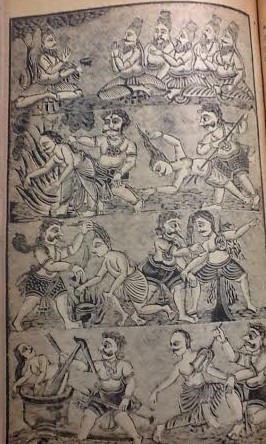
HELL in Rig Veda and Tamil Veda!(Post No.4405)

Written by London Swaminathan 


Date: 17 NOVEMBER 2017


Time uploaded in London- 20-33


Post No. 4405

Pictures shown here are taken from various sources such as Facebook friends, Books, Google and newspapers; thanks.


Hell and Heaven figure prominently in Hindu mythology. We read about in the oldest book in the world Rig Veda! There is not a single religious scripture without a reference to the hell. References to Hell are found in the Sangam Tamil literature and post Sangam Tamil book Tirukkural, the Tamil Veda.


Though later Hindu scriptures refer to various hells, Rig Veda only one hell is mentioned. It is a dark place; but no mention of torture or suffering is there. We read, “knowing he beholds all creatures; he hurls the hated and the irreligious into abyss” (RV 9-73)


In Manu Smrti, the Hindu Law Book, 21 hells are enumerated. Some of the name of the hells are: Darkness, Frightful, Burning, Place of Spikes, Frying Pan, Thorny Tree, Sword Leaved Forest and Place of Iron Fetters.

A liar would go to Raurava (dreadful) hell. He who kills a cow would go to the Rodha hell (hell of obstruction).

A horse stealer falls into the red hot iron hell. The wicked person who eats food before offering it to gods or ancestors or guests falls into where, instead of food, saliva is given to him. ( My comments: If people followed this rule and shared their food there woudn’t be any poverty, any beggar or communism in the world!).
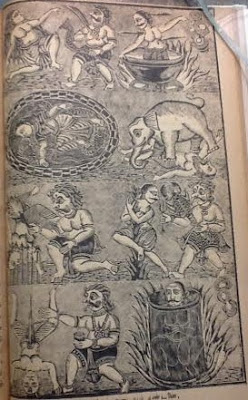
TREE CUTTING – A SIN!

He who cuts down trees goes to the Hell of Sword Leaved Trees. So much environmental awareness was there during Manu’s days! Manu has listed the hells to fit each crime perfectly. He is a great law maker.


I have already the Bhavishya Purana story” about tortures in the heaven:–

“Yama was exceedingly pleased with a girl named Vijaya, a Brahmin’s daughter. When she first saw him she was greatly alarmed, alike at his appearance and on learning who he was. At length he allayed her fears and he consented to marry him.


On her arrival at Yama’s city, her husband cautioned her and assured her all would be well if she never visited the southern portion of kingdom. After a while curiosity overpowered her, and thinking that a rival wife may live in the Southern region and that is why Yama asked her never to visit that area, she visited the forbidden region.


There she saw the torments of the wicked, and alas! amongst these she recognised her own mother. Greatly distressed she appealed to Yama to release her mother but Yama told her that was impossible unless someone living on earth perform a certain sacrifice, and transfer the act of the merit of the act to this poor woman then suffering. After some difficulty, a woman was found willing to perform the sacrifice, and Vijaya obtained her release.”


Siva Purana gives a list of 28 types of hell. Each one has five levels!
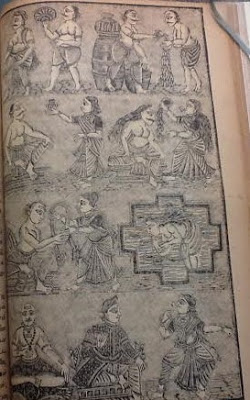
 

A Scene from Heaven


HELL in Tamil Literature

Tamils have pure Tamil words for the hell, not Tamilized Sanskrit words. This shows that the belief was very old and independent of any Puranic influence. Alaru and Nirayam are found in Tirukkural (Tamil Veda) and Pura Nanuru (Sangam Tamil Book).

NIRAYAM (hell) – Aka Nanuru-67, Pura Nanuru -5

There are more references to Heaven in Tamil. They looked more at the positive side of the life.

From the Tamil Veda Tirukkural

ALARU (hell):- Kural 255, 835 and 919

“Abstinence from meat-eating contributes to this maintenance of life. Therefore if  a man has once committed the sin of eating meat the HELL which swallowed him will not open its mouth again to release him _ Kural 255

In one brief birth a fool can gain

Enough HELL for seven births pain- Kural 835

The delicate shoulders of harlots with fine jewels are a HELL into which are plunged the ignorant vile- 919


Jeevaka Chintamani, one of the Five Tamil Epics, also has reference to hell in several places (E.g.1235)


Tamil and Sanskrit inscriptions curse those who defile or harm the inscriptions or the things mentioned in it to go to hell.


Scriptures like Bhagavad Gita have lot of references and one of them is as follows:

The gateway of this HELL leading to the ruin of the soul is three fold, lust, anger and greed Therefore these three, one should abandon. The man who is released from these, the three gates to darkness, Arjuna, does what is good for his soul and then reaches the highest gate.

It is very interesting to see the belief of sinners going to hell is found from the Rig Veda to latest poems in Tamil.


(Mr Rajendra Gupta has commented that NIRAYA for hell is a Sanskrit word. Thanks)

–Subham–


KILL ANYONE, NO SIN IF YOU ARE A BRAHMIN: MANU AND BUDDHA SAY! (Post No.4402)

Written by London Swaminathan 


Date: 16 NOVEMBER 2017


Time uploaded in London- 21-09


Post No. 4402

Pictures shown here are taken from various sources such as Facebook friends, Books, Google and newspapers; thanks.


KILL ANYONE, NO SIN IF YOU ARE A BRAHMIN: MANU AND BUDDHA SAY! (Post No.4402)

Manu said that if anyone can recite the Rig Veda, even if he destroys the three worlds, he incurs no sin!

Buddha said that even if a Brahmin killed a king, his father and mother, he incurs no sin! It may look strange. But one must read between the lines.


What is the message they want to give us?

A true Brahmin who has mastered Rig veda can’t think of anything like hurting anyone; leave alone destroying the three worlds.

A true Brahmin, according to Buddha, is equal to a saint, i.e. one with saintly virtues. So, he can’t think of hurting anyone.


Tamil poet Tiru Valluvar also said that “A Brahmin is kind to all creatures” (Kural 30)


MANU ON RV

“A Brahmin by retaining Rig Veda (RV) in his memory incurs no guilt, though he should destroy the three worlds”– 11-261

Manu on the Veda

“The Veda is the eternal eye of the ancestors, gods and humans; the teachings of the Veda are impossible to master and impossible to measure; this is an established fact”–Manu 12-94

The same verse is translated by Monier Williams as follows:-

“The Veda is of patriarchs and men

And even of gods, a very eye eternal

Giving unerring light; it is beyond

All finite faculties, nor can be proved

By force of human argument—this is

A positive conclusion”–  Manu 12-94


Buddha Says:–


“And a saint, a Brahmin, is pure from past sins; even if he had killed his father and mother, had murdered two noble kings, and had ravaged a whole kingdom and its people”

–Buddha in Dhammapada, Sloka 294


Because he has put away evil, he is called a Brahmin; because he lives in peace, he is called a ‘samana’; because he leaves all sins behind, he is called a ‘Pabbajita’, a pilgrim.

–Buddha in Dhammapada, Sloka 388

Ons should never hurt a Brahmin; and a Brahmin should never return evil for evil

–Buddha in Dhammapada, Sloka 389


It is important that we should never quote anything out of context; more important is that we should understand the meaning behind the words.

Foreigners who quoted Vedic hymns always used them out of context and took literary meaning. So we must be careful when we read anything written by foreign and non-Hindu hands.

–Subham, Subham-

Bernard Shaw, Shelley, Byron Swimming Anecdotes (Post No.4396)

Written by London Swaminathan 


Date: 14 NOVEMBER 2017


Time uploaded in London- 18-26


Post No. 4396

Pictures shown here are taken from various sources such as Facebook friends, Books, Google and newspapers; thanks.


Although unable to swim Shelley was forever invading pools and streams…. one day when Trelawney, a powerful swimmer, jumped into a deep pool in the Arno, Shelley immediately jumped in after him and lay ‘like a conger eel on the bottom’ till Trelawney fished him up with great difficulty, Shelley protesting as soon as he could breathe that ‘truth lay always at the bottom of the well’ and that in another minute I should have found it.


Xxx

Impressing upon his class an admiration for notable feats of physical prowess the teacher related the experience of a vigorous man who swam three times across a broad river in the morning, before breakfast.

There was a giggle from one of the youngsters in the class.

“Well”, said the teacher with some irritation

“What is that it seems so amusing? I see nothing amusing”.

“It’s only this sir, replied the pupil

I was wondering why he didn’t make it four times and get back on the side where he left his clothes”.


Xxx

Swimming in the Desert!

A certain American soldier, attached to one of the American Tank units fighting with the British in the Libyan campaign, had been carried by the exigencies of the service many miles deep into the heart of desert with his comrades. This outpost of the Front had been quiet for days. The soldier found himself one afternoon with a few hours leave.

It was with some surprise that his commanding officer spotted the man striding purposefully across the sands clad in his bathing trunks.

“Murphy! Shouted the officer in some astonishment. Where in blazes do you think you are going?”

Why, sir, said the soldier, I just thought while I had a couple of hours off I would take a dip in the surf.

Are you crazy? demanded the officer. The ocean is 500 miles from here!

“Beautiful big beach, isn’t it?” said the soldier.


Xxx


Shelley- Byron Argument!

The greatest and most mysterious of all Shelley s preoccupation s was with water, boat and swimming. He was apparently fascinated by water as a great element, and time and again prophesied his death by drowning. But it was typical of Shelley’s humourless absolutism where his fancy was involved that he was without fear in the business, and never troubled to learn either to navigate or to swim.


In 1816 the friendship that sprang up with Byron at Geneva was based partly on mutual literary admiration, and partly on their common love of boating. Byron knew something of sailing and navigation and they took a trip together around the lake in an open boat. They nearly foundered in a sudden storm one night. After Byron, had got the sail down and while the water poured in and the wind roared in darkness, they sat in furious argument, Byron, proud of his power as a swimmer, declaring that he would save Shelley when they sank, Shelley equally determined that he would not be saved.


Xxxxx

Following was published by me under the 15 Anecdotes from Bernard Shaw’s Life

G B Shaw Helped a youth


Bernard Shaw was enjoying a swim in a pool during a stay in South Africa; so were some boys who knew nothing of the august author one small boy was “dared” by his playmates to “duck the old man” for a Shilling. He accepted, but when he was close to his victim, panic seized him. Shaw turned, saw the youngster, and asked him what he wanted. In halting accents, the boy revealed the plot and the shilling bet.

“Well”, said Shaw, looking sternly at the youngster, “if you wait a moment while I get my breath, I will let you push my head under water.

He did, and the small boy swam back triumphantly to collect his shilling.


–subham–


ELEVEN TYPES OF PENANCE OF DEMON TARUKA (Post No.4392)

 Written by London Swaminathan 


Date: 13 NOVEMBER 2017


Time uploaded in London- 16-25


Post No. 4392

Pictures shown here are taken from various sources such as Facebook friends, Books, Google and newspapers; thanks.


SIVA Purana tells us that there was a demon king of Tripura, by name Taruka, who was exceedingly ambitious and oppressive. He forced Brahma by his austerities to grant any boon he should demand. A list of these austerities is interesting, as devotees in certain parts of India may be seen today practising many of them. Taruka went through eleven mortifications, extending over a hundred years:

  1. He stood on one foot, holding the other, and both hands up towards heaven, with his eyes fixed on the sun
  2. He stood on one great toe
  3. He took only water as sustenance
  4. He lived on air
  5. He remained in water
  6. He was buried in earth, but continued in incessant devotion
  7. He was burned in fire
  8. He stood on his head
  9. He hung on a tree by his hands
  • He bore the weight of his body on one hand
  • He hung on a tree head downwards.

Such merit was irresistible, and Brahma granted his request. After getting a boon that he should not be defeated by anyone, he became arrogant. Indra was forced to give his horse, Rishis had to part with their Kamadhenu/ magical cow. At last Siva’s son Kartikeya killed him.

MY COMMENTS

What is the message such stories give us?

1.Foreigners are wrong in describing demons as aborigines who were against Hinduism. In fact, all the demons got their boons from the same Hindu gods who Devas also worshipped.

2.Why did Hindu gods help the demons?

Hinduism go by mathematical rules. Success directly is proportional to the efforts you put in. Even bad people get their share according to their efforts, but the inherent weakness of bad people destroy them.

Tamil Poet Tiruvalluvar, author of Tamil Veda Tirukkural says,

“Though the fate written by God stands in the way, strenuous effort yields ready fruit. Labour recompenses what fate denies.”

Even if providence is not particularly helpful, personal efforts will bear proportionate results.

In Hinduism, even Gods obey the rules. Once they are propitiated they must give the boon; once they give the boon they cannot withdraw it. But god and demons are controlled by Truth. Truth alone will triumph (Satyameva Jayate).


3.The third message we get is that the methods employed by demons and seers for doing penance requires utmost concentration. Once a student gets that much concentration he succeeds in his studies. Once an aspirant practise that much concentration and involvement in the task he or she undertakes, definite success is assured.

  1. The eleven types of penance gave stuff for modern comics like Superman, Spiderman, Phantom, Tarzan and Harry Potter.

–Subham —


TWO WIVES OF BRAHMA FOUGHT AND BRAHMA LOST! (Post No.4386)

Written by London Swaminathan 


Date: 11 NOVEMBER 2017


Time uploaded in London- 8-08 am


Post No. 4386

Pictures shown here are taken from various sources such as Facebook friends, Books, Google and newspapers; thanks.


Brahma, in addition to his learned wife Sarasvati, had a second wife by name Gayatri. An interesting story is told in the Skanda Purana of their rivalry between the two women and subsequent reconciliation.


Siva told this story to his wife Parvati

“Listen, O Devi! I will tell you how Sarasvati forsook Brahma  and he in consequence espoused Gayatri. The Vedas have declared the great advantages that are derived from sacrifice, by which the Gods are delighted and bestow rain upon the earth.

For this purpose Brahma, Sarasvati, the gods and the holy sages repaired to Pushkara; but when all preparations were made, with all our rites and ceremonies for performing the sacrifices, Sarasvati detained by some household affairs was  not in attendance. A priest went to call her, but she replied, “I have not yet completed my dress, nor arranged several affairs. Lakshmi, Gowri, Gangadevi, Indrani and the wives of other gods and holy sages have not yet arrived, how therefore can I enter the assembly alone?”


The priest returned and addressed Brahma,

“Sarasvati is busy with other things and so she would not come. A man can’t do any religious rites without his other half (wife). Immediately Brahma got angry and commanded Indra, “Hurry up, get me another wife wherever you can find one”  Indra ran out and saw a beautiful milkmaid with a smiling face. He brought her to the assembly of Brahma. With the consent of the gods and sages in the assembly he married the milkmaid named Gayatri.

At this time Sarasvati accompanied by the wives of Rudra, Vishnu and other gods came to the place of the sacrifice. Seeing the milkmaid in her seat and the priests performing sacrifice, she cried out,

“O Brahma! have you decided to leave me who is your lawful wife? Have you no sense of shame and influenced by love, you did a shameful act. You are called the great father of gods and yet you publicly acted in a manner as to excite the derision of the three worlds”.


Brahma replied, “O my darling! The priests informed me that the time for the sacrifice was fast passing by and I cannot perform the sacrifice without my wife. Indra brought Gayatri and Rudra and Vishnu gave her in marriage to me”.


On hearing these words Sarasvati got and angry and cursed,

“By the powers which I have obtained by the performance of sacrifice, may Brahma never be worshipped in a temple or sacred place except one day in a year. And Indra!  since you have brought this woman you shall be bound in chains and confined in a strange country. Turning to Vishnu she said, since you gave that milkmaid in marriage you shall be born amongst men and wander for a long time with the cattle. To the priests she said you shall perform the sacrifices with the sole aim of receiving gifts.”


Having pronounced these curses, Sarasvati left the assembly; but at Brahma’s request, Vishnu and Lakshmi followed Sarasvati  and begged her to return to the assembly. In the meantime, Gayatri modified the curses and promised all kinds of benefits and blessings for the worshippers of Brahma

When Sarasvati returned to the assembly, Brahma asked Sarasvati  what she wished him to do with Gayatri. Before she replied, Gayatri threw herself at the feet of Sarasvati. She raised her up and said,

“A wife must obey the orders of her husband; for that wife who reproaches her husband and who is complaining and quarrelsome shall most assuredly, when she dies, go to hell. Therefore, let us both be attached to Brahma”.

Picture posted by Lalgudi Veda


‘So let it be’, said Gayatri

“I will obey your orders; I esteem you friendship, precious as my life. I am like your daughter. Please protect me.”

The reconciliation was complete. But Sarasvati’s curse was so strong even now Brahma is not worshipped in temples as a main deity.


(There are a few other reasons given for the non- worship of Brahma  in South India.)


My Comments:

What are the messages this story gives us:

1.A Hindu cannot do any ritual without his wife

  1. A wife though angry always obeys her husband

3.No one can escape from the curses or the evil acts they do.

4.Brahma lost his pride and prominence because of marrying second time when his wife was alive.

5.When there is obedience and humility, two women can live amicably

  1. Sacrifices don’t wait for anyone; they must be done on time. Even gods follow the rules laid out in the Vedas.

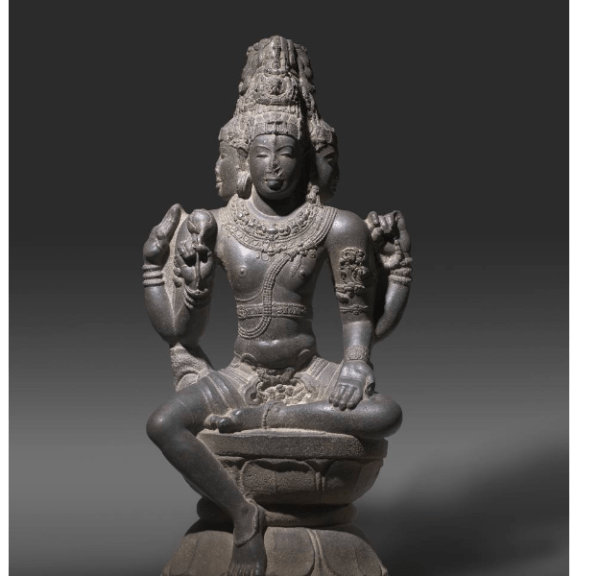
Brahma from Cleveland Museum

7.Skandam (Kanda Purana) is the largest of the 18 major Puranas (mythology) and it has lot of interesting stories like this.

8.Gayatri and Sarasvati, Savitri and Sandhya are all one and the same goddess with different aspects. They are created by the sages to give some messages.

9.Symbolism must be understood and explained at the end of each story; otherwise it would confuse children and illiterates.


–Subham–
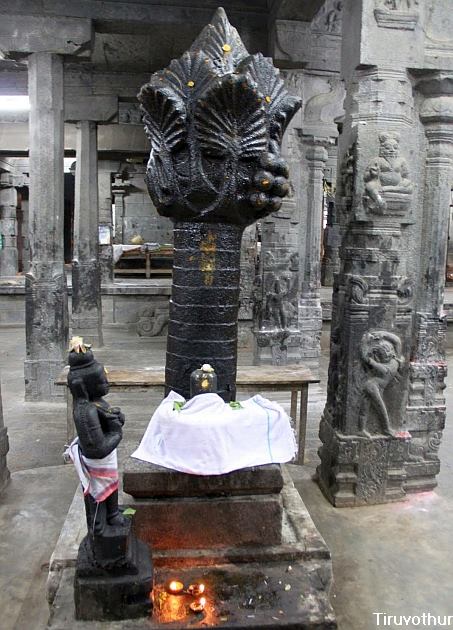
STORY ABOUT A.BRAHMANA (Post No.4383)


Written by London Swaminathan


Date: 10 NOVEMBER 2017


Time uploaded in London- 13-35


Post No. 4383

Pictures shown here are taken from various sources such as Facebook friends, Books, Google and newspapers; thanks.


This is a story about the origin of Aitareya Brahmana.

The Brahmanas are the prose works in the Vedic literature. They deal with the fire sacrifices of the Vedic Hindus. Each Veda has separate Brahmanas. In fact each ‘Shaka’ of the Veda has one Brahmana. One of the oldest Brahmanas is Aitareya Brahmana of Rig Veda.


There is a curious story about the origin of this book. Sayana, the Vedic commentator said this story. There was a sage who had many wives, and one of them was called Itara. She had a son whose name was Mahidasa. The father neglected him and loved the other sons more than Mahidasa, and at a certain sacrifice, he allowed all the other sons to sit on his lap, but refused the honour to Mahidasa.

Thereupon Itara prayed to Goddess of Earth who appeared at once and offered a divine thrown to Mahidasa and seated him on it. The goddess then made him a great scholar. To Mahidasa Aitareya, enlightened by the boon of Earth,there appeared or was revealed. One Brahmana of the Rig  Veda  (of Sakala Saka was called after his name. Itara——-A/Itareya. The aranyaka is also called Aitareya Aranyaka.


(The legend says that Aitareya was the son of Itara; itara means the other woman, probably the woman was not the legal wife of the King and so her son was neglected.)

Aitareya Brahmana is divided into eitght Panchikas (pentads), each of which has five adhyayas and so it contains forty chapters; it deals with the duties of the priests, explanations of Soma, Uktya, Shodasa, Atiratra and other sacrifices including 12 minor sacrifices


How many Brahmana Books are there?


There is one more Brahmana of Rig Veda: Kaushitaki Brahmana.

Satapata Brahmana

Of all the Brahmana books, Satapata Brahmana is the most important one. It belongs to Sukla Yajur Veda. It deals with important fire sacrifices in addition to etymology, grammar and meanings of several other things. The name itself shows that it has hundred (sata) chapters. The Krishna Yajur Veda has Taittiriya Brahmana.  Atharva Veda has Gopata Brahmana.


The Brahmanas shows the oldest stage in the development of Sanskrit prose. It is a most interesting phase in the history of Indian thought. Some of the things are said in a symbolic language and so they appear as silly stories. The seers themselves often say the gods love mysterious language. The astronomical remarks in the Brahmanas show they belong to a period between 2000 BCE and 3000 BCE. Foreigners date them around 1000 BCE. This is wrong because Max Muler gave a rough date believing that a anguage changes every 200 years. This theory is not applied to any other language and proved More over, apart from language, there is huge difference between the Upanishadic stage and Brahmana stage.


–subham —


Beauty Anecdotes (Post No.4380)

Written by London Swaminathan 


Date: 9 NOVEMBER 2017


Time uploaded in London- 9-55 am


Post No. 4380

Pictures shown here are taken from various sources such as Facebook friends, Books, Google and newspapers; thanks.


Fontanelle ,at the age of 97, after saying many amiable and gallant things to a beautiful young lady, passed before her without seeing her, to place himself at table.


See, said the lady, how I ought to value your gallantries, you pass without looking at me ”

Madam, replied the old man, if I had looked at you I could not have passed.


Xxx


Dustman’s Heart

As the beautiful Duchess of Devonshire was one day stepping out of her carriage, a dustman who was accidentally standing by and was about to regale himself with his accustomed whiff of tobacco, caught a glance of her countenance, and instantly exclaimed,

Love and bless you, my lady, let me light my pipe in your eye!


It is said that the Duchess was so delighted with his compliment, that she frequently afterward s checked the strain of adulation which was constantly offered to her charms, by saying,

OH! After the dustman s compliment, all others are insipid ”


Xxxx


Chesterfield and Voltaire


Lord Chesterfield and Voltaire were attending a reception in Paris. Noticing that the English man was being assailed by some of the ladies, the French wit said to him,

My Lord,it is said that you possess keen discrimination; tell me now, who are the more handsome, the French women or the women of your own country?


As to that , replied chesterfield, I must admit that I cannot say,as I am no connoisseur in the art of painting.


Xxxxx


Curran, speaking of Madame de Stael who was by no means handsome, but a splendid conversationalist, said she ” the power of talking herself into a beauty.


Xxxx


Someone once noted to Samuel Goldwyn the beauty of his wife’s hands.

Yes, Goldwyn said, ” she has such beautiful hands, I am thinking of having a bust made of them. ”


Xxxx SUBHAM xxxx


‘Papa, Abraham Lincoln is not Ugly!’ Homeliness Anecdotes (Post No.4377)


Written by London Swaminathan 


Date: 8 NOVEMBER 2017


Time uploaded in London- 17-24


Post No. 4377

Pictures shown here are taken from various sources such as Facebook friends, Books, Google and newspapers; thanks.


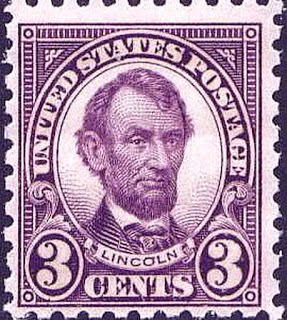
Lincoln’s great love for children easily won their confidence. A little girl, who had been told that the president was very homely, was taken by her father to see the President at the White House.


Lincoln took her upon her knee and chatted with her a moment in his merry way, when she turned to her father and exclaimed

Oh Papa ! He is not ugly at all; he is just beautiful.


Xxxx

JACK-KNIFE FOR LINCOLN

Abraham Lincoln delighted to tell stories about himself. One of his favourites was the following:


” In the days w a I used to be on the circuit (travelling from one county court to another on horse back ) I was once accosted by s stranger, who said

Excuse me, sir, but I have an article which belongs to you

How is that? I asked, considerably astonished.

The strange r took a jack knife from his pocket.

This knife, he said, was placed in my hands some years ago, with the injunction that I was to keep it until I found a man homlier looking than I am myself. I have carried it from that time until this; allow me to say ,sir, you are fairly entitled to the property.

Xxxx


NOSE IS UGLY, NOW

An acquaintance came to Jerrold and said indignantly

I hear you said my nose was like the ace of club s!

Jerrold looked thoughtful.

No,  I did not, he drawled;

But now that I look at it, I see it is– very like.”


Xxx

SKIN YOUR WIFE


Said the brash travelling salesman to the farmer,

My God, that is certainly a homely woman!

“That is my wife, young man, said the farmer, and you might remember that beauty is only skin deep ”

Then, said the salesman, for Heavens sake, skin her!”


Xxx


LINCOLN’S PORTRAIT

The day following the adjournment of the Baltimore Convention, at which President Lincoln was renominated, various political organisations called to pay their respects. While the Philadelphia delegation was being presented, the chairman of that body, in introducing one of the members said,

Mr President, this is Mr S of the second district of our state, a most active and earnest friend of yours and the cause. He has,among other things, been good enough to paint and present to our league room s a most beautiful portrait of your self.”

President Lincoln took the gentleman s hand in his, and shaking it cordially said, with a merry voice,

I presume, sir, in painting your beautiful portrait, you took your idea of me from my principle s and not from my person.”


Xxxx

UNDER THE BUSH

A farmer, making his nightly rounds, saw a shadowy figure holding a lantern and standing somewhat furtively by the side of the house.

Knowing that all his family was in the house, he shouted,

Hey, there. Who are you?

Holding the lantern head high, the figure laughed and said,

“It is only me, Albert.”


Why I thought you were in bed long ago. What are you doing out so late?


Well, said Albert, shifting about a bit as though in embarrassment, I am courting, Annie


The farmer chuckle d. Why, the lantern? Why, when I was courting my missus, I didn’t take a lantern.


The young man hesitated for a minute, then said in all seriousness,

Yes, sir. I know. We can all see that, sir.”


Xxxx SUBHAM xxx


STRANGE STORIES ABOUT TREES IN VEDAS –Part 2 (Post No.4371)

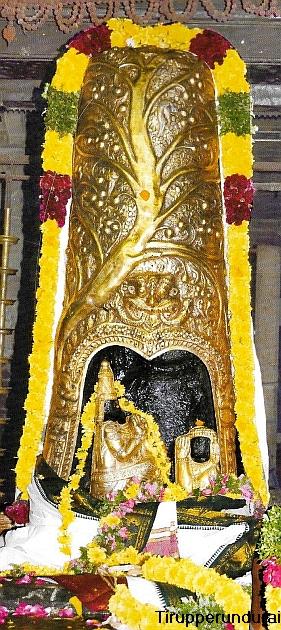
Granite tree in a Tamil Temple; posted by Lalgudi Veda

Written by London Swaminathan 


Date: 6 NOVEMBER 2017


Time uploaded in London- 16-08


Post No. 4371

Pictures shown here are taken from various sources such as Facebook friends, Books, Google and newspapers; thanks.


(First part was posted yesterday)


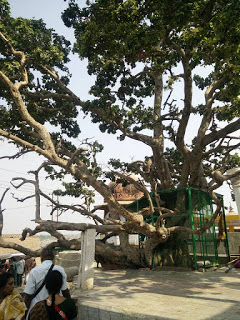
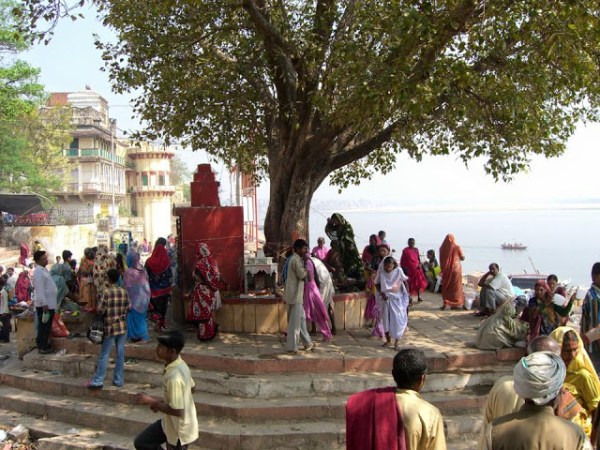
Picture of a sacred tree in Varanasi


The Gods and the Asuras, both of them sprung from Prajapati, strove together. The gods, having placed Agni in the front, went up to the Asuras.  The Asuras cut off the point of that flame held forward. It settled down on this earth and became that Krimuka tree; hence it is sweet, for there is vital essence in it. Hence also it is red, for it is a flame, that Krimuka tree being the same as Agni; it is in the shape of fire that he imparts growth to it- Satapata Brahmana 6-6-2-11


When Prajapati performed the first offering, a Vinkankata tree (Flacouritas apida) sprang forth from that place where, after offering, he cleansed his hand  –6-6-3-1


“When the gods and Asuras, both of them sprung from Prajapati, strove together, all the trees sided with the Asuras, but  the Udumbara tree alone did not forsake the gods. The gods having conquered the Asuras took possession of their trees. They said, ‘come let us lay into the Udumbara tree whatever pith, whatever vital sap, there is in these trees; were they then to desert us they would desert us worn out like a milked-out cow or like an ox that has been tired out drawing the cart. Accordingly they laid into the Udumbara tree what pith and essence there was in those trees; and on account of that it matures fruit  equal to all other trees; hence that tree is always moist, always full of milky sap- that Udumbara tree indeed, being all the trees, is all food—Sat Br. 6-3-2-3


Aitareya Brahmana also gives the same story (1-23)


(VERY IMPORTANT POINT: Gods and Asuras came from Brahma/Prajapati. Foreigners wont highlight this point anywhere in their writings; those cunning and conspiring people wanted to project Asuras as aborigines or Dravidians. Throughout Hindu literature, Asuras, Rakshasas or so called Shudras are shown as children of same father and mother)


“Trees were temples of Divinities, and in the old way the simple country folk to this day dedicate any remarkable tree to a god”—Pliny in Natural History 12-3

Pliny (23-79 CE) was a Roman scholar and his Natural History reflected the Hindu views on Trees.


Persian Poet Haafiz praised the trees too,

“Mark where yon tree rewards the stony shower

With fruit nectareous, or the balmy flower,

All nature calls aloud, ‘Shall man do less

Than heal the smiter and the railer bless?”

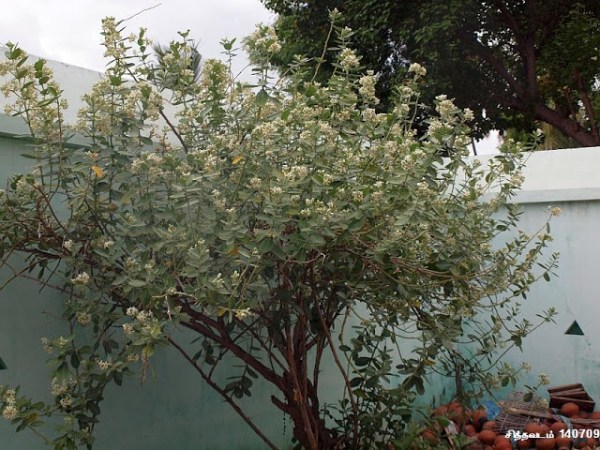
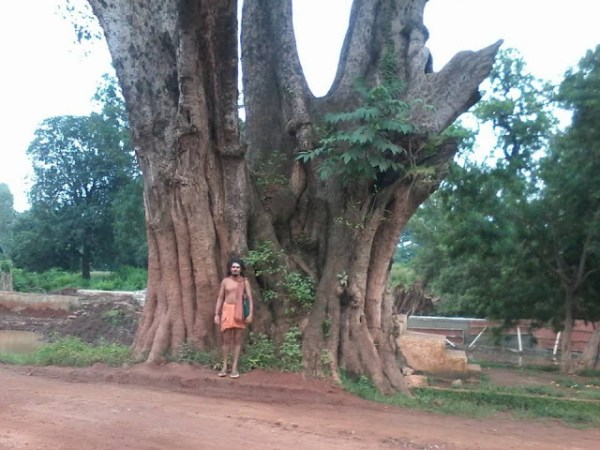
Posted by Lalgudi Veda, Vellerukku, Siddhavatam

In India that is Hindustan all life is sacred. Hindus are believers in the law of continuity, for in their creed the life of gods is connected with that of demons, the life of demons  with men, the life of men with animals, the life of animals with that of trees and plants, the life of plants with a supposed life in rocks and stones, and the divine soul is thought to permeate all. There is no break anywhere. Tamil Saints like Manikkavasagar sings about several births of soul from stone to man. According to Hindus, all plants are conscious beings, having distinct personalities and souls of their own as gods, demons, men and animals (Manu 1-49).


Good spirits and demons occupy the trees. They may often resort to it as guests or take up their abode as tenants.


There is a firm belief that certain trees are demon haunted. Tamils believe that demons occupy Tamarind trees. However it is necessary to make clear  distinction between sacred trees and trees feared as the home of evil spirits. Hindus worship trees out of fear or out of its sacredness. Another reason for the worship of trees is their wonderful utility in daily life. Their shade is grateful in a hot climate. Their wood is the source of fuel/fire. Their fruits, juices are bark have medicinal and curative properties. Plamyra palm or Coconut tree of south India has over fifty distinct uses.

Huge banyan trees are assembling point for vendors, gossip mongers, Assembly Hall and Court House of the village communities. It becomes the abode of village god or Ganesh in South India.

Kuruntha Tree, Avudayar Koil, by Lalgudi Veda


TREE MARRIAGE


In the olden days a Hindu who plants a grove of mango trees will not take the fruit f the mango tree before they have been married to another kind of tree, usually a tamarind tree, sometimes an acacia or even a jasmine plant which is planted in the grove. It is done only when the mango tree reaches fruit bearing stage. In the same way a tank is married to a plantain tree.


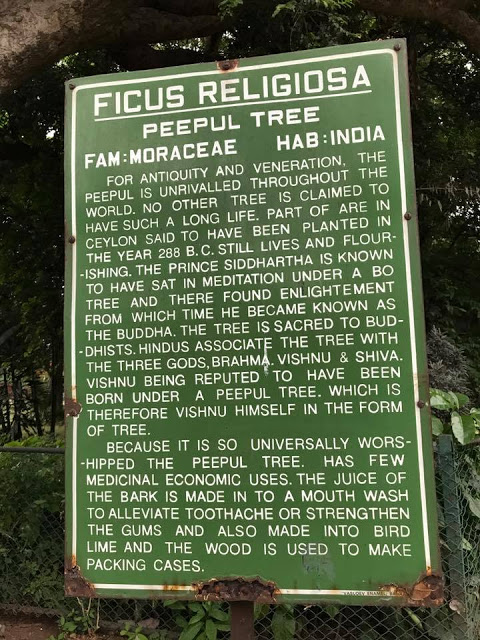
The tree worship began in Vedic age. We see a whole Mandala of Rig Veda is devoted to Soma (plant) worship. Pipal tree is worshipped from the Vedic days. Rishis/ seers are named after Pipal trees. Buddha, born as a devoted Hindu, did penance under the pipal tree (Bodhi).  Parijata came form the ocean when demons/ Asuras and Devas/angels churned the milky ocean.


Tree worship is seen among tribal Hindus as well; in the Birbhum district annual pilgrimage is made to shrine in the jungle to leave offerings to a Bel tree.


The custom of hanging votive offerings or rags or threads on the trees is of great antiquity. It is seen from Kashmir to Kanyakumari.

Kadamba  Tree in Chir Ghat, Yamuna River

This custom existed in other parts of the world as well; names like Holyoake, Hollywood recall the English worship of trees and groves.


Ovid (43 BCE), the Roman poet, says,

“There stood a mighty oak of age-long strength

Festooned with garlands, bearing on its trunk

Memorial tablets, proofs of helpful vows”

–Metamorphoses, 8-741, also Fasti 3-267


This Hindu custom was prevalent in different parts of the world; now we can see such pictures in museums or in their literature; but in Hindu India, where it originated, is still practised!!


The famous Bodhi tree in Gaya (Bihar, India) and its sister trees in Sri Lanka, Tamarind tree of Tansen and Nammalvar, Banyan Tree of Lord Krishna and Panchavati (five Banyan trees) of Lord Rama are some examples. There are hundreds of trees like these throughout India Every Tamil temple has a tree worshipped in its complex.

A pilgrim under a tree

Classical analogies of tree deities are found in many places: Daphne turned into a laurel that Apollo honours for her sake, and the sorrowing sisters of Phaethon changing into trees, yet still dropping blood and crying for mercy when their shoots are torn”

–Metamorphoses of Ovid 1-452, 2-345


Like I have pointed out earlier, they are all in old literature or museums in other parts of the world; In India, Hindus practise it even today and worship all the nature as God; and India is not primitive; it is the first developing country to send a spaceship into sky; it is the first developing country to explode a nuclear device. it is the country with highest number of computer personnel.

–Subham–


STRANGE STORIES ABOUT TREES, KUSHA AND DHURVA GRASS IN VEDAS –Part 1 (Post No.4368)

Ganesh with Dhurva Grass (Arukam Pul in Tamil)


STRANGE STORIES ABOUT TREES, KUSHA AND DHURVA GRASS IN VEDAS –Part 1 (Post No.4368)


Written by London Swaminathan


Date: 5 NOVEMBER 2017


Time uploaded in London- 14-11


Post No. 4368

Pictures shown here are taken from various sources such as Facebook friends, Books, Google and newspapers; thanks.


Origin of vegetation on the earth explained in the Aitareya Brahmana (5-23):

“The earth is the Queen of the Serpents, for she is the queen of all that moves (sarpat). She was in the beginning without hair (without grasses, bushes, trees etc). She then saw the mantra of the Rig Veda (10-189) which commences with

‘This spotted Bull (the sun) hath come, and sat before the mother (the Earth) in the East

Advancing to his Father, Heaven. ‘As expiration from his breath, his radiance penetrates within’.


In consequence of it she (the Earth) obtained a motely appearance, she became variegated, being able to produce any form she might like, such as herbs, trees and all other forms. Therefore, the man who has such a knowledge obtains the faculty of assuming any form he might choose.”

DURVA GRASS

The origin of Durva grass, of which much is made in connection with Hindu sacrifices, is described as follows:

“The Hair of Prajapati, which were lying n the ground when he was disjointed, became herbs. The vital air then went out from within him, and that having gone out, he fell down. He said, ‘Verily this vital air has undone me!’ and because he said, ‘it has undone (dhurve) me’, hence  the name Durva; durva doubtless being what is mystically called Durva, FOR THE GODS LOVE THE MYSTIC”—- Satapata Brahmana 7-4-2-11/12


Concept of ‘body being Microcosm and the Earth being Macrocosm was borrowed by the Greeks from the Hindus; so plants are equal to hair, blood vessels are equal to rivers etc.


The second point to be noticed is Gods love the Mystic, hence queer names and strange explanations. This means they dot speak straight forward language. So one must be careful in translating or interpreting.


The third point is reasoning out is found in the Vedic period itself. People named different plants differently on the basis of certain things.

KUSA GRASS

“He then places a bunch of Dharba grass (Kusa) on the middle of the altar site; for the gods then placed plants thereon, and in like manner does the sacrifice, now place thereon- — Satapata Brahmana 7-2-3-1


The reference in the next quotation is to the legend of Indra’s killing of Vritra, when the waters, disguised by his putrefying carcase, rose and flowed over —– Satapata Brahmana 1-1-3-5

“Whence spring these grasses of which the strainers are made; for they represent the water which was not putrified; in 7-3-2-3, we read of ‘Stalks of Kusa grass, for these are pure, and sacrificially clean……….. for the top is sacred to the gods.


Unclean Plants

There were plants , which are sacrificially unclean; it is said that Greek Philosopher Pythagoras banned beans and fasting Roman Catholics banned certain food.


Vedas allowed Forest Plants and Fruits of trees:

“Let him therefore eat only what grows in the forest or the fruit of trees. Barku Varsha said, ‘Cook beans for me, for no offering is made of them! This, however, he should not do; for pulse serves as an addition to rice and barley; and hence they increase the rice and barley by means of it; let him therefore eat only what grows in the forest —– Satapata Brahmana 1-1-1-10


Referring to the same incident in Prajapati’s life, we read the origin of Udembara tree —– Satapata Brahmana 7-4-1-39

“When Prajapati was relaxed, Agni took Prajapati’s fiery spirit and carried it off to the south, and there stopped; and because after carrying (karsh) it off, t stopped (ud-ram), therefore Karshmarya sprang up. And Indra took Prajapati’s igour and wet away to the noth; it became the Udumbara tree”

(Fig and its varieties)

UDUMBARA TREE

In Vishnu Sahsranama Nyagroda, Udumbara and Asvatta are worshipped as Vishnu. All these belong to Ficus family.


The bathing chair of Udumbara wood figures prominently in Taittiriya sBrahmana 2-6-5, where we find an address to to it and another to the leather spread upon it, a mantra to be repeated when sitting upon the chair, another after sitting thereon, another when descending rom chair, another inaudibly after descending from the chair, and no end of others in the course of the bathing, including many addressed to Agni and the Sun; some of which may be heard uttered to this day on the banks of the Ganges or other bathing places.


When Hindus couldn’t get the Udumbara wood they replaced it with a bundle of Dhurva grass. The details are given in Taittiriya Brahmana2-7-9-10/11


Tomorrow I will give the stories of Krimuka and Viekantka Trees


—-to be continued


–subham–