Human Sacrifice practised by the Kondhs! (Post No3225)

pic-gaund

Compiled by London Swaminathan


Date: 7 October 2016


Time uploaded in London: 6-01 AM


Post No.3225


Pictures are taken from various sources; thanks.


(Following is a piece from Arthur Mile’s book about the customs of the Kondh Tribes whom he described the DRAVIDIANS!)

The Kondhs live in dread of witchcraft, and are for ever watching for signs of it. In this connection the Madras Police Report records a case in the Vizagapatnam hill districts. The younger of the the three brothers died of fever, and when the body was cremated the upper portion did not burn. The surviving brothers therefore concluded that death had been caused by the witchcraft of a certain Kondh, and they attacked the man and killed him. After cutting their victim’s body into halves, they took the upper part to their village and threw it on the spot where the deceased brothers body had refused to burn. For their crime they were arrested and sentenced to death.


When cholera breaks out in a village, they smear their bodies with pig’s fat which has been liquefied and they continue to do this until the disappearance of the epidemic. It is believed that the cholera Goddess is driven away by the smell of the fat. They also attempt to prevent the approach of the goddess by barricading the paths to the village with ditches, which they fill with thorns and pots stinking oil.


pic-gond

Friendship Oath!

The Kondhs have a friendship oath, which in some way resembles the blood covenant of the Hebrews. Friendship is sworn on sacred rice, which has been consecrated to the god of Jagannath of Puri. Pilgrims visiting Puri get a quantity of this rice, and distribute it to those who ask for it. It is supposed that one cannot utter a lie, or have an evil thought, while holding the rice in the hand. Instances are known of friendship, sworn on the rice, being contracted between towns-men and the poor village peasants; even between a Brahman woman and a Sudra servant. Bound by such friendship, two people allow no festival to pass without an exchange of presents the house of one presents, and no ceremony goes on at the house of one unless the other is invited. If one party dies, the survivor does not consider the bond disconnected but continues to make gifts to the family of the deceased. This friendship is called songatho, and it increases with the barbarity of the division. Among the wilder tribes there are splendid examples of Songatho which have lasted for generations. One hill tribe takes an oath on a leopard’s skin, or while holding a peacock feather in the hand.


Origin of the Kondhs
The legend of the origin of the Kondhs is a story of human sacrifice.

In the beginning, when the ground was all wet, there were only two women living on the earth, and in due course each one was blessed with a son. The two women and their children came from the interior of the earth, bringing with them two plants which were their food. One day, when one of the women was cutting one of the plants, she accidentally cut her finger and the blood dropped on the ground, and instantly the wet earth became dry. The woman cooked the plant and gave it to her son to eat, who asked her why it tasted so much sweeter than usual. She told him that she did not know, but that that night she expected to have a dream and would let him know. The next morning the woman made her son promise to do as she told him if he would prosper in the world. He must forget that she was his mother, and cut flesh from her back and bury it in the ground. This her son did, whereupon the wet soil dried up and became hard, and the animals, trees, and birds came into existence. A partridge then scratched the ground, and millet and rice grew.


The two brothers agreed that, as the sacrifice of the woman brought forth abundance from the ground, they must sacrifice a human being once a year. A god by the name of Boora Panoo, together with his daughters, came to live with the brothers, and, marrying the daughters, the brothers begat children. When the children grew up, there was a dispute as to which one should be sacrificed, and, not being able decide the point, the brothers sacrificed a monkey instead. The goddess of the earth in consequence was very angry, and ordered the proper offering of a human being. The two men sought for ten years for a victim, and finally they found a man with a son five years old. They bought the son from the father, with permission to sacrifice him.


The boy was fettered to prevent his running away, toddy was made from grain, and a post was erected at which a pig was sacrificed. Two days before being offered the boy was tied to the post. On the night before the sacrifice the priest took a stick and poked it into the earth until the earth god answered, and round the hole from whence the goddess had spoken, pieces of wood were arranged lengthways and cross ways and an egg was placed the on the sacrificial day the boy was conducted to the wood, made to lie on it face downward. Pieces of flesh were then removed from his back, and buries at the caste’s place of worship. While other portions were put into the ground near  a drinking well to increase the water. The remainder of the corpse was burnt on the pile of wood. On the next day a buffalo was sacrificed, and a feast given.

gond-women-grinding-corn

The following verse (which was intended to be uttered over human sacrifice) is now recited by the Janni (priest) at the buffalo sacrifice. Come, male slave, come, female slave, what do you say? What do you call out for? You have been brought, ensnared by the Haddi. You have been called, ensnared by the Domba. What can I do, even if you are my child? You are sold for a pot of food


–Subham–


Dasara in 1930s: Arthur Miles (Post No. 3218)

dasaradinamalar

Compiled by London Swaminathan

Date: 4 October 2016

Time uploaded in London: 19-06

Post No.3218

Pictures are taken from various sources; thanks.

(latest Dasara pictures )


Contact swami_48@yahoo.com


mysbrhi-w157_ar_20_1243406e

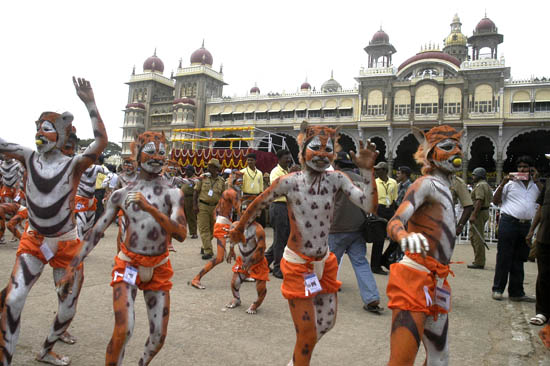
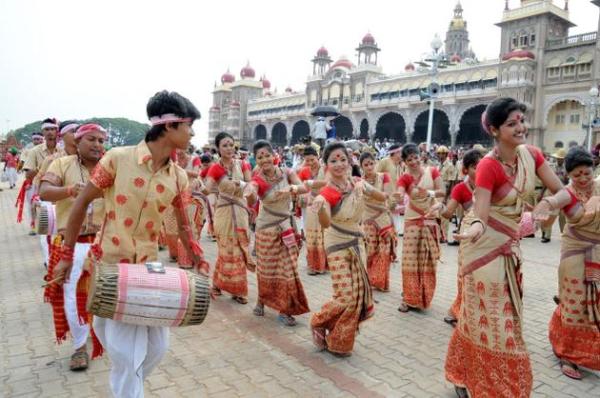
“Under the Aswija (September or October) moon, the Dasara festival begins. Dasara means ten nights and for ten nights and days the festival continues. A more elaborate spectacle than the festival of Dasara of Mysore can be seen nowhere in the world to-day. To say that the city is arrayed for carnival, gives no idea of the ten nights. Haroun-el-Rashid might have dreamed of something resembling it for ten of his Arabian Nights.


The palace of the Maharaja twinkles with thousands of electric lights. From the temple at the entrance gate a god, so decked in jewels and garlands that only his face remains visible, looks out at his worshippers, who are dressed in silks exquisite linen, and tissues of spun gold. The metallic clink of bracelets and necklaces is heard above the wail of age-old musical instruments, and glittering figures bring their offerings to the temple and prostrate themselves before the god. For all this the nights have a strange quiet, and it is as if the worshippers moved through an ancient dance lost in meditation.


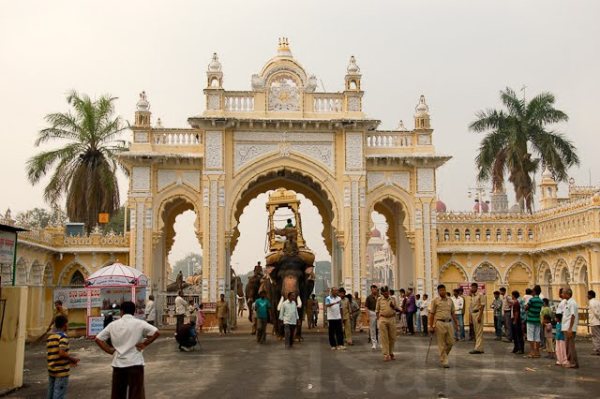
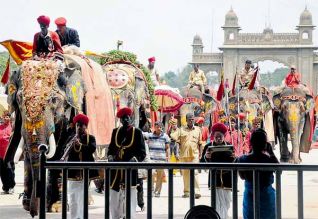
The days blaze with colour, until the eyes fairly ache. It would seem that where nature is so passionately vivid nothing could be added to the picture. But streamers from posts for miles, and temporary structures along the streets are buried under multi-coloured silk and embroidery. On the tenth day (victory day), the Maharaja, seated on the State elephant, caparisoned with velvet, flowers and jewels, leads a procession through the streets.


It was customary in former years for the Prime Minister to ride beside him. But the present Prime Ministeris a Mohammedan, and the heir apparent sits beside the Maharaja today. The elephant’s huge ears are painted with designs such as one sees in old frescoes and he wears gold anklets studded with precious stones.

KPN photo

The cream coloured State cows, walking close together, wear  ropes of pearls and gold casings on their horns. Across their backs purple colour thrown, into which gold thread has been woven. Their hoofs have received a gold wash, and just above. them are clamped anklets, the value of which would balance a tottering empire. Men wearing dhoties as light as a cobweb, move along carrying garlands of flowers; followed by men in uniform and the Palace guard, resembling players in some gorgeous extravaganza. The orchestra plays something which might have been heard in the temple of Milita in old Babylon while the virgins sacrificed themselves to Venus. Sometimes the animals from the zoo have been known to join the procession. The whole pageant is as colourful and sensuous as an oriental carpet on which slept some barbaric princess of old.


Before the opening of the festival, an auspicious hour has been chosen for setting up the Maharaja’s throne in the Durbar hall. It is the throne of his house, andis used now only for the Dasara. Tradition says that the throne was once the possession of the Pandavas, the heroes of the Mahabharata, and that it later belonged to the Yadu dynasty of Sri Krishna, from which ancestry the present reigning family claim descent. It is also said, that after the English had conquered Seringapatam, the throne was rescued from Tippu Sultan’s lumber room and set up for the house of Wodiyar, in the state of Mysore. When the throne is set up in the Durbar hall, the image of a lion is placed on it; since it was on a lion that the goddess Kali went into the battle against the demons.

05bgdasara_5assam_2139442g

On the occasions of the Dasara the goddess Kali destroys the demon of physical desire, who, in the form of a buffalo, is called Bandasura. The battle waged for nine days, and the victory to Kali came on the tenth day. One of the goddesses, fought beside Kali, slew the two demons Chanda and Manda. For this daring exploit the goddess was called Chamundi, the name being a combination of the names of the defeated demons. Chamundi hill, from which at night the city of Mysore with its thousands of lights reflected in the sacred tanks looks like an enchantment, is associated with the goddess. The Maharaja has a small temple on the top of the hill, to which he frequently retires to meditate. It is said that he is a holy man, who refuses to leave his beloved India to visit the materially-minded West.


For the first nine days of the Dasara the Maharaja cannot leave the palace. Standing before the image of the Goddess Chamundi, wearing a bracelet which is sacred to her, and a substantial growth of beard (during the nine days he must not shave), he is supposed to give himself up to the contemplation of his soul. No energy should be given to physical desire of any sort, consequently all his attention is concentrated upon the goddess and the occasion. The Maharaja is the central point of the Dasara, as according to the ancient laws of Manu the king was the representative of God. He was the will, the devotion of all his people, and during the nine nights, by his own purification, he purifies his subjects.


The festival of the nine nights is called the Navaratri. There is no difference between the two festivals, save that the Dasara celebrates its day of victory. On the ninth night European guests, who wish to pay their respects individually and receive floral acknowledgment, are received by the Maharaja. At the palace both Western and Eastern music can be heard each night of the festival.


All the aspects of the Dasara are feminine. It is the Sakta which in Mysore takes what is known as the right-hand path. This means that it does not descend into its lowest form. The people are apparently content with the magnificent pageant furnished by the Maharaja.

dasara-wrestling

The sakti, or energy of the masculine principle, goes into the female principle for destructive reasons. The female represents the male as the agent of destruction. Some woman, usually a virgin (although even widows have been known to officiate), represents the energy of Siva. Sometimes the woman is worshipped as the wife, sometimes as the mother. Behind all this objective expression lies the cosmic energy, of which Siva is supposed to be the active embodiment. The cosmic energy, which is believed by the Hindus to be masculine, cannot destroy. It has created the world and all that is in it, and when it seeks to destroy it must become feminine.


In this respect Hinduism does not differ very much from other religions. From time immemorial human imagination has given the woman the role of destruction. Even her power to destroy, according to the Hindus, had to be borrowed from man.  Each Hindu god shows his disposition through his sakti, or wife. Sivamust destroy in order to build, in order to build and is impersonated by the goddess, Kali. Brahma a milder god, uses his energy in the goddess Saraswati; while Vishnu, the lord of creation, uses Lakshmi as his vehicle of power.


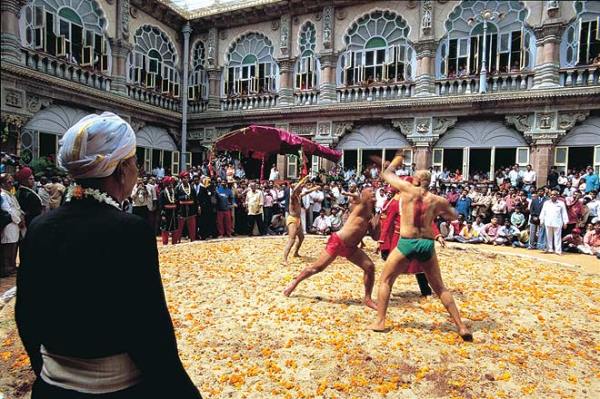
At the Mysore Dasara wrestling bouts are staged which the Maharaja watches. Special attention is paid to the girls of unusual beauty, as they are considered special representatives of the sakti. The animals are grouped with the human population on this occasion, and all are purified; the State elephant and the State horse having a special ceremony.

dasara-majestic

After the State sword is worshipped, it is placed in a palanquin and sent with the State horse and elephant to the parade ground, three miles from the palace. At sunset a parade of troops is held on the ground. The scene is very dramatic, with its background of amber sky, and its veil of sparkling sun-mist. The Maharaja performs puja (worship) before the State sword and the banni-tree, and the sword is then sent back to the palace, accompanied by the elephant and the horse. The Maharaja follows by torchlight. The worship of the banni (Vanni) tree is an incident from the Mahabharata”.


(After this, the writer narrates the story of Arjuna hiding the weapons under the Vanni, tree and the principle of Sakti, parting of hair on the head of Hindu women and applying Kumkum etc.)


Mysore Palace - Dasara procession mural

Mysore Palace – Dasara procession mural

dasara color 3.jpg


–Subham–


Vedic References to Hair Styles – Part 3 (Post No.3213)

indus-valley-priest

Picture of Indus Yogi with beard

Research article written by London Swaminathan


Date: 2 October 2016


Time uploaded in London: 16-32


Post No.3213


Pictures are taken from various sources; thanks.


Contact swami_48@yahoo.com


siva-ravi-varma

Lord Siva with moutache; Vishnu is clean shaven!

Pulasti – wearing the hair plain


Pulasti or pulastin  in the Yajurveda samhitas denotes wearing the hair plain, as opposed kapardin, wearing the hair in braids


Pulasti is found in vajasaneyi, taiittiriya,kathaka samhitas.


Sikhanda –


Sikhanda denotes a tuft or lock, as mode of wearing the hair, in the later Samhitas and the Brahmanas.


Sikhaa – top knot


Sikhaa denotes in tha satapata Brahmana , the knot of hair worn on the top of the head. Wearing the top knot unloosened was the sign of mourning in the case of women and men like.


My comments

Sikhaa is a very interesting word because it has been in vogue for over three thousand years from Kanyakumari to Kashmir.


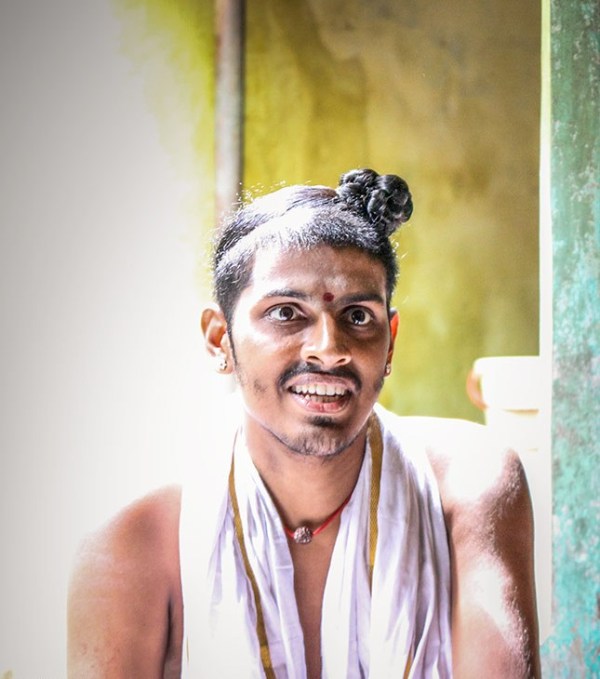
Sikai kaay podi (colloquial: Seeyakkaay podi= soap nut powder) is known to everyone in Tamil Nadu; before the synthetic shampoos flooded the market, soapnut powder was used after oil bath. Even today it is in use and the word Sikha is used to denote the tuft on the Brahmin’s head.


There are two interesting names Sikha and Anusikha in the Pancavimsa Brahmana (25-15-3); they are the names of two priests! They served as Nestr and Potr at the Snake festival.


Potr is the name found in the Rigveda(1-94-6; 2-5-2; 7-16-5). It may mean the priest who did purification of Soma pavamana.


So it is interesting to have some name like top-knot and Sub top-knot!

persian-2

Even Kalidasa sings about the honey comb beard of Persians!


Smasru -beard –


Smasru means beard or moustache and it is found in the Rig veda (2-11-17; 8-33-6 etc). it is sometimes contrasted with Kesa/hair of the head. Shaving was known in the Vedic times. Wearing a beard was a sign of manhood according to taiittiriya Samhita with which agrees the  notice of Meghasthanes that the Indians carefully  tended their beards upto the day of their death.

My comments


Beard is a very interesting word because some Hindu gods are shown with beard and others or not. In the famous paintings of Ravi Varma and others Siva is shown with moustache, but Vishnu is shown with a clean shaven face. South East Asian images of Hindu Gods are with prominent moustche. Indra is shown with beard in images. This calls for further research.


Kalidasa also did not miss the beard of the Persians. He mentioned their honey comb beard.

persian-beard

Siman – parting


Siiman denotes the parting of the hair in the Atharva Veda (4-57-8; 10-101-3/4)


The importance of parting the hair for a Hindu woman is explained in Part 1 and Part 2 of this series. Further enquiries show that using a porcupine’s quill to apply acupressure or to do acupuncture is practised in Tamil and Konkani areas of South India. It is done to pregnant ladies during the Pumsavana Seemnatha ceremonies.


Above information istaken from the Vedic Index of names and Subjects by A B Keith and AA Macdonell; comments are mine.


Xxx

How to identify a married tribal woman?


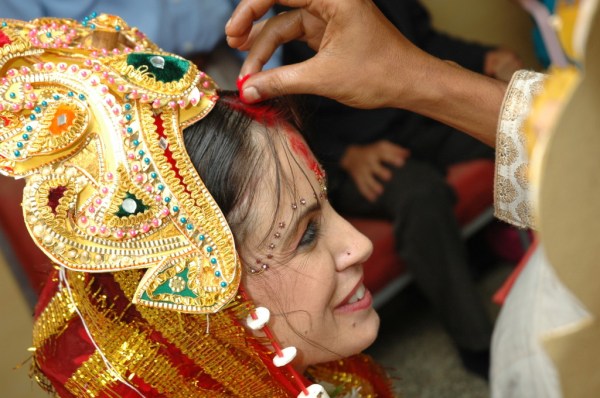
Hair style have different purposes and uses. Parting of hair and the vermilliom/ Kunkum in that parting means she is a married Hindu woman.


The Khamti tribal woman use the hair style to show whether she is married or not. The elevation of the hair on the crown of the head indicates that she is married. Unmarried girls wear it in a low down the occiput (back of the head).


vv-aani-4

vv-anni-5

Todamen and woman of Nilgris, Tamil Nadu (Tribals)


–SUBHAM–


Hair Styles of the Tribes and Castes of India (Post No.3208)

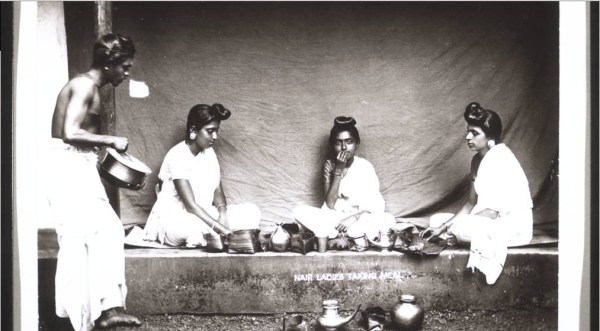
nayars-of-kerala-wiki

Nayars of Kerala

Compiled by London Swaminathan


Date: 1 October 2016


Time uploaded in London: 21-20


Post No.3208


Pictures are taken from various sources; thanks.


Contact swami_48@yahoo.com


From Arthur Miles book , “The Land of the Lingam” , Year 1933


Kondhs Hair Style

Both men and women among Kondhs paid much attention to their hair,decorating it with flowers and huge pins made of deer horn. Young girls wear pieces of broom in their ears until they are married, but once married they adorn themselves with as many  earrings as their husbands can afford.


Xxxx


Hair Style of Nayar women (Kerala) 


The Nair women are the most beautiful women in India. Their bodies, with very few exceptions, would cause a sculptor to take out his sketch book and sharpen his pencil. They wear very little clothing, but what they do wear is frequently washed and changed. Their hair never looks greasy as other Indian hair, and they wash it frequently with the pods of saponaceous plants. Their skin is their great pride, and any eruption on it considered a disgrace. They wear no head dress, but often decorate their hair with flowers. They mutilate their beauty in but one way –the lobes of their ears are dilated with pieces of metal. Contrary to the usual custom, they have their nose ring in the left nostril and they wear many gold bracelets and finger rings. A favourite talisman consists of the hair from an elephant’s tail, plaited and worn on the wrist.


Xxxx

img_2170

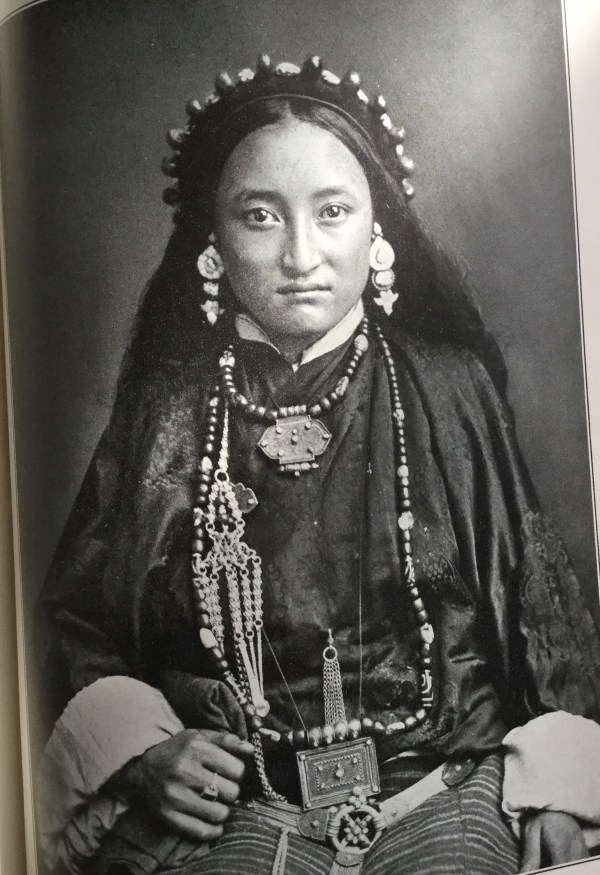
Lama woman

Maali’s (Gardners) Hair Offering


Once the Maali returned without hair on his head or face and looking like a plucked chicken. A few days later, while planting a bed of dahlias he told us the why and wherefore of his denuded condition. A poor family, who have little to give to the gods, will promise the hair of their child. The child is then brought up with this promise in mind, and the sacrifice is made. It is, however, a sacrifice where the poor feel that they can at least offer as much as the rich, and give prodigally of the hirsute offering.


This sacrifice is especially meritorious when made by a woman, who has to face her friends and relations shorn off the beauty she has nurtured and trained with so much care. What becomes of the hair is the secret of the Brahman priests but in the temple of Palani near Madura and in the temple at Tirupati , one can always see sufficient quantities to keep the European markets busy for years. Sleeping on a hair mattress in England, one cannot help casting one’s mind back to the temples of India.


Xxxx


Parting of Woman’s Hair and Sakti Principle 


To illustrate the far fetched meaning dragged into every act of daily life, I quote the following by an Indian writer, because it bears on the Sakti


Written in 1926………


The Hindu ladies in southern India wear their hair parted by a furrow on their crown of head. What is this custom due to?


Ladies in different countries wear their hair arranged in different ways. Some wear it in a single pig tail while others are in two or more pigtails and so on. A large quantity of curl paper is made use of in the countries of the West to give the hair an artificial curl in place of one denied by Dame Nnature. But the Hindu ladies wear their hair parted on the crown a line running from front to back. In the case of grownup and aged dames , the hair is simply gathered in a knot,

Whereas young girls and women wear it in a single pig tail. But everyone wears it parted on either side leaving furrow like streak of skin exposed on the crown of the head…,

Like every other Hindu custom this also followed with a particular significance attached to it. A woman symbolises Sakti or Power. There is also a myth emphasising this statement. Siva, one of the Hindu Trinity, was once conceited and thought he was the all in all. His wife, Uma , wanted to teach him that without her help , he would be able to achieve nothing. With this object in view She, who was always with Him and in Him, left him for a while. Siva all on a sudden felt himself deprived of all his strength and energy to activity! He was lying in a precarious condition, unable even to stir when his wife there. He prayed to her to lift him up. She told him that he might try to stand up without her help, as he could not do so he had to acknowledge her position as Sakti.


After a lot more of the same, the author says, this is the reason why Sakti is assigned a very important place in every form of worship and in temples “……….


When once this fact is grasped the custom of leaving a furrow on the crown of woman’s head parting the hair into the right half and the left half will be intelligible. It symbolises the radiation of the positive and the negative energies from a central place…..,”


The furrow…represents in a masterly manner this completion of the circuit between two mighty positive and negative centres, resulting in the mental plane in the formation of the universe in the beginning, to be later on crystallised and materialised into the coarser world we see ………”


The writer of the above evidently became a little involved. But let us hope that when a woman has got away from the pigtail stage and furrows her hair properly, she will understand the completion of the circuit between two mighty positive and negative centres.


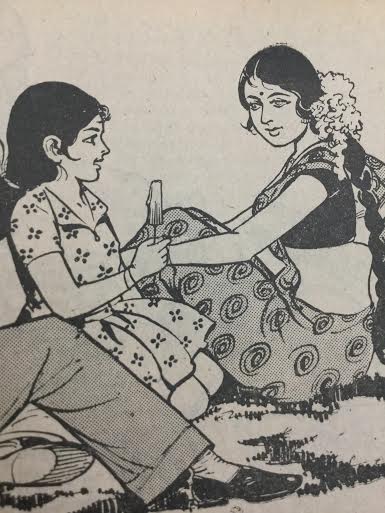
two-women-1

Xxxx


Widows hair style

Brahmin widows shave their head and cover it with her saree. A particular colour saree, like ascetic s saffron robe, is worn them ;but this is not practised anymore.Among the Tamil Vaishnavites, Tenkalai Vaishnavites are forbidden to cut their hairs.


–Subham–


Vedic References to Hair Styles – Part 2 (Post No.3205)

chidambaram-1

Hair style of Chidambaram Dikshitas

Research article written by London Swaminathan


Date: 30 September 2016


Time uploaded in London: 21-45


Post No.3205


Pictures are taken from various sources; thanks.


Contact swami_48@yahoo.com


Please read First part and then continue here:-


Source book Vedic Index of Names and Subjects by Keith and Macdonell:–

Kesa , hair

This is a word used until today in almost all the Indian languages to denote hair. Atharva veda and later Vedic literature repeatedly use this word for hair of the head. The hair was a matter of great concern to vedic Hindus and several hymns of the Atharva Veda (AV 6-136-137) are directed to securing its plentiful growth. Cutting or shaving the hair is often referred to (AV8-2-17;  for a man to wear a long hair was considered effeminate (Satapata Brahmana 5-5-3-1). As to the modes of dressing the hair, it is given under the words OPASA and KAPARDA.

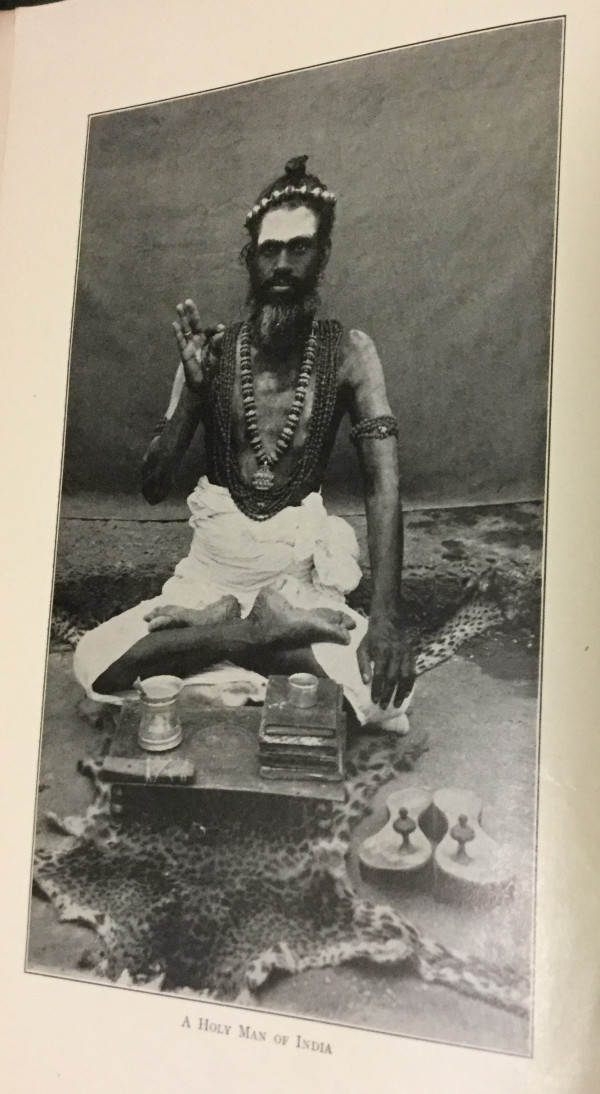
holy-man-of-india


Ksura, razor (mayir kurai karuvi in Sangam Tamil Literature)

Ksura occurs three times in the Rig Veda. The word appears to have the general sense of ‘blade’ in one passage, possibly also in another where it is said that the hare swallowed a Ksura and where the sense blade  is adequate.  In the third passage there seems to be a reference to the sharpening of a razor on a grind stone (Bhurijos), but Muir, following another view of Roth, adopts the sense, ‘the edge of the scissors’ which hardly suits the other passage , one in the Atharva Veda, where a Ksura is described as moving about on the bhurijos as the tongue on the lip. The meaning razor is perfectly clear in the Atharva veda  where shaving by means of it is mentioned; in many otherpassages either sense is adequate.

A ksuro bhrjvan occurs in the Yajur Veda; it seems to denote, as Bloomsfield suggests, a razor with a strop. Ksura dhaaraa denotes the dge of the razor. In the Upanishads (Kausitaki Upanishad) a razor case (Ksura dhaana) is mentioned .


My comments

As  usual, no two ‘scholars’ agree; as usual seems to be appears to be etc indicate they don’t know what they are talking about.

Hare swallowing a razor may be an idiom meaning something else. Tamils translated Vedas as Marai (Secret) because nothing is said openly.


dikshitar-priests-festival-ceremony

Daksinataskaparda

This is a term used as an epithet of the Vasisthas in the Rig Veda (7-33-1) referring to their mode of wearing the hair in a braid on the right side.

My comments:-

As I mentioned under KAPARDA, even today Nampoodiri Brahmins of Kerala, Tamil Dikshitars of Chidambaram have different hair styles. It is very interesting to note that such hair styles are follwd by certain sects started in the Vedic period. This must be the oldest hair style followed in the world!


Palita ,grey haired

Palita occurs frequently from the Rig Veda (1-144-4; 1-164-1) onwards. It is the distinctive style of old age. Those who, like the descendants of Jamadagni, do not grow old, are said not to become grey haired, while Bharadwaja is described as having in his old age become thin and grey haired. The Satapata Brahmana in one passage observes that grey hairs first appears on the head and elsewhere alludes to the hair on the arms having become grey.


My comments

Sangam Tamil Literature which came  approximately 2000 years after the Rig Veda, has an interesting verse in Puranaanuru 191. A very old poet had jet black hair. Everyone was wondering how come the poet Pisiraanthaiyaar still maintain the hair in such a good condition. He revealed a great truth:-

If you ask me how it is

That I am so full of years

And yet my hair is not grey,

It is because

My wife is virtuous,

My children are mature;

Younger men wish

What I wish,

And the king only protects,

Doesn’t do what shouldn’t be done.


Moreover, my town

Has several noble men, wise and self possessed

–Purananuru 191

nampudiri

Nampoodiri of Kerala

If everyone in a  family is at the same wave length, there is no worry; and no greying of hair.

Probably Jamagdagni also had such an understanding family!


To be continued………………..


Vedic References to Hair Styles – Part 1 (Post No.3200)

bengali-3

Research article written by London Swaminathan

Date: 29 September 2016

Time uploaded in London: 15-43

Post No.3200

Pictures are taken from various sources; thanks.

Contact swami_48@yahoo.com


Vedic literature has got lot of references to hair and hair style; the number of words used to describe the hairdos shows that they are from an advanced civilization and who were leading city life; otherwise they wouldn’t have so many terms. The foreign writers who studied these words couldn’t explain the meaning and as usual made wild guesses and showed themselves as laughing stocks! And those “so called scholars” described the Vedic Hindus as nomads. Here are some words and what foreigners ‘think’ about them!


Source:-Vedic Index of Names and Subjects by Keith and Macdonell


Opasa


Opasa is a word of somewhat doubtful sense, occurring in the Rig Veda, the Atharva Veda and later literature. It probably means a plait as used in dressing the hair, especially of women, but apparently, in earlier times of men also.


The goddess Siiniiivaali is called SVAUPASA an epithet of doubtful sense, from which Zimmer conjectures that the wearing of false plaits of hair was not unknown in Vedic times what was the difference between the braids referred to in the epithets PRTHU STUKA= having broad braids and VISITA STUKA =having loosened braids and Opasa cannot be made out from the evidence available. Geldner thinks that the original sense was ‘horn’ and that when the word applies to Indra it means diadem.


My comments:

The above passage has got lot of doubts. Like no two cloack agree, no two foreigners agreed on vedic words. Everywhere they express “DOUBTS”. If we agree with Zimmer that shows that the Vedic Hindus are not nomads because they used advance artificial hair accessories. If we don’t agree them and go with Geldner that shows it is crown/diadem in in men and and a stylistic hair do in women. I think that is correct because in Tamil MUDI means hair as well as crown.

yazidis

Yazidis (Vedic Hindus of Iraqi Mountains)

Kaparda, braid  (RV 10-114-3)

Kaparda means braid and Kapardin means wearing braids. These words describe the Vedic custom of wearing the hair in braids or plaits. Thus a maiden is said to have her in four plaits (catus-kapardaa), and the goddess SIINIVAALII is described as wearing fair braids (su-kapardaa).

Men also wore their hair in this style, for both Rudra and Puusan are said to have done so, while the Vasisthas were distinguished by wearing their hair in a plait on the right (dakshina- kaparda). The opposite to wear one’s hair plain (pulasti).


My comments:

Opasa and Kaparda are used for goddess Sinivali; that shows these terms are different hairstyles or hairdos.

The terms Four Plaits, Right side plait are interesting; nampudiri Brahmins of Kerala, Dikshitars of Chidambaram and Choza country Brahmins (Soziyan) have different hair styles; Sangam Tamil Literature describes the women having five plaits (AIM PAAL0. Some commentators interpret them as five different hairdo. But I have posted the picture of Vedic Hindus of Iraq, known as Yazidis with four plaits and five plaits in my year 2015 post.


Kumba

Atharva veda (6-138-3)mentions Kumba with Opasa and Kuriraas an ornament of woman’s hair. Geldner thinks that, like those two words, it originally meant horn, but this is very doubtful. Indian tradition, simply regards the term as denoting a female adornment connected with the dressing of the hair.


My comments

Again we have the word ‘doubtful’ in the commentary. Throughout the Vedas, foreigners use this word and words such as ‘meaning is obscur’e, ‘uncertain’, ‘not clear’, ‘may mean thi’s, ‘probably this, probably that’, we ‘guess’ etc. This is like a blind man trying to describe the sun.


Again this word shows that the women of Vedic society were advanced in civilization and they were using hairpins and other ornaments to fix their hair. Many cultures, even aborigines, would have used such things. But putting them in a religious book and preserving it for thousands of years differentiate them from other uncivilized people. One should pause a second to think why did they use so many words for a Goddess Sinivali’s hair style.

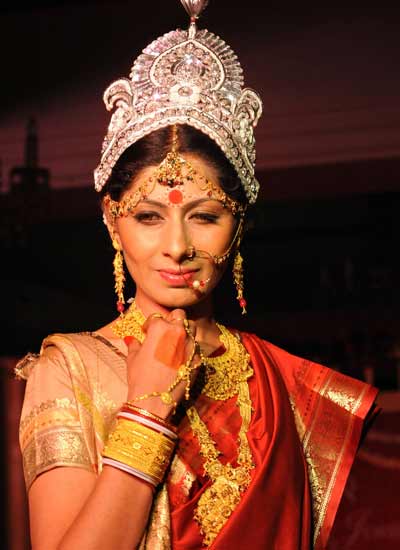
bengali-wedding-dress-4

Kuriira

Kuriira, like Opasa and Kumba, denotes some sort of female head ornament in the description of the bride’s adornment in the wedding hymn of the Rig Veda (10-85-8) and the Atharva veda (6-138-3). According to the Yajur Veda samhitas, the Goddess SINIIVAALII is described by the epithets su kapardaa, su kuriira, sv-opasa as wearing a beautiful head dress.

According to Geldner, the word originally meant ‘horn’, but this is uncertain, as this sense is not required in any passage in which the term occurs.


My comments:-

Note the word ‘uncertain’ in the above commentary. Foreigners made the biggest confusion in the interpretation of the Rig Veda by wrongly interpreting Dasyus, noseless, sisnadeva: etc. they deliberately gave racial connotation for the words Arya and Dravida which is not found anywhere in Tamil or Sanskrit. They tried to confuse the Hindus and they succeeded in it with the help of Dravidian and Marxist politicians. By the wrong interpretation of the word ARYA they created a Hitler, who boasted that Germans were of the purest Aryan race and caused the death of millions of people.

North Indian women use crowns, Kreetas, Mukutas, head ornaments etc during wedding celebrations. South Indians don’t use that type of ead ornaments. Only South Indian Kings had those crowns, diadems, Kieetas and Mukutas. India is a vast country equal to 20 European cutries. So differences in style exist in different regions.


My Earlier article:

Vedic Hindus’ Hair Style, posted on 22 April 2015

Hindu Hair Style: Why do Hindus put Kumkum on parting of hair?, posted on 28th September 2016 

–to be continued

Hindu Hair Style: Why Hindu women put Kunkum on Parting of Hair? (Post No.3198)

kumkum

Research article written by London Swaminathan


Date: 28 September 2016

Time uploaded in London: 15-30

Post No.3198

Pictures are taken from various sources; thanks.


After reading my article on Vedic and Tamil hair style, a teacher from a Delhi school wrote to me asking for more details about hair style in ancient Indian literature; the school has taken a project on hair style in ancient India; here are some more details:-


Hair Style of the Goddess

Saundarya lahari (waves of beauty) is a famous hymn on the goddess by Sri Adi Shakaracharya. It contains 100 verses. I quote below only two verses here to show the importance of hair style. The mentioning of hair styles in the oldest Sanskrit work the Rig Veda and later Sangam Tamil literature emphasize the importance of hair style in ancient India.
Tanothu kshemam nas tava vadhana-saundarya lahari
Parivaha-sthrotah-saraniriva seemantha-saranih
Vahanti sinduram prabala-kabari-bhara-thimira-
Dvisham brindair bandi-krtham iva navin’arka kiranam;

Oh mother, let the line parting thine hairs,
Which looks like a canal,
Through which the rushing waves of your beauty ebbs,
And which on both sides imprisons,
Your Vermillion, which is like a rising sun

By using your hair which is dark like,
The platoon of soldiers of the enemy,
Protect us and give us peace.

45
(Blessing of Goddess of wealth, Your word becoming a fact)
Aralaih swabhavyadalikalabha-sasribhiralakaih
Paritham the vakhtram parihasati pankheruha-ruchim;
Dara-smere yasmin dasana-ruchi-kinjalka-ruchire
Sugandhau madhyanti Smara-dahana-chaksur-madhu-lihah.

By nature slightly curled,
And shining like the young honey bees
Your golden thread like hairs,

Surround your golden face.
Your face makes fun of the beauty of the lotus.
And adorned with slightly parted smile,
Showing the tiers of your teeth,
Which are like the white tendrils,
And which are sweetly scented.
Bewitches the eyes of God,


In the above slokas/verses, we see the beauty of Goddess Parvati’s hair style described by Adi Shankara. Parting of hair is very important for married Hindu ladies. They apply Kunkum (holy vermillion powder) on the Parting. This is a symbol to identify a married woman.

img_9979

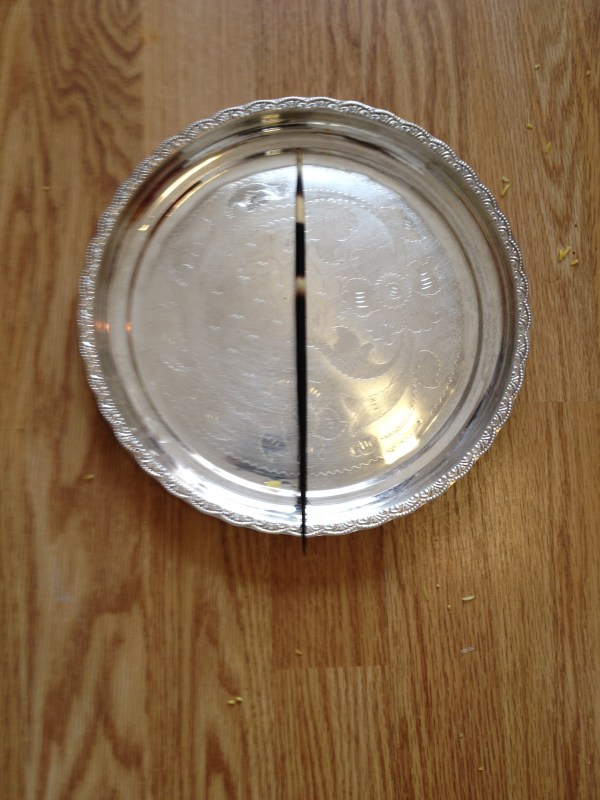
Porcupine needle/thorn

Parting of Hair Ceremony, Acupuncture?

Seemantham means ‘parting of hair’ which is one of the 40 important rituals in the life of the Hindus. This is performed when a woman is pregnant. There are two traditions of doing it: some people do it on the 6th or 8th month of pregnancy and others do it in the odd month of pregnancy (3, 5, 7).


Though there are lot of explanations, I believe that it is an acupuncture ceremony to get a healthy child. The family prays for a male child, but they are happy to get a healthy baby irrespective of the sex.


Since we have celebrated several Seemanthams in our family, I know that the priest uses a porcupine’s thorn to do the parting of hair (of the pregnant lady). This shows that the pressing with porcupine’s thorn has some effect on the health of the baby. Of course there are other things such as the Vedic mantras, shower, gifts from the relatives, big feast, worship of god, blessings of the elders – boost the confidence of the pregnant woman.


The Kunkum (sindhoor used for Tika or Bindi) was a medical preparation in the olden days. The turmeric used in Kunkum has anti-bacterial chemicals. Now they use artificial colouring.

Kunkum wards of the evil eye as well.

So the parting and applying Kunum in the parting has lot of meaning and scienitific basis.

kumkum-2

Hair Style in the Vedic Literature


Vedic literature has the following terms for hair and hair styles; I will explain them in the second part:-


Opasa

Kaparda, braid 

Kumba

Kuriira

Kesa , hair

Ksura, razor (Sangam Tamil Literature has Scissors=mayir kurai karuvi )

Daksinataskaparda

Palita ,grey haired

Pulasti, wearing the hair plain

Sikhanda , lock

Sikh, top knot

Smarsru

Siiman (parting)


Varahamihira and Vatsyayana also discuss the colouring of hair and grooming of hair in their books. I will give them separately.


My Earlier article:

Vedic Hindus’ Hair Style, posted on 22 April 2015


To be continued………………..


Mystery of Horse: Sudden Appearance from Egypt to India! (Post No.3181)

img_8090

Written by London swaminathan

Date: 23 September 2016

Time uploaded in London: 15-30

Post No.3181

Pictures are taken from various sources; thanks.


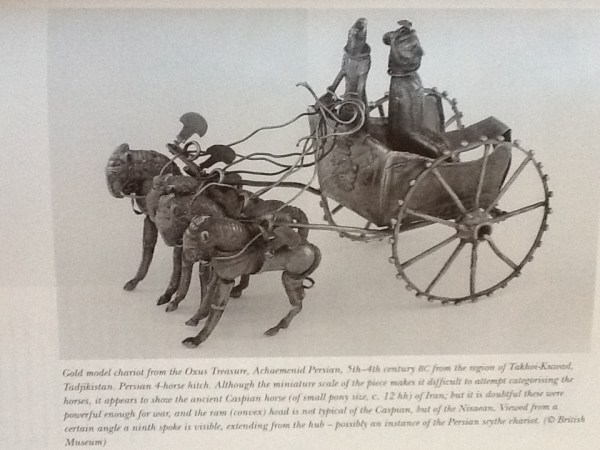
Rig Veda, the oldest book in the world, contains references to horse, horse race, chariots and riding in almost all the ten Mandalas. No other literature in the world has so many references to horses. May be Zend Avesta which came after Rig Veda has some references. We know Homer’s Iliad and Odyssey came nearly 1000 years after the Rig Veda.


A research paper submitted on the basis of fossils discovered in Western India in 2014 showed that the ancient relatives of horses originated in India.

“Working at the edge of a coal mine in India, a team of Johns Hopkins researchers and colleagues have filled in a major gap in science’s understanding of the evolution of a group of animals that includes horses and rhinos. That group likely originated on the subcontinent when it was still an island headed swiftly for collision with Asia, the researchers report today in the online journal Nature Communications. It happened more than fifty million years ago. (20 November 2014 newspaper report)

horse-body-parts

Though there is a very big gap in time between the Rig Veda and the fossils, the fossil discovery shows that horses are not new to this region. Actually a great mystery lies in the fact that horses appeared suddenly in Egypt, Middle East and India at the “same time”. But latest hydrological research in the Sarasvati basin shows that Rig Veda was “composed” or “heard” by the seers before 1900 BCE. The precession of the earth and the stars mentioned in the Vedic literature shows that Rig Veda must have been composed or heard before 3000 BCE. This means that the horses were exported from India to other parts of the world.


Is there any other proof to support this hypotheses? Yes, we have archaeological proof from the Hittite empire. They were trained in Sanskrit!

Mitannian kings had Sanskrit names found in Ramayana and Vishnu sahasranama such as Dasarata, Pratardana. But being distant from the place of origin they had corrupted spellings like Tushratta. We see such trends in Mauritius, Sri Lanka and Malaysia where the migrated Tamils write Turka instead of Durga, Tamayanti instead of Damayanti, Murder mootoo instead of Marudamuthu.


We also find the Sanskrit word asva/horse in their names: Biridaswa (Brhad Asva) possessing great horses, sattasva (Sapta+ Asva), possessing or winning seven horses.


Zend Avesta, holy book of Zoroastrians, also has names such as Drvaspa ( agoddess)- she who keeps horses in good health, Vistaspa ( a king of Bactria), son of Aurvat aspa, Pourus aspa, father of Zarathustra, he who possess many horses, Arbataspa master of war like hoses, Huaspa- having good horses.

Aspa= Asva= Hrasva= Horse

Kikkuli of Mitanni was the one who taught them to use war horses. His horse training manual is in Sanskrit:

Wartanna = vartana = a turn

Akika = Eka = one turn

Tera = tri = three turns

Panza = pancha = five turns

Nava artanna = nava = nine turns.

Foreigners looking at the colloquial form of Sanskrit thought that it was Proto Sanskrit. It is actually the localised Sanskrit. Even today Sanskrit words are Tamilized in Tamil Nadu and the ancient Tamil Grammar book has rules for it. Without understanding this, they thought it was a different language.

img_8091

There is another proof also. The Bogaizkoy inscription mentioned the Vedic Gods in the same order as Rig Veda. When two kings signed an agreement they sealed their agreement with the Vedic mantra. All the scholars who studied Vedas agree that the Vedas originated on Indian soil. This shows that  the Hindu scriptures have spread to Turkey-Syria border around 1400 BCE!

We see horses at the same time from Egypt to India


With the archaeological and linguistics evidence, now it is confirmed that the Hindus went from India to give training in horses. There are more proofs in the Rig Veda:-

The horse was called asva, atya (runner), arvant (swift), strong for pulling (vaajin), the runner (sapti). Mare was called with four different names. Different colours of horses are also described. A white horse with black ears is mentioned in the Athrva Vedas as of special value. Horses were highly prized. Gifts of 400 horse are mentioned. Horses were decorated with pearls and gold. Horses from Indus and Sarasvati were praised high.   Kings had names as Asvapati etc. chariots, races and Asvamedha Yajna are mentioned.

All these show that the technic of raising horses originated in India.

Now that we know the Rig Veda is dated between 1900 BCE and 3000 BCE following dates are better understood:–

Hittite empire, a city rebelling against King Anittas in 1750 BCE, fielded 40 Chariots; Hattusilis I (sathyaseela)  (1650 BCE) fielded 80 chariots at the siege of Urshu; by the Battle of Kadesh (1285 BCE) Hattusas fielded 2500 chariots under Muwattalis II (1306 BCE)


img_8092

The Hyksos (Hindu Yakshas)

Egypt used ‘equus asinus’ first for carrying burdens and then ‘equus caballus’. Asiatic Hyksos captured power in Nile delta in 1750 BCE. They were the one who brought horses from India to Egypt they are shown in chariots.


We see horses in a plaque of Tuthmose III (1479 BCE). Later we see more horses. So around 1400 BCE it is seen on a large area frm Egypt to Plains of Ganges. How was it possible where there was no modern transport like today. It was possible only because India sent trainers like Kikkuli to all the countries


Science of Horses

Mitochondrial DNA tests conducted on over 600 horses from 25 breeds world wide prove that at least 17 genetic groups are involved; that horses originally from diverse locations; and there were at least six locations in which horses were domesticated. At present no direct glimse of how the first horse was domesticated (Daily telegraph, 14-8-2002)


Domesticated horse was present in Mesopotamia from 2500 BCE. Horse remains found in Syria are dated 2400 BCE. Syria and Turkey were under Vedic Kings from very early times under Kassites, Hittites and Mitanni. Standard of Ur depicts five four wheeled wagons with four equids apiece. Mesopotamian horse artefacts are dated between 2800-2500 BCE. Sice the Vedas are dated before this date by astronomical refrences, we may assume that domesticated horses went for India to other countries.


The horse appears in a Sumerian text ‘The Curse of Agade” where the Goddess Inanna of Agade, capital of Sumer, sought to bring harmony to men and nimals, among them the ass of the mountains Anse Kur ra – the horse (2000 BCE)


There are proverbs about horses in Sumerian texts :

You sweat like a horse (it is) what you have drunk

If my burden is always  to be this, I shall become weak (horse says)


Domestic horse remains are recovered from south west Iran. They are from the Kaftari era (2100-1800 BCE)

 img_8088

Biblical reference

Genesis 47:16 has reference to horses. Canaanites had come requesting food from Egypt; this was granted ‘in exchange for their horses, their sheep and goats, their cattle and donkeys’.

Mari used chariotry in war, and also the donkey mounted couriers. From mari comes the earliest personal record of horse riding. King Zimri Lim was advised to take the safer option of riding a mule, or in a chariot, rather than risk riding horses.


The scarcity of horses at this time is shown by the value of a single animal:

A horse is worth 30 times that of a slave

Or 500 sheep

Or 5 minas of silver (2-4 Kilos)

From the above facts  we can prove that the Rig Veda is the first source of horses provided the date 3000 BCE is accepted.


At Jaggayyapeta, India is a relief where the horse is depicted as a symbol of the world ruler- Chakravarti.


The horse sacrifice also appears in Zend Avesta , albeit in religious fiction, when 100 male horses, 1000 oxen, 10,000 lambs are offered to Ardvi sura Anahita on the Hara, the Alborz mountains south of Caspian Sea.

(This shows Zend Avesta is an imitation of Hindu scriptures, sometimes a caricature of the Hindu Vedas)

Source: The horse in the ancient world by Ann Hyland, 2003, Newspaper cuttings and my comments.

img_8085


–subham–

Amazing Fire Walking Ceremony! (Post No.3172)

fire_walking_barrier_breaking

WRITTEN BY London swaminathan

Date: 20 September 2016

Time uploaded in London:10-35 AM

Post No.3172

Pictures are taken from various sources; thanks.

Arthur Mile’s book is full of anti-Hindu stuff. And yet he tells us what he has seen with his own eyes.

From the book The Land of the Lingam by Arthur Miles, London 1933


anastenarides-3

Fire Walking in Greece

“The Fire walking ceremony is not so popular as it used to be, and many castes do not observe it at all. Occasionally three is a ceremony, when fanaticism is mounting pretty high and a community can bear the expense.


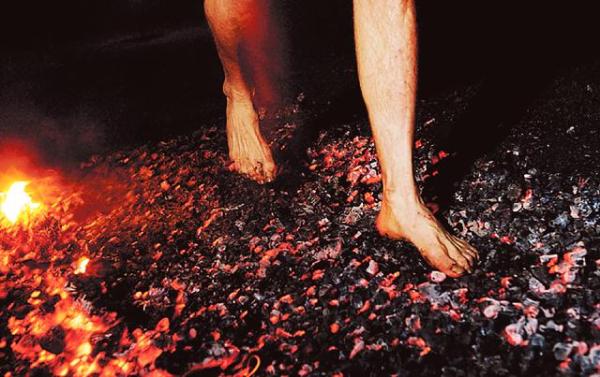
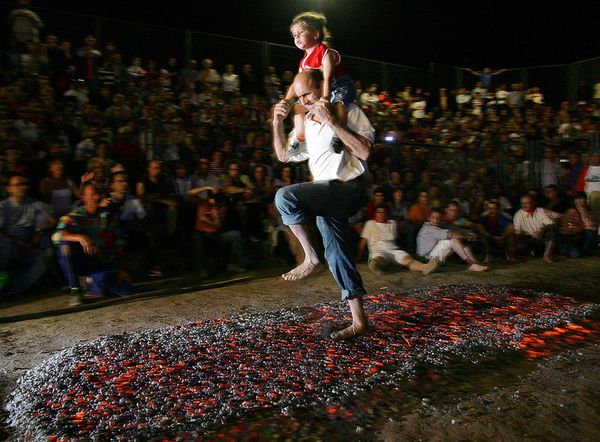
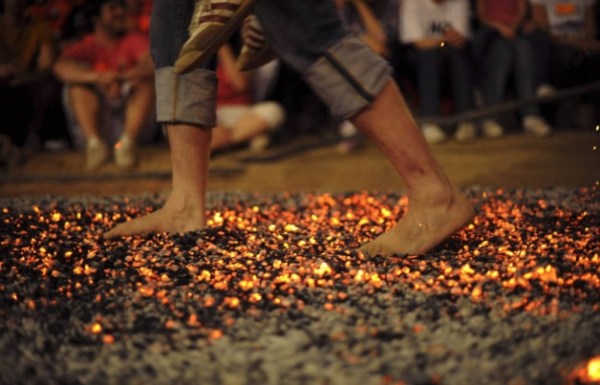
I attended one not so long ago in Mysore state. A pit had been dug, about fifty feet long and about ten feet wide., and when I arrived it was a seething mass of fire. At one end there was a pool of water, through which the performers waded after they had crossed the fire. The fire walkers were dressed I short yellow dhoties and garlands of jasmine flowers. The gods had been brought out, and were arranged along the edges of the pit. I examined the feet of two men before and after they crossed. There was nothing done to their feet to deaden the pain, and there was the slightest trace of a burn. One man, moreover, had crossed through the fire pit in a quite leisurely fashion. I attempt no explanation.


Another man crossed with a baby in his arms, which had been passed to him at the last moment by its mother. For one awful moment I had a picture of the walker, maddened by pain, dropping his tiny burden into flames. Yet, actually, the man smiles as he went, and handed the baby, which was clapping its hands and laughing, back to its mother on the other side of the pool.

An Indian who was watching the performance told me it would rain when the ceremony was over, and the gods would put the fire out. As a matter of fact, it did rain at the conclusion of the ceremony, but I think the gods had less to do with it than the Indian monsoon season”.

firewalk_7217

My comments:-

Why didn’t it rain before the fire walking or during the fire walking? If it is monsoon rain it can rain at any time or always!

Sita Devi was the first one to do fire walking. It is in Ramayana. I have already written about it.

It was performed in ancient Greece as well. Christians have adopted it their own and now do it in churches in Greek villages.


–Subham–


Maamsam and Hamsam: Sanskrit Wordplay!(Post No.3166)


meat

Compiled  by London swaminathan

Date: 18 September 2016

Time uploaded in London:16-34

Post No.3166

Pictures are taken from various sources; thanks.


Sanskrit language is very rich with lot of riddles and puzzles. Manu in his smrti (Law book) deals with one or two things. He explains why MEAT (maamsam) is called Meat. He also tells us why NARAYANA is called Narayana. This shows his interest in languages and Linguistics. Elsewhere others explain the significance of the word HAMSAM (swan) and why great saints are called PARAMAHAMSA. Let us look at these interesting explanations: –


He whose “MEAT” in this world do I eat will in the other world “ME EAT”. Wise men say that this is why meat is called meat – Manu 5-55

The translation of this much quoted verse is based on  that of Charles Lanman, who attempted to recapture the Sanskrit pun: Meat is called Maamsa because he ( sa) eats  me (Maam) in the other world if I eat him now.

Sa = he

Maam = me

xxxx

swan


HAMSA (swan)

A similar pun is made in the Vedantic  texts on the metaphor for the soul, the swan (hamsa), said to express the identity of the individual soul (aatman) and the world-soul (brahman): I AM HE (aham sa)

Aham = I (jeevaatman)

Sa = he (Paramaatman)

One who realised this truth is Parama Hamasa as in Sri Ramakrishna Paramahamsa and Paramahamsa Yogananda.

xxx


narayana

Meaning of Narayana

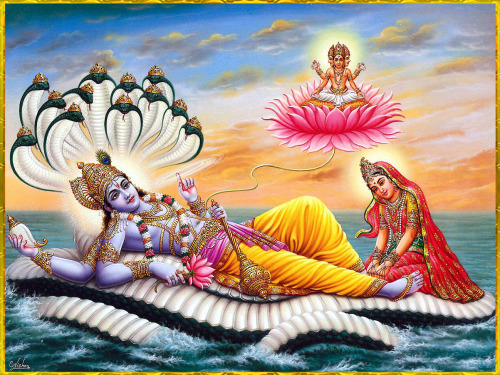
Narayana was the creator of Brahma, who, according to Manu, was so called beacause the wters (nara; Neer in Tamil) were his first ayana or place of motion. Water is always used as plural in Sanskrit).

The name is found for the first time in the Satapata Brahmana. Narayana is another name of Vishnu.


Aapo naaraa iti proktaa apau vai narasuunava:

Taa yadasyaayanam puurvam tena naaraayanah smrutah

Manu 1-10


The waters are born of man, so it is said; indeed the waters are the children of the primordial. And since they were his resting place in ancient time, therefore he is traditionally known as Narayana. (Manu 1-10)

xxx


Following is from my article posted on Tamil or Sanskrit: Which is older? posted on 16 July 2014.


Is NEER a Tamil word or Sanskrit word?

Regarding Tamil words in Sanskrit:

No language is pure in the world. Our forefathers were NOT language fanatics. They freely used Sanskrit words in Sangam literature and later Tirukkural. In the same way Tamil words are in later classical Sanskrit. But I doubt about it in Vedic Sanskrit. I have shown that even great linguists like Suneet Kumar Chatterji are wrong to claim that ‘Neer’ (water) in Rig Veda is Tamil. I have shown that it is in the oldest Greek mythology (Nereids=Water Nymphs). When a word is found in other Indo European languages it is not counted as Dravidian even in etymological dictionaries. But old linguists misled many others and so ‘Neer’ is shown as Dravidian. I have also shown that Kapi and Tuki in the Bible are Sanskrit words. Please read my article “Sanskrit in The Bible”.

In this context, my pet theory is Tamil and Sanskrit originated from a common source on the Indian soil. This is what saints like Paranjothy Munivar and others believed 300 years ago. If we believe our Puranas and Tamil commentators, we accept that Agastya from the north came to South India and codified grammar for Tamil. He was sent by Shiva to balance the population (Please read my article “Population Explosion: Oldest Reference is in Hindu Scriptures”; posted on 2nd February 2013). Naturally Agastya would have done it on the basis of Sanskrit grammar. But even Shiva accepted Tamil as a separate language and entrusted the grammar work to great Agastya. Even Lord Shiva recognised the greatness and uniqueness of Tamil. Do we need any other certificate?


–Subham–