VOYAGE BEYOND THREE SEAS- INDO-RUSSIAN CULTURAL CONTACTS (Post No.5819)

Written by London Swaminathan
swami_48@yahoo.com
Date: 23 December 2018
GMT Time uploaded in London – 16-23
Post No. 5819


Pictures shown here are taken from various sources including google, Wikipedia, Facebook friends and newspapers. This is a non- commercial blog.

Greek, Chinese and Roman travellers or pilgrims visited India long ago. Later French, English and other Europeans visited India and gave their accounts. With the Muslim invaders came Arabic and Persian travellers. But Russian contacts with India was little and was not that popular.

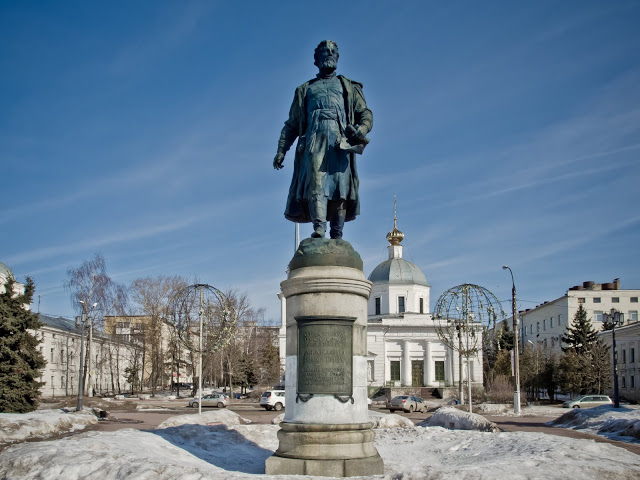
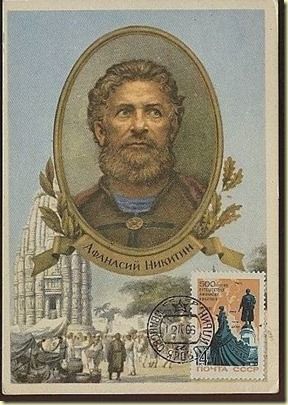
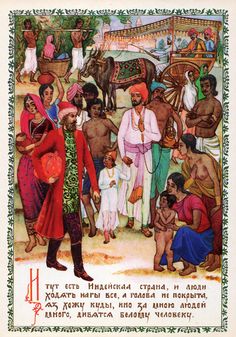
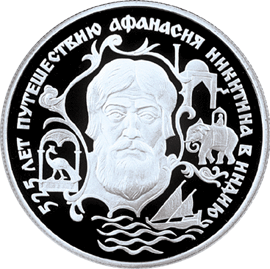
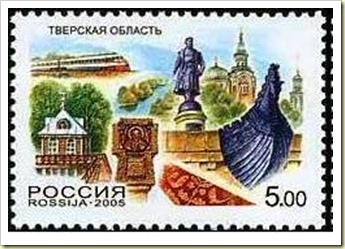
Among the accounts of India, mention must be made of the ‘Voyage Beyond Three Seas’ by the Russian Afanasy Nikitin, a merchant from Tver (present name Kalinin). His historic journey took place from 1471 to 1474. It established direct contact between India and Russia.

Russians came to know about India through Iran and some western countries. Nikitin’s work was the first-hand account by a Russian. It was hailed widely and it was incorporated in Sofiskaya Chronicle.  After Nikitin’s death in Smolensk, his manuscript was taken to Moscow in 1475; thus it was given state importance.

Nikitin sailed to Iran via Astrakhan. This was the usual route of the Russian merchants to the East.  He then followed the trade from Iran to India. During his journey he carefully recorded what grows and where, how much things cost, where was found plenty of pepper and incense and the price of horses etc. The object of his journey was not merely commercial. He had a thirst for knowledge. He made a comparison of the Indian sculpture with the monument to emperor Justinian in Tsarsgrad (Constantinople). His remarks on Indian religion and the kingdoms of Vijayanagar and Bahmani are historically valuable. This is the first account of those kingdoms by a European.
Literary works

Indian literary motifs and stories infiltrated into Russia partly through the Wet and partly through Iran.

Romance of Barlaam and Joasaph was a transposition of the legendary life of Buddha.

Indian texts on the origin of castes came to Russian folklore tradition.

Knowledge of India poured into Russia through the following works

THE NARRATIVE OF MACARIUS OF ROME

VISIT OF ZOSIMA TO THE RAHMANS

NARRATIVE OF METHODIUS OF PATARA.

THE STORY OF THE INDIAN KINGDOM, based on the story of a letter from the Indian priest king John to Greek ruler Manuel Commenus. The letter in Greek appeared in the middle of the 12th century. Russian version appeared in the 13th century.

Alexandria (Alexander’s Romance) by pseudo Callisthenes is also another work.

Fables of Indian origin by Stephanitus and Ihnelates

Polish Chronicle of the Whole Word by M Bielski

Italian Cosmographia by G Botero

Flemish Cosmographia by G Mercator also has Indo -Russian contact information.

Archaeological finds in the form of coins and goods show relations between Kiev and India in 8th and 9th centuries.

In the 14 th century, Sultans of India maintained contacts with Russia. Indian gold coins of the 14th century were found in Volga region.

The ‘Tuglakhnama’ testifies to the service of Russians in the army of Ghiassudin Tughlak.

Babur sent an ambassador to Russian king Vassily Ivanovich

During the regime of Ivan the Terrible (1533-1584) commercial contacts were made. Indian goods reached Moscow through Iran. Indian merchants appeared in the Moscow market.
Gurumukhi Inscription

A bronze vessel with an inscription in Gurumukhi script of 16th century was found in Orsk (South Urals). India merchants appeared in Astrakhan in 1615.They amassed money by money lending business as well in addition to selling precious stones, medicines and incense.

During the rule of Shajehan and Aurangzeb, Russian ambassadors came.

Closer commercial contacts were established during the rule of Peter the Great (1689-1725)

Lebdev learnt Tamil and Sanskrit

In the academic field, lot of exchanges took place. A firm link was established by noted Russian Lebdev (1749-1817). He came to Madras in 1785 and learnt some Tamil. He went to Calcutta and learnt Bengali, Hindi and Sanskrit. He wrote extensively about Indian culture and religion.
Christ Visit to India

There is a tradition that Jesus Christ not only came to India but also studied in the Gurukulam in the Himalayas. He learnt Indian philosophy and the Upanishads from Hindu saints.

The Russian traveller Nicholas Notovich, on the basis of a manuscript discovered in Tibet, wrote in his book entitled Jesus Christ, that he spent twelve years in India.

Bible is silent about Jesus’ teenage years. After talking about birth and boyhood of Jesus it suddenly jumps to his later life. King Constantine was a Christian fanatic and he burnt all other versions of the Bible in the fourth century. Now there is an old Greek version in the British library. Scholars hesitate to reveal the contents because it contradicts the current Bible in hundreds or thousands of places!

TAGS- Nikitin, Russian traveler, Voyage beyond

–Subham–

HISTORICAL ASSASSINATIONS UPTO RAJIV GANDHI’S DEATH (Post No.5772)

Written by London Swaminathan


swami_48@yahoo.com


Date: 12 December 2018


GMT Time uploaded in London – 18-18

Post No. 5772


Pictures shown here are taken from various sources including google, Wikipedia, Facebook friends and newspapers. This is a non- commercial blog.

I am not giving a comprehensive list of assassinations that happened in Indian history. Just to compare the less known assassination that happened in Tamil Nadu I am giving some known attacks. As far as we know it started in 73 BCE and went up to 1991. Tamil poet Tiruvalluvar and Vishnusarman of Panchatantra also mentioned such assassinations.

Devabhuti, the last of the Sunga emperors, who was a weak, dissipated and debauched monarch was assassinated in his bed in dark by a slave girl dressed as his queen. He was killed in 73 BCE on the orders of his minister Vasudeva.

Julius Caesar was assassinated in Rome around that time. And his own friend Brutus was part of the conspiracy. All of us know the ‘Et tu Brute?’ (You too Brutus!) exclamation of Julius Caesar.

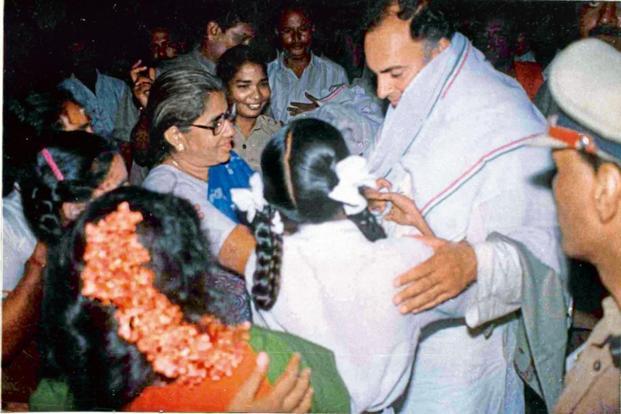
Mahatma Gandhi was assassinated by N Godse in 1948. In our own times Prime Minister Indira Gandhi was assassinated by her own bodyguard on 31 October 1984. Later her own son Rajiv Gandhi was assassinated by a LTTE girl from Si Lanka, near Chennai in 1991.

Tiruvalluvar, author of Tamil Veda, Tirukkural says,

An enemy will twist his words as he bends his bow;

Neither will forbade any good- 827

The meaning is

Do not be misled by the politeness or courtesy of language on the part of enemies. The enemy bends his words as he bends his bow, which is not for your good.

In the next couplet the poet says,

The enemy’s hands raised in salutation may conceal a weapon,

So too, his tears of sympathy are not to be trusted.

This is what happened in the case of Rajiv Gandhi’s assassination.

In Periya Puranam written around 12th century CE by Sekkizar, we have a similar story. It is a sad and heart breaking story.

Here is a summary:

There was a king by name Meyporul Nayanar ruling Chedi country from Tirukkovalur. He was a just king and conquered the nearby territories. He was a great Shiva devotee and respected any one coming with the Saivite symbols such as Vibhuti (holy ash), Rudraksha (holy garland) in saffron or white cloths.

Muthanathan, a near by king who was defeated several times by Meyporul, realised that he would never be able to defeat Meyporul by honest means. So he conspired and took the guise of Shiva devotee. He hid a dagger in a bundle of palm leaf manuscripts and approached the palace.

As usual all the gates were wide open for the ‘great devotee’ and he entered the palace room where the king was lying in bed with his wife. Knowing a person coming in an untimely hour, king’s body guard Dattan prevented him from entering the bedroom. But yet Muthanathan introduced himself as a great Guru and he had come with a rare manuscript to show it to the king. Datta could not stop him any more. When the ‘devotee/guru’ entered the bed room, the queen was surprised and got up suddenly. But the king showed all the respect due to any Shiva’s follower. When he asked the reason for his visit at the dead of night, disguised Muthanathan told the king that he had some rare Agama manuscripts and wanted to teach the king.

He also insisted that he should be alone without the queen to listen to the secret doctrines. The king readily obliged and came back all alone. Muthanathan opened the bundle and took the dagger and stabbed the king.

Hearing the commotion, his body guard Datta rushed into the room and caught hold of the assassin. But Meyporul told his bodyguard,

‘Datta, He is our man’. Please take him out of the town with full security and leave him alone; make sure that no one harms him! Datta did as he was commanded.

All this happened  just because the respect for the external Saivite (religious)  symbols! But Meyporul was made a saint among the 63 Famous Saivite Saints and worshipped in all the Shiva temples in Tamil Nadu.

We hear lot of stories even today that terrorists come in different disguises, particularly abusing religious faith and symbols. Since Tiruvalluvar also sings about hidden arms, he might have heard such stories.

Sekkizar, author of Periya Puranam, describes the appearance of Muthanathan in Saivite gear. ‘He appeared white outside (with smeared holy ash) but inside he was black. His mind was full of bad things’.

The world has not changed much from the days of Devabhuti. Even before Devabhuti, Manu gives a list of kings who were dethroned or killed. Vena was one of them who met a violent death from the revolting general public. Something like French Revolution must have happened and Vena was ‘guillotined’.

Tags- Meyporul Nayanar, Muthanathan, Assassinations, Devabhuti

–subham–
MICHELANGELO AND THE CRITIC (Post No.5662)

Compiled by London Swaminathan

swami_48@yahoo.com

Date: 14 November 2018

GMT Time uploaded in London –10-57 am
Post No. 5662

Pictures shown here are taken from various sources including google, Wikipedia, Facebook friends and newspapers. This is a non- commercial blog


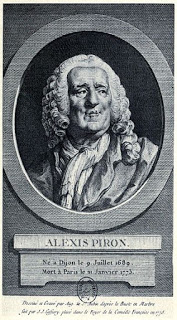
A shallow poet took Piron (FRENCH DRAMATIST)  into his confidence and entrusted him a long manuscript, assuring the critic that the verses contained therein were the best he had ever written . With an air condescension, he asked Piron to put a cross before each line which he thought might possibly be improved. When he asked for his manuscript a few days later Piron handed it to him without a word. Leafing hastily through it, the author exclaimed delightedly,
Why I don’t see a single cross on my paper.
No, returned Piron dryly,
I didn’t want to make a graveyard of it.

Xxx


MICHELANGELO AND CRITIC


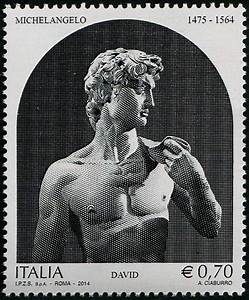
When Michelangelo had completed his great sculptural work, the David, Gonfalonier Soderini of Florence who had ordered it came to inspect his purchase. Among his other criticisms he objected to the nose, pronouncing it to be out of all proportion to the rest of the figure, and added, that he wished some reduction should take place in its size. Angelo knew well with whom he had to deal; he mounted the scaffold for the figure upwards of twelve feet high, and giving a few sonorous but harmless blows with his hammer on the stone, let fall a handful of marble dust which he had scrapped up from the floor below; and then descending from his station turned to the Gonfalonier with a look expectant of his approbation. At, exclaimed the sagacious critic; now you have given it life indeed.

Michelangelo was content, and receiving his four hundred scrudi for his tasks, wisely said no more . It would have been no gratification to a man like him, to have shown the incapacity of a presumptuous critic like Soderini.

Xxx

DRAMA-TIC CRITICISM

Professor Brander Mathews was a great stickler for proprieties. At an opening night he had gone to review a play. The next day he was asked for his opinion by one of his students at Colombia university.
Well, gentlemen, said Professor Mathews, the play was in four acts, and I was there as the guest of the author.
After the first act the audience sat silent and I applauded. After the second act I sat quiet while the audience hissed.

The professor took a long drawn and reminiscent pull at his cigarette, then held it at arm’s length and flicked off the ashes.
And the third act?
Well gentlemen, and there was a gleam of satisfaction in the Professor s eye, after the third act I went out and bought standing room and came back and hissed too.

Xxxx Subham xxx


MEN OF WIT ARE NOT FIT FOR JOBS (Post No.5643)

Compiled by London Swaminathan

swami_48@yahoo.com

Date: 9 November 2018

GMT Time uploaded in London –7-27 am
Post No. 5643

Pictures shown here are taken from various sources including google, Wikipedia, Facebook friends and newspapers. This is a non- commercial blog

Learned Men Anecdotes

Someone once rudely taunted John Maynard, Lord Commissioner of the Great Seal of England, with having grown so old as to forget his law.
“True Sir”, he replied,
“I have forgotten more law than you ever learned” .

Xxxx

PHILOSOPHERS ALSO NEED FOOD

A noble man observing a person eminent for his philosophical talents, intent on choosing delicacies at table said to him,
What! Do you philosophers love dainties?
Why not — do you think my Lord, that the good things of the world were only made for blockheads?

Xxx


MEN OF WIT ARE NOT FIT FOR JOBS
The Duke of Newcastle, when prime minister, once told the author of Tristan Shandy, that men of wit were not fit to be employed, being incapable of business.

“They are not incapable of business, my Lord, but above it, replied Sterne. A sprightly generous horse is able to carry a pack saddle as well as an ass, but he is too good to be put to the drudgery”.

Xxxx


WORDS WORTH AND COLERIDGE COULD NOT DO IT

Cottle, the Bath bookseller, recorded,

I removed the harness…..but…… could not get off the collar. In despair I called for assistance. Mr Wordsworth first brought his ingenuity into exercise, but, after several unsuccessful efforts, he relinquished the achievement as altogether impracticable. Mr Coleridge now tried his hand, but….after twisting the poor horse’s neck, almost to strangulation, and the great danger of his eyes, he gave up the useless task, pronouncing that the horse head must have grown (gout or dropsy) since the collar was put on! for it was a downright impossibility for such a huge os frontis to pass through narrow a collar! At about this juncture the servant girl appeared, turned the collar upside down, and removed it.

Xxx


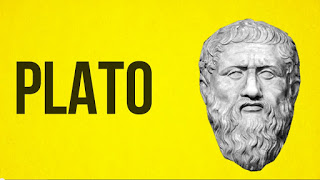
PLATO HAS MY IDEAS!
One of Emerson’s rural neighbor s at Concord borrowed from him a copy of Plato
Did you enjoy the book?, asked Emerson, when it was returned.
I did that, replied his neighbour.
This Plato has a lot of my ideas

Xxx

QUEEN CHRISTINA
Queen Christina of Sweden complimented the celebrated Vossius by saying that he was so well learned as not only to know whence all the words came but whither they were going.

Tags: Plato, Men of wit, Coleridge, law, philosophers

XXX  SUBHAM XXX

ASURAS-DEMONS OF RIG VEDA IN SUMERIA,BABYLONIA,ASSYRIA (Post No.5529)

Research Article Written by London Swaminathan
swami_48@yahoo.com
Date: 11 October 2018


Time uploaded in London –16-21 (British Summer Time)


Post No. 5529


Pictures shown here are taken from various sources including google, Wikipedia, Facebook friends and newspapers. This is a non- commercial blog.


Those who read the history of Assyria, Babylonia and Sumeria will come across lot of surprises. My research in this field shows that the Asuras of the Rig Vedic time migrated to Iraq and Turkey region. After a certain period, Rig Veda stops talking about lineages of certain Rishis or Kings. It shows clearly that they were pushed out of India by the Vedic Hindus to Iran, Iraq and Turkey.


Iran’s link to Vedic civilization is well established and well known, A revolutionary from Krishna’s land in Saurashtra region of Gujarat migrated or thrown out to Iran (old Persia) and he was called Zoroaster.

(According Kanchi Paramacharya Swamiji, Saurashtrar became Zoroaster)

The reason the Parsees came back to Gujarat in eighth century after the Muslim invasion of Iran is that they knew it was their original home.


Those who through the kings list of Sumeria and Assyria will wonder how the Sanskrit names changed or mis spelt there. If one goes through the original list supplied by Manetho (Manu), and Berossus (VARA RUCHI=BEROSSUS,third century BCE) ,one will see Sanskrit names more clearly. Vedic names like Alarka, Aila, Alavaka,Alina are there in the list. Whether it is Egypt or Middle East first king was called Manu, Menes etc.

Rim stands for Ram and Sin stands for Chandra (moon);

in Sumerian language moon god was called Sin, Suen and Nannar.

In Puranic Chronology Pargiter and other scholars were struggling hard when they found two people with the same name. So they concocted new theories or they blamed one or the other Purana or Ithihasa for the ‘mistake’.


Unfortunately, those people never read Egyptian or Sumerian History. There were 14 kings in Egypt with the name Ramesses (Ramesh or Rama seshan). Now let me give the amazing list of Sumerian kings with Sanskrit equivalents: –


WHERE IS ASSYRIA?


Modern Iraq and Turkey; areas around river Tigris.


WHAT IS ASHUR IN SUMERIAN DICTIONARY?


Assyrians can be identified from about 2000 BCE onward through their dialect Akkadian. Assyrians were probably named after the location from where they came. The word Ashur stands for God in the middle east dictionary.


This proved two things–
Asuras of Rig Vedic times migrated to or pushed out to Middle east.

The area they occupied was called Assyria. Even in Ancient Indian history the 56 countries names came from the clans. If Matsyas occupy one area it was called Matsya Desa. If Kambojas occupied one area it was called Kamboja. As and when they spread out to new areas the geographical boundaries of their Desas/countries also changed.


The second thing we know is they came to this area around 2000 BCE. In the older parts of Rig Veda, Gods were called Asura (RV 8-25-4). Varuna, Mithra and Indra had the epithet ASURA. But when the name gets a bad or different connotation, one set of people never used it. For instance, words like Negroes, Pariah (Tamil) are not used any more. In those days Pariah was just the name of Drummers who proclaimed Royal orders.

When one migrates to a new area they always remember their original home and name it after it. Ganga is found throughout the world (see my earlier article about Congo and Nile). We see this in Canada, USA and Australia. The people gave the names of their forefather’s towns or lands and added New with the name. We must remember this when we see same names in the Middle East and Egypt.


The spellings change according to the pronunciation of the local people or under the influence of a local dialect. For instance, Tamil Names in Malaysia, Sri Lanka and Mauritius are spelt differently. Same Sanskrit names are used by these people but with different spellings. Mitanni civilization of 1400 BCE in Turkey used beautiful Sanskrit names Dasaratha, Pratardana, Sathya vachan with local spellings.


If one remember these points and read the Middle East list it will be easier for them to see the truth.


Here are some interesting names:


WHO ARE THE ASURAS OF RIG VEDA?


Amarakosa, the Sanskrit thesaurus called Asuras Purva Deva (formerly God). So the ancient scholars knew that the connotation changed slowly. in our own times Panchamas,Pariahs, Dalits, Harijans, out castes, Sudras – all these changed the connotations in course of time.

Dravidian political parties dubbed all Non -Brahmins as Sudra in their political propaganda. Mahatma Gandhi coined a new word Hari Jan for the out castes or the low class people.


The great priest of the Asuras Usanas Sukra belonged to a branch of Bhargava or Atharvan family of Rishis. Puranas mentioned the descendants of all other Brahmin families except the descendants of Sukra Atharvan and his Asura followers. Even Lord Krishna praised Usanas Kavi in Bhagavad Gita. This means the Asura followers or the Atharvan priests left the country and migrated to Iraq/Assyria and Iran.


The word Asura was pronounced Ahura in Iran.Their priest Zarathustra bore the title SPITAMA or white Which is same with Sukra (white) of rig Veda. All these cannot be mere coincidence.

This is a clear proof for their migration to Iran.


in short the Devas and asuras quarreled in ancient times and one group migrated to Iraq and Iran. That is why we see Rig Vedic Gods in Bogazkoy (Turkey) inscription of 1400 BCE and Ahura Mazda in Iran/Persia and Ashur kings in Assyria/Iraq.


Kings List of Assyria


Puzur Ashur I 2000 BCE

Naram Sin (Nara simha or Nara Chandra or Nara Sena)

Sena titles are very common in Mahabharata; at least 24 kings with Sena names in Mahabharata.

Ashur Rabi – around 1500 BCE (Rabi- Ravi/Surya/Sun)

Ashur nadin ahhe

Ashur Nirari 1426 BCE (N and M are interchangeable; it may be Murari)

Ashur bel nishesu 1410 BCE

Ashur nadin ahhe II 1402 BCE

Ashur Ubalit I 1365 BCE


Then there are seven kings with ASHUR title  until 1000 BCE.

Some kings names were used up to four times with I, II, III, IV numbers.


We come across at least Four Dasarathas until Asoka’s grand son’s time in Indian History.


After 1000 BCE we come across at least 20 Asuras in Assyrian king names including the famous Ashur banipal of 668 BCE

Sanskrit name Sargon (Sat Guna or Satrugna) is found in Sumeria, Assyria and other geographical locations. First Sargon ruled Akkad in 2340 BCE.

Ram’s Name


Rim Sin (Rama Chandra or Rama Sena) – 1822 BCE (ruled from Larsa)

Rim sin II – 1741 BCE

Sin in Sumerian is Moon God; Sin= Chandra


There is another proof for using only Gods names in Sumeria:

ADAD and MARDUK- gods’ names were used by at least 20 kings.


Like today’s Hindus use  Chandra as prefix and suffix Sumerians also used Sin either before the name or after the name.


Chandra Sekara

Chandra Murthy

Chandra Hasan

Chandra (female)

Chandramati (Harischandra’s wife)

Chandravati etc


Rama Chandra

Purna Chandra

Vipina Chandran

Examples

Sin Iddinam 1849 BCE

Sin Eribam 1842 BCE

Sin Iquisham 1840 BCE


xxx


Rimush ruled Akkad in 2284 BCE

Naram Sin in 2260  BCE ( other areas also had this name)

Amar sin (Amara Sena or Amara Chandra)- 2046 BCE from Ur

Shu Sin 2037 BCE (ruled from Ur) Susena or Suchandra

Ibbi sin – 2026 BCE


Danava =Daitya = Asura = demon


The word DANAVA is in the Rig Veda a metronymic of the demon Vritra, who is regarded as an evil spirit in the form of a serpent preventing rain fall (RV 2-12- 11). Danava simply meant a demon. Indra killed him.


Stories of killing snake dragon are in Sumerian civilization as well. Probably,being of Hindu origin, they alo used the same symbolic language, where snake dragon stands for natural obstacles or catastrophes.


Madhu and Lavana, the Yadava kings were also called Danavas (Hari vamsa). Jarasandha, Kamsa were also called Danavas.


CONCLUSION


INDIAN HISTORY MUST BE REWRITTEN IMMEDIATELY.


Foreigners wrote our history and gave the list of kings only from Buddha period. We must include all the 140+ generations before Buddha.

When we come across same names twice or more times

we must remember Egyptians used the same king’s names 14 times

Sumerians 4 or 5 times.


We must remember the names get corrupted the more you travel in time and space (best examples Tamil names in Malaysia, Sri Lanka and Mauritius).

We must remember words like Ashur and Deva change connotation in course of time like our Panchama, Pariah, Dalit, Sudra, Hari Jan


We must also remember that in the beginning the areas or countries were called after the clans that lived in that area and when they moved the geography also changed. When we see the same Kambojas in different areas at different periods, the name of the country should not mislead us. Look at Kamboja in India and Kambojas in Cambodia.


We must teach our children a Dasaratha (tushratta) ruled Turkey in 1400 BCE and his letters are in Egypt now. This is in all history books in foreign countries but not in India- see Mitanni civilization, Amarna letters, Bogazkoi inscriptions in Wikipedia etc.


We must teach our children that the names of Vedic gods were used in the agreement in Turkey in 1400 BCE


We must include some ancient history in our syllabus from Sumeria, Babylonia and Assyria to show the possibilities of having same names used umpteen times, corruption of Sanskrit names etc (Tushratta=  Dasaratha in Turkey) and to show history begins in 3000 BCE in Egypt, Mayan and Sumerian. In India History begins from 600 BCE. This must be rectified with immediate effect.


–subham–


Three Layers in Rig Veda (Post No.5509)

Compiled by London Swaminathan

 
swami_48@yahoo.com
Date: 5 October 2018


Time uploaded in London –18-47 am (British Summer Time)


Post No. 5509


Pictures shown here are taken from various sources including google, Wikipedia, Facebook friends and newspapers. This is a non- commercial blog.

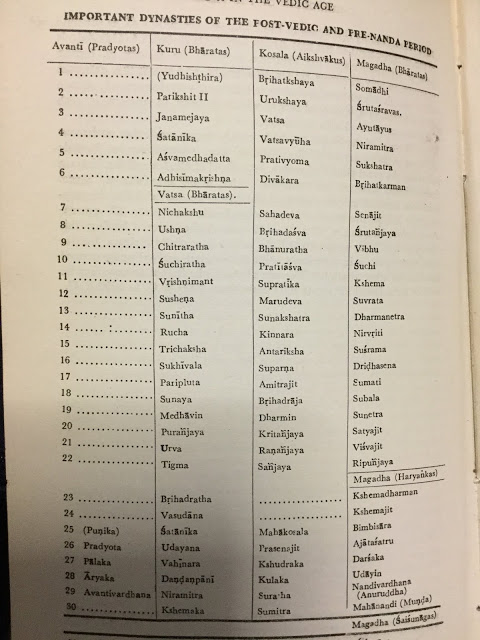
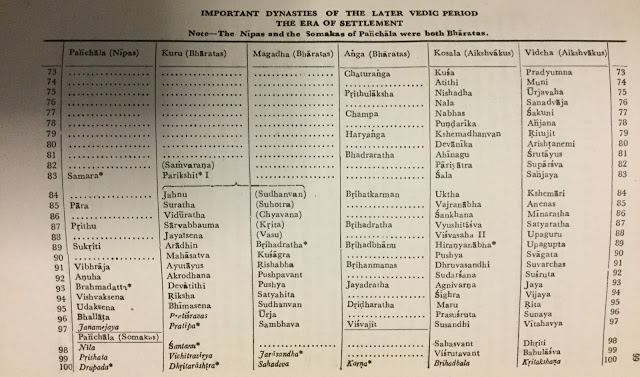
Purushottam Lal Bhargava in his book ‘India in the Vedic Age’, published in 1956, made the following interesting remarks

Pre Divodasa-Sudan’s Rishis/seers
On examining the hymns, we find that those of them, which are attributed to rishis (seers) who are known to have lived before these kings never mentioned, while the hymns ascribed to rishis who are known to have been the contemporaries of Divodasa and Sudas or to have lived later, often mentioned their names.


Thus the rishis,
Chyavana
Kavi
Usanas
Avatsaara
Devala
Asita
Budha
Archananas
Andhiigu
Naabaananedhista
Vatsapri
Brihaspati
Samvarta
Diirghatamas
Saaryaata
Nahusa
Yayaati
Maandhaatri
Trsadasyu
Vasumanas
Tryaruna
Puuru
Suhotra
Ajamiidha
Pratardana
Sivi
Mudgala and
Kusika
Lived earlier than Divodaasa and Sudaas and never mentioned the kings names.

xxx

Second Layer
Purukutsa and Trsadasyu
The names of these two famous Vedic kings are mentioned in many hymns, but never in those rishis who lived before them. Sobhari was a contemporary of Trsadasyu. The hymns ascribed to him never mentioned Divodasa and Sudas’.

xxx

Third Layer
Contemporaries of Divodasa and Sudas’s, besides mentioning the names of these kings also often mentioned the names of the Purukutsa and Trsadasyu.
Vasistha, who was a contemporary of Sudas mentioned the name of Sudas and Trsadasyu.

Rishis who were joint authors of hymns are known from other sources to have been contemporaries.
Thus a rishi Manu Samvarani is the joint author of hymn 9-101,with kings Nahusa and Yayati, which means he was their contemporary, and this is borne out by hymn 10-61 in which Nabhaanethista speaks of his father Manu Samvarani being held in high esteem by the princes Yadu and Turvasa, the sons of king Yayati.

Similarly Kutsa Angirasa is the joint author of hymn 9-97 with Vasistha and his sons which means he was their contemporary and this is borne out by the mention of Sudas IN HYMN 1-112 ATTRIBUTED TO KUTSA.

Again hymn 10-179 is ascribed to three kings Sivi, Vasumanas and Pratardana and these were contemporaries according to Puranas.


Judging from the names of authors, the oldest among the books of Rig Veda seems to be Book 5, attributed to ancient Atri family, though it does not mean all the hymns in the book are equally ancient.

Rig Veda has Ten Books or Mandalas

See the attachments for the chronology:


–subham–


TAMIL WORDS IN THE RIG VEDA (Post No.5463)

Research Article Written by London Swaminathan

swami_48@yahoo.com


Date: 
24 September 2018


Time uploaded in London – 6-31 am (British Summer Time)


Post No. 5463

Pictures shown here are taken from various sources including google, Wikipedia, Facebook friends and newspapers. This is a non- commercial blog.


Rig Veda is the oldest book in the world. Rig Veda is the oldest anthology in the world. Rig Veda has the highest number of poets, over 450 poets. Rig Veda is the first book in the world with over 20 poetesses. Rig Veda is dated between 2000 BCE and 6000 BCE by various scholars.


So far as the other ancient language of India, Tamil, is concerned we have got 2000 year old Sangam Tamil literature where we find over 450 poets and poetesses who composed 2500 verses.

We find lot of Rig vedic words in ancient Tamil literature and day to day use in current Tamil language. You may even say Tamil words are found in the Rig Veda, since both the languages evolved from the same source.


I will just give two examples


RAJA/ KING

MANAS/MIND


Both of the words are found in the Rig Veda and Sangam Tamil literature. According to world renowned linguists, both these words Raja and Manas are Sanskrit words.


Raja gave birth to Royal, Regal and scores of worlds.

Manas gave birth to Mind and sores of words in European languages.

What do we reckon when we see these words in ancient Tamil books?

People thought that the Tamils borrowed these words from Sanskrit.


It is not fully correct. Tamil and Sanskrit are the most ancient languages in the world. They belong to the same group. But foreign scholars divided them wrongly into Dravidian and Aryan languages. My theory is that both these languages evolved from the same mother tongue.


In course of time they branched out into two different languages. All Sanskrit and Tamil legends agree on one point- Agastya was sent by Lord Shiva from the Himalayas to Tamil Nadu to write a grammar for Tamil language. How was it possible for a northern Sanskrit speaker to write a grammar for Tamil?

It was possible because both came from the same source according to Thiru Vilayadal Purana.

Do we have any proof for this in the language itself?

Yes. We do have proof.

1.The Sandhi Rules (joining rules for words)

2.The case suffix

3.The alphabetical order

4.The word meaning

5.The similes etc.


Sanskrit is closely related to Tamil than any other language. Even today prose and poems can be written with Sandhi rules. No other language can be written in this way. This structure cannot be incorporated into any language because it is geographically closer. Proximity has no say in the internal structure of a language. More over, it is found in both languages for over 2000 years.


A language can develop in different ways. We know how Indo -European group branched out into Satam (100) and Centum (100) languages. In the same way Tamil and Sanskrit branched out.

Tamil words for One, Eight, Mind are closer to English pronunciation than Sanskrit. But other than 1,8 ,  numbers have different development.

ONE= ONDRU

EIGHT =ETTU

MIND = MANATHU


Surprisingly Tamils used Rajan and Mind in 2000 year old literature. Oldest Tamil Grammar stipulates that no Tamil word should begin with Sa, Ra, La.


So when Sanskrit words are used in Tamil they will add one of the three vowels : A, I, U

(e.g)

loka= ‘U’lakam or ulokam (earth, metal)

raja= ‘A’rasa

Same Raja (king) becomes Arasan in Tamil  AND Royal in English or Regal in English. This clearly explains how the same word is done in two or three different ways in different languages


What can we conclude?

In India there was only one language, may be long long ago. They branched out into Sanskrit and Tamil

Following are some examples to trace King and Mind in the Vedas and Tamil literature:–


Rajan in the Rig Veda

3-43-5, 5-54-7

Atharva-4-22-3-5; 8-7-16

These are just a few examples

Mind in the Rig Veda

RV 10-90 (Purusha sukta) and scores of places


Raja/royal,regal, (Arasan, Arasar, Arasu) in Tamil literature

Kali-27, 129, Kuru.276.

Aka-338, Pura-154

Mindi in Tamil Literature

Pura.183, Akam-231, 273, 259, 377; scores of places in Natrinai, Paripatal and kalittokai


My theory is not based on a few words or few rules. There are 100s of words including Kama (amour), Mukha.


Strangely Tamil has no word for ‘Heart’. Hrut in Sanskrit became Heart in English and hruthaya (Iruthaya) in Tamil. All the Tamil medical books used Sanskrit words freely. All the Tamil spiritual books used Sanskrit words freely,the reason being ancients never saw any difference between the two. I have already written elsewhere that if Sanskrit words are removed from today’s Tamil newspapers or 2000 year old Sangam Tamil literature, the language in them would look like virus affected software. This is applicable to all Indian languages including Tamil!.


Not a single chapter of Tirukkural, the Tamil Veda, would survive intact without Sanskrit. The first couplet and the last couplet stand as  proof.

N.B. Nenju in Tamil is not heart; it is chest.

–subham-


POISON THAT WAS USED TO KILL NAPOLEON, KINGS, POPES AND DUKES! (Post No.5454)

Written by London Swaminathan

swami_48@yahoo.com

Date: 21  September 2018


Time uploaded in London – 18-13 (British Summer Time)


Post No. 5454

Pictures shown here are taken from various sources including google, Wikipedia, Facebook friends and newspapers. This is a non- commercial blog.


How did the British kill Napoleon Bonaparte?

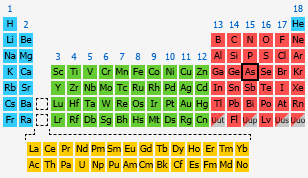
Arsenic is an interesting element in the Periodic Table. It is linked to the death of several Popes, Napoleon Bonaparte and beer drinkers of Manchester.

Here below are given some interesting titbits

1.Napoleon Bonaparte


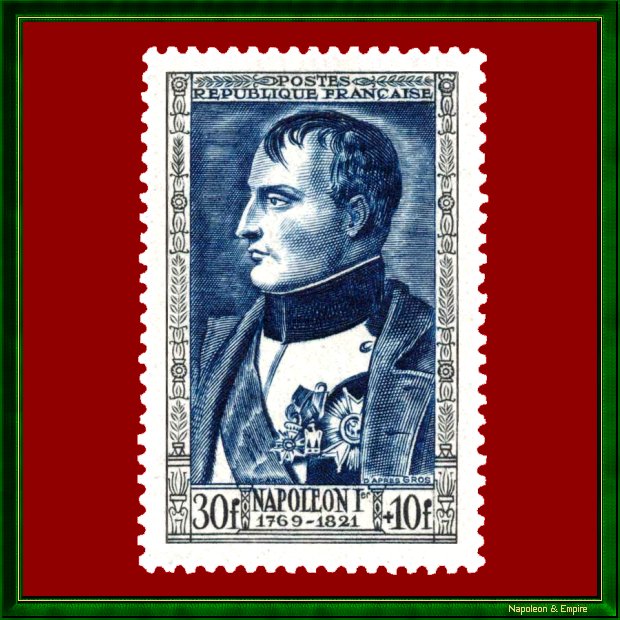
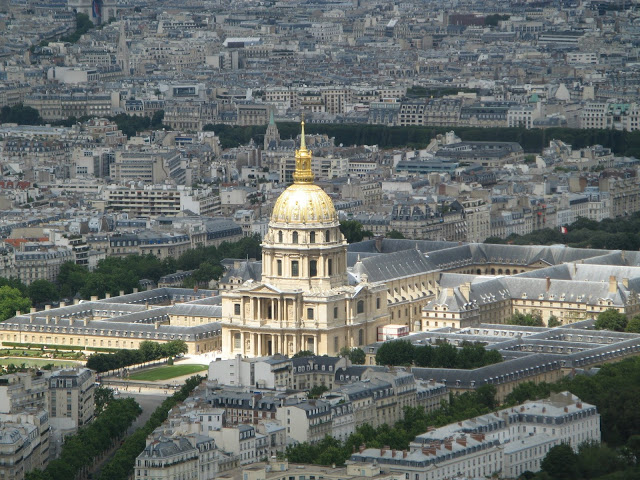
Napoleon I (1769-1821) was emperor of France. A general from 1796, overthrew the rulers and became dictator. From 1803 he conquered most of Europe and installed his brothers as puppet kings. After the Peninsular War and retreat from Moscow in 1812, he was forced to abdicate in 1814 and was banished to the island of Elba. In March 1815 he reassumed power but was defeated by the British and Prussian forces at the Battle of Waterloo and exiled to the island of St Helena where he died. His body was brought back to Paris in 1840. He was buried in Hotel des Invalides in Paris.

High levels of arsenic were detected in his hair when it was analysed by neutron activation analysis. It showed that he was exposed to the element. Some people think it was deliberately done to kill him. Arsenic is a slow killing poison. Modern research shows that it can happen from wall papers with fungal growth under damp conditions.
When a sample of wall paper from Longwood House, his home on St Helena, was found in a scrap book in 1980s  was analysed. The green pattern on it was an arsenic pigment.


How did they kill Popes?
In the past, Popes were also disposed of with slow killing arsenic poisoning. They called it ‘succession powder ‘ because it helped them to kill dukes, popes and kings. The average intake of arsenic in our daily food is up to one milligram. A lethal dose of arsenic oxide is generally 100 milligrams. The body can get rid of it with antidotes.

Horse Race and Charles Dickens
The stimulatory effect of arsenic was exploited by the unscrupulous race horse trainers. In small doses, arsenic stimulates the metabolism and boosts the formation of red blood cells; but prolonged exposure causes health problems

Arsenic was prescribed for all kinds of ailments, such as rheumatism, malaria, TB, and diabetes. It became popular with Dr Fowlers Solution. This was concocted in 1780 by the doctor. In the nineteenth century it was regarded a popular cure all, a general tonic and aphrodisiac, even Charles Dickens used it. It was often prescribed by doctors to aid convalescence.

For 5000 years, ancient civilisations have been using it. Even today it is used in Chinese medicines. More recently arsenic trioxide was approved by the US Food and Drugs Administration for treating a form of leukaemia.
It was used in World War I as a chemical weapon. It caused terrible blisters on skin.

In the 1900s beer drinkers in Manchester were affected by arsenic poisoning and seventy people were killed. In the Indian state of West Bengal high levels of arsenic are found in well waters. The Indian government issued chlorination tablets that will oxidise arsenic trioxide to form an insoluble salt with the iron that is present in the water.

Two more interesting titbits

Soil contaminated with arsenic can be cleaned by growing Chinese ladder fern Pteris vitiata.
According to Roman writer Pliny, emperor Caligula financed a project for making gold from Orpiment and some was produced but so small a quantity that the project was abandoned.

Source book- Natures building blocks by John Emsley.

Arsenic symbol –  As
Atomic number – 33
Atomic weight – 74.92160
Melting point – 616 C
It is a metalloid element.

–SUBHAM —

COMPARISON BETWEEN TAMIL POET AND ROMAN POET HORACE (Post No.5427)

Written by London Swaminathan

swami_48@yahoo.com

Date: 13 September 2018


Time uploaded in London – 21-22 (British Summer Time)


Post No. 5427

Pictures shown here are taken from various sources including google, Wikipedia, Facebook friends and newspapers. This is a non- commercial blog.


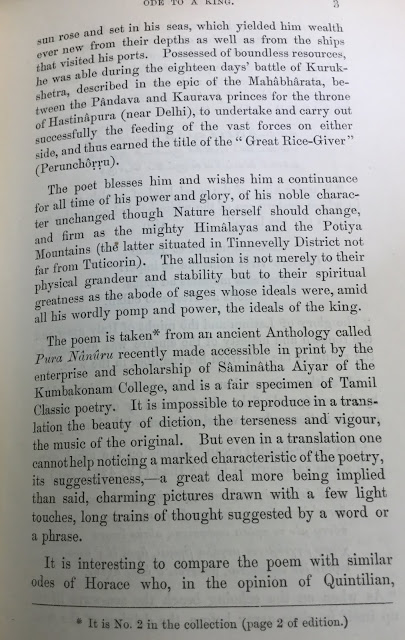
Two thousand years ago Muranchiyur Mudingarayar sang about Tamil Chera King Uthiyan Cheralathan. Around that time Roman poet Horace who composed poems in Latin also sang about kings. P Arunachalam compared both the poets and published an article in 1898. Before you read the comparison, I wanted to make some points on the same poem (verse 2 in Purananuru).


Muranchiyur Mudinagarayar’s poem is part of the oldest part of Purananuru, one of the 18 books of Sangam Tamil literature.

There are some interesting historical information as well as similes. This poem explodes all the Aryan- Dravidian myths. There was no such division.

1.The poet’s name is in Sanskrit Mudi Nagarajan. ‘The one who has snake on the head’- is the literal translation. It may be Lord Shiva or just Naga king. Since we have many Purananuru poets with pure Sanskrit names such as Damodaran,Valmiki, Brahama, Lochana, Parana, Kannadasan (Dayan Kannanar) and Maha chitran, it was not uncommon in those days.

2.Poet Nagarajan refers to Four Vedas and Brahmin’s Three Fires (Garhapatya, Ahavaniyam and Dakshinagniyam) which shows Vedic culture was strongly rooted in Tamil Nadu ( we have other refences to Yupa pillar everywhere, Rajasuyam, eagle shaped fire altar of Karikalan)

  1. The poem reflects Kalidasa’s description of the Himalayas in Kumarasambhavam and other works. The deer are taking rest in the Ahramas of seers where they enjoy the warmth of Sacred fire.

4.Another very interesting point is the reference to Pancha  bhutas. We see it in the Vedas. And the ancient Sanskrit literature always compare the Pancha Bhutas with five qualities of a King. It shows that the thought process was the same from Kanyakumari to Kashmir.

5.There is a debatable reference to Mahabharata war. Chera King praised as one who provided food for the combatants during the great war. The Tamil word used in the poem is ‘Perun Choru’ (Big food or feast). The word is not found nowhere else. Since Mudi Nagarajan was part of Second Tamil Sangam, commentator thought that the king lived during very old time. Linguistics or historic chronology wouldn’t allow any such interpretation. Language is very simple and it cannot be as old as 3102 BCE. If Uthiyan Cheran lived around that time we need a long list of Chera kings to fill the time gap. We didn’t  have such a king list. Chera king Uthiyan cheral was also sung by Mamulanar, another popular poet.


Then what is Big Rice or Big Food or Big Feast

Actually, on the death anniversary of big leaders,  people are fed to keep their memory or sacrifice alive It is just an Anna Dana like Saivite Guru pujas. Since the word is not used anywhere else in Tamil, no one could say whether it is right or wrong. But the language of the poem and the history of Tamil kings provide us enough clues.


6.The order of or the origin of Five elements (Pancha Bhutas) is in ‘Andhati’ style. Not only the style, the matter agrees with the Sanskrit scriptures.


  1. The golden Himalayas (Kanchan Srnga which is called Kanchen Janga now) is mentioned in Kalidasa’s work. Elsewhere I have given it as a proof for Kalidasa’s age. He lived before Sangam Tamil period.

8.There are references to bad omens: a)milk becoming sour b) day time becoming dark (solar eclipse; eclipses are considered bad omens)


9.Last but not the least there is an indirect reference to Agastya in the poem. Why did the poet compare Himalayas and Pothiya Hills? Pothiya Hills is the southern residence of the great seer Agastya who was sent by Lord Shiva to codify a grammar to Tamil language. Researchers say that it happened around 1000 BCE or 700 BCE. So the comparison between Pothiya and Himalayas is a veiled reference to Agastya Muni. Kalidasa refers to Pothiyam and the Himalayas in his Ragu vamsam.


Following is taken from a magazine published in 1898:-


–subham–
WHAT DID I DISCOVER IN INDIA?– JAWAHARLAL NEHRU (Post No.5412)

Compiled by London Swaminathan


swami_48@yahoo.com

Date: 10 September 2018


Time uploaded in London – 17-53 (British Summer Time)


Post No. 5412

Pictures shown here are taken from various sources including google, Wikipedia, Facebook friends and newspapers. This is a non- commercial blog.


Quotes from Jawaharlal Nehru’s ‘Discovery of India’

Man’s dearest possession is life, and since it is given to him to live but once, he must so live as not to be seared with the shame of a cowardly and trivial past, so live as not to be tortured for years without purpose, so live that dying he can say, ‘All my life and my strength given to the first cause of the world- the liberation of mankind’ –Nicolai Ostrovsky
Xxxx

We in India do not have to go abroad in search of the past and the distant. We have them here in abundance. If we go to foreign countries, it is in search of the present. That search is necessary, for isolation from it means backwardness and decay.

Xxxx

Nearly five months have gone by since I took to this writing and I have covered a thousand hand written pages with this jumble of ideas in my mind. For five months I have travelled in the past and peeped into the future and sometimes tried to balance myself on that point of intersection of the timeless with time.

Xxx

On June 15th both were discharged ( Narendra Deva and Nehru) , 1041 days after our arrest in August 1942. Thus, ended my ninth and the longest term of imprisonment.

Xxx

What did I discover?
The discovery of India — what have I discovered.
It was presumptuous of me to imagine that I could unveil her and find out what she is today and what she was in the long past. Today she is four hundred million separate individual men and women, each differing from the other, each living in a private universe of thought and feeling. If this is so in the present, how much more difficult is it to grasp multitudinous past of innumerable successions of human beings. Yet something has bound them together and binds them still. India is a geographical and economic entity, a cultural unity amidst diversity, a bundle of contradictions held together by strong but invisible threads.


Overwhelmed again and again, her spirit was never conquered, and today when she appears to be the plaything of a proud conqueror, she remains unsubdued and unconquered. About her there is the elusive quality of a legend of long ago; some enchantment seems to have held her mind. She is a myth and an idea, a dream and a vision, and yet very real and present and pervasive. There are terrifying glimpses of dark corridors which seem to lead back to primeval night, but also there is the fullness and warmth of the day about her. Shameful and repellent she is occasionally, perverse and obstinate, sometimes even a little hysteric, this lady with a past, but she is very lovable, and none of her children can forget her wherever they go, whatever strange fate befalls them. For she is part of them in her greatness as well as her failings, and they are mirrored in those deep eyes of her that have seen so much of life’s passion and joy and folly, and looked down into wisdoms well.

Each one of them is drawn to her, though perhaps each one has a different reason for that attraction or can point to no reason at all, and each sees some different aspect of her many -sided personality. From age to age she has produced great men and women, carrying on the old tradition and yet ever adapting it to changing times.


What Tagore said………………

Rabindranath Tagore, in line with that great succession, was full of temper and urges of the modern age and yet was rooted in India’s past and in his own self built up a synthesis of the old and the new.’ I love India’, he said, ‘not because I cultivate the idolatry of geography, not because I have had the chance to be born in her soil but because she has saved through tumultuous ages the living words that have issued from the illuminated consciousness of her great ones’. So many will say, while others will explain their love for her in some different way.


Xxx SUBHAM xxx