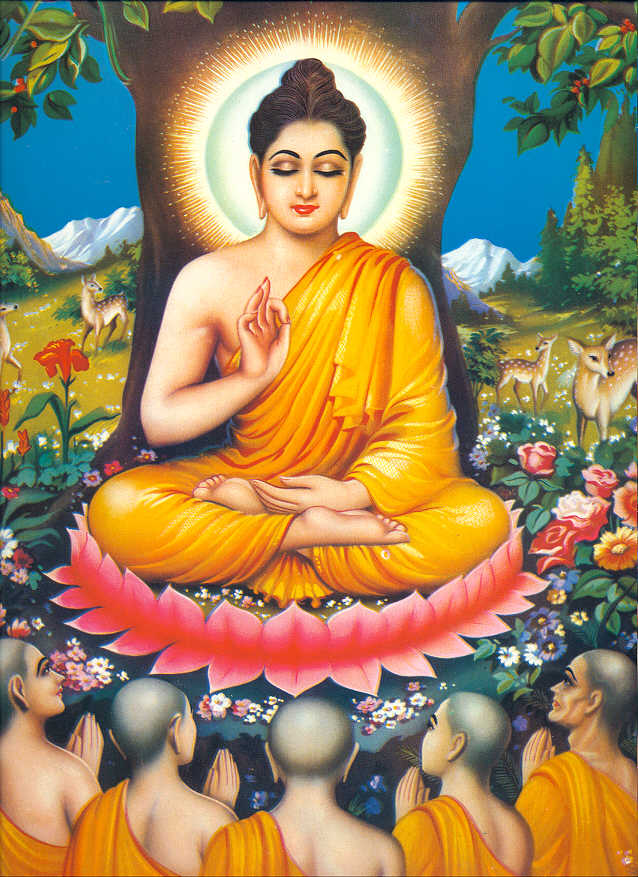
60 second interview with The Buddha


(Questions are imaginary; answers are from The Dhammapada)

Buddha, people say mind is like a monkey, jumping from one thing to another. How can we control it?

The mind is wavering and restless, difficult to guard and restrain: let the wise man straighten his mind as a maker of arrows makes his arrows straight (33).

What is the eternal law?

For hate is not conquered by hate; hate is conquered by love. This is a law eternal (5)

Who is happy?

The man who does good things is happy in both worlds. He is glad, he feels great happiness when he sees the good he has done (16).

Why are thoughts important?

What we are today comes from our thoughts of yesterday, and our present thoughts build our life of tomorrow; our life is the creation of our mind (2).

Can we criticize others when they do something wrong?

Think not of the faults of others, of what they have done or not done. Think rather of your own sins, of the things you have done or not done (50).

Who is a fool?

How long is the night to the watchman; how long is the road to the weary; how long is the wandering of lives (samsara) ending in death for the fool who cannot find the path (60).

Who is wise?

Even as a great rock is not shaken by the wind, the wise man is not shaken by praise or by blame.

What is the source of joy?

Wherever holy men dwell, that is indeed a place of joy- be it in the village, or in a forest, or in a valley or on the hills (98).

 Can we call a person Hero who kills hundreds of people with his AK 47 gun?

If a man should conquer in a battle a thousand and a thousand more, and another man should conquer himself, his would be the greater victory, because the greatest of the victories the victory over oneself (103-105).

Should I postpone doing good things till my old age?

Make haste and do what is good. If a man is slow in doing good, his mind finds pleasure in evil (116).

Lord Krishna (Gita 2-58) compares a tortoise to a self controlled Yogi and you said something similar…

The man whose hands are controlled, whose feet are controlled, whose words are controlled, who is self controlled in all things, who finds the inner joy, whose mind is self possessed, who is one and has found perfect peace-this man I call a monk (362)

Lord Krishna in Gita says Arise! Attain Glory! The Self is the friend and foe of the Self.

Arise! Rouse thyself by thy Self; train thyself by thyself, thy Self. Under the shelter of thy  Self , and ever watchful, thou shall live in supreme joy (379, 380)

Buddha, you have given one full chapter for Brahmins (Chapter 26) in Dhammapada. Who is a Brahmin according to you?

A man becomes not a Brahmin by long hair or family or birth. The man in whom there is truth and holiness, he is in joy and he is a Brahmin (393)

Who is free from anger, faithful to his vows, virtuous, free from lusts, self restrained, whose mortal body is his last- him I call a Brahmin.(400)

One should never hurt a Brahmin; and a Brahmin should never return evil for evil (389)

About misers….

Misers certainly do not go to the heaven of the gods (177)

About Birth……

It is a great event to be born a man (182).

About Love…..

O let us live in joy, in love amongst those who hate! Among men who hate, let us live in love (197).

About Health……

Health is the greatest possession. Contentment is the greatest treasure.  Confidence is the greatest friend. Nirvana is the greatest joy. (204)

Buddha, Thanks a lot. You have enlightened us.


GEM STONES IN KALIDASA & TAMIL LITERATURE


(This is the third part of my thesis to prove that the age of Kalidasa is around 1st century B.C. Please read other two parts as well-S .Swaminathan)

A country’s wealth is reflected in its literature. If the poets always sing about poverty and begging bowl we know that the general public suffered and starved. If the poets sing about gold and gems and enormous wealth and donation it means that the country was wealthy. Kalidasa,the greatest of the Indian secular poets, sings about gold and gems though out his seven books. As a matter of fact he himself was considered one of the Nine Gems (Nava Ratnas) in the court of Vikramaditya who started his own era in 56 BC.


Kalidasa’s praise of Himalayan gems is sung by Sangam poets as well. Sangam poets who lived hundred or two hundred years after Kalidasa might have got the information from his works. If this is the only similarity then we can ignore it as coincidence. But I have identified 225 similes between Kalidasa and Tamil Sangam literature which proves that Kalidasa lived around 1st century BC or before the Sangam period.


Tamil kings were very rich. Tamil literature refers to thrones and cots made up of ivory and gold. The chariots were decorated with gold. Even the elephants had big gold plated coverings to its face. Roman ships poured gold in to Tamil Nadu (South India) and took spices in exchange. This was corroborated by Roman writers of first few centuries and discovery of thousands of Roman gold coins though out South India.


Kalidasa uses 16 names for the Himalayas including Kailash and Kubera saila. He is all praise for the Himalayas. He is so excited whenever he describes the mountains.

“There is in the northern quarter, the deity souled Lord of Mountains, by name Himalaya,who stands, like the measuring rod of the earth, spanning the Eatern and Western oceans”. 1-1:Kumarasambhava


“Snow could not be a destroyer of beauty in the case of him who is the source of countless jewels.” 1-3


“Who bears on his peaks, a richness of metals, appearing like an untimely twilight, with its colours reflected upon patches of clouds, and the cause of amorous decking of the heavenly nymphs.” 1-4


In Kumara I-3 and Ragu. II 29, IV 79 he describes the gems available in the Himalayas.


Tamil poets echo it in Puram 218 (Kannakanar) 377 (Ulochanar )Pattina. 190-198 sung by a Brahmin poet Kadiyalur Rudran Kannanar:

“Brought by the cart, gems and gold from the Northern Mountain

Sandal and eagle wood from the hills of Coorg

Pearls from the southern sea, coral from the east

Ganga’s wealth and Kaveri’s produce

Eza’s provisions and Kazhaga’s plenty “(Pattinapalai 193-197)

In addition to these there are hundreds of mention of all types of gem stones and precious metals.


Nagaratna/Cobra Jewel

(Please read my article :How did Shakespeare know Cobra Jewel-the Indian Nagaratna, where in I have explained what is Nagaratna)


We find the following references about the cobra jewel in Tamil and Sanskrit.

Kakaipatini Nachellaiyar ,a poetess of Sangam period says that the the snakes with cobra jewels are dancing in the holy Himalayas like the women possessed by divine spirits in Pathitru Pathu (6-lines 10 to 1)

Hindus believed that the snakes carried luminescent gem stones on their heads. They used them to find their prey. The general theme is that snakes use the light of Nagaratnam (cobra jewel) and if they lose it, snakes become very upset.


Kalidasa in Kumara Sambhavam : 2:38, 5:43, Raghuvamsam 6:49, 10:7, 11:59, 11:68,13:12, 17:63;Rtu Samharam 1:20

Sangam Tamil poets in  Aka Nanuru 72, 92, 138, 192, 372; Pura Nanuru 172, 294, 398; Kurunthokai 239; Natrinai 255; Kurinchipattu Lines 221,239

This is not an exhaustive list. We find such references in innumerable places.


Pearl in the Oyster

If the rain falls on Swati star day the oysters open their mouth to drink the rain drops and the rain drops become pearls-This was the belief of ancient Indians including Tamils.


Malavi.1-6: Kalidasa says , ‘the skill of a teacher imparted to a worthy pupil attains greater excellence, as the water of a cloud is turned in to a pearl in a sea shell.In Puram 380 ,Karuvur Kathapillay says the same about the origin of pearls. Bhartruhari makes it more specific by saying the rain on Swati Nakshatra days become pearls. Biologits also confirm on full moon days lot of sea animals like corals release their eggs or spores. So far as India is concerned it might have happened in that particular (Swati star with Moon) season.

Kalidasa gives more similes about pearls. He describes the river that is running circling a mountain as a garland of pearls( Ragu.13-48 and Mega.-49)

Other references from Kalidasa: sweat drops as pearl:Rtu.6-7; tears as pearls: Mega 46, Ragu VI 28,,Vikra V 15; smile-KumarI-44, water drops on lotus leaf:Kumara VII 89


In Tamil the teeth are compared to the pearls: Ainkur. 185, Akam 27

Since Gulf of Mannar is the main source of pearls in India ,thre are innumerable references to pearls in Tamil literature. Even Kautilya refers to the pearls from Pandya country. Korkai was the harbour city where the pearl fishing was flourishing. Aink 185,188, Akam 27,130 and Natri 23mention pearls from Korkai.


Ivory

The pearl recovered from elephant ivory is referred by Kalidasa and other poets:Kumar I-6,Ragu 9-65.This is referred to by several Sangam Tamil poets:Murugu 304, Malaipadu 517, Kali 40-4, Puram 170 (V M Damodaran),Pathitru.32 (K Kappiyanar), Natri. 202 (P P Katunko), Kurinji 36 (Kapilar), Akam 282 (Thol Kapilar).

Pearl from bamboo trees is also sung by a Tamil poet in Akam 173 (Mulliyur Puthiyar).

Ivory throne : Ragu 17-21

Akam 369 gem shield ;Kali 40- ivory pestle; Puram 35 –diamond needle

Brahmins deserve an entry in to Guinness Book of Records

(This is written for Brahmins by S Swaminathan. If they do Sandhyavandhanam everyday, they will understand it better.)

(Sandhyavanhana Bhashyam by a layman)
I do Sandhyavandhanam everyday in London (on the banks of River Thames). Every morning I wonder shouldn’t the Brahmins get an entry in to the Guinness Book of Records for using from Astronomy to Zoolatry in their life on day today basis?
1.       A for Astronomy is in our blood. The day , one was born the parents cast one’s horoscope. When I asked about the stars ,my dad showed me the Orion constellation and showed me the red star as Arudra (Betelgeuse) and the three stars as Mrigashirsa.  Below which the V shaped constellation with red colour Rohini (aldebaran) and twinkling six stars Karthika (Pleiades) are seen. Which culture in the world use astronomy and astrology from the day of their birth till the day of death. So we must be entered in to the book of records for this knowledge.
2.       When one gets married the priest shows us  the Arundhathi and Vashista stars in the Saptarishi mandala (Known as Ursa Major or Great Bear constellation). To identify it easily, he shows us the Dhruva star (Pole Star). To identify the northern direction he points out the Tri Shanku (Sothern Cross Constellation) in the opposite southern direction.
Now that I live in London I can’t see Tri shanku stars and the Agastya star (Canopus) because I am away from equator and the Southern sky is not visible here. Which culture in the world has this Star watching ceremony in their wedding? So we must be entered in to the Book of Records for our use of astronomy.
3.       We are the one who use Panchangam on day to day basis. The eclipses are calculated precisely well in advance. Though other cultures like Sumerians and Babylonians calculated eclipses we are the ones that use it continuously to find out the good and bad. Those Middle Eastern civilizations have become a history now their clay tablets and gods are in museum.
4.       A for Arts : Every Brahmin family use arts every day. Whether it is the Kolam (rangoli) or flower garlands to Gods, or singing with Ragas in front of Gods- the art is mingled with our life. No culture in the world uses this as everyday business. Don’t we deserve a place in the Book of Records?
5.       B for Biology is in our blood. Brahmins used to feed ants with some rice in the ant hill every day. I asked the elders why they did this. They told me Brahmins must do Pancha yagna (Five sacrifices) every day and one of them is Bhutayagna (looking after living beings). He told me that was the reason women throw food to the crows every morning and our grandparents giving Agathikeerai to the cows every day. I wondered which culture had this in their day to day life. So we must get an entry in to Book of Records for this Bhutayagna alone.
6.       Everyday Brahmin women cleaned the kitchen with fresh cow dung. Now we knew it is a powerful anti bacterial agent. This is the only animal excretion which doesn’t emit any bad smell which can be used even in the kitchen! Once they even drank cow’s urine almost on daily basis knowing that it is a powerful anti bacterial agent. Now we follow this custom only on the day of Punul Kalyanam as Panchakavyam. No animal’s milk is used on a mass scale as cow’s milk which is the closest to mother’s milk. The Brahmins not only domesticated this animal but also classified it as a holy animal. Which culture in the world does this?
7.       C for Castes: The status of a Brahmin is not decided by caste alone but by virtues. In the Vedic period ,a born Kshatriya Viswamitra became a Brahmarishi and at last Vashista himself called him a Brahmarishi (Vashistar vaayaal Brahmarishi is a phrase in Tamil equivalent to from the horse mouth in English).The most powerful mantra of all the three Vedas is composed by this Viswamitra. Brahmins recite this mantra every day, This shows Brahmins never bothered about castes, but allowed anyone to become a Brahmin by following virtues and controlling passions. Brahmins were the first to throw the caste barriers in to wind. So they deserve a palce in the Book of Records for this achievement.
8.       C for Chemistry in our blood. Elderly people like grandparents are fasting on Ekadasi day and next day they eat only certain type sof food .When I asked them the reason ,they told me that it would soothe the empty stomach. Now I know that they did it because of acidity in the empty stomach, they used Agathi keerai to bring the acidity down. We deserve an entry in to book of records for following chemistry in our day to day life.
9.       D for Dreams and Sleep:   Psychologists and scholars like Sigmund Freud, Carl Jung and William Donhoff interpreted dreams from a different angle. But Brahmins knew that dreams can’t be avoided by any one as it happens to everyone during REM sleep (Rapid Eye Movement) we pray every day at the end o f the Sandhyavandhanam to get rid of  Dus swpnam ( nightmares, bad dreams) only. Ref Mantra Adhyano deva savita—–.
In Western countries, proper sleep is a rare commodity. A lot of people are on sleeping pills. We know that sleep is more important than anything and we pray for ‘sayanam cha me’ (good sleep) in Rudram and Chamakam. Who else pray for good dreams and good sleep in their daily prayers? Even if you don’t say Rudram and Chamakam every day, Brahmin priests
in every Shiva temple around the world do it for us. Don’t we deserve a place in the Book of records for following it?
10.   E for Environment: Go to any South Indian temple and you will see one local tree associated with the temple or god. I went to various temples in Madurai. One god was under Neem Tree another god was under Peepal tree (Ficus Religiosa) and main god Sundaresa had a Kadamba tree. The Ganesh was under a Banyan tree (Ficus Indica). Devotees collect Vilva and Tulsi for Puja. Devotees never ever harm these divine plants. Now I know they cared for environment more than the modern man. That is the reason every temple has a particular tree as Sthala Vriksha. We must get an entry in to the Book of records for this knowledge about environmental protection.
11.   F for Full circle: When one does Sandhyavandhanam one does a  full circle worshipping all the four directions . Which race in the world worship East,South,West and North praying for good news from all the four directions. Perhaps we were the one who discovered clocks and clockwise direction. We do go round temples in clockwise direction. In addition to four directions we add two more up and down and the middle too(aparaya,antharikshaya , Bhumyai nama:) Who in the world worship earth (Bhumi) every day? Don’t we deserve a place in the Book of Records? We show respect to every direction.
12.   G for Geography is in our blood: When we do Puja in London  or India we always start with a sankalpa (Intention to do…..) and this vow has full geography of the place where we do it. Bharata Varshe, Bharata Kande, Mero: Dakshina Parswe.. etc. Now that I live in London I slightly change it to Mero: uttare parswe. I marvelled at the way our mantas are structured. Which culture in the world says their geographical location when they do the Prayer. Even before the GPS system was invented we used our own GPS and said that we do the puja in this particular place on the earth. What a marvellous and amazing geographical sense we have. We must definitely be in the Book of Records for using geography for our daily rituals.
13.   G for Grammar: When we do the Gayatri  Japa we do touch our nose and say Gayathri (24 syllables) , Ushnik (28), Anushtub (32), Bruhathi (36), Pankthi (40), Trustub (44), jagathi  (48 syllables)–all these are Vedic meters. Grammar for writing poetry-prosody. Who in the world use grammar (prosody) term for worship? Don’t we deserve a place in the Book of Records for using grammar for our daily rituals?
14.   H for Homeopathy: In the olden days Brahmins went from village to village to perform pujas and other ceremonies. They have to drink different types of water from different sources like rivers, wells and tanks. The water contamination gave them a lot of diseases. So they invented ACHAMANAM.  Achamanam is sipping water in tiny quantity reciting god’s names. If we drink this way no water infection will affect us. This is the basic principle of Homeopathy: Like cures Likes. If you take the disease causing agents in small quantity that won’t harm your body, because your body develops immunity. Even when they go to temples, they do achamanam first, sprinkle the water on the head and then dip in to water. We must get an entry to the Book of Records for this Homeopathic practice.
15.   H for Heritage: Finding your roots has become a craze in the Western countries. Genealogy websites are doing roaring business. Brahmins touch their heads and recite the names of Seven Rishis (Atri, Bruhu, Kutsa, Vashista, Gauthama, Kasyapa, Angirasa) in their daily ritual. Human beings came from these seven rishis/seers. We have been doing this recitation for ages. This practice matches with the latest Western theory that the entire humanity came from seven mothers.
16.   H for History is in our blood. No culture in the world has so much historical sense as we have. We even know the cyclical nature of TIME. So we start from Manvatara and finish with Kali yugam, year, month, thithi , star etc. The Manvantara calculation goes back to the time of The Big Bang. We must be entered in to Book of Records for using the History of our earth in our every day puja/prayer.
17.   I for Indra: Thousands of years ago our ancestors did worship Indra on the banks of River Saraswathi and Sindhu. Indra is praised in all the four Vedas. He is mentioned as one of the gods of the Tamils in the oldest Tamil book Tolkappiyam. He is later praised in Purananuru and Tirukkural. Brahmins worship Indra every day in their Sandhyavandhanam. When Sumerian, Egyptian, Babylonian gods have gone in to the window showcases of museums we still worship Indra. Indra’s name is still used in the naming of new born children as Surendran, Rajendran, Mahendran etc. on the subcontinent. Brahmins deserve a reference in the Book of Records for this continuity.
18.   I for India : India is in our blood. Indian constitution begins with the line INDIA ,THAT IS BHARATH. Brahmins use it in their sankalpam. Even when we do a ritual inEurope or USA our priests always start the sankalpa mantra  “ Bharatvarshe, Bharata kande.”  Brahmins will never forget the holy motherland India (That is Bharat) wherever they go. For this patriotism we must be entered in to the Book of Records.
19.   J for Japa: When one does Gayathri Japa everyday day one doesn’t stop praying for oneself only. The mantra says ‘we’ ,’us’ ( Na: ). So we pray for all the humanity. That is why Kings of ancient days always funded the Brahmins. Who else in the world pray for ‘us’ in plural in any part of the world in their daily prayers? Don’t we deserve a place in Book of Records?
20.   K for “Kayena vacha manasendhriyair ——Narayanaethi Samarppayaami”:  Bank Clerks count millions of rupees every day, jewellery shop assistant sells very expensive gems and gold every day, sari shop lady assistant displays expensive silk saris everyday but all these people know that the goods are not theirs. Whatever we do or enjoy in this world is not ours.  So we dedicate everything to the God at the end of all our ceremonies including Sandhyavandhan. The mantra ‘Kayena vacha’ reminds us this every day. Nothing is mine and nothing is done by me. If we develop this attitude there won’t be any worries. Who teaches us on day to day basis?
21.   K for “Kamo Karsheet manyura karsheen namo nama:”: Watch any crime film or read any crime story in the newspapers. They were all based on two things: Kama/desire-greed and manyur-anger. We are reminded of this every day by this mantra. (The meaning of the mantra is-The sins generated through desire and anger from ignorance may please be forgiven”). If one sheds these two vices, one becomes God. Aim High is the teaching of Sandhyavandhan. Who does it every day other than Brahmins? Don’t they deserve a place in the Book of Records?
22.   L for Language: When we do Sandhyavandanam every day we use Sanskrit like Christians use Latin in Catholic churches and Muslims use Arabic in mosques. But my teacher told me Sanskrit is the only language in the world which was not named after an ethnic group. That means it belongs to the entire humanity. It is the language of the Gods-Deva Bhasha. We have been using the same Vedic recitation for more than 3500 years without a break. I also thought the person who called Sanskrit a ‘dead language’ must be an idiot. Hindu priests use it every day in the prayers  like Latin is used by the Pope. For this language reason alone we must get an entry in to the Book of Records.
23.   Living Fossil: Brahmins are like living fossils. Jurassic Park of Michael Crichton created a lot of interest in Dinosaurs when Steven Spielberg made a film on it. The reason was people thought one day we can produce even Dinosaurs from the plant resin which contains the gene of a dinosaur. Brahmins who preserve the ancient heritage – The Vedas- are like the plant resin and they may create wonders one day. Kanchi Mahaswamikal said in one of his speeches that Brahmins must preserve this rituals even if they don’t understand the full meaning of it. One day an Adi Shankara  may come again and spread our name and fame far and wide.
24.   M for Mathematics: Everyday in the Madhanhika/noon time Sandhyavandhanam we pray to the sun god to give us 100 years of life. Pashyema sharadash-shatam,Jeevema sharadash-shatam,nandaama sharadash-shatam, modaama sharadash-shatam, bhavaama sharadash-shatam, shrunavama sharadash-shatam, prabravaama sharadash-shatam, ajeetaasyaama sharadash-shatam, jok cha sooryam drushe is a beautiful mantra.(Meaning: We must be able to see, live, speak, hear, enjoy, praise the glory of god for one hundred years). Even Kannadasan has used it in one of the Tamil film songs as Nuuraanduk kaalam vaazka, Noy nodi illaamal vaazka நூறாண்டு காலம் வாழ்க,நோய் நொடி இல்லாமல் வாழ்க. I used to wonder how we use decimal system even in our dally prayers. In addition to it, we pray to Lord Ganesh  as Surya Koti Samaprabha meaning He is as brilliant as 10 million suns. Now the astronomers say that millions of stars in the sky are suns! Even when someone curses they say “ that must break in to Hundred pieces “ (decimal again). For using mathematics in daily prayers ,we must get a place in the book of Records. Tell me which culture uses the decimal system in the daily prayers?
25.   N for Numbers : Brahmins read Vishnu or Lalitha or Shiva Sahasranamam (decimal system again). But they have found the mystic number  9. So instead of just 100 or just 1000 they added 8 to make it 108, 1008. Even when Gayatri is recited in the daily Sandhya we do 108 or 1008.
26.   N for Nature Worship : Worship of nature is part of Hinduism. Sun light, particularly Sandhya/twilight, gives us a lot of peace. It elevates our thoughts. Newer and newer meanings are found for the mantras and our practices at that time .A Brahmin does it every day if he sticks to the saying Kaanaamal konaamal kandu kodu காணாமல் கோணாமல்கண்டு கொடு. (Kaanaamal- without seeing the sun-just before sunrise, konaamal-without getting your shadow-exactly at 12 noon, kandu-seeing the sun-just before sunset, kodu-give the water argyam-do Sandhyavandhanam).
27.   O for OM: Hundreds of pages of articles are available to understand the greatness of this primordial sound. From The Vedas to The Gita, we read it, we recite it. A Brahmin recites this in the Sandhyavandhanam a number of times. Who else does it every day?
Don’t we deserve a place in the Book of Records for all the above categories?
28.   P for Pranayamam: Pranayamam is part of our daily Sandhya. By this breathing exercise we increase our life span. Now the Yoga, Meditation and TM of Maharishi Mahesh Yogi are taught throughout the western world. Even if I want to learn it in London, most of the teachers available are British Whites! If you have learnt it from your father or family priest, your mental health will be far better than many people. Probably in100 year time foreigners will be teaching Pranayama to us in India.
29.   Q for Quest for truth:
Sandhyavandhanam is a proof for Brahmin’s quest for truth. The word BRHMIN has got several meanings: one who has knowledge of god, one who knows god and one who seeks Brahman/God. I will go by the last meaning because two thousand year old Tamil literature has beautifully translated the word as PAARPAAN and ANTHANAN. The meaning is very clear: one who looks inward one who is seer. In the Sandhya , a Brahmin invokes over fifty Gods and 15 Rishis(seers) thrice a day. If the repetitions of God’s names are also taken in to account one will say God’s names hundreds of times. If one recites Gayathri 108 or 1008 times that must be added to the above statistics. The structure of Sandhayvandhanam is amazing. A great genius must have developed this. If one does Sandhayavandhanam that
itself will give him the status of a Brahmin, because he is always seeking Him/Brahman.
30.   R for river Narmada : Worship of river Narmada river is included in the Mantra “Narmadayai Nama: It is strange that we have not included the holy Ganges or Sindhu or Saraswathi. It may be due to the Yagna conducted on the banks of Narmada. There is scope for research on this mantra. I hope some intellectual throws more light on this mantra.
31.   S for Seven and S for Serpent: Seven is the most sacred number is many religions. Number seven is used more times than any other number in the Indus Valley Civilisation which proves its Hindu origin and religious nature.We repeat Seven Rishis, Seven Chandas and Seven Gods in the mantra ‘Atri,Bruhu……’.
 In the above said Narmada mantra the historical clash between the Naga race and the Kuru race is explained. To avenge the death of his father Parikshit, Janamejaya started killing Nagas (euphemistically called serpents).But a sage called Astika stopped that killing and peace prevailed over thereafter. Every day Brahmins recall this 3000 year old historical clash. Who in the world remembers a peace agreement in this way in their daily prayer? That is why I say Brahmins deserve a mention in the Book of Records
32.   S for sin and confession: Confession (paava mannippu in Tamil) and atonement are part of Hindu worship. A Brahmin prays for this every day in the mantra Suryascha or Agnnischa mamnyuscha, many kruthebya:  paapebyo Rakshanthaam…….
33.   S for Sindhudwipa/Indus valley civilisation: Each Hindu mantra has a rishi, chandas and devata. The rishis for Apohista Mayo Bhuva: is Sindhudwipa Rishi-probably a seer from the Indus Valley area. This takes the origin of Sandyavandhana to the Indus valley. The Sandhyavandhana also proves that he Brahmins were original inhabitants of Indus valley. Because from birth to death they use water in all the ceremonies. Even before eating, they sprinkle water around the leaf or plate with a mantra. If they were from any cold area like Central Asia they wouldn’t use water for each and every thing. They would have frozen to death. Brahmin ladies can’t survive without water. If they touch any cooked food they wash their hands. This proves they were from a riverside culture, not cold areas.
34.   T for Twelve/Dwadasa Namam & Touching twelve places: When Brahmins do Achamanam, they touch their bodies with cold water in twelve places. They also recite twelve names of Lord Vishnu starting with Kesava,Narayana——-. Each of these names has a detailed story.
Touching 12 places in the body with cold water makes a person alert. Even Christians do it but touching only three places. It is an abridged version of what Brahmins do.
35.   T for Twilight: The very word Sandhya means twilight. Nature can take anyone to SAMADHI and give concentration power very easily. One day Sri Ramkrishna Paramahamsa  was walking along the ever green paddy fields of West Bengal. The sky was darkening due to gathering thick clouds. At that time, beautiful white cranes were flying in the sky. Emerald green Paddy fields, Dark blue clouds, Pure white cranes- When Ramakrishna looked at this beautiful colour combination as creation of God , he fell in to Samadhi. His disciples had to carry him home. Knowing the power of Nature ,ingenious Brahmins selected the twilight time for Sandhya.
36.   U for Upanishad Mahavakyas: The ultimate aim of all the Hindu prayers is to elevate man to the status of GOD. Our Vedas have four Maha Vakyas.
(a)PRAJNANAM BRAHMA: Consciousness is Brahman (Aitareya Upanishad of Rik Veda)
(b)AHAM BRAHMA ASMI: I am Brahman (Brihadaranya Upanishad of Yajur Veda)
(c) TAT TVAM ASI : That Thou Art  (Chandokya Upanishad of Sama Veda)
(d)AYAM ATMA BRAHMA: This self is Brahman (Mandukya Upanishad of Atharva Veda)
When Brahmins say Asavaadityo Brahma, Brahmaivahamasmi, it reminds us of the highest goal. பிரக்ஜ்நானம்பிரம்ம , அஹம் பிரம்மாஸ்மி, தத் த்வம் அசி , அயமாத்ம பிரம்ம
 Even Valluvar says man can become God: வையத்துள் வாழ்வாங்கு வாழ்பவன்  வான் உறையும்தெய்வத்துள் வைக்கப்படும்
37.   V for Vedic Gods : Throughout Sandhya Vandhana we invoke all the Vedic Gods from Agni to Varuna. Veda starts with the letter A. AGNI MEELE PUROHITHAM is the first mantra of Rik Veda. Lord Krishna says in the Gita  ‘Aksharanam Akaarosmi’-I am the first letter of the alphabet. Tamil Poet Valluvar also says அகர முதல எழுத்தெல்லாம் ————-
The beauty in the Sandhyavandhana is all the ancient Gods like Agni, Vayu, Indra, Yama, Varuna and the later Gods like Brahma, Vishnu, Shiva(Rudra) are all covered.
We can’t see such higher thoughts anywhere else in the daily prayers. That is why I think Brahmins deserve a place in the Book of Records.
38.   W  for Water:
The use of water by the Hindus, particularly Brahmins, remains a mystery. From Birth to Death they use it in all the ceremonies. No one can imagine doing Sandhyavandhana without water. Ancient Rishis used it to bless, curse, donate, wed, purify, to satisfy the departed souls and cleanse. Though Christians use it for Baptism, Brahmins use it for everything. How can water get so much power when it is used in a curse or in a blessing (Prokshanam), no one knows.
W for We: Most of the Vedic mantras including Gayatri pray for the entire mankind. It is always ‘We’ and not ‘I’.
39.   X for Who are you? : Another beauty of Sandhyavandhanam is the self introduction. When unknown value is mentioned, we always use X and Y as we do in Algebra. With the Brahmins no one needs to ask’ Who are you?’ From Sandhyavandhanam to meeting elders (Except Sanyasins) a Brahmin introduces himself by saying Abhivadaye—- which indicates his Kulam, Gothram, Vedam etc. What a beautiful system we have. Who else in the world do it in their daily prayers?
40.   Y for Yamaya Nama: Everyone is afraid of death. But for Brahmins even death is a subject of worship. He faces South and prays to Yama everyday in his Sandhya and praises him as Dharmarajan-A king of Justice! This mantra will drive away the fear of death. No one else worships the God of Death every day. This reminds everyone that Life is short and Art is long. It motivates us to do more good. Which community in the world does it?
41.   Z for Zodiac and Z for Zoolatry : Nine planets travelling through twelve zodiac signs are worshipped by the Brahmins every day to ward off  their evil influence. The beauty of the worship lies in the order of the heavenly bodies in Sunday (adityam Tarpayami) ,Monday (somam),Tuesday (angarakam),Wednesday (budham),Thursday(bruhaspathim) ,Friday(sukram) and Saturday (sannaischaram tarpayami). We invented the days of the week. Neither the Egyptians nor the Europeans invented this. They haven’t got the heavenly bodis for all the seven days. Norse gods and Roman gods take the place for several days. Whereas our system has been the same from the Vedic days. Even Thirugnana Sambhandhar sings this in his KolaRu Thiruppathikam
ஞாயிறு திங்கள் செவ்வாய் புதன் வியாழன் வெள்ளி
சனி பாம்பிரண்டும் உடனே ஆசறு நல்ல நல்ல அவை
நல்ல நல்ல அடியாரவர்க்கு மிகவே
                                                                –கோளறு பதிகம் (சம்பந்தர்)
Zoolatry is the worship of animals. We do worship the snakes in the Narmadhayai  nama: mantra. The mantra is actually done on two planes. One is the Naga race Vs Kuru race clashes as explained earlier. The other is actual snakes which ancients wanted to avoid.
So Sandhyavandhanam contains all sciences from Astronomy to Zoolatry. We must get an entry in to the Guinness Book of Records for carrying out this practice for several thousand years.
(Posted in Tamilbrahmins.com until 3rd December 2011 in 9 parts over nine days)
**************
BULL FIGHTING: Indus Valley to Spain via Tamil Nadu


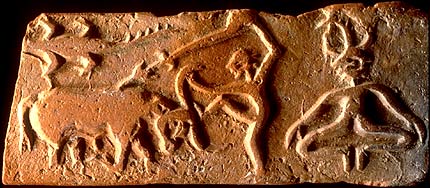
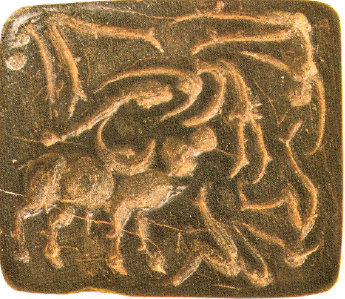
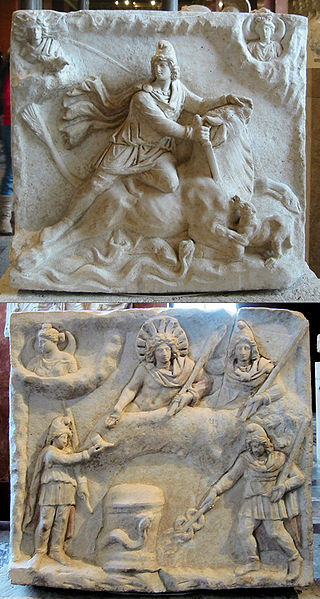
Bull fighting is practised till this day in two different parts of the world- Tamil Nadu in India and Spain in Europe. Both are poles apart culturally and geographically. Bull fighting in Europe is at least two thousand years old. It has its origin in Mithraism cult. They have 2000 year old Roman sculptures showing killing bulls. Mitra is a Vedic God of friendship. We have archaeological evidence about Vedic Mitra from the Bogakoy (Turkey) inscription dated to 1400 BC. All the important Vedic gods Indra, Mitra, Varuna and Ashwins find their place in the inscription of Hittite Friendship treaty with the Mittannis. But the Mithraic cult has nothing to do with the Vedic Mitra. It has come to Europe from Persian Mithra. We did not know how it got corrupted to killing bulls. In the Vedas, Indra was identified with the bull. Probably the Zoroastrians who opposed the Vedic hierarchy of gods and changed them upside down (Asura as Sura and Sura as Asura) might have done it to avenge Indra (bull).


In India the earliest archaeological evidence comes from the Indus Valley seals according to some scholars. But it is doubtful. It looks like a ritual killing of a buffalo to satisfy a god or a goddess. Those who argued that it was the most ancient bull fighting figure did not put together all the available seals. Other available seals clearly show it was a ritual killing of a buffalo to a god or goddess(Please see the pictures) . Bengalis sacrifice buffaloes to goddess Durga during Durga Puja.


If we consider our Hindu mythology pre dates the Indus seals we have the earliest reference of a killing of buffalo in the story of Mahisasuramardhani. Probably this is the only reference to a woman killing a buffalo in the world. In Indus seals men kill buffaloes for the gods. In the story of Mahisasura, it was a demon that comes in the form of a buffalo and got killed by the goddess. There are beautiful sculptures portraying this episode from Mahabalipuram in Tamil Nadu to Ellora in the North.


Bull fighting in Spain started around 18th century. There are different versions of bull fighting. In Spain the bull is killed ,that too with a weapon like we see in the Indus seals. This type of bull fighting has spread to Latin America and Mexico when the Spanish culture was introduced.


Whether it is Tamil Nadu or Spain special kind of bulls are raised exclusively for this purpose with a special type of diet and special training. Tamils have practised this ancient sport for at least two thousand years. They call it Jalli kattu or Manju Virattu or Eru Thazuvuthal. It means chasing the bull or tackling the bull. In ancient Tamil Nadu the horns of the bulls were tied with coins, may be gold coins. Whoever tackled the bull took it and in some places the owner of the bull gave his daughter to the person who tackled the bull. They were considered heroes. Like the Kshatriyas practised Swayamvaram ( a princess choosing her own husband from among the kings and princes), the Yadava Chief’s girls (cowherd community) choose their husbands from among the heroic bull fighters.


Now the bull fighting is conducted every year in Alanganallur, Palamedu, Avaniapuram and several other places around Madurai. Huge crowds gather to watch such events. After protest from animal welfare groups the government has introduced new laws for the safety of the animas and the bull fighters.

Lord Krishna started Bull Fighting


We have lot of proof to believe that the Bull fighting was started by Lord Krishna who was the most popular cowherd (Yadava Kula Tilaka) in the world. Kaliyuga started in 3102 BC after the death of Krishna. But Mahabharata war took place between 1000 and 1500 BC according to majority of the scholars. Even if we go by this date, Krishna was the first one to have a fight with almost all the animals. He fought with an elephant, a bull, a python, a horse, a cran , a donkey and many more . All were set up by his uncle Kamsa according to Hindu mythology. These anecdotes have produced huge literature in Tamil and Sanskrit which has got no parallel in any part of the world. Krishna’s episodes are mentioned in film songs even today in almost all the Indian languages. The bull Krishna fought was Aristasura.


The proof for Krishna starting this comes from 2000 year old Sangam Tamil literature. Kalitokai is one of the eight anthologies of Sangam (Cankam) period. Nalluruthtiranar who sang Mullai Kali gave a graphic description of bull fighting. Justifying his name Shiva (Rudra), the poet mentioned Lord Siva in all his poems. Justifying that it was started during Mahabaharata days the poet gave lot of references to Mahabharata episodes. He said that it was practised by the Ayar community (cowherds)in the pastoral areas.


The poet mentioned how the bulls tear the bull fighters apart like the buffalo riding Yama, God of Death. The colourful bulls are described and compared to various personalities -white bull to Balarama and black bull to Krishna and so on. The Mullaik Kali has got 16 poems beautifully describing the pastoral culture of ancient Tamilnadu. Anyone who reads this Mullaik Kali will get a better picture of how it was practised in ancient Tamil Nadu. All the suspense, gossip, flirting, amorous desires of Ayar girls are dealt with in hundreds of lines- a feast to Tamil lovers.

*****************


கரிகால் சோழனின் பருந்து வடிவ யாக குண்டம்

சங்கத் தமிழ் நூல்கள் சங்க கால மன்னர்கள் செய்த பல அபூர்வ யாகங்கள் குறித்து பல அதிசயமான செய்திகளைத் தெரிவிக்கின்றன. ஒரு யாகம் முடிந்தவுடன் ஒரு பார்ப்பனரும் அவர் மனைவியும் மாயமாக மறைந்துவிட்டார்கள். இதைப் பாடிய புலவரின் பெயர் பாலைக் கவுதமனார். அவர் வேண்டுகோளின் பேரில் சேர மன்னன் 10 யாகங்களைச் செய்து முடித்தவுடன் இந்த அதிசயம் நடந்தது.(காண்க: செல்வக் கடுங் கோ வாழியாதனைப் பாலைகவுதமனார் பாடிய மூன்றாம் பத்து– பதிற்றுப் பத்து)

வேளிர் என்னும் குறுநில மன்னர்கள் தாங்கள் யாகத் தீயிலிருந்து உதித்ததாகக் கூறுகின்றனர். பஞ்ச பாண்டவர் மனைவியான திரவுபதி இப்படி யாகத்தீயில் உருவானவர். பல ராஜஸ்தானியர்கள் ,குஜராத்திகள், பஞ்சாபியர் ஆகீயோரும் இப்படிக் கூறுவது வியப்பான ஒற்றுமையாகும். கபிலரும் கூட இதே செய்தியைக் கூறுகிறார் (புறம் 201).

கரிகால் சோழன் வேத நெறி தவறாது ஆண்டவன். 2000 ஆண்டுகளுக்கு முன் ஆண்ட இவன் சோழ மன்னர்களில் மிகவும் புகழ்பெற்றவன். இவன் பருந்து வடிவ யாக குண்டம் அமைத்து அதில் யூபம் (கம்பம்) நட்டான் என்று புறநானூற்றுப் புலவர் பாடுகிறார்.

தூவியற் கொள்கை துகளறு மகளிரொடு

பருதி உருவிற் பல்படைப் புரிசை

எருவை நுகர்ச்சி யூப நெடுந்தூண்

வேத வேள்வி தொழில் முடித்த தூஉம்

புறம் 224 (கருங் குழலாதனார்)


கரிகாலனின் எல்லா மனைவியரும் அப்போது உடன் இருந்தனர். மனைவி உடன் இல்லாமல் வேள்வி செய்ய முடியாது. அவர்களை வேள்விக் கிழத்தியர் என்றே தமிழ் நூல்கள் கூறும்.

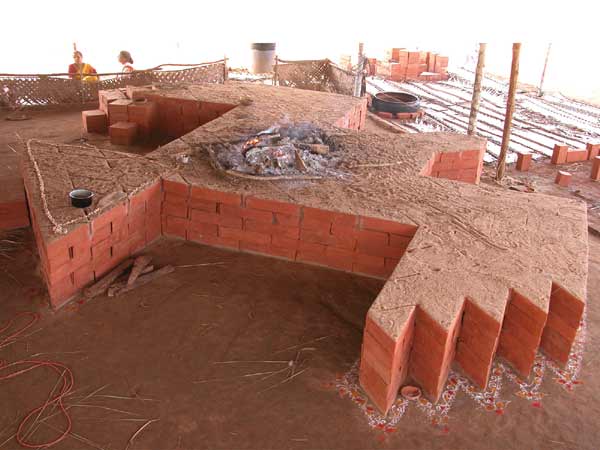
1008 அல்லது 10008 செங்கற்களை சுத்தி செய்து மந்திரம் கூறி ஒவ்வொரு செங்கல்லாக அடுக்குவர். சமீபத்தில் கேரளத்தில் கழுகு வடிவ யாக குண்டம் அமைத்து பெரிய யாகம் செய்தனர். கலிபோர்னியா பலகலைக் கழக ஆசிரியரகள், அறிவியல் வல்லுனர்கள் புடைசூழ இந்த யாகம் நிறைவேறியது.

தமிழ் மன்னர்கள் வேத நெறியை தங்கள் வாழ்வியல் நெறியாகக் கொண்டனர். காஞ்சி மகா சுவாமிகளும் தனது உரையில் வேதம், யாகம், பிராமணர்கள் ஆகியவற்றுக்கு சங்க காலத்தில் வழங்கும் தமிழ் சொற்களைப் பார்க்கையில் இந்தப் பண்பாடு எவ்வளவு காலத்துக்கு முன் எவ்வளவு ஆழ வேரூன்றியிருக்க வேண்டும் என்கிறார்.

வெளி நாட்டுக் காமாலைக் கண்ணர்கள் பொய்யான ஆரிய திராவிட வாதத்தை அவர்களுடைய மதத்தைப் புகுத்த நம் முன் வைத்ததால் நாம் மதி மயங்கிக் குழம்பிவிட்டோம்.

கல்யாண மந்திரங்களில் சப்தபதி என்னும் ஏழடி நடக்கும் மந்திரம் முக்கியமான மந்திரமாகும். மணப் பெண்ணும் மண மகனும் கையைப் பிடித்துக் கொண்டு தீயை வலம் வருவார்கள். இந்த மந்திரங்களின் அர்த்தம் தமிழ் திரைப் பட காதல் பாடல்களை எல்லாம் மிஞ்சிவிடும். கண்ணகியும் கோவலனும் தீயை வலம் வந்து ஐயர்கள் முன்னிலையில் திருமணம் செய்துகொண்டதை சிலப்பதிகாரம் பத்திரிக்கை நிருபர் தோற்றுப் போகும் அளவுக்கு அழகாக வருணிக்கிறது.

ஏழடிகள் ஒருவருடன் நடந்து சென்றால் பந்தமும் பாசமும் உறுதி பெற்றுவிடும் என்று ரிக்வேதம் சொல்லுகிறது. கரிகாலன் தன்னைப் பார்க்க வந்தவர்களை வழி அனுப்புகையில் வேத நெறிப்படி ஏழு அடிகள் கூடவே நடந்து சென்று வழி அனுப்புவானாம்.


பால்புரை புரவி நால்குடன் பூட்டிக்

காலின் ஏழடிப் பின் சென்று கோலின்

தாறு களைந்து ஏறு என்று ஏற்றி வீறு பெறு

–பொருநர் ஆற்றுப்படை வரிகள் 165-167


மதுரைக் காஞ்சி எழுதிய மாங்குடிக் கிழார் இன்னும் ஒரு அதிசிய விஷயத்தைச் சொல்லுகிறார். மற்ற எல்லா நாட்டு மன்னர்களும் சேவல் கூவும் சத்தத்தைக் கேட்டு எழுந்திருப்பான். அனால் மதுரைப் பாண்டிய மன்னனோவெனில் ஐயர்கள் முழங்கும் வேத ஒலியைக் கேட்டு எழுந்திருப்பான் என்று.

சிறுபாண் ஆற்றுப் படை எழுதிய புலவர் இன்னும் ஒரு வியப்பான விஷயத்தைச் சொல்லுகிறார். பிராமணர்கள், பாணர்கள் போன்றோர் நல்லியக்கோடன் அரண்மனையில் 24 மணி நேரமும் அனுமதியின்றி உள்ளே போகலாம் என்கிறார்.


பொருனர்க் காயினும் புலவர்க் காயினும்

அருமறை நாவின் அந்தணர்க்காயினும்

அடையா வாயில் (சிறு பாண்—வரிகள் 203-206)


பாண்டிய மன்னர்களில் மிகவும் பழைய மன்னர்களில் ஒருவன் முதுகுடுமிப் பெருவழுதி. அவனுக்கு அடைமொழியே பல் யாக சாலை முது குடுமிப் பெரு வழுதி என்பதாகும். நாடு முழுதும் யாகத் தூண்கள் இருக்குமாம் (புறம் 6,15). அவன் தலை தாழ்வது இரண்டே முறைதானாம். ஒன்று சிவன் கோவிலில், இரண்டு நாலு வேதம் படித்த அந்தணர் முன்பு (புறம் 6).

அவ்வையாருக்கு ஒரே மகிழ்ச்சி. ஏன் தெரியுமா? உலகில் 1500 ஆண்டுகளுக்குக் குடுமி பிடிச் சண்டை போட்ட ஒரே இனம் தமிழ் இனம் தான். உள் சண்டையினாலேயே அழிந்த ஒரே இனம் என்ற பெருமை உடைத்து. அப்பேற்பட்ட மூன்று தமிழ் மன்னர்களும் ஒரே மேடையில் வீற்றிருந்ததைப் பார்தவுடன் அவ்வைப் பாட்டிப் பூரித்துப் போய்விட்டார். எப்போது தெரியுமா? சோழ மன்னன் பெரு நற் கிள்ளி ராஜசூய யாகம் செய்தபோது –ஆகாயத்திலுள்ள நட்சத்திரங்களை விட நீங்கள் நிறைய நாட்கள் ஒற்றுமையாக வாழ வேண்டும் என்று பாடினார் (புறம் 367)

அப்போது பெருநற் கிள்ளியுடன் சேரமான் மாரி வெண்கோவும் பாண்டியன் உக்கிரப் பெருவழுதியும் ஒருங்கே இருந்தனர்.

ஒவ்வொரு மன்னனும் என்ன யாகம் செய்தான் என்பதை தொல்பொருட்துறை அறிஞரும் வரலாற்று நிபுணருமான டாக்டர் நாகசாமி அவர்கள் கல்வெட்டு இலக்கியச் சான்றுகளுடன் யாவரும் கேளிர் என்னும் அவரது நூலில் பட்டியல் இட்டிருக்கிறார். ஒவ்வொரு மன்னரின் கோத்திரம் என்ன என்பதையும் செப்பேட்டுச் சான்றுகளுடன் எழுதி இருக்கிறார். சிம்மவர்மன் என்ற பல்லவ மன்னன் பத்து அஸ்வமேத யாகங்களைச் செய்ததாக சிவன் வாயில் கல்வெட்டு கூறுகிறது.


புதிய விஷயம்: அஸ்வமேத பாண்டியன்

குப்தர்கள் அஸ்வமேத யாகம் செய்தவுடன் குதிரைப் படத்துடன் தங்க நாணயங்களை வெளியிட்டார்கள். அப்படி தமிழ் மன்னர்களின் தங்க நாணயம் கிடைக்க வில்லை. ஆனால் ஒரு பாண்டிய மன்னனின் செப்பு நாணயம் குதிரைப் படத்துடன் கிடைத்துள்ளது. இது முதுகுடுமிப் பெருவழுதியாக இருக்கலாம். ஏனெனில் கி.மு. முதல் நூற்றாண்டில் வாழ்ந்த உலகின் மாபெரும் கவிஞர்களில் ஒருவரான காளிதாசன் அவனது ரகுவம்ச காவியத்தில் பாண்டிய மன்னர்கள் அவப்ருத ஸ்நானத்தால் நனைந்ததாக எழுதி இருக்கிறார். அவரது காலத்தில் வாழ்ந்த முதுகுடுமிப் பெருவழுதியையே இது குறிக்கிறது. யாகம் செய்யும்போது குளிப்பதை அவப்ருத ஸ்நானம் என்று அழைப்பர். காளிதாசனின் காலம் கி.மு முதல் நூற்றாண்டு என்பதற்கு சங்கத் தமிழில் 200க்கும் மேலான சான்றுகள் இருக்கின்றன. (இதை எனது காளிதாசனின் காலம் என்ற கட்டுரையில் காண்க).

‘பொய்யா நாவிற் புகழ்’ உடைய கபிலர் தரும் இன்னொரு வியப்பான தகவல் (புறம்122): மலையமான் திருமுடிக்காரியின் நாட்டை யாரும் வெல்லவும் முடியாது, படை எடுக்கவும் முடியாதாம். ஏனேனில் நாடு முழுதையும் அவன் ஏற்கனவே அந்தணர்க்கு தானமாகக் கொடுத்துவிட்டானாம்!


கடல் கொளப்படா அது, உடலுநர் ஊக்கார்,

கழல் புனை திருந்து அடிக் காரி! நின் நாடே;

அழல் புறந்தரூஉம் அந்தணரதுவே;( புறம் 122—கபிலர்)


வேதங்களை ஏற்றுப் போற்றும் தமிழ் இலக்கியங்கள் என்ற நூலில் திரு கே சி இலக்குமிநாராயணன் , ஒரு கலைக் களஞ்சியம் கொள்ளும் அளவுக்கு தகவல்கள் தந்துள்ளார் என்பதையும் இங்கே குறிப்பது பொருத்தமாக இருக்கும்.

***********************

Karikal Choza and Eagle shaped Fire Altar

–S Swaminathan

Fire altar, Kerala, April 2004

Ancient Tamil kings followed Vedic customs in their daily life. They respected the Vedas and performed Yagnas/fire ceremonies like the Rajasuya and the Aswamedha. The oldest Tamil book available today is Tolkappiyam, a grammatical treatise. The book says that the Vedic Gods Indra, Varuna, Vishnu were worshipped along with Durga and Skanda. Vedic deities were the gods assigned to three of the four Tamil land divisions. For Marutham-Indra, Neithal-Varuna and Mullai- Vishnu. Skanda and Durga were the deities for Kurinji and Palai respectively.

Mudukudumi Peruvazuthi, one of the earliest Pandya kings had the epithet of “The King Who Performed Several Yagas”. In fact that was his greatest achievement. He probably even performed the Aswamedha Yagna. His country was full of Yupa posts. (Purananuru verses 6, 9, 16 ).They treated Vedic culture as their own culture. The Pandya king was praised for holding his head high except in two situations: one is in the temple and second, before Brahmins. He would bow to only these two in the whole world! Another Pandya king of Madurai was praised for awaking to the Vedic chants of the Brahmins where as other kings wake up to the cry of fowl. (Mankudi Maruthn in Madurai Kanchi). Another king Nalliakodan says that his palace doors were always open to Brahmins (Ref. Sirupan Atruppadai).

Kalidasa, one of the world’s greatest playwrights and the most celebrated Indian poet for his 1000+ beautiful similes mentioned the Pandya king and Agastya in consecutive slokas in his Raguvamsa, which indicates a close relationship that ran for thousands of years. The commentators mention Avabruda Snanam which is done during the Aswamedha Yagna.

The grand old lady of Tamil Sangam period poetess Avvaiyar praised the unity of the three great kings Chera, Choza and Pandyas on the occasion of Rajasuya Yagnam of Perunar Killi (Puram verse 367)

Why did he walk SEVEN STEPS?

The most interesting reference is about the greatest of the ancient Cholas Karikalan by Mudathama Kanniyar. Karikal Peruvalathan is dated 1st century BC. (Please read my article Why British Judges follow Karikalan?).  There are two interesting references to show that Karikalan followed the Vedic customs. He was praised as the one who walks with his guest SEVEN STEPS before seeing them off (Line 166 ,Porunar Atrupadai). Rig Veda says that a friend must be seen off after walking seven steps. Walking Seven Steps (Saptapadi) is an important ceremony in Hindu marriages as well. If both any two friends or a couple walk the seven steps together, their bond last for a lifetime.

This is the meaning of the Sanskrit Saptapadi mantra in marriage:

“Now let us make a vow together. We shall share love, share the same food, share our strengths, share the same tastes. We shall be of one mind, we shall observe the vows together. I shall be the Samaveda, you the Rigveda, I shall be the Upper World, you the Earth; I shall be the Sukhilam, you the Holder – together we shall live and beget children, and other riches; come thou, O sweet-worded girl

We have taken the Seven Steps. You have become mine forever. Yes, we have become partners. I have become yours. Hereafter, I cannot live without you. Do not live without me. Let us share the joys. We are word and meaning, united. You are thought and I am sound. May the night be honey-sweet for us. May the morning be honey-sweet for us. May the earth be honey-sweet for us. May the heavens be honey-sweet for us. May the plants be honey-sweet for us. May the sun be all honey for us. May the cows yield us honey-sweet milk. As the heavens are stable, as the earth is stable, as the mountains are stable, as the whole universe is stable, so may our union be permanently settled.

Eagle Shaped Altar

The second reference is that Karikalan did a Yagna with an EAGLE-SHAPED FIRE ALTAR (Yaga Kunda). Poet Karunkuzalahanar praised Karikalan for setting up eagle shaped fire altar and a Yupa post in Puram verse 224. When he did this he consulted the Brahmins in his court and all his wives were with him during the Yagna, the poet added.

For important fire ceremonies such as the Soma Yaga, the Athirathra and the Aswamedha the fire altar is set up with 10,008 bricks or 1,008 bricks (Please read my article Hindu’s Magic Numbers). Each brick is cleaned ritually and mantras are chanted while the eagle shape fire pit is constructed. The altar is sprinkled with gold chips. If it is an Aswamedha Yagna the altar that is constructed is three times bigger.

In the Valmiki Ramayana we get more details about the Aswamedha performed by King Dasaratha. Gupta Kings issued gold coins after they performed the Aswamedha. Pandya coins were excavated featuring a horse on its side. This proves that they performed the Aswamedha. All credit for this goes to Mudukudumi Peruvazuthi.

The Eagle is the King of Birds. Lord Krishna says in Vibhuti Yoga of Bhagavad Gita that among the birds, he was the eagle. Garuda/eagle was his vehicle as well. The Eagle is used as an emblem throughout Western countries, including the USA. It is Thailand’s national emblem. Though Indonesia is the largest Muslim country in the world, it has named its national airlines after Vishnu’s vehicle Garuda.

The symbol of the national airline of Indonesia

Mankudi Kizar in Puram 29 praised Thalaialangkanathu Neduncheziyan for performing a fire ceremony .Dr R Nagaswamy, famous historian and archaeologist has given a long list of all the Yagas done by the Tamil kings and the Pallava kings in his book (Yavarum Kelir page 78 to 82). Almost all the Chera kings listed in Pathitru Pathu performed several yagnas. It gives a lot of detail, such as the fasting done by the kings before the ceremonies. Cheran Chenguttuvan even released all the prisoners in his jails to mark this occasion.

Velirs claim that they were born in Fire pits. They belonged to the Agni clan. Several clans in Gujarat, Punjab and Rajasthan also claimed themselves as fire-born. One famous Maya King’s name was Fire-Born.

Pallavas were powerful and they performed the famous Aswamedha (Horse Sacrifice) to establish their political superiority. If we look at the epigraphs and copper plates of that time, they give a long list of the Yagas they performed and the donations they gave on such occasions. Rajathi Rajan I performed an Aswamedha according to his epigraphs. Foreign scholars, with their mischievous propaganda of Aryan Dravidian divide distorted Indian history beyond recognition. They made us believe that there were two different cultures existing in India during ancient times. Anyone who studies our ancient literature without the Aryan Dravidian prejudice will find one culture and unity of thought throughout its 5,000 year history from the northernmost Himalayas to the southernmost oceans. The minute our scholars realise this truth, they will find the key to the Indus script as well.

Finally, a twelve day Athirathram Yagna was recently performed in Kerala (April 2011) in Panjal near Thrissur. The eagle-shaped fire altar was set up with 1,110 specially designed bricks. Frits-Staal, Indologist and Emeritus Professor of Philosophy, University of California, Berkley attended the ceremony with a group of scholars and scientists to study the effects on the environment and biosphere.

***********************

Tulabharam: Indian-Sumerian connection

By S Swaminathan


Sibi in Borobudur (Indonesia)

Tulabharam is a Hindu ritual that has been practised from Dwapara Yuga. Tulabharam means a person weighing himself or herself in a balance and pay in equal weight of gold, fruits or grains to God when one’s prayers are fulfilled. Temples in Tirupati, Guruvayur, Dwaraka, Udupi and several other towns practice such offerings. Recently, Guruvayur temple hit the headlines in newspapers when a businessman from Bangalore gave the temple his weight in gold – 70 kg. Tirupati temple hits the headlines now and then when famous politicians and film stars give something to god measure for measure. This is offered to the gods when their prayers are answered.

The earliest reference to a Tulabharam comes from the Mahabharata, about the great emperor Sibi. He was so famous his name is found in ancient Tamil Sangam literature in four places and later in hundreds of places. He was even praised in Buddhist Jataka stories and Borobudur (Indonesia) sculptures. Emperor Sibi was a just king. Lord Indra and Agni wanted to test him and came in the form of an eagle and a dove. When the dove came to Sibi for protection from the chasing eagle, Sibi was ready to offer anything to save the dove. The eagle asked him to give his flesh measure for measure. Sibi cut himself bit by bit but the pans in the balance were never equal. At last when he himself stood on the pan the Gods appeared in front of him and blessed him. The story is found in other Sanskrit works as well.

The Tamil king who refused to take gold

The worst thing we read in Sangam Tamil literature is the execution of a little girl just because she took a mango fruit from the king’s garden. Tamil poets were so angry that not only they refused to sing about him but also ridiculed him in the Cankam poems. The story is as follows: Nannan was a king who ruled part of Kerala called Poozi Nadu. A mango fell from one of the trees in his garden and it was washed away in the water of a canal. Any little girl or boy who sees a fruit will naturally go for it. So did a little girl in his town. The servants reported this ‘theft’. Immediately Nannan ordered to kill the girl for theft. The whole town rose against him. The girl’s father with the support of the VIP’s of the town met the king and begged to release his daughter. He even came forward to give Nannan 81 elephants as a penalty. Nannan did not budge.

Then her father told him that that he WOULD GIVE GOLD MEASURE FOR MEASURE. But evil Nannan executed the girl refusing to accept the gold. One of the great poets of Tamil Cankam (Tamil Academy) Paranar gave this story in Kurunthokai poem 292. Perunthalai Sathanar who sang a poem long after this incident refused to sing about another king Ilam Vichiko (puram 151) just because he was born in Nannan’s clan. Till this day Nannan was ridiculed as a ‘Murderer of a little girl’. This story shows the practice of Tulabharam in ancient Tamil Nadu. Look at the words – MEASURE FOR MEASURE in gold.

Tulabharam in Silappadikaram

Indian kings used to give sixteen kinds of gifts to Brahmins and poets. The Vijayanagara empire period inscriptions mention Tulabharam as one of them. We have a literary reference to such a practice in the famous Tamil epic Silappadikaram. Cheran Chenguttuvan who went to the holy Himalayas to get a stone for the chaste woman Kannaki washed it in the holy river Ganges and consecrated the statue at a place in modern Kerala. At that time he gifted his body weight of gold to a Brahmin called Matalan. The epic says the king weighed 50 Tulams (not Tola which is only 12 grams).

Periapuranam: Amarneethi Nayanar

Peria Puranam gives the life story of 63 Saivite saints called Nayanmars. Amarneethi Nayanar of Pazaiyarai was one of them. He was running an inn at Thirunalloor. One day a bachelor came to the town and asked Amarneethi to take care of his loin cloth until he comes back from bathing in a nearby river. When he came back the loin cloth was not found at the place he left it. After a frantic search Amarneethi started panicking and offered anything in compensation. The bachelor, who was God himself in disguise, asked him to give some cloth equal in weight to what he was keeping as a spare. When Amarneethi put one loin cloth after loin cloth on the pan, it did not rise even a single inch. Getting ready to sacrifice himself he stood on it. Even then, the scale did not move. When all his family members came and stood on the pan of the balance the pans were equal. God blessed all of them after this Tulabharam.

Krishna Tulabharam

 
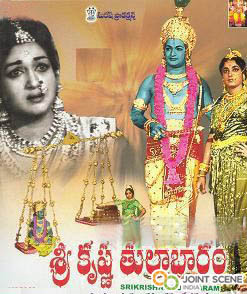
Telegu film of Krishna Tulabharam


The most famous Tulabharam story comes from the life of Lord Krishna. Tamil and Telugu films were made using this story long back. Krishna had several wives including Rukmini, Sathyabhama and Jhambavati.

There was a rivalry between the posh, proud, jealous and fashionable Sathyabhama and simple and innocent Rukmini. The heavenly sage Narada wanted to teach Sathyabhama a lesson. When he met her he mooted a plan to attract Krishna towards her. Sathyabhama fell prey to his clever and cunning plan. The plan was to sell Krishna as a slave to Narada and buy him back with gold. Whoever pays more would win Krishna. Sathyabhama was so confident that she would win hands down because Rukmini was not as rich as her. Innocent Rukmini had to accept this when Krishna himself agreed to be sold. When the scene was set, Sathyabhama brought all her gold and diamond jewellery to buy back Krishna. It could not match Krishna’s weight. Seeing Sathyabhama struggling, the mischievous Narada himself suggested that she borrowed some gold from Rukmini. Pure hearted Rukmini knew that nothing was greater than the Tulsi (Holy Basil) leaves and she put some Tulsi leaves onto the pan after removing all of the jewellery. The problem was thus solved. This story also showed the importance of Tulsi in Hindu worship. Tulsi is one of the most powerful medicinal herbs.

Sumerian Tulabharam

Sumerian culture has a lot of similarities with Indian culture. No one can dismiss them as sheer coincidences. (Please read my article DOUBLE HEADED EAGLE: INDIAN SUMERIAN CONNECTION). Clay tablets from the 13th century BC unearthed at Ugarit give some interesting information about a king. His name is given only in consonants KRT (perhaps Kirta or Kurita rather than Keret). The king lost his brothers and seven wives but had no heir. Praying for a son, he was advised in a dream by their chief god El to sacrifice to Baal then march with his army to Udumu to ask for it’s king’s daughter Hurriya as his wife. On the way he VOWED TO GIVE TWICE HER WEIGHT IN SILVER AND THRICE HER WEIGHT IN GOLD TO THE GODDESS ATHIRAT (AHSERATH) of Tyre, if he were successful. When he got her, he did not fulfil his vow to the god Athirat. The god struck him with an illness. This story of Keret was published in the Dictionary of the Ancient Near East. The story continued with what his wife did later etc. We can even see some similarities in the names with Hindu mythological names Kratu (KRT), Surya (Hurriya), Kreeta and many more. But we could clearly see the practice of Tulabharam to gods and goddesses, offering in silver and gold.


*******************


Tamil article: The Age of Tamil Race

Click the title below for my Tamil article about The Age of Tamil Race


தமிழ் இனத்தின் வயது என்ன

Double Headed Eagle: Sumerian-Indian Connection

By S Swaminathan

 
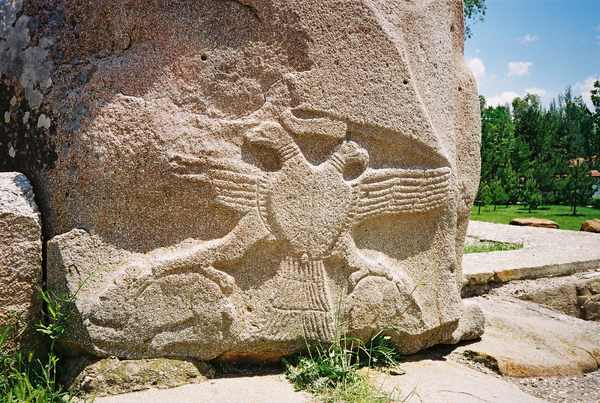
Double-Headed bird found in Alaja Huyuk, Turkey, 14th C BC


There are striking similarities between the Indian and Sumerian civilizations. One of them is the use of the Double Headed Eagle as a royal symbol. From 3800 BC until today this mythical bird is used as a symbol of royalty. Russia and other Eastern European countries use it on their currency notes and national flags. Tamil Nadu, Karnataka and Andhra Pradesh praise the mighty strength of this bird in coins, sculptures and literature. The Panchatantra used the story of double headed bird, also known as Ganda Berunda bird, to emphasize unity. Ancient Cankam (Sangam) Tamil literature used this bird in their love poetry. Devotional poets of India like Ekanath also used this bird as a simile.

Sumerians considered this bird the symbol of God Ninurta of Lagash. They thought it had divine power. We can trace the history of this mythical bird from the Sumerian days. A cylindrical seal shows the double headed eagle from 3800 BC. Later, the Hittite empire which had its capital in Bogazkoy (in Modern Turkey) used it in several monuments. Even today we can see the monuments displaying this symbol in huge sculptures in Hattusa and Yazilikaya. Bogazkoy was the place where a tablet with the names of the Vedic Gods: Indra, Mitra, Nasatya and Varuna was discovered. The tablet was dated 1380 BC. This establishes the Indian connection of the region.

Even the Holy Roman Empire and the Byzantine Empire used this symbol. This Hindu symbol was used by the Christians.

In Sanskrit literature – the Panchatantra (book of fables) has a story about Ganda Berunda bird. It says that the bird had two heads but one stomach. In the story, one head wanted to drink Amrita (ambrosia) but the other head went for poison. Ultimately, the head that drank the poison made the bird die. The moral of the story is that disunity is dangerous.

 
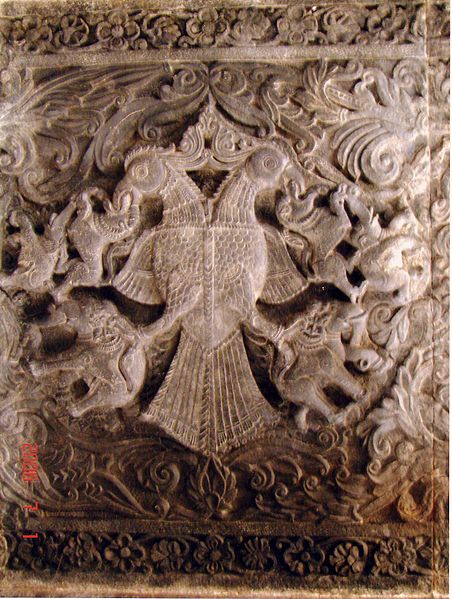
Sculpture in Keladi Temple, Karnataka


Tamil literature, dated two thousand years old, mentions it in three places. In Akananuru, poet Kapilar (verse 12) compares this double-headed, single-bellied bird to two people in love. Though there were two physical bodies, they have one life. Nallanthuvanar also used this simile in Paripatal (Verse 8-72). But another Tamil poet Maruthan Ilanagan in Kalithokai (verse 89) used this bird in the form of two fighting heads, like the Panchatantra story. It shows that Indians from one end of the land to the other knew this bird very well. Thakadur Yaththirai is a lost Tamil book, but excerpts are available as quotes in other works. These quotes compared the fight between two kings Athiyaman and Peruncheral Irumporai to the double headed bird fighting with itself. (Ref. Purath thirattu verse 785).


The Bird that lifts elephants

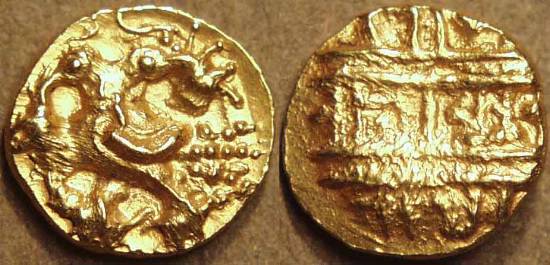
The most imaginative story of the bird comes from the Vijayanagar Empire. Gold Coins issued by Achyuta Raya (1530-1542) show the Ganda Berunda bird lifting an elephant in each of its beaks. Its power is legendary. Other coins show each head holding a snake. Before Achyuta Raya Devaraya II (1422-1446) issued coins with the bird’s name in Deva Nagari script.

Jain Stupa at Sirkap, Taxila is the most ancient Ganda Berunda monument in India. We can see this mythical bird sculptures in Srisailam, Keladi, Koramangala, Belur and the medieval art of Sri Lanka.


Achyuta Gold coin with the bird


Recently even dances were choreographed showing the magical strength of the bird. Dasara Flower Show in Mysore had a 10 foot flower decoration of the bird to commemorate the 500th anniversary of the bird symbol in Karnataka.

The Wodeyar family of Mysore use this as their royal emblem. Later the Government of Karnataka used it as the emblem of the state. There are stories connecting this bird with the Narasimha (Man-Lion) avatara of Vishnu.

Eastern European country Albania has this bird in its national flag. Several countries issued stamps and coins as well. Russian Roubles and Kopeks had this bird.


National flag of Albania


In the Eastern Province Erzurum of Turkey, a huge double headed eagle is being erected in 2011 which is visible from space. Turkey gives so much importance to this legendary bird.

An ancient monument of Turkey shows this bird lifting two hares on its beaks. But the imagination of Indians made it a dinosaur lifting two elephants on its beaks!

Follow me on Twitter @Swami_48 and find me on Facebook.


Three Wise Monkeys from India

By S Swaminathan

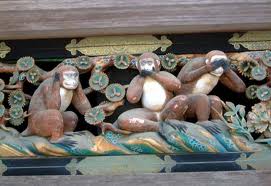
Hear no evil; speak no evil; see no evil!

Mahatma Gandhi had a porcelain doll of three monkeys by his bed side. It was presented to him by some Chinese visitors. Since Gandhiji’s days this doll became a popular figure in India. Moreover the theme the monkeys explained is a typical Indian theme: See No Evil, Hear No Evil and Speak No Evil. Every Indian mother tells her children the same thing almost every day. Particularly when Indian children watch unsavoury programmes on TV, elders emphasise this in their own words. But lot of people wonder about the origin of the Three Wise Monkey doll.

Encyclopaedias and several websites say that it originated in China and at present Japan has a temple with the three wise monkeys figure in Nikko. The Tosho-gu shrine where the three wise monkeys are located exists from 1636. Scholars think that the Buddhist monks took it from China to Japan. The Japanese call these three monkeys “Mi zaru (see no evil), Kika zaru (hear no evil)  and Iwa zaru (speak no evil)”.
But my research shows that the original idea went from India to other countries probably through the Buddhist emissaries. We have got a clear proof in Bhagavad Gita and ancient Tamil literature. ‘The mind is a monkey ‘ is a well known saying in Indian languages and several saints used this expression in their hymns and poems.
The Monkey in the Rig Veda
A monkey was  mentioned as a favourite animal of Indra in Rig Veda (10-86).
Lord Krishna says in the Gita (Chapter 2-29),”one SEES him with wonder, another likewise SPEAKS of him as a wonder, and as a wonder another HEARS of him, yet even on (seeing, speaking and hearing) some do not understand him”.
Panchatantra stories were popular abroad from 5th century AD onwards. It was translated by Borzuya in to Persian language in the year 570 AD. Vishnu Sharma wrote it in Sanskrit around 3rd century BC. We have at least three stories involving monkeys in it. It shows that Indians used monkey stories to teach morals.
But the oldest and the clearest evidence comes from a Tamil book called Naladiyar. It is a Tamil book of ethics with 400 poems on different topics. They were composed by Jain saints 1500 years ago.
One of the poems runs like this:

“If one knowing what is right, be deaf to the secrets of others, blind to the wives of his neighbours, and dumb in calumniating others, it is not necessary to inculcate any virtue to him.”

Adi Shankara also use this deaf, blind and dumb sequence in another context in Viveka Cudamani (sloka101). A later book known as Vakkundam says ,” it is bad to see evil people and it is worse to hear their words and it is the worst to speak about their bad things”
Suffice is to prove that the idea of using monkey as a moral tool and SEE, HEAR, SPEAK no evil sequence are typical Indian.
Another story about THREE WISE DOLLS
A king in India was presented with three dolls by a wise man. The king was wondering why someone would present such dolls. He called all the wise people to find out their meaning.
Several people came forward ,examined the dolls and came with no answer. One or two people found some holes and yet could not say what they were for. At last a very wise man came and asked for a string from the king. He passed the string through the holes in each doll. The string went through one ear and came through the other ear in the first doll. The wise man explained that represents a person who can’t retain anything and whatever he hears leaks through the other ear. The second doll had one hole in the ear and another in the mouth. This person will tell everything you tell him to everyone in the world and so he is dangerous, explained the wise man. And in the third doll the string went through one ear but never came out. He is the most trustworthy person fit for a job in the royal palace, said the wise man. The king was very happy and amply rewarded the wise man.
In conclusion we may boldly say that the concept of three dolls, concept of seeing, hearing, speaking no evil and the concept of using monkey to teach morals have spread to other parts of the world from India alone.
Please email comments and feedback to: swami_48@yahoo.com.
Please visit  my blogs: swamiindology.blogspot.com and
tamilandvedas.wordpress.com for more interesting articles.