Dos AND DONTs FOR BRAHMINS- THEY MUST NOT SAVE MONEY (Post No.5441)


Written by London Swaminathan

swami_48@yahoo.com

Date: 17  September 2018


Time uploaded in London – 15-31 (British Summer Time)


Post No. 5441

Pictures shown here are taken from various sources including google, Wikipedia, Facebook friends and newspapers. This is a non- commercial blog.


MY COMMENTS ON THE FIRST 100 SLOKAS/COUPLETS ON FOURTH CHAPTER OF MAAVA DHARMA SHASTRA

I have already finished three chapters. Now we look at the fourth chpater


Fourteen interesting Points


1.Note slokas 4 and 7. Five ways of food gathering; no saving for more than three days. If Brahmins follow these rules no one would feel jealousy towards Brahmins. That is the reason Brahmins were given donations by the kings and others. Manu made these rules so that Brahmins would be dependent upon others for ever. They have to do Pujas and sacrifices to earn their livelihood.


  1. Read a beautiful quotation in sloka 12. ‘for happiness has contentment for its root, the root of unhappiness is the contrary (disposition).


3.Read sloka 29;’Guests must be honoured’ which we can find only in ancient Tamil and Sanskrit literature. This is purely a Vedic Hindu concept which is not found in any other ancient culture as a daily duty. This explodes the Aryan invasion theory.

4.Sloka 11 ; please do agnihotram. Nowadays very few Brahmins do it.

5.sloka 21- pancha yajna (Five Types of sacrifice done everyday)

6.sloka 29 exploded Aryan invasion theory; customs like this found only in Sanskrit and Tamil as a meritorious daily duty; you cant find this anywhere in the world

  1. Sloka 40-lying in bed with wife rules

8.Slokas 44 and 52 Interesting rules regarding looking at women, and urinating etc

  1. Slokas 64 and 74- No singing, No dancing and No gambling

10.Sloka 76- Must have wet feet while eating, dry feet while sleeping

11.Sloka.84- No presents from kings

12.Sloka 86- Kings are butchers

13.Slokas 88-90- Twenty One types of Hell.

14.Sloka 92- Importance of getting up at 4 am (Brahma Muhurta)


MANU SMRTI-CHAPTER IV

  1. Having dwelt with a teacher during the fourth part of (a man’s) life, a Brahmana shall live during the second quarter (of his existence) in his house, after he has wedded a wife.
  2. A Brahmana must seek a means of subsistence which either causes no, or at least little pain to others, and live by that except in times of distress.
  3. For the purpose of gaining bare subsistence, let him accumulate property by following those irreproachable occupations which are prescribed for his caste, without unduly fatiguing his body.
  4. He may subsist by Rita (truth), and Amrita (ambrosia), or by Mrita (death) and by Pramrita (what causes many deaths); or even by (the mode) called Satyanrita (a mixture of truth and falsehood), but never by Svavritti (a dog’s mode of life).
  5. By Rita shall be understood the gleaning of corn; by Amrita, what is given unasked; by Mrita, food obtained by begging and agriculture is declared to be Pramrita.
  6. But trade and money-lending are Satyanrita, even by that one may subsist. Service (LIKE A SLAVE) is called Svavritti; therefore one should avoid it.
  7. He may either possess enough to fill a granary, or a store filling a grain-jar; or he may collect what suffices for three days, or make no provision for the morrow.
  8. Moreover, among these four Brahmana householders, each later-(named) must be considered more distinguished, and through his virtue to have conquered the world more completely.
  9. One of these follows six occupations, another subsists by three, one by two, but the fourth lives by the Brahmasattra.


MUST DO AGNIHOTRA (DAILY FIRE SACRIFICE)

  1. He who maintains himself by picking up grains and ears of corn, must be always intent on (the performance of) the Agnihotra, and constantly offer those Ishtis only, which are prescribed for the days of the conjunction and opposition (of the moon), and for the solstices.
  2. Let him never, for the sake of subsistence, follow the ways of the world; let him live the pure, straightforward, honest life of a Brahmana.
  3. He who desires happiness must strive after a perfectly contented disposition and control himself; for happiness has contentment for its root, the root of unhappiness is the contrary (disposition).
  4. A Brahmana, who is a Snataka and subsists by one of the (above-mentioned) modes of life, must discharge the (following) duties which secure heavenly bliss, long life, and fame.
  5. Let him, untired, perform daily the rites prescribed for him in the Veda; for he who performs those according to his ability, attains to the highest state.
  6. Whether he be rich or even in distress, let him not seek wealth through pursuits to which men cleave, nor by forbidden occupations, nor (let him accept presents) from any (giver whosoever he may be).
  7. Let him not, out of desire (for enjoyments), attach himself to any sensual pleasures, and let him carefully obviate an excessive attachment to them, by (reflecting on their worthlessness in) his heart.
  8. Let him avoid all (means of acquiring) wealth which impede the study of the Veda; (let him maintain himself) anyhow, but study, because that (devotion to the Veda-study secures) the realisation of his aims.
  9. Let him walk here (on earth), bringing his dress, speech, and thoughts to a conformity with his age, his occupation, his wealth, his sacred learning, and his race.
  10. Let him daily pore over those Institutes of science which soon give increase of wisdom, those which teach the acquisition of wealth, those which are beneficial (for other worldly concerns), and likewise over the Nigamas which explain the Veda.
  11. For the more a man completely studies the Institutes of science, the more he fully understands (them), and his great learning shines brightly.


PACHA YAGNA

  1. Let him never, if he is able (to perform them), neglect the sacrifices to the sages, to the gods, to the Bhutas, to men, and to the manes.
  2. Some men who know the ordinances for sacrificial rites, always offer these great sacrifices in their organs (of sensation), without any (external) effort.
  3. Knowing that the (performance of the) sacrifice in their speech and their breath yields imperishable (rewards), some always offer their breath in their speech, and their speech in their breath.
  4. Other Brahmanas, seeing with the eye of knowledge that the performance of those rites has knowledge for its root, always perform them through knowledge alone.
  5. A Brahmana shall always offer the Agnihotra at the beginning or at the end of the day and of the night, and the Darsa and Paurnamasa (Ishtis) at the end of each half-month,
  6. When the old grain has been consumed the (Agrayana) Ishti with new grain, at the end of the (three) seasons the (Katurmasya-) sacrifices, at the solstices an animal (sacrifice), at the end of the year Soma-offerings.
  7. A Brahmana, who keeps sacred fires, shall, if he desires to live long, not eat new grain or meat, without having offered the (Agrayana) Ishti with new grain and an animal-(sacrifice).
  8. For his fires, not being worshipped by offerings of new grain and of an animal, seek to devour his vital spirits, (because they are) greedy for new grain and flesh.

HE MUST HONOUR GUESTS

  1. No guest must stay in his house without being honoured, according to his ability, with a seat, food, a couch, water, or roots and fruits.
  2. Let him not honour, even by a greeting, heretics, men who follow forbidden occupations, men who live like cats, rogues, logicians, (arguing against the Veda,) and those who live like herons.
  3. Those who have become Snatakas after studying the Veda, or after completing their vows, (and) householders, who are Srotriyas, one must worship by (gifts of food) sacred to gods and manes, but one must avoid those who are different.
  4. A householder must give (as much food) as he is able (to spare) to those who do not cook for themselves, and to all beings one must distribute (food) without detriment (to one’s own interest).
  5. A Snataka who pines with hunger, may beg wealth of a king, of one for whom he sacrifices, and of a pupil, but not of others; that is a settled rule.
  6. A Snataka who is able (to procure food) shall never waste himself with hunger, nor shall he wear old or dirty clothes, if he possesses property.

HAIR CUT

  1. Keeping his hair, nails, and beard clipped, subduing his passions by austerities, wearing white garments and (keeping himself) pure, he shall be always engaged in studying the Veda and (such acts as are) conducive to his welfare.
  2. He shall carry a staff of bamboo, a pot full of water, a sacred string, a bundle of Kusa grass, and (wear) two bright golden ear-rings.
  3. Let him never look at the sun, when he sets or rises, is eclipsed or reflected in water, or stands in the middle of the sky.
  4. Let him not step over a rope to which a calf is tied, let him not run when it rains, and let him not look at his own image in water; that is a settled rule.
  5. Let him pass by (a mound of) earth, a cow, an idol, a Brahmana, clarified butter, honey, a crossway, and well-known trees, turning his right hand towards them.


GOING TO BED WITH WIFE

  1. Let him, though mad with desire, not approach his wife when her courses appear; nor let him sleep with her in the same bed.
  2. For the wisdom, the energy, the strength, the sight, and the vitality of a man who approaches a woman covered with menstrual excretions, utterly perish.
  3. If he avoids her, while she is in that condition, his wisdom, energy, strength, sight, and vitality will increase.
  4. Let him not eat in the company of his wife, nor look at her, while she eats, sneezes, yawns, or sits at her ease.


DON’T LOOK AT WOMEN

  1. A Brahmana who desires energy must not look at a woman who applies collyrium to her eyes, has anointed or uncovered herself or brings forth a child.
  2. Let him not eat, dressed with one garment only; let him not bathe naked; let him not void urine on a road, on ashes, or in a cow-pen,
  3. Nor on ploughed land, in water, on an altar of bricks, on a mountain, on the ruins of a temple, nor ever on an ant-hill,
  4. Nor in holes inhabited by living creatures, nor while he walks or stands, nor on reaching the bank of a river, nor on the top of a mountain.
  5. Let him never void faeces or urine, facing the wind, or a fire, or looking towards a Brahmana, the sun, water, or cows.
  6. He may ease himself, having covered (the ground) with sticks, clods, leaves, grass, and the like, restraining his speech, (keeping himself) pure, wrapping up his body, and covering his head.
  7. Let him void faeces and urine, in the daytime turning to the north, at night turning towards the south, during the two twilights in the same (position) as by day.
  8. In the shade or in darkness a Brahmana may, both by day and at night, do it, assuming any position he pleases; likewise when his life is in danger.

URINATING RULES

  1. The intellect of (a man) who voids urine against a fire, the sun, the moon, in water, against a Brahmana, a cow, or the wind, perishes.
  2. Let him not blow a fire with his mouth; let him not look at a naked woman; let him not throw any impure substance into the fire, and let him not warm his feet at it.
  3. Let him not place (fire) under (a bed or the like); nor step over it, nor place it (when he sleeps) at the foot-(end of his bed); let him not torment living creatures.
  4. Let him not eat, nor travel, nor sleep during the twilight; let him not scratch the ground; let him not take off his garland.
  5. Let him not throw urine or faeces into the water, nor saliva, nor (clothes) defiled by impure substances, nor any other (impurity), nor blood, nor poisonous things.
  6. Let him not sleep alone in a deserted dwelling; let him not wake (a superior) who is sleeping; let him not converse with a menstruating woman; nor let him go to a sacrifice, if he is not chosen (to be officiating priest).
  7. Let him keep his right arm uncovered in a place where a sacred fire is kept, in a cow-pen, in the presence of Brahmanas, during the private recitation of the Veda, and at meals.
  8. Let him not interrupt a cow who is suckling (her calf), nor tell anybody of it. A wise man, if he sees a rainbow in the sky, must not point it out to anybody.
  9. Let him not dwell in a village where the sacred law is not obeyed, nor (stay) long where diseases are endemic; let him not go alone on a journey, nor reside long on a mountain.

DON’T LIVE UNDER SHUDRA RUlERS

  1. Let him not dwell in a country where the rulers are Sudras, nor in one which is surrounded by unrighteous men, nor in one which has become subject to heretics, nor in one swarming with men of the lowest castes.
  2. Let him not eat anything from which the oil has been extracted; let him not be a glutton; let him not eat very early (in the morning), nor very late (in the evening), nor (take any food) in the evening, if he has eaten (his fill) in the morning.
  3. Let him not exert himself without a purpose; let him not drink water out of his joined palms; let him not eat food (placed) in his lap; let him not show (idle) curiosity.

NO   SINGING, DANCING

  1. Let him not dance, nor sing, nor play musical instruments, nor slap (his limbs), nor grind his teeth, nor let him make uncouth noises, though he be in a passion.
  2. Let him never wash his feet in a vessel of white brass; let him not eat out of a broken (earthen) dish, nor out of one that (to judge) from its appearance (is) defiled.
  3. Let him not use shoes, garments, a sacred string, ornaments, a garland, or a water-vessel which have been used by others.
  4. Let him not travel with untrained beasts of burden, nor with (animals) that are tormented by hunger or disease, or whose horns, eyes, and hoofs have been injured, or whose tails have been disfigured.
  5. Let him always travel with (beasts) which are well broken in, swift, endowed with lucky marks, and perfect in colour and form, without urging them much with the goad.
  6. The morning sun, the smoke rising from a (burning) corpse, and a broken seat must be avoided. Let him not clip his nails or hair, and not tear his nails with his teeth.
  7. Let him not crush earth or clods, nor tear off grass with his nails; let him not do anything that is useless or will have disagreeable results in the future.
  8. A man who crushes clods, tears off grass, or bites his nails, goes soon to perdition, likewise an informer and he who neglects (the rules of) purification.
  9. Let him not wrangle; let him not wear a garland over (his hair). To ride on the back of cows (or of oxen) is anyhow a blamable act.
  10. Let him not enter a walled village or house except by the gate, and by night let him keep at a long distance from the roots of trees.

NO GAMBLING

  1. Let him never play with dice, nor himself take off his shoes; let him not eat, lying on a bed, nor what has been placed in his hand or on a seat.
  2. Let him not eat after sunset any (food) containing sesamum grains; let him never sleep naked, nor go anywhere unpurified (after meals).


WET FEET WHILE EATING

  1. Let him eat while his feet are (yet) wet (from the ablution), but let him not go to bed with wet feet. He who eats while his feet are (still) wet, will attain long life.
  2. Let him never enter a place, difficult of access, which is impervious to his eye; let him not look at urine or ordure, nor cross a river (swimming) with his arms.
  3. Let him not step on hair, ashes, bones, potsherds, cotton-seed or chaff, if he desires long life.
  4. Let him not stay together with outcasts, nor with Candalas, nor with Pukkasas, nor with fools, nor with overbearing men, nor with low-caste men, nor with Antyavasayins.
  5. Let him not give to a Sudra advice, nor the remnants (of his meal), nor food offered to the gods; nor let him explain the sacred law (to such a man), nor impose (upon him) a penance.
  6. For he who explains the sacred law (to a Sudra) or dictates to him a penance, will sink together with that (man) into the hell (called) Asamvrita.
  7. Let him not scratch his head with both hands joined; let him not touch it while he is impure, nor bathe without (submerging) it.
  8. Let him avoid (in anger) to lay hold of (his own or other men’s) hair, or to strike (himself or others) on the head. When he has bathed (submerging) his head, he shall not touch any of his limbs with oil.


DON’T TAKE PRESENTS FROM SOME PEOPLE

  1. Let him not accept presents from a king who is not descended from the Kshatriya race, nor from butchers, oil-manufacturers, and publicans, nor from those who subsist by the gain of prostitutes.
  2. One oil-press is as (bad) as ten slaughter-houses, one tavern as (bad as) ten oil-presses, one brothel as (bad as) ten taverns, one king as (bad as) ten brothels.

KINGS= BUTCHERS

  1. A king is declared to be equal in wickedness to a butcher who keeps a hundred thousand slaughter-houses; to accept presents from him is a terrible crime.
  2. He who accepts presents from an avaricious king who acts contrary to the Institutes (of the sacred law), will go in succession to the following twenty-one hells:


21 TYPES OF HELLS

  1. Tamisra, Andhatamisra, Maharaurava, Raurava, the Kalasutra hell, Mahanaraka,
  2. Samgivana, Mahaviki, Tapana, Sampratapana, Samghata, Sakakola, Kudmala, Putimrittika,
  3. Lohasanku, Rigisha, Pathin, the (flaming) river, Salmala, Asipatravana, and Lohakaraka.
  4. Learned Brahmanas, who know that, who study the Veda and desire bliss after death, do not accept presents from a king.

BRAHMA MUHURTA

  1. Let him wake in the muhurta, sacred to Brahman (BRAHMA MUHURTA= STARTING FROM 4-30 AM), and think of (the acquisition of) spiritual merit and wealth, of the bodily fatigue arising therefrom, and of the true meaning of the Veda.
  2. When he has risen, has relieved the necessities of nature and carefully purified himself, let him stand during the morning twilight, muttering for a long time (the Gayatri), and at the proper time (he must similarly perform) the evening (devotion).
  3. By prolonging the twilight devotions, the sages obtained long life, wisdom, honour, fame, and excellence in Vedic knowledge.
  4. Having performed the Upakarman according to the prescribed rule on (the full moon of the month) Sravana, or on that of Praushthapada (Bhadrapada), a Brahmana shall diligently study the Vedas during four months and a half.
  5. When the Pushya-day (of the month Pausha), or the first day of the bright half of Magha has come, a Brahmana shall perform in the forenoon the Utsargana of the Vedas.
  6. Having performed the Utsarga outside (the village), as the Institutes (of the sacred law) prescribe, he shall stop reading during two days and the intervening night, or during that day (of the Utsarga) and (the following) night.
  7. Afterwards he shall diligently recite the Vedas during the bright (halves of the months), and duly study all the Angas of the Vedas during the dark fortnights.
  8. Let him not recite (the texts) indistinctly, nor in the presence of Sudras; nor let him, if in the latter part of the night he is tired with reciting the Veda, go again to sleep.
  9. According to the rule declared above, let him recite the daily (portion of the) Mantras, and a zealous Brahmana, (who is) not in distress, (shall study) the Brahmana and the Mantrasamhita.


TO BE CONTINUED……………..


–SUBHAM–


Mantra and Medical Prescription (Post No.5439)

Written by London Swaminathan

swami_48@yahoo.com

Date: 17  September 2018


Time uploaded in London – 8-59 am (British Summer Time)


Post No. 5439

Pictures shown here are taken from various sources including google, Wikipedia, Facebook friends and newspapers. This is a non- commercial blog.


A doctor met a saint and asked whether he could learn Mantras from the websites or You Tube.

The saint said ‘No’.

Next, the doctor asked whether anyone one could recite a Mantra .

The saint said ‘No’.

Expecting at least one ‘Yes’ answer from the saint he quizzed him more.

“Can anyone teach Mantra to another person?”

The saint patiently, but firmly said ‘No’.

“Okay, suppose I put saffron cloth on me tomorrow, can I do all the above things?”

The saint smilingly said a big ‘No’ and then interrupted him, when he was about to ask more questions.

The saint said, “please wait, I wanted to ask you a few questions. Please answer them truthfully”.
Doctor was very happy when he heard it.
“At last the saint has recognised me”, he thought.

“Ok now it is my turn,” the saint started bombarding him with some questions

“Can I give a medical prescription, I mean allopathic medicines, by looking at websites?:

Doctor was surprised to get such a stupid question from a leaned Saint .

Doctor said,
“Oh Swamiji, Dont you know that it is against law and moreover dangerous?”

“Hang on, I am ready to learn from social media and websites.

Can I treat my disciples with allopathic medicines?”

“Oh, Swamiji, unless a medically qualified person prescribes it, you can’t treat any one with the medicines that you get from any Tom Dick and Harry”
‘Why?’ asked the saint.

“Each patient is different.
You have to know his/her case history, ethnicity
age, weight, height, sex, his/her other medications
Whether s/he is allergic to any substance etc


“Ok, ok. Now I understand. If I put on a white coat and a stethoscope around my neck and behave like a doctor, can I do all the above things?”

“Swamiji!  I am shocked to hear such things from you.

How is it possible ? Certain medicines have very serious side effects which may result in serious consequences. Every medicine bottle or carton have a long list of side effects. Don’t you know all these things? People may even abuse certain things”.

“You need to study for at least five years and practise as a house surgeon for a while and then practise under the supervision of experienced seniors. It is like a lawyer practising like a junior in a legal office”.

Swamiji felt very happy when he heard that. “It is good that you said all the things necessary to become a good doctor”.

“That is exactly an ascetic also does. After several years of penance and learning scriptures, he goes to a senior Guru, who watches him for several years and then teaches certain Mantras . He
also looks at various things before doing that . Like you take into account the ethnicity, age, sex, height, weight, previous medications, allergy factors, family history of certain illnesses, we also look at various factors before teaching Mantras. Like you don’t like people practising medicine via website and social media knowledge we also don’t like people learning secret Mantras from websites.”

Like certain medicines are available over the counter without prescription for headaches, cough, cold etc. we also have simple hymns and Bhajan songs which you can learn from any one”.

“Earlier you beautifully explained the side effects and abuse of medications. Mantras also have side effects if they are wrongly used or mispronounced. If someone like Ravana or Pasmasura gets it  may be abused”

“In short, a saint’s work is similar to the work of a doctor”.


The doctor was convinced with his answer and made a big salute to hime and let with ‘prasad’.

-Subham-

5 STORIES-LEARNING LEADS TO JEALOUSY, MONEY LEADS TO ARROGANCE (Post No.5437)

Written by London Swaminathan

swami_48@yahoo.com

Date: 16  September 2018


Time uploaded in London – 14-49 (British Summer Time)


Post No. 5437

Pictures shown here are taken from various sources including google, Wikipedia, Facebook friends and newspapers. This is a non- commercial blog.


5 STORIES-LEARNING LEADS TO JEALOUSY, MONEY LEADS TO ARROGANCE (Post No.5437)


Bhartruhari composed 300 slokas and they are in three books- Neeti Sataka, Srngara Sataka and Vairaga Sataka. The Neeti Sataka looks at the ethical issues; let us look at two slokas.


बोद्धारो मत्सरग्रस्ताः
प्रभवः स्मयदूषिताः ।
अबोधोपहताः चान्ये
जीर्णम् अङ्गे सुभाषितम् ॥ 1.2 ॥

The learned are filled with jealousy, the wealthy are full of arrogance, all others are ignorant. Therefore my words of wisdom have become emaciated 1-2


There are a few stories to illustrate these points.

Learned men suffer from jealousy. Tamil poet Valluvar says,


‘The wise will do no wrong actuated by jealousy as they realise that evil bound is to result from such wrong doing- Tirukkural 164


He who is envious needs no enemy to ruin him. Envy itself is enough to bring him ruin’- Tirukkural 165


1.Bandi, an arrogant scholar was in the Court of Janaka who ruled from Mithila. He used to challnege scholars coming to the Royal court and if the scholars lose they will be thrown into river nearby. This was the fate of many and one of them was Kahoda, a Brahmin scholar. Kahoda’s son Ashtavakra learnt about his father’s death at the age of 12. He set out to avnge him. The lad was possessed of great wisdom and great ability.  He got better of the court poet Bandi who worsted his father. He insisted that Bandi should be thrown into river and it was done. This story is found in Vana Parva of Mahabharata.

2.There is a similar story in Tamil Nadu. A poet of 15th century by name Villiputhurar challenged all the scholars and cut the ear of the opponent if he was lost. Many lost their ears. Once Arunagirinatha, a great saint and disciple of Lord Skanda happened to be at the same place. He was challenged by Villiputhurar. Arunagiri accepted the challenge and on his part asked the meaning of certain verses composed by him on Lord Muruga. Villiputturar couldn’t answer his questions and his ear was cut off.


3.The greatest of the Tamil poets of ancient Tamil Nadu, Tiruvalluvar was also asked to prove his book Tirukkural a genuine one and above fault. In ancient India book launch was not an ordinary meeting. Great scholars will assemble and try to tear the new poet like sharks in the sea. He has to answer all critics and prove that his book is fit for approval. When Tiruvalluvar came with his master piece Tirukkural, jealous poets challenged him. There was a magical plank which would allow only genuine poets to sit on it. It allowed only Tiruvalluvar and his book throwing all other wrong doers into water.


These anecdotes show how jealous were scholars in those days. In the same way money also corrupts.


There are two anecdotes from Mahabharata and Ramakrishna Paramahamsa’s life.

4.Drupada was the king of Punjab (Panchala) and he was the schoolmate of Drona, greatest archer and teacher of Pandavas and Kauravas. When Drona went to see him as an old classmate, he was sent back saying that he did not know him at all. When the Pandavas and their cousins finished their training under him ,they asked what Guru Dakshina ( convocation fees for the teacher) would make him happy. Drona told them that they had to bring Drupada and make him fall at his feet. Arjuna took the challenge and defeated Drupada in a battle and brought him as a prisoner of war. Drona got half of his kingdom and released him. This shows that power and money corrupt.


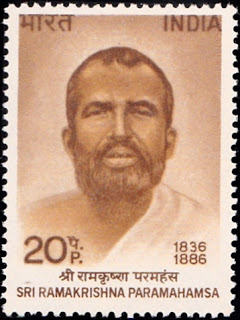
5.Ramakrishna Paramahamsa, the great saint of Calcutta always warned about Kamini and Kanchana (Women and Money/gold). He narrated the following anecdote:

“Money is an upadhi ( a deceptive influence) of a very strong nature. As soon as a man becomes rich, he is thoroughly changed. A Brahmin who was very meek and humble used to come to Dakshineswar every now and then. After some time he stopped his visits, and we knew nothing of what happened to him. One day we went to Konnagore in a boat. As we were getting down from the boat, we saw him sitting on the banks of the Ganges, where in the fashion of a big folk, he was enjoying the breeze of the river.


On seeing me, he accosted me in a patronising tone with the words, ‘Hello, Thakur! How do you do now?’


At once I have noticed the change in his tone and said to Hriday who was with me, ‘I tell you Hriday, this man must have come by some riches. See what a great change has come over him!’ And Hriday burst into laughter.


That is the evil power of money.


xxx


अज्ञः सुखम् आराध्यः
सुखतरम् आराध्यते विशेषज्ञः ।
ज्ञानलवदुर्विदग्धं
ब्रह्मापि तं नरं न रञ्जयति ॥ 1.3 ॥


It is easy to explain an ignorant man. It is even easier to explain to a wise and leanrned person. But, even Brahma cannot explain and please a person who has only a little knowledge and yet considers himself to be the mot learned man 1-3

In Tamil there are some proverbs to say that that a fool cannot be taught. ‘He will argue that the rabbit he caught has only three legs’.

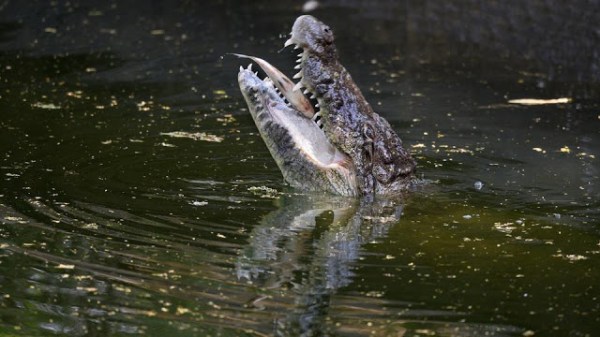
There is another proverb which says ‘a dog’s tail can never be straightened!” And the last one is “An ignorant idiot and a crocodile will never lose the grip of its catch’. That is an idiot will stick to his argument,come what may.


There is an Arabic saying which categorizes people into four types:-


“He who knows not, and knows not that he knows not, is a fool. Shun him.
He who knows not, and knows that he knows not, is simple. Teach him.
He who knows, and knows not he knows, is asleep. Wake him.
He who knows, and knows that he knows is wise. Follow him.”


–Subam–


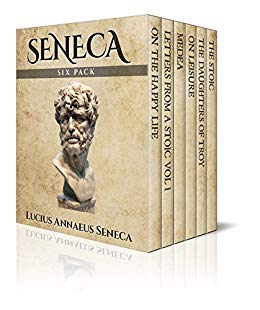
Seneca and Valluvar (Post No.5434)


Compiled by London Swaminathan

swami_48@yahoo.com

Date: 15 September 2018


Time uploaded in London – 20-52 (British Summer Time)


Post No. 5434

Pictures shown here are taken from various sources including google, Wikipedia, Facebook friends and newspapers. This is a non- commercial blog.

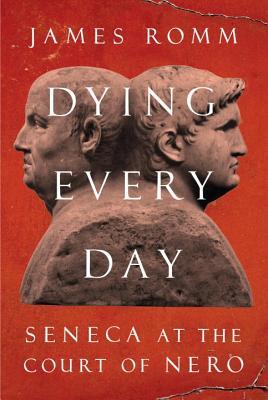
Who is Seneca?
Lucius Annaeus Seneca (4 BCE-65 CE) was a Roman stoic playwright, author of essays and nine tragedies. He was tutor to the future emperor Nero but lost favour after Nero’s accession to the throne, he lost his support and was ordered to commit suicide. His tragedies were accepted as classical models by 16th century dramatists.

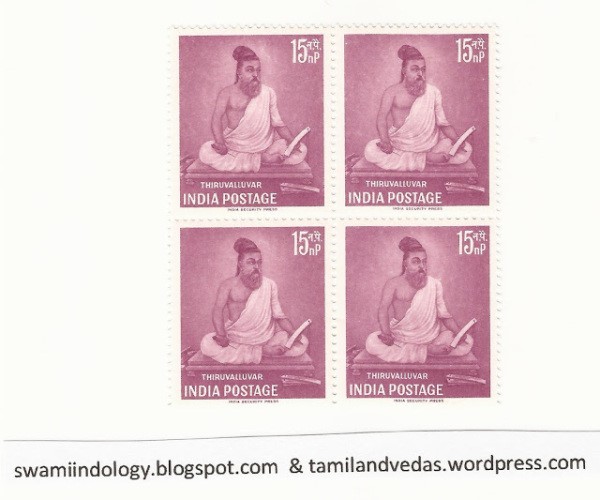
Who is Valluvar?
The greatest of the ancient Tamil poets. He was the author of Tirukkural, an ethical work with 1330 couplets dealing with 133 topics. His aphorisms are famous for its brevity and clarity.


PURITY OF MIND 

There are number of similarities between Valluvar and Seneca. Let us look at few couplets:
Tiru valluvar says in the chapter on the Importance of Virtue,

To be of pure, spotless mind is real virtue; all else is of no avail- Kural 34

He says a blemish less mind is the basis of all virtues. Every thing else is an empty show.
Seneca agrees with him ,
‘Between good men and the gods there exists a good friendship brought about by virtue (arising from a pure mind)’.– Seneca on Providence

Xxxx


PATIENCE 

Under the chapter on Forbearance or Patience, Valluvar said,

‘Overcome by forbearance those that harm thee by this overbearing act’– 158

Another translation of the same couplet is

‘Pride leads a man to do wrong; but this could be overcome
By the greater pride of one’s own forbearance.

Seneca also says,
Unkindness must be treated with kindness.

This, we find, in Dhammapada of Buddha and Mahabharata of Vyasa.
Almost all Hindu saints said this.

Xxx

ANGER, CONTROL OF TEMPER

If you would protect yourself, guard against your own anger.
For anger, not controlled would lead to self- destruction–305

Seneca’s words fully agree with Valluvar,
‘Anger leads to self- destruction’.

Xxx

NOT CAUSING INJURY


We find in Valluvar’s Kural,
Refraining from doing harm in retaliation of harm done with animosity is the rule of conduct of the noble hearted- Kural 312
This is also said by all the great saints
Seneca said,
‘For the wise and the great injuries don’t exist.’

Once again we are reminded ‘Great men think alike’.

Source for Seneca s quotations- Tirukkural by Dr S M Diaz
Xxx subham xxxx

RADISH GANESH AND CAMEL HANUMAN (Post No.5429)


Written by London Swaminathan

swami_48@yahoo.com

Date: 14 September 2018


Time uploaded in London – 7-58 am (British Summer Time)


Post No. 5429

Pictures shown here are taken from various sources including google, Wikipedia, Facebook friends and newspapers. This is a non- commercial blog.


Hinduism is the oldest religion in the world. When other ancient religions of Egypt, Greece, Rome and China went into museums how did hinduism survive? Even the name Hinduism is only 2500 years old: before the Greeks and Persians called the people living beyond Indus River, Hindus, the religion was flourishing, aptly under the name Sanatan Dharma- The Eternal Religion.


The reason for the amazing success of Hindus is adaptation, absorption and digestion of foreign thoughts and newer ideas. Earlier I wrote about the newest vehicle of Hindu Gods- camel for Anjaneya. Each Hindu god has a vahana/vehicle. Camel is added as a vehicle of Anajaneya also called Maruti, Hanuman and Vayu putra. Strangley the vehicle is found in South Indian Anjaneya temples, where as the camel is a desert animal of Rajasthan and other western states. But Hindus can adopt, adapt, absorb and digest anything and make it look like ‘pukka’ Hindu!


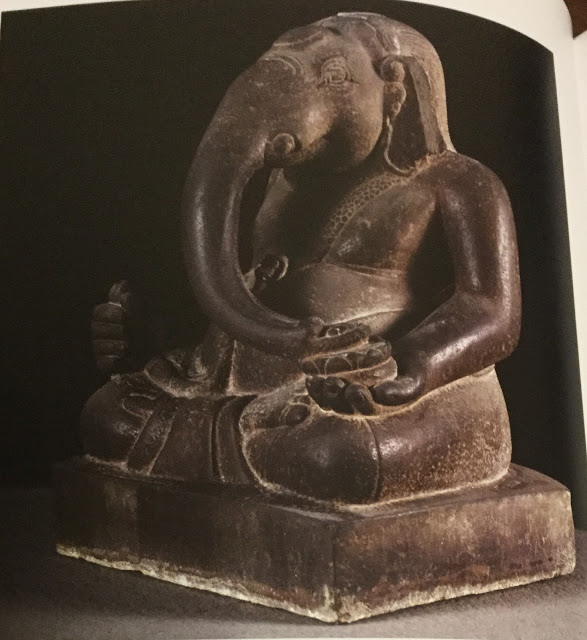
Here is another story not known to many of us. Radish Ganesh! Ganesh with Radish (Muli) is found mostly in South East Asian countries.


Ganesh is one of the most original gods of Hindu pantheon and one of the most loved. Associated with intelligence- knowing and knowledge—he is said to have worshiped by all other gods before embarking on any new adventure. He put the Mahabharata- the longest epic in the world, into writing for Veda Vyasa. He lost one of his tusks in the gigantic task of writing 200,000 lines.


Ganesa is considered the protector of corps. That is why a rat is shown as his vehicle/vahana. It is believed that he protects the crops by controlling the crops. Considered as one who surmounts of obstacles, Ganesh or Vinayaka (or Pillaiyaar in Tami)l is invoked before each undertaking. He does not need big temples. He is shown in natural surroundings in caves, under the trees ad in open spaces without even a roof over his head!

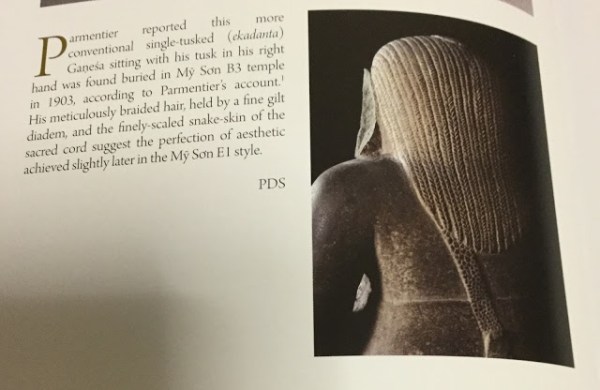
One of his attributes is the axe (Parasu) which cuts and tears down the bad things such as sins and evil fate. In places like Vietnam (Champa of olden days) he is shown with a radish (Mulaka gandha) in one of his hands. The association of the deity with with the world of agriculture, vegetation, more widely, with nature is betrayed by the attribute of a radish in his left hand. This radish with acidic taste is loved by the elephants. We see it in some of  the Indian Ganesh statues of 6th and 8th centuries. The other attribute of Ganesa is a bowl with Modakas ( sweets made up of coconut and rice flour or sometimes ladduka). Ganesh image is rich in symbolism. We see snakes, tiger skin draped around his hips, gem studded gold necklaces, Brahmanical cord (the sacred thread) on left shoulder. One statue of Ganesh was recovered from Myson in Vietnam with missing parts, but others are intact and displayed in museums.

–subham–


Veena and Tamil Yaaz in the Rig Veda (Post No.5422)

WRITTEN by London Swaminathan


swami_48@yahoo.com

Date: 12 September 2018


Time uploaded in London – 16-02 (British Summer Time)


Post No. 5422

Pictures shown here are taken from various sources including google, Wikipedia, Facebook friends and newspapers. This is a non- commercial blog.


Veena or Vina is seen in the hands of Sarasvati and Veena Dakshinamurthy (Shiva). Ravana and Agastya were very good Veena players. I have already given the story of a competition beween the two. Narada, the inter galactic traveller,was the greatest Veena player.Demon Ravana has Veena on his flag. Veena is found in the Rig Veda and thee Atharvan Veda. But in the 2000 year old Sangam Tamil literature we dont find Veena but Yaaz. Yaal is similar to veena, a string instrument. Veena figures for the first time in Post Sangam work, Silappadikaram,the most beautiful epic of the Five Tamil Epics.

Yaal or Yaaz is similar to lyre and harp.

Did Veena become Yaal (Yaaz) or Yaaz become Venna is a debatable point. Alternately they might have evolved simultaneously because  we find wind instruments, string instruments and drums all over the world. Even he Australian aborigines invented their own unique musical instrument.


My research shows that the seven notes went to Greece, Sumer and other parts of the world from the Hindu scriptures. Tamils also speak of seven notes with special Tamil tecnical terms. Since the seven notes are found in the Rig Veda, the oldest book in the world, it should have spread to other parts of the world fron the Vedic land.


There are supporting evidences in the Vedas. They talk of different musical instruments and they formed part of the main Vedic rituals.


Word Research


Yaaz gave birth to the musical term Jaaz (J and Y are interchangeable as we see in Jesus = Yesu, Judaism = Yuda etc)


Vaanan a musical term became Banan in Tamil (B and V are interchageable as we see in Bengal= Vanga in Tamil aad Sanskrit; even in ancient Tamil we seethis B=V change. Bandi was cart in Sangam Tamil; now Vandi is the modern Tamil word for cart).

I can give innumerable examples.


Vanan= Banan change is an important one. Throughout 2000 year old Tamil literature we see Banans (bards) singing the praise of Tamil kings. Greek God ‘Pan’ (god of the wild and Music) is also a cognate word to Banan and Vanan.

Now the question is how did Yaaz or harp or lyre disappear and only Veena survived. The strange thing is until fifth century CE we see only Yaaz in Tamil (except one refrence in Tamil epic about ‘Naradar Veenai’ in Silappadikaram); but after fifth century we see only Veena and not Yaaz (harp or lyre). The starnge thing about this harp or lyre or Yaaz is , it is seen in Gupta scultures and Gupta coins. Slolwly it disappeared from the scene.

Picture taken by me in London


Even today Yaaz is seen in East European countries. I took a picture of harp player in South Kensington, London where a lyre player was playing the music in the street. I got a similar picture in social media from Croatia. Why did this disppear and yield to Veena in India is a subject for research.


Now let us look at the Tamil Yaaz. We have refrences to several types of Yaaz from 7 to 1000 stringed instruments. The commentators of the Tamil epic gave all thse details about them. Swami Vipulananda was one of the scholars who collected all refrences to Yaaz from literature and published a book.

Yaaz or Lyre in Sumer

Like Vedic ceremoies musical instruments were used in religious rituals; Hittite texts attest to this. Like Vedic Hindus (Narada, Ravana), even priest played harps and lyres. Though lot of muscial instruments were discovered in tombs in Mesoptamia, they were only parts and not intact. But the 4000 year old reconstructed instruments are on display  in the museums now. Cylinder seals attest to Platforms on which musicians played.

Mesopotamia had two musical systems Akkadian and Sumer. It can be compared to the two main music streams in modern India- Carnatic and Hindustani. The Sumerian system used fixed tunings and prescribed patterns. Akkadian system used seven muscial notes and nine strings. Both have similarities to Indian Ragas and Spata Svaras.


This is the summary of my research paper submitted to souvenir in connection with Swami Vipulananda memorial Celebrations in France.


Please see the refrences from the Vedic literature given below:–

Vana in Rig Veda (RV) 1-85-10; 8-20-8; 10-97-8; 10-32-4

Atharvana- 10-2-17


Sapta Svara in RV (SEVEN NOTES) – 10-32-4


Pancha vimsa Brahmana says Sata tantu (hundred string Yaaz or Lyre) was used in MAHA VRATA CEREMONY.  taittiriya Samhita (7-5-92), Kataka Samhita (24-5) also refer to this 100 stringed lyre or Yaaz.

Picture shows Makara Yaaz and Senkotti Yaaz


‘Sapta Vani occurs in RV (1-164-24; 3-1-6; 9-103-


SOURCE FOR REFRENCES- VEDIC INDEX OF NAMES AND SUBJECTS, VOL.2, AA MACDONELL AND AB KEITH


‘Veena in Taittiriya Samhita  6-1-4-1; Kataka Samhita 24-5; Matrayani Samhita , 3-6-8; Satapata Brahmana 3-2-4-6


Veena Vaadha (Palyer on Veena)Vajasaneyi Samhita

‘30-20; Taittiriya Brahmna 3-4-15-1


Veena Gathin (Veena palyer), Parts of Veena, Skin cover of Veena are also mentioned in the edic literature


‘Taiitiriya Brahmana 3-9-14-1; Satapata Brahmana 13-1-5-1 etc.


–subham–

Mark Twain, Coleridge, Boswell, Dr Johnson Books Anecdotes (Post No.5419)


Mark Twain, Coleridge, Boswell, Dr Johnson Books Anecdotes (Post No.5419)


Compiled by London Swaminathan


swami_48@yahoo.com

Date: 11 September 2018


Time uploaded in London – 18-28  (British Summer Time)


Post No. 5419

Pictures shown here are taken from various sources including google, Wikipedia, Facebook friends and newspapers. This is a non- commercial blog.


Mark Twain Startled!


It was an English man, met somewhere in Europe, who startled Mark Twain by saying abruptly, Mr Clemens, I would give ten pounds not to have read your Huckleberry Finn! And when Mark looked up awaiting an explanation of this extraordinary remark, the English man smiled and added
“So that I could have again the great pleasure of reading it for the first time.”

Xxx

‘Life of Johnson’ Book!

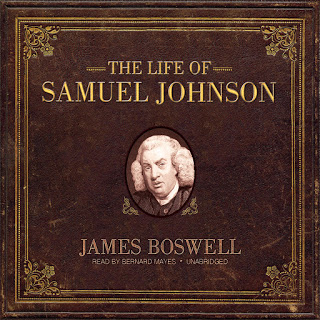
Sir John Malcolm once asked Warren Hastings, who was a contemporary and a companion of DrJohnson and Boswell, what was his real estimation of Boswell’s Life of Johnson?

Sir, replied Hastings, ‘it is the dirtiest book in my library’.
Then proceeding he added,
‘’I knew Boswell intimately; and I well remember when his book made its first appearance. Boswell was full of it that he could neither think nor talk of anything else; so much so, that meeting Lord Thurlow hurrying through parliament street to get to the House of Lords, where an important debate was expected, for which he was already too late, Boswell has the temerity to stop and accost him with,
‘Have you read my book?’
‘Yes, damn you! replied Lord Thurlow, ‘every word of it; I could not help myself’.

Xxx

‘Thief’ Coleridge

Coleridge was always a tremendous reader. While he was a student at Christ’s Hospital he used to spend his free time wandering aimlessly about London, shivering in front of the window s of book shops and print shops. Once, while so standing, he got, in his own words, ‘absent mindedly involved with the coat tail pocket of a stranger, who at first took him for a thief, then was so charmed by his conversation that he made him free of a library’ in Cheapside . Thenceforth he would run all risks in skulking out to get the two volumes to which he was entitled daily.

Xxx


Rousseau

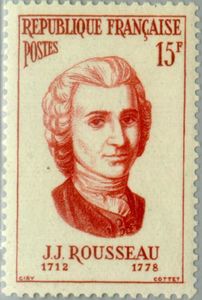
When Dr Johnson was told that Rousseau’s ‘Confessions’ would contain every motive that had induced him to act in every situation— ‘Then’, replied he, ‘if he was an honest man, his book will not be worth a farthing’.

Xxx Subham xxx

WHAT DID I DISCOVER IN INDIA?– JAWAHARLAL NEHRU (Post No.5412)

Compiled by London Swaminathan


swami_48@yahoo.com

Date: 10 September 2018


Time uploaded in London – 17-53 (British Summer Time)


Post No. 5412

Pictures shown here are taken from various sources including google, Wikipedia, Facebook friends and newspapers. This is a non- commercial blog.


Quotes from Jawaharlal Nehru’s ‘Discovery of India’

Man’s dearest possession is life, and since it is given to him to live but once, he must so live as not to be seared with the shame of a cowardly and trivial past, so live as not to be tortured for years without purpose, so live that dying he can say, ‘All my life and my strength given to the first cause of the world- the liberation of mankind’ –Nicolai Ostrovsky
Xxxx

We in India do not have to go abroad in search of the past and the distant. We have them here in abundance. If we go to foreign countries, it is in search of the present. That search is necessary, for isolation from it means backwardness and decay.

Xxxx

Nearly five months have gone by since I took to this writing and I have covered a thousand hand written pages with this jumble of ideas in my mind. For five months I have travelled in the past and peeped into the future and sometimes tried to balance myself on that point of intersection of the timeless with time.

Xxx

On June 15th both were discharged ( Narendra Deva and Nehru) , 1041 days after our arrest in August 1942. Thus, ended my ninth and the longest term of imprisonment.

Xxx

What did I discover?
The discovery of India — what have I discovered.
It was presumptuous of me to imagine that I could unveil her and find out what she is today and what she was in the long past. Today she is four hundred million separate individual men and women, each differing from the other, each living in a private universe of thought and feeling. If this is so in the present, how much more difficult is it to grasp multitudinous past of innumerable successions of human beings. Yet something has bound them together and binds them still. India is a geographical and economic entity, a cultural unity amidst diversity, a bundle of contradictions held together by strong but invisible threads.


Overwhelmed again and again, her spirit was never conquered, and today when she appears to be the plaything of a proud conqueror, she remains unsubdued and unconquered. About her there is the elusive quality of a legend of long ago; some enchantment seems to have held her mind. She is a myth and an idea, a dream and a vision, and yet very real and present and pervasive. There are terrifying glimpses of dark corridors which seem to lead back to primeval night, but also there is the fullness and warmth of the day about her. Shameful and repellent she is occasionally, perverse and obstinate, sometimes even a little hysteric, this lady with a past, but she is very lovable, and none of her children can forget her wherever they go, whatever strange fate befalls them. For she is part of them in her greatness as well as her failings, and they are mirrored in those deep eyes of her that have seen so much of life’s passion and joy and folly, and looked down into wisdoms well.

Each one of them is drawn to her, though perhaps each one has a different reason for that attraction or can point to no reason at all, and each sees some different aspect of her many -sided personality. From age to age she has produced great men and women, carrying on the old tradition and yet ever adapting it to changing times.


What Tagore said………………

Rabindranath Tagore, in line with that great succession, was full of temper and urges of the modern age and yet was rooted in India’s past and in his own self built up a synthesis of the old and the new.’ I love India’, he said, ‘not because I cultivate the idolatry of geography, not because I have had the chance to be born in her soil but because she has saved through tumultuous ages the living words that have issued from the illuminated consciousness of her great ones’. So many will say, while others will explain their love for her in some different way.


Xxx SUBHAM xxx

Poet Bharati and Mahatma Gandhi condemned Purdah (Post No. 5408)

Compiled by  London Swaminathan


swami_48@yahoo.com

Date: 9 September 2018


Time uploaded in London – 17-07 (British Summer Time)


Post No. 5408

Pictures shown here are taken from various sources including google, Wikipedia, Facebook friends and newspapers. This is a non- commercial blog.


Bharati born on 11 December 1882

Died on 11 September 1921


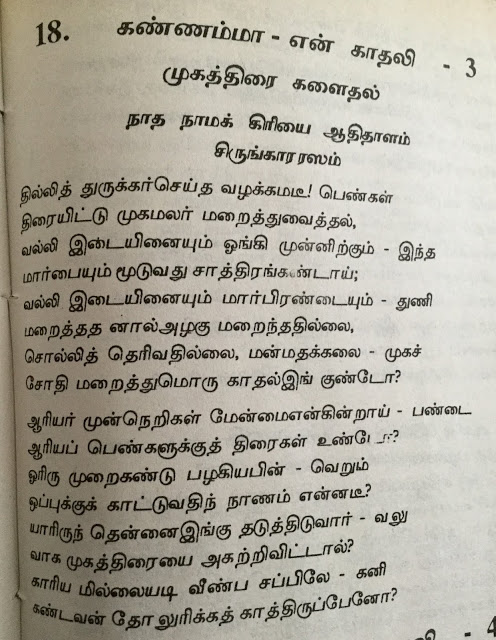
Subrahmanya Bharati, the greatest of the modern Tamil poets, condemned purdhah (veil) on Hindu women. he teases animaginary lady love Kannamma on wearing veil.

Here is the poem with English translation by Dr T N Ramachandran


Removal of the Veil by Bharati
TN Ramachandran’s Translation

It is the custom with Delhi Muslims
To keep the lotus face with veil covered
The liana waist and the jutting breast
Are to be veiled, as Sastras so prescribe

By veiling the breast and liana waist
Beauty is not under bushel hid;
Cupidry is not taught by word of mouth;
Can love flourish behind a veiled visage?


Noble you say are Aryan custom s old;
Did ever Aryan dames their face s veil?
Having met more than once and love exchange d
Wherefore this coy persistence— all formal?

Who will then dare essay, me to obstruct
If by force I pluck the veil from you r face?
Of what avail is pretension idle?
Can ever rind of fruit the eater defy?


Orignal Tamil Verse


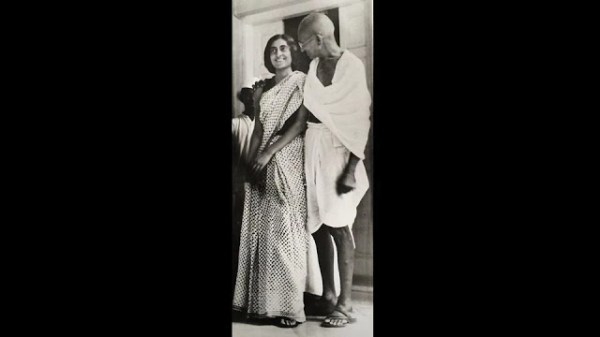
Gandhi on veil from Nehru’s ‘Discovery of India’ (posted yesterday)


Anti Purdah
Gandhiji has been, and is, a fierce opponent of purdah and has called it ‘a vicious and brutal custom’ which has kept women backward and undeveloped. I thought of the wrong being done by the men to the woman of India by clinging to a barbarous custom which, whatever use it might have had when it was first introduced, had now become totally useless and was doing incalculable harm to the country. Gandhiji urged that woman should have the same liberty and opportunity of self -development as man.


–subham–

Indian Ivory Antiques in England and Russia! (Post No.5393)

Research article Written by London Swaminathan

swami_48@yahoo.com

Date: 4 September 2018


Time uploaded in London – 21-39 (British Summer Time)


Post No. 5393
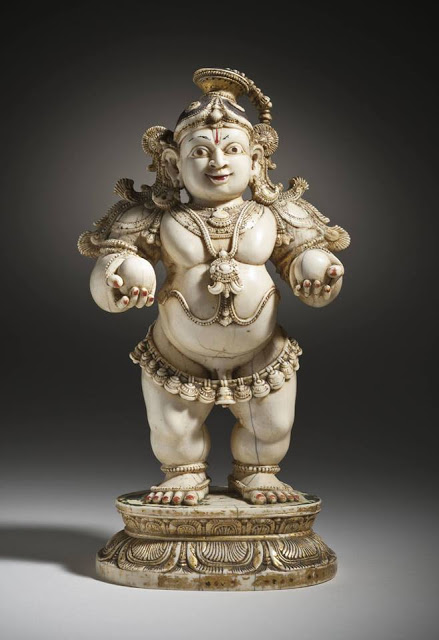
Ivory products of India are found in Ancient Egypt, Russia and Britain. Ivorry objects are mentioned in Kalidasa’s works and Sangam Tamil Literature. Harappans of Indus valley exported Ivory combs and other gold and silver ornaments to Sumeria accoording to Mortimer Wheeler. That shows India is one of the oldest countries in the world to make and use ivory products.

It is supported  by later inscripttions and litearature.

The ivory recovered from elephant is referred toby Kalidasa and other poets:

In Tamil there is a proverb “An elephant is worth 1000 gold coins whether it is alive or dead’. This expalins the value of its tusk and the hide. Moreover Hindu literature is full of references to pearls dropping from tusks (though it is scientifically not proved).

Ivory is referred to in Sangam Tamil Literature as well. Through 200 similes of Kalidasa found in Sangam Tamil literature, I have proved Kalidasa, the greatest Indian poet and playwright, lived before Sangam period, may be in first century or second century BCE.

Ivory Throne : Raguvamsam 17-21

King Athithi had the coronation abishekam sitting in Bhadrasana posture and then went to the next room for changing his clothes where he sat on the Ivory seat (Chair or stool)- (Rv 17-61)

Several Sangam Tamil poets used ivory objects in their poems:

Kapilar sings about the women who pounded the grains in the mortar with pestles made up of ivory and sandal (Kalitokai 40-4)

Tol Kapilar sings about a hunter using the ivory tusk to dig the land to get gold. While he was doing it the tusk broke and pearls inside the tusk came out along with the gold! (Akam 282 -Thol Kapilar).

There is an inscrption in Sanchi (200 BCE) which mentions a guild of ivory carvers in the nearby city of Vidhisa (now known as Besnagar). This fully testifies to the craft ivory carving. Ramayana also mentioned ivory craft. The indian stauette found in Herculaneum and the ivory paques found in Begram further testify to the antiquity of ivory trade. Varahamihira’s Brhat Samhita advises people to make legs of the bed with solid ivory. High ivory potal of a courtesan’s house is mentioned in Sudraka’s ‘The Little Clay Cart’ drama. All these refereces are from the first few centuries of moden era.


Chessmen made up of ivory were used in Brahmanabad in Sind. Ivory laid doors of Bijapur Palace was famous in the eighth century. So we have continous refrences from the Indus valley Time.


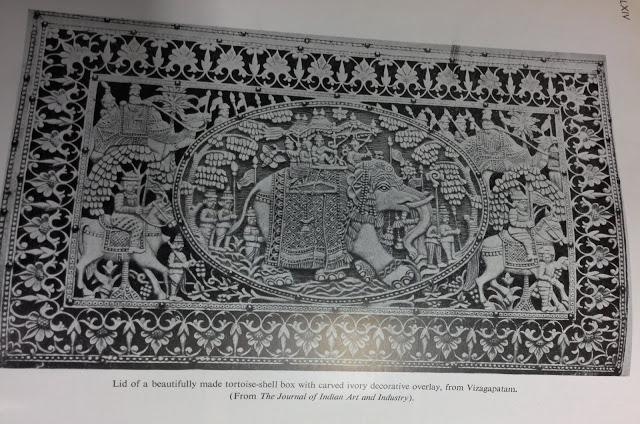
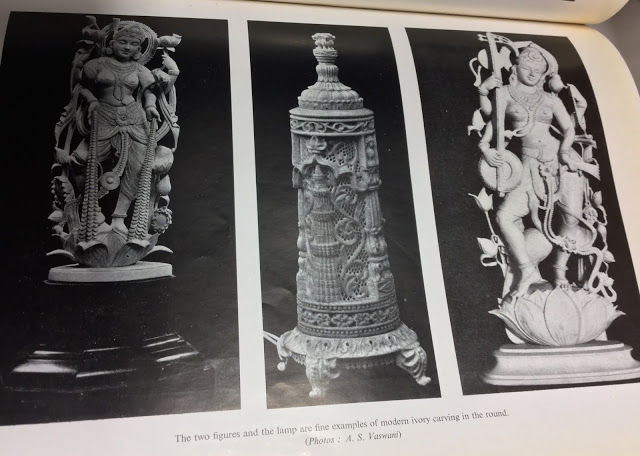
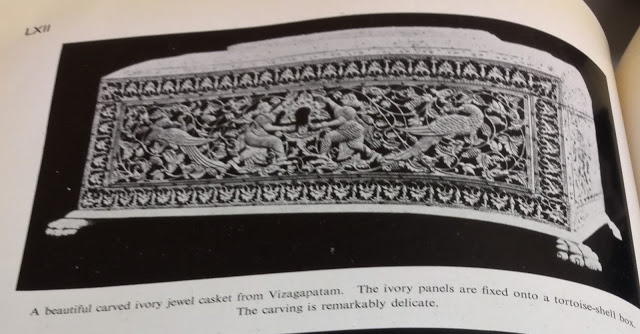
Terry in his’ Voyages to the East Indies’ (1655 CE) tells us of the skill of Indian crafsmen in making cabinet boxes, trunks and stands. He also describes the ivory work on tortise shells. Portugese traveller Paes wrote about a hall made up of ivory in Vijayanagara Empire. Hindu temples in South India has several ivory objects. A nagaswara instrument (Tamil Pipe) made up of ivory is in a Hindu temple in Tiruvarur, Tamil Nadu. Sir George Watt made a deep study in the ivory craft of Indians during the 1903 exhibition in Delhi. He has collected lot of trade secrets of ivory traders. Form Kerala to Himachal, there were several towns famous for ivory craftwork.Till ivory sale was banned, all craft shops in India were selling ivory boxes, caskets, statues and combs.

There is ample evidence that ivory craft was well developed in India before the second century BCE.

Jawaharlal Nehru, former Prime Minisrer, donated a three fold ivory carved screen to Soviet Union in 1955. This is on dispaly in Moscow.

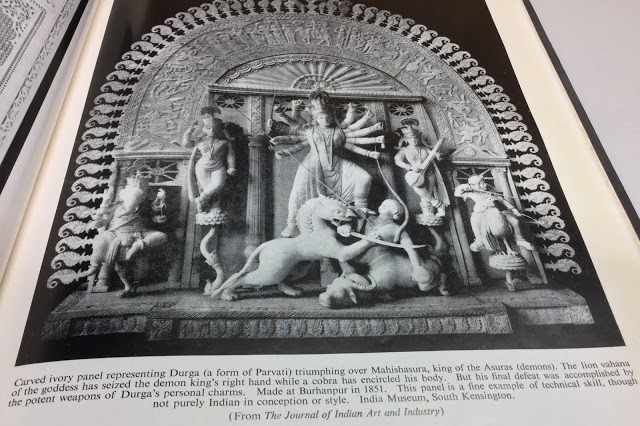
Museum in London has a statue of Durga made in Burhanpur in 1851.


Indian Ivory Throne to Queen Victoria
Edgar Thurston, former superintendent of Madras Government Museum, has related the interesting history of India’s ivory industry of 1800s. When one Maharajah, Rama Varma, saw some five ivory carvings , he became enthusiastic about the craft and began to strongly encourage a broader application. The Maharajah who succeeded him, Marthanda Varma sent to Queen Victoria a new ivory throne, elaborately carved and decorated with inset jewels. After prominent display at the Great Exhibition of 1851 in London, it was installed in the State Apartment at Windsor Castle. Nineteenth century ivory products included individual cases for calling cards, envelopes , gloves, handkerchiefs, bookshelves, chessboards etc.

Also carved in Madras was scent bottles, special talismans for children, ‘howdahs’ for carrying royalty on the back of the elephants.
Especially in western India ladies combs and bangles were very common ivory products

The residual ivory saw dust was sometimes sold to cow and buffalo dealers, who fed it to the female animals to increase their milk yield. In northern India ivory saw dust was considered to be a fortifying medicine. In India, ivory craft was a family trade. Boys learnt from their parents when they were young.

The ancient Indian town of Pali, on the old trade route between Bombay and Delhi, turned ivory bangles for several centuries. Entire streets of crafts men made only this article in sets of graduated sizes, so as to cover a woman’s arm from shoulder down to wrist. They were cut from the tusk as it too decreases from base to Point.

English alphabet sets were also made during British rule for export.


In Madras some children wore special talisman s made of ivory.
Following India n museums have ivory products
Prince of Wales museum in Mumbai
Crafts museum, Thapar House, Delhi
Salar Jung Museum, Hyderabad
Art Museum, Thiruvananthapuram

and abroad:-

Museums in London and Windsor

Museum in Moscow

Ivory Craft In other parts of the World:-

The Old Testament includes references to ivory One passage tells that “King Solomon made great throne of ivory and overlaid it with pure gold”, 1 kings 10:18 and 2 chronicles 9:17
More strikingly Ahab allegedly made a house of ivory, 1Kings 22:39
“And the houses of ivory shall perish”, Amos 3:15

The earliest surviving ivory carvings are mainly from Egypt, Phoenicia, Assyria, China and India.
In pre dynastic Egypt tombs contained ivory and fish hooks, arrowheads pins, bodkin,s spoons, knives, combs, bracelets and necklaces

The British Museum has probably the best collection of the Assyrian ivories, 1200-600 CE from Ancient Nineveh

Elephant tusks were used through out ancient China; in addition walrus tusks were utilised in the north, and hippopotamus tusks in the warm southern regions.
China imported tusks from South East Asia and India. The first Chinese, Shang Dynasty , was already producing animal figures and other items .

Source books

Ivory and its Uses by Benjamin Burack,Tokyo 1984

Handicrafts and Arts in India, Taraporevala

Tamil and Sanskrit Literature

Please read Indian Ivory in Ancient Egypt in the following article:-

  1. Egypt ivory figures | Tamil and Vedas

tamilandvedas.com/tag/egypt-ivory-figures

Posts about Egypt ivory figures written by Tamil and Vedas

GEM STONES IN KALIDASA & TAMIL LITERATURE | Tamil and Vedas

tamilandvedas.com/2012/02/13/gem-stones-in…

The pearl recovered from elephant ivory is referred by Kalidasa and other poets: … //tamilandvedas.com/2012/02/13/gem-stones-in-kalidasa-tamil-literature/

–Subham–