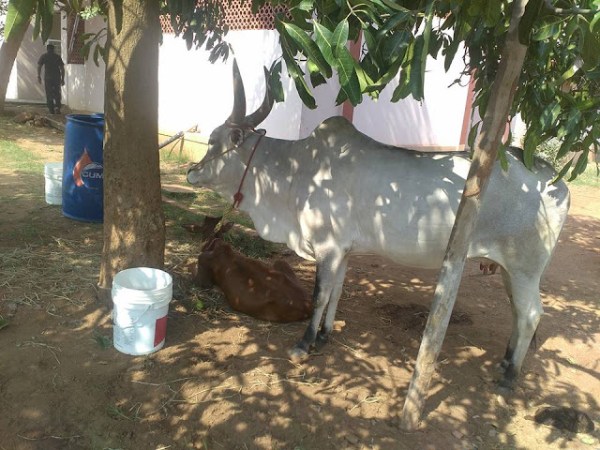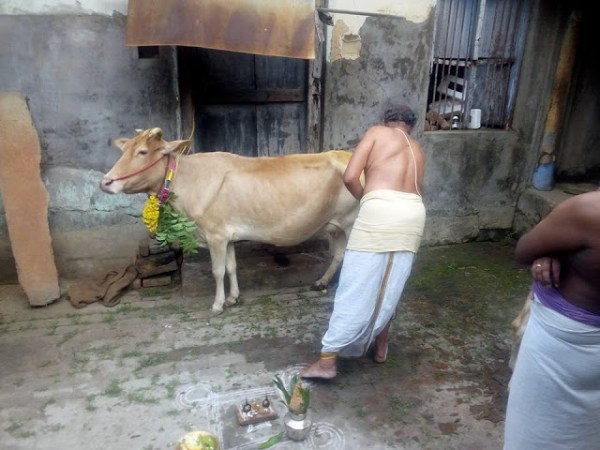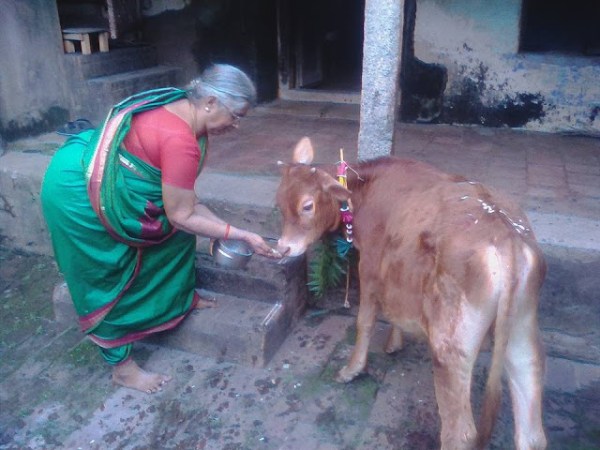
A Vedic Story: How did the Cow get a Shiny Skin? (Post No.4068)

Compiled by London Swaminathan
Date: 10 July 2017
Time uploaded in London- 10-20 am
Post No. 4068

 
Pictures shown here are taken from various sources such as Facebook friends, Books, Google and newspapers; thanks.


There is a symbolic story in the Satapata Brahmana (3-1-2-16)

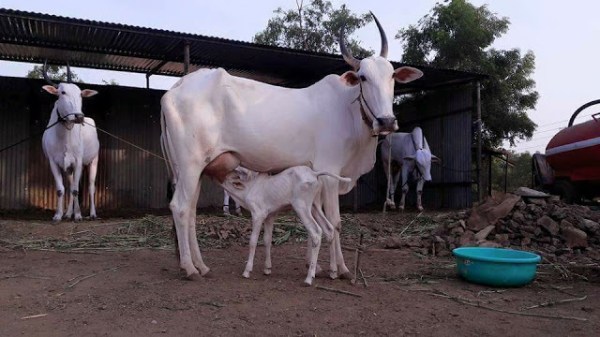
“That same skin which belongs to the cow was originally on man. The gods speak, ‘verily the cow supports everything here on earth; come, let us put on the cow that skin which is now on man; therewith she will be able to  endure rain and cold and heat’.
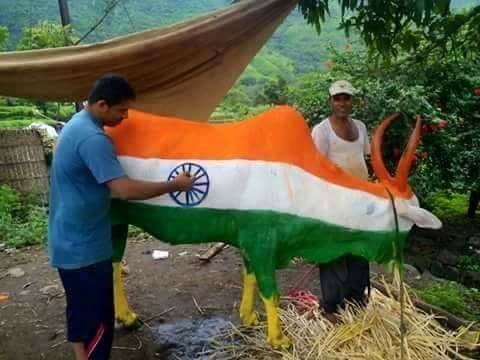
Accordingly having flayed man, they put that skin on the cow, and therewith now she endures rain and cold and heat. For man was indeed flayed; and hence wherever a stalk of grass or some other object cuts him, the blood trickles out. They then put that skin, the garment on him; and for this reason none but man wears a garment, it having been put on him as his skin. Hence also one should take care to be properly clad, so that he may be completely endued with his own skin. Hence also people like to see even an ugly person properly clad, since he is endued with his own skin. Let him then not be naked in the presence of a cow, for the cow knows that she wears his skin and runs away for fear lest he should take the sin from her. hence also cows draw fondly near to one who is properly clad”


Taittiriya Brahmana has the following passage:

“That a calf extorted a promise from certain sacrifices not to milk a cow within the first ten days after calving, and to let the calf suck for a fifth of the day after milking, and that for all time the promise has been honoured” (2-1-1-4)

Silence is observed when cows are milked.

My comments:

This story shows that the cow is the most sacred animal. It is needless to say that is the most useful animal. The cow is treated like a human being, particularly like a woman, who should be given all respect. Manu Smrti says that a woman must be respected, adorned and adored; if she is made to cry the family will be destroyed lock stock and barrel.

Probably they want us to understand that cows and human beings are same when it comes to giving respect. In Sangam Tamil literature and in the later devotional Tamil literature Brahmins and cows are treated equally.


This story can be interpreted in many ways. One should not misbehave in front of the cows or with the cows. One should also note that no other animal is dealt with in this way. Hindus gave respect to all animals  — Sanskrit and Tamil literature has stock phrase “from ant to elephant”—- the animals from plankton to whale should be fed and respected. Hindus do it in life every day. They do use flour to feed the ants when they draw kolams (rangoli) in front of their houses. It is a common decoration seen in front of all the houses in South India. This is part of Pancha Yajna (five sacrifices0 done by all orthodox Hindus.

Also read

How did Cow get Hoofs and Horns? A Vedic Story (Post No.4059)

Posted on  7 July 2017
–Subham–
How did Cow get Hoofs and Horns? A Vedic Story (Post No.4059)

Written by London Swaminathan
Date: 7 July 2017
Time uploaded in London- 6-47 am    
Post No. 4059

 
Pictures shown here are taken from various sources such as Facebook friends, Books, Google and newspapers; thanks.


The Aitareya Brahmana (4-3-17) explains how the cows got their hoofs and horns.


“The cows being desirous of obtaining hoofs and horns, held a sacrificial session.

in the tenth month of their sacrifice, they obtained hoofs and horns.

We have obtained fulfilment of that wish for which we underwent the initiation into the sacrificial rites.

Let us rise, the sacrifice being finished. When they arose they had horns. They however, thought, let us finish the year. and recommenced the session.

On account of their distrust their horns went off; and they consequently became hornless.


They continuing their sacrificial session, produced vigour. Thence after sacrificing for twelve months, and having secured all the sessions,  they arose again at the end. For they had produced the vigour to reproduce hoofs and horns. Thus the cows made themselves beloved by all the whole world and are beautified (decorated) by all. He who has such a knowledge, makes himself beloved by everyone, and is decorated by everyone”.


The symbolic meaning is very clear in this story. If some one leaves a job in the middle without reaching the goal, he loses his name and fame. Name and Fame are described as horns in Vishnu Sahasranama and Tamil literature (Komban= horned; Srnga = horn, Chatvari srnga:; Na Eka Srnga etc). Vishnu Sahasranama and Vedas describe the Indus Valley God (so called Pasupati seal) as Komban. We can see the horns on the figure.

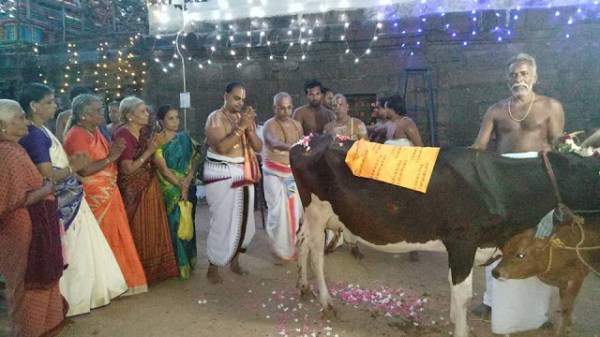
Till this day, cows are decorated and worshipped, particularly on Krishna’s birth day (Janma Ashtami). Tamils decorate the cows and bulls on Maattu Pongal Day (Cattle Pongal is celebrated one day after Makarasankaranti/Pongal Day)


Foreigners’ Ignorance!

In primitive parts of Africa there are some folk tales such as how did the cheetah get its spots? How did the tiger get lines on its body? Why did the elephant’s hand is long like a snake? Why did the giraffe has a long neck? In India we have some stories in Ramayana that squirrel got three lines because of Rama’s touch, crow’s one eye was blind because Rama’s arrow pierced it etc.


In Vedic literature, we have some stories such as cow getting the hoof, horn and skin. But there is a big difference between these stories and primitive folk tales. Our Vedic stories are religious stories where as others are folk tales. They are not used in rituals. Our stories have been kept alive for thousands of years by word of mouth (now in writing). Our stories have symbolic meaning and that is the reason they are embedded in between other religious rituals. Folk tales are just folk tales, no other significance is attached to it.


Foreigners who did not understand the symbolic meaning compared them with the folk tales of primitive tribes. They couldn’t say why they are absent in Europe and other parts of the world. If Hindus have come to India from other parts of the world these cow stories must exist there; cows must be venerated as we do in India for thousands of years. The fact of the matter is, we went to various parts of the world and taught the value of cows and bulls. Those ignoramuses forgot all those good things and started eating cows and blunted their brains. They fought two world wars and killed millions of people. They called themselves ‘civilised’ but in heart they are ‘uncivilised!’


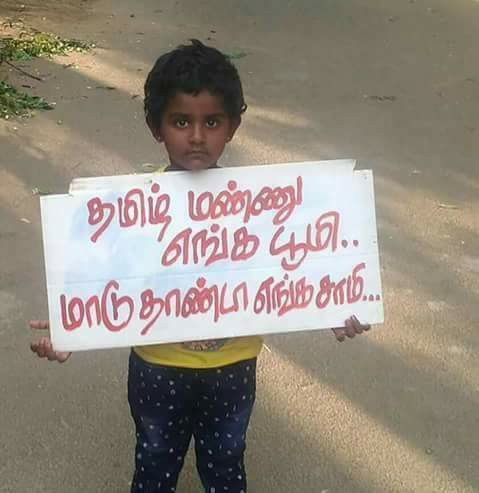
-The placard says Tamil land is our land; cattle is our God.


-Subham–

Importance of Cow in Sanskrit Literature! (Post No.4053)

Written by London Swaminathan
Date: 5 July 2017
Time uploaded in London- 9-28 am
Post No. 4053

 
Pictures shown here are taken from various sources such as Facebook friends, Books, Google and newspapers; thanks.


The cow occupies a unique position in Hinduism. Kalidasa’s Raghuvamsa gives a graphic account of care and respect shown to a cow by the emperor Dilipa.

Hindus’ greatest contribution to the world civilization is cow and its products. When the world was drinking goat’s milk and camel’s milk and even donkey’s milk they discovered that the cow’s milk is the best in the world and it is as good as mother’s milk. No ancient literature praises or values cow’s milk as Hindu literature. From Rig Veda to Sangam Tamil literature we find innumerable references in praise of the cow.


There are very interesting words in Sanskrit from the cow:-

Vaatslayam

Love and affection shown towards calf by its mother cow. Oft quoted in the Vedas

Go loka

The heaven of Krishna is Go loka (cow’s world)

Duhitri

A daughter is called milk maid (duhitri)

Gotra

clan; group

Gopis

Women with divine love towards Krishna

Madhuparka

All the saints are honoured with Milk and Honey. Hospitality is a unique Hindu concept. Rig Veda and Tamil Sangam book Purananuru have a lot of Danastutis, in praise of donation and hospitality. (English word donation comes from Sanskrit Dhaana).

Hosipitality is the rule of life among the Hindus. Tamil Veda Tirukkural has a chapter on it. Rig Veda praises it. Mahabharata has several stories in praise of hospitality. Panchatantra is full of quotations on hospitality. Guests were received with great ceremonies in ancient India. They must be given water to wash their feet and a seat to take rest. If they are unknown people, pial of the house was given to them to take rest and provided with full meals.


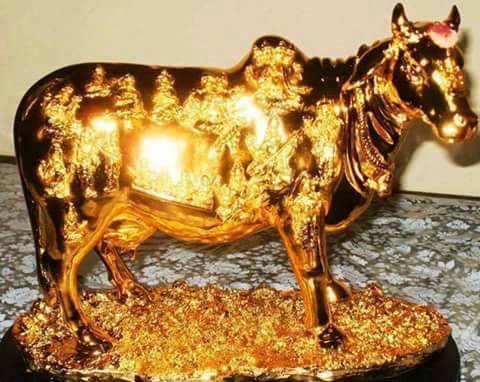
Hindus not only domesticated the cows and oxen, they worshipped them as gods and goddesses. Kamadhenu is the wish fulfilling cow. The picture and statues of Kamadhenu are in Hindu houses and temples.

Go puja and Gaja Puja (cow and elephant worship) are done in all the temples and religious Mutts. This has been going on for several thousand years without stopping. No animal in the world is worshipped continuously like this.

A word ‘Gohna’ is used for the guests. Foreigners translated it literally as Cow killer. They thought a cow was killed by the seer to feed another seer. The real meaning is that a cow’s products such as milk, butter, ghee, curd/yogurt, cow dung Go mutra (cow’s urine)– all are used in the service of the guests. Cow dung will be sprinkled with water in front of the house. Cow dung will be smeared in the oven to clean it. Cow’s urine is used to purify a place and a person.

Story of Cow’s creation

Satapata Brahmana (2-2-4-1) gives the story of Cow’s creation.

“Prajapati alone existed. He generated Agni (fire) from his mouth.

When they had sung praises, they went towards east saying, ‘We will go back thither! The gods came upon a cow which had sprung into existence. Looking up at them, she uttered the sound ‘hin’. The gods perceived that this was the ‘hin’ of the Saman (melodious sacrificial chant of Sama Veda); for heretofore their song was without ‘hin’, but after that it was the real Saman. (musical chant of Rig Vedic mantras; Hindus discovered the musical notes sa, ri, ga , ma pa, da ni – seven notes)


And as this same sound, ‘hin’ of the Saman, was in the cow, therefore the latter affords the means of subsistence; and so does he afford the means of subsistence whosoever thus knows the ‘hin’ of the Saman in the cow”.


“They said, ‘Auspicious indeed, is what we have produced here, who have produced the cow; for truly she is the sacrifice, and without her no sacrifice is performed; she is also the food. This word ‘go’ (Sanskrit word for cow; English word cow came from Sanskrit Go) then, is a name of those cows, and so it is of the sacrifice; let him therefore repeat it, saying , good, excellent! and verily, whosoever, , knowing this, repeats it, as it were saying good, excellent! with him those cows multiply, and the sacrifice will incline to him”.

Foreigners couldn’t understand this mantra. They took the word sacrifice and wrote that cow was sacrificed in the fire. But Hindus knew the correct  meaning: without cow’s products they cant run their life or do religious performance; Hindus use milk in birth and funeral ceremonies. Without Go mutra (cow’s urine), Ghee and milk no ceremony is done. They were great scientists to find that that Cow’s urine and Cow’s poo (cow dung) have got great curative and anti- bacterial properties.

Another story about cow is as follows:

Cow came from Prajapati’s Breath

Satapata Brahmana says ((7-5-2-6)

“Prajapati was alone at first. He desired, May I create food, may I be reproduced!. He fashioned animals from his vital airs, a man from his soul (mind), a horse from his eye, a cow from his breath, a sheep from his ear and a goat from his voice”.


Foreigners couldn’t understand the meaning of such mantras. Whenever and wherever they wanted they interpreted some words according to their whims and fancies; and the fact is no two foreigners agreed on the meaning, because they don’t know the real meaning. We can see this tend throughout the Vedic translations done by 20 to 25 authors. For them it was jigsaw puzzle game.


In the above mantras if they see a direction ‘North’, they will write “Look, they have come from North pole”. Here in the mantra the direction mentioned is east. Poor foreigners couldn’t say that Aryans came from the east. So they will keep quiet!


–Subham–


Biggest Loss of the Hindus- Wonderful Soma Plant! (Post No.4009)

Written by London Swaminathan
Date: 17 June 2017
Time uploaded in London- 14-50
Post No. 4009
Pictures are taken from various sources such as Face book, Wikipedia and newspapers; thanks.
contact: swami_48@yahoo.com


Most wonderful herb in the world is the Soma herb. Hindus must rediscover the Soma plant; it must be somewhere in the Himalayas or beyond the Himalayan Mountains. The whole ninth Mandala of the Rig Veda and the later literature praise it sky high. It has got miraculous effects. Had it been a narcotic drug, Hindus would have replaced it with opium or similar drugs. Had it been identified, foreigners would have made billions of dollars, by bottling the juice for sale. Vedic Hindus knew it; but in the modern times, It is not identified yet and it is not found yet. So Hindus must rediscover it through serious research.

Parsees also praised Soma plant in Zend Avesta. It is unique to Indian sub continent. Since Zoroaster migrated from Saurashtra region of Gujarat, he knew the miraculous properties of the Soma plant (See Kanchi Shankaracharya’s lecture on Zoroaster)

Here is the gist of Ninth Mandala of Rig Veda where 114 hymns praise the Soma herb.

Immortality

The juice of the plant is an immortal draught, which the gods love. Soma, the god in the juice, is said to clothe the naked and heal the sick, though him the blind see, and the lame walk. Many other divine attributes are ascribed to him. He is addressed as a god in the highest strains of veneration. All powers belong to him; all blessings are besought of him as his to bestow.


He is said to be divine, immortal and to confer immortality on gods and men. Future happiness is asked from him:

“Place me Oh, Pavamana, in that ever lasting and imperishable world where there is eternal light and glory” -RV 9-113-7


Gave God Like Powers

Soma sharpened the sense. Gods, men and angels enjoyed it, especially Indra and Maruts, Yama and the Pitrs/ancestors (This mantra shows it is not alcoholic drink because gods and ancestors are included). The potent juice of the Soma plant which endowed the feeble mortal with god-like powers.


The gods bought soma in the eastern direction. Thence he is generally bought in the eastern direction.

Number 17

The Adhvaryu priest draws 17 cups of Soma plant and the Nesthri 17 cups of Sura (alcohol), for to Prajapati belong these two plants, to wit the Soma and Sura – and of these two the Soma is TRUTH, PROSPERITY, LIGHT and the Sura is untruth, misery, darkness.

(This Satapata Brahmana mantra explains the bad effect of alcohol and the good effects of Soma- SB 5-1-2-10/14)


Girl and Soma

There are many symbolic stories about Soma which confused and baffled the foreigners; they started blabbering like drunkards when they read these passages!

“King Soma lived among the Gandharvas. The gods and rishis (seers) deliberated as to how the king might be induced to return to them. Vach—the goddess of the speech said—The Ganharvas lust after women. I shall therefore transform myself in to a woman and then you will sell me to them in exchange d for Soma (Aitareya Brahmana)

In the Taittiriya Brahmana, Vach is turned into a woman one year old, and induced to come back again by singing, and hence women love a man who sings”

The meaning is those who have lust cannot have Soma.


Such symbolic stories made the foreigners crazy and stated writing rubbish. Their Vedic translations have become a big Joke Book now!

Satapata Brahmana says (3-2-41)

Soma formerly lived in the sky, whilst the gods were on earth. They desired to get it that they employ it in sacrifice. The Gayatri flew to bring it to them (Gayatri is the most powerful mantra found in all the four Vedas, which was discovered by a Non Brahmin; Brahmins recite it three times a day until today). While she was carrying it off, the Gandharva Vibhanasu robbed her of it. The gods became aware of it and knowing the partiality of the Gandharvas for females, they sent a Vach (Word) to get it from them and the word succeeded in doing it.


There are hundreds of pages with symbolic mantras like it about Soma. No where in the world a narcotic drug is treated like this. If it is a drug they would have consumed it and the race would have perished. But Vedic civilization is alive today! That is the only civilization alive today from among the ancient civilizations!!


Fragrant Flowers!


The Soma is a creeping plant, with small white fragrant flowers. It yields a milky juice, which is filtered and mixed with milk. While they press the plants for juice, they recite mantras. They sing the praise of it and pour it in the sacrificial fire. They even named the different vessels and spoons in the Soma sacrifice.

Various accounts are given of the way in which the Soma plant was obtained. Soma plant is brought from the mountains by an eagle, says the scriptures. Some passages say it is with the Gandharvas. Other passages say it is brought from a mountain by sellers. Foreigners bluffed about these things without understanding the hidden meaning.

When Soma was brought to the gods, there was a dispute  as to who should have the first draught. It was decided that a race should be run.; the winner to have first taste. Vayu first reached the goal, Indra came second


Soma juice purifies the mind, says a Tamil inscription. Soma Yaga performers were gifted with a white umbrella meaning that person is equal to a king; in those days, only kings and gods can have white umbrella. White umbrella stands for purity, authority and intelligence.


Soma also meant Moon. Hindus only connect plants with the moon. Future research will establish this fact and the Hindus would get the credit. So far only sun is linked with the plants because it helps them in photosynthesis.


–Subham–


Drought in Tamil and Sanskrit Literature (Post No.3953)

Research Article Written by London Swaminathan


Date: 29 May 2017


Time uploaded in London- 14-36


Post No. 3953


Pictures are taken from various sources such as Face book, Wikipedia and newspapers; thanks.


contact: swami_48@yahoo.com


Our forefathers and writers gave a true account of the weather conditions prevailing in those days. These true accounts prove that they wrote genuine things and not concocted anything. We have reports of Tsunamis, earth quakes, accidents, shipwrecks, massive engineering works such as diverting River Ganga (by Bhageeratha) and River Kaveri (by Agastya), laying roads through the Vindhya Hills (Agastya ), population explosion in North India and migrating to South east Asia (Agastya drank sea) etc. Only thing is people could not understand their symbolic language. They though these are all mythological ‘stories’.


If we read through our literature, we can see many droughts which caused massive migrations. We even come to know the drying of Saraswati river ended the Indus Valley civilization and they migrated to different parts of India. These are very important events to know the history of the land.

Massive drought resulted in the migration of people from the Saraswati River Valley during Vedic days. Brahmins in India are generally divided into 10 groups: Pancha Goawda and Pancha Dravida. Gowda Brahmins lived in North India and Dravida Brahmins lived in South India. It is all in our literature. Many droughts caused the migration of Brahmins from one part of the country to the other.


Hindus believed that the 12 year orbit of Jupiter around the sun caused a drought every twelve years. Position of Venus was also considered to measure the amount of rain.

Tevaram sung by three Saivite saints mentioned the drought in different parts of Tamil Nadu. Lord Siva helped the saints by providing huge quantity of paddy and gold coins, which are considered great miracles by the Tamils. Those  1400 year old Tevaram verses are sung by all the Saivaite Tamils even today.


The word for drought in Sanskrit is Varkadam. In Tamil we have Varatchi and it is related to Varkata.


Tamil Tiruvilaiyaadal Purana talks about the drought in and around Madurai.


Kalidasa and Tamil Sangam Literature

Kalidasa and other poets used drought followed by rains as similes in their poems.

रावणावग्रहक्लान्तमिति वागमृतेन सः।
अभिवृष्य मरुत्सस्यम् कृष्णमेघस्तिरोदधे॥ १०-४८

rāvaṇāvagrahaklāntamiti vāgamṛtena saḥ।
abhivṛṣya marutsasyam kṛṣṇameghastirodadhe || 10-48

rAvaNAvagrahaklAntamiti vAgamR^itena saH|
abhivR^iShya marutsasyam kR^iShNameghastirodadhe || 10-48


On showering ambrosian water called his speech on the desiccating crop called gods owing to the drought called Ravana, he that black cloud called Vishnu disappeared.

Rain=speech, dry crops=gods, drought caused by=Ravana, Black Cloud=Vishnu


Tamil poet Alankudi Vanganar used the same simile in Natrinai verse 230. A man came back to his wife after visiting a courtesan. She told that the very sight of him is like rain flooding the land affected by drought.


Raghuvamsa 10-48= Natrinai 230


Sangam Tamil poets (Pura nanauru 35, 383 and 397) say that even if the planet Venus is seen in the wrong direction there wont be any drought because of the just rule of the kings. This shows their belief n the position of Venus in the sky.


12 long Drought and Indus Valley Civilization


There is an interesting reference to the drying of River Saraswati, the mighty river which ran through Punjab, Uttapradesh and other states.


Sarasvata, son of Dadhichi and Sarasvata survived a twelve year long drought. But all other rishis had gone away  in search of food. They had forgotten the Vedas completely. Then Sarasvata rishi taught them the Vedas (Mahabharata 9-51). This gives credit to the story of Vedic Hindus migration from the Indus valley to other parts of India after a 12 year long drought. Story of Saraswata Brahmins’ origin also corroborates this.


During the reign of Ukra Kumara Pandya, a legendary king, there was a 12 year long drought. Then he went and prayed to Agastya. He showed them the way.


The reference to 12 year long drought and once in 12 year drought are plenty in our literature.

Two droughts during Tevaram days


Tevaram is a collection f hymns sung by three saints Sambadar, Appar and Sundarar.


Sambandar and Appar were contemporaries who lived during seventh century CE. Because of drought and famine they went to Siva temple and prayed for the sake of the people. They were given one coin each till they tided over the famine. They used the coins to buy food articles.


Sundarar, who lived later than Appar and Sambadar , was getting regular  supply of paddy  from a generous Shiva devotee.  Suddenly he stopped it due to a severe drought. When Sundara came to know about it, he was very much worried. Lord Shiva appeared in the dream of that philanthropist and promised him a good supply of paddy. The very next day he went to nearby Tiruvarur and informed Sundara about the miracle. When Sundara saw the huge hills of paddy I a village he was wondering ow to carry them. Shiva told him that the paddy would be in Tiruarur. His words came true and every house in Tiruarur had a heap of paddy in front of his/her house. Sundara was very happy to see the delivery at the doorstep.

–SUBHAM–


Venkai Tree is Tiger: Kalidasa and Tamil Poets Imagine! (Post No.3884)


Written by London Swaminathan


Date: 6 May 2017


Time uploaded in London: 21-05


Post No. 3884


Pictures are taken from various sources; thanks.


contact; swami_48@yahoo.com


The word ‘Venkai; means a Venaki tree and a tiger in Tamil. The surprising thing about the word is that it is called Venga (benga) even in Western Nepal. So, my favourite hypothesis that Sanskrit and Tamil were the original languages of the world and you can trace any old word to these two languages – is confirmed once again.


My next favourite hypothesis that Kalidasa lived well before Tamil Sangam age is confirmed once again in this Venkai-Asana tree (Pterocarpus marsupium) comparison. I have been showing that over 200 similes of Kalidasa were used by 400+ Sangam Tamil poets


The Venkai tree and its surrounding ground with its flowers looks like a tiger according to Kalidasa and Sangam Tamil poets. Tamil poets are very familiar with this image. We have got lot of this images in Sangam Literature.

The Venaki tree in the field blossoms in the season for marriages of olden days and for the harvest of the fields. So, it has some significance in the life of the villagers. One of the Tamil poets says “One day in her usual overheard speech, the lady companion enquires the heroine why her mother prayed that the Venkai tree should blossom and immediately looked at her face. She thereby suggests to the overhearing hero that her mother may thereafter restrain her daughter from going to the field and thereby indirectly urges him to marry soon” (Natrinai 206)


Here are some scenes from Sangam Tamil Poetry:


“A block of rock covered with Venaki blossoms looks like the coloured spots and stripes on the tiger’s skin (Kuruntokai.202)

“The elephant hears the blended notes of the musical notes of the musicians and mistakes it for the roar of a tiger, gets angry, attacks a blossomed Venkai tree, tears off one of its branches and wearing it on its head makes a roar that echoes in the mountain rocks” (Pathitrupathu -41)


“There is a picture of an impenetrably dark night on a mountain in which the tiger springing from its lair attacks and kills an elephant, drinks its blood and cleans its mouth rubbing it against the trunk of the Venkai” (Natrinai 158)


The name Venkai denotes the tiger (also the tree) and it is a wondrous sight that the blossomed tree resembles the tiger with its dots and stripes Purananuru 202. This fact has attracted the imagination of many poets of the age and they have described the elephants attacking with vengeance or running away from the tree mistaken for a tiger (Pura.202, Kali.38, Aka.12). Poet Senkannanar has put this image in a nutshell in the three words ‘Venakiyum puli Iindrana’ meaning that the tree has given birth to a (blossomed) tiger (Natrinai 389)


The poet, Netuven Nilavinar (Kuruntokai 47), in an apostrophe to the moon, says,

“The lady companion addresses the moon and states that it is not favourable to the hero’s coming to her at night, since it is so bright that even the rock whereon the Venaki flowers have fallen and spread appears bright and clear and looks like a tiger cub, and may, in her opinion, frighten him when he comes that way.”


“An angry elephant attacks a Venkai tree and destroys its branches (thinking it as a tiger); the branches are not broken but only bent to the ground; the branches continue to blossom and the girls find it easy to pluck the flowers standing on the ground (Kuru.208). This picture is in the utterance of the heroine suggesting the companion that the hero has caused her untold sufferings but has been merciful enough to make her still live without perishing and undergo some more sufferings by others”.


Asana (Venkai in Tamil) Tree in Kalidasa

In the Raghu Vamsa (9-63), the spotted tigers rushing onward appeared like the branches of Asana Tree, full of reddish yellow blossoms, broken and blown off by the wind, says Kalidasa.


व्याघ्रानभीरभिमुखोत्पतितान्गुहाभ्यः
फुल्लासनाग्रविटपानिव वायुरुग्णान्।
शिक्षाविशेषलघुहस्ततया निमेषा
त्तुणीचकार शरपुरितवक्त्ररन्ध्रान्॥ ९-६३

vyāghrānabhīrabhimukhotpatitānguhābhyaḥ
phullāsanāgraviṭapāniva vāyurugṇān |
śikṣāviśeṣalaghuhastatayā nimeṣā
ttuṇīcakāra śarapuritavaktrarandhrān || 9-63


In consequence of the agility of the hand from long practice, the dauntless king in the twinkling of the eye turned the wide opened mouth of tigers into quivers, as it were, of those tigers that rushed upon him from their caves, by filling their mouth cavities with arrows, and made them resemble the blossom laden branches of the Asana trees broken down by the wind. [9-63]


Both the tigers and Asana tree branches with flowers have a colourful look.


Though I have come across only one reference to Tiger and the tree in Raghuvamsa, there are references to the tree in his other works.


–Subham–
Women are Cuckoos: Kalidasa and Tamil Poets agree! (Post No.3881)

Written by London Swaminathan


Date: 5 May 2017


Time uploaded in London: 14-12


Post No. 3881


Pictures are taken from various sources; thanks.


contact; swami_48@yahoo.com


Women are Cuckoos (Koels) say Kalidasa and other poets. Is it a compliment or a complaint? Both, I would say.

When the poets want to praise them, they say that women’s voice is like the Koel (Cuckoo). When they wanted to attack their cunningness, they say women are as cunning as a cuckoo!


There is a popular couplet in Sanskrit:

“The crow is black and the cuckoo is black. What is the difference between the two? It is when spring arrives that the crow is identified and the cuckoo is identified as cuckoo” (by their harsh and sweet voice)


kakah krsnah pikah krshnah ko bedhah pikakakayoho

vasanta kale samprapta Kakah kakah pikah pikah


Kalidasa in his most famous work, Shakuntalam says, “king Speaks,

Intuitive cunning is seen even in females

of lower creatures; what then of those

endowed with reason and understanding;

the cuckoo, as we know, has her young reared

by other birds before they take to the air”

(Shakuntalam Act 5- 22)


The voice of cuckoo is sweet but cuckoo is cunning by nature. In the Raghuvamsa (12-39), Surpanakha speaks in sweet voice as that of a cuckoo. But she is planning cunningly to capture Rama and Lakshmana by her magical wile.


in the Shakuntalam drama women are portrayed as tricky as cuckoo. Intuitive cunningness exists even in females other than humans (species of animals and birds). What then in regard to those that possess power of understanding? The female cuckoos indeed, cause their offspring to be reared by other birds, before flying in the sky (AS 5-22 and Malavikagni Mitram 3-41)


In hundreds of places, the poets described the voice of women is as sweet as a cuckoo.


In one of the verses in Niti Venba, a collection of didactic poems by an anonymous author, the poet says “a person’s nature can’t be known by his appearance but known only by his speech like we know a crow from a cuckoo from its difference in voice.”


–Subham–


Follow the Habits of a Crow: Tamil Poets’ Advice (Post No.3878)

Written by London swaminathan

Date: 4 May 2017

Time uploaded in London: 22-07

Post No. 3878

Pictures are taken from various sources; thanks.

contact; swami_48@yahoo.com

Tamil poets use several birds or their habits to teach certain morals to the society. Tiruvalluvar, the author of the Tamil Veda ‘Tirukkural’ send us two messages using the crow:

The crow does not hide what it has got, but cries out to is fellows, before it eats

Prosperity among men will come only to those who have this disposition (Kural 527)

The message is “Go to the crow and learn, you selfish man”.

In another couplet, he says,

“A crow may overcome a much stronger bird, the owl, during day time,

Even so, at the right opportunity, the king could succeed easily in his campaigns” (481)

It is said that in the nocturnal fight, the owl could easily beat the crow; but if the fight takes place during the day time, the crow will be the victor. There is a story to this effect in the Panchatantra. Asvattama also used this tactic to kill important Pandava family members (see below my Mahabharata article link)

Follow the Six Points

Another Tamil poet lists six points in a four-line verse:

1.Get up early in the morning

2.Do sex like the crows, unseen by anyone

3.Take a bath everyday like the crow

4.When you have food call everyone

5.Come back to ‘your house’ (don’t go to other women)

6.Socialise like crows (they sit in a line and caw)

The crying of crows when it sees food and sharing it with others have been noticed by many other poets. They also praised the crows.


My articles on Crows


What can a Crow Teach You?

Date : 5  August  2015

Strange Belief about Crows in India and Britain!!

Research Article No. 1678; Dated 26 February 2015.


Strange Bird Stories in Mahabharata!

Research Article no. 1711; dated 12 March 2015


பிரிட்டனில் கா கா ஜோதிடம்! மேலும் ஒரு அதிசயம்!!

Research Article No. 1679; Dated 27 February 2015.


கா…கா…கா…!!! கா..கா..கா..!!!

28 March 2013


–Subham–
Kashmir Minister’s Sacrifice Saved the King! (Post No.3872)

Written by London swaminathan

Date: 2 May 2017

Time uploaded in London: 21-35

Post No. 3872

Pictures are taken from various sources; thanks.

contact; swami_48@yahoo.com


We have read about the great sacrifice of Dadhichi Rishi (see) who sacrificed his backbone to make Vajrayudha weapon to kill the bad people. We have heard about the sacrifice of eyes by Tamil saint Kannappa Nayanar and Mahavishnu. We also know the sacrifice of head by Dadhyank in the Rig Veda. But not many people know the great sacrifice of Devasarman the minister of Kashmiri King Jeyapida who ruled Kashmir around 750 CE.

Kalhana gives a graphic account of his sacrifice in his book Rajatarangni (River of Kings) in Sanskrit

From the Fourth Taranga (Chapter):

Jayapida invaded Nepal; but the King Aramudi did not fight with him. He was skilled in magic and statecraft. He retired to a great distance from his army. Jeyapida also followed him. Aramudi went to the other side of a river and beat the war drums. Jeyapida’s army crossed the knee-deep water in the river. Suddenly the water level rose from the tides of the sea. Aramudi was waiting for this moment; He caught the king from the middle of the flooded river. Jeyapida did not know the territory but Aramudi skilfully drew him to a place near the eastern ocean. Jeyapida’s army was washed away into the sea.


Kashmiris use Drti (Inflated skin) to cross the river; it was the primitive method to cross a river or stream. it is inexpensive because they use the buffalo skin to make this skin bag.


Jeyapida was imprisoned in a stone building on the bank of the River Kalagandika. The natural sceneries were so beautiful, Jeyapida composed slokas (couplets) on it. Kashmiris were reciting those slokas, at least until the days of Kalhana. Rajatarangini says his slokas were melting hearts.

Jeyapida had a very wise minister called Devasarman. He sent emissaries to the Nepalese King Aramudi. Devasarman told the Nepalese king that Jeyapida’s treasure would be given to him. Since the army is holding the war booty he had brought the entire army to the other side of the river bank. Nepalese King Aramudi believed all these things.


Devasarman had a different plan. After getting the permission of Aramudi, he went and saw Jeyapida.


Devasarman told Jeyapida:

“I hope you have not lostyour personal bravery; for it exists like mural support for frescoes, the plans of perilous adventure will be successful”

Jeyapida replied to him: “O minister! thus segregated and without arms what wonderful act could I do even if I were possessed of courage”

Devasarman said: Are you capable of, after falling into the waters of the river from this window, of going to the further bank? For your own army is there.”

The King said to him: “After falling from here one cannot come to the surface of the water without an inflated skin (Drti) and in this place even the inflated skin would burst owing to the distance of the fall.”


Then after consideration the minister said to him: “Stay out side for two nalikas (48 minutes). Then the minister entered the room alone and killed himself; He has written with his blood:

I am the inflated skin for you; the body is filled with breath, it having been destroyed just now, mount me and cross the river; to serve as a hold for your thighs when mounted, the turban has been tied by me around my own loins, get into this and jump at once into the water”.

Such was the direction tied to the neck with a strip of cloth, written in blood, torn with the nails from his limbs, which he saw and deciphered.


At first the king was surprised and shocked, but later without wasting time jumped into the waters and reached his army. His army went into Nepalese territory and defeated Aramudi. Thus, the minister sacrificed his own life and saved Jeyapida.

–Subham–


Dravidian Magician in Kashmir: Kalhana’s Strange Story! (Post No.3869)

Written by London swaminathan

Date: 1 May 2017

Time uploaded in London: -12-21

Post No. 3869

Pictures are taken from various sources; thanks.

contact; swami_48@yahoo.com


Kalhana, the 12th century historian and author of Rajatarangni mentioned DRAVIDIAN in three places. There is a very interesting story about a Dravidian magician in his book Rajatarangini (River of Kings).


It is a true story according to Kalhana and it happened during the reign of Jayapida (751 CE).


From Fourth Taranga (Chapter) of Rajatarangini:

On one occasion, to the king who had acquired glory in all directions a certain person of divine figure spoke in a dream with folded hands:

“O King! in your realm I have been residing in comfort with my relatives; I am the Lord of the Nagas called Mahapadma, I come to you for asylum.


‘A certain Dravidian spell-monger is trying to draw me away from here in order to sell me for money in the Territory of Maru (desert) which yearns for water.

If you save me from him, I shall show in your country, a hill which produces god ore. The king having heard it in the dream, despatched spies in all directions the very next day. King’s spies found him and brought him before the king (Jayapida).


Ulur Lake Near Sri Nagar, Kashmir, India (also known as Wular)

When he confessed his intention, the king pardoned him. The king asked the Dravidian spell-monger (magician):

“How is it possible for you to draw out this Naga, who excels in spiritual power,  from the interior of the lake which extends for several Yojanas?”

Dravidian magician said to the king, “O, King! Inconceivable are the powers of the spell (mantra). If you desire to see it, come and see the marvel.


The king followed the magician to the lake. The Dravidian muttered incantations and then shot some arrows. The lake became dry. Then the king could see a snake (Naga) about a span in size with a human face, which was wriggling in the mud surrounded by several small snakes.


O King! I am going to catch him now. But the king ordered him not to catch the snake. At once the Dravidian spell monger (magician) withdrew the power of his spell and the lake became full. (The Vulur/Wular lake was called the Mahapadma lake after this naga who was supposed to live in it).


King disposed the magician by paying him some money.


The king was expecting the Naga to show him the Hill of Gold ore. But it did not happen. When the king asked him about it Mahapadma Naga said, “I asked for asylum; you did not give me asylum; but you drove away the spell-monger. So I will show you the hill of copper. When the king got the directions to it, he excavated copper from Kramarajya Hill and struck a hundred crores of Dinnaras (coins)”.


Dravidian Brahmins

In another chapter Kalhana referred to Dravids (Dravidian Brahmins in Kashmir). Until Max Muller and Caldwell gave the wrong connotations for the words Dravidian and Aryan, the words meant only A South Indian (Dravida) , A cultured person or ascetics of Himalayas ( aryan) in Indian literature.

Following is the reference found in Eighth Taranga (chapter)

“The daughter’s son of the chief of Karapatha settled in this place (Simhapura). Brahmans born in Indus region as well as Dravid Brahmans who formerly lived in the centre of siddhacchatra.”


Translator R S Pandit adds a footnote: As late as the 12th century Dravid Brahmans are mentioned as students in Kashmir.


My old articles on Kalhana’s Rajatarangini and Kashmir


1.Who are Dravidians? | Tamil and Vedas

Who are Dravidians?

17 Jul 2013 – He says ‘Pancha Dravida‘ means the Brahmins of Gujarat, Maharashtra, Karnataka, Andhra Pradesh and Tamil Nadu. Here again the word …


2.Ramayana cures Curses! Rajatarangini Episode! (Post No.3754); Date: 24 March 2017


3.Kaliyuga Calculation: Kalhana’s Blunder!

Post No: 1574: Dated 14th January 2015


4.Nehru on Rajatarangini; Article No.1465; Dated 7th December 2014.


5.Kashmiri King who attacked Tamil Nadu and Sri Lanka; Article No.1468; Dated 8th December 2014.


(6). 106 Kings of Hindu Kashmir!; Post No: 1577: Dated 15th January 2015


7.Beautiful Names of Ancient Kashmiri Women!; Article No 1583; Dated 17th January 2015.


8.Sanskrit in Mahmud of Ghazni Coins!; Article No 1579; Dated 16th January 2015


–SUBHAM–