The Mysterious Vedic Homa Bird: Does It Exist?

By S Swaminathan

The Emblem of Iran Air is the Homa Bird

There is a very interesting story about a mythological ‘Home Bird’ in Oriental literature.

Though Sri Ramakrishna Paramahamsa said that it was a bird mentioned in the Vedas, there are no references to such a bird in Vedic literature. But there are indirect references elsewhere. Before going in to those details, let us first look at the interesting story. The Homa bird lives in the air, breeds in the air, lays eggs in the air, but before the eggs reach the surface of the earth they are hatched in the air and the baby bird flies upward to join its mother. This is the story told by the great saint. Is there any such bird in the world that fits this description? “No” is the categorical reply from ornithologists.

But Ramakrishna pointed to Narendra (later Swami Vivekananda) and compared him to a Homa bird. The meaning is very clear. Like some people are born with a silver spoon in their mouth, some are born with spiritual treasure. Before they settle into a mundane life they go up the spiritual ladder and become God-men. This is what happened in the case of Adi Shankaracharya, Swami Vivekananda and the great Tamil saint Thiru Gnana Sambandhar. Even when they were teenagers they realised God and taught the world. They were like Homa birds. They never touched the surface of the earth like us. They were always high- up in the sky.

Sri Ramakrishna said: “When they grow a little older they feel the awakening of inner consciousness and go directly toward God. They come to the world only to teach others. They never care for anything of the world. They are never attached to women and gold.”

Is there a Homa bird? The ornithologists (those who study birds) say the Wandering Albatross doesn’t return to land for six years at a time; it uses the ocean water as its surface. Swifts always land on trees but not on the ground because of their weak legs. Arctic Terns fly nonstop for seven days and travel 11000 miles – literally from one pole to the other. Certain birds live most of the time in water or on top of the trees and so literally they don’t “land” on earth for several years. They come to ground only when they lay eggs. But what we understand about today’s 9000 different kinds of birds may not be complete. In our own times we lost several bird species like the Dodo. So once upon a time there might have been a Homa bird in the world.

We have indirect references to the Homa bird in Persian literature. The Persian poets, Turkish poets and Sufi poets praise them as divine birds. If it flies over someone’s head, that person will become a king, they wrote. They described it as bird of paradise.

Though Iran is a Muslim country it has Homa bird as its emblem (please see the picture) for its airlines. The Homa bird in ancient Iranian monuments looks like an eagle or Garuda. There are lot of references about eagles bringing the divine Soma plant from the mountains in our Vedic literature. The English letters S and H change place in Greek and Persian. For example – they named those living on the banks of the river Sindhu as Hindus. Another example is the number Six (Shashti) becomes Hexa in Greek. In the same way, it may be the case that what we called the Soma bird is the mythical Homa bird. Whatever said in the Vedas is repeated in the Persian Zoroastrian literature. Moreover, Hindu literature also associates the Garuda bird (eagle) with Amrita (ambrosia).

Tippusultan and the Homa bird

When Tippusultan of Mysore was defeated by the British army his enormous wealth was plundered and looted. Some was sent to Britain. Other treasures were broken in to pieces and distributed to its troops. Tippusultan’s golden throne had a Homa bird encrusted with beautiful and expensive gem stones. A British auction house sold it some time ago naming it as the bird of paradise. “Tippu’s throne was eight feet in length, by five in width [and] was raised four feet from the earth. It had tiger legs. It was made up of gold and silver. Arabic sentences, chiefly from the Koran, decorated it. The canopy was made of pearls. The central part of the roof was surmounted by the MOST CURIOUS AND COSTLY FIGURE OF THE HUMAH (the fabulous royal bird of the East) formed of solid gold nearly the size of a pigeon, and covered over with the most valuable jewellery”.

Sufi teacher Inayat Khan describes the bird in beautiful words: “Its true meaning is that when a person’s thoughts so evolve that they break all limitations, then he becomes a king. “

The bird is described as a phoenix that comes to life even after it is consumed by fire. All of these concepts are metaphorical. If we apply it to great men and their teachings, it makes more sense. India is full of such Homa birds/Great men and women.
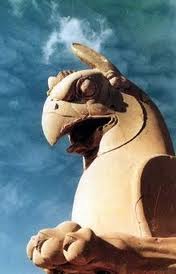
 

A bust of the mythical Homa Bird


Please visit my blogs: swamiindology.blogspot.com and tamilandvedas.wordpress.com.

Follow me on Twitter @Swami_48 and find me on Facebook.

Two Little Animals that Inspired Indians

By S Swaminathan

Squirrel

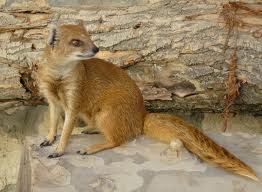
Mongoose


There are two stories of little animals in the Ramayana and Mahabharata. They have been inspiring us for thousands of years. Let us hear the first story in the words of Swami Vivekananda:

Be like the humble Squirrel

 “The monkeys removed whole hills, placed them in the sea and covered them with stones and trees, thus making a huge embankment. A little squirrel, so it is said, was there rolling himself in the sand and running backwards and forwards on to the bridge and shaking himself. Thus in his small way he was working for the bridge of Rama by putting in sand. The monkeys laughed; for they were bringing whole mountains, whole forests, and huge loads of sand for the bridge— so they laughed at the little squirrel rolling in the sand and then shaking himself. But Rama saw it and remarked: “Blessed be the little squirrel; he is doing his work to the best of his ability, and he is therefore quite as great as the greatest of you.” Then he gently stroked the squirrel on the back, and the marks of Rama’s fingers, running lengthways, are seen on the squirrel’s back to this day.” Now, the squirrel knows that the effort of building a bridge across the ocean is an effort that is on a gigantic scale. It also knows that compared to that its own contribution is very small. But it did not remain idle assuming that its contribution would not be of much significance. It wanted to contribute to the work with all its might. This is what we have to learn. Working like that squirrel according to once own capacity is the way to build a complete personality. Be ready to shoulder responsibility.

Swami Vivekananda narrated this story while delivering a lecture on Ramayana

The story teaches us some important virtues:

  • Little drops of water make the mighty ocean
  • No work is too small
  • Learn to appreciate sincere work even if it comes from the lowest ranks
  • Ignore other people’s discouraging remarks and carry on with your job
  • Quality of work is more valued than the quantity of work

A Vaishnavaite Saint’s praise for the squirrel

There were 12 great Vishnu devotees (Alvars) in Tamil Nadu who composed 4000 hymns in Tamil on Lord Vishnu. One of the earliest of the twelve Alvars is Tirumazisai Alvar. He composed his poems 1500 years ago in which he said he was not like the famous squirrel. Here is the translation:

“ I am not like the little squirrel ,which

As the monkeys shoved and heaved the mountains

So spontaneously dipped in the water:

With its wet fur rolled, it on the sand

And ran back in to the waves of the sea

Concentrating only on building the bridge

But my heart is hard as the trees, I grieve that

Even my heart did not desire to serve the Lord of the Rangam”

-Tirumaalai 27

This hymn proves that the Ramayana squirrel has been inspiring people for thousands of years.

Mahabharata Mongoose

There is another interesting story in the Mahabharata about a mongoose:

It is the story of a poor Brahmin who lived with his wife, son and daughter in law. The Brahmin used to beg for food. Sometimes the family went without food for several days. One day they got some food after a long period of starvation. Though they were poor, they never forgot to do the rituals like yagna. So the Brahmin dedicated one fourth of the food to the Gods and divided the other part in to four equal portions. Just before they started eating, a beggar came and asked for food saying that he was very hungry. The Brahmin gave his portion first. When he asked for more and more food each one gave his or her portion of food as well. When his stomach was full he went to wash his hands. At that time a mongoose was running across and the water fell on one part of its body. That part became golden in colour. The Brahmin revealed his true identity as Brahma, one of the Hindu Trinity. When he offered them a boon, all the family members refused to accept it saying it was part of their duty to show hospitality to any guest. Brahma, very much pleased with them, sent them straight to heaven.

Several years after this incident, the eldest of the five Pandavas, Dharma performed a Rajasuya Yagna in Indraprastha. It was a grand success and everyone praised the Pandavas sky high. But the mongoose whose body partly turned golden went there and challenged them. It said, “ Look I rolled on the water of the Rajasuya Yagna. But my body did not turn fully gold. When I went to a greater Yagna in Krita Yuga, my body turned partly gold than I was told the other part would also turn in to gold when an equally great Yagna was performed. Dharma was humbled by the mongoose challenge. At last the mongoose requested Lord Krishna to bless it and Krishna readily obliged the mongoose. Pandava’s Yagna was performed in the Dwapara Yuga (third of the four yugas).

Moral of the story: The values change from Yuga to Yuga. The people’s approach was 100 percent perfect during the Krita Yuga or Golden Age. During Dwapara Yuga it was only 50 percent perfect. The Brahmins in the Golden Age refused to take any credit for the charity they did. But the Pandavas made a big show of their charity. The second point is that giving food to the needy is equal to a great Yagna like Rajasuyam. Don’t feel proud for everything you do. There is always someone out in the world who can outsmart you. So be humble.


An Anonymous English poem about the squirrel (the last four lines are mine)

“Whisky, frisky, Whisky

Hippity hop;

Up he goes

To the tree top

Whirly, twirly,

Round and round,

Down he scampers

To the ground

Furly, curly

What a tail !

Tall as a feather

Broad as a sail!

Where’s his supper?

In the shell

Snappity, crackity

Out it fell”

“Ramayana or Mahabharata

Every where you are

And inspire to perspire

And persevere for ever”

Please send feedback and comments to: swami_48@yahoo.com. Followme on Twitter @Swami_48.

Please visit my blogs: swamiindology.blogspot.com and tamilandvedas.wordpress.com.

Hindu’s Magic Numbers 18, 108, 1008

By S Swaminathan

In Hinduism numbers have a lot of significance. In some places it is used as a symbol or metaphor. Vedas also have a lot of numbers and their meanings are still mysterious. One example is the odd and even numbers up to 33 and 44 respectively in the Chamakam (a part of the Rudram in the Krsna Yajur Veda). But 108 and 1008 are used for all the Gods in Ashtotharam (108) and Sahasranamam (1008), particularly in all the South Indian Temples on day to day basis.

Hindu epic Mahabharata is associated with number 18 in several ways. The Mahabharata is divided in to 18 books (parvas) and the Bhagavad Gita also has 18 chapters. The original name of the  Mahabharata was JAYA and according to Sanskrit numerical system (Ka Ta Pa Yathi sankhya) Jaya is 18. The architect of the war Sri Krishna’s Yadava caste – which had 18 clans. The army number of divisions that took part in the war were also 18 (11 divisions/Akshauni of Kauravas and 7 Akshauni of Pandavas).

There is a beautiful description about the number 18 in the Tamil epic Cilappatikaram: The war between the Devas and Asuras went for 18 YEARS. The fight between Rama and Ravana went on for 18 MONTHS. The war between the Pandavas and Kauravas went on for 18 DAYS, but the battle between the King Cheran Senguttuvan and Kanaka Vijayan went on only for 18 NAZIKAS! (A day consists of 60 Nazika and one Nazika is 24 minutes). Cheran Senguttuvan was a great Chera (Kerala) king who went up to the Himalayas and brought a stone from the holy Himalayas to erect a statue for the Tamil heroine Kannaki. He washed the stone in the holy Ganges and brought it on the heads of Kanka and Vijayan who were defeated by him in seven hours (Ref. Cilappatikaram, Neerpataik kaathai lines 8-9).

The Number 10,008

The priests who did havan/yagna erected the yaga kund (fire altar) with 10,008 bricks in the shape of an eagle. The reason for this may be the Deva year was equivalent to (360 X 30) 10,800 days and Brahma’s kalpa was 40 times of this i.e. 432,000 years. If we add any of these figures and bring it to one digit it will always be 9.

Number 9 and its multiples are in Sanskrit and Tamil literature. Planets are nine-Nava Grahas, Gems are nine- Nava Ratnas and the scholars in the assembly of Vikramaditya were also called Navaratnas.

Another reason for this is a man breathes 21,600 (half of 43,200) times a day, on average. The book written by Romarishi calculated this on the basis of 15 breaths for every minute. This is reflected in the famous Nataraja temple in Chidambaram, Tamil Nadu where the Golden Roof of the temple contains 21,600 gold tiles. They used 72,000 nails to fix them.

Sathya Sai Baba’s interpretation

Sri Sathya Sai Baba went one step ahead of others in explaining the significance of these numbers. A man breaths 21,600 time a day (at the rate of 15 a minute and 900 times an hour). During the day time he breaths 10,800 times. During this day time one must say the mantra ‘soham’ ( sa=He, aham=I;  in other words – God and I are one) and to signify this we have 108, 1,008 and 10,008. Baba added by saying that number nine represents Brahman and number 8 represents Maya (illusion). He demonstrated that Nine remains intact after multiplying by any number (e.g. 9×12=108,8×9=72,3×9=27 if  we bring them down to one digit it is always 9) Where as if we multiply 8 with other numbers it will go down when we bring them down to single digit (e.g. 1×8= 8, 2×8=16,3×8=24,4×8=32,5×8=40,6×8=48 etc. One digit numbers will be 8, 7, 6, 5, 4, 3, 2, 1).

“With each breath you are positively affirming ‘Soham (I am He)’. Not only you, every being thus affirms it. … When you watch your breath and meditate on that grand truth, slowly the ‘I’ and the ‘He’ will merge; Soham will become transformed into Om, the primal sound, which the Vedas (ancient scriptures) proclaim as the symbol of the formless, all-knowing God.” 

-Sathya Sai Speaks X, ‘Meditation’

The Devas spent 10,800 days (in other words 29 years and 5 months) to churn the Ocean of Milk to extract Amrit (ambrosia). The planet Saturn, which plays a significant role in our lives, also takes the same time to complete one circuit of the Solar System.

Tamils have divided their 2,000 year old Sangam Literature in to 18 books (Pathu Paattu & Ettu Thokai) and the post-Sangam ethical literature in to another 18 books! (Pathinen Keez Kanakku).

These numbers have also got some significance in the Buddhist and Greek literatures as well.


Send comments and feedback to: swami_48@yahoo.com.


Please visit my blogs: swamiindology.blogspot.com and tamilandvedas.wordpress.com.

Atom Bomb to Zoo of the Bhagavad Gita: Part 2

By S Swaminathan

This is Part 2 of a two part series on the A to Z of the Bhagavad Gita.


N for Nirvana 

Nirvana is an interesting term used both by the Buddhists and the Hindus with different interpretations. Gita uses this term several times (chapters 2-72,5-24,25,26 and 6-15). In Gita it means complete union with God. Brahma nirvana means the mystic state of extinction of self in the union with God. Literal translation of nirvana is blow out ,extinguish.

Osho on Gita 

Osho’s(Acharya Rajneesh) interpretation of the Gita stands out for many qualities. He creates a multifaceted analysis of Gita, drawing from all sources—philosophy, scriptures, biographies and his own experience. The shlokas of the Gita are often abstract, mysterious and sometimes downright contradictory. In such cases the listener will definitely appreciate Osho’s deep and precise insight in explaining why Krishna said it this way. He has the skill of explaining apparently impossible slokas in layman’s terms, using simple analogies.

P for Paramahamsa Yogananda 

Elucidating on the Gita’s primary metaphor of inner battle, Sri Yogananda writes, “From the moment of conception to the surrender of the last breath, man has to fight in each incarnation innumerable battles: biological, hereditary, bacteriological, physiological, climatic, social, ethical, political, sociological, psychological, metaphysical- so many varieties of inner and outer conflicts. Competing for victory in every encounter are the forces of good and evil. The whole intent of Gita is to align man’s efforts on the side of dharma or righteousness. The ultimate aim is self realisation.

Q for Queen of Greece 

What should be leader doing in regard to customs, usages, etc.? Even after he finds them to be not of any benefit for himself, should he follow them? Asked Queen of Greece, who was a devotee of Ramana Maharishi and Kanchi Sri Chandrasekarendra Saraswathy (1884-1994).

Kanchi Sankaracharya’s answer on 4/12/1966: Those who are the leaders of a group, society, or state should not neglect the established religious customs and usages. In the words of Bhagavad-Gita: “The wise one should not unsettle the minds of those who are ignorant, and are attached to action. On the contrary, he should encourage them to perform what they should perform, by himself doing the appropriate actions well and with diligence.”

R for Ramakrishna Paramahamsa 

The essential message of the Gita can be obtained by repeating the word several times, “‘Gita, Gita, Gita’, you begin, but then find yourself saying ‘ta-Gi, ta-Gi, ta-Gi’. The message is Thyaga/sacrifice –Thyagi means one who has renounced everything for God”, says Sri Ramakrishna Paramahamsa

Question : The Gita seems to emphasise karma yoga, for Arjuna is persuaded to fight. Sri Krishna himself set the example by an active life of great exploits.
Ramana Maharshi : The Gita starts by saying that you are not the body and that you are not therefore the karta [the doer].

S for Sivananda 

Study of the Gita must be made compulsory in all schools and colleges of India; nay of the whole world. It must become a text book for students of schools and colleges-Swami Sivananda wrote it on 4thJuly ,1942

T for Thoreau 

“In the morning I bathe my intellect in the stupendous and cosmogonal philosophy of the Bhagavad Gita, in comparison with which our modern world and it’s literature seems puny and trivial “- Henry David Thoreau (1817-1862) American poet and philosopher

U for Upanishads 

The Gita is a boquet composed of beautiful flowers of spiritual truths collected from the Upanishads- Swami Vivekananda

V for Vivekananda 

According to Swami Vivekananda the most important shloka in the Gita is the 3rd in the 2ndChapter. He says, “If one reads this one shloka –klaibyam mas ma gama: …… one gets all the merits of reading the entire Gita: for in this one shloka lies embedded the whole message of the Gita. The meaning of the verse is “Yield not to impotence, O Arjuna, son of Pritha. It does not befit thee. Cast of this mean weakness of the heart. Stand up, O scorcher of the foes.”

W for Water 

Hindus offer to God anything from hair to gold in different temples. Lord Krishna says he is happy with even an offering of little water. Chapter 9 verse 26: “If one offers me with love and devotion a leaf, a flower, fruit or WATER, I will accept it.” Lord Krishna has a scale where devotion gets more value than the actual value of the goods!

X for X number of commentaries 

Gita has 700 commentaries when Sita pati das (Joshua J Wulf) wrote a commentary several years ago. Now we have x number of commentaries on it. Even the Tamil atheists have written a commentary interpreting the shlokas with negative connotation.

Y for Yama & Yoga 

Adi Shankara in Bhaja Govindam (hymn 20) says: To one who has studied the Bhagavad Gita even a little, who has sipped at least a drop of Ganges water, who has worshipped at least once Lord Murari

Gita deals with three Yogas:karama/action,Bhakti/devotion,Jnana/wisdom

Zoo and Gita: 

Lord Krishna uses a lot of animal names in his dialogue with Arjuna. If we have to set up a Bhagavad Gita zoo to teach Krishna’s philosophy , we need the following animals:

Elephant, eagle, horse, shark, snake, cow, lion (Chapter 10) and dog, cow and elephant (5-18)

Send comments and feedback to: swami_48@yahoo.com.


Please visit my blogs: swamiindology.blogspot.com and tamilandvedas.wordpress.com


Atom Bomb to Zoo of the Bhagavad Gita: Part 1

By S Swaminathan

Atom bomb, Football, the British Empire, animals—such words may be strange for a spiritual seeker, but look at the harmony in the following A to Z compilation of beautiful quotes from world famous poets, philosophers, scientists and thinkers. 

This is the first part of a two part series covering A to M


A for Atom Bomb 

The world’s first nuclear test was conducted in 1945. Father of the atomic bomb was J.Robert Oppenheimer,an American physicist and Director of the Manhattan Project that developed atom bomb. He was a Sanskrit scholar and read Bhagavad Gita in Sanskrit. When he witnessed the first nuclear test ,huge fire ball brightened the sky for many miles. Huge mushroom cloud rose up. On witnessing the awe inspiring scene, Oppenheimer burst in to a Bhagavad Gita sloka(Chapter 11,verse 32) where Krishna says ,” Now I am become Death, the Destroyer of worlds”.

We always compare God to the biggest source of energy that we know of. Hindus have been worshipping the sun when they recite the most powerful Gayatri mantra. Modern science says that sun is where billions of hydrogen bombs explode every second to give tremendous energy.

B for British Raj 

Warren Hastings, the first Governor General of India (1773-1784) wrote an introduction to the first-ever English translation of the text by Charles Wilkins (1784) where he declares that, “Works as the Gita could live long after the British Domination ceased to exist and it contains passages elevated to a track of sublimity into which our habits of judgement will find it difficult to penetrate”.

C for Carl Gustav Jung 

“The idea that man is like unto an inverted tree seems to have been current in bygone ages. The link with Vedic conceptions is provided by Plato in his Timaeus in which it states……”behold we are not an earthly but a heavenly plant”- Carl Gustav Jung (1875-1961, Founder of Analytical Psychology)Ref. To Gita verse Chapter 15-1

D for Dnynaneswari 

Dnyaneshwari also known as Jnaneswari was written in Marathi by Jnaneswar in the 13th century. He expanded 700 verses of the Gita in to 9999 Marathi verses ‘ovis’. The first line of each ‘ovi’ rhymes with the next two lines adding beauty to the verses.

E for Einstein 

An interesting incident took place in 1948-49. A young researcher by name B M Gupta met the great scientist Albert Einstein (1879-1955).The German scientist hailed him in Sanskrit instead of English. The Indian scientist pleaded his inability to reply in Sanskrit. Surprised Einstein showed him his collection of books and told him, “See my library which treasures classics from Sanskrit namely the Gita and other treatises on Hindu philosophy. I have made Gita as the main source of my inspiration and guidance for the purpose of scientific investigations and formulation of my theories”.(Ref. Ezine article by Santanam Nagarajan)

F for Football 

“First of all, our young must be strong. Religion will come afterwards. Be strong, my young friends; that is my advice to you. You will be nearer to Heaven through foot ball than through study of Gita” said Swami Vivekananda .

G for Gandhi 

“When doubts haunt me, when disappointments stare me in the face, and I see not one ray of hope on the horizon, I turn to Bhagavad Gita and find a verse to confront me@ and I immediately begin to smile in the midst of overwhelming sorrow. Those who meditate on the Gita will derive fresh joy and new meanings from it every day”-Mahatma Gandhi

H for Huxley and Hesse 

“The Bhagavad Gita is the most systematic statement of spiritual evolution of endowing value to mankind. It is one of the most clear and comprehensive summaries of perennial philosophy ever revealed: hence its enduring value is subject not only to India but to all humanity”- Alduous Huxley

“The marvel of the Bhagavad Gita is truly beautiful revelation of life’s wisdom which enables philosophy blossom in to religion”-Herman Hesse

I for India 

TO INDIA 

So have I read this wonderful and spirit-thrilling speech,

By Krishna and Prince Arjun held discoursing each with each;

So have I writ its wisdom here,- its hidden mystery

For England; O our India as dear to me as She!

Edwin Arnold wrote in the year 1900

J for Jawaharlal Nehru

“The Bhagavad-Gita deals essentially with the spiritual foundation of human existence. It is a call of action to meet the obligations and duties of life; yet keeping in view the spiritual nature and grander purpose of the universe.” Jawaharlal Nehru, First Prime Minister of India

K for Karmayoga 

Lokamanya Bal Gangadhar Tilak ,freedom fighter and a scholar, interprets Gita as the scripture of Karmayoga. Karmayoga is performing one’s duty without having any desire for its fruits. According to Tilak Gita teaches selfless action as is said in Chatper 2, Verse 48:

“Yogasthah kuru karmaani sangam tyaktvaa dhananjaya
siddhyasiddhyoh samo bhuutvaa samatvam yoga ucyate”


Remaining steadfast in yoga, oh Dhananjaya (Arjuna), perform actions, abandoning attachment, remaining the same to success and failure alike. This evenness of mind is called Yoga.

L for Languages 

The poem has been turned into French by Burnouf, into Latin by Lassen, into Italian by Stanislav Gatti, into Greek by Galanos, and into English by Mr. Thomson and Mr Davies, the prose transcript of the last-named being truly beyond praise for its fidelity and clearness. Mr Telang has also published at Bombay a version in colloquial rhythm.

M for Milk 

All the Upanishads are cows, the son of the cowherd (Gopala Nandana) is the milker, Partha is the calf, the man of pure intellect is the enjoyer and the supreme nectar Gita is the milk (Gita Dhyana Sloka). 

Send comments and feedback to: swami_48@yahoo.com.

See Part 2 for N to Z 


Three Wise Monkeys from India

By S Swaminathan

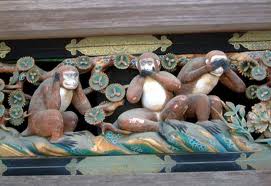
Hear no evil; speak no evil; see no evil!

Mahatma Gandhi had a porcelain doll of three monkeys by his bed side. It was presented to him by some Chinese visitors. Since Gandhiji’s days this doll became a popular figure in India. Moreover the theme the monkeys explained is a typical Indian theme: See No Evil, Hear No Evil and Speak No Evil. Every Indian mother tells her children the same thing almost every day. Particularly when Indian children watch unsavoury programmes on TV, elders emphasise this in their own words. But lot of people wonder about the origin of the Three Wise Monkey doll.

Encyclopaedias and several websites say that it originated in China and at present Japan has a temple with the three wise monkeys figure in Nikko. The Tosho-gu shrine where the three wise monkeys are located exists from 1636. Scholars think that the Buddhist monks took it from China to Japan. The Japanese call these three monkeys “Mi zaru (see no evil), Kika zaru (hear no evil)  and Iwa zaru (speak no evil)”.
But my research shows that the original idea went from India to other countries probably through the Buddhist emissaries. We have got a clear proof in Bhagavad Gita and ancient Tamil literature. ‘The mind is a monkey ‘ is a well known saying in Indian languages and several saints used this expression in their hymns and poems.
The Monkey in the Rig Veda
A monkey was  mentioned as a favourite animal of Indra in Rig Veda (10-86).
Lord Krishna says in the Gita (Chapter 2-29),”one SEES him with wonder, another likewise SPEAKS of him as a wonder, and as a wonder another HEARS of him, yet even on (seeing, speaking and hearing) some do not understand him”.
Panchatantra stories were popular abroad from 5th century AD onwards. It was translated by Borzuya in to Persian language in the year 570 AD. Vishnu Sharma wrote it in Sanskrit around 3rd century BC. We have at least three stories involving monkeys in it. It shows that Indians used monkey stories to teach morals.
But the oldest and the clearest evidence comes from a Tamil book called Naladiyar. It is a Tamil book of ethics with 400 poems on different topics. They were composed by Jain saints 1500 years ago.
One of the poems runs like this:

“If one knowing what is right, be deaf to the secrets of others, blind to the wives of his neighbours, and dumb in calumniating others, it is not necessary to inculcate any virtue to him.”

Adi Shankara also use this deaf, blind and dumb sequence in another context in Viveka Cudamani (sloka101). A later book known as Vakkundam says ,” it is bad to see evil people and it is worse to hear their words and it is the worst to speak about their bad things”
Suffice is to prove that the idea of using monkey as a moral tool and SEE, HEAR, SPEAK no evil sequence are typical Indian.
Another story about THREE WISE DOLLS
A king in India was presented with three dolls by a wise man. The king was wondering why someone would present such dolls. He called all the wise people to find out their meaning.
Several people came forward ,examined the dolls and came with no answer. One or two people found some holes and yet could not say what they were for. At last a very wise man came and asked for a string from the king. He passed the string through the holes in each doll. The string went through one ear and came through the other ear in the first doll. The wise man explained that represents a person who can’t retain anything and whatever he hears leaks through the other ear. The second doll had one hole in the ear and another in the mouth. This person will tell everything you tell him to everyone in the world and so he is dangerous, explained the wise man. And in the third doll the string went through one ear but never came out. He is the most trustworthy person fit for a job in the royal palace, said the wise man. The king was very happy and amply rewarded the wise man.
In conclusion we may boldly say that the concept of three dolls, concept of seeing, hearing, speaking no evil and the concept of using monkey to teach morals have spread to other parts of the world from India alone.
Please email comments and feedback to: swami_48@yahoo.com.
Please visit  my blogs: swamiindology.blogspot.com and
tamilandvedas.wordpress.com for more interesting articles.

‘Is California, USA – Kapila Aranya?’ – Kanchi Sankaracharya

By S Swaminathan

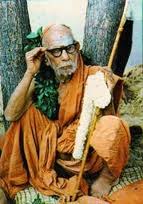
Sri Kanchi Sankarcharya

Kanchi Sankaracharya Sri Chandrasekarendra Saraswathi (1894-1994) who lived for one hundred years and attained Samadhi in 1994 was a great scholar, a voracious reader and a good speaker. His great scholarship is seen in his speeches that were published in seven volumes in Tamil. Some of his lectures were translated in to English. He was very fluent in Tamil, Sanskrit and English. He was met by famous leaders and prominent writers like Mahatma Gandhi, Indra Gandhi, Arthur Koestler, Paul Brunton, Milton Singer and the Queen of Greece to mention a few. Mr R Venkatraman, former President of India was a devotee of Sankaracharya.

Sri Sankaracharya made a passing remark about California (USA) in his talk on 12th of October 1932 in Chennai. His talks were published in 1933 ( by Sri Kamakoti Kosathanam, Chennai).

When he gave a lot of examples to show Hinduism prevailed in different parts of the globe he also happened to mention California. He narrated the Puranic story of King Sagara and the incident where his horse was stolen by Indra during a yajna (fire sacrifice). When he sent all his 60,000 sons in search of the horse they travelled to the Patala Loka.(Please read my article about the ancient idioms and phrases under the title Is Brahmastra a Nuclear Weapon? in which I have explained sixty thousand means innumerable, countless, a lot).

When Sagara’s sons reached the netherworld (all the places down south of the Indian Sub Continent were called Patala Loka in Sanskrit literature) they saw the horse near the seer Kapila who was in deep meditation. They thought that he was the one who took the horse and abused him. When Kapila opened his eyes all Sagara’s sons were burnt to ashes. King Sagara felt very sad. Baghiratha who was a descendant of Sagara vowed to bring the river Ganges to earth to dissolve the ashes so that they would go to heaven. Baghiratha tried for a very long time and ultimately succeeded. That is why the ocean is called ‘Sagar’ and Ganges was called ‘Bhagirathi’(please read my article GreatEngineers of Ancient India in which I explained the symbolic language used by our forefathers about Ganges and Bhagiratha).

Kanchi Sankaracharya Swamiji, after narrating this story pointed out that a Horse Island and an Ash island near California. He humorously explained how the residents of Madurai call the city Marudai and how a Tamil folk called a Kuthirai (horse) Kuruthai – interchanging the letters. He continued to say that the words KAPILA ARANYA might have been misspelt as KALIFO ARANYA (California). Ash Island was the place where the sons of Sagaras were burnt to ashes. Horse Island was the place where they found the horse. But he never reopened this topic in his future lectures.

Now let us analyse it. English people who have migrated to USA, Canada, South Africa and Australia named the new places after their native towns or states. Now we have duplicates of those place names all over these countries. So it is possible that ancient Indians who went to different parts of the globe by planned voyages or by shipwrecked and washed ashore might have named them after the Sagara story. The modern atlas shows the existence of an Ash Island in Oregon, USA and a Horse Island in California. Oregon is the neighbouring state of California.

A lot of research is going on about the link between the Mayas and the Hindus and the Red Indians and the Hindus. So far the researchers have found out amazing similarities between the North American and South American tribes and the Hindus. It may not be outright migration of the Hindus. But a few wayward adventurers might have gone there and left some indelible Hindu marks on those civilizations.

(I will explain the Hindu-Maya links in another article)

No one can miss the fact that Hinduism is the only religion without a name because it was the only one prevailed in the olden times. Foreigners named it as the Hindu religion. We call this nameless religion Sanatana Dharma (the Eternal Truth). Sanskrit is the only language which is not named after people because it was one of the oldest languages and spoken by all. All other languages were spoken only by their own people and so are named after that particular community.

Send comments and feedback to: swami_48@yahoo.com.

Please visit  my blogs: swamiindology.blogspot.com and tamilandvedas.wordpress.com for more interesting articles.

Krishna’s Restaurant in Dwaraka – Hot Satwic Food Sold!

By S.Swaminathan

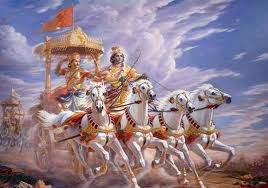
Sri Krishna and Arjuna

Imagine Lord Krishna is running a restaurant called Panchajanya in the city of Dwaraka. What he would sell?

He has given the menu in the Bhagavad Gita in several places. He advocates vegetarianism. So you would only get vegetarian dishes. He would never sell you old food which was made overnight or unsold from the previous day.

Let us look at Chapter 17 of Gita for more details on the menu; if you still don’t understand his policy don’t forget to read the two interesting stories at the end!


The Menu

Only Sattwic food available:

“The foods which increase life, purity, strength, health, joy and cheerfulness (good appetite) which are savoury and oleaginous (oily), substantial and agreeable are dear to sattwic people”

Bhagavad Gita Chapter 17-8

Not available: Rajasic food:

“The foods that are bitter, sour, saline, excessively hot, dry, pungent and burning are liked by the Rajasic and are productive of pain, grief and disease”.

Chapter 17-9

Banned Food: Tamasic

“That which is stale, tasteless, putrid, rotten and impure refuse is the food

liked by the Tamasic.”

Chapter 17-10

MOTTO of our restaurant :”Eat to live; don’t live to eat!”

HOLIDAYS: Ekadasi (twice a month) and Shivratri -Complete closure; half-day closure on full moon and new moon days; days of eclipse and Navaratri.


Rules for Customers

Customers, please note the following rules are strictly followed in the restaurant:

1.Salt ban: On fasting days food will be made without salt. Food with salt is considered meat according to the scriptures.

2. “Verily yoga is not possible for him who eats too much……..” Chapter 6-16

So we will serve only set meals. Unlimited meals or Buffets are not available here

3. “The righteous, who eat of the remnants of the sacrifice, are freed from all sins; but those sinful ones who cook food (only) for their own sake, verily eat sin”- Chapter 3-13

Please note whatever we serve in this restaurant is Prasad from the nearby temple.

4. We provide you four types of food  Chapter 15-14   Gathyam-food that has to be eaten by chewing, Soshyam-Drinks that which has to be sucked, Lehyam – food that which has to be licked and last but not the least Peyam –that which has to be drunk.

This is what Lord Sri Krishna said to Arjuna in the Gita.


Salt ban in New York

In March 2011 The New York Assembly proposed to ban salt in the restaurants. Those who violate the ban would be fined one thousand dollars. This news sent shock waves across the Western restaurants around the world. New York Mayor Bloomberg is opposed to display of salt bottles on the tables of the restaurants .The research showed that salt was the cause for blood pressure, heart disease and stroke. They believe that 100,000 lives a year could be saved by cutting the salt intake. Lord Krishna said it thousands of years ( Gita 17-9) before the western scientists. Salt was banned in religious food and on fasting days. Salty dishes were considered Rajasic.

The problem with the modern diet is not one of deficiency, but one of excess. We eat too much and become obese. Obesity leads to diabetes, heart problems, hypertension and other complications. A lot of us live to eat, but it should be other way round. We must practise to eat to live. When the stomach says ‘enough’ and the tongue says ‘more’ we must follow what the stomach says. This is what Lord Krishna said about too much food (Gita 6-16).

Sri Sathya Sai Baba rightly said, “As the food, so is the head. As the head so is the mind. As is the mind, so is the conduct. As is the conduct so is God’s grace”.


Story #1

Food influences our thoughts. Good food gives us good thoughts. Sri Ramakrishna Paramahamsa said a story to illustrate this point. A saint approached him one day and told him that he gets violent thoughts for some unknown reason. Ramakrsishna asked him what he read, what he saw and who he met the previous day. None of the answers to these questions solved the puzzle. Then he asked him where and what he ate – he found out the food he ate was the cause for the violent feelings. If we eat food cooked by bad people our very thoughts will be polluted.

Story #2

Osho tells us a beautiful story about Sri Ramakrishna. He had a great passion for food. His attachment for food was so much it bewildered every one of his followers. When people asked about this he did not give a clear answer. Now and then he popped in to kitchen to see what his wife was cooking- that too half way through his satsang. Now she also became very curious and insisted for an answer. Then he told her the truth. All his Praraptha karma was already over and once he discards this passion for food (attachment with the world) he would have to leave the mortal frame.

He did not stop there. He told her that he would stop eating three days before his death. He would refuse the food even if it was forced upon him. In course of time even his wife forgot what Sri Ramakrishna told her. That big day came. He refused to take food for three days. He turned his face away from the food for those three days. His wife suddenly remembered what he told her about food. Now she realised a great soul never lived for eating. They ate only for the survival- survive to redeem the world. That is what Sri Ramkrishna did. He created a Vivekananda out of an atheist Narendra to enlighten the Western world with reverberating English speeches about the glories of Hinduism.

Let us eat to live and not live to eat.

The Sugarcane Mystery: Indus valley and the Ikshvaku Dynasty

Ikshvaku was the founder of the Solar Dynasty. Lord Sri Rama, Bhageeratha and other great kings of the solar dynasty are well known to the Hindus. What is interesting is that we get more and more evidence to link him with the Indus Valley Civilisation, first Jain Thirthankara, Rishabadeva, the Rik Veda and a Tamil king called Adhiyamaan.

Ikshvaku was mentioned in Rik Veda. The meaning of his name is SUGARCANE. The plant sugarcane (Saccharum officinarum) is mentioned in the Atharva Veda. Ayurvedic authors Charaka and Susruta mentioned the sugarcane in many places. The word ‘sugar’ and the words for sugar in other European languages came from the Sanskrit word ‘Sharkara’. Columbus introduced the sugarcane to the Americas in 1439. Arabs took it from India to other parts of Asia around 8th century AD.

Encyclopaedias say that the people of New Guinea were the first to cultivate sugarcane around 6000 BC. But they did not extract sugar from it. They just chewed it to get the juice out of it. But King Ikshvaku was the first one to show the people of extracting sugar from the sugarcane. That is how he got this name Mr Sugarcane.

Who was Ikshvaku?

Ikshvaku was the son of Vaivasvata Manu who is equated with the King Satyavrata of Dravidian country in whose time the first avatar of Lord Vishnu- Matsyavatara (Fish incarnation) – took place. So all the facts lead us to the remotest period. Ikshvaku was more famous for his just rule rather than sugarcane juice.

Jains have another interesting story about the sugarcane. Their first Thirthankara Rishabadeva (Adi Nath) was the one who taught the people of extraction of sugarcane juice. So he was known as Ikshvaku. Another version is that he took sugarcane juice after a year of fasting. Both the Hindu and Jain Ikshvakus are probably one and the same.

Indus Valley civilisation has evidence to show that they knew sugarcane and sugar extraction. Crystallised sugar was used by the Indus Valley people. Hindu Gods and Goddesses such as Lalitha (Ref. Lalitha Sahasranamam), Kamakshi, Tripura Sundari and the Hindu Cupid Manmatha are depicted holding a sugarcane in one hand. The Sanskrit word Sharkara and these Hindu goddesses prove that sugarcane was very much Hindu and Indian.

Tamil King Adhiyamaan Nedumaan Anji

Another interesting fact about sugarcane is in Tamil literature. The word for sugarcane in Tamil is ‘Karumbu’.The grand old lady of Tamil literature Avvaiyar praised chieftain Adhiyamaan  Nedumaan Anji of Thagadur (modern Dharmapuri in Tamil Nadu)  for his philanthropy in Puranaanuru verse 99. Avvaiyar lived two thousand years ago. While praising him she made a passing remark. She said that the forefathers of Adhiyamaan were the one who introduced sugarcane to the people. If we get all these facts together we get a good picture of sugarcane cultivation in India. Ikshvaku or Rishabadeva was the one who taught people how to get the juice and make sugar. But if Indus valley had it by 3000 BC then we had to push the date of Ikshvaku dynasty or Rishabadeva to 3000 BC as well. Tamils also say indirectly that Adhiyamaan was related to him. The South Indian Tamils corroborate what their North Indian counterparts said about the sugarcane. The idea that it was ‘introduced’ by some king is undeniable. The sugarcane mystery pushes back the date of Ikshvaku dynasty and the Jain Thirthankara to the remotest periods of Indian history.

Other Sanskrit words for sugarcane are Mahashira, Mahapushpaka and for jaggery ‘Gur’ or ‘Gud’ (Tamil word Vellam).

Send comments and feedback to swami_48@yahoo.com.


Why Do Hindus Practise Homeopathy?

By S Swaminathan

Health is Wealth

Health is wealth is a popular saying in many Indian languages. The message is same, but they convey it in different ways. The Tamils developed a medical system called Siddha therapy 2000 years ago. Siddha is a person who has attained some extraordinary powers – both mental and physical. Siddha system is similar to Ayurveda – another old medical system of India. Like Ayurveda, Siddha also treats the imbalances of the three body humours called vatha/wind, pitha/bile and kapha/phlem. Siddha men used herbs and minerals to treat the sick patients.

Both Ayuerveda and Siddha believed in the principles of ‘a sound mind in a sound body’ and ‘prevention is better than cure’. The Hindu Upanishads say ‘the soul can’t be reached by a weak person’ (na ayamathma balaheenena labya – Mundakopanishad).

These indigenous systems create an awareness of diseases and emphasize the importance of healthy life. Unlike western medicines they guide you through your everyday life- literally from morning till night. They tell you what to eat and what not during a particular day or a particular time of the day. They tell you with what you should brush your teeth and which direction you should lay your head in the bed. The proverbs, similes, sayings and actual medical writings in Sanskrit and Tamil supply enough evidence for it.

Who gave the world Homeopathy?

We are told that Homeopathy was developed by the German physician Samuel Hahnemann (1755-1843).But Indians know the principle long ago and are practising it in their day to day life.

The basic principles of Homeopathy are:

(1) ‘Like cures Likes’;

(2) ‘Symptoms of diseases are body’s self healing processes’ and

(3) ‘If one is administered with very dilute dose of what causes the disease, one will be cured of the disease’

When Hindus go to a holy place, they won’t drink or bathe in the water at once. Even when they go to temple tanks or holy rivers they will take three sips of water and sprinkle it on their head. Then they will use it for washing their feet and hands ,bathing etc. This small dose of three sips of water (Brahmins call it Achamana) will help them to avoid all the diseases from that particular water source. In those days, water was the main source of diseases. The mineral contents, temperature, taste and quality of water were different from place to place. There was no chlorination or protected water supply for the public. Even today one can practise this ‘achamanam’ and avoid getting diseases from water. The diluted water-in small quantity- gives immunity to us from the germs and other impurities. So Hindus know the principle of Homeopathy ‘Like cures Likes’. No need to say that we should remeber other basic rules about hygiene.

The rule for doing ‘achamana’ (sipping of water) is that the amount of water you take should submerge only one black gram seed (Urad Dhal in Hindi and Masha in Sanskrit). So when you do it three times you would have taken water that submerges only three seeds-so little. When Hindus did it they recite Lord Vishnu’s names: 1.Achyutaya Namaha 2.Ananthaya Namaha 3.Govindaya Namaha

Tamil book Tirukkural 1102 and Natrinai 140 also talk about this principle but in the context of a love sick woman’s look. “For the disease caused by this beautiful maid, she herself is the cure”-says Tirukkural. Like cures Likes!

What is the secret of black hair? 

Stress triggers or complicates most of the diseases is a modern discovery. But a Tamil Cankam poet called Pisiranthaiyar who lived 2000 years ago gives the secret of his black hair at a ripe old age in a beautiful Tamil poem.

When Pisiranthaiyar went to see the great Chola king Kopperun cholan (who was starving himself to death following an ancient Tamil rite) all were amazed to see an old poet without any grey hair. When they asked about the secret of his black hair, he sang;

“How can it be you don’t have any grey hair, through you have lived for many years?

You have asked the question and I will give you an answer!

My children have gone far in learning. My wife is rich in her virtue!

My servants do what I wish and my king, who shuns corruption, protects us!

And in my city there are many noble men who through deep knowledge, have acquired calm, have become self controlled, and the choices they make in their lives are built on the quality of restraint.”

-(Purananuru 191 by Pisiranthaiyar)

To put it in a nutshell:

My son is well educated

My wife is very cooperative

My servants are obedient

My king is a good ruler

My town is full of scholars

If one has all these, one need not worry. If you lead a care free life, you won’t get stressed. You will be ever young like Markandeya. Modern science says that stress triggers blood pressure, heart diseases, cancer and diabetes .

You are what you eat is in all our scriptures. Lord Krishna speaks in detail about the three kinds of food (Bhagavad Gita –chapter 17) and what qualities one gets from those. There is a beautiful saying as well:

“One fourth of what you eat keeps you alive and three fourths of what you eat keeps your doctor alive”

(From an Egyptian Inscription)

1,2,3,4 Out! 

Similar to this, there is a very good poem in he Tamil book ‘Neethi Neri Vilakkam’:

If one eats once a day he is a YOGI.

If anyone eats twice a day, that person is a BOGI (enjoyer of life)

If one eats three times a day, that person is a ROGI (sick person)

If one eats four times a day, that person is a Pogi (Tamil word for gone for ever/dead)

We know very well that indigestion is the root cause of all problems. Too much food leads to indigestion or obesity. This leads to other complications.

Tirukkural written by Tiruvalluvar has a full chapter (Chapter 95-Medicine) on the basic principles of Tamil medical science.

Send comments and feedback to: swami_48@yahoo.com

Please visit my blogs: tamilandvedas.wordpress.com and swamiindology.blogspot.com