How Did a Pandya King Get a Golden Hand?

By S Swaminathan

It is a well known fact that the Ancient Indians made tremendous advancements in the field of medical sciences. The Ayurveda and Siddha medical systems were widely practised for the benefit of the general public. Charaka and Susrutha wrote great treatises. A lot of surgical instruments, surgeries like rhinoplasty (plastic surgery for nose), hundreds of medicinal plants and thousands of medicines were listed by them. They were not only appreciated in India but reached western world through Arabic translations nearly one thousand years ago. The old medical books in Sanskrit and Tamil run in to several thousand pages.

Though Charaka, Susrutha,Vagbhata and Agastya are known to many even in the western world, one important surgery went unnoticed by many scholars. There is a very interesting story about a Pandya king in ancient Tamil literature. The king lived two thousand years ago is known from the Tamil epic Silappathikaram (Ref.Mathurai Kandam-Katturai Kaathai) dated around second century AD. A Pandya king was fitted with an artificial hand made of gold; he was known only as the Golden Handed Pandya. Nobody knows his real name even today. One more old Tamil book refer to this story (Ref. Pazamozi Naanuru).

The Story:

The story according to the epic runs like this: a Pandya king was going through the streets of Madurai (the second largest city of Tamil Nadu in South India) in disguise during the night. In the olden days kings used to visit their subjects and observe the general public in disguise to feel the pulse of the populace. Though the ancient Arthashastra of Kautilya speaks of kings employing spies for this purpose, the monarchy always wanted to know what the people feel about them or the country directly.(Every Hindu knew what Rama did to Sita just because a washer man raised some doubts about the purest woman Sitadevi). So much importance was given to the opinion of general public – absolute democracy!

When the Pandya king was passing by a house the lights were on at the dead of night and he heard a conversation. A brahimn by name Keeranthai was consoling his crying wife with these words, ”Darling, don’t worry too much about your safety and security. I am only going to be away for a very short period. Our great king is there to protect all the citizens. Nothing will go wrong in this just place”. As soon as the king heard this conversation he felt some big responsibility fell on his shoulders. So he increased his ward rounds and kept an eye on that house. Months passed. To his surprise he saw light again in the same house at the dead of night. He heard someone talking. In a hurry he mistook that person for a stranger and knocked at the door to scare away the stranger. Alas, it was not a stranger. It was her own husband Keeranthai himself who had just returned from his tour. When Keeranthai shouted back, the king realised his mistake.

One stupid mistake will make you to do more stupid things to hide the first one. It is human nature. So the king knocked at all the houses in the brahmin street and ran away to his palace. Next day a battalion of brahmins went to the palace and complained about what happened the previous night. The king, after patiently listening to their complaints, said to them that the ‘thief’ was already caught. All his ministers were surprised to hear his statement. The king did not stop there. He asked the opinion of the complainants what should be the punishment for that ‘thief’. Everyone shouted in chorus to follow the Hammurabi law: a hand for hand, an eye for an eye. The hand that knocked on the doors must be cut off. Before a second lapsed the king drew his sword and cut off the hand with which he had knocked on the doors the previous night. When he narrated the incident, the whole world praised his justice. The royal physicians rushed for his help and attached a gold hand to his arm. He came to be known as a Gold Hand Pandya in Tamil “Por Kai Pandyan”.

This is a story to elucidate the justice that was followed in ancient Tamil Nadu. No medical information was given about fixing the artificial limb but it didn’t surprised any Indian (please read my article Why do British Judges follow a TamilKing?) because they practised either the Ayurveda or the Siddha medical system.

Send comments and feedback to: swami_48@yahoo.com.

Please visit my blogs:
swamiindology.blogspot.com and tamilandvedas.wordpress.com

Follow me on Twitter: @swami_48 and find me on Facebook.

Lord Shri Rama – The World’s Best PR Man!

By S Swaminathan

Lord Shri Rama

Valmiki praised the way Sri Rama spoke to people. The way Valmiki described him showed Sri Rama was the best PR Man. The best company would have hired him as a Public Relations Officer with the highest pay. Why? He was Srutha Bhashi, Hitha Bhashi, Mitha Bhashi and Purva Bhashi according the Adi Kavi Valmiki.

  • Srutha Bhashi: Rama always spoke truth
  • Hitha Bhashi: He spoke whatever was pleasant to hear.
  • Mitha Bhashi: He spoke very little.
  • Purva Bhashi: He did not wait for others to open a dialogue. He opened the conversation.

Let us analyse it for a minute. Many a times we speak the truth and get caught in a trap. Why? Though we spoke truth, it was bitter. One example is a wife’s cooking. Under the pressures of work and modern living a man may shout at her saying that she put too much salt in the dishes. It may be true – but the way we spoke was wrong.

If we were Rama we would have passed the message in the gentlest way with the kindest words.  Rama would probably have said “Darling, your cooking is usually wonderful. What happened to you today? Aren’t you feeling well? The food you prepared was a bit salty today which is unusual.” Speaking truth is good but it should not harm or upset any one. That is why Valmiki called him a Srutha Bhashi and Hitha Bhashi.

When people attend weddings or birthday parties they often wait for others to come and talk to them. Their arrogance and ego stop them going up to others, who they consider their rivals, to enquire about their welfare. They pretend to look at other people and wait for their ‘rivals’ to approach them. When they go home they boast to their friends that they snubbed those arrogant rivals. The other people would probably have told their friends the same thing. But look at Rama. He was the son of a great emperor and crown prince of a kingdom. He went up to people and voluntarily spoke to them and enquired about their welfare. He was called a Purva Bhashi.

Mitha Bhashi: Many people suffer from verbal diarrhoea. They can never stop blabbering. We meet them with their mobile phones on 24/7 – on the bus, in the office and of course, at our political meetings! Rama spoke only very little, but made everyone happy. When he met a hunter Guhan he declared him as the fifth brother. When Ravana lost all his weapons in the final phase of the war he told him: “Go home today. Come back tomorrow” and gave him a last chance for survival. These words were meaningful and powerful.  (Guhan and Ravana references are from a version of the Ramayana written by Kamban in Tamil).

If you were running a business today, wouldn’t you hire Rama as your PRO with the highest pay?

Please visit my blogs: swamiindology.blogspot.com and tamilandvedas.wordpress.com


Send comments and feedback to: swami_48@yahoo.com

“Three Apples that Changed the World”

3 Apples are said to have changed the world - can you guess which?


By S .Swaminathan

Steve Jobs’ death deeply affected many people and triggered a media frenzy. One of the most interesting comments made was: “Three Apples That Changed the World”. But not many people knew that there is an interesting story behind each of the three apples:

  • Eve’s apple
  • Newton’s apple
  • Steve Jobs’ Apple

No doubt they changed the world to a great extent.

Biblical Adam and Eve ate the forbidden fruit and committed the original sin. They fell from the grace of God and all the sufferings started from that day onwards. Not only Christians but also Jews and Muslims believe in the story.

Adam and Eve’s apple story is actually a Hindu Upanishad story. Wise people of the ancient world made up a lot of mythology to help the layman understand high philosophy. If philosophy was given directly it would have been rejected by many as a bitter medicine. So they gave it as a sweet coated capsule – called mythology. Unfortunately in the course of thousands of years, people forgot the principles behind the stories and stuck to the literal meaning. For a student of science or astronomy all these mythologies would appear as superstition or absolute stupidity.

There are lot of striking similarities between Hindu and Christian scriptures. They cannot be discounted as coincidences because the sheer number. There are good proofs to show that they are borrowed from common sources.

The Bible begins with a story from the Upanishads. It is the story of two birds eating the fruits, but instead of two birds, the Bible has Adam and Eve.

The very name reveals the Hindu origin of the story.  In the Upanishads the two birds are the symbolic representation of Atma (atam) and the Jeevatma (Jeev – Eve). Any student of linguistics can easily recognise the transformation of Atma into Adam And Jeeva into Eve. This parallel has been pointed out by Sri Chandrasekarendra Saraswathy, Sankaracharya of Kanchi Kamakoti Peetam in his lectures in Chennai in the 1930s. The story of the two birds is in the oldest religious record of human beings – the Rig Veda (RV 1-164-20) – and it is repeated in the Mundaka Upanishad and Svetasvatara Upanishad.


Mundaka Upanishad:

“Two birds, beautiful of wings, close companions, cling to one common tree: of the two, one eats the sweet fruit of the tree; the other eats not but watches his fellow” – Mundaka Upanishad.


The bird that eats the fruits is Jeevatma (ourselves-human beings). The bird that enjoys without eating the fruit is the Paramatma (the Supreme being).

The Bible says that Eve (Jeev-atma) ate the apple in the Garden of Eden and this was the cause for the fall of humanity. This is nothing but the above Upanishad story with some changes. The Upanishads say that it was a fig tree.

The Bible says Eve was created from Adam’s rib. This is once again the Hindu story of Uma/Parvathy forming the left part of Shiva. Nowadays we call our wives and husbands our ‘other half’. It is very interesting to note that this expression has come from the Vedas. Kalidas and other Sanskrit poets also use this expression freely. In all Shiva temples of Tamilnadu one can see Ardhanareeswara (half female and half male –Parvathi Parameswara) proving men and women are equal.

Another interesting fact is Bible never mentioned the word apple. Genesis of Bible says that Eve ate the fruit of the tree of knowledge of good and evil. The word for evil in Latin is ‘malum’. The same word is used for apple in Latin.

When we call a married woman by name we put the woman’s name first followed by her husband’s name Eg. Michelle Obama, Samantha Cameron. This was also started by Indians. We worship our gods in similar pairings – SITAram, RADHAkrishna and so on. When the greatest Sanskrit poet wrote his epic Raghuvamsa two thousand years ago he prayed to Parvathy-Parameswara in the very first couplet. Ladies first, again. There are too many similarities to mention in this short article.


Sir Isaac Newton(1642-1727)

Newton is considered the most influential scientist who ever lived. He described universal gravitation and the three laws of motion. We are only able to send vehicles into space because of his discoveries. It is said that he discovered the law of gravitation when an apple fell onto his head. Though the apple analogy is partly correct, the fact was it did not ‘fall on his head’. But cartoons drawn after some time showed apple hitting his head. Buddha attained wisdom simply by sitting under the pipal tree. However, nothing hit his head to allow wisdom to dawn upon him. In both the cases, it was actually meditation on a particular subject that helped them to acquire such wisdom.


Steve Jobs (February 24, 1955 –October5, 2011)

Steve was co-founder, chairman and chief executive of Apple Incorporated until his death. Apple’s iPod, iTunes, iPhone and iPad changed the entire world. Now no-one can think a world without these gadgets. We will feel handicapped without these equipments. Steve was the force behind these technological innovations. 

But what was the cause of his charming and composed personality?  If the idea that Apple changed the world is not an exaggeration, then we can boldly say that India changed Steve Jobs! Steve Jobs was greatly influenced by the Beatles. Like the Beatles, he also took a spiritual retreat in India. He became a Buddhist and his wedding was done according to Buddhist custom. Like monks he used to walk bare footed in his neighbourhood and in the office. His sober views of life reflected his beliefs in rebirth and karma. He took his terminal pancreatic cancer like a Hindu saint.  

The Mysterious disappearance of Great Hindu Saints

By S Swaminathan


The deaths of great people have always been a mystery. People have immense interest in it and so the mass media never stops exploiting it. Even today the TV channels in western countries broadcast newer and newer stories about the death of John F Kennedy, President of America, who was assassinated on 22nd November 1963 – 50 years ago!

Even Lord Krishna’s death at the hands of a hunter, Lord Rama’s death in the river Sarayu, Buddha’s death after eating a special food given by a devoted host ,and Jesus’ death on the Cross raise the eyebrows of believers and non-believers alike.  Even the death of the great exponent of Advaita philosophy Sri Adi Shankara is shrouded in mystery. His followers believe that he disappeared after climbing ‘Sarvagna Peetam’ or the mountains in Kedarnath. All these come very handy for the propaganda mill of non-believers and atheists.

Tamils also have such stories about the great saints who revived Saiva and Vaishnava faiths in Tamil Nadu after a brief spell of Jainism and Buddhism. There were four great saints Thiru Gnana Sambandhar, Appar alias Thirunavukarasar , Sudarar and Manikka Vasakar. Of the four great saints Sambandhar and Manikkavasakar became one with God by entering the fire (jyoti).  Andal, the only woman in the great 12 Vaishnava saints known as the Alwars also did ‘merge’ with the god. Worshippers of Shiva and Vishnu (Saiva and Vaishnava followers) strongly believe that the saints became one with the god –the ever shining LIGHT and they celebrate such days as Guru Puja every year.  Tiruppanalvar and Nandanar were others who also merged with God in the form of light/fire. Atheists in Tamil Nadu interpret it as fire accidents or arson attacks.


Vallalar became Light

If we go into the details of these anecdotes we come to know it happened not only to the saints but also to their followers. In the case of Sambandhar, he took with him a great number of people with him in to fire on the day of his wedding. Lord Rama also took a lot of people when he entered the river Sarayu. In the case of Manikka Vasakar, his devotees went first and merged with the light. Later he also joined them. The great four Saiva saints and 12 great Vaishnava saints of Tamil Nadu lived between 6th and 9th centuries AD.

Very recently another popular saint Vallalar alias Ramalinga Swamikal also became ‘light’ and disappeared. He entered his room on 30th January 1874 and asked his disciples not to open the doors. After rumours spread the Government forced the doors open in May that year and the room was empty without any trace of the saint. The Madras District Gazeteer published his disappearance. His devotees saw him in the form of Light.


Tamil woman burnt Madurai City

The greatest of the five Tamil epics is Cilappatikaram. This is purely a Tamil story- no import from Northern Indian or Sanskrit literature. Kovalan the son of a big merchant married Kannaki but fell in love with a dancer Madhavi. His chaste wife Kannaki waited for his return which he did after realising his mistake. This happened 1,800 years ago .When they decided to make a new beginning they moved to the Pandyan Kingdom from the Choza kingdom. The Pandya King of Madurai was misled by an evil goldsmith who accused Kovalan of stealing the queen’s anklet. The king executed Kovalan without proper enquiry. His chaste wife Kannaki who was compared to ancient Arundhati (Wife of Sage Vashista) by the author of Cilappatikaram, stormed into the palace and proved that the king was wrong. Both the King and the Queen died of heart attack the very same minute out of shock.

Enraged, Kannaki wanted to revenge for the great injustice done to her husband. She ripped off one of her breasts and threw it on the city of Madurai. The city burst in to flames. But she requested the god of fire ‘Agni Deva ‘not to harm the good people. The story was written in a moving style which will melt even the stoniest of hearts. Tamils believed that chaste women can burn bad people or bring showers to the parched lands (Ref. Couplet 55 in Tirukkural).


Spontaneous  Human Combustion

What is the truth behind all these mysterious deaths or disappearances? Millions of followers believe that it did really happen and they pay their respects on the day of their disappearance even today. We can find some explanations for such phenomena. One falls under the category of paranormal and it is called Spontaneous Human Combustion (SHC). Encyclopaedias explain this as a ‘fire caused death but without an external agent’. The fire was created from within the body. In many of the documented cases even the dress, the surrounding furniture of the victim had no trace of fire. Though there was no scientific proof for such Body Fire, the scientists who studied such cases were mystified.

There is scientific proof of people who can create electricity within their own bodies. They can light the bulbs or short circuit electrical systems wherever they go. Science has proof for people with magnetic powers and whatever objects made up of iron they touch, stick to them. But so far, there is no proof that for spontaneous combustion is the cause of such occurrences – it is such a rare phenomena.


Deepak Raga kindled Fire

We have one more popular anecdote where music created fire and burnt a person to death. Gopal Naik was a famous musician in the days the Moghul King Akbar. The king heard the mysterious powers of Ragas and he asked Gopal Naik to sing Raga Deepak which kindles fire. In spite of his insistence that he would be burnt to ashes if he sang the raga, Akbar suggested some preventive measures. He asked him to sing Deepak raga standing neck deep water in the river Jamuna. He obeyed king’s orders and was burnt to ashes as he sang the raaga in full spirit!

The second reason that we can think of is the effect of sound. For a Hindu who believes that the primordial sound, OM, is the basis of entire universe, nothing is implausible. Scientists knew the effect of wrong sound/noise that it can harm the buildings, break a glass and drive a man to madness. But it would take some more time for them to discover that sound can kindle fire – after all, sound acts on the same particles and matter as electromagnetic waves do. Light, microwave, x rays, infra red and ultra violet rays are all part of the same spectrum.

Email comments and feedback to swami_48@yahoo.com.


Mysterious Messengers for Ajanta, Angkor Wat and Sringeri

By S Swaminathan


Angkor Wat in Cambodia and Ajanta in India are world famous tourist spots. They are listed as wonders of the world. But these places and many other tourist attractions came to light through some mysterious messengers. Who are these messengers? Are they the incarnations of some great people who lived there in their previous births? No one will ever be able to tell us. But people do believe in such miracles.


Angkor Wat

When Cambodia was under French rule Henri Muhot went to collect butterflies in 1860.  He was very much involved in the study of butterflies. One day while he was collecting the butterflies, he saw one rare butterfly and running behind it. That took him far away into the thick jungle. There he was trapped amidst some ruins. He was surprised to see vast ruins in a thick forest. Now his interest moved slowly from the butterflies to the archaeological ruins. The ruins were nothing but the world’s largest Hindu temple Angkor Wat! A temple complex that was spread over 38 square miles. When the world attention turned on the temple there were huge trees growing on top of several structures. It was too late to remove them. Then the civil war broke out. Now thanks to UNESCO and other organisations the temple is saved. But who was the mysterious messenger that came in the guise of a butterfly?


Ajanta Caves

Ajanta Caves are famous for its ancient paintings and Buddhist sculptures. They are in 29 rock cut caves in the Indian state of Maharashtra and they are dated from 2nd century BC. John Smith was an officer of the then British Government. He was interested in hunting. When he was hunting tigers deep inside the forest in 1819, a goatherd led him in to a cave and showed something and went away. The cave was full of birds and bats. When he cleared them one more wonder of the world was revealed. If the goatherd did not appear on that day, who knows, we would have discovered Ajanta when it was too late. Who was that non English speaking, mysterious goat herd? Why should he lead an English officer into the cave? Was he the reincarnation of a Buddhist monk?


Egyptian Pyramids

There is no need to explain the most popular world wonder Egyptian Pyramids. We came to know the 5000 year history of Egypt from the majestic and beautiful pyramids. The hieroglyphs, the mummies, the sculptures and huge stone structures evoke eternal interest in history even in those who hated history as a lesson in schools. But this came to the knowledge of the world because of a mysterious messenger- a fox. An Arab was watching a fox running into a hole under a pyramid in Saqqara. He followed the fox and entered the underground structure. That led him through a tunnel where he saw the beautiful hieroglyphs amidst gold and sapphire studded jewellery. Then the excavations started which did not stop till today. We have been getting interesting information from the 138 pyramids . Who was that mysterious messenger-fox? Was it the reincarnation of an Egyptian king?


Dead Sea Scrolls From Amman Museum,Jordan

Dead Sea Scrolls were discovered in 11 caves in the West Bank, Israel in 1947. They were the collection of Hebrew Bible dating from 150BC. They attained huge importance and created controversy because they shed new light on the Bible and Judaism. They were written on 972 parchments in three different languages. The way they were discovered again is shrouded in mystery. A goatherd was looking for a missing goat. He went into a cave in search of the goat and stumbled upon the valuable manuscripts. Who was the mysterious goatherd? Was he a scholar of the Biblical Days in the guise of a goatherd?


Mexico

Mexico is one of the oldest and largest cities in the world. But it was rediscovered by a curious incident. In the year 1325, an eagle was sitting on a cacti plant with a snake in its beak. When the snake was devoured by the eagle, locals recognised some divinity in the place and built a temple . It slowly grew up in to a city in the name of Tenochtitlan which became part of Today’s Mexico. Who was that mysterious Eagle which inspired the locals to rediscover their city. The eagle and the snake figure in the flag of Mexico.


Madurai

Madurai in South India is the second largest city in Tamilnadu.Ancient Madurai was devoured by the sea during a tsunami attack. Following utter devastation nobody knew the old boundaries. When the Pandya king was worried he went and prayed in the temple of Lord Shiva. A sage appeared before him and set the snake in his hand on a new mission of drawing the old boundaries. The snake made a big circle till its head and mouth joined together (ouroboros in Greek means head eating the tail) giving Madurai a new name Uragapuram in Sanskrit and Aalavaay in Tamil. Sanskrit playwright Kalidasa mentioned Uragapuram in his Kavya Raghuvamsa. Probably Uragapuram was corrupted in Greek as Ouroboros. But here the snake is not a mysterious messenger because Madurai Mythology (Thiru vilaiyadal Puranam) clearly said that it was sent by the god through its messenger, the sage.


Sringeri

A shrine on the bank of River Tunga,Sringeri (Photo from Sringeri Mutt)

Adi Sankara, the most popular exponent of Advaita (non Dualism) philosophy of India was looking for a suitable place to establish a centre. There were too many holy places in India and he was struggling to select one from them. A rare and unusual sight helped him to decide it once and for all. When he came to Sringeri on the banks of Tungabhadra river (in Karnataka, South India) he saw a cobra snake using it’s hood as an umbrella for a pregnant frog in labour. The cobra was shielding the frog from the scorching sun. Adi Sankara realised this was the most suitable place for establishing a centre because even natural enemies will come under the umbrella of love in this serene place. Thus he started establishing four centres in four corners of India. Who was the mysterious messenger in the form of a cobra?


Panchalankurichi

Panchalankurichi near Tirunelveli was the headquarters of the chieftain Veerapandia Kattabomman. He fought against the British rule. The reason he built the fort was a hare. His hunting dogs were chasing a hare which suddenly stopped and heroically stood against the dogs. Seeing the sanctity of the place he built his head quarters in that place. India is full of such stories. The general public believed that god sent the messenger to reveal something-like the Holy Fire of Moses.


Please send comments and feedback to: swami_48@yahoo.com. Follow me on Twitter: @Swami_48 and find me on Facebook.


Why Do British Judges Follow a Tamil King?

By S Swaminathan


Strange as it may look, British judges, magistrates and barristers follow a custom that was started by a Tamil king two thousand years ago. British judges and several others who preside over the courts of justice wear a white wig.

If we go to encyclopaedias they don’t explain why they wear it or when it was exactly started. Ancient Egyptians wore wigs for protecting their heads from the scorching sun. Then Romans and others wore different types of wigs as symbols of aristocracy.

The British judiciary started wearing wigs from 17th century. Many of the commonwealth countries also followed it. Whenever the reason for the custom is asked many people say that it is the tradition or uniform for professional discipline or it shows experience. Actually it was started by the most famous Tamil king, Karikal Chola two thousand years ago. Crystal clear proof comes from the ancient Tamil Cankam (Sangam) literature.

Karikalan was the greatest of the Tamil kings for three reasons. He ruled vast areas of Tamil-speaking land, subjugating other Tamil kingdoms. He was the first Tamil king who went up to the Himalayas and carved his dynastic emblem there. Till today, there remains a Chola pass in the Himalayas. The second reason was he was a just king and his court of justice in Uraiyur became very famous. Tamil literature praises his justice and gives the story of wigs. And the third reason is the Grand Anaicut he built across the river Cauvery is one of the oldest dam s in the world. 

Though we did not have any historical records scholars have dated him around 1st century BC. He was a boy king – like the Egyptian Tutankhamen. He came to power while he was a teenager.


The Story of Wigs:

One day two elderly people came to his court seeking justice. They had a dispute among themselves. They decided that whatever the Uraiyur court says must be the final settlement. When they came in to court they were shocked to see a boy sitting as the judge. They were greatly disappointed – which Karikalan felt immediately by looking at their faces. Indeed the face is the index of the mind.

Karikalan politely asked the elders to take seats and told them to wait for the ‘judge’ and he went in. The entire assembly was puzzled. Then came an elderly person and sat on the chair. After carefully listening to the arguments of both the sides he gave his judgement. Both of them were immensely happy to hear a fair settlement. Now the assembly wanted to know who the elderly judge was. King Karikalan removed his white hair wig (Narai Mudi in Tamil) and revealed himself.  All applauded the Wisdom of the ‘Solomon of India’.

The proof for the anecdote is in three Tamil books:

  1. Porunar Atruppadai –lines 187-188. Porunar Atruppadai is one of the ten long poems of Tamil Cankam literature dated  between 1st to 3rd century AD
  2. Manimekalai- This is one of the five Tamil epics dated 3rd century AD  
  3. Pazamozi – poem 25 translation:


“The grey haired old men said the young man could not come to a decision about their case. They were delighted to find the Choza wore a grey wig, and understood the case from listening to their statements”.

This proves that even before they learn the arts suited to their caste, men are “ripe for their duties” This book is dated around 5th century AD.

Nobody can deny the fact that Karikalan was the first one to use white wig in judiciary matters.

There are lot of interesting stories about Karikalan in Tamil literature. He had to fight his own relatives to get the throne after the death of his father Ilam Chet Senni. He escaped an arson attack and his feet were charred and thus he got the name “Kari Kalan” (man with charred legs). The ancient custom in India is to select a king by the Royal elephant if nobody knew who the real heir apparent was. Karikalan was garlanded by the royal elephant when he was standing in the crowd. The episodes about his daughter Adi Mandi also formed the basis of several interesting stories.

How did Shakespeare know about the Indian Cobra Jewel-Nagaratnam?

“Sweet are the uses of adversity, Which like the toad, ugly and venomous,

Wears yet a precious jewel in his head”

Shakespeare’s ‘As You Like It’ Act 2:1.13-14

There are a lot of references about Nagaratnam or Nagamani (Cobra Jewel) in Tamil and Sanskrit literature. But the strange thing about it is that even the most famous English playwright Shakespeare mentions in his play ‘As You Like It’. Instead of snake he says toad. Indeed any story will change when it travels 6,000 miles!

 The story about the cobra jewel is that the cobras keep it inside their bodies and use it during night time to search for preys. Ancients believed that the Nagaratnam emits enough light to identify the prey.

The concept of the Nagaratnam has not been scientifically proven. But there are lot of stories about people being defrauded by the name of Nagaratnam. Gullible people pay millions of rupees for fake Nagamanis.

My research shows that they did not mean Nagaratnam/Cobra Jewel , but only the power of snakes to see in the dark. Ancient Tamils were good observers. They named snakes with different words and one of them is Katchevi. The meaning is Kan+Sevi=Eye+Ear. That means the snakes have a single body part which functions like both its eyes and ears.

People who have watched Nature programmes on TV channels could see the way snakes see their prey in the night. The body heat of the animals are perceived by snakes using infra red rays. A snake’s prey will appear highlighted red in its vision. This extrasensory ability is probably what is popularly known as the Nagaratnam/Cobra Jewel.

The organ that identifies the prey by this ray is in a pit under the eye. Modern research shows that the snakes can’t see or hear properly. Snakes have these heat sensory pits on their faces. Even a small change of temperature in its surrounding can be easily detected by the snakes.

Snakes have got another organ called Jacobson’s Organ. Snakes stick their tongues out very often to sense smell. When the tongues are pulled back the Jacobson’s organ identify the smell, which may be a prey and provokes the snake to attack it.

Tamils haven’t named any other animal as “Eye-Ear “(Katchevi) except snakes. This shows their keen observation and scientific knowledge about animals.

Interesting it may sound that the Tamils used a simile “like a snake that heard thunder” (“idi ketta nagam pola nadunginaan”) he was shaken. This simile is used to describe one who is shaken and trembling out of fear. Snakes can’t hear properly but can feel vibrations through the ground. Poets like Kamban used this concept in their books.

We find the following references about the cobra jewel in Tamil and Sanskrit:

·        Kumara Sambhavam of Kalidasa: 2:38, 5:43, Raghuvamsam 6:49, 10:7, 11:59, 11:68,13:12, 17:63;Rtu Samharam 1:20

·        Tamil Aka Nanuru 72, 92, 138, 192, 372

·        Pura Nanuru 172, 294, 398

·        Kurunthokai 239

·        Natrinai 255

·        Kurinchipattu Lines 221,239

This is not an exhaustive list. We find such references in innumerable places.

The general theme is that snakes use the light of Nagaratnam (cobra jewel) and if they lose it, snakes become very upset.

 Please send comments and feedback to: Swami_48@yahoo.com. Follow me on Twitter @Swami_48. Find me on Facebook.


The Mysterious link between Karnataka and Cambodia


By S Swaminathan


It is very interesting to find out a mysterious link between the Indian state of Karnataka and a South East Asian country Cambodia. This is an ancient link but existing till today. In both these places we find the sculptures SAHASRA LINGA, literally translated one thousand Lingas. Linga is the shapeless form of Hindu God Shiva.

Cambodia is famous for its Angkor Watt temple. This is the largest Hindu temple in the world outside India. The temple is dedicated to Lord Vishnu and full of beautiful sculptures. It is a historical fact that the Hindus ruled various parts of South East Asia for 1300 years from 1st century AD. But not many people noticed the mystery of Sahasra Linga.

Sahasra Linga is located seventeen kilometres from Sirsi In the northern part of Karnataka known as Uttara Kanara. One can see hundreds of Shivalingas carved in stones and rocks in the middle of the river. The river is called Shalmala.  All the statues are washed by this holy river water for ever. During Hindu festival Shivratri thousands of pilgrims visit this place and offer pujas. One advantage of visiting this place during Shivratri is the water level in the river is low and most of the Lingas are visible with their bases called Yonis. No one knew when and who carved them. People visit this spot for its scenic beauty as well. This place is situated in the middle of forest in the Western Ghats.

There is another place in Cambodia with the same name Sahasra Linga and there also the carved Shiva Lingas are in the middle of a river. The only difference is nobody worships it in Cambodia but tourists visit his place out of curiosity and to enjoy nature.

Cambodian Sahasralinga is located 25 kilometres from Angkor watt. There are statues of Hindu gods Lakshmi, Rama and Hanuman in addition to the Lingas. The place is called Kbal Spean and its meaning is ‘the Head  Bridge’. Unlike Karnataka this place is not easily accessible. Tourists have to climb very hard and rough rocks. They have to go via a stone bridge. Animal figures are also carved on the side rocks. The river Slung Kbal Spean is flowing from Kulen mountains. There is a fifty feet high water falls which adds beauty to this holy spot. Long ago the kings used to come here for holy bath. No one knew who carved these lingas and for what purpose. But the tourists are told that the Lingas are symbols of creative energy and the river water that flows on the lingas will make the Cambodian paddy fields more fertile. A lot of Hindu symbols were destroyed during the civil war in Cambodia. But these Sahasra Lingas were not affected because of the surrounding thick forest. Those who wanted to travel to this place leave from Banteasy Srei and travel 12 kilometres and then walk for 45 minutes through rough terrain. The area is closed for tourists around 3 pm.

One of the remarkable sculptures here is of Maha Vishnu and Brahma emerges from his belly on a lotus flower. It is very heartening to see Brahma, Vishnu and Shiva, all the three greats of the Hindu Trinity at the same place.

Any one who wants to see the pictures can see them on You Tube and images through google websites. Just type Sahasralinga in Karnataka and Sahasralinga in Kbal Spean you will see the beautiful images and videos.

Now the question is how come the same name and the same sculptures exist in two different places which are wide part by thousands of miles? Who and Why did they carve them? Neither the Indians nor the Cambodians knew. But if we dig deeper we can find the answers. I have shown somewhere  (Please read my articles Did Agastya drink theocean under Brahamastra – a nuclear weapon? And my other article The PandyaKing who ruled Vietnam) that Agastya was associated with the Pandyas in many copper plate inscriptions of the Pandyas and the famous Raghuvamsa Kavya of Kalidas. He led the Pandyas and other South Indian kings to South Asian countries two thousand years ago. He was the torch bearer of Hindu culture. Since those people were without a religion and culture Sage Agastya civilised them. This was not invasion but cultural expansion.  As a token of gratitude Agastya statues were installed by the local people in different countries in South East Asia. Even before the British reached these areas French archaeologists and historians went to do a lot of research and published books on the temples. Anyone who has access to those  French books can see the pictures of Agastya statues.

It is a well recognised fact that all the South East Asian scripts are evolved from Indian Brahmi. All Indian scripts also evolved from the same Brahmi. The Pallava script contributed to most of the S E Asian scripts. If one places the pictures of  Pallava temples and S E Asian temples the similarity can’t be missed . And if one places more pictures from the Central American Maya temples the link can be easily established. So we can assume that the culture travelled from South India towards S E Asia and then to Central and South America. There is even mention of 1000 pillar Hall/Mandap in the Maya culture.

There are more Sahasralingas in India. For instance Pathan in North Gujarat has one Sahasralinga. But because of the foreign invasions followed by destructions only a 48 pillar mandap exists today with few lingas.

Sahasralinga also means one thousand linga forms on the face of a single big linga. The best of the Sahasralingas of this type is seen in Parasurameshwara Temple in Bhuvaneswar,Orissa.


 Please send comments and feedback to: Swami_48@yahoo.com. Follow me on Twitter @Swami_48. Find me on Facebook.

The Connection between William Wordsworth and Dattatreya

“ Let Nature be Your Teacher ’’–William Wordsworth and Dattatreya

William Wordsworth was an English poet who lived from 1770 to 1850 in England. He was the first and the greatest of the English Romantic poets. He was born in Lake District .The region’s magnificent landscape gave him a love of nature that deeply affected his life. Wordsworth lived 200 years ago.

Dattatreya was an incarnation of Lord Vishnu and Shiva. Dattatreya must have lived at least 2000 years ago .We did not know when exactly Dattatreya lived. But his name was mentioned in Valmiki Ramayana and Mahabharata, the two great epics of India. Bhagavata Purana has Dattareya’s teachings in the form of Uddhava Gita. Both Dattatreya and Wordsworth advocated let nature be our teacher. So it is worthwhile comparing both of them.

The most interesting thing about Dattatreya is that he mentioned 24 natural objects or living beings as his teachers. Dattatreya was the divine child of Anusuya and sage Atri Maharishi.

One day a king asked him why he was so cheerful and asked him who his Guru was. When he mentioned he had 24 Gurus (spiritual teachers) the king was surprised because he was very young.

Wordsworth was known for his poems on nature. His poem on ‘Daffodils’ was taught at school level all over the world. In one of his poems Wordsworth asks us to throw away the boring books and get outside to enjoy nature. He is very confident that nature can teach us more than all the sages.

In his poem ‘The Tables Turned’ he says

“And hark! How blithe the throstle sings!He, too, is no mean preacher;Come forth into the light of things,Let nature be your teacher”
“One impulse from a vernal woodMay teach you more of manOf moral evil and of goodThan all the sages can.”

Let us now look at Dattareya’s 24 Gurus:

  1. Mother Earth,
  2. Water,
  3. Fire,
  4. Air
  5. and Space(Pancha Bhuthas/five elements);
  6. Then comes the Moon,
  7. the Sun
  8. the Ocean;
  9. later he lists many living creatures :Pigeons,
  10. Python,
  11. Bumble bee,
  12. Moth,
  13. Honey bee,
  14. Elephant,
  15. Deer,
  16. Fish,
  17. Snake,
  18. Spider,
  19. and a Bird with a worm……etc

Among the human beings it is very interesting that he even mentions a prostitute as his guru, the others being an arrow maker, a young woman and a baby.

What did he learn from the nature? Let us read the answer in his words:

The earth taught me patience and generosity.

The ocean taught me to remain calm in spite of storms.

The fire taught me to give myself so that I would shine brightly.

The air taught me to move freely anywhere and not to stay in one place.

The water taught me how much purity is needed for one’s good health.

The sky taught me to be above everything and yet embrace all things.

The moon taught me the Self remains the same even when the appearance changes.

The sun taught me that a luminous face is reflected by all smooth surfaces.

The flock of pigeons taught me that love and attachment mean entanglement.

The bee taught me to collect sweet wisdom from no one suspected it to be.

The arrow maker taught me to be purposeful and always concentrate to one point.

The fish taught me never to take the bait and so destroy myself.

The bird taught me to sit peacefully and be content with little food.

The moth taught me to plunge in to the flame of knowledge.

The python taught me how to be content.

The elephant taught me to be careful with my passions and desires.

If one has read the Indian mythologies and the fables like Panchatantra the answers will be clearer and easily understood.

Love for nature and kindness towards animals are two common themes that run through ancient Sanskrit and Tamil books. Kalidasa’s portrayal of Princess Shakuntala was beautiful when he says that Shakuntala was so careful not to disturb the birds when she watered the plants. Once again the poet describes the reaction of the deers and the plants when she left the forest for good.

A great Tamil devotional poet of modern era Ramalinga Swamigal, popularly known as Vallalar says he was withering (became very upset) whenever he saw withering plants ( “vaadiya payirai kanda pothellaam vaadinen”).

One of the anthologies of Tamil Cankam (Sangam) period is Natrinai where in a beautiful poem describes how a girl raised a Punnai tree by watering it with milk and ghee. Her mother described the tree as her own sister. When the lover comes to date her, the girl refused to date him and said that she felt very shy in front of her “ sister”- the Punnai tree! Nature was part of ancient Tamils’ life.


Please send comments and feedback to: swami_48@yahoo.com. Follow me on Twitter @swami_48 and find me on Facebook.

My Blogs are: swamiindology.blogspot.com and tamilandvedas.wordpress.com


Pradeep’s Talk on Saraswathy Mahal Library

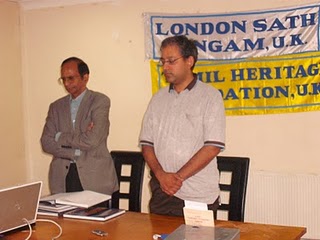
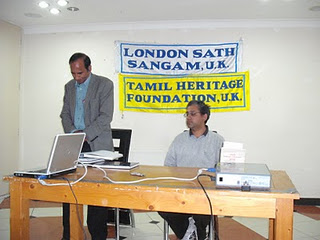
Mr Pradeep Chakravarthy of Leadership Institute at Infosys,Chennai addressed an elite audience in London on 9th August 2011 . He is seen with the president of London Sath Sangam Mr Balaji. Mr S Swaminathan, Secretary of London Sath Sangam and Tamil Heritage Foundation, UK welcomed the gathering.  Chakravarthy’s talk on the Saraswathy Mahal Library of Thanjavur was very interesting and informative.

His book “Thanjavur-A cultural History “was a well researched work. It has got a lot of very rare photos unpublished so far. All the books he brought to London were sold like hot cakes. Mr Chakravarthy is a historian and columnist.

His articles are published in reputed dailies like The Hindu ,Chennai.